Hawaii’s PBR Efforts Get Conference Spotlight

Hawaii’s recent move to performance-based regulation (PBR) is still “a work in progress,” state Public Utilities Commission Chair James Griffin told participants at the Smart Electric Power Alliance (SEPA) Grid Evolution Summit last week.

“None of this is easy. I want to be clear: It was contentious,” Griffin said Wednesday. Hawaii switched from cost-of-service regulation to PBR in June, an effort “two-and-a-half years in the making,” with some programs still being implemented.

Hawaii’s PBR framework includes “four big sections,” Griffin said, including revenue adjustment mechanisms, performance incentive mechanisms (PIMs), grid services incentives and a collaborative effort between the PUC and energy efficiency providers to provide programs for low- to moderate- income residents.

Noting Hawaii’s “high electricity cost environment,” Griffin said, “From the outset of this, [the PUC] did want to see Day One savings for customers.”

Moderating the discussion with Griffin, SEPA Managing Director Janet Gail Besser pointed to a key feature of Hawaii’s PIMs: “The focus is on outputs or outcomes for customers to set rates, rather than inputs on the part of the utility — what it costs to serve the customer.”

Griffin said the PUC wants to ensure cost savings by setting a key productivity factor for utility companies at zero. “Our prior experience with this did inform us that this was a sufficient factor to meet our goals.”

But speed is of the essence for the PUC. “The timing aspect of this is really important for us, and I think that’s where we’re still looking for improvement. We’re wanting to see the projects come online sooner. The incentive structure here is front-loaded, but I haven’t quite seen the urgency yet to move the timelines up, so we’re still working on that.”

Griffin referred to the PUC’s contentious proceeding around the looming shutdown of a critical coal plant on Oahu, with the commission repeatedly expressing frustration at Hawaiian Electric’s halting efforts to replace the plant with renewable resources. “Our near-term needs enough replacement resources for when our power plants go offline.” (See Hawaii PUC Weights Coal Plant Closure Options.)

Besser asked Griffin about the PUC’s pilot process for the PBR framework, “because that’s something that SEPA has been encouraging and sees as very important for grid modernization — in particular, how to really expedite the review of pilots so that utilities can get new pilots and new operating practice out there quickly to see if they’re actually going to benefit customers.”

Griffin explained that the commission has 45 days to review a pilot plan once it has been submitted. Investors and developers need to have their “homework done” so that the review process does not become bogged down, he said. “We hope to see more of this in the next five years.”

“This has been a cultural change internal to the commission as well,” Griffin said. “One of my observations is that this is what it’s going to take for this to be successful. What the tradition has been is, we’ve received some pilot applications in the past, but generally they follow through our normal regulatory framework. So, a $1 million request for a short-term pilot would be treated, in our former process, similar to a $400 million dollar [advanced metering infrastructure] request.”

Griffin said the commission can accept that some projects will fail, “and it’s better to learn that and avoid the long, protracted fight over something that you learned, that you shouldn’t be doing. That’s been a cultural discussion internally … We need to allow the utility the flexibility to do these pilots, learn, and even find out where things don’t work out perfectly.”

Griffin pointed to the PUC’s experience with Hawaii Gas. “We had a good case with our gas utility, trying to look at different renewable gas technologies a while ago. And we learned that it wasn’t [commercially viable] yet, and to me, that was a decent learning experience. So, we can see some of this on the electricity side too,” he said.

No Easy Shortcuts

All this change has been noted by crediting agencies, who have since raised their outlook for Hawaiian Electric.

“We weren’t quite on a watch yet, but this docket and these decisions were being closely watched through the entire period,” Griffin said, referring to the utility. “As we worked through the process, we were put on an upgrade watch. The outlook was upgraded.” He said that before the upgrade, the utility was not doing well, with its S&P rating “one notch above junk status.”

Asked what lessons or key takeaways he would share with other states, Griffin said “the incentive mechanisms can be very powerful” and that the PUC is seeing “actual results delivered.”

“Taking the time to set it up right, it’s been a very resource-intensive process for our commission. There’s no easy shortcuts here if you want to do the type of comprehensive review, comprehensive stakeholder engagement that we’ve done … Don’t underestimate the undertaking,” he said

The PUC chair also made clear that the decision to switch from a cost-of-service regulation to a PBR framework was resolute. “It’s something that we see is a strong part of our future. We’re not intending to return back to a traditional cost-of-service regulatory framework, and it was important to signal that from the outset.”
Eversource Focuses on Connecticut amid Appeal of Penalties

Eversource Energy (NYSE:ES), New England’s largest utility, spent a good deal of its second-quarter earnings presentation with analysts Friday talking about one state in the region: Connecticut.

Whether it was lingering issues from the response to Tropical Storm Isaias last year, current storm preparedness levels, offshore wind or electric vehicles, Connecticut was front and center for CEO Joe Nolan. He said improving Eversource’s relationship with Connecticut policymakers and ratepayers is his “top priority.”

To prepare for Tropical Storm Elsa — which last month produced heavy rain and wind but not the widespread power outages and restoration problems in Connecticut that accompanied Isaias last August — the utility brought in 500 extra line crews and tree-trimming teams and prepositioned them with its 700 line crews and 250 tree teams. There was also an online portal for cities and towns to prioritize repair sites for Eversource’s teams. Nolan said it was “a good exercise” for Eversource to show that “a lot of things have changed for our business.”

Eversource was forced to make these changes through legislation and regulatory mandates in the wake of Isaias. First, the Connecticut General Assembly passed the Take Back Our Grid Act, which directed the Public Utilities Regulatory Authority (PURA) to develop and implement performance-based regulations, including financial penalties such as fines and reductions of return on equity.

PURA finalized a $28.6 million civil penalty and annual profit reductions of about $31 million against Eversource last month after releasing an April assessment of the utility’s storm performance. Eversource appealed the ROE reduction in state court. The “pancaking” of penalties, according to Eversource CFO Phil Lembo, forms the basis of the appeal, which the company believes violates state law in effect at the time of the storm.

Update on OSW, EVs

Eversource’s joint offshore wind ventures with Ørsted continued to make significant progress during the quarter, Nolan said. He first cited the agreement with Dominion Energy to charter its U.S.-built, Jones Act-compliant wind turbine installation vessel, currently under construction in Texas. Upon completion, he said, the vessel will sail to New London, Conn., where Eversource will use it to install wind turbines for the Revolution and Sunrise Wind projects. Work has also recently begun at State Pier in New London to convert it into a central staging area for OSW, Nolan added.

PURA approved a comprehensive EV charger program to support the state’s push for having at least 125,000 zero-emission vehicles on the road by the end of 2025. Nolan said Eversource appreciates several PURA changes made to the draft decision “to enhance the program’s expected success,” and the utility will submit an implementation plan by Oct. 15.

Outside of Connecticut, Eversource will have invested $55 million in its Massachusetts EV program by the end of the year, helping to connect about 4,000 charging ports. It also has proposed spending more than $190 million on EV support from 2022 to 2025, including $68 million in capital investments to add charger infrastructure in environmental justice communities.

Earnings

Eversource reported earnings of $264.5 million ($0.77/share), up about $12 million from the same period in 2020 ($252.2 million, $0.75/share) driven by its transmission and distribution segments. Transmission earned $137.6 million during the quarter, up from $129.5 million, and distribution was up $121.6 million from $115 million.

Transcript courtesy of Seeking Alpha.

SEPA Highlights Lessons from Microgrid Feasibility Study at Housing Project

All microgrids may be different, but the process of developing one can be standardized.

That was one of the takeaways of a microgrid feasibility study by Baltimore Gas & Electric (BG&E), officials of Annapolis, Md., and the Smart Electric Power Alliance (SEPA) for a public housing development now under construction.

Funded by a $100,000 grant from the Maryland Energy Administration, the collaborators considered four scenarios for the Newtowne 20 public housing project, which the Housing Authority of the City of Annapolis (HACA) is redeveloping after razing a 1970s-era project that originally stood on the site. Residents are expected to move into the 78-unit housing project next spring.

Whether the microgrid will be built is uncertain. SEPA delivered a preliminary report to MEA a few weeks ago, and a project team of BG&E, HACA and property developer Pennrose are considering potential business and financial models. They hope to seek funding from the Federal Emergency Management Agency’s Building Resilient Infrastructure and Communities program or other funding sources.

Regardless, participants told SEPA’s Grid Evolution Summit last week that they learned a lot from the exercise.

“This is what we do — help utilities learn how to fish,” Jared Leader, SEPA’s senior manager of research and industry strategy, said of SEPA’s role in the project. “This gets under the hood for microgrids, so maybe we can develop a template we can use for future projects.”

SEPA Framework (Smart Electric Power Alliance) Content.jpg
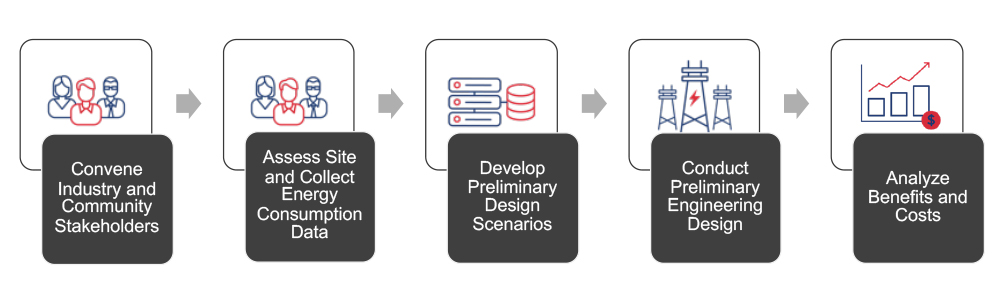
SEPA’s framework for the Annapolis microgrid feasibility study. | Smart Electric Power Alliance

The centerpiece of the feasibility study process was stakeholder engagement, which began with kickoff meetings involving city officials, HACA, environmental consultants, residents and Pennrose in the summer of 2020. “The stakeholder engagement is important,” said Justin Felt, BG&E’s manager of strategic planning. “You want people to stand up and say they support it.”

“The width and breadth of the stakeholder pool that the team put together was impressive,” said Jennifer Adams, HACA’s director of development. “We had all different backgrounds. Education was important, so that all became familiar with the basics.”

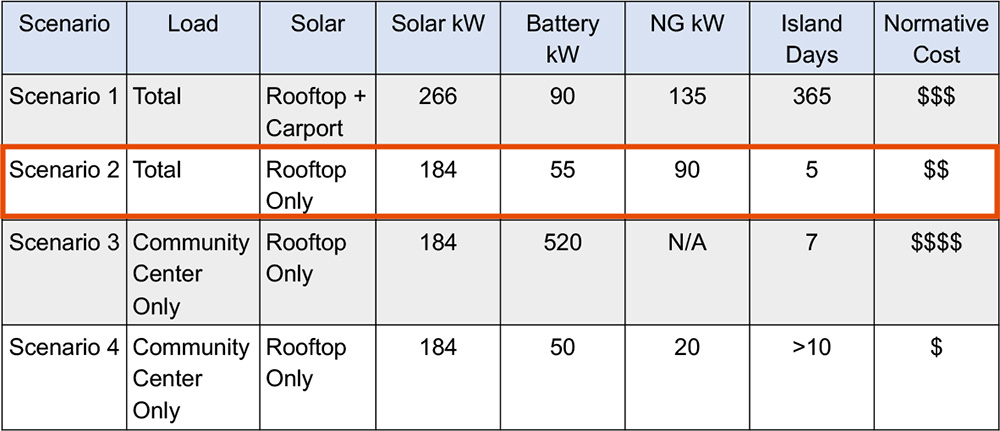
Stakeholders were presented with four scenarios, including the ability of the entire community to “island” during grid disturbances or limiting that capability to a community center, where residents could recharge their phones and access the Internet. The participants also considered whether to include rooftop and carport solar and whether to include a natural gas generator for backup.

Because not all stakeholders can understand all the engineering details, Felt said, “it’s important to boil it down, and not give them 20 options and tons of footnotes.”

Feasibility project options (Smart Electric Power Alliance) Content.jpg
The feasibility project looked at four scenarios, choosing scenario 2. | Smart Electric Power Alliance

Ultimately, the team settled on a 184-kW rooftop solar system with a 55-kW battery and a 90-kW natural gas generator that could provide five days of islanding capability for the entire development.

“It was a surprise,” said Leader. “We went into it thinking that natural gas would be a non-starter, but I remember that the mayor’s office … was keen on including some of that in a minimal amount to reduce the cost and to increase the duration of the ability of this site to island.

“We were thinking maybe the entire facility wouldn’t be served; it would just be the community center,” he added. “But the stakeholders really wanted to see” coverage for all the homes and the community center.

“One of [the] barriers identified through the study was the difficulty in passing savings on to the end user due to complex HUD regulations on how utilities feed into affordable rents,” Adams said in an email after the presentation. “So, there is no cost benefit to residents. However, residents would directly benefit from energy resiliency in the case of any power interruption.” This was attractive to the residents, who had experienced frequent power outages in the old buildings, she said.

Learning Opportunity for Utility

BG&E had applied to the Maryland Public Service Commission several years ago for permission to build its own microgrid, but the commission did not approve it and recently rejected fellow Exelon (NASDAQ:EXC) utility Pepco’s microgrid proposal as well, said Felt.

BG&E would not be the owner of the Newtowne 20 microgrid, he said in an interview with NetZero Insider. “Some distribution infrastructure in front of the meter would need to be owned by the utility. But the natural gas generation [planned as a backup source of power] would not be owned by us.

“The purpose of this project … is to get a sense of economics, what the technical details would look like,” he added. “With this feasibility study we can gain some learnings, especially around stakeholder engagement.”

“This is a perfect example of an energy project that can really advance some of the equity, environmental and social justice goals within communities, as well as resiliency needs and sustainable energy, to populations that have historically been left out,” Leader said in an interview. “It’s still nascent, and utilities are still grappling with what microgrids are and what their role should be. It’s an interesting pilot to demonstrate BG&E’s role and their strategy in working on this.”

Michigan Official Says Net-Zero Proposal Will Be About Jobs

LANSING, Mich. — Establishing a net-zero climate policy for Michigan is as much about jobs as it is protecting the state and planet, Department of Environment, Great Lakes and Energy (EGLE) Director Liesl Eichler Clark told Michigan’s Council on Climate Solutions Tuesday.

“This is all about the attraction of jobs to Michigan,” Clark said, calling for the state to “lead by example” in increasing  energy efficiency and developing the products and policies needed to create a carbon neutral system to draw companies to the state.

In an interview with NetZero Insider, Clark said Gov. Gretchen Whitmer’s (D) September 2020 executive directive (2020–10) calling for the state to reach economy-wide carbon neutrality by 2050 is “a huge opportunity” for the state’s economy. “The world and the nation are evolving. We can either use our expertise and know-how on making things and fixing things as a jobs development tool, or we let it smack us in the face,” Clark said.

Whitmer created the council in executive order 2020-182 and tasked it with advising EGLE on the Healthy Climate Plan for cutting the state’s carbon emissions, starting with an interim 28% reduction below 2005 levels by 2025.

Since February, the council has explored how transportation, building, agriculture and high energy use industries can be made carbon neutral. In August, the council will hear information on how climate change affects equity among low-income and minority populations. Beginning in September, Clark said, the council will begin winnowing down proposals in preparation for EGLE delivering its proposal to Whitmer in February 2022 (though the ED set a Dec. 31, 2021 deadline).

In the interview, Clark said the effect of achieving net-zero status on economic development was “very much on the governor’s mind” when she issued the directive. The order notes that along with degrading Michigan’s environment and affecting the health of its citizens, climate change “hurts our economy.”

Council members include executives from utilities and top state manufacturers, such as Whirlpool, as well as the head of the Michigan Economic Development Corp., a cabinet-level organization to promote the state’s economy.

Clark told the council that when assessing its final proposals, members must consider how they will affect the public and the costs faced by industries as they decarbonize. “We’ve got a little bit of a Gordian knot here,” she said.

But she said Michigan is primed to lead the effort toward a net-zero future as the home to major manufacturers such as Dow Chemical (NYSE:DOW) and the Big Three automakers. The state also has an infrastructure of smaller companies that will play a primary role in developing and installing the systems to decarbonize, she said, adding that Michigan could be a leader in developing energy efficiency systems.

MISO Stresses DR Capacity as Emergencies Accumulate

MISO has been framing load-modifying resources (LMR) this summer as necessary to access its demand response fleet during operating emergencies, de-emphasizing the emergency protocols the RTO must enact before deploying them.

Speaking during a Reliability Subcommittee teleconference Thursday, MISO’s Jason Howard said the use of LMRs will probably become “the new normal” within the footprint. Since 2016, MISO has experienced a substantial rise in the frequency and severity of generation emergencies.

Howard said intensifying weather events paired with additional gigawatts of wind and solar resources coming online within the next three years will make demand response’s use even more ubiquitous.

“There are definitely things that make managing the reliability margins very challenging,” Howard said. “Having to step into that max gen step 2A for demand response will become more of a normal occurrence as we face tight operating conditions.”

J.T. Smith, MISO’s senior director of operations planning, agreed. “Those are the resources that are provided to us and, unfortunately, we have to be in an emergency to access them,” he said.

Smith said despite multiple hot weather and capacity advisories issued in July, the grid operator hasn’t had to enter emergency procedures since a brief declaration on June 10 for the North and Central regions. (See “MISO Defends June Emergency Declaration,” MISO Market Subcommittee Briefs: July 8, 2021.)

“Luckily, we haven’t had to move past that because the fleet has responded well and we’re out of [maintenance] outage season,” he said.

Customized Energy Solutions’ Ted Kuhn asked whether MISO is considering limiting the number of emergency-only resources that can clear the capacity auction.

WEC Energy Group’s Chris Plante, chair of the Resource Adequacy Subcommittee, asked stakeholders to provide feedback during future meetings on the possible saturation of emergency-only resources.

Stakeholders asked whether thermal generation retirements and renewable growth is driving up demand response use.

“I have a theory, and it’s not necessarily proven, but we’re seeing thermal retirements replaced with smaller natural gas plants and other energy resources, and it just drives us to a point where when that capacity is needed, it just drives us to that usage,” Smith said.

A decade ago, he said, MISO had available capacity well above its reserve margin requirements. Today, the grid operator simply works with tighter margins, Smith said.

MISO Executive Director of Systems Operations Renuka Chatterjee said it was expected that MISO would use its demand response fleet to manage summer heat. She said the RTO considers the LMR fleet as the capacity that members have made available to the grid operator.

“We will be using all of the capacity that’s available to us to continue delivering energy this summer,” Chatterjee said during the Entergy Regional State Committee meeting on July 20.

MISO averaged an 83.4-GW load in June and peaked at 112.2 GW on June 11, a day after the June 10 maximum generation event.

Howard said an unusually hot weather pattern encased much of the North and Central regions in the days leading to the event. He also said 22 GW of non-planned outages was the “primary contributor” to the tight conditions. In addition to forced and lingering generation maintenance outages, Howard said capacity dropped with high transmission congestion and lower-than-anticipated wind production.

Howard said that during the event, the RTO was granted a temporary 250 MW increase to the 2,500-MW South-to-Midwest transfer limit so that resources in MISO South could provide additional support northward.

Xcel Increasing Pace of Decarbonization Effort

Xcel Energy (NASDAQ:XEL) is accelerating its transition away from fossil-fueled resources by proposing to add about 10 GW of renewable generation in its Minnesota and Colorado service territories.

Incoming CEO Bob Frenzel told financial analysts during Xcel’s second-quarter earnings call on Thursday that the company’s Northern States Power subsidiary has filed an alternative plan with Minnesota regulators that would retire all coal plants and reduce carbon emissions 85% by 2030 from 2005 levels, a 5-percentage point increase from a previous plan.

Xcel’s Colorado affiliate, Public Service Company of Colorado, submitted a proposal in March for a $1.7 billion, 560-mile, 345-kV transmission project it says will enable up to 5 GW of renewable generation in eastern Colorado.

Ben-Fowke-(Edison-Electric-Institute)-Content.jpg
Retiring Xcel Energy CEO Ben Fowke during 2020’s EEI conference | Edison Electric Institute

Frenzel said during the call that he is only following in the footsteps of Ben Fowke, who is stepping down after 10 years as CEO on Aug. 18. (See Xcel Energy CEO Fowke to Retire.)

“I recognize the LeBron James-sized shoes that I’m filling,” said Frenzel, who joined Xcel five years ago and currently serves as president and COO. “Ben and I have worked closely on the development and the execution of our strategy, and that will not change. We’ll continue to lead the clean energy transition, enhance our customers’ experience and … constantly work to keep our customers bills low and deliver an affordable product.”

Frenzel said innovation “is more critical than ever” as the Minneapolis-based company moves toward its goal of 100% carbon-free electricity by 2050.

“It’s really been an amazing decade as CEO. … I’m really proud of the tremendous accomplishments we made as a company,” Fowke said. “It’s really hard to retire from a role that I’ve truly enjoyed, but I’m leaving the company in great hands.”

Xcel’s Minnesota resource plan calls for shutting down the A.S. King and Sherco 3 coal units in 2028 and 2030, respectively. The generators have a combined capacity of 1.3 GW. It would also add nearly 6.9 GW of solar, wind and storage resources and hydrogen-ready combustion turbines.

The Minneapolis-based company reported second-quarter earnings of $311 million ($0.58/share), compared to 2020’s second-quarter performance of $287 million ($0.54/share). That beat the Zacks Consensus Estimate of 56 cents/share.

Xcel’s share price spiked to $69.76 when the market opened Thursday but finished the week down at $68.25.

California Governor Proclaims Emergency as Blackouts Loom

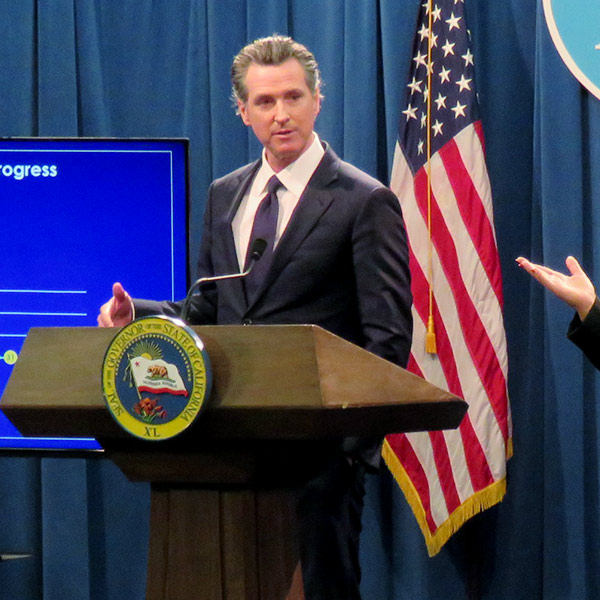
California Gov. Gavin Newsom signed an emergency declaration Friday aimed at keeping the lights on this summer by paying for demand response from industrial users, speeding battery interconnections and waiving clean air regulations to allow for backup diesel generation.

Newsom-Gavin-2020-01-10-RTO-Insider-FI.jpg
Gov. Gavin Newsom faces a recall election in September. | © RTO Insider LLC

“While we build toward a safe, affordable and reliable energy future that benefits all our communities, we’re also taking action to meet the challenges caused by climate change that are already at our doorstep,” Newsom said in a statement.

The governor faces a recall election in September. Former Gov. Gray Davis was recalled after the Western energy crisis of 2000-2001 caused blackouts. The state experienced its first rolling blackouts since the crisis last August, when demand outstripped supply during a severe Western heat wave. Close calls followed in September and in June and July.

In his emergency proclamation, Newsom cited the ongoing effects of heat waves, drought and wildfires in the West.

“Because of drought conditions, water supplies in California’s reservoirs have dropped to levels so low that hydroelectric power plants have had to reduce or cease production, leading to a reduction of nearly 1,000 MW of capacity and further exacerbating the drought’s impact on California,” he said. (See Western ‘Megadrought’ Curtails Hydropower.)

He also cited a potential shortfall, under extreme circumstances, of up to 3,500 MW this summer and 5,000 MW next summer.

During a heat wave in July, the Bootleg Fire in southern Oregon derated the Pacific AC Intertie, “which delivers power from the Pacific Northwest to California, by almost 4,000 MW,” it noted. (See CAISO Declares Emergency as Fire Derates Major Tx Lines.)

“Many other transmission lines are located in high fire threat areas, including lines located in other states on which California depends, and thus wildfires are likely to continue impacting California’s energy supply unpredictably during this wildfire season,” Newsom said.

The governor ordered a series of measures, some of which backtrack on the state’s push toward clean air and energy. The closure of fossil fuel plants in the West without sufficient nonpolluting resources to replace lost capacity is part of the state’s energy shortfalls. (See CPUC Orders Additional 11.5 GW but No Gas.)

Newsom’s order allows greater use of gas and diesel backup generators on days when CAISO declares an energy warning or emergency “based on its determination that, despite its reliance on all available resources, an imminent shortfall is projected because of an extreme heat event, a sudden and severe reduction in transmission capacity (including reductions due to wildfire), or both.”

It also releases ships in port from the requirement that they connect to shore power rather than continuing to run their diesel engines.

“Ships that are berthed in California ports while the CAISO grid warning or emergency notice is in effect shall not be required to use shore power until 11:59 p.m. on the third day following the last consecutive day on which the CAISO issued a grid warning or emergency notice,” Newsom said.

The governor’s office last summer asked U.S. Navy and Marine ships to disconnect from shore power to help avoid additional blackouts. (See CAISO Provides More Details on Blackouts.)

The proclamation also suspends certain water discharge requirements “for any thermal power plant that maintains operations to abate the effects of [an] emergency.”

The governor ordered the state’s utilities to pay large industrial customers a premium of $2/kWh to cut usage during tight supply conditions. Industrial customers in California currently pay an average of 14 cents/kWh for electricity, according to the U.S. Energy Information Administration.

He also ordered CAISO, the California Public Utilities Commission, the California Energy Commission and state agencies to speed the connection of lithium-ion batteries and other clean-energy resources this summer by expediting permitting and cutting through red tape.

State law and regulations “are suspended to the extent that the Energy Commission determines that such systems should be licensed,” he said.

“All energy agencies shall act immediately to achieve energy stability during [emergencies],” he said. The CPUC, the CEC and CAISO “are requested to work with the state’s load-serving entities on accelerating plans for the construction, procurement and rapid deployment of new clean energy and storage projects to mitigate the risk of capacity shortages and increase the availability of carbon-free energy at all times of day.”

PG&E Faces New Criminal Charges, Wildfire Liability

PG&E Corp. last week said it could face serious financial consequences from the massive Dixie Fire burning in Northern California but denied it committed any crimes in starting last year’s fatal Zogg Fire.

The company issued its denial of criminal culpability in response to Shasta County District Attorney Stephanie Bridgett’s announcement Thursday that her office had “determined that PG&E is criminally liable for causing the Zogg Fire.”

The fire killed four residents, including a mother and her young daughter, destroyed 204 structures and burned more than 56,000 acres in September and October.

Bridgett said on Facebook that “a final decision as to the nature and grade of charges has not yet been made. A filing decision will be made prior to the anniversary of the Zogg Fire.”

PG&E disputed the prosecutor’s finding in a statement Friday.

Zogg-Fire-(Cal-Fire-Shasta-Trinity-Unit)-Alt-FI.jpg
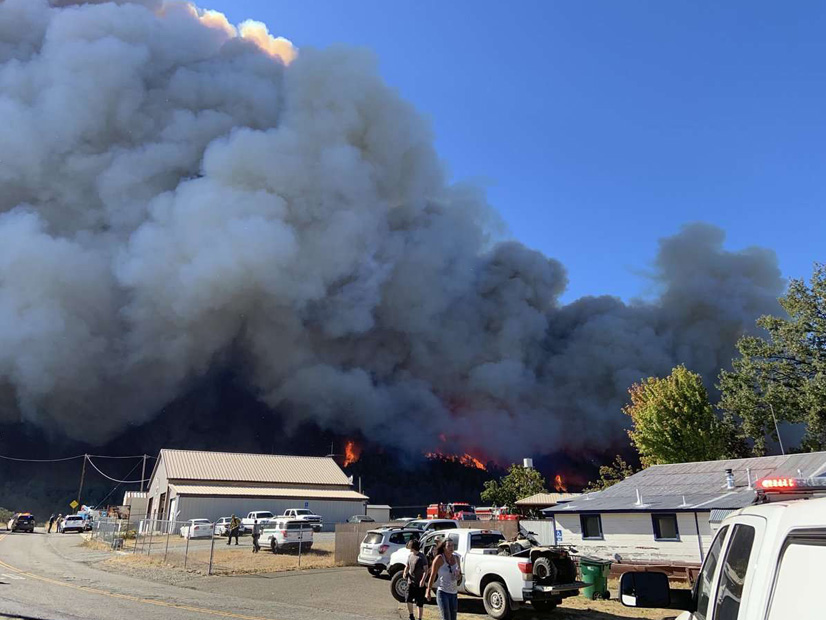
Smoke from the Zogg Fire billows in Shasta County, Calif., on Sept. 27, 2020. | Cal Fire Shasta-Trinity Unit

“The company already has resolved civil claims with Shasta County and continues to reach settlements with individual victims and their families impacted by the Zogg Fire in an effort to make it right,” the utility said. “We do not, however, agree with the district attorney’s conclusion that criminal charges are warranted given the facts of this case.”

An investigation by the California Department of Forestry and Fire Protection (Cal Fire) found that the Zogg Fire began when a leaning gray pine tree fell onto a PG&E power line near the rural community of Igo, in Shasta County. (See PG&E Equipment Started Zogg Fire, Investigation Finds.)

Cal Fire’s findings came after PG&E acknowledged its equipment probably started the fire and after a federal judge blamed the utility for leaving a line energized during high-threat fire conditions and failing to clear vegetation.

“I think it was reckless, maybe criminally reckless, for PG&E to have left that … gray pine looming,” Judge William Alsup said in a February hearing. “It was leaning at a 60-degree angle over that line. Gray pines … have a shallow root system. That tree had also been burned earlier. That tree was a clear and present danger to the line, and whoever made the decision to leave that tree up should be looked at very carefully. And PG&E did leave it up.”

Dixie Fire

Alsup oversees PG&E’s criminal probation from the San Bruno gas pipeline explosion in September 2010. He has already ordered PG&E to explain its role in starting the Dixie Fire.

The 244,000-acre blaze in the Sierra Nevada foothills was about 30% contained as of Saturday with more than 5,000 firefighters battling it.

PG&E said previously that the fire started July 13, near where a tree had fallen onto one of its distribution lines in the rugged Feather River Canyon. Cal Fire seized PG&E equipment as part of its investigation. (See PG&E Says Its Line May Have Started Dixie Fire.)

In its second-quarter report to the U.S. Securities and Exchange Commission on Thursday, PG&E said it would likely face new liabilities from the Dixie Fire.

“While the cause of the 2021 Dixie Fire remains under investigation and there are a number of unknown facts surrounding the cause … the utility could be subject to significant liability in connection with this fire,” it said. “If such liability were to exceed insurance coverage, it could have a material impact on [PG&E’s] … financial condition, results of operations, liquidity and cash flows.”

PG&E’s stock price, already depressed by news of the Dixie Fire, sunk from $9.24/share prior to Thursday’s earnings report to $9.08 by the close of trading Friday. The company’s stock has yet to recover from its bankruptcy in the wake of catastrophic fires in 2017 and 2018 that cost it tens of billions of dollars. Those fires included the Camp Fire, the state’s deadliest and most destructive wildland blaze, which killed at least 84 residents and leveled the town of Paradise. Fires in 2019, 2020 and 2021, possibly started by PG&E equipment, have kept the company in troubled circumstances.

Midwestern Grid Operators Battle Summer Heat

SPP set a new peak load record last week as a heat dome left much of the Midwest sweltering in near 100-degree Fahrenheit temperatures.

Regionwide electricity usage in SPP’s 14-state footprint reached 51.04 GW at 4:24 p.m. CT on Wednesday. The RTO’s previous record came in August 2019, when peak load bit 50.67 GW.

The grid operator declared conservative operations, beginning at noon Thursday and ending at 8 p.m. Friday. However, it extended a resource alert until 8 p.m. Saturday. It was originally to have ended Friday night.

When operating under conservative operations, SPP can commit generation to serve load earlier than during normal operations and ahead of standard day-ahead market processes. The declaration alerts market participants that they should make available all necessary generating resources to meet the expected high demand.

The RTO had issued the resource alert for July 26 to 30. It uses resource alerts when severe weather conditions, significant outages, wind forecast uncertainty and/or load forecast uncertainty are expected.

ERCOT has been running under conservative operations since June, increasing its supply of operating reserves and using reliability unit commitments to strengthen grid reliability. (See ERCOT Stakeholders Sign Off on More Ancillary Services.)

Those measures have helped the Texas grid operator meet demand without falling back on emergency actions. ERCOT warned last week that it might reach its record peak this week of 74.8 GW, set in 2019. Staff forecasted a load of nearly 74.7 GW on July 26, but it came in at 72.9 GW, its high for the week.

The load forecasts for Sunday and Monday were nearly 74.8 GW and 76.9 GW, respectively. High temperatures are expected to be at or above 100 F through Aug. 6.

MISO last week instituted a hot-weather alert meant to prepare operations personnel and facilities for potential conservative operations. The alert expired Wednesday evening.

Webinar Participants Warn Against Fading Memories, Complacency in Cold Weather Prep

The winter storms that led to mass outages in Texas and the Midwest have spurred interest across the nation in ensuring the power grid is prepared for future extreme temperature events. However, representatives from Texas’ electric utilities warned in a webinar on Thursday that they are not sure this energy can be sustained long enough to ensure the needed investments are actually made.

“For us, I think the challenge is convincing … our regulators [and] politicians that this money needs to be spent, because what happens is people [only] remember the last few years,” said Steven Buraczyk, senior vice president of operations at El Paso Electric. “If you talk to [people] in El Paso, they may not remember a whole lot about [the 2011 cold weather event]. They remember it because it was really cold, but they don’t remember the impact and what happened to our community.”

Speakers at Thursday’s webinar, which was sponsored by POWER Magazine, frequently referred to the events of 2011 — which led to 4,000 MW of controlled load shed at one point, affecting 3.2 million customers — both because of their similarity to February’s cold snap and the lessons they taught about preparing for sudden extreme cold weather.

Questions About 2011’s Lessons

In a congressional hearing in March, Sen. Mazie Hirono (D-Hawaii) told NERC CEO Jim Robb that Texas utilities “probably didn’t follow your recommendations very well,” referring to the cold weather preparedness guideline issued by FERC and NERC after the 2011 event. (See Senators Grill Robb, Asthana over Texas Outages.)

The webinar participants acknowledged that this is a reasonable comment given the widespread generation failures in February, when Texas’ grid came within “seconds and minutes” of total collapse, according to operators. (See ERCOT: Grid was ‘Seconds and Minutes’ from Total Collapse.) While they claimed that their utilities had, in fact, instituted significant changes, including regular inspections and efforts to weatherize key components, they also noted that after 10 years without a major cold weather event, some complacency is inevitable.

“If we were here in person, I would ask for a show of hands of how many people have pristine insulation at their plants,” said Jeff Parker, engineering manager at Salt River Project. “[If] they’ve never had an operator step on insulation, or [have it] mashed from someone rigging or climbing to access something. That happens; that’s real. And we saw that when it’s mashed down or it’s just peeled off by the wind, that you get some exposure.”

Additional Insights from February Freeze

Dennis Buchanan, plant director at Xcel Energy (NASDAQ:XEL), pointed out that unlike other areas of the country, Texas still lacks experience with regular, long-term cold temperature exposure. This resulted in many oversights revealed during the February freeze that may seem relatively obvious to grid operators from other regions but took their counterparts in Texas by surprise.

“We had some combustion turbines running; [it] shouldn’t be any problem, except for the cooling power mist from an adjacent unit was blowing just in the right direction to ice up the inlets to those [turbines],” Buchanan said. “So it’s not just a matter of looking at a single unit and its capabilities, but what are the things around you that can affect you?”

February’s event also underscored that electric utilities need to be aware of the linkages between their own industry and other critical infrastructure sectors. Buchanan noted that one “catch-22” arising from February’s mass outages was that some natural gas suppliers lost power too, leading to further outages at gas-fired generators. In addition, water facilities in many cities were unable to function without power, depriving thousands of Texans of clean water along with electricity and gas in another of the week’s humanitarian disasters.

Even in light of this graphic warning of the dangers of under-preparedness, panelists worried that fears about expense could ultimately turn customers, regulators and politicians off from approving of the needed investments. While they acknowledged the need to keep costs under control, they reminded listeners that the burden of neglect could be much worse, both in financial and human terms.

“Every dollar that we spend, that’s going to be borne by the customer. And so we need to make sure that we’re spending their money appropriately,” Buraczyk said. “[Did] the money that was spent in 2011 … turn out to be cost effective in 2021? From my perspective, the answer is absolutely. … Did everything turn out perfect? No. But I’m 100% sure that if we had not spent that money, our outcome would have been much worse.”