IESO Moving Forward with Competitive Tx Plans

IESO will begin opening some transmission projects to competition under a hybrid rate model, with cost-of-service rates following an initial 10-year contract.

IESO, which has about 1,500 kilometers of new transmission lines planned or under development, says competition will lower costs and produce innovation.

The first projects eligible for competition may be identified as soon as the fourth quarter of 2025 when recommendations from the South and Central Bulk Study are due. The grid operator also has two other major transmission projects underway, with recommendations from the North of Sudbury Bulk Study and Eastern Ontario Bulk Study expected in 2026.

Once projects suitable for competition are identified by IESO, the province will issue a directive to formally launch competitive procurements.

Incumbent Projects

But only some projects will be open for competition.

“Not every project will be suitable for transmission procurement,” Denise Zhong, IESO senior manager for resource adequacy and sector evolution, told more than 70 attendees at a June 25 webinar outlining the ISO’s Transmitter Selection Framework Registry (TSF-R). “In fact, the majority of the projects that will be recommended through transmission planning will likely go to an incumbent transmitter. But we’re looking at a very small subset of projects that will meet certain eligibility considerations.”

IESO’s Denise Zhong | IESO

The registry will allow prospective transmission builders to prequalify for upcoming procurements. Prequalifying bidders will cut procurement timelines by more than six months compared to issuing separate Requests for Qualifications for each procurement, IESO said. The Ministry of Energy and Mines’ Integrated Energy Plan directed IESO to launch the registry by Aug. 15.

The plan listed three major projects that have been assigned to incumbent Hydro One.

To expand the province’s north-south infrastructure, IESO is backing a Barrie-to-Sudbury 500-kV single circuit line due in service in 2032 and has recommended beginning early development work on a second 500-kV line along the same route.

“IESO has determined that these projects are not suitable for a competitive procurement process given their urgent need,” the Ministry said. Thus, the government will direct the Ontario Energy Board to designate Hydro One to develop the first line and to begin development work on the second.

Another project to strengthen the north-south “backbone,” reconductoring the 230-kV Orangeville-to-Barrie line, also will be awarded to Hydro One, because it owns the line.

IESO also has rejected competition for a new double-circuit 500-kV line from Bowmanville Switching Station to an existing 500-kV station in the Greater Toronto Area, again selecting Hydro One.

Rate Model

IESO said it has decided to use a “partial contracting” model in which the winning bidder will receive a contract covering all costs of financing, designing, building, operating and maintaining the line for the first 10 years of its commercial operation. In year 11, it will transition to traditional rate regulation under the OEB.

“To support a smooth trend in annual payments and consistent payments over the life of the asset,” the ISO said it will limit the year 11 payments to a percentage increase over year 10.

“So, for example, the contract may limit the filing amount for year 11 to be within 5% of the payment that was made through the IESO contract in year 10,” Nicole Kosonen, senior adviser for capacity integration and development, said during the webinar.

By holding developers to proposal costs and schedules, the partial contracting approach will protect ratepayers while working within the existing rate regulation framework, the grid operator said.

It rejected both a “selection only” option, in which it identifies a developer and immediately enters rate regulation under the OEB, and a “full contracting” model, in which the ISO signs a contract with the developer for the life of the transmission asset.

IESO said ratepayers will assume the risk of project scope, changes in law and early termination while developers would assume risks regarding routing, land acquisition, design, construction, operations and financing. The two parties will share risks of Force Majeure, tariffs and inflation, it said.

Indigenous Participation

To encourage Indigenous communities to participate in TSF projects impacting them, the rules allow the communities to engage with multiple bidders, barring developers from signing exclusivity arrangements.

IESO also has proposed that bidders submit an Indigenous Engagement and Participation Plan to identify the “engagement approach and participation opportunities” for impacted Indigenous communities.

“Those that have a higher overall level of Indigenous participation may be scored higher in the IESO’s proposal evaluation,” the ISO said.

Experience Requirements

To join the TSF-R, prospective bidders must meet requirements for experience and financial capacity.

To balance the desire for competition with the need to ensure developers have appropriate technical capabilities, the ISO said it will allow potential bidders to demonstrate their capabilities via the experience of affiliated companies.

The proposed rules require the applicant or an affiliate to have built at least two transmission lines of at least 200 kV and 30 kilometers within the past 20 years.

FortisOntario, which owns three local distribution companies, was among those calling for crediting companies for their affiliates’ experience. In comments submitted in April, the company noted that it is a subsidiary of Fortis, which owns 10 regulated utilities, including ITC, the largest independent transmission company in the U.S. “Without recognizing the value of decentralized companies, the draft rules risk creating barriers for parent companies that, despite lacking a transmission license, possess the scale, expertise and established presence in Ontario needed to deliver reliable and cost-effective transmission solutions,” it said.

Feedback to Date

IESO said it had received “broad support” from stakeholders for its proposed TSF-R program rules, although there were requests for greater clarity on efforts to encourage Indigenous involvement.

FortisOntario urged the ISO to open competition for projects above 115 kV, saying the competitive plan “currently appears focused on projects above 200 kV.”

Some stakeholders requested more clarity on credit rating requirements for smaller or privately held firms. Hydro One said IESO should boost the minimum net worth of proponents not already licensed by OEB as a transmission company to $500 million from its proposed $200 million, noting that the ISO has said the minimum project size for the TSF is $100 million.

“Taking on a project that would involve more than half of the net worth of the entire company could create significant risk for Ontario ratepayers if the project is beset with large budget overruns,” Hydro One said.

Next Steps

IESO still has to define the criteria that will be used to evaluate competing proposals, including bid parameters and cost caps.

The grid operator said it seeks feedback on whether its proposed bid structure and risk allocation “strike[s] the right balance between protecting ratepayers while providing an attractive proposition to transmitters and financiers” and how it should evaluate bidders’ proposals for providing “meaningful Indigenous economic participation and engagement.”

It also asked for ways to reduce bidders’ risk premiums and whether it should use a “highly prescriptive approach” to cost-containment or leave it open for bidders to include in their proposals.

Written feedback or questions are due to engagement@ieso.ca by July 16. The IESO plans to compile answers in an FAQ document.

IESO plans another engagement session in September to discuss its draft term sheet and additional RFP and contract design details.
Oregon PUC Approves IOUs’ Wildfire Plans, Issues Recommendations

The Oregon Public Utility Commission has approved wildfire mitigation plans proposed by the state’s three investor-owned utilities and supported staff recommendations that the commission said the utilities should implement in the future. 

The three commissioners unanimously signed off on wildfire mitigation plans for Portland General Electric, Pacific Power and Idaho Power. 

PUC Chair Letha Tawney noted that when discussing wildfire in the utility space, there usually are two intertwined questions: Are the utilities meeting the requirements of the law, and are the utilities finding the most cost-efficient way to reduce wildfire risk? 

“Today, we’re not talking about the cost,” Tawney said at the PUC’s June 26 meeting. “Today, we’re talking about whether the utilities are appropriately evaluating the risk [and] responding to that evaluation and what that evaluation tells them.” 

“I still expect the utilities to provide staff with all the evidence that these spending choices are prudent and reasonable,” Tawney added. 

The PUC enlisted Climate Wildfire and Energy Strategies (CWE) to independently evaluate the IOUs’ wildfire mitigation plans. PUC staff also performed their own assessments of the plans. The PUC and CWE largely reached the same conclusions on whether the utilities had followed through on last year’s recommendations. However, there were some differences.  

For example, even though the PUC found that Pacific Power, a division of PacifiCorp, had “partially met” recommendations related to ignition risk driver investigations, short-term fuels and assessment of vegetation actions and timing, CWE concluded the utility “did not meet” the recommendations. 

Heidi Caswell, division administrator of safety, reliability and security at the PUC, said CWE’s analysis was “constrained” to a limited time frame and the specific docket of each utility, while “staff’s view could be informed by other dockets.” 

As for PGE and Idaho Power, CWE and the PUC agreed the two utilities either had met or partly met staff recommendations. 

“Our wildfire mitigation plan, which is approved by the Oregon Public Utility Commission, reflects the company’s ongoing efforts and substantial investments to protect the communities we serve from the risk of wildfire,” Simon Gutierrez, a spokesperson for PacifiCorp, told RTO Insider in an email. “The company is committed to working closely with policymakers and regulators to prevent wildfires before they happen.” 

Recommendations

The PUC provided three recommendations to Pacific Power: 

    • Outline how it plans to incorporate future land use and climate changes to demonstrate how Pacific Power’s “long-term plans align with the future state for those areas.” The PUC noted California has similar requirements, saying some of the processes Pacific Power uses in California can be shared in Oregon.
    • Provide wildfire risk scores for circuit segments.
    • Justify use of vendor project management to reduce costs to deliver covered conductor projects. 

PGE received one recommendation: 

    • Explain actions to address outage data quality, including why PGE uses a record set of only six years and provides information only on vegetation and equipment failure.  

Kellie Cloud, PGE senior director of wildfire and operational compliance, told RTO Insider the utility is “pleased” with the approval and the “acknowledgment of the progress in our wildfire mitigation planning process.” 

“We look forward to working with commission staff, stakeholders and other utilities to continue to advance our mitigation plans,” Cloud said. “PGE has been executing mitigations in advance of fire season; we are now actively monitoring and managing risks in the active season.” 

Idaho Power received three recommendations: 

    • Provide a timeline for when it will model wildfire risk for circuit segments and wildfire risk zones. 
    • Clarify its analysis of its battery program and whether it aims to pursue a rebate program for medically vulnerable customers in Oregon. If not, the utility should explain how those customers are supported during public safety power shutoffs and other events. 
    • Share its vegetation risk index with other IOUs. 

Jordan Rodriguez, spokesperson for Idaho Power, told RTO Insider the utility appreciates the PUC’s approval of the plan. Rodriguez added that the wildfire plan details how the utility uses “wildfire risk modeling tools, extensive system hardening efforts and growth in coordination with community partners.” 

Future Plans

The utilities presented their plans in February and touted various grid-hardening efforts under way, such as undergrounding of lines, installment of more powerful weather stations, fire-proofing utility poles and improved forecasting models. (See Oregon Utilities Enter 2025 With Ambitious Wildfire Plans.) 

During the meeting June 26, CWE consultant Melissa Semcer said communities on the West Coast are facing the threat of “catastrophic wildfires,” whether from ignition by utility equipment or another source. Semcer argued the future of wildfire prevention should not just focus on undergrounding or other traditional mitigation efforts. 

She posed the question of whether ratepayer dollars can be used for land management outside of utilities’ right of way “or to potentially invest into home hardening.” 

“And might that actually be less expensive and negate the need to have some of those larger investments of undergrounding?” Semcer said. “And I think that’s really the bleeding edge of where this conversation is across the West at this point, is to maybe move out of our boxes and our silos that we’ve all … been in and try to come up with what is the comprehensive solution, because it is such a large amount of money.” 

Future of Transmission Planning and Policy in Focus at Infocast Summit

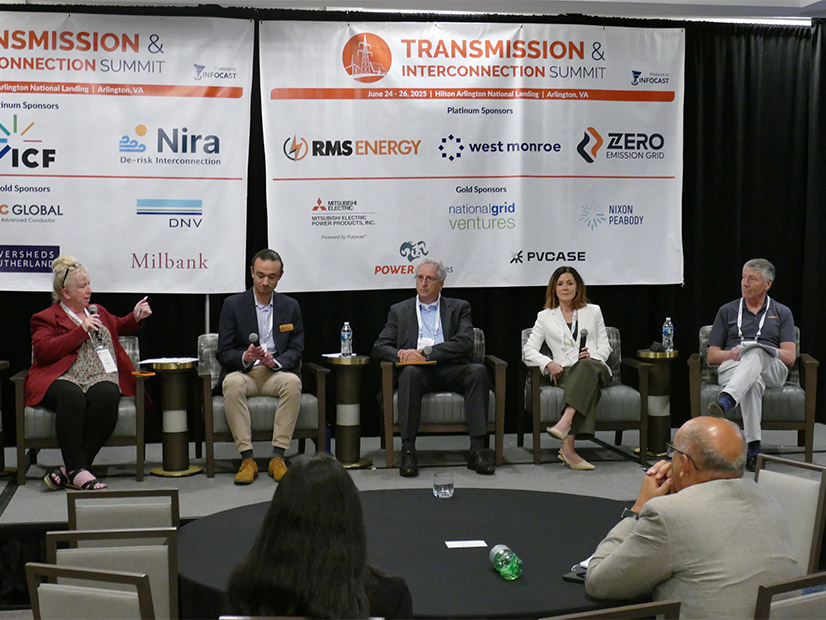
ARLINGTON, Va. — While much of the energy industry is focused on the latest news on the reconciliation budget bill and its cuts to tax credits, the transmission sector is not — because it was left out of the Inflation Reduction Act.

“This, to me, was a flaw with the original Inflation Reduction Act,” Grid Strategies President Rob Gramlich said at Infocast’s Transmission and Interconnection Summit on June 25. “They really didn’t do much transmission; it was sort of overlooked.”

The Democrats passed the IRA using reconciliation, a process that allows the Senate to vote on items related to the budget without the threat of a filibuster, in 2022. With control of the White House and Congress, Republicans now are using the same process for their so-called One Big Beautiful Bill that includes cuts to many tax credits and programs from the IRA.

In between these two major bills, bipartisan permitting legislation did make it out of the Senate Energy and Natural Resources Committee in 2024 but never was brought to the floor. Permitting legislation should get another chance, but Gramlich said it will have to wait.

“Basically, you can’t do big permitting reform in a reconciliation/budget bill,” Gramlich said. “But they did have to try, because if you’re a Republican member of Congress, why would you not try that first and see what you can get that way? And also, why would you not try to do everything you can try to do with executive action?”

The budget bill is likely to take up most of Congress’ time over the next month, but once it is back in session this fall, Gramlich expects permitting will be taken up again.

Energy Secretary Chris Wright has said he hoped transmission could get similar treatment to natural gas pipelines, which shows some in the Trump administration support changes, MWR Strategies President Michael McKenna said. Support for changing permitting laws is growing on both sides of the aisle.

“The Republicans are going to find it much easier to live with if President Trump is still president, so I think the sweet spot is going to be starting in about eight or 10 months and going until the end of the Trump presidency,” McKenna said.

While the industry waits to see if Congress can pass a permitting bill, it is implementing major changes from FERC: Order 1920 on planning and cost allocation, and Order 2023 on interconnection queues.

Some of the regions already have rules in place that have led to significant regional transmission being built under the regimes in compliance with Order 1000. MISO and SPP have different markets, but both have transmission planning processes with significant buy-in from the states in their two large footprints, ITC Holdings Director of Federal Affairs Devin McMackin said.

“So hopefully, for us at least, that means it’s not going to be a particularly arduous process to implement the order, and we’ll kind of basically see some repetition of the continuous planning efforts that we already have,” McMackin said. “So, I’m fairly optimistic that the concepts that underlie 1920 in many cases are already in place.”

The cluster study approach in Order 2023 already was adopted in some markets before FERC started working on the rule, and more utilities adopted it while the order was pending, Gramlich said.

“But that doesn’t mean it didn’t have an impact: That three-year process really led everybody to that outcome, and that’s helpful,” Gramlich said. “It doesn’t mean that’s the end of the reforms or the process either. It just means that it’s kind of herding all the cats in that general direction.”

Regional Differences

FERC left certain details in implementing the orders up to the different regions, so their choices will have an impact on how much transmission planning is truly reformed by its recent orders, Zero-Emission Grid CEO Mike Tabrizi said. Sometimes transmission planning can become a standardized process where not much gets done, especially when it comes to meeting the minimum of maintaining compliance with NERC standards, he said.

“What happens is, every year they go through this compliance process because they are so overloaded with so many other tasks that they have on their hand,” Tabrizi said. “The goal is not to actually plan the system; the goal is actually to check the boxes for the compliance.”

Grid United President Kris Zadlo said Order 1920 did not seem like a big deal to him the first time he read it because it was standard operating practice when he joined the industry during a time of high load growth.

“Over the last 25 years, we’ve had essentially flat load growth in the United States, and it allowed us to be essentially reactive,” Zadlo said. “Like I would say, for the last two decades, we haven’t been doing transmission planning. Transmission planning means you’re planning for the future. You’re not reacting.”

The industry had seen such huge load growth in the 1960s and ’70s that it overbuilt the system, and that allowed planners to be reactive for longer than the lack of load growth on its own, Zadlo said.

“We didn’t inherit an industry that had strong regional institutions that were charged with infrastructure planning,” Gramlich said. “RTOs, in any case, are 25 years old. That wasn’t their original focus for the reasons we’ve described. It was more about markets.”

FERC’s regional transmission plan applies to RTO footprints, but it also applies to utilities outside of them that have formed regions like WestConnect, which covers parts of the Southwest. While it has held meetings over the years, hasn’t selected a transmission project for the entire region, New Mexico Public Regulation Commissioner Gabriel Aguilera said.

“They’ve never selected a regional transmission project since its inception in” 2002, Aguilera said. “And I don’t know if that is a little bit shocking to any of you; it’s a little bit shocking to me that there were no regional transmission needs identified. And, so, there is some work to do there, clearly.”

Order 1920 has caused states in the West to look at regional transmission planning again, with more diverse stakeholders, including state regulators, getting involved than in the WestConnect process, which Aguilera said has been dominated by incumbent utilities and some independent transmission developers.

Every region of the country could use more transmission capacity for various reasons, and the West is no different, though things have been changing significantly there in recent years, said former FERC Chair Richard Glick, now a consultant at GQ New Energy Strategies.

transmission

From left: WECC Vice President Kris Raper, RMI’s Tyler Farrell, former FERC Chair Richard Glick, ENGIE North America’s Margaret Miller and SouthWestern Power Group General Manager David Getts | © RTO Insider

The Northwest used to think it could rely on cheap and plentiful hydropower, but recent years have made clear that it needs more access to imports from other parts of the Western Interconnection, Glick said.

“The Southwest, for instance, could bring in more power from the Northwest,” Glick said. “The problem is that the grid in the West is becoming increasingly congested. It’s more difficult to engage in those transactions, certainly at an economic level. So, there certainly is a growing recognition that transmission is needed.”

Order 1920 requires more anticipatory planning, so that should force all regions to improve their actual planning processes, but it’s an open question on how much regional transmission will get built, Glick said. The region faces unique issues like huge, non-FERC-jurisdictional utilities that have to opt into planning processes and cost allocation.

“Transmission planning regions cannot plan for the needs of the non-jurisdictional utilities unless those non-jurisdictional utilities volunteer to pay whatever is allocated in the cost allocation process,” Glick said. “And the odds of that happening are obviously very small.”

Load Growth

The return of load growth, caused by very high computing demand from data centers for artificial intelligence and other applications, was not known to FERC when Glick launched the rulemaking process that led to Order 1920, but it has changed the discussion around its implementation.

ELCON CEO Karen Onaran represents traditional industrial customers who also contribute to demand growth, but the hyperscale data centers have demoted her members from large load to “middle load,” she joked. A key policy goal of manufacturers is to keep the price of energy down because that makes their products more competitive.

“Over the past year [to] year-and-a-half, one of my major focuses is going around the country and talking to state-level manufacturers … who have been fighting against transmission for a long, long time and changing that narrative of it to say, ‘Yes, transmission is expensive, but not having transmission is even more expensive,’” Onaran said.

Order 1920’s shift to 20-year plans instead of 10 is well suited to the return to demand growth, Con Edison Transmission CEO Stuart Nachmias said.

“I think 10 years have been sort of the norm,” he added. “I think looking at longer before we had growing demands and growing needs were sort of pushed off as a little bit too theoretical. We don’t really know what’s going to happen, but now we really know that there is load and there are needs, and we can look out further.”

While the order faces some legal challenges, including the question of whether FERC can force transmission owners to file cost allocation agreements struck by states they disagree with, WIRES Executive Director Larry Gasteiger said it was important to get states supporting transmission.

“I completely recognize the importance of that engagement in order to have success in moving forward and getting state buy-in on some of these projects in order to move forward,” Gasteiger said. “So I agree, I think the community where some of the success stories have been — look at things like the MISO [Multi-Value Project] process, which was a whole array of projects that came out of a process, and the underlying theory behind them — it was something for everyone in that process at the end of the day, and you had large buy in among all of the involved states, and that was absolutely critical.”

FERC Upholds MISO and SPP’s JTIQ Cost Allocation over Criticism

FERC has found that MISO and SPP’s 100% cost allocation to generation for the pair’s $1.7 billion Joint Targeted Interconnection Queue (JTIQ) transmission portfolio remains appropriate (ER24-2797-001, et al.).  

In an order issued at its monthly open meeting June 26, the commission rejected arguments from a group of clean energy organizations that took issue with the 100% allocation to interconnecting generation, and Arkansas and Mississippi regulators, who criticized the backstop feature that allocates costs to load if the lines aren’t fully subscribed. It ruled that it continues to find that the JTIQ cost allocation is just and reasonable. 

MISO and SPP won approval from FERC in late 2024 to fully allocate the costs of the JTIQ portfolio to interconnecting generation assessed per megawatt. The RTOs initially planned to use a split involving 90% to generators and 10% to load, but they abandoned the approach after the U.S. Department of Energy announced that the portfolio would receive $464.5 million from its Grid Resilience and Innovation Partnership (GRIP) program. (See MISO, SPP Ditch 90/10 JTIQ Allocation After $465M DOE Grant.) Under the approved allocation, load will act as a temporary backstop for their share of the costs until enough new generation projects commit to the lines and pick up the tab for construction. 

The American Clean Power Association, Solar Energy Industries Association and Advanced Power Alliance argued that the JTIQ’s allocation, where generation pays all line costs and load pays nothing, ignores that load would “undeniably benefit” from the transmission. They also said the commission overlooked that new interconnection customers aren’t the “legally relevant cause” of the JTIQ portfolio, nor its sole beneficiaries. The groups said FERC abandoned its cost-causation principles and violated the Federal Power Act and the Administrative Procedure Act by greenlighting the allocation. 

FERC said it approved the allocation “based on the unique set of facts and circumstances of the proposed JTIQ framework” and cited “‘massive amounts of interconnection requests,’ the lack of transmission system capacity at the seam to accommodate this volume of interconnection, the significant incremental cost of constructing network upgrades under the RTOs’ affected-system study process … as well as the $464.5 million DOE GRIP funding, which covers approximately 25% of the costs that will be allocated to the interconnection customers.” 

The commission said MISO and SPP’s JTIQ studies and economic theory show that interconnection customers will benefit from more certain and smaller upgrade costs and a reduced interconnection timeline. 

“We continue to find that, based on substantial record evidence, interconnection customers are the primary beneficiaries of the JTIQ upgrades … and therefore should bear the primary responsibility for the … capital costs. In contrast, load still receives ‘some benefit’ and is correspondingly reasonably allocated more limited, potentially temporary, cost responsibility through the backstop funding mechanism,” FERC wrote. 

The commission added that MISO and SPP can continue to use their load as a backstop cost allocation for JTIQ lines despite the Arkansas and Mississippi public service commissions’ argument that MISO could not prove enough benefits would flow to MISO South from JTIQ lines to justify a footprint-wide backstop allocation. 

“The RTOs have shown that the entirety of MISO will benefit to some degree from the high-voltage transmission facilities in JTIQ portfolio No. 1 that will enable the interconnection of generation, regardless of the subregion in which these facilities are located,” FERC said. 

The commission said that despite MISO’s Midwest-to-South transfer limit, transmission customers in both regions would receive “minor and incidental benefits from increased transmission system robustness” and “more timely interconnection of new generation capacity that enables lower production cost generation to access the entire MISO market.” FERC also said lower congestion at the RTOs’ seam could lower MISO’s congestion payments to SPP. 

FERC cited an SPP study that showed that a swifter interconnection of projects at the seam would boost reliability and confer almost $176 million of adjusted production costs benefits to the RTOs, with $76.5 million benefiting MISO.  

FERC echoed MISO and SPP that the backstop allocation is “highly unlikely” to become the permanent allocation based on the “substantial” amount of proposed generation in their interconnection queues and their forecasts that call for increasing load. 

MISO generation developers, meanwhile, have expressed disdain for the JTIQ cost allocation, saying the additional studies the RTO tacked onto the process could send cost assignments as high as they were under its former affected-system study process with SPP. (See MISO Gen Developers Sour on RTO’s JTIQ Cost Allocation.)  

Generation developers also don’t believe GRIP funding is assured under the Trump administration. National Grid Renewables in May told MISO the “certainty of this funding has come into question under the current presidential administration.” The company said allocating costs solely to generation was approved only because the grants would fund almost half of the JTIQ portfolio. National Grid predicted challenges in construction timelines if grant funding is revoked and generators are left to pay more than what they estimated. 

MISO responded at the time that it was not expecting JTIQ funding changes and said DOE had not indicated that GRIP funding is in jeopardy. However, the RTO added that “JTIQ is not contingent upon the receipt of GRIP funding.” 

FERC Says MISO’s Interconnection Compliance Lacking, Approves General Design

FERC told MISO it needs a few more edits to its queue rules to be compliant with the commission’s wide-ranging order to streamline generator interconnection.  

FERC decided MISO is free to maintain its three-phase approach to interconnection queue studies under Order 2023. The commission said MISO’s setup already used a cluster study process with a first-ready, first served philosophy for projects in accordance with its order and therefore didn’t require a transition plan. FERC also said MISO’s site control requirements, milestone payments, withdrawal penalty fees and study deposits were appropriate under Order 2023 (ER24-2046).   

FERC issued Order 2023 in July 2023, seeking to clear backlogged interconnection queues by implementing a first-ready, first-served cluster study process; increasing interconnection customers’ financial obligations; and penalizing grid operators for missing study deadlines. (See FERC Updates Interconnection Queue Process with Order 2023.) 

However, FERC in a June 26 order said some details of MISO’s plan need refinement. It said MISO fell short in describing how it would allocate the costs of different types of network upgrades. FERC noted that MISO’s plan didn’t distinguish between thermal and non-thermal network upgrades, though its business practice manuals make a distinction.  

The commission said MISO didn’t include a plan for allocating the shared costs of cluster studies and ordered MISO to revise its interconnection procedures to include an allocation that assigns between 10 and 50% of study costs per capita, with the remaining 50 to 90% allocated pro rata by megawatt.  

FERC said MISO should have committed to updating a points-of-interconnection heat map after the final system impact study takes place. MISO proposed to provide the heat map one time after it completes a preliminary system impact study. FERC said without a heat map update after the final system impact study, prospective interconnection customers might rely on outdated information to decide whether to enter their projects.  

The commission said MISO needed to eliminate the term “reasonable efforts” in a section on completing affected system studies and preparing a final report.  

Order 2023 ended a “reasonable efforts” standard on interconnection studies. Instead, the order requires transmission providers to meet fixed study deadlines and enacts financial penalties for delays.  

FERC said MISO must remove a provision that multiple interconnection customers must form a common business entity before they could share a single interconnection request. FERC said multiple interconnection customers that have a contract or agreement can co-locate and share a single interconnection request without creating an LLC.  

The commission also said MISO should not have included steps that allow a transmission provider to conduct extra studies to assess a request for surplus interconnection service. FERC said the additional measures aren’t necessary under Oder 2023 and rejected them without prejudice to MISO proposing them in a future filing.  

Finally, FERC ordered MISO to define several terms it used throughout its filing and rephrase other parts of the plan. MISO has 60 days to make the changes. 

FERC Partly Accepts SPP’s Order 2023 Compliance

FERC has accepted SPP’s compliance with Orders Nos. 2023 and 2023-A in part and directed the RTO to submit a further filing within 60 days of the order (ER24-2026). 

The commission said in its June 26 order that SPP’s proposed tariff revisions amending the commission’s pro forma generator interconnection procedures and pro forma generator interconnection (GI) agreements partly comply with the orders. 

It found that the RTO’s proposal to post the interconnection studies from the close of its definitive interconnection system impact study (DISIS) cluster to the date when the transmission provider provided the completed study, as opposed to from the close of the cluster request window, deviated from the pro forma GI procedures. FERC said SPP’s standard “does not explain how the proposed variation accomplishes the purposes of Order 2023.” 

The commission also found SPP’s revisions did not incorporate a reference to the “surplus interconnection service study” contained in the pro forma large generator interconnection procedures (LGIP) and that the definition of “scoping meeting” in its GI procedures didn’t incorporate the commission’s revisions to the definition. It said the proposal does not incorporate FERC’s removal of the phrase “to determine the potential feasible points of interconnection” and that its pro forma GIA does not include the defined term “cluster.” 

When SPP made its compliance filing May 24, it said it had made several reforms following Order 2023’s issuance, including a three-stage interconnection study process with increasing financial milestones at each stage. It also proposed replacing “cluster study” and “cluster restudy” with “DISIS” and “DISIS restudy.” 

FERC had several issues with SPP’s proposed language on site control. It said the grid operator did not explain the omission of timing requirements when it would notify interconnection customers of a required restudy; it did not fully incorporate the commission’s revisions to the pro forma definition of “site control”; it did not request an independent entity variation for its proposal to retain its existing GI procedures provisions requiring 100% site control at the time of an interconnection request; and it did not address FERC’s requirement for transmission providers to include a narrative description of how they will define regulatory limit. 

The commission ordered SPP to address: 

    • How the following two items meet the purposes of Orders 2023 and 2023-A. Not adopting the commission’s requirement that the transmission provider treat the GIA deposit as part of the security that the interconnection customer must provide for network upgrades and interconnection facilities; and not requiring the transmission provider to explain and estimate the dates at which an interconnection customer must provide additional security for interconnection facilities and network upgrades when the GIA deposit is depleted. 
    • How it will incorporate the requirement that the transmission provider perform affected system restudies within 60 calendar days from the date of notice. 

FERC directed the grid operator to: 

    • Remove certain language regarding the submission of multiple interconnection requests and deposits or further justify its proposal under the independent entity variation standard. 
    • Revise the GI procedure language to specify which enumerated alternative transmission technologies evaluation results are reported in the first two DISIS studies and to clarify when interconnection customers will receive the evaluation results of the alternative transmission technologies. 
    • Reinstate language regarding transitional notice requirements for generating facility replacement in a future Section 205 filing under the Federal Power Act. 

SPP’s filing drew 22 intervenors and protests by the Clean Energy Association, Longroad Energy Holdings and Shell. FERC rejected the majority of the complaints. 

FERC issued Order 2023 in July 2023, seeking to clear backlogged interconnection queues by implementing a first-ready, first-served cluster study process; increasing interconnection customers’ financial obligations; and penalizing grid operators for missing study deadlines. (See FERC Updates Interconnection Queue Process with Order 2023.) 

In 2024, the commission rejected challenges to the interconnection rules under Order 2023 and made several clarifications, minor modifications and an extended compliance deadline with Order 2023-A. (See FERC Upholds, Clarifies Generator Interconnection Rule.) 

First Texas Energy Fund Loan Goes to Kerrville Utility

The Texas Public Utility Commission has executed the first loan agreement under the state’s low-interest energy fund to the Kerrville Public Utility Board, the developer of a 122-MW natural gas plant. 

The loan agreement was finalized June 25 under the Texas Energy Fund’s In-ERCOT Generation Loan Program. The program has been allotted $5 billion by state lawmakers to help provide up to 10 GW of new gas-fired generation for ERCOT. 

The PUC and Kerrville PUB agreed to a 20-year loan of up to $105 million for the Rock Island Generation Project at a 3% interest rate, subject to customary financial closing procedures. The project’s total costs are not to exceed $175 million, and the project must meet minimum performance standards, as outlined in the program’s rules. 

The PUB says it will finance the remainder of the project through tax-exempt revenue bonds. 

Rock Island will interconnect to the South Texas Electric Cooperative’s grid in ERCOT’s South load zone. Construction is scheduled to begin in the fall of 2025, and the plant is projected to begin operations by June 2027. 

The site is almost 200 miles away from Kerrville, which is northwest of San Antonio. However, it has access to four natural gas pipelines, which was not the case in Kerrville. 

Texas Gov. Greg Abbott (R) said in a statement that the plant, 75 miles away from the huge Houston load center, will “help bear the load of the largest electricity demand area in the state.” 

The PUC is tracking 18 other applications in the In-ERCOT program’s due-diligence review, representing an additional 9.1 GW of gas generation. 

FERC Approves NERC’s Proposed INSM Standard

FERC on June 26 approved NERC’s proposed reliability standard requiring utilities to implement internal network security monitoring (INSM) while ordering the ERO to modify the standard by extending its reach (RM24-7).

Acting during its monthly open meeting, the commission also withdrew a Notice of Inquiry to determine whether NERC’s Critical Infrastructure Protection (CIP) standards need further modification (RM20-12).

NERC submitted CIP-015-1 (Cybersecurity – INSM) in June 2024 in response to a 2023 directive from FERC. The commission called the proposal a necessary precaution against events like the SolarWinds hack of 2020, in which malicious actors — later identified by U.S. law enforcement as belonging to Russia’s Foreign Intelligence Service — infiltrated the update channel for SolarWinds’ Orion network management software and pushed code to customers that the attackers could use to gain access to their systems.

FERC said the SolarWinds compromise indicated that the kind of security measures mandated in the CIP standards at that point could be bypassed. Those standards required utilities to monitor communications from the inside of their electronic security perimeter (ESP) — the electronic border around its internal network — to the outside. Implementing INSM could help security staff discover attackers that already had infiltrated the system, it said.

CIP-015-1 requires utilities to implement INSM for all high-impact grid-connected cyber systems with or without external routable connectivity (ERC), as well as medium-impact systems with ERC. The commission approved this requirement but indicated that further modification is needed in light of new developments since NERC submitted the standard.

FERC’s requested changes have to do with a clarification that NERC requested in comments on a Noticed of Proposed Rulemaking in November 2024. (See NERC Responds to FERC Cybersecurity NOPRs.) The ERO noted that the NOPR called on it to protect “all trust zones of the CIP-networked environment” but did not define the term “CIP-networked environment,” which made the directive unclear.

In response, FERC specified that the term “does not cover all of a responsible entity’s network,” but it does include “the systems within the [ESP] and network connections among and between electronic access control or monitoring systems (EACMS) and physical access control systems (PACS) external to the [ESP].”

With this definition established, FERC ordered NERC to modify the standard to “extend INSM implementation to EACMS and PACS outside of the” ESP, which it called “known targets for malicious actors.” The commission gave NERC 12 months from the effective date of the order (Sept. 2, 2025) to file the modified standard; as for CIP-015-1, it will take effect 60 days after the date of publication of FERC’s final rule in the Federal Register.

The NOI that the commission withdrew was initiated in 2020 to identify potential gaps in the CIP standards, after FERC raised concerns that the then-current standards did not adequately address the rapidly evolving cybersecurity threat landscape. FERC based its questions on a review of the National Institute of Standards and Technology’s (NIST) Cybersecurity Framework, asking stakeholders whether the standards provide sufficient protection regarding data security, detection of anomalies and events, and mitigation of cybersecurity events.

The commission noted in its June 26 filing that most commenters on the NOI said the CIP standards, both those in existence and those under development at the time, “adequately addressed the … categories identified.” Those that acknowledged gaps between the CIP and NIST standards still warned that they “serve fundamentally different purposes and … cautioned against an apples-to-apples comparison.” (See Stakeholders Speak out on FERC CIP Concerns.)

FERC also acknowledged that since the NOI’s issuance, NERC and FERC have worked to improve the grid’s cybersecurity posture and address emerging risks. FERC cited multiple CIP standards approved since 2020 including CIP-015-1, CIP-003-9 (Cybersecurity – security management controls) and CIP-012-1 (Cybersecurity – communications between control centers). This progress, the commission said, justified closing the inquiry and the docket.

Northwest Summers Now Include ‘Huge’ Energy Flows from California

For decades, Portland General Electric watched electricity move from north to south through its system during the summer, as relatively cheap hydroelectric power from the Pacific Northwest flowed to California.

But now, the flow on a typical summer day has reversed, with electricity moving from south to north, PGE officials told the Oregon Public Utility Commission.

“With the 10,000 MW of batteries and 20,000 MW of solar that California has, we see a reversal of paths, where there is a huge northbound flow from California — cheap energy — up into the Northwest,” said Lee Recchia, PGE’s senior manager of the grid control center.

Recchia spoke during a special OPUC meeting on summer readiness on June 24.

The flow reversal has created issues that PGE “didn’t really see coming,” Recchia said, particularly on the North of Pearl transmission path. The Bonneville Power Administration owns the Pearl flowgate, and PGE partially owns some 230-kV lines out of Pearl.

“We’ve seen some overloads that we hadn’t seen in the past years, and it’s one of our big congestion points,” Recchia said.

PGE has developed a North of Pearl action flow chart for operators and a forecasting tool. The utility also is in regular discussions with BPA.

“It strikes me as one of those places where there will be really important coordination, as they move forward with their Markets+ decision,” OPUC Chair Letha Tawney said. “This could get hairy.”

PacifiCorp Preparations

Weather forecasters predict higher-than-average temperatures for most of the West this summer.

But PacifiCorp’s predicted summer peak of 11,163 MW is not a significant jump from its 2024 summer peak, according to Ben Faulkinberry, senior originator in the company’s energy supply business unit.

Since summer 2024, PacifiCorp has added 1,000 MW of wind resources and 320 MW of solar while also completing a 75-MW natural gas plant expansion. Another 400 MW of wind and 500 MW of solar are expected by the end of this summer.

PacifiCorp also energized the Gateway South transmission line, a 500-kV line that will carry electricity from the company’s wind power projects in Wyoming to the load center in Utah.

With the new line in service, curtailments of Wyoming wind are down by about 70%, Faulkinberry told the commission. And during the summer, when there’s less wind in eastern Wyoming, Gateway South gives PacifiCorp greater capacity to transact with market participants on the east side of the Rockies, he said.

“Our load requirement has not jumped substantially. We’ve added new resources. We’ve added new connectivity,” Faulkinberry said. “So we’re feeling, on the whole, pretty well-situated going into summer 2025.”

Still, PacifiCorp faces potential summer threats. One concern is the possibility of extreme heat simultaneously hitting the Pacific Northwest, Desert Southwest and California regions.

“That really puts a stress on our system as well as for the region as a whole,” he said.

Another worry is wildfire, which could affect transmission across the grid. Southern Oregon and southern Idaho, areas where PacifiCorp has “some pretty key connectivity,” are particular concerns, Faulkinberry said.

PacifiCorp also is expanding its demand response programs, including Cool Keeper, which has been a longstanding program in Utah.

Through the program, which PacifiCorp now is rolling out in Oregon, a technician installs a device that curbs power to the air conditioner compressor of a residence or small business. The company controls the device, and the customer can’t bypass it.

A typical Cool Keeper event lasts 5 to 15 minutes — enough time to stabilize the grid when it gets out of balance.

Because the fan and air handling components of the air conditioner keep running, customers generally don’t feel uncomfortable. Customers receive a bill credit for participating.

PacifiCorp forecasts that participation in Cool Keeper, along with a battery incentive program called Wattsmart, will offset the need to build three natural gas peaker plants within four to five years.

New CAISO-Powerex Dispute Centers on ‘Voluntary’ Nature of EDAM

CAISO has dismissed Powerex’s contention that the ISO only recently has “revealed” that participation in its Extended Day-Ahead Market is voluntary at the balancing authority level but not voluntary for “individual customers” operating within the BA participating in the market. 

“Powerex’s claim is incorrect and directly at odds with the factual record,” CAISO wrote in a June 17 “limited answer” filed in the FERC docket for PacifiCorp’s proposed revisions to its Open Access Transmission Tariff, intended to facilitate the utility’s participation in EDAM (ER25-951). 

In February, PacifiCorp’s OATT proceeding had opened yet another front in the competition between EDAM and SPP’s Markets+. 

That’s when Powerex — a strong Markets+ backer — published a paper arguing that PacifiCorp’s revisions showed the EDAM contained a “design flaw” in how it allocates transmission congestion revenues in situations when congestion results from loop flow. (See Powerex Paper Sparks Dispute over EDAM ‘Design Flaw’.) 

CAISO and PacifiCorp initially rebuffed that characterization, but the ISO and its stakeholders did move to quickly address the matter with congestion revenue allocation rule changes developed through an expedited stakeholder process. (See CAISO Approves New EDAM Congestion Revenue Allocation Design.) 

But the issue spelled out in CAISO’s June 17 answer represents a new twist in the running dispute in the OATT proceeding. 

In its answer, CAISO was responding to a June 11 comment Powerex submitted in the docket in which the Vancouver, B.C.-based power trader said the ISO has long promoted the EDAM as “voluntary and incremental” — a “natural evolution” of the Western Energy Imbalance Market (WEIM). 

But, Powerex went on to contend, in a May 19 filing, CAISO for the first time “revealed” a “radically different approach” in which “EDAM could no longer be described as voluntary at all because only PacifiCorp (or other prospective balancing authorities) will be offered the choice to participate in EDAM.” 

Powerex was pointing specifically to CAISO’s statements around an EDAM provision that allows a participating BA to “carve out” the embedded transmission of nonparticipating transmission service provider (TSP) from EDAM’s market optimization. In the May 19 filing, the ISO said it agreed PacifiCorp had the right to take that action but added that “any such carveouts should be an option of last resort.” 

Instead, CAISO argued, a “similar and more efficient” option would be for the nonparticipating TSP to self-schedule the use of its own transmission within EDAM and directly settle the associated energy schedules, including congestion price differences, with the market operator.” 

Powerex said this showed CAISO was seeking to “achieve this compulsory participation” and create a “captive market” along the lines of an RTO, but without providing the full benefits of an RTO. 

That would mean PacifiCorp’s decision to join the market would “in turn, require every electricity transaction and every delivery by every customer in PacifiCorp’s area to take place through EDAM,” Powerex wrote. “In addition, once PacifiCorp joins EDAM, all of its own transactions and all of its own deliveries will also be required to occur entirely through EDAM.” 

Powerex went on to warn that “if CAISO’s new vision for EDAM is accepted, it would effectively make all activity in the electricity sectors of Wyoming and Utah, as well as significant portions of Idaho, Oregon and Washington, captive to CAISO’s authority and ongoing decision-making under CAISO’s governance structure, as a result of PacifiCorp’s election to join EDAM.” 

‘No Recognizable Reason’

In its June 17 answer, CAISO retorted that, although Powerex “professes surprise” at the ISO’s statements in its May 19 filing, those comments represented “nothing new, surprising or radically different” from the ISO’s previous description of EDAM. 

“In fact, … CAISO was explicit in its 2023 tariff amendment filing to implement the EDAM design — on which Powerex submitted comments not even raising this subject — that participation in EDAM is voluntary at the balancing authority level but that all supply and demand in each EDAM balancing area must participate in the day-ahead market,” the ISO wrote. 

CAISO noted FERC approved this “foundational concept” of the EDAM in its December 2023 order approving the market’s tariff and “should reject Powerex’s factually inaccurate claims and its arguments based on those claims.”  

It pointed out that the transmittal letter accompanying the EDAM tariff filing stated the tariff included three options for the use of OATT transmission service rights in the market but that CAISO “had rejected proposals for other options involving broad or automatic opt-outs or carveouts of transmission capacity from the market.” 

The transmittal letter noted that CAISO and its stakeholders had determined that carveouts would create market inefficiencies, in part by potentially creating congestion in situations when a carveout leaves a path underused despite the availability of sufficient transmission capacity. 

“In addition, Powerex contradicts history in claiming the CAISO is in 2025 announcing a ‘radically different approach’ under which every electricity transaction and every delivery by every customer in PacifiCorp’s area will take place through EDAM. The CAISO made this requirement clear multiple times in its 2023 filing of tariff amendments to implement EDAM,” the ISO wrote. 

“In short, there is no cognizable reason for surprise on Powerex’s part,” it said.