‘Best Market in the World’ Faces Uncertain Future

AUSTIN, Texas — Peter Cramton, ERCOT board member for more than five years and board vice chair for 15 days, spoke wistfully of his tenure, which ended shortly after Winter Storm Uri brought the grid to its knees.

“I still believe ERCOT is the best market in the world,” he said earlier this month during a symposium on Texas’ energy system sponsored by the Energy Bar Association (EBA) and the University of Texas School of Law.

“The mission was so clear. We delivered reliable energy at the least cost,” he said. “We embraced that. Then, you can let the engineers, the market designers, the stakeholders jump in and all work together and solve this very technical problem. It works beautifully, most of the time, until it doesn’t.”

It didn’t in February. Uri’s ice accumulation and below-freezing temperatures rendered about half of ERCOT’s thermal generation useless as demand, fueled by poorly insulated homes, spiked to record levels. Millions of Texans went without power and hundreds died during the days of misery that followed.

Fingers were quickly pointed at the lack of dependable renewable energy and ERCOT’s leadership, especially the out-of-state board members who hailed from cold-weather locales such as Illinois, Maine, Michigan and Canada.

Peter-Cramton-2021-07-29-(RTO-Insider-LLC)-FI.jpg
Peter Cramton | © RTO Insider LLC

One of the Texas legislature’s many bills addressing the winter storm’s aftermath blew up the board structure. The five unaffiliated directors and eight directors elected by their market segments will be replaced by eight political appointees. All Texans, of course.

The board’s political makeup, unlike most other regional grid operators, has left stakeholders unnerved. CAISO’s board members are appointed by the California governor and approved by the state Senate, a result of the 2000-2001 energy crisis.

“Politics and electricity don’t mix very well. Electricity is very technical. Physics wins. As a result, it puts politics in an uncomfortable position,” Cramton said.

“There was tremendous value with the prior structure, which emphasized independent expertise … I don’t think it makes sense to have the ERCOT board be all political appointees,” he said. “What the legislature and the governor should do is set broad principles and explain what they want to accomplish, and delegate that authority to the regulators. The [Public Utility Commission] then delegates the important operational authority to ERCOT.”

Becky Armendariz Klein, a principal with Klein Energy and a former PUC chair and ERCOT board member, agreed with Cramton. She reminded her audience that she had joined with other former Texas commissioners to recommend the ISO’s board be made up of independent directors who go through a search process, “like a corporate board.” (See Former PUC Commissioners Weigh in on ERCOT Fixes.)

“That really takes some of the politics out of it and brings some objectivity [to the process],” Armendariz
Klein said. “We felt as a group that independent board directors at ERCOT are really important, so maybe one day, that will change.”

‘Kind of a Pickle’

Armendariz
Klein and Cramton were among the speakers discussing lessons learned from the winter storm and next steps to be taken during the July 15 summit. Except for those who spent the spring lobbying and testifying before the legislatures, it was the first in-person meeting since March 2020.

EBA President Mosby Perrow was so thrilled to be back among fellow human beings that he donned the last suit he wore one year, four months and seven days ago. But who’s counting?

“We’re back, which feels very good,” a tieless Perrow said. “We thought the EBA summit was a perfect vehicle to have a non-partisan, vigorous debate about what should happen to prevent another blackout.”

Rick Smead, managing director of advisory services for RBN Energy, was the natural gas industry’s lone representative. Addressing the loss of fuel supplies that hamstrung ERCOT’s response, he was duly apologetic, calling the lack of deliverability “the catalyst of everything that happened.”

“It doesn’t feel good. We left it on the shelf like a Soviet grocer,” Smead said. “It was the loss of power to producers that made it such a prolonged and deep outage, so somehow, the producers have to have a different design. The weather simply went … beyond their designs.”

Much of the discussion focused on the uncertain future. The PUC, ERCOT staff and its stakeholders are just beginning to dirty their hands in redesigning the ERCOT market’s focus on affordability over reliability. PUC Chair Peter Lake has called the energy-only market’s emphasis on scarcity pricing, designed to incent new generation, a “crisis model,” while ERCOT Interim CEO Brad Jones is stressing reliability over affordability.

Gov. Greg Abbott, meanwhile, has directed the PUC — whose three members he has appointed over the last three months  — to streamline incentives for thermal resources and allocate reliability costs to resources that can’t guarantee availability, such as renewables. (See PUC Debates Answers to ERCOT’s Reliability Issues.)

Will the new market create new winners and losers? That’s likely, but no one is making predictions right now.

“ERCOT is in a state where it wants to perform incredibly conservatively. What that means is price suppression, and price is the way we incent new investment and resources,” said Amanda Frazier, Vistra’s senior vice president of regulatory policy. “[The governor] wants more dispatchable generation. The way the market is designed, which we’ve always thought was correct, was that prices and revenue streams will create the investment that we need. A lot of that investment has been through the development of renewable resources.”

Becky-Klein-2021-07-29-(RTO-Insider-LLC)-FI.jpg
Becky Armendariz
Klein, Klein Energy | © RTO Insider LLC

Armendariz
Klein said she is sensing concern in the investment community, which she said is in “kind of a pickle.”

“On the one hand, they’re attracted to the Texas market because of its historically low wholesale prices,” she said, noting ERCOT’s bounty of renewable resources is important to them.

“Especially now where there’s a lot of impetus for them to report out on environmental activities. Their shareholders are asking for that too,” Armendariz
Klein said. “Going forward, we’re going to have pricing in the market that’s more expensive. That’s just expected. Texas will have higher wholesale prices, but who knows what happens to the renewable portfolio. I think in time, that mix is going to change.”

Energy consultant Alison Silverstein put in a plug for the report she drafted for Armendariz
Klein and four other PUC commissioners. The report, “Never Again: How to Prevent Another Major Texas Electricity Failure,” lists 22 recommendations to improve the ERCOT grid.

Several of the measures call for strengthening housing efficiency, including retrofits for low-income and multifamily housing across Texas. More than half of the state’s homes were built before building energy codes with insulation requirements were adopted in 2001, the report says, and more than 60% of Texas homes are heated with electricity instead of gas.

“Most of [the recommendations] are nowhere near the governor’s and legislature’s immediate priority list,” Silverstein said. “That’s unfortunate because most of the measures have low costs. Those things don’t have the same headline glamour as pounding your fist on the table and demanding to build more power plants.”

Panel Says Transmission Spending Can Fix Economy, Fight Climate Change

Tens of billions of dollars in transmission project spending could help the economy recover from the pandemic and help fight climate change, according to a panel at the WIRES 2021 Summer Meeting on Thursday.

“Delaying the infrastructure also delays our success at curbing the significant property damages and health damages to our economy” resulting from extreme weather events, said Julia Frayer, managing director of London Economics International.

LEI in May published a report that examines the economic impact from $83 billion in approved or planned transmission projects across the U.S.

A transmission project that runs between PJM and NYISO doesn’t necessarily undermine the benefits of a project in the Midwest between SPP and MISO, Frayer said.

“When we talk transmission versus renewables, many folks think of lots of renewables; every rooftop will have a solar panel, so we don’t need transmission,” Frayer said. “I think that is a myth that has a probably grown too big and is on very shaky facts, because in fact it is a combined system that we’re trying to create here.”

Building interregional transmission lines is key to making the power grid work better, said Brennen Cain, policy adviser with clean energy advocacy coalition BlueGreen Alliance.

“There are all these places that are producing renewable energy right now … and increasing connectivity to deliver power to places that don’t have the capacity for massive solar farms or onshore wind farms is going to be vital,” Cain said.

To add more solar in parts of the country will require massive increases in the transmission network, said Aaron Bloom of Energy Systems Integration Group (ESIG). “Because we don’t have that we’re seeing lower quality sites being developed … and they’re just struggling to find that place to interconnect,” which slows down the scale of deployment.

Panel moderator and Bloomberg News reporter Brian Eckhouse asked about labor unions advocating for large transmission projects.

“Engagement from labor unions comes with individual projects when those projects are planned and have approval and are shovel-ready,” Cain said. “We focus our efforts on making sure that the federal investment in these projects … have labor standards attached to them.”

The multiplier effect is also known as the “drop in the water” effect, Frayer said.

One dollar goes to the construction worker, who in turn needs to go and buy some groceries, or buy or rent a home, “and we want to see this private sector spending really reach as far across the economy as possible,” Frayer said.

States Key to Tx Planning

Need is the key factor in building large infrastructure projects, whether generation, distribution or transmission, and state regulators are best situated to determine need, said FERC Commissioner Mark Christie, who spent nearly 17 years on the Virginia State Corporation Commission before being appointed to FERC in January 2021.

“The best transmission policy is the policy that is actually achievable … so it needs to be based on the reality of the circumstances,” Christie said. “State regulators are critically important to getting needed infrastructure built, and you’re not going to get the needed transmission built without state regulator involvement and the credibility that they’re going to bring.”

Christie recalled the “extremely controversial” Trans Allegheny Interstate Line (TrAIL), a 165-mile, 500-kV transmission line that crossed Pennsylvania, West Virginia and Virginia.

“I can remember sitting in high school gyms where people were passionately opposed to having this 500-kV line built,” he said.

All three state commissions, despite the opposition, approved TrAIL and it got built, which today is the largest single regional project ever built in PJM, he said.

Christie recalled another controversial project, Project Mountaineer, which was going to be four 765-kV lines running from West Virginia to East Coast load centers. He never had a chance to rule on the project because PJM, which had originally put it in its Regional Transmission Expansion Plan as a needed project, ultimately changed the load forecast and took it out.

He challenged the presumption that had the federal government designated the project as a National Interest Electric Transmission Corridor (NIETC), it would have been built. None of the opposition would have gone away, and state regulators still would have done monthslong analyses, taken hundreds of pages of testimony and held hearings where people could express their opposition, he said.

It’s the states that determine the need, and “it’s the states who are going to review all the projects and do what we did in TrAIL and compile an extensive record which can stand up on appeal — and it did stand up on appeal. … That’s the vital role that state regulators play getting these projects built because the state commissions do their due diligence and have credibility,” Christie said.

He also dismissed the idea of a national “transmission czar” who could force a needed project on an unwilling public.

“I don’t think it’s realistic to think some national transmission czar is going to override a decision made by state officials and have any credibility in that state, and I think you’re going to have a firestorm of opposition if you start trying to do that,” Christie said.

State vs. Federal

Developing coordination and collaboration between state and federal agencies will be a major key in successfully upgrading the transmission system as renewable resources continue to proliferate, according to participants in the second panel in the afternoon.

Abe Silverman, general counsel of the New Jersey Board of Public Utilities and self-professed history lover, said that when he looks at the current transmission buildout, he is seeing the “most profound transmission expansion since rural electrification” in the 1930s.

Silverman said New Jersey is at the forefront of the transmission expansion as it continues to proceed with its offshore wind initiatives, including installing 7,500 MW in the next decade. (See NJ Awards Two Offshore Wind Projects.) He said adding generation in locations that previously did not have it is creating transmission, interconnection and distribution-level issues.

“We’re talking about for the first time taking the grid to places where it isn’t at the moment, whether that be off the Eastern Seaboard or to renewably constrained areas that don’t have a robust transmission system,” Silverman said.

The “herculean challenge” of building out transmission must be done at a price that consumers can afford, Silverman said, or excessive costs will “kill this transmission revolution.” He said the “enormous untapped power” between state and federal regulators will help to keep costs in check, pointing to entities like PJM playing a major role.

Silverman said New Jersey wouldn’t be able to enact their ambitious wind goals without the use of the state agreement approach with PJM that began a year ago to aid in the transmission planning. (See PJM Dusts off ‘State Agreement’ Tx Approach.) He said he would like to see similar programs be the default across the country.

“States can’t be expected to take on this burden alone,” Silverman said. “We really need to be working with our fellow states and collaborators.”

Sue Glatz, director of strategic initiatives and interregional planning at PJM, said the RTO has recognized the world is “generally moving towards decarbonization.” She said that while PJM remains technology- and fuel-neutral for generation, it recognizes the change in generation goals among different states and must assure their processes are in place to meet the changes and the “evolution of the fuel mix” in the region.

Glatz said the state agreement approach has allowed PJM to work with a state like New Jersey on complicated transmission planning projects not typically done on a local level. “We’d like to see that this becomes perhaps a role model or a template should other states want to move forward either individually or collectively.”

Moderator Jodi Moskowitz, deputy general counsel and RTO strategy officer for Public Service Enterprise Group, asked where the lines of responsibility and authority exist between FERC and the states regarding transmission planning and cost allocation.

Jennifer Murphy, director of energy policy and senior counsel for the National Association of Regulatory Utility Commissioners, said she’d like to see a move away from the idea of “lines of authority” to “areas of cooperation.” Murphy said there are different ways RTOs and ISOs take into account state perspectives and input into the planning process across the country, and having a way to share lessons learned and best practices in planning with different entities would be helpful.

Murphy said she agreed with comments made earlier in the conference by Christie, which she said debunked the myth that states are the entities slowing down or stopping infrastructure development. Murphy said there are ongoing efforts in Congress to “increase the backstop siting authority” for the federal government, but that it’s “imprudent” for the federal government to take that role.

Federal regulators typically aren’t familiar with state laws and different circumstances on the local level regarding projects, Murphy said, leading to scenarios and planning that aren’t in the best interest of states.

“To have the federal government override a decision can be very detrimental not only to the process but to the public interest in general,” Murphy said. “It’s important to listen to state regulators.”

Biden Launches ICS Cybersecurity Initiative

Calling cybersecurity threats to critical infrastructure “among the most significant and growing issues confronting our nation,” the Biden administration on Wednesday announced an initiative to strengthen cyber defenses in industrial control systems (ICS) at “priority critical infrastructure” systems.

The Industrial Control Systems Cybersecurity Initiative will comprise a “voluntary, collaborative effort between the federal government and the critical infrastructure community” focused on accelerating the deployment of cybersecurity technologies in essential ICS and operational technology (OT) networks. The effort will deploy systems and technologies that target capabilities, including threat visibility, indications, detection and warnings, along with cybersecurity response, according to a National Security Memorandum issued on Wednesday.

“We cannot address threats we cannot see; therefore, deploying systems and technologies that can monitor control systems to detect malicious activity and facilitate response actions to cyber threats is central to ensuring the safe operations of these critical systems,” the White House said in the memorandum.

Wednesday’s announcement comes on the heels of a speech in which Biden warned that “a real shooting war with a major power” is a “more than likely [result] of a cyber breach of great consequence,” according to Reuters. In recent months a number of cyberattacks against major U.S. companies such as Colonial Pipeline and JBS USA have led cybersecurity experts and government officials to call for stronger action to secure U.S. critical infrastructure. (See King, Mandia Warn of ‘Unlimited’ Cyber Dangers.)

Cyber Performance Goals on the Way

The new initiative builds on one begun in April, although the earlier 100-day “sprint” applied only to the electricity industry. (See Biden Reinstates Trump Supply Chain Order.) Wednesday’s memorandum expands that program to cover natural gas pipelines. Similar measures aimed at the water, wastewater and chemical sectors will begin later this year.

According to a White House fact sheet, more than 150 electric utilities representing almost 90 million residential customers have either deployed or have agreed to deploy control system cybersecurity technologies since the earlier initiative began. That effort, led by the Department of Energy’s Office of Cybersecurity, Energy Security and Emergency Response (CESER), encouraged utilities to:

  • invest in “technologies and systems that enable near-real-time situational awareness and response capabilities” in ICS and OT networks;
  • deploy technology or processes that enhance their detection, mitigation and forensic capabilities; and
  • improve the cybersecurity posture of critical infrastructure information technology networks.

In addition to formalizing the April initiative and applying it to more sectors, Wednesday’s memorandum also directs the Department of Homeland Security’s Cybersecurity and Infrastructure Security Agency (CISA) and the Department of Commerce’s National Institute of Standards and Technology (NIST) to implement “cybersecurity performance goals for critical infrastructure.”  

The aim of these performance goals is to establish a set of “baseline security practices” that should be followed by critical infrastructure owners and operators across sectors. Homeland Security Secretary Alejandro Mayorkas will issue preliminary cross-sector goals no later than Sept. 22, with final cross-sector and sector-specific goals to follow within one year of the memorandum.

In a call with reporters, a senior administration official labeled the initiative “the first steps” toward securing U.S. critical infrastructure but warned that, “short of legislation,” this type of public-private partnership is limited in how far it can go.

“The government’s responsibility is to feel confident that critical services that the American public [relies] on have the modernized defenses to ensure that they can continue to deliver the critical services they do,” the official said. “And the current patchwork of sector-specific statues does not enable us to … have confidence that there [are] cybersecurity thresholds in place. … That is something that will likely require [Congress] to partner with us to address.”

NYISO Proposes Changes to CRIS

NYISO on Tuesday proposed changes to three concepts of capacity resource interconnection service (CRIS): the retention notification process, transfers and partial expiration.

The project’s objective is to investigate ways to tighten CRIS retention rules where it is not fully utilized, Market Design Specialist Emily Conway told the Installed Capacity/Market Issues Working Group.

CRIS is a threshold requirement for an internal generator or an unforced capacity deliverability rights (UDR) facility with a terminus in a locality to participate in NYISO’s Installed Capacity (ICAP) market.

Notification Process

Current rules state that for a facility contemplating a CRIS transfer to a different location, it must notify NYISO prior to the start of the Class Year deliverability study in which the transfer will be evaluated. The ISO proposes to modify the rules to require retired units to demonstrate, prior to each deliverability study, whether a transfer (at the same or different location) is anticipated and feasible before the CRIS expires.

This requirement could make resources seeking CRIS more likely to be deliverable by removing the unused CRIS from the deliverability base case, Conway said.

Transfers

The proposed changes for same-location CRIS transfers would allow units to transfer their CRIS while still in the process of shutting down, or elect to continue operating as energy resource interconnection service only.

Units can currently only transfer unused CRIS at the same location if the facility is deactivating and the new unit will be online before the CRIS expires. Proposed modifications would permit same-location CRIS transfers even if the transferor unit is not deactivating, which could allow for more flexibility and potentially more deliverability for new resources, and thus less likelihood of CRIS units requiring system deliverability upgrades, Conway said.

The proposed changes would make the rules for same-location transfers consistent with the rules for different-location transfers with respect to deactivation requirements, Conway said.

Partial Expiration

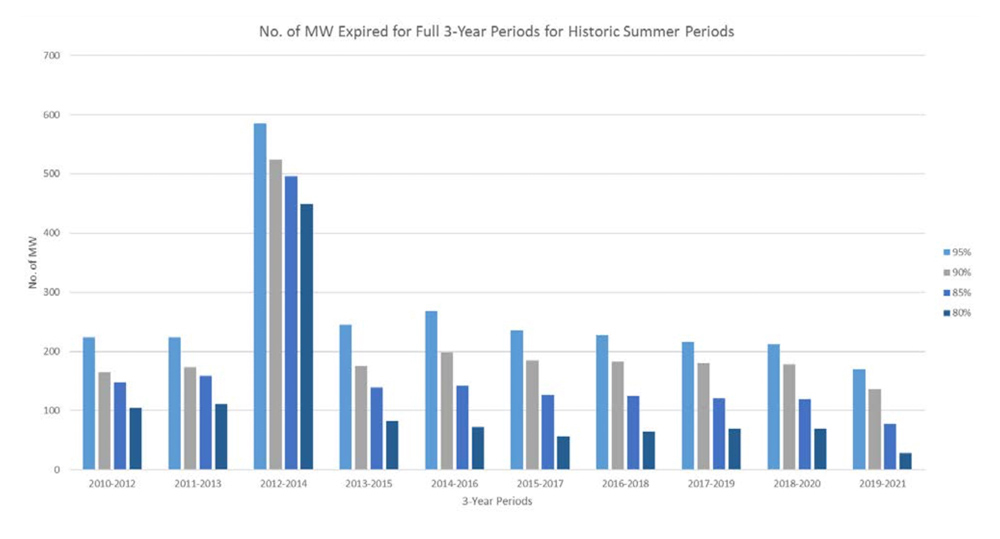
NYISO currently sees value in limiting a portion of a unit’s CRIS where its existing CRIS exceeds its utilization and capability, such as when a facility requests CRIS at its full nameplate but goes in service at a lower megawatt level. The net megawatt output can likely never reach full nameplate, so the facility gets to hold onto more CRIS than it can ever use, absent an uprate or modification, Conway said.

CRIS-MW-Available-(NYISO)-Content.jpg
Number of megawatts available for CRIS expiration | NYISO

Other examples include when a facility downsizes after obtaining its CRIS, or if a facility only uses a percentage of its CRIS over time in the ICAP market.

“If the ratio of the unit’s CRIS and utilization or capability is consistently falling below the specific threshold, a portion of that CRIS could be expired, which would potentially increase deliverability headroom,” Conway said. “For example, if a unit is consistently testing below 90% of its CRIS value, the CRIS could be expired.”

For the ISO proposal, “consistently” means for a consecutive three-year period. For units that are in an ICAP-ineligible forced outage or mothballed, the partial expiration rule would not be applicable, as they are have already began their three-year clock and could return to the system at full capacity.

For the threshold level, NYISO proposes to set it to 90% to remain consistent with trends of historic degradation levels.

If a unit falls at or below the threshold, the unit’s CRIS level would be reset to its maximum test or offer value within the three-year period, plus 5% of the unit’s original CRIS, which gives units flexibility for recoverable losses and maintenance repairs, Conway said.

The proposed changes would be effective on a rolling three-year, moving-forward basis, using the maximum test and/or offer value within that three-year period, and would be applicable to all generators as well as controllable lines.

If stakeholders decide later this year to prioritize this project, it could be a completed market design concept in 2022.

NJ Sees Solar Growth in Reduced Incentives

New Jersey’s Board of Public Utilities (BPU) approved a new solar incentive package Wednesday for net-metered residential, smaller commercial and community solar projects that the agency hopes will double the state’s solar capacity in five years even as it cuts some subsidies for developers.

The program, Successor Solar Incentive Program, set incentives for solar projects between $70 and $100 per MWh, depending on the type of project, with an additional $20/MWh for public projects. The incentive levels for certain non-public projects are slightly below those in an interim incentive program the BPU enacted in May 2020 and are about half the size of those in the Solar Renewable Energy Certificate (SREC) Program that was the foundation of the state’s solar growth for many years before it closed last year.

The package drew the support of the New Jersey Division of Rate Counsel, who has criticized past solar incentive packages for being too generous, and solar developers, who claimed the subsidies in earlier iterations of the package were too small. BPU said the incentive levels struck a balance between supporting the solar industry and providing “significant savings” over the SREC program.

BPU President Joseph L. Fiordaliso said he had no doubt that the state’s solar capacity would continue to grow even with lower incentives than in the past.

“Our solar industry has been immensely successful,” said Fiordaliso, shortly before the five-member board unanimously backed the proposal. “And we expect with this measure today, and the new successor program, that it will continue to be successful.”

Solar developers vigorously pushed back against the reduced incentives in the proposed Successor Solar program after it was released in April, saying they would slow solar development. But Fred DeSanti, executive director of the New Jersey Solar Energy Coalition, said the goal of doubling the state’s capacity is “doable” under the final package. (See: Doubts Dog NJ Solar Proposal.)

“By and large, I think everybody feels that what’s been pushed forward is fair, equitable, and works,” he said.

Protecting Ratepayers

The state is seeking to quadruple solar energy capacity to 17.2 GW by 2035 as part of Gov. Phil Murphy’s goal of 100% clean energy by 2050. Murphy wants the solar sector to generate 32 GW by 2050.

The state currently has 143,555 solar installations with a combined capacity of 3,655 MW, which put the state at seventh in the nation by solar capacity according to a study by the Solar Energy Industries Association (SEIA).

The BPU expects the Solar Successor program to encourage the addition of 3,750 MW of capacity, with the first projects expected to be registered for the program in 30 days. About 60% of the new capacity is expected to be generated with incentives at rates set by the BPU, and the remainder with incentives set by competitive bidding.

Stefanie A. Brand, director of the New Jersey Division of Rate Counsel, said the new rates are “reasonable.” But she expressed concern that the BPU is setting the rates for 60% of the incentives, rather than having them set by competition, and said that could open the door to future increases because of developer lobbying efforts.

Brand also worried about a potential weakening of a state statute that limited the amount the state could spend on solar incentives. The calculation of the spending cap, under the grid-scale solar law signed by Murphy, must now be offset by the BPU’s estimate of the savings reaped through the use of clean energy, as well as an accounting of the health and other benefits from reduced emissions. The BPU approved details of the calculation on Wednesday.

“Normally, competition will protect consumers, or the (spending) cap would protect consumers,” from overspending on incentives, Brand said. “Right now, all we have is the board’s order, which could be changed at any time. So that makes me a little bit nervous.”

Competitive Bidding

The package approved Wednesday did not provide final rules for how the state will handle grid-scale solar projects, which are considered by some developers to be key to the state’s ability to reach its goals. Legislation signed by Murphy on July 2 provided the broad outline of a new incentive program and competitive bidding process for projects of more than 5 MW, and the board on Wednesday approved the hiring of a consultant to design and implement the program. The BPU said it expects the first competitive process to take place in early- to mid-2022. (See: NJ Grid-scale Solar Bill Signed by Murphy.)

The approval of the package concluded a three-year evaluation process that included 10 public hearings, BPU officials said.

Abe Silverman, general counsel for the BPU, explained the agency’s belief that the incentive levels will stimulate growth by noting that 2020 and 2021 “are really shaping up to be record years,” for the solar industry. He said that after “hundreds of hours of modeling, looking at cost data, taking actual cost of these projects over the last decade, looking at them, analyzing, slicing and dicing,” the BPU is “very comfortable” that it has set the incentives at a level to protect taxpayers while stimulating development.

The resulting package includes these incentive levels for each MWh of power generated:

  • Net metered residential: $90
  • Net metered, non-residential on rooftop, carport, canopy and floating solar projects smaller than 1 MW: $100
  • Net metered, non-residential on rooftop, carport, canopy and floating solar projects between 1 MW and 5 MW: $90
  • Ground mount net metered non-residential projects smaller than 1 MW: $85
  • Ground mount net metered non-residential projects smaller between 1 MW and 5 MW: $80
  • Community solar, non-low and moderate-income customers: $70
  • Community solar projects low- and moderate-income customers: $90

The board also voted to end the Transition Incentive Program, which awarded incentives known as Transition Renewable Energy Certificates (TRECs), on Aug. 28. The BPU created the program to replace the SREC program after the state legislature decided it should close when solar installations reached 5.1% of the state’s electricity sales, in part, because the program was seen as unnecessarily expensive.

While the value of a SREC was above $220/MWh, TRECs ranged from $91.20/MWh for net-metered residential projects to $152/MWh for net-metered non-residential rooftop and carport projects.

New Public Solar Market

DeSanti, of the solar coalition, said the development sector softened its opposition to the program after the BPU increased the incentives in certain categories. In particular, the final package provides an incentive of between $110 and $120/MWh for carports, when there was no incentive in the initial proposal, and it increased the incentive by $15/MWh on commercial rooftop projects, he said.

The additional $20/MWh for public projects would create a “new market that will help us a lot,” he added.

Shaun Keegan, CEO of Asbury Park, NJ-based Solar Landscape, singled out the incentive for public projects, saying it was “encouraging.” He also welcomed the increased incentives on community solar projects, especially those for projects aimed at low- and moderate-income households.

“The increased incentives to support community solar adoption by low- and moderate-income households pairs the innovation in the renewable energy sector with New Jersey’s environmental justice goals,” he said.

GOP Presses Glick on Natural Gas, Climate at FERC Oversight Hearing

WASHINGTON — FERC Chair Richard Glick bobbed and weaved his way through a House Energy and Commerce subcommittee hearing Tuesday as Republicans attempted to pin him to positions on natural gas and decried the Biden administration’s climate policies.

Glick and his fellow commissioners also addressed numerous questions on the cybersecurity of the nation’s oil and gas pipelines.

The hearing spanned almost five and a half hours, including a 90-minute recess during floor voting, but only the FERC commissioners, their staff and committee staff attended all of it in the John S. Dingell Room at the Rayburn House Office Building. About 17 Democrats and 14 Republicans made statements and asked questions during the hearing. Many of them sought to win endorsements of legislation they had sponsored or bring attention to issues in their districts. But none of those participating in person — Chair Bobby Rush (D-Ill.) and several representatives joined via video — remained for the entire hearing.

Many of the representatives left the hearing shortly after getting their five-minute spot to question the commissioners. Two — Reps. Greg Pence (R-Ind.) and Marc Veasey (D-Calif.) — arrived just before their time slots and left immediately after. When Rush called a recess for a floor vote after more than three hours of testimony, all the members of the subcommittee had left the meeting room, leaving the FERC commissioners with only staffers.

FERC-Oversight-Hearing-Panel-2021-07-27-(RTO-Insider-LLC)-Alt-FI.jpg
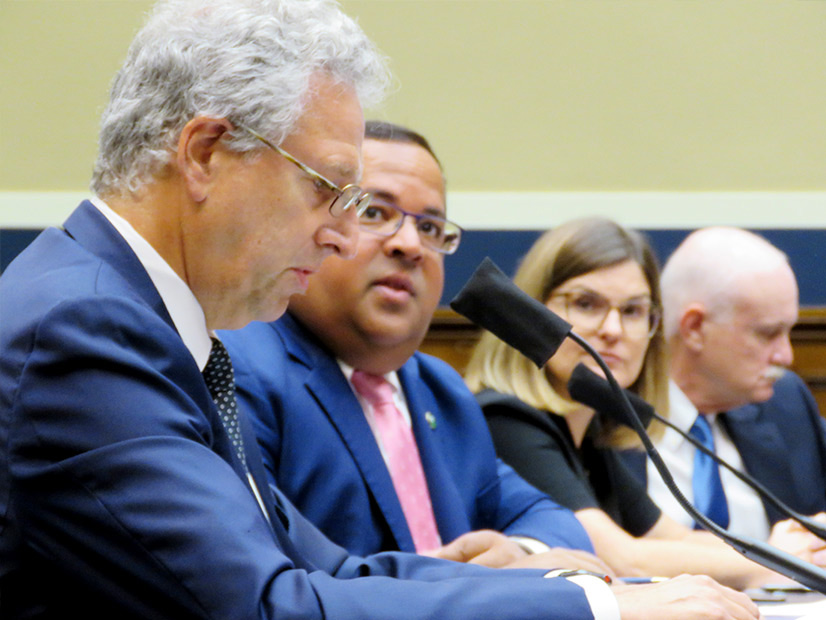
(Left to right) FERC Chairman Richard Glick and Commissioners Neil Chatterjee, Allison Clements and Mark Christie testified at the House Energy and Commerce Subcommittee on Energy’s hearing. Commissioner James Danly participated via video. | © RTO Insider LLC

Preserving the US ‘Standard of Living’

Rep. Cathy McMorris Rodgers (R-Wash.) was among the Republicans who insisted climate change concerns should not impinge on Americans’ lifestyles. The government must “make sure policies work for people: protect our way of life; protect our standard of living. We must make sure that our policies enable, not undermine, access to affordable and reliable energy,” she said. “We all agree in the importance of a clean energy solution, but not as a substitute for the affordable energy that keeps the lights on.”

Rodgers said state renewable energy mandates and “certain existing electric market structures are driving out traditional baseload generation,” resulting in what she called “an electric reliability crisis.”

Rep. Bill Johnson (R-Ohio), who proposed a bill (H.R.1575) that he said would “cut Washington red tape” slowing LNG exports, got into a testy exchange with Glick.

Johnson said the Biden administration was undermining efforts to project American power abroad by “greenlighting” Russia’s Nord Stream 2 gas pipeline while expressing “disdain for America’s domestic pipeline infrastructure and support for [a] radical rush to decarbonization.”

Citing data from the National Energy Technology Laboratory that found U.S. LNG has lower lifecycle emissions than Russian gas, Johnson pressed Glick on whether FERC would include climate considerations in reviewing permits for LNG export terminals.

Glick said court rulings limit FERC to considering only direct emissions, and that downstream impacts are under the jurisdiction of the Department of Energy. “I understand your question, Mr. Johnson; we just don’t have authority to consider that,” Glick said.

“Well sure you do,” Johnson shot back. “You just don’t want to answer.”

Rep. David McKinley (R-W.Va.) challenged Glick over FERC’s March ruling on Berkshire Hathaway Energy’s proposal to replace 87 miles of facilities on its Northern Natural Gas pipeline — the first time the commission assessed the greenhouse gas emissions of a proposed natural gas infrastructure project and its impact on climate change. (See FERC Assesses Climate Impact of Gas Project for 1st Time.)

“What level of CO2 emissions is going to be acceptable?” he asked, accusing Glick of making “very subjective determinations.”

Rep. Nanette Diaz Barragán (D-Calif.) returned to the subject at the end of the hearing, asking Glick “what is the threshold at which a [gas] project’s climate impact is too great to move forward?”

“I can’t tell you at this point what level of emissions is too much,” he said. “It’s not just the emissions level. It’s actually whether you can mitigate those emissions. There’s a whole bunch of other potential adverse impacts — whether it be [threats to] species or wetlands, to air emissions, to a whole bunch of other impacts associated with a pipeline that the commission, when we consider a certificate proposal, try to mitigate.

“We very well could … require the pipeline developer to mitigate their greenhouse gas emissions before we made a final decision on a pipeline. [But] we have to address these issues on a case-by-case basis.”

Several representatives used their time to pitch bills they have sponsored, including Scott Peters (D-Calif.), who touted his bill to give FERC “backstop” transmission siting authority if states refused to act. (See Can New Laws Overcome Tx Permitting Roadblocks?)

Rep. G. K. Butterfield (D-N.C.) wants to amend the Natural Gas Act to give FERC the authority to order refunds when an interstate pipeline is found to be overcharging, as the commission has for addressing overcharges by electric utilities under the Federal Power Act. Glick agreed that not having gas refund authority “inhibits us from being able to fully protect consumers.”

Cybersecurity, Pipelines

Cybersecurity and the ransomware attack on the Colonial Pipeline were raised by several representatives, including Ranking Member Fred Upton (R-Mich.).

“This is a new reality that all of us have to deal with in the energy space,” said Commissioner Neil Chatterjee, who coauthored an article with Glick in 2018 that urged Congress to move responsibility for pipeline security from the Transportation Security Administration to an agency with sufficient resources to address cybersecurity threats.

“If a missile had taken out the Colonial Pipeline, we would very clearly recognize that as an act of terrorism or war and known how to respond accordingly. Our mindsets are not quite there yet for something like a cyberattack taking out critical energy infrastructure,” Chatterjee said. “But the reality is the economic and national security impact is the same as if it was a missile attack. So I think it’s incumbent upon all of us to remain vigilant, identify regulatory gaps and work to stay ahead of this.”

“When you look at what happened on the pipeline, the seriousness of that demands a response much higher than an economic regulator such as FERC” can provide, added Commissioner Mark Christie.

In May, Glick and Commissioner Allison Clements called for “mandatory cybersecurity standards,” like NERC’s Critical Infrastructure Protection (CIP) standards, to cover the nation’s 3 million miles of natural gas, oil and hazardous liquid pipelines.

There is “a mismatch between the mandatory standards that the electric industry follows and the voluntary guidance that the pipeline industry currently follows” under TSA, Glick told the committee Tuesday.

Earlier this month, TSA announced that it would require operators and owners of “critical” pipelines to develop and implement a cybersecurity contingency and recovery plan, including protections against ransomware and other threats. (See TSA Issues New Pipeline Cybersecurity Requirements.) Glick said he had not reviewed the proposal.

Glick said he would like to see additional supply chain protections for entities regulated by NERC.

“As we saw in the SolarWinds example, the supply chain is not safe currently from cybersecurity threats,” he said. “We have a rule that says utilities have to have a plan to address supply chain. I think we need to go forward with that and implement some specific standards.”

Chatterjee said standards are not the only response. He recalled a recent conversation with the CEO of a pipeline company who had been briefed by the Office of the Director of National Intelligence “at a high level that his system was vulnerable, but no one in his company had a high enough security clearance to gain access to the classified briefing to know where to make investments in his system.”

“These kinds of things are easily remediable,” Chatterjee continued. “We need to find ways to [help] the private sector, where these executives now find themselves on the front lines of 21st century warfare. I don’t think that’s a hyperbolic statement; that’s the reality of protecting critical infrastructure today, and we need to work together.”

Different Role

Asked during a break in the hearing for his reaction to his first oversight hearing as chairman, Glick — who like Chatterjee served as a Senate staffer before joining the commission — joked, “It’s a lot easier sitting back behind the members [as staff] than being in front of them.”

California GHGs Decline 1.7% in 2019

Increased use of renewable diesel and greater availability of hydropower helped California cut its greenhouse gas emissions by 1.7% in 2019, according to a new report from the California Air Resources Board (CARB).

The 2019 decrease, which is a reduction of 7 million metric tons of CO2 equivalent, came after statewide GHG emissions essentially stayed flat in 2018, increasing by less than 1%.

California’s GHG emissions were 418.2 million metric tons of CO2 equivalent in 2019, 425.3 MMT in 2018, and 424.5 MMT in 2017. Statewide GHG emissions peaked in 2004 at around 490 MMT.

On a per capita basis, the state’s GHG emissions have dropped from a peak of 14.0 metric tons per person in 2001 to 10.5 metric tons per person in 2019, a 25% decrease. And as California’s gross domestic product grew by 63% from 2000 to 2019, the carbon intensity of California’s economy decreased by 45%, according to CARB.

The 2019 figures were released Wednesday in the latest edition of CARB’s annual greenhouse gas inventory.

GHG Reduction Targets

Under Assembly Bill 32, the California Global Warming Solutions Act of 2006, the state must reduce its GHG emissions to 1990 levels by 2020. The state reached that goal four years early, in 2016.

California’s Senate Bill 32 of 2016 set an even more ambitious target: reducing statewide GHG emissions to 40% below 1990 levels by 2030.

CARB Chairwoman Liane Randolph called the latest GHG inventory good news but noted that much larger GHG reductions will be needed to meet the 2030 goal.

“We are now once again witnessing massive wildfires and recurring heat waves while large parts of our state are suffering from extreme drought,” Randolph said in a news release. “This is a clear call to redouble our efforts.”

Analysis by Sector

CARB’s GHG inventory analyzes emissions by sector, including transportation, electric power, industrial, commercial and residential, and agriculture.

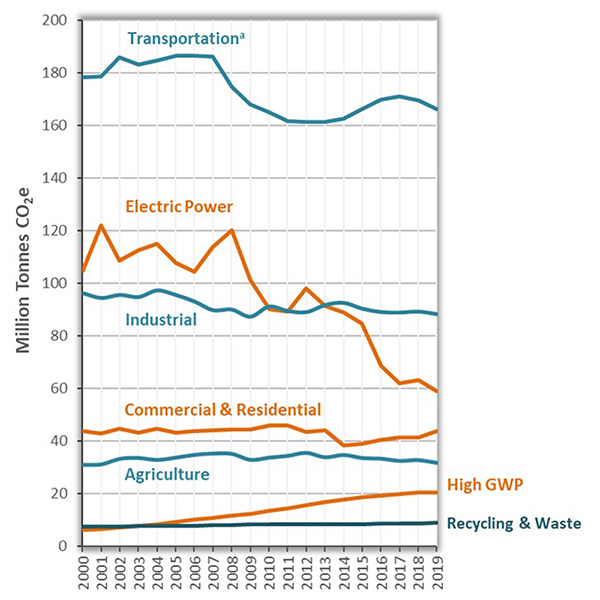
GHG emissions from the transportation sector, which accounts for 40% of the state’s inventory, fell in 2018 and in 2019. CARB said the 2019 reduction was due, in part, to a 61% increase in the use of renewable diesel fuel under the low-carbon fuel standard.

Trends-in-CA-GHG-Emissions-(CARB)-FI.jpg
Trends in California GHG Emissions | CARB

In the electric power sector, which accounts for 14% of the state’s GHG inventory, emissions have been falling since 2012, except for an uptick in 2018.

In 2019, California’s electric power emissions decreased by almost 7%, as 48% of total electricity generation came from solar, wind, hydropower and nuclear power, CARB said. The trend was boosted by a 46% increased availability of in-state hydropower in 2019.

Alex Jackson, a Sacramento-based senior attorney with the Natural Resources Defense Council, said CARB’s greenhouse gas inventory represents “impressive progress.” Still, he said, the state needs to redouble its efforts to reach its 2030 goal.

“I hope this is a call to arms,” Jackson said.

Jackson said the reductions in GHG emissions from transportation, which had long been a “stubborn sector,” were encouraging. The increasing adoption of electric vehicles should help continue that trend, he said.

But other sectors need more work, he said. For example, statewide emissions from the commercial and residential sector have been increasing, as have been emissions of high global warming potential gases, such as refrigerants.

“It is overall a mixed bag,” he said.

Emissions Counted Separately

CARB’s greenhouse gas inventory includes emissions from fossil fuel combustion, chemical reactions in industrial processes, use of GHG-containing consumer products and agricultural and waste sector operations.

CARB said it maintains a separate inventory for the exchange of ecosystem carbon between the atmosphere and plants and soils, including wildfire emissions.

The latest GHG inventory tracks the emissions of seven greenhouse gases covered by AB32: carbon dioxide, methane, nitrous oxide, hydrofluorocarbons, perfluorocarbons, sulfur hexafluoride and nitrogen trifluoride.

Other climate pollutants, including black carbon and sulfuryl fluoride, are monitored separately, CARB said in its report.

CARB said several programs that helped the state reach its 2020 GHG reduction target are increasing in stringency. Those include the renewables portfolio standard, the low-carbon fuel standard and the cap-and-trade regulation.

Other programs will reduce GHG emissions further, CARB said. These include rules to cut emissions from climate super pollutants such as hydrofluorocarbon refrigerants.

PJM Stakeholders Blast TOs’ Petition to Rate-base Network Upgrades

PJM stakeholders urged FERC on Wednesday to reject a proposal that would allow transmission owners to fund network upgrades and add them to their rate bases.

Environmental groups, state regulators, generators, industrial customers and the RTO’s Independent Market Monitor all filed comments opposing the proposal (ER21-2282). WIRES and the Edison Electric Institute, two groups whose members include the PJM TOs, were the only ones filing comments in support.

In their June 30 proposal, the TOs’ contended their ability to raise capital is being threatened because they are being forced to absorb the risks of the increasing transmission needed to support new renewable generation without earning any return on the assets.

Under PJM’s “participant funding” model, generators provide the capital for network upgrades, and the additional infrastructure is added to rate bases at zero cost, allowing TOs to recover only their operations and maintenance expenses from network transmission customers.

When FERC approved the funding model in 2004, the TOs said, PJM’s Regional Transmission Expansion Plan (RTEP) envisioned the addition of 10,700 MW of new generation and the RTO was processing only 55 interconnection requests. As of October 2020, PJM’s interconnection queue listed about 1,600 requests totaling 147,000 MW in new generation. (Only 23% of projects and 15% of requested capacity megawatts in the queue are ultimately developed and interconnected, according to PJM’s 2020 RTEP report.)

“When the commission approved the existing funding model in PJM, the impact on the PJM transmission owners from the failure of that model to provide a return or profit on network upgrades was minimal due to the limited number of network upgrades on the transmission system and generation interconnection requests in the PJM interconnection queue at the time,” the TOs said. “As the number of network upgrades has grown, the corresponding risk of owning and operating those facilities has also increased. The anticipated increase in network upgrades over the next several years makes the continuation of the existing funding model unsustainable.”

The filing included an affidavit in which David Weaver, vice president of transmission strategy at Exelon (NASDAQ:EXC), cataloged the risks he said TOs face from the expanded grid: litigation and regulatory penalties resulting from transformer fires and accidents; NERC compliance risks; environmental risks from the discharge of contaminants; damage to transmission lines from severe weather; and liability over outage coordination.

To address the issue, the TOs proposed giving themselves the option to provide the initial funding for upgrades and the ability to earn a return on the facilities. They said the proposal was modeled on one FERC approved in MISO last year following the D.C. Circuit Court of Appeals’ 2018 Ameren ruling, in which the court said the commission failed to consider complaints from TOs who claimed RTO policy forced them to accept “risk-bearing additions to their network with zero return” and essentially act as “nonprofit managers” of network “appendages.” (See MISO Gauging Aftershocks of TO Self-fund Order.)

‘Convoluted Procedure’

In filings Wednesday, opponents of the proposal questioned the TOs’ claimed risks and contended there is no evidence that they are having trouble attracting capital. They also said it would raise generators’ interconnection costs and allow vertically integrated utilities to favor their own generation affiliates.

Because PJM did not join the TOs’ June 30 filing, Invenergy said they must prove their proposal is “consistent with or superior to” the commission’s reimbursement policy.

FERC Order 2003 required interconnection customers to initially fund network upgrades, with the TOs reimbursing the costs and adding the infrastructure to its rate base after generation projects achieve commercial operation. But PJM and its TOs won FERC approval for an alternative model in which interconnection customers receive tradable transmission rights instead of reimbursement.

“Instead of reverting to the commission’s existing Order No. 2003 reimbursement policy, which would address these concerns and permit the PJM TOs to earn a reasonable return on network upgrades, they propose something entirely different: a convoluted procedure that will burden customers with additional costs, create opportunities for undue discrimination and for which the PJM TOs attempt to provide the thinnest of evidentiary support,” Invenergy said.

“The filing elides the fundamental truth that PJM, with the unanimous support of the PJM TOs, voluntarily sought the variation and impact that is the subject of the filing,” said the American Clean Power Association, Advanced Energy Economy, Natural Resources Defense Council, the Sustainable FERC Project and the Sierra Club, filing as “joint protesters.”

‘Risks’ Questioned

“The PJM TOs describe a number of risks that businesses in the utility space face, but like the New York transmission owners who earlier this year sought a similar additional profit opportunity, they present no evidence that they are the least unable to attract capital or that the current network upgrade funding rules have any material impact on their ability to do so,” Invenergy said. “Indeed, given that most network upgrades are improvements to the existing system (e.g., to replace old equipment with new equipment), these improvements most likely reduce the risks inherent in owning and operating a transmission system.”

The Organization of PJM States Inc. (OPSI) said the TOs offered only anecdotes in support of their claims of increased risk “but do not attempt to quantify these risks in any way. For example, the TOs entitle one type of risk ‘Operational and Safety Risks’ and provide an affidavit that describes those risks as ‘the inherent safety hazards involved in both the installation and day-to-day operations of high-voltage transmission equipment.’ If there is one type of risk the TOs should be able to quantify, it is this type. … The Weaver affidavit spends over 1,200 words describing this type of risk, yet at no time sets forth even an approximate cost of this type of risk for an average network upgrade.

“Many of the risks complained of by the TOs could potentially — but not certainly — result in increased expenses for a TO. In the event of increased expenses, and so long as the expenses are the type meriting commission approval for ratemaking, the TO will pass its increased expenses onto transmission ratepayers through its transmission tariff,” OPSI added.

“PJM TOs’ argument that they are unable to attract capital under the existing funding approach is undercut by the many indicators of financial wellbeing … including attracting billions of dollars in capital in recent years, receiving authorization from the commission to issue over $19.9 billion of new securities and maintaining strong credit ratings,” the joint protesters said. “That risk is not reflected in PJM TOs’ [Securities and Exchange Commission] filings, and many of the TOs cited investments associated with attaining these clean energy targets as revenue opportunities. This marked inconsistency may explain why complainants offer no evidence that rating agencies have downgraded ratings (or might downgrade them in the future) because of an increase of generation in the queue that would result in increased amounts of network upgrades.”

The PJM Industrial Customer Coalition (ICC) said the commission should hold an evidentiary hearing to determine the extent of the risks faced by TOs under the current rules.

‘Explicit Attempt to Eliminate Competition’

OPSI also called the proposal “anticompetitive and discriminatory.”

“Because generation-owning TOs will be able to unilaterally increase the interconnection cost of a competitor’s generation, benefiting the TO’s own or affiliate generation, the proposal provides an economic incentive for discrimination,” OPSI said. “Even if the proposal did not allow the TOs to pick and choose who faces increased costs, adding additional costs for new-entry generation to interconnect still puts that new generation at a competitive disadvantage to incumbent generation; of course, TO-affiliated generation is incumbent generation.”

PJM’s Monitor said the TOs’ proposal should be rejected because they are not authorized to propose changes to the RTO’s market design. “The rules that TOs propose to change were filed by PJM pursuant to its exclusive authority under Section 205 [of the Federal Power Act], and they remain subject to such authority,” it said.

The Monitor said “the proposed changes are an explicit attempt to eliminate competition” by increasing the cost to interconnect new generation. “Rather than eliminating competition to fund interconnections, the rules should extend competition to the financing of all transmission projects, including reliability projects in the RTEP.”

For its part, PJM agreed that the proposal “raises the potential for undue discrimination.” It said the TOs’ pledge to include notices of their decisions to elect to fund a network upgrade in the interconnection customer’s facilities study report was an insufficient protection.

Instead, PJM said TOs should be required to list the criteria they will apply in determining whether or not to fund upgrades. “Posting criteria may assist an interconnection customer in understanding which network upgrades a transmission owner may elect to fund at a time when the customer is making its initial siting choices,” PJM said. “The commission should seek additional clarity with respect to any circumstances under which the transmission owners would elect or decline to fund network upgrades before accepting the proposal.”

Increased Costs

Invenergy said its experience in MISO shows that “the capital cost typically charged when initial funding is elected can be higher than the cost of capital that is available to the interconnection customer. And this does not even account for the incentive PJM TOs will have in studying future requests to exaggerate the network upgrades required for an interconnection and the costs of those upgrades in order to maximize rate base.”

It also said the proposal would raise generators’ costs because it would require them to pay for TOs’ income taxes and provide a letter of credit as financial security for as long as 20 years. “Under the current participant funding model, security is posted only prior to the completion of the upgrades and is reduced dollar for dollar as the customer pays for the upgrades.”

In addition it could deny interconnection customers capacity interconnection rights and incremental auction revenue rights created by the upgrades, Invenergy said.

PJM acknowledged that TO funding of network upgrades could benefit an interconnection customer if its cost of capital is less than the customer’s. “However, any advantages associated with the lower cost of capital may be lost if the interconnection customer is required to maintain a letter of credit for the full cost of the project post construction,” PJM said. Requiring 20 years of financial security “may adversely impact the continued development of the competitive market in the PJM region.”

Cost Shifting

Several commenters raised concerns that the plan would result in cost shifts.

“The PJM TOs  provide no good reason why, given the commission’s general finding that network upgrades benefit all grid users, any return on those facilities must be borne solely by the interconnection customer,” Invenergy said.

OPSI said it would shift the risk of default from individual generators to transmission customers. “Having no incentive to ensure receipt of effective security when issuing loans for building network upgrades, TOs will be more susceptible to accepting ineffective forms of security, thus unjustly increasing the general ratepayers’ exposure to charges for unrecovered portions of loans in default,” it said.

The ICC also said FERC should ensure that any changes do not increase costs for transmission customers. “The commission must remain steadfast to ensure that other transmission customers do not subsidize service to interconnection customers,” it said.

PJM said the proposal would impose costs on its members by making the RTO responsible for administering the pro forma network upgrade funding agreement, billing and collecting payments, and holding the security required.

The Long Island Power Authority and Neptune Regional Transmission System filed joint comments seeking assurances that interconnection customers will remain solely responsible for the capital costs of network upgrades and that those  costs will not be incorporated into transmission rates for PJM network integration transmission service or firm point-to-point transmission service to the border of PJM.

Ameren Order

Opponents also contended the TOs offered a misleading interpretation of the Ameren order, saying that although the court vacated the commission’s orders, it did not reach the merits of the MISO TOs’ arguments.

“The commission did not reverse its prior determination that the MISO initial funding option is impermissible, nor did it find that the MISO funding option is just and reasonable or that the flaws previously identified with were incorrect,” Invenergy said. “The commission simply abandoned any effort to develop a record under FPA Section 206 to support a determination one way or the other.”

“In fact, the court was explicitly permitting the commission to conclude what the TOs now say the commission cannot conclude, so long as the commission justifies its reasoning,” OPSI said.

Other Protests

Shell Energy North America (NYSE:RDS.A) said the proposal “raises significant issues with respect to the integration of new resources, including offshore wind projects.” The company said it should be set for hearing, “subject to the outcome of settlement procedures, which include technical conferences” and subject to the Advance Notice of Proposed Rulemaking that FERC issued on July 15 (RM21-17). (See FERC Goes Back to the Drawing Board on Tx Planning, Cost Allocation.)

Consumer advocates for D.C., Maryland, Delaware and Illinois said the TOs’ proposal, “submitted without the consent of any other PJM Member, would raise costs and risks for consumers, undermines competition, could negatively impact the development of certain generation resources, and is contrary to the ongoing efforts by FERC and PJM to craft more robust interconnection and cost allocation policies. While the [joint consumer advocates] do not dispute that additional  interconnection and cost allocation reforms may be needed to better promote competition and to protect both ratepayers and transmission utilities from the impacts of interconnecting additional generators on PJM’s system, the Transmission Owners’ request is premature and unsupported [and] provides no analysis of its impacts on costs, competition, or other consumer interests.”

Others filing comments opposing the proposal included solar developer Savion, the Solar Energy Industries Association, J-POWER USA and Public Citizen.

Defending the TOs

WIRES defended the proposal, saying it “aligns with the Biden administration’s climate change goals.”

“The PJM transmission owners are poised to play a pivotal role in the prompt and reliable interconnection of network resources in order to make the necessary accommodations to support this exciting clean energy transition,” WIRES continued. “While these efforts will be made, they cannot continue to be made on a nonprofit basis or achieved if significant enterprise risks are left uncompensated.”

“As increasing amounts of generator-funded assets are turned over to be owned, operated and maintained by the PJM TOs, larger amounts of the TOs’ business would operate as a ‘nonprofit,’” EEI said.


NYISO Management Committee Briefs: July 28, 2021

Likely Sept. Return to Meeting in Person

NYISO hopes to return to holding in-person stakeholder meetings starting September 20, two weeks after staff is scheduled to return to work at the ISO building, CEO Rich Dewey told the Management Committee on Wednesday.

“I will offer the caveat that at least in some parts of the country, though not yet in the Capital District or New York generally, this new Delta variant is causing a significant rise in infections that has caught our attention,” Dewey said. 

The ISO monitors the national situation daily and “will push that date back” if necessary for the health and safety of employees and market participants, he said. 

“We’re not at that juncture yet, but we’re going to keep our eyes on that and will give people plenty of notice if we decide to change those dates,” Dewey said.

In a survey of market participants the ISO conducted about the return to in-person meetings, respondents were evenly split between those who want to restart in-person meetings immediately and more cautious respondents who would like to wait longer. Market participants will continue to have the option to join the meetings remotely in either case, he said.  

In addition, because the conference center is set up with desks abutting each other, the ISO will require all participants to prove vaccination against COVID-19 in order to attend meetings in person.

Cost of Service Study

The NYISO Management Committee on Wednesday voted against (70.15%) conducting a new cost-of-service study in 2021/22 to evaluate the Rate Schedule 1 allocation between withdrawals and injections.

The ISO wanted to consider the RS1 impact of the most significant market design changes to be implemented since 2005, all concerned with integrating and optimizing renewable resources such as hybrid resources, co-located energy storage and large-scale solar, said Chris Russell, manager of customer settlement.

“Conducting a new cost-of-service study in 2021-2022 would help provide rate certainty for new entrants, as well as a more solid basis for NYISO cost recovery and budget planning,” Russell said.

Stakeholders resisted the idea, partly because they felt the resource mix is in such flux now that a study on the current RS1 allocation of 72% withdrawals and 28% injections would soon be out of date.

The most recent RS1 study done in 2010/11 was scheduled to be effective for a minimum of five years, through December 2016. Because the MC voted to decline conducting a study in 2016/17, a study would go forward in succeeding years unless the committee takes a required vote in the third quarter of each year to decline conducting such a study. The MC has voted against conducting a study every year since 2017.

Robert’s Rules of Order discourage the making of negative motions, thus stakeholders know this issue as the annual “yes means no” motion.

Metering Updates for Demand Side Resources

Con-Ed-Smart-Meter-(Con-Edison)-Content.jpg
Con Ed Smart Meter | Con Edison

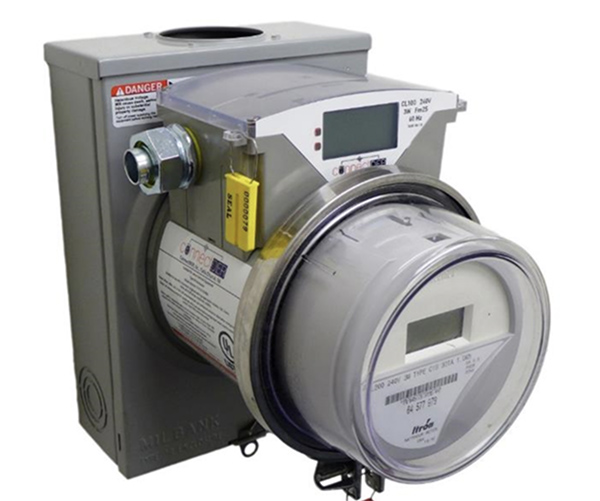
The MC also unanimously approved a tariff update to allow municipal electric utilities to provide metering and/or meter data services for demand side resources, and recommended that the NYISO Board of Directors authorize ISO staff to file such revisions with FERC under Section 205 of the Federal Power Act.

The update will be consistent with the ISO’s historical practices and in the future will also apply to distributed energy resources, said Alexis Hormovitis, distributed resources operations analyst.

NYISO has historically accepted demand-side resource meter data from transmission owners and meter data service providers, including municipal electric utilities.

In 2019, the ISO submitted the DER participation model tariff revisions to FERC, which modified the types of entities eligible to provide metering and meter data services.

NYISO said the revisions will close an unintended gap in its tariff and that it will continue to accept demand-side resource meter data from municipal electric utilities.

MISO Dusts off MVP Cost Allocation for Long-range Tx Plan

MISO said it will likely draw on a decade-old cost allocation method for its long-range transmission plan — at least in the Midwest.

The grid operator proposed using the cost allocation of 2011’s Multi-Value Projects (MVPs), with some departures, during a stakeholder cost allocation teleconference Wednesday.

The costs of MVPs were recovered through a 100% uniform, “postage stamp” rate from load. While the method would apply to long-range projects in MISO Midwest, the grid operator is holding off on proposing a method for projects in MISO South.

“Once we took a step back, we saw a lot of parallels with the Multi-Value Project type,” MISO planner Jeremiah Doner told stakeholders.

Doner said the method’s emphasis on congestion relief, reliability, energy policy goals and economics fits well with the aims of the current long-range plan, even 10 years later.

“We also heard that we should try to leverage what’s already in our tariff. This [allocation] has gone through a lengthy stakeholder process and FERC approval. So instead of coming up with a completely new project type, let’s look at the Multi-Value Project and see what needs to be changed,” he said.

The RTO intends to maintain the MVPs’ 100-kV minimum voltage threshold and $20 million cost minimum. To qualify for recovery, the grid operator proposed that long-range transmission projects meet the MVP criteria of supporting state or federal energy policies; addressing NERC issues and showing reliability benefits across multiple zones; and demonstrating multiple types of economic value across multiple pricing zones with at least an overall 1:1 benefit-to-cost ratio over the first 20 years of service.

Reviving the MVP methodology also means MISO might consider evaluating projects in groupings, though it’s not certain yet that it will advance portfolios of projects for approval in annual transmission cycles. The RTO has yet to announce any specific projects under the long-range transmission plan.

The postage stamp rate will likely be calculated based on local balancing authorities’ monthly net actual energy withdrawals and follow a 40-year depreciation schedule with operations and maintenance costs thereafter for projects.

Doner said MISO would not enact a systemwide postage stamp rate and instead opt for a subregional rate. “We would define MISO as the MISO Midwest and MISO South subregions” for the purposes of allocation.

The Environmental Groups sector and some MISO transmission owners last month advocated for a subregional postage stamp methodology. (See MISO Members Revive Debate over ‘Postage Stamp’ Cost Allocation.)

Different Treatment for MISO South

Exactly how South transmission projects would be allocated on a subregional basis remains up in the air.

“At this point in time, we’re not ready to make a recommendation on how to allocate costs in the South,” Doner said.

MISO South regulators in July voiced opposition to long-term planning. (See South Regulators Lambast MISO Long-term Tx Planning.) The grid operator is hoping for majority support among its states’ regulatory bodies on its long-range plan.

Stakeholders registered concern that MISO South might get special treatment through a different cost allocation method. Some pointed out that a few areas in MISO Midwest have limited transfer capability, similar to the Midwest-South subregional constraint, but will nevertheless share in a Midwest postage stamp rate.

“If MISO South comes up with a different cost allocation scheme … then are we basically suggesting that customers’ in the Midwest … benefits are going to be viewed differently? Can you help me understand how that would pass the fairness test, the equity test?” energy consultant Kavita Maini asked.

Maini said the fairness question will be particularly important for members who own facilities in both regions.

Doner said the question was fair, and the RTO would have more information when it proposes a specific cost allocation for MISO South.

“To the extent that the cost allocation differs, the rationale for that is going to be important,” he said.

Clean Grid Alliance’s Natalie McIntire said she was troubled that MISO has not yet proposed an allocation method for the South.

North Dakota Public Service Commissioner Julie Fedorchak urged MISO to build stronger business cases and show more proof of heightened reliability to sell the dramatic transmission expansion. “I need more than this to sign my ratepayers on to 40 years of costs,” she said.

Fedorchak said there needs to be clarification on what qualifies as a long-term transmission project, otherwise “anything could be labeled a long-range project” and cost-shared regionally.

Doner said MISO will build business cases as projects emerge, including demonstrating future NERC violations without them. MISO has already said that voltage and thermal issue will proliferate in the Midwest footprint without major transmission construction. (See MISO Analyses Show Reliability Woes Without Transmission Builds.)

The Union of Concern Scientists’ Sam Gomberg said that while he understands the concerns around protecting consumers from wasteful spending, he said he’s confident that MISO would present clear business cases as staff begin to analyze specific transmission solutions.

“Our world is changing so fast that we can’t wait on a perfect process. If we wait — I don’t want to say we will be left in the dark, because that would be too literal — but we’ll be behind the eight-ball,” Sustainable FERC Project attorney Lauren Azar said. She said if members wait any longer, there will be a scramble to build infrastructure.

Azar urged stakeholders to look no further than the 2011 MVP portfolio, whose benefits increased over time and even stabilized the grid as February’s winter storm lashed the footprint.

“They brought benefits that were never considered in the benefit analysis or the triennial reviews,” she said.

WPPI Energy’s Steve Leovy said that while he agrees with broad cost sharing, he hoped to see an allocation plan where MISO assigns a portion of costs to interconnecting generators.

“It’s imperative that generations see the cost impacts of their siting decisions,” Leovy said. “This is a big undertaking. We shouldn’t really on existing mechanisms to allocate costs.”

WEC Energy Group’s Chris Plante also asked that MISO modify the MVP methodology to include elements of its shared network upgrades so that generators share cost burdens.

“The long-range transmission plan is not an interconnection study. It’s a broad, regional system needs study,” McIntire countered.

Azar said the long-range plan contemplates the “total transformation” of the industry over the next two decades, including retirements, electrification and utility goals.

“Just placing this on the back of the generators is not the thing to do,” Azar argued.