Collaboration, Cultural Shift Key to Utility Transformation

Decarbonizing the U.S. transmission grid will also mean expanding it and overcoming communities’ aesthetic objections to siting large projects with towers and wires that run across their regions, said Debra Smith, general manager and CEO of Seattle City Light.

“We could cram it down people’s throats, and it may come to that at the end of the day,” Smith said during the opening session at the Smart Electric Power Alliance’s virtual Grid Evolution Summit on Monday. “But I honestly believe there’s an educational component; people need to understand … why, what’s best for me, I may need to let that go.”

Collaboration will be critical, Smith said, “because if I truly care, if I want to 1) make sure that me, my neighbors, my friends and the people around me have adequate resources; and 2) if I believe that climate change is real and that the solution is to integrate more renewables, then perhaps, just perhaps, I am able to let go of my own concerns about the aesthetics.”

Smith and Ralph Cavanagh, co-director of energy at the Natural Resources Defense Council, were speaking with SEPA President and CEO Julia Hamm about the cultural shift going on at utilities across the country as an increasing number are making commitments to decarbonize their generation mix in the coming decades. SEPA earlier this year released its Utility Transformation Profile report, tracking the changes being made at 135 utilities across the country, and Seattle City Light was one of 10 utilities the report identifies as industry leaders.
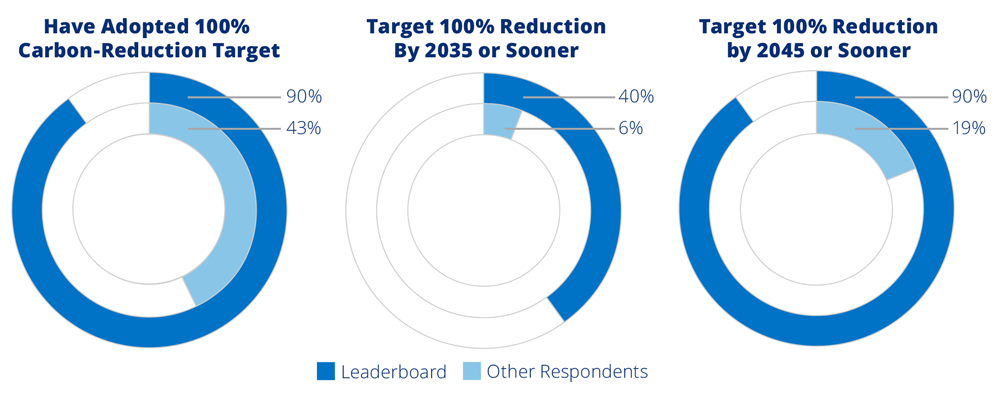
Clean-energy-targets-(SEPA)-Content.jpg
Industry leaders are setting aggressive clean energy targets. | SEPA

A key finding of the report is that utilities with strong carbon reduction commitments are also the ones making the most progress on clean energy and decarbonization. For example, 67% of the survey respondents with 100% targets are providing 30% or more clean energy in the power they supply to their retail customers, while 57% of those without strong commitments are providing 30% or less.

At the same time, Cavanagh said, U.S. utilities deserve credit for “continual environmental improvement” from 2007 to 2019. The electric power industry as a whole cut its carbon emissions 30% during that time, he said. “But even more significant reductions are in the toxic pollutants in nitrogen and sulfur. Nitrogen oxides [were] down more than 70%; sulfur dioxide, down almost 90%.”

He also stressed the role of energy efficiency, noting that the U.S. economy expanded 22% between 2007 and 2019, but energy consumption only increased 1%.

Both Cavanagh and Smith said that the approach going forward should be a mix of distributed energy resources and large, well integrated regional grids. Calling out a recent article in The New York Times titled “More Power Lines or Rooftop Solar Panels,” Cavanagh said, “I utterly reject that” premise.

“What I see across the West, across the nation, now are effective efforts … by mobilizing the distributed resources; by finding ways to integrate them more effectively, but also to support the enhanced integration of big regional grids.”

Smith agreed, “The Times missed it. …

“The new movement towards distributed energy resources — whether it’s energy efficiency [or] load-shedding technologies that are just emerging — they create the dispatchability that allows us to continue to invest in renewable resources,” she said.

Investing in the Future

Seattle City Light is one of five municipal utilities that made SEPA’s 2021 Utility Transformation Leaderboard. The others were Austin Energy, Holyoke Gas & Electric Department, the Los Angeles Department of Water and Power and Sacramento Municipal Utility District.

As municipals, these utilities are less regulated, and more open to experimentation, than investor-owned utilities, and they all generally serve a more progressive customer base.

Under a city mandate, Seattle City Light is committed to providing 100% clean energy by 2045, according to Smith. About 80% of its power already comes from hydro, but it has also expanded its access to a mix of clean energy resources by joining CAISO’s Energy Imbalance Market. It continues to add solar and wind to meet the needs of big customers, like Google and Amazon, which have set their own carbon-reduction goals.

“They’re really players in the additivity world,” Smith said, meaning the companies want to back projects that add new clean power to the grid. “So, we are just coming out with what we call ‘Renewable-Plus,’ which will be a program that is available to our largest customers who want to contribute in that way. We will go out and purchase or invest in new renewable resources on their behalf, with their commitment, so our bread-and-butter customers won’t share the risk.”

Seattle City Light also has a very tech-savvy customer base that wants to participate in energy efficiency and demand flexibility programs, Smith said. “We’re looking at microgrids; we’re looking at how do we use battery storage,” as well as the possibility of vehicle-to-grid, she said.

Smith sees electrification as “a primary focus for solving our climate problems.” But it’s also “a hard challenge culturally” for utilities, she said. “The cultural changes are huge because you’ve got one foot in the process and then you have a foot looking to the future. What we talk about at City Light a lot is that electrification and that cultural shift [are] the way we invest in the future.”

Cavanagh sees electrification as “very much part of the core utility mission going forward. You’re not fighting against your fundamental business model.”

But, he said, one part of the transformation that still needs attention is “the tradition of thinking of the electric industry, in some respects, as a commodity business, whose financial interests lay in maximizing sales of kilowatt hours.”

Breaking the links between utilities’ financial health and sales is still incomplete across the country, he said, and those changes are needed to ensure the transition stays focused on efficiency.

“There’s going to be electrification; there are going to be increased applications of electricity,” Cavanagh said. “We don’t want utilities simply grabbing for the solutions that maximize kilowatt-hour sales in the short term, because that will undercut energy efficiency progress in the long term.”

California Needs New Transmission for 100% Clean Energy

The West needs new transmission in the near term and more in the long term for California to meets its goals of providing retail customers with 100% clean energy by 2045 under the requirements of Senate Bill 100, presenters said in a day-long workshop Thursday.

The session was the second SB 100 workshop held jointly this year by CAISO, the California Public Utilities Commission (CPUC) and the California Energy Commission (CEC), which have planning, procurement and operational responsibilities for the state’s power grid.

The first workshop in June focused on the unprecedented buildout of generation resources necessary to meet SB 100 mandates. (See Calif. Needs Tx and Gas to Decarbonize, Advocates Say and Calif. Must Triple Capacity to Reach 100% Clean Energy.)

The transmission required to carry so much new capacity occupied Thursday’s workshop.

CPUC Senior Analyst Karolina Maslanka said that the CPUC’s current integrated resource plan includes 1,000 MW of out-of-state resources from New Mexico, Wyoming and Idaho requiring transmission upgrades.

“Connecting these resources would require transmission expansion to bring the power to the CAISO system border,” Maslanka said. “I highlight this because, as we plan for the SB 100 goal, it’s important not only to think about what upgrades may be necessary within the CAISO system but also what transmission expansions may need to take place to bring generation from other states to the CAISO load.”

CAISO is studying the CPUC IRP in its 2021/22 transmission planning process (TPP), with a draft expected in November.

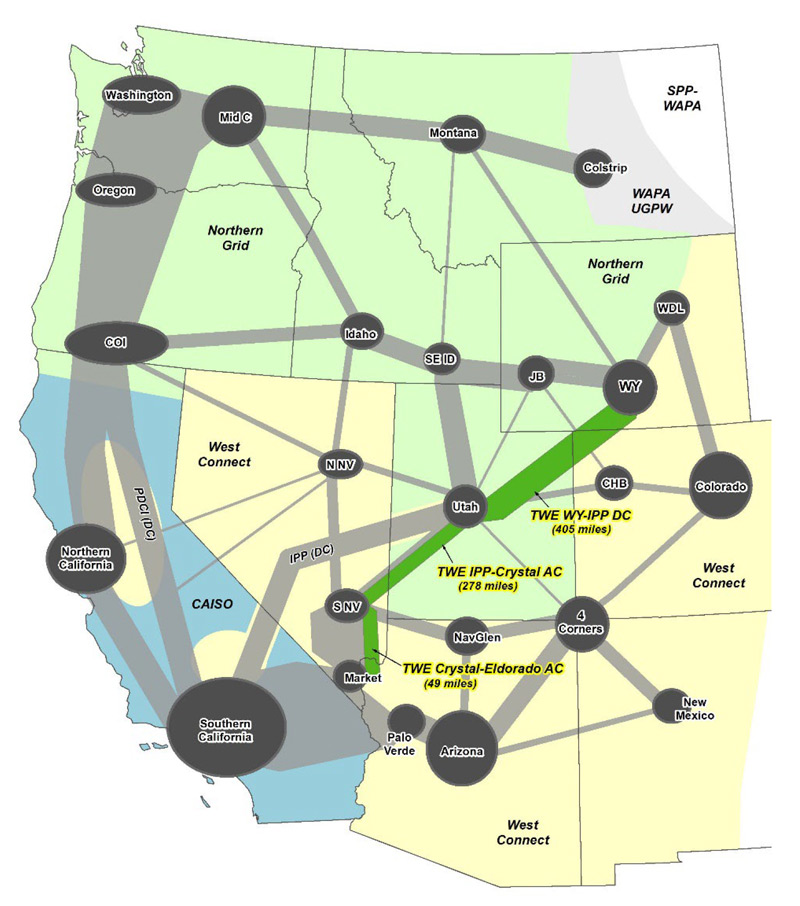
Calif-Transmission-flows-map-(TransWest-Express)-Content.jpg
Transmission flows to California with planned TransWest Express lines, in green, bringing wind power from Wyoming. | TransWest Express

In the last few years, the state seemed to have “sufficient headroom on the transmission system” to accommodate an influx of new resources,” Maslanka said. “But we are we are beginning to see a shift from an era of available transmission headroom to one where transmission development will be necessary to accommodate the large amount of resources expected to come online in the next 10 years.”

CAISO opened a 20-year TPP in May to look more broadly at the clean energy transition. The long-term TPP runs in parallel with CAISO’s traditional 10-year planning cycle and coordinates with its 2021/22 plan, said Jeff Billinton, the ISO’s director of transmission infrastructure planning. (See CAISO Launches 20-year Transmission Planning Process.)

Billinton said in May that the CPUC’s IRP portfolio envisions importing 3,000 MW of wind from Wyoming and New Mexico, potentially requiring both in-state and out-of-state transmission upgrades.

On Thursday, he touched on potential in-state needs, such as lines to carry offshore wind to major urban areas and out-of-state transmission projects to serve CAISO load.

In the long- and short-term planning process, “we’re welcoming and wanting to encourage and incorporate stakeholder input and consultation,” he said.

Tx in the Works

Transmission developers pitched their projects at Thursday’s workshop. Some of the projects are still in early planning; others are close to construction. They included:

      • The Pacific Transmission Expansion Project, an underwater line to carry renewable power from the Central California coast directly to the Los Angeles Basin, bypassing congestion.
      • TransWest Express, a transmission project intended to carry large amounts of wind power from Wyoming to California that is “nearly shovel ready,” said David Smith, its engineering and operations director.
      • The Southwest Intertie Project, North, the final link in a three-part project to carry wind power from Idaho to CAISO through eastern Nevada.
      • The Sunzia Southwest Transmission Project, connecting wind resources in central New Mexico to Arizona and Southern California.
      • And the Lucky Corridor Transmission Project, intended to bring wind energy from northeastern New Mexico to Arizona and California.

Jim Avery, an independent consultant, presented the Pacific Transmission Expansion Project. (Avery is also a member of the WECC Board of Directors.)

He emphasized “the need for planning for the future, especially when you consider that the electric load on the grid has to increase dramatically in order to deal with the decarbonization of [the transportation, residential, industrial and commercial] sectors” as the state seeks to eliminate natural gas from its resource mix.

Decarbonization “will place traumatic stress on the grid,” requiring new transmission from “the renewables zones, where the potential energy is going to come from … [and] getting that power to California,” Avery said.

A third workshop in August will focus on resource mapping and land use, a touchy topic given the vast acreage needed for new solar arrays, wind farms and transmission rights-of-way.

FirstEnergy to Sell Shares of Assets to Boost Equity

FirstEnergy officials said Friday they expect to sell minority interests in their distribution or transmission assets to raise capital following fallout from the Ohio House Bill 6 scandal.

News of FirstEnergy’s (NYSE:FE) deferred prosecution agreement with the federal government and its $230 million fine dominated the company’s second-quarter earnings call Friday as its CEO vowed to raise the company’s ethics.

CEO Steven E. Strah said the conduct that led to the action by the Department of Justice was “wrong and unacceptable,” and that the board and management team have done “extensive work” to regain trust of customers and are “committed to make the necessary changes to move on from this.”

Federal attorneys on Thursday filed a 49-page deferred prosecution agreement against FirstEnergy in U.S. District Court in Cincinnati, charging the company with conspiracy to commit honest services fraud. (See DOJ Orders $230 Million Fine for FirstEnergy.)

In the agreement, FirstEnergy acknowledged to paying $61 million in bribes and “dark money” campaign contributions and advertising to elect Larry Householder as speaker of the Ohio House of Representatives and help his allies, who in turn helped pass $1.5 billion in subsidies in 2019 for the company’s struggling nuclear plants.

“We will continue to cooperate fully with the ongoing investigations, audits and related matters as we work to resolve these issues and rebuild trust with our employees, customers, regulators and investors,” Strah said. “We are intently focused on fostering a strong culture of compliance and ethics and assuring that we have robust processes in place designed to ensure that nothing like this happens again.”

Equity Needs

FE’s second quarter 10-Q filing with the Securities and Exchange Commission said the company “believes that it is probable that it will incur a loss” over the resolution of an SEC investigation over possible security law violations from the scandal although it has not set aside a contingency and cannot estimate the size of the loss. The report also mentions more than a half-dozen class action lawsuits by shareholders accusing company executives and the Board of Directors of breaches of fiduciary duty.

CFO Jon Taylor declined to respond to a stock analyst’s question on whether the company was considering the sale of its MonPower or Jersey Central Power & Light units, but he said the company is considering “a minority sale of distribution and/or transmission assets, which would raise substantial proceeds and eliminate all of our expected non-SIP [stock investment plan] equity needs.”

“With respect to the different assets, I’m not going to get into specifics,” Taylor added. “We are getting more and more comfortable with a minority interest sale in one of our assets, and we’re fairly confident that that’s the right path forward. We think we can do this in a way that limits dilution to shareholders but can raise a significant amount of capital.”

Strah said he “would be very pleased to resolve the Ohio issues by year end, for sure, but I am determined to do it in a way in which it truly is collaborative. So, we are not going to be in a rush to do something that’s going to upend the process unnecessarily, but my true hope is that everybody will come to the table with progress and openness on their minds.”

Ethics Steps

Strah also said FE will remain engaged in the political “arena,” but that it would “do that in a much more limited basis.”

He pointed out several steps FirstEnergy has already taken. In May, the company held its first compliance town hall with employees to discuss the “importance of building a culture of trust” through ethics, integrity and compliance of all its workers.

Following the town hall, Strah said, FirstEnergy’s management team responded to employee questions and concerns to continue dialogue. He said another town hall meeting with employees is planned to be held this week to introduce the company’s updated mission statement while “reinforcing the role of uncompromising integrity as the cornerstone of FirstEnergy’s identity and business strategies.”

Strah highlighted two new hires: Michael Montaque joined the company earlier this month as vice president of internal audit, and Soubhagya Parija, the former risk manager for the New York Power Authority, was named vice president and chief risk officer effective Aug. 16.

“Our leadership team is committed to modeling the behaviors and the humility necessary to restore trust with our stakeholders,” Strah said. “We look forward to continuing this work and achieving the milestones that will mark our progress.”

John Somerhalder, vice chairman of the FirstEnergy Board of Directors, spoke about the company’s updated internal code of business conduct, called The Power of Integrity, saying the updates included the importance of reporting ethical violations and policies around corporate lobbying efforts.

“While the transformation of our culture and our steps to restore trust with all stakeholders will be long-term endeavors, this team has started building a stronger company built around a foundation of ethics, honesty and accountability,” said Somerhalder, who joined the board earlier this year.

Earnings

Taylor reported second-quarter earnings of $58 million ($0.11/share), compared to 2020’s second-quarter earnings of $309 million ($0.57/share). Taylor said the second-quarter results include the $230 million DOJ fine.

The company generated revenues of $2.6 billion in the second quarter, which missed the Zacks consensus estimate of $2.69 billion by 2.7%. For the third quarter of 2021, Taylor said, FirstEnergy is providing a GAAP and a non-GAAP operating forecast range of $380 million ($0.70/share) to $435 million ($0.80/share).

Taylor said second-quarter operating results benefited from higher revenues related to capital investment programs in Ohio and Pennsylvania, the implementation of the base distribution rate increase in New Jersey and lower expenses. He said those factors were offset by the lower distribution revenues in Ohio and higher interest expense compared to the second quarter of 2020.

Total operating expenses in the quarter under review came in at $2.3 billion, up 15.1% from $2 billion in 2020.

Residential sales decreased 3.3% on a year-over-year basis, Taylor said, while commercial deliveries increased 9.8% and industrial sales improved 11.4% year over year. Total distribution deliveries climbed 5.3% from 2020.

“We think more permanent work from home initiatives could impact our longer-term load forecast, and we will be watching closely to see if the structural shift in our residential customer class continues,” Taylor said.

FirstEnergy shares rose from $39 to $39.15 Thursday after the deferred prosecution agreement was announced, then closed at $38.47 Friday after earnings were announced.

Vermont Climate Council Puts Clean Heat Standard on the Table

Vermont could turn to a Clean Heat Standard (CHS) to reduce emissions from heating and hot water in buildings, the state’s second highest emitting sector behind transportation.

The Vermont Climate Council’s Cross-sector Mitigation Subcommittee on Monday recommended that the full council adopt a CHS as part of the state’s climate action plan due in December.

A CHS is like a renewable portfolio standard but would apply to the sales of fossil-fuel heating providers in Vermont, David Farnsworth, subcommittee member and principal at the Regulatory Assistance Project, said during the meeting.

“Because it’s a performance standard, companies are given a choice of how to best comply,” Farnsworth said. “It also gives the opportunity to consumers to decide what works best for them and how to engage with energy providers to achieve those choices.”

Vermont’s thermal sector accounts for about 34% of the state’s GHG emissions, and 74% of its thermal energy use is fossil fuel-based, according to the Energy Action Network’s Annual Progress Report for Vermont, 2020-2021.

A CHS would cap emissions, and providers would either purchase clean heat credits or earn them though clean-fuel sales or customer conversions to clean heating technologies. Those heating options might include heat pumps, pellet stoves, wood chip boilers, biofuels, renewable natural gas, district heating and thermal solar.

Vermont has plenty of experience with clean heating rollouts, including advanced wood chip burners, pellet stoves and heat pumps, Richard Cowart, council member and principal at the Regulatory Assistance Project, said during the meeting.

The biofuels industry, he said, is very enthusiastic about a CHS.

“They think that there are prospects in the near term for blending biofuels into fuel oil and renewable natural gas into the pipeline gas system,” he said.

Longer-term solutions would require deeper penetrations of clean-heat sources, but there would be time to build up expertise and a workforce, Cowart said.

The 2020 Global Warming Solutions Act authorized the council to develop a state climate action plan to reduce GHG emissions 80% below 1990 levels by 2050. Interim targets include a 26% reduction from 2005 levels by 2025 and 40% below 1990 levels by 2030.

Improving building heating through a CHS would pair with improvements to the buildings themselves through aggressive weatherization efforts, Farnsworth said.

It took the state about 10 years to weatherize 27,000 existing buildings, and it needs to weatherize 50,000 through 2025 and an additional 70,000 between 2025 and 2030 to align with the state’s emission-reduction mandates.

“Not only do we need to ramp up, but we’re going to find that we need to accelerate the effort,” Farnsworth said.

Thermal energy is one of four sectors for which the cross-sector committee is responsible. The committee also presented recommendations to the full council for the electricity, transportation and non-energy sectors.

Subcommittee recommendations on Monday comprised only pathways and strategies for emission reductions. Over the coming months, they will develop the actions the state could take to achieve those pathways and strategies.

A draft climate action plan is due in early November.

100% Clean Energy

The subcommittee recommended that the council consider boosting the state’s existing Clean Energy Standard to 100% as part of its group of pathways for reducing emissions in the electricity sector. It did not, however, set a date or specific program design for that target.

With a strong energy standard in place already, Vermont’s electricity sector has very low emissions. It is in fourth place for total emissions, behind transportation, thermal and agriculture, respectively.

The state’s electricity is about 67% renewable and is on track to increase to 75% renewable by 2032, Ed McNamara, subcommittee member and director of the Regulated Utility Planning Division at the Vermont Department of Public Service (DPS), said during the meeting. An energy standard, he added, can keep pace with any electrification that would occur from decarbonizing the transportation and thermal sectors.

“We’ve recommended focusing on a clean energy standard rather than carbon-free energy standard, as some other states have done, just recognizing where we are as a state,” he said.

Details about what a 100% standard might look like will develop as the council discusses important electricity system factors, such as resource mix, imported supply and changes in load from electrification in other sectors.

The subcommittee also is coordinating its recommendations with DPS, as the department develops its latest state energy plan, which is due in January. (See Vt. Energy Plan Update Will Shift to Strategy Narrative.)

EV Priorities

With transportation accounting for 40% of Vermont’s GHG emissions, the subcommittee recommended making vehicle electrification a near-term priority in the climate plan. But since EV adoption in the state has been slow, it also wants to see the council prioritize alternatives to single-passenger cars, exploration of low-carbon fuels, and development of smart communities.

In 2020, only 7% of registered cars in Vermont were electric, according to EAN’s state progress report.

“We would need 46,000 [light-duty] EVs replacing fossil-fuel vehicles in order to achieve the 2025 goals, which would be one out of every four annual vehicle purchases or leases,” said Gina Campoli, subcommittee member and environmental policy manager at the Vermont Agency of Transportation.

Incentives for EV adoption would need to pair with an expansion of public and residential charging infrastructure and EV education.

Vermont, Campoli said, is a “blip” in the larger transportation economy, necessitating regional coordination.

“We encourage the council to be ready to present to the public revenue scenarios that are linked to its recommendations,” she said. “These might include how federal funding opportunities could maximize potential public-private partnerships and identifying and pursuing long-term sustainable revenue sources, such as the [Transportation Climate Initiative’s cap-and-invest program].”

Reducing emissions in the heavy-duty transportation sector, including buses and industrial vehicles, will require developing a much longer-term set of pathways. To that end, the subcommittee recommended that the council consider research and development for alternative heavy-duty vehicle technologies and setting fleet conversion requirements as new technologies become available.

Why Utilities are Externalizing Innovation to Accelerate Clean Tech

With electric utilities as its target customers, vehicle-to-grid software startup WeaveGrid knows that utility culture may not be the best at nurturing and accelerating clean tech innovation.

But some utilities get that, and they have decided to externalize their innovation efforts to compensate for it.

“The Sacramento Municipal Utility District [SMUD] has a long history of being a very innovative company … but we also recognized that we do not move at the speed of light; and even though we’ve sped up our cycles, we still move like a utility,” Arlen Orchard, former SMUD CEO and current board chair for the California Mobility Center (CMC), said Tuesday.

Launched in 2019, CMC was the “brainchild of SMUD,” Orchard said during the virtual Smart Electric Power Alliance Grid Evolution Summit. While SMUD is part of CMC’s advisory board, the center is a separate entity from the utility.

Orchard, who also is strategic adviser at EnerTech Capital, said CMC is a nonprofit, public-private consortium that functions as an accelerator for new, clean transportation technologies.

For WeaveGrid, participating in utility-related accelerator programs provides an opportunity to get feedback from its primary customers, CEO Apoorv Bhargava said during the event.

“It helps us accelerate what is generally a pretty long sales cycle for the utility,” he said.

In April, the Dominion Energy Innovation Center (DEIC) selected WeaveGrid as a member of its 2021 cohort. Like CMC, DEIC is a nonprofit, public-private partnership that accelerates clean tech and originated from a utility (NYSE:D).

“From our founding [in 2009], our goal was to help decarbonize Virginia’s economy, create a cleaner, safer, more reliable grid, and to do that by supporting the entrepreneurs that were going to create the companies that would get us there,” DEIC Director Adam Sledd said during the event.

The DEIC cohort members participate in an 18-week program that includes networking space and mentoring to help their companies grow quickly.

“Navigating utilities, particularly when you’re trying to make a sale … and helping them get comfortable with innovative solutions is generally hard,” Bhargava said.

His company, which supplies smart EV grid integration solutions to utilities, also participated in the Duke Energy-related (NYSE:DUK) Joules Accelerator. In May, the company secured $15 million in Series A funding for its next stage of growth.

WeaveGrid’s readiness for seed funding positioned the company perfectly for a spot with DEIC, according to Sledd.

“In the last few years, we’ve gone from working with really early-stage companies to creating the DEIC Accelerate Program, where we bring in mostly companies that are at a little later stage,” he said.

DEIC looks for companies that have been around for a while, completed a seed funding round, and maybe even completed a pilot, according to Sledd.

“They are what we call ‘ready for primetime,’” he said. “They are ready to come into a Fortune 500 utility and meet some people, spend some time doing business development, and then hopefully do a pilot project that helps Dominion, or any other utility partner, move along in their innovation journey.”

CMC also selects later-stage startups for its program, which Orchard said is focused on rapid commercialization.

“We’ve put together a group of service providers narrowly tailored to the needs of the company and its products,” he said. The center provides access to everything from prototyping to initial manufacturing to navigating the California regulatory environment, he added.

It’s all done in “a very curated fashion,” he said. “It helps them move through things more quickly and not have to figure it out on their own.”

While CMC and DEIC try to bridge the agile life of a startup and the slower timeline of a utility business model, it can be a challenge driving utility innovation from the outside.

DEIC overcomes that hurdle by listening to utility employees and understanding the problems that they are currently trying to solve.

“We’re bringing them solutions that they asked for and that are already on their to-do lists for the year,” Sledd said. “We’re being responsive, rather than just trotting out some cool startups.”

Eventually, Orchard said, what happens in the area of innovation can begin to influence a necessary cultural shift within a utility.

Fleet Electrification Will Require Smart Grid Technologies

The electrification of trucking fleets will require utilities to adopt smart grid technologies and design new rates, says a representative of one California utility already pushing ahead with EV charging programs to meet the state’s goal of 5 million electric vehicles on its roads by 2030.

Natasha-Contreras-(SEPA)-Content.jpg
Natasha Contreras, SDG&E | SEPA

Natasha Contreras, San Diego Gas & Electric’s (NYSE:SRE) EV customer program manager, made the case for a slow, steady and smart buildout of EV charging infrastructure rather than massive projects during a webinar Monday sponsored by the D.C.-based Smart Electric Power Alliance.

“At the end of the day, it’s not all about building infrastructure to accommodate EV load,” Contreras told other SEPA panelists. “It’s about adopting new technologies that can help us maximize the use of the existing grid and maximize the use of the abundant solar we do have.

Molly-Elizabeth-(SEPA)-Content.jpg
Molly Middaugh, EVgo | SEPA

“It’s a matter of designing the right price signals to encourage people to charge during grid-friendly hours,” she added. “And we have demonstrated through our existing EV rates that we can indeed shift EV load by sending the right price signals.

“Although there are currently more than 70,000 EVs in our service territory, we have not had to make significant upgrades to our grid to accommodate that EV load. It remains to be seen how much investment we need to make to the grid. But our goal is certainly to minimize the costs for our customers.”

Although the focus of the discussion was “fleet electrification,” discussion moderator Molly Middaugh — director of business development at EVgo, a Los Angeles-based company that has built more than 800 fast-charging stations in 34 states — kept the focus on “last mile” delivery fleets, including smaller companies that may have to rely on their utilities for advice and directions.

Andrew-Price-(SEPA)-Content.jpg
Andrew Price, Clean Power Research | SEPA

To that point, Andrew Price — business development manager with Clean Power Research, a Napa, Calif.-based company that partners with utilities across the U.S. preparing to integrate EVs into their distribution grids — said forward-looking utilities are already offering fleet electrification advice.

“In addition to designing and rolling out infrastructure programs, many are developing fleet advisory services to advise on the costs of charging, total cost of ownership … suitable vehicle models, and ultimately offer best practice fleet charging guidance,” he said.

“A good example is our partner DTE Energy and their E-Fleets program, which is being launched later this year. This program supports fleet operators looking to electrify, provides rebates for customer-sited charging infrastructure and funds a portion of service connection upgrades.

“Noting that very few commercial and industrial companies have enough on-site power to charge many EVs,” Price said one answer to the expected surge in demand when EV charging systems are built is vehicle-to-grid-integration (VGI), enabling an EV or a fleet of EVs, while in charging docks, to sell power back to the system if it’s needed.

“I think VGI is critical to all vehicle electrification applications, and it really must be incentivized,” Price said.

Examples of VGI strategies include not only time-of-day pricing, which encourages EV owners to charge their batteries at off-peak hours, but also much more sophisticated integration systems, algorithmically controlled to limit charging to certain times and that also enable a utility to draw measured amounts of power from EVs connected to chargers. In other words, the power can flow in both directions.

Contreras said SDG&E is building a five-year VGI pilot project with a local school district in San Diego County that will connect six school buses to 60-kW “bi-directional, direct-current fast chargers.”

“The batteries on board the buses will soak up energy during downtime when clean energy is abundant on the grid — at midday, when solar energy production is at its peak — and return the energy to the grid in the evening as solar energy fades away,” she explained.

“The goal is to help ease the strain on the grid, reduce energy costs for the school district and explore new technology to support the pathway to net zero. This pilot is the first of its kind to test advanced use cases of vehicle-to-grid technology,” Contreras said.

Price said utilities with residential time-of-day rates would have a better chance of managing the demand from EVs, whether that demand is coming from vehicles owned by individual motorists or commercial fleets.

“We all know that the vast majority of charging takes place at home, so the continued rollout of residential time varying rates will be an increasingly valuable tool for utilities to manage the costs associated with EV charging,” he said.

Frank-Barton-(SEPA)-Content.jpg
Frank Barton Sidles, BP | SEPA

Consumer EVs or electrified school buses are just at the edge of the transformation of commercial fleets, especially the “last-mile” delivery services, said Frank Barton Sidles, EV fleet business development manager for BP Advanced Mobility (NYSE:BP).

“The demand response programs are going to play a critical part of managing the grid and the energy, so as to hopefully keeping the investments in the utility upgrades as low as possible to be able to allow for the greatest electrification as soon as possible,” he said.

And while VGI arrangements will play “a critical part” in enabling utilities to offer charging services, commercial trucking fleets will have their own cost issues and will be most concerned with having the power when they need it.

“What the fleets want is … to make sure that their vehicles have the power and the range to be able to do the route that they’re supposed to be doing. Fleets have that strict scheduling regime of when they need to be on the road,” Sidles said.

NJ Plans for More Electric Truck Chargers

New Jersey is looking to jump-start greater medium- and heavy-duty (MHD) electric truck use with a new rule and incentive package aimed at stimulating private-sector construction of charging stations statewide. Crafted by the New Jersey Board of Public Utilities (BPU), the proposal seeks to cut range anxiety for truckers with a planned geographic distribution of chargers that also would address fairness and environmental justice concerns.

The BPU proposal envisions private developers and investors installing, owning and operating electric vehicle service equipment and marketing the sites to customers who would pay to charge their vehicles, thus providing the owners a return on their investments.

Electric distribution companies (EDCs) would be responsible for wiring and providing the backbone infrastructure necessary, generally funded by ratepayers, to ensure the state has a “robust number of publicly accessible or public-serving” locations that are ready for MHD chargers to be installed. An EDC would be allowed to own and operate chargers only as an “operator of last resort,” that is, if no private investor has stepped in due to an unattractive location, according to the proposal.

The BPU will hold seven public hearings to gather comments on the proposal, with the first scheduled for Aug. 5. The state is increasing its efforts to replace polluting diesel trucks with electric trucks as part of its plan to cut greenhouse gas emissions from transportation, which accounts for about 40% of the state’s overall carbon emissions.  

Medium and heavy-duty vehicles make up about one third of those emissions, and the BPU says the proposed rule package aims to create an “equitable, reliable electric vehicle (EV) Ecosystem.” Disadvantaged and low-income communities may not buy electric vehicles, but they often experience heavy air pollution from diesel trucks running through their communities, especially in neighborhoods located near ports on the New Jersey coast.

“New Jersey needs to create a comprehensive EV Ecosystem that provides both light-duty and MHD EVs with public access to charging infrastructure on travel corridors and at workplaces,” the rule proposal says. “New Jersey cannot meet its ambitious clean energy goals … unless it can electrify its transportation section.”

Truckers in New Jersey, like those around the nation, cite the lack of MHD charging sites as a key obstacle to greater use of electric trucks. Other barriers include the short range of existing electric trucks — only up to around 250 miles — and the high cost of the vehicles.

Enviros’ Varied Response

Transitioning to electric trucks and light-duty vehicles is a key element of Gov. Phil Murphy’s target of reaching 100% clean energy by 2050. The state’s master plan, released in 2019, assumes that 75% of medium-duty trucks and 50% of heavy-duty trucks will be electric by 2050.

As another part of Murphy’s plan, the Department of Environmental Protection (DEP) in May released a rule proposal designed to increase electric truck use by requiring truck vendors in New Jersey to dramatically increase sales of MHD electric trucks by 2035. Those rules faced vigorous criticism in a public hearing, with opponents arguing they would do little to cut emissions because too few electric truck models are available and demand for them is low. (See NJ Electric Truck Rules Face Many Questions.)

The charger proposal, which the BPU released on June 30, drew a mixed response from environmentalists. Mary Barber, director of legislative and regulatory affairs for the Environmental Defense Fund in New York and New Jersey, said, it is “encouraging” that the BPU has fulfilled its commitment to “open a formal conversation with stakeholders about how to prepare the electric system and the utilities to support New Jersey’s achievement of its critically important truck and bus electrification goals.”

Sierra Club New Jersey also welcomed the rules. But the organization questioned whether the state could meet its equality goals through private investment. In the proposal, the BPU says the rule package is designed to “ensure equitable geographic diversity, particularly with respect to ensuring a viable EV Ecosystem in low-income, urban and environmental justice communities.”

But, in an email to NetZero Insider, Taylor McFarland, acting director for the Sierra Club New Jersey Chapter, said that relying on private investors to create the charging network will “slow that process down and perversely ensure that communities hit hardest by MHD vehicle pollution are among the last to see air quality improve.” Private investors will focus mostly on developing infrastructure in wealthier — more lucrative — areas, according to the Sierra Club. To avoid that outcome, the organization said, electric utility companies should have a greater role in developing charging sites with ratepayer funds.

The BPU proposal describes a more limited role for EDCs, with a role as owners and operators only in the “last resort.” While in most cases they would be providing the “make-ready” wiring and infrastructure for privately owned and paid-for charging stations, they would be able to use ratepayer funds to prepare charging sites for public fleets, especially in urban or low-income areas.

Ratepayer funds could not be used for installing charging infrastructure for private fleets, but EDCs could provide technical assistance, the proposal says, adding that the New Jersey Economic Development Authority (NJEDA) is “currently working on programs” to provide funding in this area.

Demand For Electric Trucks

While few electric trucks are on New Jersey roads, industry analysts, including the authors of two separate reports released in March by the Environmental Defense Fund and Lawrence Berkeley National Laboratory, say that technological advances, especially in battery size, mean that electric trucks are becoming more viable and can have long-term economic advantages over diesel. Reaping those benefits, however, will require government support, the reports said. (See NJ Looks to Boost Heavy-duty Charge Points.)

New Jersey’s effort to bolster a shift to electric trucks includes several programs, now underway, to encourage truckers to buy and use them. In February, Murphy announced $100 million in state funds to be used for clean energy grants, including $22 million for the purchase of 52 electric buses, trucks and shuttles, mainly for use by local governments. (See NJ RGGI Spending Focuses on Transportation).

The funding will be used to replace diesel trucks with electric trucks in the Port of New York and New Jersey, which has long been the source of pollution concerns, in large part due to emissions created by drayage trucks moving containers in and out of the port next to the cities of Newark and Elizabeth. (See NJ Targets Ports for EV Incentives.)

In January, Murphy unveiled a $16 million incentive program designed to cut emissions in two environmental justice communities close to ports by awarding vouchers of between $25,000 and $100,000 to fund the purchase of electric zero-emission MHD trucks. To be eligible, the trucks must be used within 10 miles of Newark and Camden, home to the South Jersey Port Corp.

ERCOT Briefs: Week of July 19, 2021

Staff File for $2.9B in Debt Recovery from Winter Storm

ERCOT has filed two applications for debt-obligation orders with the Texas Public Utility Commission to finance $2.9 billion in market debt stemming from high prices during February’s devastating winter storm.

The first application proposes a $2.1 billion market uplift to cover short pays during the storm’s Feb. 12-20 emergency period (52322). The second proposes financing the $800 million owed to ERCOT by market participants (52321).

As of Friday, the ERCOT market was still short $2.97 billion from transactions during the storm. Brazos Electric Power Cooperative ($1.88 billion), which declared bankruptcy shortly after the storm, and Rayburn Country Electric Cooperative (nearly $640 million) account for the bulk of the short pays.

Both proposals are a result of legislation passed earlier this year during the 87th Texas Legislature, allowing the securitization of various debts incurred during the storm. (See Securitization Offers Texas a Way Forward.)

The $2.1 billion debt obligation would cover “extraordinary” uplift charges assessed to the market’s load-serving entities for energy consumption during the emergency period, including reliability deployment price adder charges and ancillary service costs above the commission’s systemwide offer cap.

The grid operator has asked to recover the amount financed by imposing monthly uplift charges to qualified scheduling entities, based on the load ratio share of their eligible LSEs. ERCOT said it doesn’t have the financial relationships between LSE and QSEs and can’t determine the eligible costs without quantifying the LSEs’ actual exposure. It asked the PUC to open a parallel proceeding to allow LSEs and the commission to determine the final uplift balance.

The $800 million debt obligation would apply to amounts owed to ERCOT by market participants during the emergency period and subject to market uplift; the revenue auction receipts staff used to temporarily reduce short-pay amounts; and reasonable costs incurred by a state agency or ERCOT to implement the debt-obligation order.

It would impose a non-bypassable default charge on all wholesale market participants, except those exempted by statute from payment of default charges, and use the proceeds to pay debt obligations. It would not affect Lubbock Power & Light, which joined the ERCOT system on May 29, and those market participants subject to a default charge by acting as a central counterparty clearinghouse in market transactions.

The default charges would be charged on a monthly basis and allocated among market participants using the same allocated pro rata methodology under which the charges would otherwise be uplifted.

PUC staff have set procedural schedules in both dockets, with prehearing conferences scheduled for Wednesday. Hearings could be held in September. The commission faces an Oct. 14 deadline to issue final orders.

The commission on Wednesday asked market participants to help the PUC develop the debt-financing mechanism for the $2.1 billion debt obligation, with briefs to be filed by Aug. 4 (52322).

In its filing, the PUC asked whether the phrase “exposed to the costs included in the uplift” suggests offsetting payments above the systemwide offer cap with amounts received above the cap. The commission also asked market participants for the appropriate definition of entities affiliated with the entity that made such payments.

As of Friday, six parties have intervened in the dockets.

‘Strong Upward Pressure’ on Budget

During a special Board of Directors meeting Friday, ERCOT staff told the directors that the grid operator faces “strong upward pressure” on its budget and the administrative fee as it continues to recover from the winter storm and COVID-19’s effects.

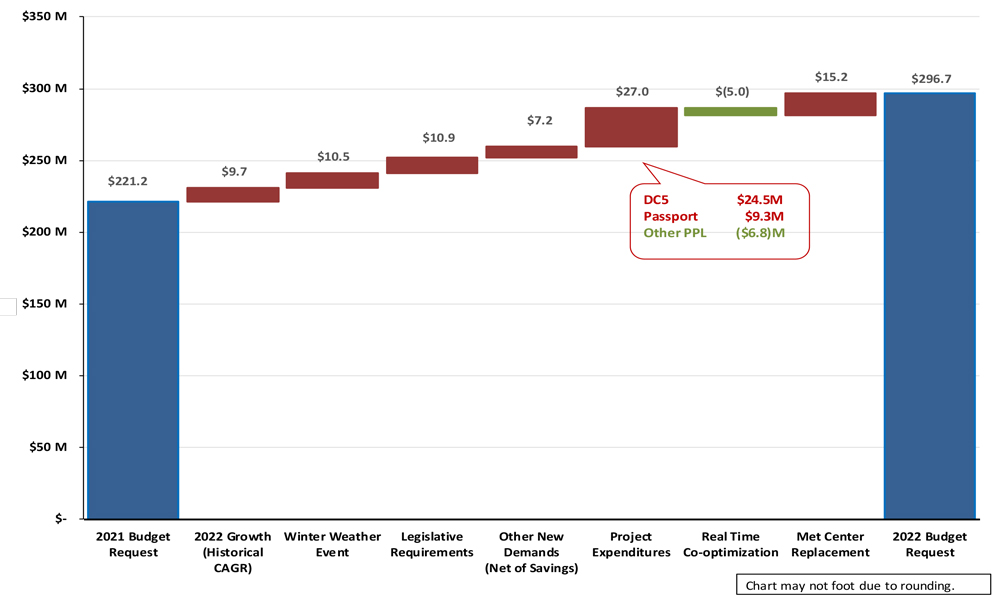
2022-ERCOT-Budget-Request-(ERCOT)-Content.jpg
ERCOT is requesting a 34% increase in its budget for 2022 as a result of winter storm-related expenses. | ERCOT

Together with the added costs to incorporate new legislative mandates from Texas lawmakers, ERCOT’s budget could reach $296 million in 2022, up from this year’s $221 million.

“We think we can manage that in the next few years,” interim CEO Brad Jones said.

ERCOT currently faces $10.5 million in unexpected annual insurance and legal costs following the storm. Staff expect to ultimately take on an estimated $10.6 million in annual costs for weatherization inspections and cybersecurity responsibilities.

The grid operator’s administrative fee of 55.5 cents/MWh, which funds 95% of its operations, has been held flat since 2016. Staff are recommending the fee stay at that level when the 2022-2023 budget comes up for board approval Aug. 10.

The city of Dallas’ Nick Fehrenbach, representing the commercial consumer segment, spoke for board members opposed to keeping the fee flat. He said he is concerned over the market’s uncertain future design and deficit spending in the interim.

“The new board could be put in a position where a fee increase is almost necessary,” Fehrenbach said. “I think we should bite this bullet now. We can cut elsewhere.”

The board meeting was held to review ERCOT’s annual financial audit, which was delayed by the winter storm. Public accounting firm Baker Tilly expects to issue a clean report following receipt of legal documents from the grid operator. The Finance and Audit Committee and the board were both unanimous in accepting the report.

The directors also agreed to let Demand Control 2’s Shannon McClendon, the retail electric provider segment’s representative, begin drafting governing documents for a transition committee between the current board and the new one, which must be selected by Sept. 1.

Texas Senate Bill 2 replaces the current setup of five independent directors and eight market segment representatives with eight Texas residents with executive-level experience in finance, business, engineering, trading, risk management, law or electric market design. No more than two board members from institutions of higher learning will be allowed.

SB2 also sets up a three-person selection committee, with one member each appointed by the governor, lieutenant governor and the speaker of the House of Representatives. The committee will also choose the board’s chair and vice chair, retaining an outside consulting firm to help with the process.

Lt. Gov. Dan Patrick on July 20 selected G. Brint Ryan, owner of a Dallas-based global tax consulting firm and chair of the Texas Association of Business, as his appointee to the committee.

Lake, Jones Hold Joint Presser

Jones and PUC Chair Peter Lake joined  for a press conference Thursday to update Texans on the operational changes they have made to improve grid reliability in advance of potential record demand this week.

The Weather Channel forecasts temperatures above 100 degrees Fahrenheit in the Dallas-Fort Worth metroplex for much of the week, thanks to a massive heat dome settling over the central part of the U.S. With projected heat indexes above the century mark in the rest of the state, Jones said the grid operator expects record demand as high as 76 GW.

“We want to make sure you are each aware that summer has arrived,” Jones said, addressing his in-person and virtual audience. “As it stands today, looking at our conditions and what we expect next week, we expect a sufficient amount of generation to serve all Texans.”

That is standard operating language when ERCOT discusses long-term resource adequacy. However, Jones bolstered his argument by explaining how the grid operator is increasing its supply of operating reserves to strengthen grid reliability. (See ERCOT Stakeholders Sign Off on More Ancillary Services.)

“We need a cushion of reserves going into the deepest summer months,” Lake said. “It’s going to be tight for the rest of the summer. We all know the heat is coming, but we’re ready for it.”

Lake said the PUC, working with ERCOT and its stakeholders, are redesigning the Texas market “from scratch.” Whereas the emphasis used to be on affordability over reliability, with generators earning greater revenues for producing when supplies are scarce, he said, the market will now prize reliability over cheap power.

“Our goal is to reallocate the payments currently being made to the most reliable source of power,” Lake said. “We don’t want to raise costs. We’re just shifting payments to the generators that provide the most reliable energy.”

Jones urged consumers not to panic over ERCOT calls for conservation, as it issued in April when a perfect storm of low wind production, thermal outages and unexpected demand almost required a return to energy emergency alerts.

“It’s a tool we need to keep in our toolbox. It’s something that is used across the country, across the world,” he said, pointing to similar conservation alerts during April in Chicago and on both coasts.

ISO-NE to Study Additional Model for Capacity Market

ISO-NE last week summarized a hybrid model for its capacity market that it plans to study, featuring both net carbon pricing and the variant of a forward clean energy market (FCEM) or integrated clean capacity market (ICCM).

The inclusion of the hybrid pathway will require additional modeling time, pushing the deadline for a report on the “pathways” from February 2022 to April, the RTO told a NEPOOL Participants Committee working group session on “Pathways to the Future Grid.”

The New England States Committee on Electricity originally floated the idea of a hybrid model and further refined the approach and assumptions in a June 22 memo to the PC. It would be based on the FCEM/ICCM-only model and include an incremental carbon price as an input, allowing it to only solve for the clean energy certificate price.

Based on the memo and related discussions, the RTO said that a net carbon price applied to all emitting resources increases revenues. In comparison, the FCEM/ICCM pathway awards clean energy credits (CECs), and their corresponding revenues, to all resources that provide clean energy. The hybrid model awards CECs to new resources.

Market Outcomes

ISO-NE said that the model aims to achieve two market outcomes simultaneously: reduce carbon emissions in the electricity sector, and produce average energy market prices that are no less than some administratively determined value.

In the first outcome, the central case assumes the same level of decarbonization as other pathways and status quo, corresponding with an 80% carbon reduction relative to 1990 levels.

In the second, NESCOE proposes that modeling parameters be set to produce an average annual LMP of $41, which is calculated using average historic hub LMPs and a contract rate of $49.99/MWh from the Millstone nuclear plant. NESCOE contends that such energy market revenues may support Millstone’s continued operation.

The RTO and its consultant, Analysis Group, continue to evaluate how to best model the hybrid pathway, which may evolve based on stakeholder feedback and design details. ISO-NE said the hybrid approach might be more challenging and time-intensive to model than the two other pathways, which seek to satisfy a carbon emissions outcome. The hybrid approach cases must additionally meet the average LMP value.

Preliminary Policy Observations, Stakeholder Feedback

While ISO-NE has agreed to study the hybrid approach to provide information to the region, the RTO highlights two ways the hybrid pathway appears to be inconsistent with sound market design.

The hybrid approach limits CEC awards to new resources only and does not pay a uniform price for the desired clean energy attribute. It also does not let the market decide how the desired environmental attributes can be provided at the least cost. Instead, it aims to set energy prices to ensure the operation of selected resources.

ISO-NE seeks stakeholder feedback on the model’s design elements, including target LMP level and limitation of CECs to new resources. The RTO plans to present preliminary modeling results in the fourth quarter of this year.

Washington Moving to Adopt Calif. Vehicle Emission Rules

Washington environmental officials have kicked off the public portion of their work to adopt California’s transportation emissions standards, which will set targets for the adoption of zero-emission vehicles.

The Washington Department of Ecology has begun public hearings on implementing a law that the state legislature passed in 2020 to adopt the standards — the strictest in the country. The agency is aiming to finish the new regulations by this November to meet a deadline of Jan. 1, 2022. The regulations will go into effect Jan. 1, 2024, before 2025 models hit the street.

With both chambers controlled by Democrats, the legislature passed the law mostly along party lines.

Under the federal Clean Air Act, most states are restricted from enacting their own emissions standards for new motor vehicles. California is the only state allowed to adopt state standards for vehicle emissions. States are allowed to adopt the federal or the stricter California emissions standards.

California maintains two programs for low- and zero-emission vehicles, which have criteria for pollutants and greenhouse gas emissions. ZEVs include battery-powered and hydrogen-fueled vehicles.

In 2005, the Washington legislature adopted the California emissions standards for passenger cars, light-duty trucks and medium-duty passenger vehicles. It did not adopt California’s standards for ZEVs or low-emissions vehicle standards for medium- and heavy-duty trucks. The 2020 law adds California standards for medium- and heavy-duty vehicles.

The new rules being mapped out tentatively divide the zero-emission, medium- and heavy-duty vehicles into three categories.

One category covers vans and large pickup trucks. Washington is tentatively looking at requiring 7% of those vehicles sold in the state to be ZEVs by 2025, increasing to 55% by 2035.

A second category covers bucket trucks, delivery trucks, school buses and transit buses. Eleven percent of the 2025 models are to be ZEVs, growing to 75% by 2035.

The third category covers tractor-trailer rigs, cement trucks and dump trucks. Seven percent of the 2025 models are to be ZEVs, increasing to 40% by 2035.

If a manufacturer cannot meet those goals in Washington sales, it will be allowed to buy and swap for credits with companies exceeding those targets, similar to cap-and-trade credits.

Ecology Department officials mentioned no targets for low-emission vehicles Wednesday during a public webinar on the proposed regulations. Two more public hearings are scheduled for July 27 and 29.