New Jersey environmental groups filed a petition Wednesday to demand the state accelerate its timeline for reducing greenhouse gas emissions and immediately stop issuing permits for fossil fuel projects, including pipelines and power plants that use natural gas.
The petition, filed with the New Jersey Department of Environmental Protection (DEP) by Empower NJ, a coalition of about 60 environmental, community, faith and grassroots groups, demands that the agency cut greenhouse gas emissions 50% below 2005 levels by 2030. Gov. Phil Murphy’s goal is to cut greenhouse gas emissions by 80 percent by 2050, as set out in an updated climate change masterplan released in 2020 by his administration. (See: NJ Unveils Plan for 100% Clean Energy by 2050.)
In a press conference and the 23-page petition, the groups said Murphy talks aggressively on climate change but doesn’t match his words with action. The governor is moving too slowly to cut greenhouse gases, and the DEP continues to approve projects that use or transport natural gas, which the U.S. Energy Information Administration considers a “relatively clean burning” fossil fuel that nevertheless emits methane, a “strong greenhouse gas.”
At the same time, drought, flooding and other environmental disasters around the world show the need for dramatic action is growing, the groups said.
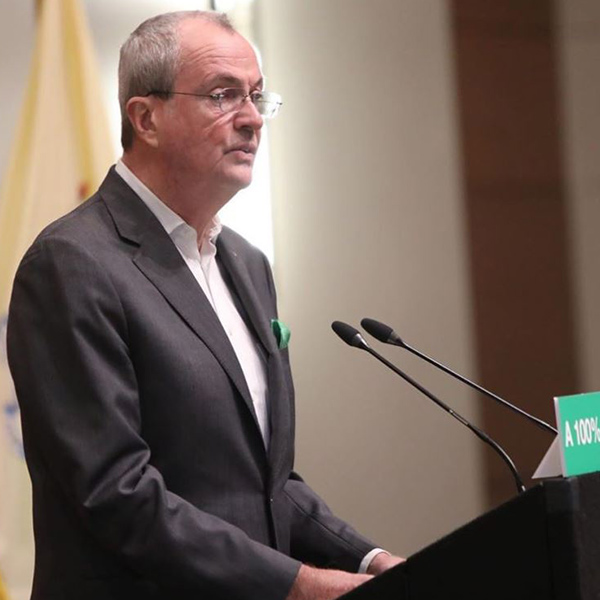
Gov. Phil Murphy | Phil Murphy
Speaking at the press conference, Jeff Tittel, retired director of the New Jersey Sierra Club, said, “Gov. Murphy, who says many of the right things and proposes some nice things, has not lived up to those words.”
“We’re here to do the job the DEP should do, which is to face the climate emergency and act bold and act quicker — and do it now,” Tittel said.
Members of Empower NJ include Clean Water Action, Blue Wave NJ, Environment New Jersey, League of Women Voters of New Jersey and NJ Citizen Action.
In response to media queries about the petition, Murphy’s office released a statement that called him a “leader in climate action” who has “taken bold and aggressive steps to reduce the impacts of climate change in New Jersey. Governor Murphy and his Administration remain committed to a just transition and a clean energy future,” the statement said.
The petition presents a challenge to Murphy, a Democrat, as it comes from some of the state’s most prominent environmental groups and other organizations that he could be looking to for support as he seeks re-election to a second term in November. A vigorous response to climate change has been a major plank of his administration’s record since he took office in 2018, especially his administration’s championing of wind energy and the approval of three projects off the state’s coast that will together generate more than 3.7 GW of wind power. (See: NJ Awards Two Offshore Wind Projects.)
Leader or Laggard?
Under New Jersey law, the DEP has 60 days to respond to the petition, either by accepting it and taking action, such as beginning rulemaking to address the issue, or denying it, according to the groups.
The DEP, in a statement emailed to NetZero Insider, said the agency “does not comment on the specifics of petitions for rulemaking.”
The statement added, however, that “under Governor Murphy’s leadership, New Jersey has taken an aggressive, whole-of-government approach to reducing the impacts of climate change.”
The statements from the DEP and Murphy highlighted similar initiatives the governor has undertaken to demonstrate his commitment to acting against climate change. They included: his decision to rejoin the Regional Greenhouse Gas Initiative (RGGI) after his predecessor Chris Christie pulled the state out; his pursuit of carbon-free electricity; the state’s investment in promoting electric vehicles; and its “ambitious climate change regulatory reforms,” called New Jersey Protecting Against Climate Threats (NJPACT).
Rule changes under that program are “in various stages of development,” the DEP said. They include strengthening air pollution rules to help reduce future greenhouse gas emissions and improving the state’s GHG reporting and inventory system.”
Still, the petition claims that New Jersey is “not keeping pace,” with other members of the United States Climate Alliance, a bipartisan coalition of 25 states working toward achieving net-zero emissions by 2050, according to the group’s website. New Jersey is a member of the group.
“New Jersey is an outlier in the Climate Alliance,” the petition says. “The vast majority of member States already have set 2030 targets, and many have set 2025 targets.” The petition notes that President Biden has announced a target of 50 to 52% reduction from 2005 levels of GHG by 2030. It also cited the June announcement by PSEG, the state’s main utility, that it is accelerating its greenhouse gas reduction efforts to reach net-zero emissions by 2030, 20 years earlier than its previous target. (See: PSEG Speeds up Plan to Cut Emissions.)
GHG Impact of Natural Gas
The petition says that serious arguments can no longer be made that natural gas should be seen as a “bridge fuel,” a cleaner alternative to coal-fired energy production that can be used while clean energy sources are developed. Natural gas is “as bad as coal” in some respects, due to the presence of methane in natural gas, the petition says.
“Natural gas is not a bridge to the future. It’s a highway off a cliff. And the state must act faster,” said David Pringle, a member of the steering committee of Empower NJ. “So, this effort will help move the administration farther, give them the cover they need to do the right thing, educate and mobilize the public to save money, create jobs and get us the health and safety that we deserve.”
The petition says that despite the state’s commitment to cutting emissions, it has “continued to allow the construction of new fossil fuel facilities” over the past three years. These include the expansion of the Sewaren 7 natural gas electricity generating plant, owned by PSE&G in Woodbridge, N.J., and several expansions of the Transco pipeline, which delivers natural gas to consumers in the state. Those Transco expansions include the Garden State Expansion Project.
Specifically, the petition calls for the DEP to create rules “denying permits for any new fossil fuel project” unless it certifies that:
The 2030 target can be met if the facility is constructed and operates;
There is no renewable energy alternative to provide the same amount of energy;
The state’s energy requirements can’t be met by any other means.
“New Jersey has done a lot of good stuff on green energy, offshore wind especially,” Pringle said. “But those efforts won’t get the [GHG] reductions we need. We have to be saying no to dirty energy too.”
The most cost-effective way to cut greenhouse gas emissions from buildings in Maryland — while also keeping consumers’ electricity bills affordable — could be a hybrid approach of heating electrification with fuel backup, according to an analysis presented Tuesday to the Greenhouse Gas Mitigation Working Group’s Buildings Ad Hoc Group.
Hybrid residential customers, who use a combination of electrification and renewable fuels, “can save money by keeping their existing fuel-based heating equipment to provide backup heating during the coldest hours of a year,” said Jared Landsman, senior consultant with Energy and Environmental Economics (E3). Consumers could end up paying anywhere from $3,100 to $7,800 a year for heating by 2035, depending on how their homes are heated and the strategy the state adopts for building decarbonization, he said.
Christopher Beck, climate change program policy chief at the Maryland Department of the Environment, said Tuesday’s meeting was “a midyear check-in on the work E3 has been doing.” The ad hoc group is scheduled to meet again Aug. 17.
High electrification, in which almost all buildings switch to air source heat pumps and ground source heat pumps, with heating supplied by electricity throughout the year, and efficiency improved through building retrofits.
Electrification with gas backup, in which “existing buildings keep using fuels for heating and are supplied with a heat pump combined with existing furnace/boiler that serves as a backup in the coldest hours of the year,” while new buildings would be required to have all-electric heat.
High decarbonized methane, in which “buildings keep using fuels for heating while fossil fuels are gradually replaced by low-carbon renewable fuels.”
While recapping some material from previous meetings Charles Li, a managing consultant with E3, also drilled down into the projected costs and technical details for implementing each pathway. Electrification with fuel backup is expected to be the relatively least-cost and lowest-risk path among the three options, he said. However, costs across the entire building sector could vary widely because of ongoing uncertainties about fuel and equipment costs and evolving installation practices for electric heating systems, Li said.
“A hybrid scenario could potentially hedge for this uncertainty, given its lower overall costs and narrow cost ranges,” he said.
During a public comment period at the meeting, David Smedick, Mid-Atlantic senior campaign director for the Sierra Club, countered that E3’s cost analysis did not take into account the costs and emissions of methane leakage that could occur in the gas backup and decarbonized methane scenarios.
“The state needs to actively plan for rapid shrinkage of the natural gas distribution system,” he said.
Many Ways to Get to Net Zero
Under its 2016 plan for GHG reductions, Maryland is targeting at least a 40% reduction of emissions over 2006 levels by 2030, with an aspirational goal of an 80 to 95% reduction by 2050. The Greenhouse Gas Mitigation Group advises the Maryland Commission on Climate Change, which last year recommended that Maryland get more aggressive on GHG reductions by raising the 2030 goal to 50% and setting a 2045 goal for net-zero emissions.
Cutting emissions from buildings will play an integral part in achieving such goals because, according to 2017 data in the E3 analysis, buildings account for 90% of the state’s electricity load and 13% of its GHG emissions.
To calculate costs in its three scenarios, E3 looked at different combinations of the state’s electricity and gas systems, equipment and other fuel costs, Li said. The electric system’s cost components include investments for expanding transmission and distribution infrastructure, and for additional generating capacity to meet both peak electric demand and any other additional demand for electricity.
Li provided further detail about the estimate he supplied at the July 13 ad hoc group meeting that growing electricity demand under the “high electrification” scenario would result in about $2 billion to $3 billion in annual incremental system costs. The low-end estimate would require improved system configuration, he said, while with current installation practices, annual incremental system costs could even top $3 billion, reaching $3.2 billion by 2045.
The latter figure contrasts with just $400 million in annual incremental costs by 2045 under the electrification with fuel backup scenario, he said.
However, pairing air source heat pumps with fuel systems could save more than 80% of the annual incremental costs in the high electrification scenario, mainly by avoiding transmission and distribution infrastructure and generating capacities, Li said.
Gas system costs in all scenarios show wide ranges because of the high uncertainty associated with renewable natural gas commodity costs, he said. The high decarbonized methane scenario has the biggest range of incremental system costs because it would create high gas demand. Under this scenario, the annual gas system cost could range as high as $12 billion.
Deep Retrofits
Taking a different approach, Montgomery County, Md., is looking at proposed legislation to reduce building GHG emissions through strong building energy performance standards (BEPS) for several classes of commercial buildings. The county, located north of Washington, D.C., has set itself an even more ambitious goal of zeroing out its emissions by 2035, and commercial buildings account for 26% of the region’s GHG emissions, according to a County Council staff report.
Speaking for the bill at a council meeting on Tuesday, Adam Ortiz, director of the county’s Department of Environmental Protection, said while the county has “ambitious green building codes for new construction, we need similar requirements for existing buildings.” BEPS would, he said, “reduce climate impacts through deep energy retrofits, operational improvements and tenant engagement.”
Using a “trajectory approach,” Ortiz said, the bill would provide “a phased, long-term performance standard, highly engaged with our department, that balances building owners’ need for flexibility, while also meeting energy reduction targets, because each building and each industry sector is different.”
While the bill appears to have no strong opposition, some groups and one county resident did have improvements to recommend.
Todd Nedwick of the National Housing Trust noted that affordable housing owners may not have big enough staffs or the access to capital needed for high efficiency building upgrades. The bill should include funding mechanisms for such “under-resourced” buildings.
Timothy Truett, a county resident, said the bill was good, but “the enforcement provisions need to be strengthened. Under this bill, a building owner could do nothing for years and then maybe pay a modest fine.” He called for more frequent performance audits, with results on individual building made public. Anticipating that “the county will have very limited resources for compliance, public reporting of performance data could help produce compliance.”
Several U.S. cities, including Washington, D.C., have passed local BEPS, but if the bill passes, Montgomery County would be the first county in the nation to put one in place, Ortiz said.
The council took no further action on the bill; the public comment period on the legislation remains open through July 27.
DENVER — Renewable- and natural gas-powered microgrids are supplanting diesel generators, but “public purpose” microgrids are struggling because of high costs and the lack of a widely accepted metric for resilience, speakers told the National Association of Regulatory Utility Commissioners’ Summer Policy Summit.
Allan Schurr, chief commercial officer for microgrid developer Enchanted Rock, said his company has found success developing projects for commercial and industrial customers that value continuous operations.
“Some are manufacturing sites, where it’s very costly if they lose power for even a few minutes. Others are critical infrastructure, like water utilities that need continuous power to maintain pressure in their system. Some are retailers like Walmart that want to be part of the community and being open all the time; hospitals, health care. There’s a standard out there that’s becoming more and more common: that if you can have no outages, why shouldn’t you have no outages?” he said. “The grid can’t keep up with all of those expectations.”
Schurr’s company builds microgrids powered by natural gas or renewable natural gas, “a vast improvement,” he says, on the environmental impact of diesel generators that such customers have used historically.
“We also can provide economic efficiency because those assets can be dispatched. A few hundred hours a year are all that’s needed in order to provide … grid services revenue [that] allows us to get that price below the price of diesel.”
Enchanted Rock has about 210 microgrids in Texas, 97% of which were available during the winter storms that left millions without power for days.
“Microgrids helped save part of the rotating outages in Texas. We were delivering about 450 MW into the ERCOT grid to try and alleviate some of the pressure on the grid,” he said. “The price of power in the Texas winter storm were $9,000[/MWh] for eight straight days. Microgrids could have been fully financed and paid for in that week.”
Pacific Gas and Electric (NYSE:PCG) has connected diesel generators at dozens of substations to supply electricity during wildfires. “During the public safety power shutoffs in 2020, it did keep electricity flowing for thousands of customers,” California Public Utilities Commissioner Genevieve Shiroma said. (See Calif. Rushing Microgrids for Fire Season Shutoffs.)
Valuing Community Resilience
But the math is harder to pencil out for public-purpose microgrids, said Suzanne Mora, director of utility initiatives and analysis for Exelon (NASDAQ:EXC).
“Microgrids are costly. It’s hard to make a value proposition work, and part of the reason for that is we don’t really have a clear understanding of how to value community resilience,” she said. “The No. 1 benefit that’s offered by a microgrid is resilience, and yet we don’t really have a metric that’s accepted by everybody to give a value to” it.
Commonwealth Edison’s microgrid in the Bronzeville section of Chicago, the U.S.’ first utility-operated microgrid cluster, “works economically [only] because of the significant money that came from the U.S. [Department of Energy] and grants,” she said. “So, it’s still not a proof point for the economics of public-purpose microgrids.”
The microgrid includes 750 kW of solar and a 500-kW battery system with a four-hour run time. In January, ComEd, a unit of Exelon, chose Enchanted Rock to provide 5.5 MW in natural gas-fired generation to ensure the complex maintains power during any grid interruption.
On the bright side, Mora said, utilities, the Electric Power Research Institute and DOE’s National Laboratories “are getting very close to being able to come up with metrics that are acceptable to all in terms of assigning a value to resilience.”
FERC Order 2222, which requires RTOs to open their wholesale markets to distributed energy resources, will help by adding new revenue streams, she said. “But it adds to the complexity of how you regulate [microgrids] and how you operate them.”
Mora said microgrids that have more than a single customer should be regulated like a utility.
“I don’t think a microgrid is a reason to set aside the other regulatory constructs that are very important to [state regulators’] charter to protect customers,” she said. “Our rule of thumb is if a microgrid behaves like a utility — in that it’s distributing electricity to more than one customer — it should be regulated like a utility.”
Mora said regulators need to find a balance between allowing microgrids to offer grid services when they’re not in island mode and preventing them from shifting costs to other distribution customers.
“We’ve had microgrids … in our service territories that might disconnect from the grid voluntarily 100 times a year based on [arbitraging against the] market price,” she said. “It puts stresses on the system … and it has the opportunity to start doing some cost shifting if you’re not appropriately taking care of the distribution system costs associated with allowing that.”
If a microgrid is designed with more generation than its clients’ load, “then you have a microgrid that’s out there looking for customers,” raising the threat of grid defection, she added. That “has implications for the customers who can’t defect from the grid.”
Another challenge is the variety of microgrids. “When you see a microgrid, you’ve seen one microgrid. They’re all different, and we can learn from each and every one of them,” she said.
The New Jersey Board of Public Utilities’ microgrid definitions, she said, have been useful in providing some structure for classification. The BPU defines three types of microgrids based on their interconnection to the grid:
Level 1: a single customer microgrid, such as a solar PV system, combined heat and power or fuel cell system, that serves one customer through a single meter which is connected to and can island from the distribution grid.
Level 2: a single customer/campus setting that includes a single or multiple DER systems connecting multiple buildings but is controlled by one meter at the point of common coupling, which is connected to and can island from the distribution grid.
Level 3: serves multiple customers that are not on the same meter or on the same site as the DER.
“I went through an exercise in the District of Columbia where we had a working group looking very closely at microgrids. It was kind of like trying to saddle a unicorn. You know, you’ve heard about them; you’re never sure that you’ve actually seen one; … you’re not 100% sure what the measurements are and how they operate. I think trying to come up with classification schemes is great. And I think the New Jersey one allows that level of flexibility that just about anything that would come up would fall into one of those three” categories.
Megan Levy, local energy programs manager and energy assurance coordinator for the Wisconsin Public Service Commission’s Office of Energy Innovation, said microgrids are “part of the solution” in ensuring resilience.
“Energy security is diversity in resources,” she said. “The most important thing is the partnerships and the coordination and continuing to innovate. We’ll figure this thing out. I just don’t think we quite have yet.”
Environmental justice advocates on Thursday told New York officials to consider smoke from western wildfires a week after torrential rains flooded the subway as a sign to hurry up on forming climate policy for the power sector.
“In a week where we’re seeing red moons and yellow skies … we’re talking about a moratorium on fossil fuel when it should be a no-brainer,” said Eddie Bautista, executive director of the New York City Environmental Justice Alliance. “Don’t be the mayor in Amity Island [Jaws] that doesn’t listen to the sheriff. Close the beaches. This is that analogy.”
Members of the Climate Justice Working Group (CJWG) on July 22 gave feedback to the New York State Climate Action Council (CAC) on policy recommendations from its Power Generation Advisory Panel.
The 22-member council is working to complete a scoping plan by year-end to help achieve the state’s goals under the Climate Leadership and Community Protection Act (CLCPA).
In its recommendations to the council, the Power Gen panel said that electrifying buildings and transportation will be crucial to meeting the state’s ambitious goal to reach net-zero electricity by 2040. It recommended minimizing electrification costs by balancing behind-the-meter with grid-side costs and using bulk and local solutions. It also said that storage, managed load and clean dispatchable generation could optimize deployment and operation of resources: “Look to utilities, DER providers and bulk providers for this — as makes most sense, and with steady improvement and rules.”
Affordability, False Promises
On affordability, Sonal Jessel of WE ACT for Environmental Justice, sought an emphasis on the need for major reform for utility bill assistance.
“If we move towards more electricity, what is that going to do to people’s utility costs, especially for lower income individuals?” Jessel asked.
It’s important to have no energy burden exceed 6% of income, but there are 1.2 million New Yorkers over that line, which proves the need to prioritize modifications to the state’s low-income home energy assistance program, she said.
The CJWG supports launching an assessment and planning process to determine emissions-reduction targets to reach net-zero by 2040, Bautista said. Grid reliability can be maintained and adequate CLCPA-compliant resources like clean generation, battery storage, demand response, etc., can be planned for and implemented as fossil generation resources are retired in order to achieve the 2040 target.
Environmentalists like the Power Gen panel’s interest in expanding workforce development and renewable energy and to phase out existing fossil fuel plants, but are concerned about the promotion of “false solutions” like green hydrogen, renewable natural gas and waste-to-energy, Bautista said.
In terms of the achievement of power production, 100% free of emissions by 2040, the CJWG is concerned about demonstration projects distracting from the clear renewable energy goals, he said.
The CJWG highlighted the recommendation for further research and consideration of lifecycle GHG accounting and potential air quality and health impacts of “unproven” technologies, Bautista said.
“Industry-supported technology fixes promise to reduce emissions despite their questionable legality under the CLCPA, but research shows they often do the opposite and often don’t reduce pollution burden,” he said.
In addition, NYISO should be more transparent, with more checkpoints and opportunities for public input and critique, Bautista said. “For example, the NYISO’s reliability needs assessment can be better disseminated and shared with local energy advocates … and there needs to be more energy advocates considered for appointment to the board of NYISO.”
Equitable Benefits
The state needs to make a careful examination of the equitable development of infrastructure, including the distribution system, in the context of the CLCPA mandate to spend between 35% and 40% of clean energy investments in low-income communities, said Raya Salter, lead policy organizer for NY Renews.
The CLCPA mandate on clean energy investments in low-income communities could include rate cases as well, Salter said.
“We do not have the complete roadmap on how we’re going to get there in a way that fulfills the mandate and provides a complete equitable solution across all ratepayers,” Public Service Commission Interim Chair John B. Howard said.
The commission hopes to conclude its low-income proceeding relatively soon, over the next month or two, but it will be an ongoing proceeding because these issues become more acute as you add more costs to the system, Howard said.
New technologies and rebuilding the entire electric generation system are enormously expensive, and funding the rebuilding entirely on ratepayer bills “will be nearly impossible,” Howard said. “We’ll need other sources of funding. … We have mandates, so we must spend the money.”
The Climate and Community Investment Act (CCIA) (S4264A), which proponents estimate could raise up to $15 billion per year over the next decade via a carbon tax, could pay for a large part of the costs of rebuilding the state’s power grid and infrastructure, Bautista said.
“It will be helpful if we can get our partners in government to sit down and actually look at the CCIA that was introduced in both houses last session,” he said. “We have a budget coming up and that’s a perfect opportunity to see where the CCIA could add value.”
CAC Executive Director Sarah Osgood laid out a timeline for the Council, which aims to issue a draft scoping plan by year-end and hold public meetings throughout 2022 before issuing a final plan in 2023.
FERC last week defended its prior ruling directing MISO and SPP to fix overlapping congestion charges on pseudo-tied loads and resources (EL17-89).
Responding, in April, to a 2019 complaint from American Electric Power subsidiary Southwestern Electric Power Co. and the city of Prescott, Ark., the commission ordered the RTOs to mitigate the overlapping charges through a rebate mechanism. (See MISO, SPP Ordered to Resolve Overlapping Charges.)
MISO sought a rehearing of the ruling, arguing that FERC lacked evidence in its decision-making because the grid operators managed their interface within the bounds of their joint operating agreement and respective tariffs. MISO also said FERC improperly relied on the “potential” for unjust charges, not actual transactions.
But FERC said in its July 20 order that the Federal Power Act doesn’t require it to “identify unjust and unreasonable charges in specific timing intervals as a prerequisite to exercising its power to remedy an existing unjust and unreasonable rate applicable to an entire market.”
“Instead, as long as the remedy the commission directs is proportional to the identified problem, the commission may make a generic finding of a systemic problem to support a market-wide solution,” the commission wrote. “Here, the commission has appropriately identified a systemic problem, and any remedy will be proportional to the identified problem.”
FERC said it had “sufficient evidence to conclude that the RTOs have assessed unjust and unreasonable overlapping congestion charges, despite lacking the information to quantify the exact amount.”
The commission has yet to assess whether AEP, Prescott, or any other parties are owed refunds stemming from the overlapping charges.
FERC also said that it was within its rights to find that the RTOs’ existing hedging mechanisms to alleviate duplicative transmission charges — auction revenue rights, financial transmission rights, and virtual transactions — are inadequate.
FERC said while it doesn’t expect that the hedging mechanisms will perfectly address congestion, the current array of tools aren’t removing unjust and unreasonable charges.
The head of the Arizona Corporation Commission has requested a new proceeding to explore the merits of requiring utilities to join an RTO, as Colorado and Nevada did earlier this year and other Western states are considering doing.
ACC Chairwoman Lea Márquez Peterson requested the new docket to investigate the “question of mandatory or voluntary participation in regional transmission organizations” by the state’s load-serving entities, including Arizona Public Service (APS) (NYSE:PNW) and Tucson Electric Power (TEP).
The move followed a July meeting in which the commission agreed to hold workshops as part of its biennial transmission assessment (BAT) to study issues such the potential for increased participation by transmission owners in regional markets.
Márquez Peterson encouraged the studies in an April 23 letter that mentioned possibilities such as joining CAISO or SPP, forming a separate RTO or gaining access to ERCOT.
“I believe the technical transmission system reliability studies … could help the commission learn the potential reliability impacts and needs for the future transmission system under a number of different load and generation assumptions,” she wrote.
At the ACC’s July 14 meeting, representatives of APS and TEP supported holding the workshops.
Amanda Ormond of Western Grid Group, an organization that advocates for transmission improvements to deliver clean power, said the raft of proposed studies could take up to three years and urged a more intensive focus on RTO membership.
Arizona regulators want an examination of potential RTO benefits. | Arizona Corporation Commission
RTO participation would have “significant effects on transmission — what we build, how we build, how we use the transmission system — and so we recommended that the commission have a workshop to talk specifically about regional transmission organizations and the different component pieces that go into participating,” Ormond said.
The Arizona development builds on a growing initiative to develop a Western RTO after several failed attempts by California lawmakers to expand CAISO into a multistate entity. (See CAISO Expansion Bill Dies in Committee.) SPP is preparing to allow members of its Western Energy Imbalance Service to fully join the RTO. (See related story, Commitment Deadline Set for SPP West Participation.)
Meanwhile, Oregon lawmakers have instructed the state’s Department of Energy to look into the benefits of joining an RTO. Avangrid’s planned $4.3 billion merger with the parent company of Public Service Company of New Mexico contains language regarding potential RTO membership. (See FERC OKs Avangrid PNM Purchase.)Nevada’s governor is convening a task force to explore RTO membership. (See Many Next Steps to Follow Passage of Nevada Energy Bill.) And Colorado lawmakers ordered TOs to join an RTO by 2030 or explain why they could not. (See Polis Signs Bipartisan Bill to Support Interstate Tx.)
“Arizona doesn’t want to get behind in looking at market development because it’ll keep us competitive,” Ormond said. “It’ll save customers money. So that’s why in the BTA today I’m advocating that we … do a deep dive on RTO development because it is very complicated, and we really haven’t had any conversation about it at all in Arizona.”
Below is a summary of the issues scheduled to be brought to a vote at the PJM Markets and Reliability and Members committees on Wednesday. Each item is listed by agenda number, description and projected time of discussion, followed by a summary of the issue and links to prior coverage in RTO Insider.
Markets and Reliability Committee
Consent Agenda (9:05-9:10)
B. Stakeholders will be asked to endorse proposed revisions to Manual 13: Emergency Operations to address conservative operations, PJM’s emergency protocols to ensure the bulk electric system remains reliable during extreme events. The manual changes were endorsed at the July Operating Committee meeting. (See “Manual 13 Changes Endorsed,” PJM Operating Committee Briefs: July 15, 2021.)
E. Stakeholders will be asked to endorse a proposed revision to Manual 33: Administrative Services for the Operating Agreement around the operating reserve demand curve (ORDC) data in accordance with FERC transparency requirements. The new section states that PJM may publish annual information on aggregated forced outages for the RTO and other reserve zones directly relevant to the ORDC calculations. (See FERC Approves PJM Reserve Market Overhaul.)
F. Members will be asked to endorse proposed revisions from the Governing Document Enhancement and Clarification Subcommittee (GDECS) addressing administrative changes and clarifications in the tariff and OA.
Endorsements (9:10-9:35)
1. Non-firm Transmission Service Pre-emption (9:10-9:35)
The MRC will be asked to endorse proposed revisions to section 14.2 of the tariff related to pre-emption of non-firm transmission service. The committee will be asked to endorse the proposed solution upon first read, and MC endorsement will be sought on the same day. The tariff language revisions exclude the right of first refusal (ROFR) process from PJM’s evaluation of non-firm transmission service requests. (See “Non-firm Transmission Service Pre-emption,” PJM Operating Committee Briefs: July 15, 2021.)
Members Committee
Consent Agenda (1:10-1:15)
D. Stakeholders will be asked to approve proposed revisions to Manual 34: PJM Stakeholder Process to address clarifications within the newly revised section 9.5: Motion Amendments.
E. Members will be asked to endorse tariff revisions to address concerns associated with the pro forma interconnection construction service agreement’s lack of superseding language and current automatic termination provision. The revisions were endorsed at the June MRC meeting. (See “ICSA Revisions Endorsed,” PJM MRC/MC Briefs: June 23, 2021.)
Renewables Leader Beats Expectations with Q2 Results
NextEra Energy (NYSE:NEE) highlighted the importance of new transmission facilities and the support of regional grid operators during its second-quarter earnings call last week with financial analysts.
CFO Rebecca Kujawa said the company is following the infrastructure discussions at the federal level and has an eye out for opportunities for NextEra Transmission, its competitive wires company.
“We’re looking out decades and looking at the enormous renewables build opportunity across the U.S. It is clear that over time, new transmission needs to be built to support some of that buildout,” Kujawa said during a conference call Friday. “It certainly is important to start today to build the type of infrastructure that’s needed over time. … From a broader policy standpoint, we saw that it is important for the regional ISOs to continue to focus on how you support that transmission build out.
“I think there’s a receptive audience in the Biden administration, making sure that they support laying a foundation that’s supportive of renewables, not just in the next couple of years, but in the next couple of decades. Transmission moves slowly, so stay tuned,” Kujawa said.
The Juno Beach, Fla.-based company beat expectations in reporting earnings of $256 million ($0.13/share), compared to $1.28 billion ($0.65/share) for the second quarter of 2020. NextEra’s adjusted earnings of 71 cents/share outperformed the Zacks Consensus Estimate of 67 cents.
NextEra said it surpassed 40% completion during the quarter of its “30-by-30” plan to install more than 30 million solar panels by 2030. It expects to reach the halfway point early next year.
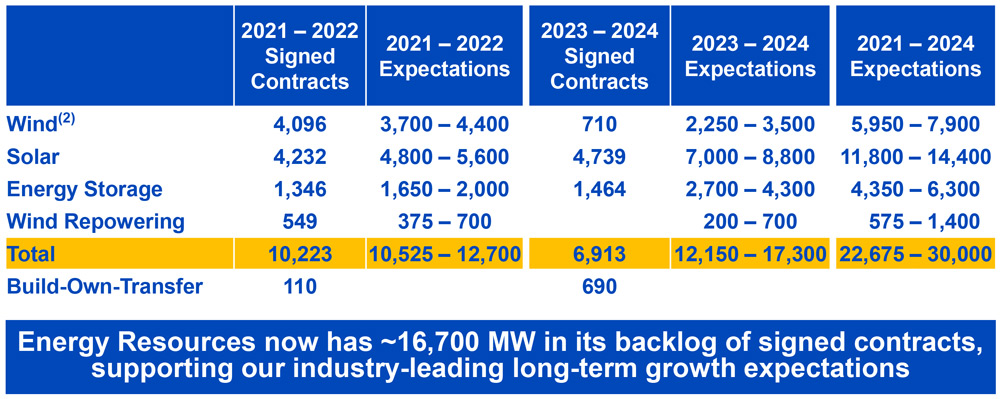
NextEra Energy Resources continues to add to its massive backlog of renewable projects. | NextEra Energy
The company’s development arm, NextEra Energy Resources (NEER), added about 1.8 GW of renewable and storage projects to its backlog since the release of first-quarter results in April. NEER expects to add between 22.7 and 30 GW of renewable power projects within the 2021-2024 time frame.
NextEra’s share price opened at $76.12 on Friday and was at $77.10 in after-hours trading.
AEP Beats Analysts’ Expectations
American Electric Power (NASDAQ:AEP) on Thursday reported second-quarter earnings of $578 million ($1.16/share), compared to 2020’s second-quarter earnings of $521 million ($1.05/share). The company’s adjusted earnings of $1.18/share beat the Zacks Consensus Estimate of $1.14 by 3.5%.
“We are seeing positive signs of economic improvement as the nation recovers from the pandemic,” AEP CEO Nick Akins said. “Commercial and industrial sales have bounced back throughout our service territory across nearly all sectors. Residential sales are down compared with the second quarter last year as many customers we serve are now returning to the workplace.”
The Columbus, Ohio-based company said it is advancing its plan to transition generation capacity to approximately 50% renewables by 2030. It has recently issued requests for proposals for two large-scale renewable energy resources as it works to bring up to 16.6 GW of new, clean energy online this decade.
AEP’s share price opened Thursday at $84.61 and spiked to $86.22 shortly after the earnings call with analysts. The share price ended the week at $85.98.
DENVER — More than 600 people attended the National Association of Regulatory Utility Commissioners’ Summer Policy Summit in person, and hundreds more watched via livestream for discussions on topics including electrification, new technologies and the challenges of building transmission.
“The alliance wants to be proactive in state proceedings; we’ve been playing a lot of defense,” said Jones, a former Washington state regulator and NARUC president. “We just felt that we, the alliance, needs to have a more consistent … proactive policy on rate design, and then find common ground with all stakeholders.”
The paper covers both residential and commercial and industrial rates. “Over 80% of charging is done at home, but public DC fast charging is really, really important to the ecosystem because it alleviates range anxiety,” Jones said.
The group said transportation electrification rate design should “fairly recover costs to serve customers while optimizing the use of the electric system and providing overall benefits to customers,” including time-differentiated electric rates to encourage off-peak charging.
But it says “rigid application” of traditional cost-of-service ratemaking may conflict with state’s public policy goals, and “there may be instances where transitional relief is needed to meet state policy goals during a transitional period of EV market development.”
One area for relief is demand charges that can impede the use of commercial EV chargers because of their current low utilization rates. “The usage of public EV chargers can also be unpredictable and ‘spiky,’” the alliance said. “Such charging loads can create unusually high loads (in terms of demand based on kilowatts) for brief periods of time, which are hard to predict. This problem is particularly acute for DC fast chargers.”
Jones appeared on a panel with Francesca Wahl, senior charging policy manager for Tesla (NASDAQ:TSLA), who noted that the company reached a milestone of 2,000 fast chargers globally last year, including 1,000 in the U.S.
Wahl said 39 states have passed legislation or approved regulations concluding that EV charging stations and charging as a service should not be considered public utilities.
“We’re not considered a traditional retail sale of electricity,” she explained, which provides regulatory certainty for EV charging site hosts and enables billing based on consumption.
“Some states used to bill on a dollar-per-minute basis,” she said. “It’s fairer to the customer to bill on a dollar-per-kilowatt-hour.”
Danly Surprised at Success of EIM
Four of the five FERC commissioners attended the conference in person, with Commissioner Allison Clements appearing virtually.
Commissioner James Danly answered questions at a meeting of NARUC’s Committee on Energy Resources and the Environment, where he expressed his surprise at the success of CAISO’s Energy Imbalance Market (EIM).
“I have been amazed at how successful the EIM was given the trepidation with which many of the jurisdictions around California approached joining any kind of market structure at all,” he said.
He said FERC should not attempt to persuade other Western states to join a full RTO but should give “moral support from the sidelines, cheering people on to do the best they can for ratepayers.”
Is there a role for capacity markets in the West?
“Capacity markets are fraught with problems. It takes a Solomon-like wisdom to properly adjust a capacity market to achieve [its] goals,” he said. “That being said, we have had a couple of recent unfortunate experiences in markets that did not have capacity markets to ensure a certain buffer, and that’s also” problematic.
Former Michigan Public Service Commission Chair Sally Talberg re-emerged at NARUC after her ill-fated tenure as a member of ERCOT’s Board of Directors, hosting a breakfast for several clients of her growing policy consultancy.
Talberg gave up the PSC’s chair to become one of five independent directors on the ERCOT board. She held that position for 55 days, 15 as the board’s chair, before joining the other independent directors in resigning after the February winter storm, when their out-of-state residencies became a target of Texans’ anger.
She declined comment on her ERCOT experience as a couple of breakfast diners seated nearby chuckled. She did allow to her audience of 60 or so friends, associates, regulators and potential clients that 2021 “has been an interesting year.”
As president of her eponymous Talberg Policy Solutions, she focuses on gas decarbonization, distribution grid modernization and solar supply chain issues. Talberg does policy and regulatory research, formulates strategy, and identifies and develops connections with government, private sectors and nongovernmental organizations.
Her biggest issue these days is whether her firm’s logo resembles a ginkgo tree, as intended, or an alien’s head.
“I’m excited to use my experience in regulatory and policy strategy to help accelerate our clean energy transition,” Talberg said in an email.
Last week that meant engaging NARUC attendees on how she and her clients can make the U.S. solar supply chains more resilient and sustainable.
“We need a reliable supply of sustainably produced solar panels to meet utility and state clean energy goals,” Talberg said. “Unsustainable practices in some portions of the supply chain threaten that supply, as recent U.S. government actions to block imports from parts of that supply chain demonstrate.”
Michael Parr, executive director of The Ultra Low-Carbon Solar Alliance, said that as an example, China has used primarily coal-fired power to produce enough solar modules to grab a 71% share of that global market. It owns even greater shares of the global supply chain’s other pieces.
“We are providing utilities, governments and corporations the tools to buy better solar and, in so doing, create a more resilient solar supply chain, including reshoring solar manufacturing to the U.S.,” Parr told RTO Insider.
Rob Gramlich, founder and president of Grid Strategies, praised the FERC-NARUC task force that is intended to spur increased transmission development to deliver renewable power, reduce congestion and improve reliability (AD21-15). (See related story, Glick Works to Strengthen Relationship with NARUC.)
“It’s something we’ve needed for some time,” he said. Transmission infrastructure’s “great value is resilience, and that’s something we need to figure out a way to incorporate. It’s a lot more expensive to continue to do the reactive, incremental approach, rather than the efficient, scaled-up approach. If we can do transmission on a wider, regional basis, you will get lower costs per delivered megawatt.”
Gramlich, who breaks down transmission construction into “the three P’s” (planning, permitting and paying), said allocating transmission costs tends to be the most difficult.
“It’s a public good. Everyone benefits,” he said. “I would love to see the joint task force develop some guidance. We will try our best in Washington to get some federal dollars to alleviate the burden on taxpayers. The general message is we can do this. We’ve built big before. This is not rocket science, but we do need to figure out how we structure it in each region.”
Enter, then, the nation’s grid operators. Gramlich said the states play a critical role in transmission planning and cost allocation, but he urged that they work closer with the RTOs.
“The RTOs provided tremendous benefits, and the transmission they’ve built has done the same,” he said. “It would be great for the states to work with the RTOs and the utilities to deliver as much as we can on existing lines. I know the costs are a big issue. Just make sure everybody is comfortable with the existing grid and plan the future grid on an economic basis.”
Speaking alongside Gramlich — albeit virtually in front of a background that screamed tropical paradise — Debra Lew, associate director of Energy Systems Integration Group, called for a national grid authority, housed in the Department of Energy, to work with the regions to increase the development of clean, cheap and reliable energy.
“The existing interregional coordination within an interconnection won’t be sufficient if you’re looking to get large parts of the country to high levels of clean energy,” she said. “We could do this much cheaper if we do this big, using this holistic viewpoint. I agree that it entails a huge amount of effort to try and operationalize, but working with a bottom-up and top-down approach will be needed to get at some of the best solutions.”
Keeping Energy Development in US
Jigar Shah, director of DOE’s Loan Programs Office, said the federal government is working to ensure the technologies of tomorrow are developed in the U.S. today.
“There’s actually much smarter ways of doing things that use American technologies and workers. I’m tired of this technology that has to be rolled out in other countries and not here, just because we’re so conservative,” Shah said during a panel discussion on helping new technologies survive the “valley of death” to commercialization.
“Not all companies deserve to succeed. The goal is not for all companies to succeed, but those that come out of development with a pathway to succeed that is equal to or better than other countries around the world,” he said. “In the past, we’ve encouraged companies to go to the United Kingdom, South Africa or India to scale up technologies.”
DOE has $40 billion in loans and loan guarantees at its disposal to build out energy projects in the U.S., an enticing offer to keep those projects at home.
“The formula is project finance. It’s really a simple model. You start with technology that people believe works,” Shah said. “President Biden has said he would bring the full force of the federal government in the procurement process. That’s what we’re solving for with long-duration storage, short-duration storage [and] pumped hydro.”
Renewable project capital “stacks are great,” he continued. “They provide an equity cushion to make everybody feel comfortable for the companies to be around for the sausage making to occur, but we still have to make great sausage.”
The Electric Power Research Institute’s Neva Espinoza, GTI’s Mike Rutkowski and Colorado Sen. Chris Hansen (D) joined to discuss natural gas decarbonization and new advances in the industry. Moderated by New Jersey Board of Public Utilities Commissioner Dianne Solomon and Wisconsin Public Service Commissioner Tyler Huebner, the panel stressed the importance of taking advantage of every method and technology on the path to decarbonization, rather than focus on just a few.
Rutkowski kicked off the discussion, noting that reducing methane emissions from the production and transport of natural gas will be necessary to meet decarbonization goals. Detection and prevention of gas leaks, as well as quick repair when they do occur, will be an important piece, he said. He added that natural gas suppliers that produce minimal emissions should be able to be certified as such, allowing utilities to ensure they’re purchasing from verified low-emissions sources.
GTI and EPRI are collaborating on the Low-Carbon Resources Initiative, a project that aims to identify new technologies to decarbonize the economy. Espinoza touted the possible merits of alternative fuels such as hydrogen, ammonia, synthetic fuels and biofuels, but she also warned that the decisions made now will affect whether it will be feasible to use these alternatives in the future. Rutkowski said it will be crucial that these fuels be able to integrate into existing infrastructure.
Hansen shared a more local view of decarbonization. He pointed to Colorado’s coal mines, landfills and wastewater treatment plants as large contributors to fugitive methane emissions. He said this methane can be captured and used with the right resources.
Solutions to decarbonization will need to be unique and abundant, Espinoza said. “Optionality is not an option. So, we need to be looking at an abundance of technologies, and they’re going to be applied very different across the states, across the world.”
Are Utilities Ready for Fleet Electrification?
While consumer vehicle emissions garner the most attention, fleet vehicles contribute almost a third of North America’s total transportation emissions, Yann Kulp of eIQ Mobility said at a panel on fleet electrification.
“From the EV perspective, I think a lot of the discussion until maybe last year was all around consumer vehicles. … Fleets represent at least 30 million vehicles in North America … and they punch above their weight class in terms of emissions,” he said.
Joining Kulp on the panel were Duke Energy (NYSE:DUK) Managing Director Jay Oliver and Tom Kamantauskas, senior director at PepsiCo (NASDAQ:PEP). Kamantauskas was able to offer the perspective of corporations that would like to electrify their fleets but see various obstacles in making the transition. Oliver noted that his utility is not currently equipped to handle the massive load required for an industry-wide transition to fleet electrification.
“We’re going from a grocery store to a shopping mall essentially in load,” Oliver said.
He added that when major fleets decide to start electrifying, “some serious upgrades are going to be required. We need time to do that. We need to be innovative to do that.”
Oliver said that Duke’s goal is to be ready when that transition comes. Electrifying another sector of the economy leads to questions of resilience, he said. In states like North Carolina and Florida, where Duke operates, there are often severe weather events that jeopardize electric reliability.
“Resiliency is very important for [a company like] PepsiCo, for example. We need to keep them delivering what they deliver. They deliver water. … In an area that’s been devastated by a hurricane, that’s a very critical service,” he said.
Kulp noted that current fleets are highly optimized, but the transition to electric will be unfamiliar territory for these companies that have been following the same processes for almost a century. While Fortune 500 companies may have the resources available to make informed decisions, medium and small fleets will lack that advantage. Kulp sees the role of utilities in fleet electrification as being resources for smaller companies looking for information on making the transition.
“I think it’s important to build an environment in which you have the support mechanisms. … It’s important to put yourself in the shoes of your customer and understand that they need help and that you are the sole trusted adviser that they will have … in [coordinating] these decisions,” he said.
The move to total fleet electrification will inevitably come with a cost, and stakeholders often wonder who’s going to pay for it.
Kamantauskas said if an organization is paying for the vehicles, which are more expensive than internal combustion engines, as well as the charging infrastructure, it can quickly become a financial burden. But Kulp pointed to the potential of private investment, and Oliver said, “If you do this correctly, rates will go down.”
DENVER — State regulators must change their thinking about the value of energy efficiency if their jurisdictions are to meet their net-zero-carbon goals, speakers told the National Association of Regulatory Utility Commissioners’ Summer Policy Summit.
“The way that we regulate utility energy-efficiency programs from my perspective is becoming increasingly out of synch with state policy and what the real driver of EE programs is and should be,” Paul Hibbard, a principal with Analysis Group and a former Massachusetts regulator, said during a panel discussion Sunday. To reduce carbon emissions “the first thing we should be doing to the maximum extent possible is … energy efficiency to a level that … goes way beyond what’s commonly implemented by electric utilities and gas utilities in the country today.”
Hibbard and Charlie Buck, director of regulatory affairs and market development for Oracle (NYSE:ORCL), said regulators should value EE by translating energy savings into carbon reductions using the social cost of carbon.
Avoided energy costs and ratepayer benefits do not equal the value of carbon abatement for states, they said, citing one of the conclusions Analysis Group made in a report it produced for Oracle last year.
“There are certain places where there are arbitrary caps on behavioral efficiency savings,” said Buck, whose company’s Opower unit helps customers reduce energy use through home energy reports, behavioral load shaping and proactive alerts. “I think those efforts are well intended, but at the same time, really what we should be going after is all cost-effective energy efficiency” as measured against other carbon-reduction efforts.
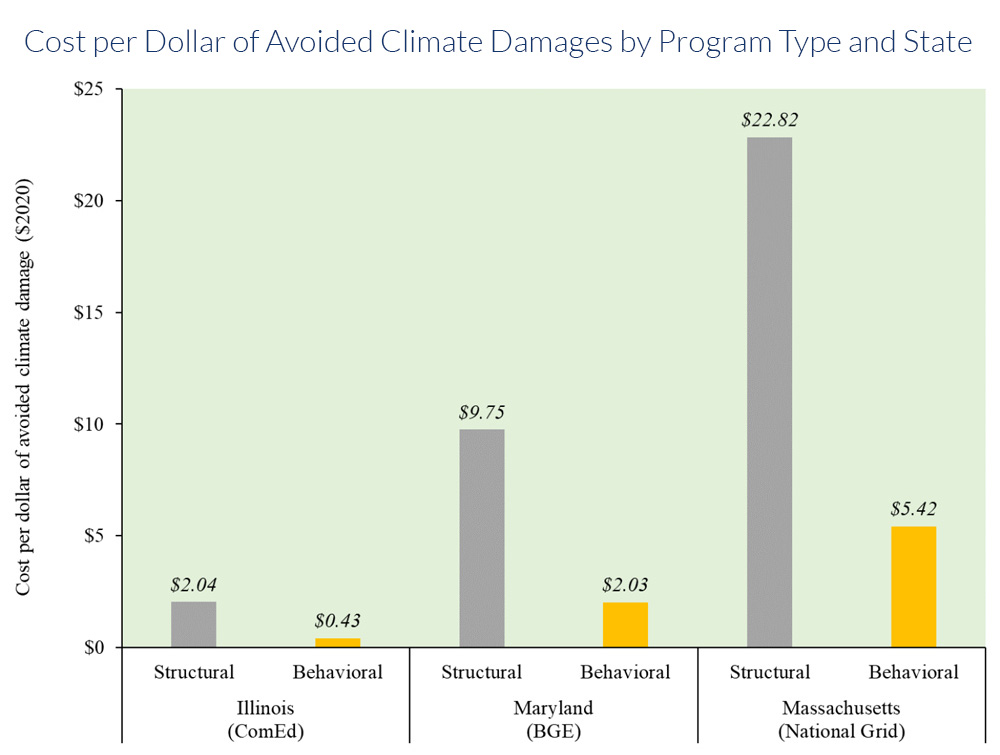
The report compared the cost and impact of structural energy efficiency (SEE) programs, which can require expensive investments out of reach for low- and moderate-income (LMI) residents, with behavioral energy efficiency (BEE) programs, which are free or cheap to implement.
National Grid’s behavioral energy efficiency program could achieve the same aggregate climate change benefits as its structural EE program in less time. | Analysis Group
SEE programs, which generally begin with a home energy audit and require the installation or retrofit of HVAC and other systems, can generate savings for up to 30 years.
BEE programs, which seek to change customer behavior by providing information on energy use and social norming (e.g., comparing one household’s energy use to their neighbors), typically produce savings over a shorter time frame but achieve them more quickly. Buck said behavioral programs can reduce customers’ electric usage by 1 to 2.5%, with smaller reductions for gas customers.
Analysis Group concluded that BEE programs can reduce greenhouse gas emissions faster than SEE programs and at only one-fifth the cost.
And because electricity generation is shifting to less carbon-intensive fuels, reducing electricity usage today avoids more emissions than reducing the same amount in the future, reducing the risk that the climate system will cross dangerous “tipping points.” That means EE programs initiated now will have a higher net present value than those deployed five years from now.
Analysis Group concluded that within six years, National Grid’s BEE program in Massachusetts could achieve the cumulative avoided damages that would take the utility’s SEE program almost 20 years.
One of the advantages of BEE programs is that they automatically enroll customers to receive home energy reports, while SEE programs require a customer to take several affirmative steps (e.g., choosing to participate based on a bill insert, selecting a contractor, selecting and purchasing energy-efficient equipment, etc.). As a result, BEE programs reach more than 10 times as many customers as SEE programs, the research shows.
Behavioral energy efficiency programs can be more cost effective than structural EE programs in reducing damages from CO2 emissions. | Analysis Group
The report found that BEE programs also complement SEE programs, resulting in higher enrollment in the latter.
BEE “is a great gateway drug to demand-side management,” Buck said. “Of course, customers can opt out if they want — but only 1 to 1.5% of customers ever do. And in so doing, you cannot only reach up to 60% of a utility’s service territory with these communications, you can also be very targeted to those low- to moderate-income, those harder-to-reach, market segments.”
LMI consumers save at the same rate as high-income consumers, according to the research. As a result, “energy efficiency stands out among all of the potential ways to decarbonize … that’s consistent with a lot of the states’ equity objectives,” Hibbard said.
While many states have cost caps on their EE programs, five states that invest in the maximum feasible amount of EE — Massachusetts, California, Rhode Island, Vermont and Connecticut — ranked among the top seven states in the 2019 American Council for an Energy-Efficient Economy’s energy-efficiency ratings, Analysis Group said.
Karen Olesky, a staffer with the Nevada Public Utilities Commission who moderated the panel, asked Buck about the potential of BEE programs to grow.
“Had I been sitting here seven, eight years ago when I first joined Opower … I would have had a very different response. It’s been incredibly encouraging in that time to actually see the program grow — just exponentially,” he said. “There were programs when I came up in Southern California that were reaching 75,000 customers at a giant utility. They’re now reaching 2.8 million customers. So we are getting there. We’re starting to get there.”