Major transmission construction will help the grid tolerate increasingly severe weather, but bickering over cost sharing needs to end, panelists said during an American Council on Renewable Energy (ACORE) webinar Thursday.
“Making the grid bigger than the weather is what we need to do to integrate large amounts of wind and solar,” said Grid Strategies Vice President Michael Goggin, author of a report on transmission.
“If you make the grid large enough and strong enough,” Goggin said, imports from neighbors can help a region withstand even the most widespread weather event.
ACORE’s webinar highlighted the Grid Strategies report, “Transmission Makes the Power System Resilient to Extreme Weather.” The report examined five recent extreme weather events and how transmission buildout either helped or could have helped mitigate the severity of the grid emergencies. It concluded that:
During mid-February’s winter storm, each additional gigawatt of tie capability between ERCOT and the Southeast could have saved the Texas grid operator almost $1 billion with power flowing to “hundreds of thousands” of customers.
During an August 2019 heat wave in Texas, each additional gigawatt of tie capability between ERCOT and the Southeast could have saved ratepayers nearly $75 million.
During the Northeast’s “bomb cyclone” arctic blast December 2017-January 2018, each additional gigawatt of interregional transmission ties “could have saved New England, New York and the Mid-Atlantic regions $30-40 million” apiece.
More transmission ties between New England, New York and the Mid-Atlantic region during the 2014 Polar Vortex event would have saved ratepayers tens of millions.
Had MISO and PJM added a gigawatt of transfer capability between their footprints, they could have together saved $2.4 million during the Midwest’s Polar Vortex event in early 2019.
Goggin said MISO and SPP were able to largely keep power flowing during the winter storm because of their well established transmission systems. ERCOT could have greatly reduced the disaster and kept the lights and heat on for hundreds of thousands of customers “had [it] had stronger ties, particularly to the Southeast,” he said.
“Much like we built the national highway system for security and economics, we need to build the national grid,” Goggin said.
Webinar panelists agreed that fast and comprehensive transmission buildout will allow the grid to deliver, even in dire weather.
“I couldn’t agree more with the takeaway that we need more transmission buildout,” FERC Commissioner Neil Chatterjee said of the report. “It’s clear to anyone paying attention that we’re experiencing more frequent and more severe weather events.”
Chatterjee said he’d like to see larger regional and interregional projects built. He said FERC’s Order 1000, meant to foster competition, has “sadly” become a barrier to backbone transmission projects and has instead driven more local projects.
Factoring resilience into transmission planning “makes a lot of sense,” Chatterjee said. He said he hoped that resilience considerations in the planning process could be handled in a “non-political” fashion, especially when dealing with cost allocation.
“In the MISO space, cost allocation is the problem,” said Jennifer Curran, MISO’s vice president of system planning. The RTO’s membership is in the throes of a heated cost-allocation debate over the RTO’s burgeoning long-range transmission plan. (See South Regulators Lambast MISO Long-term Tx Planning.)
Curran said that for resilience benefits to be divvied up in cost allocation, the advantages must be demonstrated in a “believable and consistent” way.
Calls for a National Plan
Independent energy consultant Alison Silverstein said she supports a national, taxpayer-funded macro grid agency to oversee major transmission development.
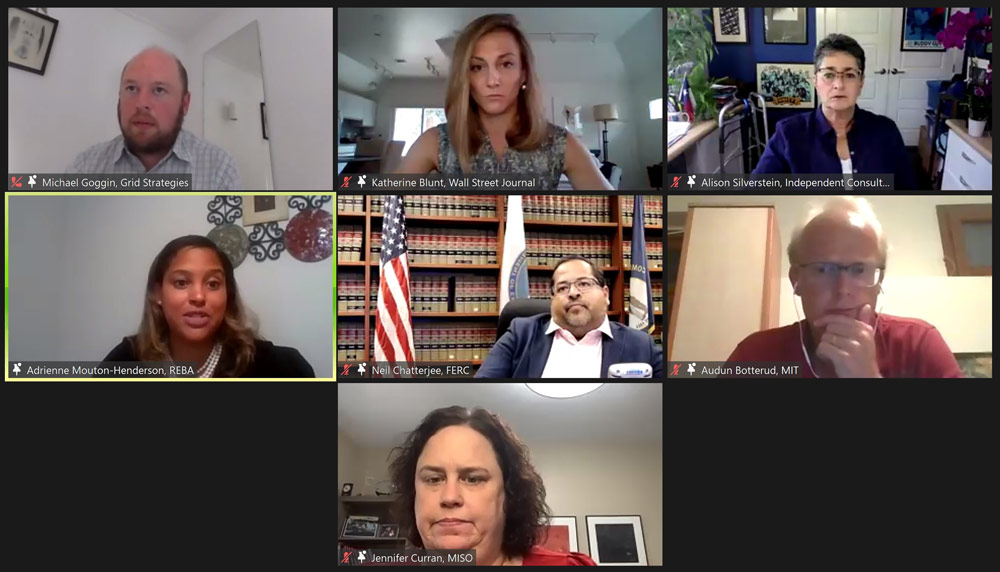
Clockwise from top left: Michael Goggin, Grid Strategies; Katherine Blunt, The Wall Street Journal; Consultant Alison Silverstein; Audun Botterud, MIT; Jennifer Curran, MISO; and Adrienne Mouton-Henderson, REBA. In the center is FERC Commissioner Neil Chatterjee. | ACORE
“RTOs and utilities have been too local, if I can say that of a 15-state footprint. It’s too parochial a set of calculations … for national, massive, long-term grid benefits,” Silverstein said. “We are using process to kill speed. And we are using process to kill production of new transmission to deliver energy.”
Silverstein said it remains to be seen whether Texas will lose its cherished regulatory “sovereignty” over grid decisions.
“I will tell you as an ex-Texas regulator, it’s fun to be king. It’s fun to have your own patch,” she said. But she said Texas has not been eager to share infrastructure costs with other states, “unless we’re going to make out like bandits, like with pipelines.”
“I think the cost of reliability and resiliency is very different region-by-region. We can’t keep piecemealing it … and operating in our own silos,” said Adrienne Mouton-Henderson, deputy director of policy innovation at Renewable Energy Buyers Alliance.
Mouton-Henderson called for a federal-level development of “best practices across the entire United States” to guide grid planning. She said grid planners can no longer afford to ignore intensifying weather threats.
Goggin said transmission belongs in a federal infrastructure bill and that it could be funded in part by the tax code. He said national leadership could use the more progressive income tax to help build transmission instead of the “regressive” method of cost recovery through electric bills. Goggin said that while electric bills vary between economic classes, it’s not by much and it unfairly straps disadvantaged populations with transmission infrastructure costs.
He said MISO’s 2011 portfolio of multi-value projects are a success story of major transmission projects that have broad cost allocation.
“If we continue with the status quo of fighting over who pays for which lines, we’re not going to make progress,” Goggin said.
Curran said extreme weather and renewable penetration muddles the straightforward transmission planning that has occurred thus far.
“We’ve had the luxury of using history to plan for the future,” she said.
Curran said the east-to-west power flows during the February winter storm were highly abnormal and the unusual flows highlight that transmission planners have much more to consider in the future.
“When we designed the transmission, it was designed for west-to-east flows,” she said.
“Trust me, widespread misery accompanied the five days we were out of power,” Silverstein, a resident of Austin, Texas, said.
Silverstein said had ERCOT had just a few hundred megawatts of transfer capability, it could have slowed the rate of frequency decline and secured more time, allowing utilities to better prepare and restore power faster. She reminded the audience that an estimated 700 people died and ERCOT was a mere four minutes away from total grid collapse.
“No one should have to go through those kinds of human trauma” because we don’t have sufficient transmission, Silverstein said.
FirstEnergy (NYSE:FE) has agreed to pay a $230 million fine for its role in the Ohio House Bill 6 scandal, in what federal officials described as the largest bribery scandal in state history.
Federal attorneys on Thursday filed a 49-page deferred prosecution agreement against the company in U.S. District Court in Cincinnati. FirstEnergy is charged with conspiracy to commit honest services fraud but could eventually have the charge expunged from its record with continued cooperation in the case.
FirstEnergy allegedly spent $61 million in bribes and “dark money” campaign contributions and advertising to elect the speaker of the Ohio House of Representatives and allies, who won $1.5 billion in subsidies for the company’s struggling nuclear plants under H.B. 6, passed in 2019.
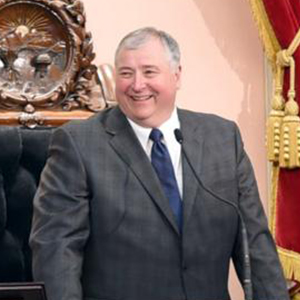
Former Ohio House Speaker Larry Householder | Ohio House of Representatives
Former Ohio House Speaker Larry Householder, FirstEnergy lobbyist Juan Cespedes, lobbyist Neil Clark, former state Republican Party Chair Matt Borges and Householder political strategist Jeff Longstreth were all arrested on racketeering charges almost exactly one year ago. (See Feds: FE Paid $61 M in Bribes to Win Nuke Subsidy.)
The alleged scheme helped pass the bill authorizing zero-emission credits for FirstEnergy Solutions’ (FES) money-losing Perry and Davis-Besse nuclear plants. FirstEnergy no longer owns the nuclear plants after FES emerged from bankruptcy in February 2020 as Energy Harbor.
Within 60 days of the filing, FirstEnergy must pay $115 million to the U.S. government and $115 million to the Ohio Development Services Agency’s Percentage of Income Payment Plan Plus, a program that assists Ohioans in paying their regulated utility bills.
Vipal J. Patel, acting U.S. Attorney for the Southern District of Ohio, said the $230 million fine was the largest in the history of the district and would be a significant deterrent to corporate crime.
“The principle here is trying to come up with a number that stings but doesn’t annihilate,” Patel said.
‘Statement of Facts’
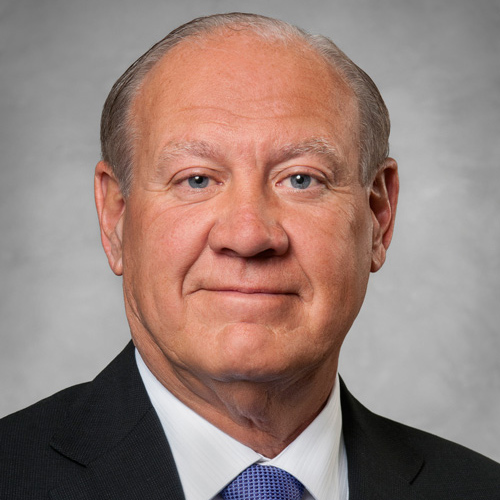
Former FirstEnergy CEO Charles Jones | First Energy
FirstEnergy announced last October it had fired CEO Charles Jones and Michael Dowling, senior vice president of external affairs, after an internal investigation determined they had violated the company’s code of conduct in the alleged scheme. (See FirstEnergy Fires Jones over Bribe Probe.) While not directly named in the deferred prosecution agreement released Thursday, Jones can be identified as “Executive 1” and Dowling as “Executive 2” based on company records and news reports.
Also featuring prominently in the deferred prosecution agreement are Householder, listed as “Public Official A,” and Sam Randazzo, former chair of the Public Utilities Commission of Ohio (PUCO), listed as “Public Official B.” Randazzo resigned in November after the FBI raided his house in Columbus. (See PUCO Chair Randazzo Resigns.)
While many of the high-level details of the alleged conspiracy between FirstEnergy, Ohio government officials and social welfare organizations (501(c)(4)s) had been disclosed in previous court document releases, some new specifics about the case emerged Thursday in the agreement.
Officials said Partners for Progress Inc., which appeared to be an independent 501(c)(4) on paper, was “controlled in part by certain former FirstEnergy Corp. executives, who funded it and directed its payments to entities associated with public officials.” Partners for Progress was incorporated in Delaware in February 2017, just a few weeks after senior FirstEnergy executives traveled with Householder on the company’s private jet to President Donald Trump’s inauguration in January 2017.
The agreement said FirstEnergy executives directed the formation of Partners for Progress and incorporated the entity in Delaware, rather than Ohio, because “Delaware law made it more difficult for third parties to learn background information about the entity.” Before it was officially organized, Dowling directed that $5 million be “designated for an unnamed 501(c)(4) in December 2016.”
Officials said that between 2017 and March 2020, FES paid more than $59 million ($16.9 million attributed to FirstEnergy and $43 million attributed to FES) to Generation Now, the 501(c)(4) entity controlled by Householder, in return for him pursuing legislation to benefit the company. The agreement said the use of 501(c)(4) entities was “central to the scheme” because it allowed FirstEnergy executives and co-conspirators to “conceal from the public the nature, source and control of payments” to Householder.
The agreement said on March 7, 2017, an unnamed “Individual A” emailed wiring instructions for Generation Now to Dowling, saying that “this is the organization that [Jones] and [Householder] discussed.” In his response, Dowling forwarded the email internally and carbon copied Individual A, stating, “Let’s do $250,000 asap, and we will do $1 million by year-end 2017.”
The FirstEnergy payments began in 2017 as Householder began his bid to regain the house speaker role, officials said, which was “consistent with the strategy” that Dowling outlined in an internal presentation. Dowling’s presentation explained that political contributions were “strictly money spent to influence issues of key importance to FirstEnergy in 2017, such as saving our baseload generation” and that FirstEnergy’s “preferred manner of giving is through section 501(c) groups, as these are considered ‘dark money’ because they are not required to disclose where the donations come from.”
In 2017, the agreement said, FirstEnergy, through FES, wired $1 million to Generation Now consisting of four quarterly payments for Householder’s “benefit” following the inauguration trip.
“These payments were intended to contribute to [Householder’s] power and visibility for the speakership and allowed him to support other candidates who would in turn support his speakership,” the agreement said.
In another episode in October 2018, FES paid Generation Now $500,000 to Householder, $400,000 of which was hand-delivered during an in-person meeting. About a week before the payment, officials said, Dowling told Jones, “I know you know this, but this is where companies and people get in political trouble — everyone is in a rush, and they all need a ton of hel$p [sic]. Let me gather everything. I’ll bring it to you, and you/we can decide.”
On the day of the meeting, Jones texted Dowling, saying, “FES meeting with [Householder] today. I told him to be nice but listen to us.”
Dowling replied, “He’ll learn about the $400k at this [meeting],” and Jones responded by saying, “They better get it done quick or he won’t be able to spend it.” Following the meeting, Householder thanked Jones via a text for the money from FES, stating, “$400k… thank you.”
Officials said that when H.B. 6 was signed into law on July 23, 2019, Dowling texted Jones a screenshot showing the bill passing with 51-38 votes and a message that said, “Boom! Congrats. This doesn’t happen without CEO leadership.” Jones responded by saying, “We made a bbiiiiiiiig bet and it paid off. Actually, two big bets. Congrats to you and the entire team! See if [unnamed person] has any Pappy, and we’ll all head to Columbus tonight,” referring to the rare and expensive Pappy Van Winkle’s Family Reserve bourbon.
In February 2020, officials said, Householder approached FirstEnergy about funding a ballot initiative to change Ohio law to increase term limits for Ohio public officials, which would allow Householder to potentially remain in power as speaker for up to 16 additional years.
The agreement said Jones had a text conversation with an unnamed individual, with Jones calling Householder an “expensive friend” after talking to him about his term limit initiative. In the messages, Jones says, “[Householder] told me he’ll retire from there but get a lot done in 16 more years,” with the unnamed individual responding, “Probably more than five previous speakers combined. He will make Ohio great again.”
On March 2, 2020, FirstEnergy wired $2 million from Partners for Progress to Generation Now for Householder’s term limits initiative.
Randazzo’s Part
Besides payments to Householder, officials said FirstEnergy paid more than $4.3 million to Randazzo through his consulting company in return for his actions as chair of PUCO to “further FirstEnergy’s interests relating to passage of nuclear legislation and other specific FirstEnergy legislative and regulatory priorities, as requested and as opportunities arose.”
In December 2018, Randazzo discussed the $4.3 million payment with Jones and Dowling, with the FirstEnergy executives meeting at Randazzo’s condominium, prosecutors said. After the meeting, Randazzo texted Jones and Dowling detailing the remaining payments under his consulting agreement with FirstEnergy from 2019 to 2024.
In the text, Randazzo said, “Thanks for the visit. Good to see both of you,” to which Dowling immediately responded, “Got it, [Randazzo]. Good to see you as well. Thanks for the hospitality. Cool condo.”
Later that day, Jones texted Randazzo and Dowling, “We’re gonna get this handled this year, paid in full, no discount. Don’t forget about us, or Hurricane [Jones] may show up on your doorstep! Of course, no guarantee he won’t show up anyway.” Jones then attached an image of a venomous snake protruding from a hurricane.
Randazzo replied, “Made me laugh — you guys are welcome anytime and anywhere I can open the door. Let me know how you want me to structure the invoices. Thanks.” He then added, “I think I said this last night, but just in case — if asked by the administration to go for the chair spot, I would say ‘yes.’”
After Randazzo was appointed as PUCO chair, officials said, he performed official actions related to H.B. 6 and the elimination of FirstEnergy’s requirement to file a new base rate case in 2024, which the company was seeking.
When H.B. 6 passed in July 2019, Jones sent a “photoshopped” image to Randazzo of Mount Rushmore with the face of Randazzo, Dowling, the “Ohio Director of State Affairs” and “Company C Executive” imposed over the four presidents’ faces. A caption read, “HB 6 FUCK ANYBODY WHO AINT US,” and Randazzo wrote back, commenting that his picture was “smaller than the others.”
In another incident in November 2019, after a PUCO rate case policy change that benefited FirstEnergy, Jones thanked Randazzo through a text message and an image showing the company’s stock increase, saying, “Thank you!!” Randazzo responded, “Ha — as you know, what goes up may come down.”
FirstEnergy Actions
Aside from the wire fraud charge and the deferred prosecution agreement, FirstEnergy also agreed to engage in “appropriate reviews of its existing internal controls, policies and procedures and to address any deficiencies in its internal controls, compliance code, policies and procedures regarding compliance with U.S. law.”
The agreement said FirstEnergy will modify its compliance program, including internal controls, compliance policies and procedures to “ensure that it maintains an effective system of internal accounting controls designed to ensure the making and keeping of fair and accurate books, records and accounts.”
FirstEnergy must also report to the U.S. Attorney’s Office “periodically” during a three-year term regarding “remediation and implementation of the compliance program and internal controls, policies and procedures.” The reports will include “proprietary, financial, confidential and competitive business information.”
“All of these efforts, along with today’s agreement, demonstrate that we are positioned to move forward as a stronger, integrity-bound organization,” FirstEnergy CEO Steven Strah said in a videotaped message to the company on Thursday.
Reaction
Reaction to FirstEnergy’s decision varied from outrage and the assertion that the company is ducking real punishment, to calls for Ohio lawmakers to finish abolishing H.B. 6.
H.B. 6 also created a publicly funded bailout of two aging coal-fired power plants, one of which is in Indiana. The plants are operated by the Ohio Valley Electric Corp. (OVEC), a consortium of utilities including AEP Ohio and Duke Energy.
“A paltry $230 million for admitting to a bribery scheme to gouge consumers for more than $2 billion is a small drop in a very large bucket for FirstEnergy,” fumed Tom Bullock, executive director of the Citizens Utility Board of Ohio.
Bullock said the agreement does nothing to end the $700 million subsidy of the OVEC power plants. H.B. 6 also dismantled energy-efficiency programs aimed at helping consumers save on energy bills.
“For a company that made $1.1 billion last year, this penalty doesn’t seem to sufficiently ‘sting,’ to quote the U.S. Attorney’s Office. This penalty should sting a lot harder if it’s going to discourage corruption,” said Environmental Law & Policy Center Senior Attorney Rob Kelter.
Neil Waggoner, senior campaign representative for Sierra Club’s Beyond Coal Campaign in Ohio, also said the fine was insufficient, calling it “a drop in the bucket compared to the incalculable cost from a loss in trust in the elected officials and regulators who are supposed to safeguard against corruption.” He called upon the governor and the legislature to repeal the OVEC subsidies.
The Ohio Environmental Council Action Fund also used FirstEnergy’s admission as an occasion to push for the complete repeal of H.B. 6.
“Today’s FBI announcement confirmed what we already knew: FirstEnergy bribed former Speaker Householder and former PUCO Chair Sam Randazzo to pass legislation and influence decisions benefiting their bottom line at the expense of Ohioans,” the organization’s president, Heather Taylor-Miesle, said in a statement. “Even with this settlement, ratepayers continue to pay the egregious costs of H.B. 6 and this corruption scandal every month on their electric bills. The legislature has only repealed portions of H.B. 6. Leaving the coal plant subsidies in place fails to restore the public’s trust in the legislative process, hurts Ohioans’ health and pocketbooks, and sets Ohio further back in the fight against climate change.”
Ohio Consumers’ Counsel Bruce Weston, whose agency testified against H.B. 6 and has in recent months waged a legal battle before PUCO to reverse all of FirstEnergy’s subsidies, called the agreement only a beginning.
“Today the public got some justice regarding the Ohio House Bill 6 scandal and FirstEnergy. But justice is also a longer road. And that road should lead to government reforms — reforms that curb the utilities’ political influence. Utility influence has been costing Ohioans money on their utility bills.”
“We are thrilled to see this decision come out today,” said Jason Smith, associate director of advocacy for AARP Ohio. “We have been very concerned from the onset that H.B. 6 did not prioritize consumers and put them first.”
State Rep. Casey Weinstein (D) called for his GOP colleagues, who control both the House and the Senate, to repeal the last remnants of H.B. 6.
“FirstEnergy has undermined the integrity of our democracy while costing Ohioans millions in corruption taxes. We must continue to call for the full repeal of H.B. 6,” he said.
FirstEnergy’s share price spiked upward upon news of the agreement, which was announced the day before the company’s second-quarter earnings call. The company’s stock ended Thursday up $1.61 (4.29%), closing at $38.85.
As Maine solidifies an aggressive stance on climate, energy and equity, one utility regulator wonders if the state’s traditional electric utility ratemaking principles might be outmoded.
A lot of Maine’s policy on renewable energy and carbon reduction will require significant investments that Maine Public Utilities Commission (PUC) Chairman Philip Bartlett says are funded through electricity rates.
That “starts to change the game on how we think about how rates should be allocated and some of the equity and environmental justice issues that come up,” Bartlett said on Wednesday during a Northeast Energy and Commerce Association webinar about environmental justice in New England.
The state’s climate goals, he said, require investments in and incentives for renewable energy as well as modernizing the distribution grid to accommodate distributed energy resources and load growth from electrification of transportation and heating. In addition, the state needs significant transmission system investments to unlock renewable resources, such as wind power in northern Maine.
An ambitious stance from the legislature on climate change is appropriate, Bartlett said, but he also sees a need to reconsider how the costs of achieving those policy goals are allocated to ratepayers who have different abilities to pay.
Under a traditional cost causation approach to ratemaking, regulators seek to ensure a customer’s rates are equal to costs they add to the system. But adding costs for public policy to rates, he said, does not align with the cost causation principle.
“You have to try to assess whether the cost of these policy programs should be allocated in the same way going forward, because there will be individuals and communities that will be disproportionately impacted as we add these costs to electric bills,” he said.
Building equity and environmental justice into the regulatory space also requires giving everyone a voice in the PUC’s work.
“It’s incumbent upon us as an agency to be constantly thinking about what changes need to be made to truly make our processes accessible,” Bartlett said. If people are not confident that their concerns are heard and accounted for, he added, there will be a lot of opposition to the big changes that are coming.
Equity in Regulation
Maine took a significant step this year to require the PUC and other state agencies to consider environmental justice in their work.
In June, Gov. Janet Mills signed LD 1682, which directs the Governor’s Office of Policy and Innovation and the Future to work with agencies to build an equity framework for decision making.
The Maine Climate Council is tasked with leading that effort and bringing a proposal to the legislature next year, Bartlett said.
A council subcommittee on equity meets monthly and already has begun developing its recommendations on equity and inclusion. The committee expects to take the next six months to conduct public engagement and complete its draft recommendations before issuing a final proposal.
The next subcommittee meeting is scheduled for Aug. 19.
Bartlett says that it’s important that the work of the council clarifies what the goals of environmental justice are and how they fit into agency proceedings.
“To be successful in this work, we have to make sure that voices are heard and that we take significant steps to reach out to impacted communities to make sure that we understand the issues, and that we are making decisions that are truly [in] the best interests of the state and all the affected communities,” he said.
Vermont’s Approach
The Vermont Agency of Natural Resources (ANR) is trying to “hit the reset button when it comes to environmental justice,” Deputy Secretary Maggie Gendron said during the webinar.
ANR includes departments for environmental conservation, fish and wildlife, and forest, parks and recreation. To address issues related to climate justice, diversity, equity and inclusion, the agency has an environmental justice working group and a diversity and equity committee. In addition, it has just hired an environmental justice coordinator, Gendron said.
She said community engagement is central to their work. “We’re working with a contractor to support us in developing a strategy to talk to communities and populations in Vermont that is targeted outreach and is not used as a tool of extraction of information,” she said. In that strategy, ANR wants to fold communities into the process of policy and decision making, she said.
Addressing environmental justice across the agency has been exciting and challenging, Gendron said. Each department is at a different stage of incorporating the work into their policies, so Gendron has focused on reassessing the agency’s position and discovering what environmental justice and injustice is to Vermonters.
“We are on what I would say is the front lines of trying to incorporate a lot of the moving pieces and energy within this work and making sure that there’s consistency across our agency,” she said.
ANR also is central to the activities of the Vermont Climate Council, which was authorized by the 2020 Global Warming Solutions Act. The council has five subcommittees, including one for just transitions. ANR Secretary Julie Moore sits on the council and will help put regulations in place that reflect recommendations to be made by the council for meeting the state’s climate and energy targets.
Council members have been working since last fall to build the state’s first climate action plan, which the council expects to adopt in December. All recommendations in that plan must benefit Vermont’s residents equitably and consider impacts of climate change on marginalized communities.
The Just Transitions Subcommittee created a draft set of equity and justice definitions and guiding principles to support the other subcommittees as they build recommendations for the final action plan. (See Expert Tells Vt. Climate Council to Spend More Time on Equity)
The climate council meets on Monday, when it will hear draft recommendations from three of its subcommittees.
The secretary of the Pennsylvania Department of Environmental Protection (DEP) touted an “exciting milestone” this week as the commonwealth continues to promote its renewable energy projects.
DEP recently celebrated the installation of the 1,000th Level 2 electric vehicle charger through the department’s Driving PA Forward program, Secretary Patrick McDonnell told members of the DEP’s Citizens Advisory Council at their monthly meeting. The program is funded through the $118 million settlement set aside from the Volkswagen emissions scandal to support zero- and low-emission vehicles and related infrastructure. (See “Charging Infrastructure Expansion,” Pa. Seeking to Boost EV Sales.)
McDonnell said of the 1,000 chargers installed since the beginning of the program in 2019, 71% are located on privately-owned property, including apartment complexes and companies with large staffs. The remaining 29% are on government-owned properties, including 12 projects installed by the Department of Conservation and Natural Resources (DCNR) at state parks.
Organizations submitting applications for EV installations are provided rebate vouchers after the projects are completed, with funding of up to $4,000 per plug. About $7.7 million is being allocated over a five-year period to fund the program.
McDonnell said the chargers funded by the program can be found at more than 300 locations across 39 counties in Pennsylvania. An additional 140 charging station projects are in progress, which will add more than 500 plugs in 45 of Pennsylvania’s 67counties.
There are now more than 1,600 public Level 2 EV chargers that can be used by any vehicle at more than 800 locations in the state, McDonnell said. McDonnell said the Pennsylvania Department of Transportation has around 28,500 EVs registered in Pennsylvania as of February. Three years ago, that number was a little more than 11,000.
“The time is definitely now to make sure to take advantage of the program,” McDonnell said.
Solar Hub
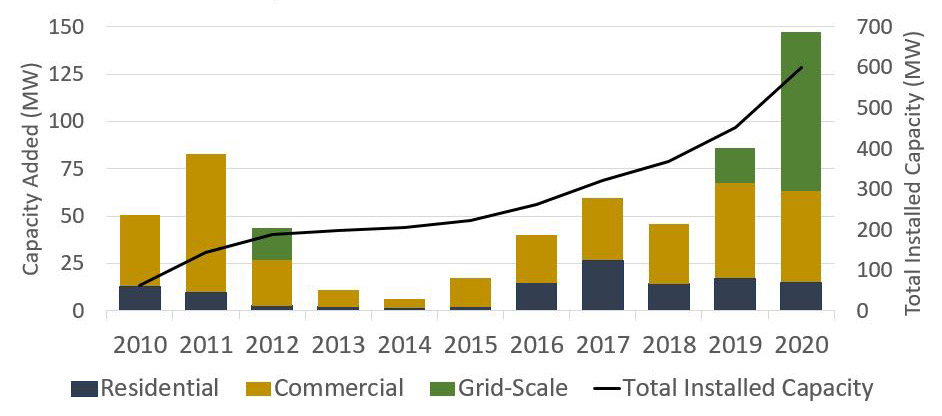
During the Advisory Council meeting, McDonnell also promoted the DEP’s new solar energy resource hub website. McDonnell said the database “covers the evolving solar energy landscape” in the state and was driven by the renewable energy goals set in Pennsylvania’s 2018 Solar Future Plan, which set a goal of obtaining 10% of electricity from in-state solar by 2030.
In March, Gov. Tom Wolf announced that nearly 50% of the electricity used by the state government will be produced by seven new solar energy arrays comprising 191 MW of capacity to be built around Pennsylvania. (See Pa. to Source 50% of Govt. Electricity from Solar.)
Annual solar installations in Pennsylvania continue to grow. | Pa. DEP
“As we see large development of grid-scale solar resources being developed, we felt the need to make sure there was some central location for information,” McDonnell said.
The DEP began pulling together information for residents and businesses in Pennsylvania to “make smart, informed decisions” about siting and deploying solar arrays, McDonnell said. The website contains information for landowners on leasing agreements and land use restrictions as well as a local government page that includes permitting tools, power purchase agreements and model ordinances for grid-scale solar projects.
McDonnell said DEP is working with members of the Penn State Extension to develop more resources for local governments and information for solar developers on permit requirements and land use considerations.
“As we get more resources, we’ll continue to update that page,” McDonnell said.
As distributed energy resources (DER) such as rooftop solar and battery storage spread throughout electric grids and even into utility customers’ homes, industry stakeholders must implement strong safeguards to ensure the data they collect does not fall into the wrong hands, panelists told the National Association of Regulatory Utility Commissioners’ (NARUC) Summer Policy Summit on Tuesday.
Speaking at the “Grid Data: Valuable or Vulnerable?” panel, representatives from industry, regulators and the academic community discussed the difficulty of balancing the need for accurate data about grid conditions — which allows for DERs to be managed safely — with protecting the privacy of those who depend on access to electricity.
“There’s always that tension: Is it an opt-in or is it an op-out kind of situation?” said Jay Balasbas, a member of Washington’s Utilities and Transportation Commission. “A few years ago, our legislature gave us the task of doing some consumer protections for community solar projects with customers, and … one of the questions we [had] in the rules was, how do we deal with that? How do the customers work with vendors and get that information? It’s a very interesting tension, and … it really can go a lot of different ways.”
In response to a question from moderator Dianne Solomon of New Jersey’s Board of Public Utilities about the role of state regulators in deciding what grid data can be made available, Balasbas discussed a Washington statute that mandates that data from customers be considered “valuable commercial information [that] can only be released in very limited circumstances.”
Matthew Green, CIO for PPL Electric Utilities (NYSE:PPL), said his company balances the needs of information and privacy by providing vendors with “contextual data that helps them achieve their goals.” PPL has achieved this balance through a platform that aggregates and anonymizes user information when necessary, so that DER vendors have the information they need for installing their projects but the risk of third parties gaining access to personally identifiable information is minimal.
“As a consumer, I’m sure you’re experiencing all this, where you search for something, and then all of a sudden you get targeted advertisements for that product or service for the next several weeks,” said Green. “I appreciate the ability of leveraging data to provide more customized experiences, but when I’m seeing those types of things without giving consent, I feel like that’s crossing a line.”
Andy Bochman of Idaho National Labs attended the panel remotely. | NARUC
Andy Bochman, senior grid strategist at Idaho National Labs, said that reckless information sharing has problems beyond simply annoying customers. Improperly managing the flow of data can put customers at very real risk of exposure to malicious cyber actors. While utilities must make sure “the good people have access to the data that they need,” they must also make sure that information is “closely held” to protect against security lapses.
“When our folks start to look at … how you would target an entity, the first thing they do is a sweep of open source intelligence, which basically means … everything you can find on websites, from press releases … and elsewhere, where people are bragging about what they bought, how they deployed it, who they partnered with, and other details that maybe each on their own aren’t tremendously helpful, but pieced together can form a picture that can help the adversary,” Bochman said.
Following up on Bochman’s cybersecurity remarks, Trevor Rudolph, vice president for global digital policy and regulation governance at Schneider Electric, emphasized that grid operators and regulators cannot rely on their customers to manage their own cyber risk exposure to the extent that utilities can. Not only do most customers lack the expertise to know when their information is at risk, but also the sheer volume of cyber incidents coming to light may cause a kind of “attack fatigue” that leaves individuals feeling helpless to stop the next incursion.
“My perspective is that the government has a role from a regulatory standpoint … to improve security protections across the board, because I don’t believe that the market can … answer the problem alone,” Rudolph said. “When you have a state of the world where everyone just kind of assumes they’re going to be the next victim, that’s actually quite dangerous, because you fall into a state of complacency. That can put you in an even worse position.”
Developing and updating energy-efficient building codes involves some serious multitasking, said David Nemtzow, director of the U.S. Department of Energy’s Building Technologies Office.
“Buildings generate roughly 35% of U.S. CO2 emissions, so it’s essential that we lower their carbon footprint,” Nemtzow said in his opening remarks at DOE’s National Energy Codes Conference on Wednesday. “We have to do it while simultaneously balancing affordability, energy reliability and social justice and equity. You have to walk, chew gum and probably juggle bowling pins at the same time. There’s a lot being demanded of energy codes and building energy efficiency and the clean energy workforce.”
As part of the conference, DOE rolled out its official “final determinations” of the potential energy savings for the latest updates of two key national building codes. The national standard for commercial buildings, Standard 90.1-2019, will cut overall energy use for these buildings by 4.7% over the previous standard, while the residential standard, the 2021 International Energy Conservation Code (IECC), is 9.38% more efficient than its predecessor.
These codes are the benchmarks and models used for state and local building codes across the country, and DOE is also upping its support and technical assistance to local jurisdictions looking to pass more efficient and rigorous codes. According to DOE, it will be focusing on emerging opportunities for increasingly ambitious codes, as well as workforce training efforts and providing local jurisdictions with a range of technical analyses to quantify the economic and environmental benefits of code upgrades.
Codes providing high efficiency are “one of the easiest things we can do to make progress in our effort to overcome the climate crisis,” Energy Secretary Jennifer Granholm said in a keynote address. “That’s why we want to guide more homeowners and more builders and more developers towards greater energy efficiency by making higher standards and building codes.”
Both Granholm and Nemtzow backed up their pitch for stronger codes with some heavy-hitting numbers. The road to a net-zero economy by 2050 runs right through the country’s 129 million residential and commercial buildings, which use roughly 40% of the nation’s energy, 30% of which is wasted, Granholm said.
“We pay $100 billion per year on energy we don’t actually use, which of course creates needless emissions and dirties our air and worsens the climate crisis,” she said.
Nemtzow provided figures from DOE’s impact analyses, showing that the updated model building codes could provide $138 billion in savings over the next 20 years and reduce carbon emissions by 900 million metric tons.
Compliance
But like most things related to President Biden’s climate agenda, building codes have become highly politicized. While California’s building code requires all new residential construction to be net-zero, Ohio recently joined the 18 other states that have passed laws prohibiting local jurisdictions from enacting codes that ban natural gas hook-ups in new construction. (See Ohio Lawmakers Vote to Block Local Natural Gas Bans.)
And in Congress, Sen. John Barrasso (R-Wyo.), ranking member of the Senate Energy and Natural Resources Committee, is a constant opponent of funding for DOE’s building code programs because he believes the department will promote such bans.
Granholm and Nemtzow stressed that as with most local policies, one size will not fit all, and active, robust stakeholder engagement is critical to ensuring local voices are heard and incorporated into local solutions.
“We’re asking for a commitment from everyone within the building energy codes community,” said Kelly Speakes-Backman, principal deputy assistant secretary for DOE’s Office of Energy Efficiency and Renewable Energy. “That every process at every level is built around inclusiveness; that it provides participation from new and diverse perspectives; that it is equipped to deliver equitable outcomes.”
On a more practical level, one of the main challenges facing advocates of green and net-zero construction at the regional and state level is ensuring compliance and enforcement of their local codes.
“Policies are one thing, but actually complying with those policies is really important if we’re going to be trying to hit these goals,” Alison Lindburg, senior building policy manager for the Midwest Energy Efficiency Alliance (MEEA), said during a later breakout session on state and local building codes.
“There’s a lack of awareness; city staff resources are small and dwindling,” Lindburg said, reeling off a list of the barriers to compliance. “Energy codes are not a priority; that may not mean that a code official doesn’t want to enforce the code, but if he or she has to make a decision on what’s a priority, [the energy code] may be one that falls to the wayside.”
An MEEA survey found that even when officials are enforcing their local codes, enforcement efforts are often uneven. “Some of them had different interpretations of the code,” Lindburg said. “Some code officials were a little bit more lenient on certain code requirements, and some of them just didn’t think that the energy code was a health and safety code.”
While the topic was not directly discussed, the convergence of energy efficiency and a view of buildings as grid-edge assets was one thread of the session. Looking ahead, Lindburg conducted a quick audience survey on the kinds of workforce training that will be needed to effectively implement net-zero building codes. A focus on advanced technologies for energy-efficient building envelopes took the top spot, but expertise on making buildings more grid-friendly — through distributed energy resources and demand flexibility technologies — placed both second and third.
Southern regulators this week didn’t disguise their distaste for MISO’s long-range transmission plan, with one Mississippi regulator drawing comparisons to the much-maligned Entergy System Agreement.
The contentious exchange occurred during Entergy’s Regional State Committee (ERSC) meeting July 20. The meeting was held less than a week after some transmission owners and the Environmental Sector suggested MISO adopt a subregional postage stamp rate. They proposed MISO devise separate postage stamp rates for the Midwest and South to split some costs of its long-range transmission plan. (See MISO Members Revive Debate over ‘Postage Stamp’ Cost Allocation.)
Mississippi Public Service Commissioner Brandon Presley said the postage stamp proposal seemed — “God forbid” — reminiscent of the now-terminated Entergy System Agreement, which allocated production costs among Entergy’s half dozen operating companies under its multistate system from 1982 until 2013. Interpretation of the system agreement has been a source of disagreement at the FERC level for more than a decade. (See La. PSC Complaints Denied in Entergy System Disputes.)
“I’m old enough to remember … the reason this committee was formed,” Presley told other MISO South stakeholders at the ERSC.
He said a postage stamp rate would force some states to pay for the “political choices” of renewable energy goals of other states.
“Tell me where I’m wrong,” Presley said.
MISO Executive Director of System Planning Aubrey Johnson said MISO’s long-term planning is simply based on members’ plans. Currently, more than 95% of MISO members have carbon emissions reduction goals.
Johnson also said MISO South players could advance their own cost-sharing proposals for the long-range transmission plan.
Entergy itself has a net-zero emissions goal by 2050. Entergy Texas CEO Sallie Rainer has said that meeting the goal will initially require replacing coal with solar.
“I think post-2030, it’s going to be all about technology [innovation] helping us,” Rainer said during the Gulf Coast Power Association’s spring conference in April. She said that Entergy is investigating using carbon capture and burning renewable-created hydrogen at its newer natural gas plants at night when renewables aren’t available.
Presley said having reservations about cost allocation on MISO’s long-range plan doesn’t equate to an anti-environmental sentiment.
“From my perspective, that couldn’t be any further from the truth,” he said. “When some of us ask these types of questions about cost allocation, [some say], ‘You must be against goals related to renewable energy development.’ … If you want to have a dictatorship, we’ll stand up and salute MISO. But that’s not how this works.”
“I’m just throwing up the cautionary flag very nicely and politely,” Presley said, adding that a postage stamp treatment could begin to “smell like and look like an Entergy System Agreement.”
“I don’t think anyone wants to go back to those nightmares,” he said, adding that MISO should take care to avoid the “undue and unjustified spreading of costs to just everyone.”
“The increasing of electric rates in Mississippi hurts us more because we’ve got less money than other states,” Presley explained.
Noel Darce, counsel for the Louisiana Public Service Commission, pressed on whether MISO’s long-range plan is really intended to facilitate new wind generation built far from load centers.
“I would not frame it that way,” Johnson responded. He said MISO’s modeling has indicated new resources will be sited all over the footprint, though he acknowledged that some renewable resources would cluster where natural conditions are more optimal.
“Our message throughout all this is: ‘It’s going to be expensive.’ … As we see today, the retirements are actually outpacing our predictions,” Johnson said.
Conservatively, MISO expects 77 GW of thermal generation retirements and 120 GW of mostly renewable additions over the next two decades, Johnson said. He said the added generation will double MISO’s current capacity supply.
Johnson said MISO is not trying to “lean into” one generation technology over another.
“This has to do with member goals. This is about our members’ plans. This is about ensuring the system holds up over the 8,760 hours in a year,” Johnson said.
To accommodate a transformed resource mix, Johnson said MISO must do more than the “very linear” and largely local need-planning focus of MISO’s annual Transmission Expansion Plans.
“With the long-term transmission plan, that’s not how we expect things to flow,” Johnson said. “We recognize that this will be a challenging process.”
Johnson also said MISO’s long-term transmission planning might necessitate upgrades on the lower-voltage system, as the increased transfers could affect smaller systems.
Werner Roth, economist with the Public Utility Commission of Texas, asked if MISO is willing to consider separate cost allocation methodologies for MISO South versus MISO Midwest.
Johnson said MISO will consider alterations, where appropriate, between the regions.
“Ultimately, what we believe is the best cost allocation is the one the most can agree on,” Johnson said.
Johnson said MISO has not yet identified projects that could be readied for the RTO’s approval by the end of this year. He also said the RTO has yet to tackle solution ideas that would directly address the Midwest-South transfer constraint. The subregional postage stamp proposal is predicated on a continued limited transfer capability between Midwest and South.
So far in 2021, flows on the limit moved North-to-South 57% of the time. MISO Independent Market Monitor Jason Fogarty said flows bind most often in the South-to-North direction. MISO’s agreement with SPP and other neighbors restricts flows to 2,500 MW in the South-to-North direction and 3,000 MW in the North-to-South direction.
MISO will hold another stakeholder workshop on its long-range plan July 30.
At an Organization of MISO States meeting on July 21, North Dakota Public Service Commissioner Julie Fedorchak voiced apprehension over her state funding transmission projects that are “hundreds of miles away.”
“Signing on to cost allocation without knowing the impacts to our ratepayers is problematic,” Illinois Commerce Commission Chairman Carrie Zalewski agreed.
The increasingly heated fight over President Biden’s nomination of Tracy Stone-Manning to lead the Bureau of Land Management lurched forward on Thursday with the Senate Energy and Natural Resources Committee deadlocking 10-10 on whether to advance her to the Senate floor.
Noting the “equally divided vote,” committee Chair Joe Manchin (D-W.Va.) said his next step under Senate rules is “to transmit a notice of the tie vote to the secretary of the Senate, after which the majority leader may make a motion to discharge the nomination [and] if the motion is agreed, to place the nomination on the executive calendar.”
In other words, the decision on giving Stone-Manning a full Senate vote is now up to Majority Leader Chuck Schumer (D-N.Y.).
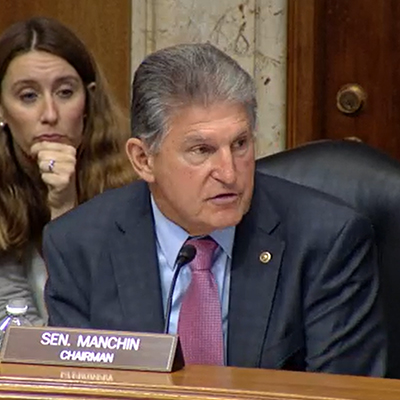
Sen. Joe Manchin (D-W.Va.) | Senate ENR Committee
The committee also voted and moved to the Senate floor four other nominations: Robert Anderson, to be solicitor of the Department of the Interior; Shalanda Baker, to be director of the Department of Energy’s Office of Minority Economic Impact; Samuel Walsh, to be DOE’s general counsel; and Andrew Light, to be assistant secretary of energy for international affairs.
But Stone-Manning’s nomination has become a flashpoint, based on her involvement in a 1989 tree-spiking incident in Clearwater National Forest in Idaho. Republicans are charging that Stone-Manning lied about her role in the incident during the subsequent investigation, both at the time and at her confirmation hearing June 8. Democrats maintain that the legal record shows that she was never charged with any crime and that her testimony helped convict two men who had taken part in the incident.
Tree spiking involves hammering a metal rod into a tree trunk to prevent it from being cut down. If a saw hits the rod, it will shatter, as will the rod, which can cause serious and life-threatening injuries to loggers or employees working at a sawmill. It was mostly associated with the environmental group Earth First! in the 1980s; however, the group later publicly spoke out against it, and Congress made it a federal crime in 1988.
At the time of the 1989 incident, Stone-Manning was a graduate student at the University of Montana. She has admitted to typing a letter warning about the spiking — the original of which may have been given to her by one of men convicted of the spiking — which she then sent to the U.S. Forest Service. In 1993, she was drawn into a grand jury investigation of the crime but later made a deal for limited immunity and testified against the spikers.
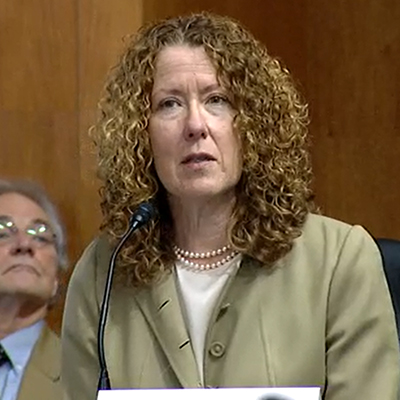
Tracy Stone-Manning | Senate ENR Committee
The incident was not brought up at the June 8 hearing, where she introduced herself as an outdoors woman, hunter and consensus builder who has successfully worked across the aisle on tough environmental issues. GOP senators focused more on her views on oil and gas leasing on public lands and her role in an environmental group’s campaign ads opposing the election of Sen. Steve Daines (R-Mont.), a member of the committee. (See Biden’s Pick for BLM Head Sidesteps Oil, Gas Leasing Questions.)
Sen. Jon Tester (D-Mont.), whom she worked for as a senior aide from 2007 to 2012, supported her nomination at the hearing. Stone-Manning “listens; she works; she does the right thing,” Tester said. “There are places we can mine; there are places we can drill; there are places that are appropriate for resource extraction; there are other places that are not. Tracy Stone-Manning brings that understanding to the table.”
Stone-Manning has also maintained the support of both Interior Secretary Deb Haaland and the White House. As reported in The Colorado Sun on Thursday, Haaland said, “Tracy Stone-Manning has a wealth of experience and knowledge about all issues to do with our public lands. We have full faith that she will put her nose to the grindstone as soon as she’s confirmed with the Senate and work cooperatively with everyone across the federal government.”
The White House said in a statement, “Tracy Stone-Manning is a dedicated public servant who has years of experience and a proven track record of finding solutions and common ground when it comes to our public lands and waters. She is exceptionally qualified to be the next Director of the Bureau of Land Management.”
What the Republicans Said
For GOP members of the committee, the issue was clearly what Stone-Manning knew about the tree spiking and when she knew it. Armed with blown-up images of the 1989 letter Stone-Manning typed and other damaging quotes, and brandishing a metal rod he said was a tree spike, Sen. John Barrasso (R-Wyo.) was relentless.
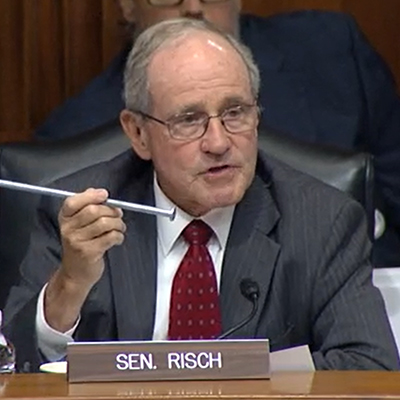
Sen. James Risch, tree spike in hand. | Senate ENR Committee
“Tracy Stone-Manning collaborated with eco-terrorists. She lied to this committee, and she continues to harbor extreme views most Americans find reprehensible,” Barrasso said. “She is thoroughly disqualified from holding the important position of director of the Bureau of Land Management.
“In written questions for the record, I specifically asked her, ‘Did you have personal knowledge or participate in, or in any way directly or indirectly, support activities associated with the spiking of trees in any forest during your lifetime?’ Her response was ‘no.’ Tracy Stone-Manning is lying,” Barrasso said.
Sen. James Risch (R-Idaho), also with tree spike in hand, likened the impact of the rods when shattered by a saw to hand grenades and shrapnel. “It will either kill or injure anyone that is within range,” he said. “That’s what tree spiking is. You put this in a tree to kill somebody.
Sen. Lisa Murkowski (R-Alaska) | Senate ENR Committee
“Somewhere in the deep recesses of her heart and her soul is something so malignant and so bad that she would try to take another life,” Risch said. “If you want to confirm her, you absolutely can, but believe me, this stain on this administration will last for the next three and a half years.”
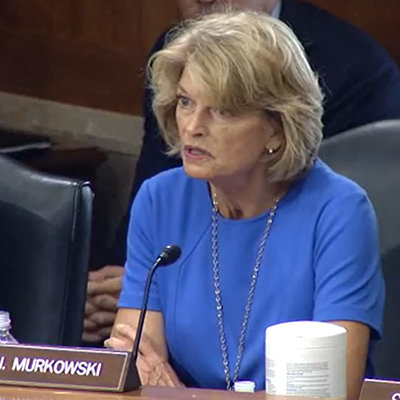
Arriving late at the hearing, Sen. Lisa Murkowski (R-Alaska) said she was disturbed about the allegations but would be opposing her nomination based on significant concerns about “her broader view of [and] understanding of multiple use.”
“When it comes to the multiple-use mandate of the Bureau of Land Management and all that it administers, she doesn’t have the balanced approach that I am looking for in a nominee,” Murkowski said. “It is very clear the bureau is there to manage, but also balance, the use of both renewable and non-renewable resources on our public lands. It does not appear to me that she holds that value of a true balance, and that, in my view, disqualifies her from this office.”
What the Democrats Said
The Democrats countered the Republicans’ blown-up quotes and spikes with an examination of the 1,800-page record of the 1993 grand jury and trial of the men convicted in the tree spiking.
Sen. Martin Heinrich (D-N.M.) | Senate ENR Committee
“I have been unable to find any credible evidence in the exhaustive court trial record at the tree-spiking case that shows that Ms. Stone-Manning was an eco-terrorist, that she spiked any trees, that she conspired with eco-terrorists to spike trees or that she lied to the committee,” Manchin said in his opening statement. “What I find instead is compelling evidence that she built a solid reputation over the past three decades as a dedicated public servant and as a problem solver who brought people together … and that is the evidence on which I will base my vote in support of her nomination.”
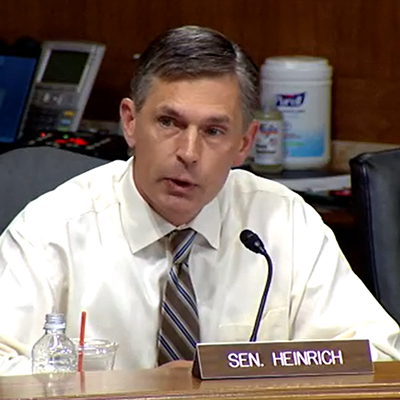
Responding to Barrasso and Risch, Sen. Martin Heinrich (D-N.M.) said the labeling of Stone-Manning as an “eco-terrorist” was “the worst case of character assassination I’ve ever seen on this committee.”
“We know a lot more about domestic terrorism than any of us would like because we had a front row seat to it on Jan. 6 of this year,” Heinirich said, referring to the attack on the Capitol. “And more than a few members of this committee refused to hold the instigator of that responsible, and yet they’re hell-bent on dragging Ms. Stone-Manning’s name through the mud.”
Sen. Maria Cantwell (D-Wash.) | Senate ENR Committee
Sen. Bernie Sanders (I-Vt.) went even further, attacking Republican senators charging Stone-Manning with dishonesty for themselves supporting former President Donald Trump’s false claims of a “stolen election.”
“Why do we have people in this room who are undermining democracy?” Sanders said.
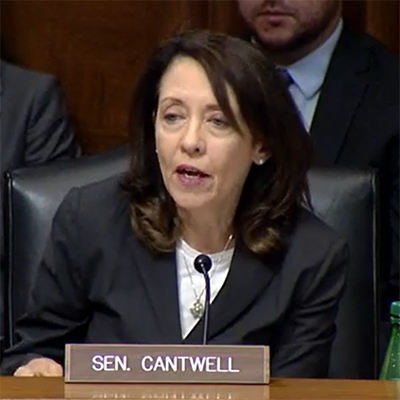
“This vitriol against her is not about Ms. Stone-Manning. What’s really on trial here is the future of America’s public lands,” Sen. Maria Cantwell (D-Wash.) said. “Basically, the issues that are at stake here [are] oil, gas and mineral extraction — and where we’re going in the future.”
With public lands, especially in the West, now under threat from climate change, Cantwell said, “there’s too much at stake we have to get right.” Stone-Manning “is going to work with all of us to move forward on these important issues that are now at a big crisis point.”
NERC’s Standards Committee moved ahead with several standards development projects, while ending another, at a fast-moving meeting on Wednesday.
Members first approved teams to draft standard authorization requests (SAR) for Project 2021-01 (Modifications to MOD-025 and PRC-019) and Project 2021-02 (Modifications to VAR-002). The SAR drafting team for Project 2021-01 includes a chair, vice chair and 10 additional members, while the team for Project 2021-02 has 11 members including the chair and vice chair.
NERC had recommended a slate of 11 members for Project 2021-01, including the leadership, but the committee decided to add more to the team at the suggestion of Robert Blohm from Keen Resources, who noted that NERC’s 11 recommendations came from a slate of 18 industry nominations. Reminding committee members that they had previously discussed encouraging industry participation in standard drafting teams (SDT), Blohm moved to add two of the unrecommended nominees to the team; when this motion failed to receive a second, he revised it to just one additional member, which passed.
Marty Hostler, reliability compliance manager for the Northern California Power Agency, made a similar motion regarding the team for Project 2021-02, calling for one additional member to be added from the pool of nominees not recommended by NERC. However, while Blohm seconded this motion, it failed to carry; other committee members suggested that NERC might wish to save those unrecommended nominees for other SDTs. Consultant Philip Winston moved that NERC’s recommended slate be approved with no changes; this motion passed without objection.
The committee next moved to Project 2020-06 (Verifications of models and data for generators), approving the SARs submitted by the SAR drafting team and naming this team as the project’s SDT. Also accepted was a SAR submitted by ISO-NE proposing modifications to CIP-002-5.1a (BES cyber system categorization) and CIP-014-2 (Physical security); the committee agreed to authorize posting of the SAR for a 30-day formal comment period and assign the SAR to the SDT for Project 2021-03 (CIP-002 Transmission owner control centers).
Finally, committee members voted to reject the SAR for Project 2019-05 (Modifications to PER-003-2) and disband the project’s SDT. Unlike previous occasions on which the committee rejected a SAR — for example, the case of Project 2020-01 in December — this was not caused by any issues with the SAR itself or the drafting team. (See SAR Rejected over Industry Concerns, NERC Standards Committee Briefs: Dec. 9, 2020.)
Instead, the project was ended at the request of NERC’s Personnel Certification Governance Committee, which recently formed a joint task force with the Credential Maintenance Working Group to investigate the potential impact of the proposed changes. The SAR is to be withdrawn until the investigation has been completed and “the joint task force has obtained the necessary technical justification to support NERC’s effort to again move forward.”
A new document from the National Association of Regulatory Utility Commissioners and the National Regulatory Research Institute (NRRI) aims to help state utility regulators deal with issues of resource adequacy.
Presenting the Resource Adequacy Primer for State Regulators to NARUC’s Summer Policy Summit on Monday, Judith Jagdmann — chair of the Virginia State Corporation Commission and first vice president of NARUC — explained that because “resource adequacy is the foundation for providing reliable electric service,” both organizations felt it necessary to provide a guide to help.
“This may be a first for commissioners: We’re not trying to tell you what to do,” Jagdmann joked, further explaining that the document’s “purpose is to assist you in making your own decisions on many of the current and evolving issues of the day.” NARUC and NRRI intended the primer not just for new commissioners and staff who need to get up to speed on the basics of resource adequacy, but also as a handy reference for experienced members of the regulatory community facing topics they may not have encountered recently.
Bird’s-eye View
The primer is divided into three parts. The first provides basic information about the bulk power system, such as generation, transmission, distribution and operational practices, as well as metrics used to evaluate resource adequacy. This includes material on “resource planning, reserve margins, and the responsibilities of state and federal regulators.”
In the second part, NARUC and NRRI lay out how states apply resource adequacy in market and non-market areas around the country. Sections on ERCOT, CAISO, ISO-NE, MISO, PJM, NYISO and SPP are included along with non-market areas of the Western and Eastern Interconnections. Each section covers the general functioning of each area and the entities involved in resource adequacy and planning, as well as region-specific topics such as the impact of rapid wind and solar penetration in Texas and NYISO’s capacity market.
The third part focuses on current and emerging issues across the BPS, divided into two sections:
measuring resource adequacy with an evolving resource mix and changing demand characteristics; and
the interplay between regional and state planning.
In the first section, the authors note “significant and ongoing changes to the resource mix and usage patterns” of the North American grid. Primarily this means the introduction of significant wind and solar generation resources into the system, along with increasing output from demand-side resources such as rooftop solar panels and battery storage, and a rise in extreme weather events. These trends mean that the amount of dispatchable generation has declined significantly, while forecasting demand has become more difficult because of “changing load profiles, behind-the-meter resources, and increasing occurrences of extreme weather events.”
The second section includes discussions of a rise in court disputes in recent years from “the ongoing tension between FERC capacity market rules and state generation policies,” as well as constitutional challenges to state generation policies. For example, one ongoing argument deals with whether FERC can “establish wholesale market rules in ways that negatively impact and potentially frustrate state generation policies.”
Elliott Nethercutt, principal researcher at NRRI, acknowledged that because the primer is meant to be an introduction to resource adequacy, there are many areas that could be explored in greater detail, such as “how those different [state and federal regulatory] levels interact.” Jagdmann added that the hope is for commissioners to use it as a jumping off point for further investigation.
“It’s not going to be everything, but it’s going to give you a beginning and the core components so that you’ll know what’s going on,” she said.