In a direct response to May’s ransomware attack against Colonial Pipeline, the Transportation Security Administration on Tuesday announced that “a number of urgently needed protections against cyber intrusions” will be imposed on operators of “critical pipelines” in the U.S.
The security directive builds on cybersecurity measures issued in the immediate aftermath of the attack, which led Colonial to shut down for nearly a week its entire 5,500-mile network that delivers nearly half of the U.S. East Coast’s supply of gasoline, diesel, jet fuel and other petroleum products. (See Glick Calls for Pipeline Cyber Standards After Colonial Attack.) The FBI attributed the ransomware attack to the Eastern European criminal organization DarkSide, which seems to have gone quiet since a raid by law enforcement that recovered most of the ransom paid by Colonial. (See Colonial CEO Welcomes Federal Cyber Assistance.)
TSA’s earlier measure required owners and operators of critical pipelines to “report confirmed and potential cybersecurity incidents” to the Department of Homeland Security’s Cybersecurity and Infrastructure Security Agency (CISA). They were also required to appoint a cybersecurity coordinator to serve as a single point of contact with federal officials 24 hours a day, seven days a week; review their current cybersecurity practices; and identify and report to TSA and CISA any cyber risks identified, along with related mitigation measures.
The new requirements, developed alongside CISA, mandate that critical pipeline operators and owners:
implement “specific mitigation measures” (not named in TSA’s announcement) to protect against ransomware and other threats to information technology and operational technology systems;
develop and implement a cybersecurity contingency and recovery plan; and
conduct a cybersecurity architecture design review.
TSA defines a critical pipeline as one that “provides primary service to designated critical infrastructure” and constitutes a “single point of failure” — meaning that rendering the pipeline inoperable would leave the critical infrastructure unable to perform its mission.
Operators may also designate pipelines as critical themselves according to more stringent criteria, including whether damage to them could disrupt service to critical national defense facilities, airports or power plants; cause mass injuries or environmental effects; or disrupt the ability of state and local governments to provide essential services for an extended period.
“Through this security directive, DHS can better ensure the pipeline sector takes the steps necessary to safeguard their operations from rising cyber threats, and better protect our national and economic security,” Secretary of Homeland Security Alejandro Mayorkas said in a statement. “Public-private partnerships are critical to the security of every community across our country, and DHS will continue working closely with our private sector partners to support their operations and increase their cybersecurity resilience.”
Cyber Actions Spurred by Colonial Hack
The Colonial attack focused attention on the cybersecurity preparedness — or apparent lack thereof — of the U.S. pipeline system, with multiple recommendations emerging after the hack. For example, the week after the attack FERC Chairman Richard Glick and Commissioner Allison Clements called for “mandatory cybersecurity standards,” similar to NERC’s Critical Infrastructure Protection (CIP), to cover the nation’s pipelines. Glick previously joined then-Chairman Neil Chatterjee for an op-ed in 2019 calling for Congress to reassign responsibility for pipeline security from TSA to a new agency. (See TSA Defends Pipeline Security Practices Before FERC.)
Concrete actions taken by the federal government include an executive order issued by President Biden in May that, among other things, expanded the role of CISA to include reviewing federal agencies’ current cybersecurity requirements, developing future security strategies, and receiving reports of cyber vulnerabilities and incidents from government contractors. (See Biden Directs Federal Cybersecurity Overhaul.)
Biden’s order also created a cybersecurity safety review board led by public- and private-sector officials to investigate incidents and make recommendations for improvements, as well as a pilot for a software supply chain security labeling scheme that consumers can use to judge the safety of software products at a glance.
Avangrid (NYSE: AGR) CEO Dennis Arriola said during an earnings call Wednesday that the company expects the Park City offshore wind project to begin commercial operations in 2026 instead of the 2025 date it previously announced.
Arriola said Park City will begin generating electricity in 2025 and that the shift in the operating date, though pushed to the following year, is “by months, not a year.”
“I think that we’re being conservative here based upon the notice of intent that came out,” Arriola said.
Arriola said he hopes that completing construction of Vineyard Wind I, the 800-MW joint venture between Avangrid and Copenhagen Infrastructure Partners off the coast of Martha’s Vineyard in Massachusetts, for which the U.S. Bureau of Ocean Energy Management approved its final permit in May, will provide “additional synergies and learnings that will adapt to Park City.” Vineyard Wind I will feature 84 turbines and produce electricity starting in 2023 ahead of full commercial operation in 2024.
“I think one of the things that give us confidence that we’re going to get through this again is because we’re the first ones with Vineyard Wind,” Arriola said. “We know how the process works; they’re comfortable with how we provide information, and we’ve learned a lot, and they have as well.”
Avangrid Senior Vice President and CFO Doug Stuver added that 2026 was “always assumed” to be the first full year of operation for Park City despite previous assertions.
BOEM also granted an extension of the operations term for Vineyard Wind I from 25 years to 33 years that also applies to Park City and Vineyard Wind South.
Development of the Kitty Hawk Offshore project off the coast of North Carolina, which has the potential to deliver 2,500 MW of clean energy into Virginia and North Carolina, is progressing, and Arriola said Avangrid expects to receive the notice of intent “soon.” He added that Avangrid has access to lease areas with as much as 7.5 GW of OSW capacity. In terms of future opportunities, Massachusetts has released its third request for proposals for up to 1.6 GW with bids due in September, which is expected to be followed by more than 3 GW in Rhode Island, New York and Connecticut starting next year.
NECEC, PNM Merger Talk
Construction of the $1 billion New England Clean Energy Connect (NECEC) transmission line with Central Maine Power is “ongoing in all parts” after an injunction to halt work on the northern portion of the project was lifted in mid-May. NECEC would span 145 miles with the capacity to carry 1,200 MW of Canadian hydropower from the Maine-Québec border to Lewiston, Maine, where it will connect to the New England Control Area. The HVDC project includes upgrading 50 miles of existing AC transmission and a new converter station and substation. It has an in-service date of 2023, which Arriola said remains “on track.”
Avangrid’s acquisition of PNM Resources also continues to churn along. The New Mexico Public Regulation Commission is the only remaining approval necessary to close the merger. Evidentiary hearings are set for mid-August on the stipulated agreement among PNM, Avangrid and 13 other parties. New Mexico Gov. Michelle Lujan Grisham has also expressed support for the merger.
Arriola said that conversations continue with other stakeholders to have them join the stipulation agreement. He ultimately expects the New Mexico PRC to approve it and for the transaction to close by year-end.
Earnings
Avangrid reported earnings of $122 million ($0.35/share), up $24 million from the same period in 2020 ($98 million; $0.32/share). Avangrid Networks earned $108 million during the quarter, up from $82 million in June 2020. Avangrid Renewables posted earnings of $41 million during the quarter, compared with $30 million in June 2020.
In an era of cyberattacks, difficult-to-predict weather and the ongoing transition from baseload power plants with spinning reserves to intermittently available renewable and distributed generation makes grid resilience a lot tougher to maintain than it once was.
Sophisticated electronics — from embedded sensors to ultra-fast switches and complicated state estimators to give grid operators a realistic view of the system and what it could look like in the near future — are part of the answer. Yet there is a growing sense in the industry that perhaps the most important tool is “human performance.”
Now, a new effort by the Electric Power Research Institute looks at workplace behavior and underlying attitudes — and how they appear to reflect the culture of a workplace, which in turn reflects the business practices of a company.
The study wades through the complexity of human factors in a workplace to show how a company’s overall management and employee culture can produce dangerous mistakes or trouble-free outcomes.
“Human Performance in Electric Power,” an exhaustive statistical analysis of data contributed voluntarily by 13 U.S. power companies, debuted July 15 in a webinar sponsored by NERC.
“Individuals have a personality, but so do organizations, and the thing we’re going to talk about today is how … organizations reflect leaders, and how individuals then respond in the [workplace] context,” said webinar moderator James Merlo, former NERC director of reliability management and now vice president of Knowledge Vine, a human performance consulting company, in introducing the study.
The exhaustive analysis — produced by Eric Bauman, manager of EPRI’s Occupational Health and Safety Programs, and Matthew Hallowell, a teaching scholar at the University of Colorado and executive director of consultancy Safety Function — relies on a complex analysis of data to show the continuous and bidirectional influence of business factors, managerial leadership and resulting employee attitudes on the workplace atmosphere — and ultimately how contingencies are handled.
The analysis itself notes that “safety performance has improved considerably in the past 50 years” but argues that despite an enormous number of studies examining “safety climate,” safety programs and employee perceptions, the research has remained “fragmented and dispersed across industries.”
The analysis starts with the acknowledgement that the safety culture of a workplace reflects what the employees collectively think the company and its managers, including upper management, value. In turn, that employee workplace culture influences the management practices themselves.
“What if you and your CEO, your CRO, your CFO had hard numbers to guide your future safety management investments?” Bauman asked the audience.
“We created this project to get at that challenge: Can we quantify the combined impacts of safety management actions and programs on safety performance?
The study examined and correlated “safety climate,” or what employees think management’s degree of safety emphasis is; “leading indicators,” or what management is doing to address safety issues; and “business factors”: whether safety is a corporate objective. “This is the first-of-its-kind analysis,” Bauman said.
“We thought as we envisioned this project, if we found associations, it would empower health and safety managers with numbers that support potential return on investment in health and safety initiatives,” he added to explain further the objective of the study.
“These initiatives have a higher likelihood of improving your company’s safety performance,” he said of the study’s conclusions. “And it’s not theoretical or belief-based. These are numbers. And that’s the beauty,” Bauman said.
Continuing that theme, Hallowell stressed that all of their number crunching of the employee survey data that they received from participating power companies — along with a meta analysis of existing statistical information — produced results that were not simply opinion.
“We structured the research in a way where we let the data tell us what the findings were. And I think you’ll find that to be really important, because at the end, what you’ll find in the final results that … human factors, prevention through design, and some of these other human-oriented practices or behaviors rose to the top of the many things that we considered. And we have very strong empirical evidence for that.
“What Eric and I were trying to do and in this study was find, of those hundreds of things that we might be able to do to improve safety, what are the few that matter the most, what truly differentiates safety performance.
“As a researcher, as a scientist, I can say, that’s something I think what has been somewhat missing from the human performance side of the world, is that hard empirical data to support the very strong logic, theory and philosophy,” Hallowell said.
Noting that previous studies have repeatedly examined employee attitudes about safety and management safety programs, this analysis also devotes time to an examination of “business factors” that play a less obvious role.
A few examples of the 18 business factors examined include:
Do performance evaluations of upper management include “safety-related considerations?”
Is management stable, or are there changes in leadership?
The frequency of technological changes and whether employees are properly trained for it.
Is safety represented in the company’s organizational structure?
Is there a robust risk management protocol to identify and respond to organizational risks?
Pacific Gas and Electric (NYSE:PCG) proposed the largest undergrounding effort in U.S. history on Wednesday, saying it would bury 10,000 miles of distribution lines in high-threat fire areas of Central and Northern California.
PG&E CEO Patti Poppe made the announcement at a news conference in Chico, near where the PG&E-caused Camp Fire destroyed the town of Paradise in November 2018 and where the Dixie Fire is now burning, possibly sparked by a PG&E line on July 13. (See PG&E Says Its Line May Have Started Dixie Fire.)
“We are here in Chico today because there’s a cloud of smoke in the air, and for many people that brings back traumatic memories and difficult times,” Poppe said. She said she understood that for many worried residents, “the Dixie Fire is a punch to the gut.”
She vowed, however, to make the utility safer after years in which it started catastrophic wildfires that killed more than 100 people, including at least 84 in Paradise.
“PG&E’s commitment represents the largest effort in the U.S. to underground power lines as a wildfire risk-reduction measure,” the company said in a news release.
Undergrounding will reduce the need for public safety power shutoffs, the intentional blackouts that are now a mainstay during the state’s prolonged fire season, PG&E said. It will also reduce the need for vegetation management, it said.
PG&E’s power shutoffs and faulty tree maintenance have subjected it to public outrage and heavy criticism from the federal judge overseeing the utility’s criminal probation stemming from the 2010 San Bruno gas explosion.
The Dixie Fire may have started near where a 70-foot pine tree fell onto a PG&E distribution line, Poppe said.
The Zogg Fire started when a pine tree struck a PG&E line, killing four people in a rural area near Redding, investigators with the California Department of Forestry and Fire Protection determined. (See PG&E Equipment Started Zogg Fire, Investigation Finds.)
Undergrounding often has been dismissed as too costly to perform on a large scale, potentially costing around $4 million per mile. PG&E owns 25,000 miles of overhead distribution lines in high-threat fire areas in the Sierra Nevada foothills and the state’s rugged coastal ranges.
But a series of PG&E demonstration projects have suggested that a massive effort could be possible, with cost savings achieved through scale and falling prices during years of work, Poppe and the utility said Wednesday.
“We don’t have a total price tag because we know it’s going to get cheaper over time,” Poppe said. “It will over time become even more affordable.”
The California Public Utilities Commission would need to approve the undergrounding proposal, and commissioners have repeatedly expressed concerns about rising utility bills as consumers are saddled with the costs of infrastructure upgrades and wildfire-prevention efforts.
Utility operators and regulators are increasingly confident in the ability of their industry to coordinate in response to major catastrophes, participants told the National Association of Regulatory Utility Commissioners’ Summer Policy Summit on Monday.
“Our situational awareness today is light-years more than it was just a few years ago,” Stefan Bird, CEO of Pacific Power, said at a panel titled “Black Sky: Are We Ready?”
“And that information that we have, we’re increasingly sharing on our website, with our customers, with our regulators, and how we interact in technology is giving us all some very exciting new pathways.”
The panel focused on the response of utilities to “black sky” events, defined by NARUC President and panel moderator Paul Kjellander as “a multiregional catastrophic event that affects multiple critical infrastructure sectors for an extended period of time.”
2017’s Hurricane Maria was mentioned repeatedly as a prominent example of such an event because of the devastation it wrought on multiple islands in the Caribbean — particularly in Puerto Rico, which suffered a monthslong electric blackout. Other examples include February’s winter storms in the Midwest, which led to the near collapse of the power grid in Texas. (See ERCOT: Grid was ‘Seconds and Minutes’ from Total Collapse.)
The mass outages in Texas illustrated the “interdependencies of the utility sector,” said David Anderson, CEO of NW Natural. This theme has been touched on by many observers since the crisis, including NERC CEO Jim Robb — who pointed out in a congressional hearing in March that many gas pipelines in Texas exhibited weather-related difficulties in February as well. (See Senators Grill Robb, Asthana over Texas Outages.)
However, this interdependency may have a silver lining in the sense that utilities, more aware than ever that failures in one industry could ripple across the critical infrastructure sector, have greater incentive to work together and help one another restore service. Anderson and Bird both observed that the 2018 explosion of a gas pipeline in British Columbia prompted an immediate response by electric and gas companies in the region, constituting a “core coordination effort amongst all of us,” as Anderson put it.
Regulators Essential to Response
Pennsylvania Public Utility Commission Chair Gladys Brown Dutrieuille participated virtually in the discussion. | NARUC
Regulators have a major role to play in the response to black sky events as well, serving as a neutral third party that can coordinate utilities across industries, regions and even jurisdictions: Anderson praised public utility commissioners for helping prod a recalcitrant Canadian utility into providing crucial information to its peers. Gladys Brown Dutrieuille, chair of the Pennsylvania Public Utility Commission, said the usefulness of PUCs in this job has become increasingly clear to utilities.
“In Pennsylvania, when we do have a big event where we need to bring in all the utilities, our list includes those that we don’t even regulate, because they want to be part of the discussion,” Dutrieuille said. “During those calls we’re talking to the CEOs and the presidents and whatever technical members that they need … and we also include our elected officials. … Everyone wants to be on the call to discuss what it is that we can do, or what they need in certain areas, and discuss all those different things that come along with it.”
This increased willingness to work together with peers and regulators comes at an important time, as panelists noted that changing climate conditions are likely to bring ever more extreme weather events to bear around the world, while a polarized political atmosphere creates its own challenges to cooperation. Utility managers will have to learn to step out of their comfort zones and find help wherever they can.
“Whether it’s Tokyo [or] New Zealand, there’s all sorts of examples around the world that these black swan events are, at least, events that we should all learn from and say, ‘Did I get that right and how do I prepare?’” Anderson said. “I know, at least in our jurisdictions, I can pick up the phone [and] I have no worry that it’s going to be taken out of context, or it’s going to go public when it doesn’t need to go public. I can say, ‘This is the problem I’ve got — how can you help me, and how can I help you?’”
Some New England states are prioritizing climate and energy in their spending plans for federal aid targeted at recovery efforts from the COVID-19 pandemic.
Vermont and Maine leaders have approved $136 million for climate and energy initiatives, and Massachusetts Gov. Charlie Baker wants to spend $400 million on those sectors.
Baker told legislators on Tuesday that he wants to put some of the state’s American Rescue Plan Act (ARPA) funding to work immediately for energy and mitigation measures.
“To support economic development in the offshore wind industry, our [COVID recovery bill (H.3922)] includes $100 million for marine port development,” Baker said in testimony during a Joint Committee on Ways and Means hearing. “Funding would be used to rehabilitate or expand port areas across the commonwealth, particularly those in environmental justice communities, including places like New Bedford, Salem and Somerset.”
Baker introduced the bill at the end of June, and it is now before the Ways and Means committee.
The bill sets out investments for $2.9 billion in federal aid to support economic recovery from the pandemic in the state, leaving an additional $2 billion for allocation in the future.
OSW funding under the bill would support port area improvements or operations and maintenance of facilities where it would promote economic development.
Port improvements could include “projects that would expand the acreage of facilities, reinforce structures, harden storage and laydown areas, and dredge for increased site access,” Michael Heffernan, secretary of the Office of Administration and Finance, said in his testimony.
New Bedford is a hotbed of OSW port activity, most recently seeing its port capacity for project staging doubled through a redevelopment plan with Eversource Energy. The city, which is the sixth largest in the state, has 62 out of a total 87 census blocks that meet the definition of an environmental justice community, according to the Conservation Law Foundation.
Residents of the city stand to benefit from the first project labor agreement for utility-scale OSW, which Vineyard Wind and the Southeastern Massachusetts Building Trades Council announced in New Bedford last week. The deal includes terms to ensure that the workforce comes from the counties of Plymouth, Barnstable, Duke and Bristol, the last of which being where New Bedford is located.
Resilience Measures
The OSW fund is part of $1 billion in ARPA funding Baker wants to put into infrastructure investments across the state.
That package includes $300 million to support resilience and adaptation measures necessary to combat the effects of climate change.
“This funding would be distributed through programs like the Municipal Vulnerability Preparedness program, the Coastal Resilience grant program, and the existing land conservation and parks programs under the Resilient Lands Initiative,” he said.
The Resilient Lands Initiative focuses on, among other things, increasing carbon storage and climate resilience in forests, wetlands and soils.
“These programs have been blessed by the legislature and have proven their worth,” Baker said. “This funding could replace failing municipal culverts and coastal infrastructure across the commonwealth, which has been clearly unable to deal with the rainfall that we’ve seen over the course of the past several months.”
Maine and Vermont
Maine Gov. Janet Mills signed a bill on Monday authorizing about $1 billion in ARPA funding for the state and carving out $76 million through 2023 for climate- and energy-related initiatives.
“The Maine Jobs and Recovery Plan — modeled on the advice of experts, backed by a wide coalition of organizations and supported by funding from the American Rescue Plan — is likely the most transformational proposal of our lifetimes,” Mills said upon signing the bill (LD 1733).
The spending plan includes a $50 million fund for Efficiency Maine Trust to accelerate home weatherization and efficiency upgrades. Initiatives that build GHG emission-reduction strategies for industrial facilities would qualify under the fund. The trust also will help administer an $8 million fund to expand state, municipal and publicly accessible electric vehicle charging infrastructure.
An additional $5 million will support clean energy workforce development programs, and $2.5 million will help establish a clean energy innovation program.
The governor’s Energy Office will help administer an $8 million fund to support electric grid upgrades that directly benefit businesses in areas hit hardest by the pandemic. And $3 million will support research and policy initiatives related to fisheries and OSW development.
In Vermont, Gov. Phil Scott signed a state budget in June that allocated about $250 million in ARPA and general funds for climate change and mitigation measures over the next three years. About $60 million of federal aid will go to home weatherization, energy efficiency, and clean energy workforce and renewable energy development. (See Vt. Governor Signs State Budget with $250M for Climate Mitigation.)
DENVER — FERC Chair Richard Glick brought a desire to improve communications with state regulators and a personal soundtrack to the National Association of Regulatory Utility Commissioners’ Summer Policy Summit on Wednesday.
Taking the stage to the strains of Elvis Costello’s “(What’s So Funny ’Bout) Peace Love and Understanding” — “That’s a song I really like,” he said, explaining his choice — Glick sat down with NARUC President Paul Kjellander for a wide-ranging discussion on the organizations’ joint transmission task force and the challenges facing regulators and the industry.
Kjellander commended Glick for reaching out to NARUC within 24 hours of assuming FERC’s chairmanship earlier this year and setting up phone calls with the other four commissioners. “We’ve been able to have meaningful conversations from the very beginning,” he said.
Glick credited former FERC Commissioner Cheryl LaFleur for stressing the importance of having a strong relationship with NARUC. He said he knew transmission was the perfect issue to find solidarity with the states.
“From my perspective, we can learn more from the states,” Glick said. “Cost allocation, planning, siting … that’s one area we needed to work together, because those are difficult issues. We can’t achieve our goals, the states can’t achieve their goals, if we don’t work together. We’ve laid out a vision, and it’s worked out very well.”
Glick said he has been encouraged by his conversations and overall positive feedback he has been receiving from state regulators. He said he hopes that “solid input” continues with the recently announced joint federal-state task force on electric transmission.
The task force, comprising all five FERC commissioners and 10 state regulators, is intended to spur increased transmission development to deliver renewable power, reduce congestion and improve reliability (AD21-15). (See FERC Sets Federal-State Taskforce to Spur New Tx.) Glick hopes the team can hold its first meeting in November during NARUC’s annual meeting in Louisville, Ky.
“There’s a lot of people at FERC looking forward to working on it,” he said, promising a positive agenda for the meeting.
NARUC has selected 10 nominees to represent the states, divided equally among the organization’s five regions. The nominees were selected from 38 candidates, any of whom would have been equally qualified to serve, Kjellander said.
“I could have put all 38 names on a wall, thrown a dart and hit the perfect candidate,” Kjellander said. “Can I have five more?”
“We could talk about that,” Glick said. He said he would have to talk with the other commissioners, but he promised state regulators other opportunities to stay engaged through the commenting process.
“How can we help you while getting everything we want?” Kjellander jokingly asked Glick. “You can’t throw rocks through the window and expect to be invited for dinner.”
“We have some protesters that throw rocks through our window,” Glick quipped in response, before turning serious.
“Our commissioners are wildly supportive of the [task force],” he said. “There has been some tension between states and FERC. This is a way to work together on some of the issues.”
Glick reminded his audience that they have the ability to go outside Order 1000’s directive on competitive projects. FERC last week opened a rulemaking to reconsider its rules on transmission planning, cost allocation and generator interconnections. (See FERC Goes Back to the Drawing Board on Tx Planning, Cost Allocation.)
“States can do that on their own. They can work with other states; they can work with utilities,” he said. “It’s just a reminder that there are other ways to do this. I hope the states can work together in a voluntary way that doesn’t necessarily involve FERC’s cost allocation and planning processes.”
On Monday, NARUC filed its nominees for the task force. They include:
Pennsylvania Public Utility Commission Chair Gladys Brown Dutrieuille and Maryland Public Service Commission Chair Jason Stanek, representing the Mid-Atlantic Conference of Regulatory Utilities Commissioners;
Kansas Corporation Commission Chair Andrew French and Michigan Public Service Commission Chair Dan Scripps, representing the Mid-America Regulatory Conference;
Vermont Public Utility Commissioner Riley Allen and Massachusetts Department of Public Utilities Chair Matthew Nelson, representing the New England Conference of Public Utilities Commissioners;
North Carolina Utilities Commissioner Kimberly Duffley and Arkansas Public Service Commission Chair Ted Thomas, representing the Southeastern Association of Regulatory Utility Commissioners; and
Idaho Public Utilities Commissioner Kristine Raper and California Public Utilities Commissioner Clifford Rechtschaffen, representing the Western Conference of Public Service Commissioners.
“We look forward to the next steps in the process and creating the much needed federal-state coordination to better serve the public interest,” Kjellander, who chairs the Idaho PUC, said in a statement.
FERC must next officially appoint the state participants from NARUC’s nominees. Those appointed will serve one‑year terms that can be renewed for a total of three years. Their responsibilities will include conducting outreach to other commissioners and commissions in their regions “to ensure the task force receives a broad view of the regional issues.”
FERC, NARUC and state public utility commission staff will support the task force.
“We’re not going to have public statements and go home,” Glick said. “I hope we have a dialogue between meetings. It’s going to take quite a bit of time to sort this out.”
Imagine, sometime in the not-too-distant future, telling Alexa to run your washing machine, and the virtual assistant device, interfacing with an energy management platform, answers back that you will lower your electric bill if you run it in four hours rather than right now.
That scenario, in a nutshell, is what proactive demand-side management (DSM) via a transactive energy market with dynamic, time-varying rates is all about, said Stephen MacDonald, managing director of business development at TeMix Inc. The California company has developed such a platform and tested it in a pilot project with Southern California Edison.
Running for 36 months from 2016 to 2019, the Retail Automated Transactive Energy System (RATES) pilot was designed to demonstrate the technical feasibility for facilitating transactive energy at the retail customer level, MacDonald said during a recent webinar on proactive DSM hosted by the Smart Electric Power Alliance.
Stephen MacDonald, TeMix | SEPA
“The transactive market allows end customers to become active participants in the market, as opposed to passive participation,” he said. That active engagement means customers automatically shift “away from consuming energy when prices are high, which equates to reducing the need for grid services from the utilities. It reduces spinning reserves; it reduces the need for resource adequacy and [provides] more beneficial things for both the grid operator as well as the consumer, meeting clean energy goals and reduction in greenhouse gases.”
The webinar looked at both the critical role of dynamic pricing for unlocking transactive markets and their benefits, and the regulatory challenges of getting dynamic and other time-of-use (TOU) rates approved and widely adopted.
The evidence that TOU rates save customers money is “overwhelming,” said Ahmad Faruqui, principal at The Brattle Group. But only about 10% of U.S. utility customers are on them, he said in his opening remarks during the webinar.
“The rates that are being offered today come across to new customers as unfriendly,” Faruqui said. “Sometimes a peak period is 12 hours long; sometimes the messaging is incomplete. Sometimes the price is so weak — the differential between peak and off-peak — that you can’t save much even if you shift all your load from A to B.”
Another problem, he said, is the possibility of cross subsidies. “Some utilities and commissions are fearful that those people [who] take these rates will instantly save money, so there will be revenue loss, and the question will be how to recover the revenue loss. Then, they say, ‘we have to recover it from other customers,’ and then create a class subsidy.”
While California is in the process of rolling out residential TOU rates, most regulators and utilities have not been willing to make TOU or other dynamic rates the default option for utility customers, Faruqui said. Getting 100% participation for such rates may not be realistic or cost effective, he said, citing what he calls the 80-20 rule.
“If you can get 20 to 30% of your customers on these rates, you’re going to get 80% of the benefits” he said. “Trying to get 90 or 100% of the benefits will be extremely costly, and a lot of inconvenience and political capital will have to be consumed in the process.”
Talking to the House
The RATES pilot was the brainchild of TeMix founder and CEO Ed Cazalet, a former governor and interim CEO of CAISO. He was awarded about $3.2 million in funding for the project from the California Energy Commission in 2016. SCE was not directly involved in the development of the project but provided a letter of support and helped TeMix identify the area north of Los Angeles where utility customers were recruited to participate.
TeMix recruited about 100 SCE customers in the area, with a pitch that avoided talking about transactive energy or dynamic rates. Rather, said Mark Martinez, the utility’s senior portfolio manager for emerging markets and technologies, potential participants were told, “We want to demonstrate how we could be saving money in the future using new technology.”
A transactive tariff with time-varying rates was a critical part of the pilot, based not only on TOU, but on individual customers’ location and the load on the local distribution system, MacDonald said.
“The concept here was … to take the volatility of the wholesale market and develop a tariff that wouldn’t expose customers to that volatility but would actually provide a way for them to take advantage of cost reductions and use automated systems,” Martinez said.
Another unique feature, rather than use an app or log into a computer, customers could interact with the platform using a virtual assistant like Amazon’s Alexa. Once registered, customers interact with the platform, changing settings for the level of savings for different smart devices in their households, “simply by just talking to the house,” MacDonald said. For the pilot, the platform specifically managed and optimized customers’ HVAC and heat pump systems, pool pumps, storage batteries and electric vehicle chargers, according to a final report by the CEC.
While the customers in the pilot were not actually on the transactive tariff — they paid their regular SCE rates — TeMix used it to calculate demand shifting and potential savings. The CEC report shows that in a small sampling of customers, four out of five would have saved money on the RATES tariff, with savings especially strong for those with rooftop solar or other technology, such as a battery or EV charger, allowing demand flexibility. One customer in the sampling without solar or other technologies would have seen bill increases, according to the report.
“What was really kind of neat is that Alexa actually developed a vocabulary for time of use,” MacDonald said. “It understood how different terms are being used, load management and things like that. We were very pleased to see this being developed and look forward to getting more of this type of information out there.”
For SCE, the pilot served as a catalyst, Martinez said. SCE recently issued a request for qualifications for its Distributed Energy Resources Partnership Pilot program, which is aimed at finding out “how we can get distributed energy resources to dispatch in accordance with our grid needs,” he said.
The five-year assessment the utility is planning will examine technologies both in front of and behind the meter, Martinez said. He characterized SCE’s approach as neither running nor crawling, but walking to “be observant, take a situational awareness of what the opportunities and technologies are out there.”
Better Grid Partners
MacDonald and TeMix, on the other hand, are working with “prime movers” — regulators, utilities and original equipment manufacturers — to move toward creating a real transactive market.
California has been rolling out time-of-use rates since 2019, and all three of the state’s investor-owned utilities — Pacific Gas and Electric, San Diego Gas & Electric and SCE — now offer two or more TOU plans to their residential customers, along with traditional volumetric rates based on the amount of electricity used.
In addition, the California Public Utilities Commission in May held a workshop on advanced DER and demand flexibility, during which commission staff presented a future vision for a “unified, universal, dynamic and economic (UNIDE)” system. A roadmap forward included rate reform and optimization of customer energy devices and use, with the goal of widespread demand flexibility.
On the rate side, customers would have universal access to dynamic, real-time electricity prices through home energy management systems that would enable many of the same transactive features as the TeMix platform. A presentation from CAISO at the workshop offered strong support for “greater demand flexibility and new ‘grid informed’ rate options,” as well as “dynamic pricing policies that shift load.”
But MacDonald says it is a chicken-and-egg situation convincing OEMs to integrate transactive platforms, such as TeMix’s, into the front-end controls of their devices, while also pushing utilities to move ahead with dynamic rates. The utilities want to know how many devices will be able to process transactive transactions, while the OEMs want to know how many transactive markets will be out there for their products, he said.
SCE’s incremental approach notwithstanding, Martinez knows the markets are coming. “Customers now are generating their own electricity; they’re storing it; they’re driving it around,” he said. “So, all these technologies really will help not only customers be able to manage their lifestyles, but they can be better partners for the grid. The future is really a linkage. It’s a reliability partnership where we can have customers, with the proper signals and the proper information, able to manage the load on the grid, if there is an issue that needed to be managed.”
MacDonald likens transactive energy markets to other aspects of the shared, digital economy. It is, he said in a phone interview with NetZero Insider, all about incentivizing market participation through monetization. “We have devices that are smart, and we want to monetize them for the owners’ benefit, as opposed to being passive participants,” he said. “Why am I incentivized to get a battery behind the meter unless I’m able to use it optimally to make money? It’s only half the story if I am only doing arbitrage. Monetizing our assets digitally incentivizes and capitalizes on that kind of momentum.”
FERC Commissioner Neil Chatterjee bid farewell and gave thanks to his colleagues and staff during what he said was “very likely” his last monthly open meeting at the commission Thursday.
Chatterjee’s term ended June 30, but by law, he is allowed to remain on the commission until Congress confirms his replacement or the end of the year, whichever comes first. FERC does not hold an open meeting in August.
However, that does not necessarily mean Chatterjee thinks a successor will be confirmed before September’s meeting. On July 8, Chatterjee tweeted that Chair Richard Glick, Senate Minority Leader Mitch McConnell (R-Ky.) and Energy Secretary Jennifer Granholm had all encouraged him to continue serving until he was officially replaced.
“There’s no doubt FERC is best at full strength.” But “there’s a lot to weigh, and I haven’t yet determined my departure date,” he concluded.
Chatterjee ended Thursday’s meeting by thanking a long list of family members and staff for supporting him during a turbulent four years at the commission.
Appointed chair by former President Donald Trump in August 2017 until the confirmation of Kevin McIntyre later in December, Chatterjee was in charge of overseeing a backlog of dockets that had built up over several months in which the commission lacked a quorum. He took over the chairmanship again in October 2018, when McIntyre stepped down because of an illness that would ultimately claim his life. Chatterjee then led FERC through the COVID-19 pandemic, which saw the commission transition to working from home, until Trump demoted him again in November last year in favor of Commissioner James Danly, his own former general counsel. Biden installed Glick upon taking office in January.
“It’s no secret that Commissioner Chatterjee and I have had our differences over a number of issues,” Glick said Thursday. “We have both said a few non-complimentary things about each other during the heat of the battle.” He noted that both of them had come from a background as advisers in the Senate, where members and staff heatedly debate in public while remaining friends. “I value his friendship and advice. He has been nothing but completely gracious in helping me transition into the chairmanship role.”
Glick also noted that Chatterjee, a former adviser to McConnell who initially made no secret of his support for coal plants, “probably unfairly came to this commission with a Capitol Hill reputation as a climate change denier.” But he said he would be leaving with a new moniker: “the New Green Neil.”
Chatterjee said he is not sure what he will do next, but he hopes to have another role in public service.
“I don’t know in what capacity, whether elected, appointed or staff. But I fully intend, should I be able, to return to serving my country at some point in the future. In the meantime, the only definitive plan that I have is to take stand-up comedy classes at DC Improv. … I really want to test it to see if I’m actually funny, or if you guys have laughed at my jokes because of my tenure at the commission.”
POLITICO on July 8 reported that President Biden has narrowed his list of potential nominees to the commission to three: Willie Phillips, chair of the D.C. Public Service Commission; Massachusetts Rep. Maria Duaime Robinson, who represents part of the city of Framingham in the state legislature; and Tom Dalzell, a lawyer who has spent much of his career with the Northern California-based International Brotherhood of Electrical Workers Local 1245.
ERCOT CEO Jones Adds Details to Grid Reliability Roadmap
The new members of the Texas Public Utility Commission have quickly learned that redesigning ERCOT’s deregulated market to add dispatchable generation and accommodate renewable energy will be a daunting task.
As Commissioner Will McAdams put it during the PUC’s open meeting last Thursday, “The commission staff, the staff at ERCOT — it’s fair to say we’re all living on coffee and anger right now with the workload in front of us and reaffirming public confidence in the grid.”
The comments drew a laugh, but the commissioners are serious about getting started on the work that lies ahead. To that end, Commissioner Lori Cobos, fresh off a successful confirmation hearing before the Texas Senate, asked Brad Jones, ERCOT’s interim CEO, to update the PUC on the grid operator’s plans to ensure reliability this summer and its 60-point roadmap to grid reliability. (See ERCOT Issues ‘Roadmap to Grid Reliability’.)
Jones said he has been working on the Roadmap to Improving Grid Reliability for many weeks, leveraging his many relationships within the state to gather ideas from market participants, former regulators, environmentalists and other stakeholders.
“This list is not my list; it’s not ERCOT’s list. It’s the list of many advisers that have worked to put this together,” he said. “I wanted to ensure we reached out to a diverse group so we could get a lot of different ideas of what had to be done within ERCOT to improve ERCOT, and to make sure we are meeting the needs of all Texans in providing a reliable grid.”
Jones focused on three of the roadmap’s 60 items, of which 22 have now been completed, he said. Listing the item numbers from memory, he reminded the commissioners that No. 6 describes ERCOT’s more conservative approach to grid management this summer by increasing the number of operating reserves. (See ERCOT Stakeholders Sign Off on More Ancillary Services.)
“We are operating much more conservatively than we have been before,” Jones said.
Item 50, he said, while “it seems like an innocuous study” (“Conduct a study to gauge the impact of varying levels of wind and solar penetration, including the impact of energy storage and dispatchable energy, as well as revenue adequacy for each of these levels.”), is extremely important and “complete with many activities and many actions.”
Staff will have to identify what kind of dispatchable generation ERCOT needs, Jones said, and ask what attributes there are looking for.
“Is there a duration requirement? Is there a requirement for ramp speed? A requirement for how fast a unit can turn on?” he said. “Those are questions we have to answer. What do we need in the future for balancing wind and solar generation? Once we identify what that is, the question is, how do we provide revenue adequacy for that type of generation?”
Jones also labeled Item 18 as very important. It calls for a process to address transmission limitations in the Lower Rio Grande Valley, including construction of new transmission capacity.
“I believe [the Rio Grande Valley] has been underserved by transmission for more than 15 years. Throughout my career, we in the industry have struggled to make sure we are getting the right resources down to that area,” he said. “It’s a very fast growth area, and it’s been very difficult to stay ahead of that. I’ve asked our team to push in certain areas we have never pushed before.”
Jones said that would mean using the region’s frequent droughts, which can constrain transmission in the valley, as a constant scenario for planning purposes.
PUC Chair Peter Lake commended Jones on the speed and action he has taken since assuming the CEO position and for the “sea change” of conservative operations, which include reliability unit commitments.
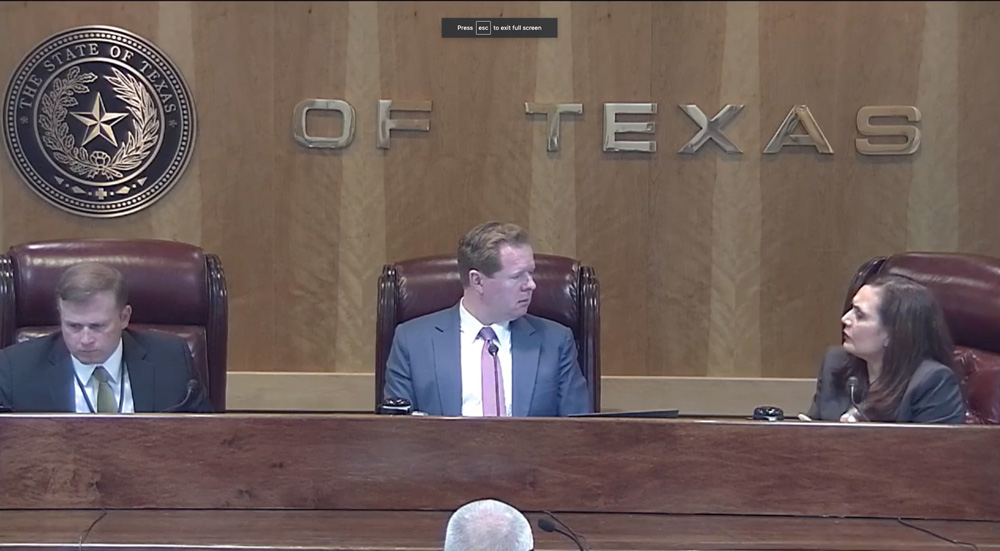
Commissioners (from left) Will McAdams, Peter Lake and Lori Cobos discuss the hard work of redesigning the ERCOT market. | Texas Admin Monitor
“I know it seems it is disruptive to the industry,” McAdams said. “We are all experiencing pushback from the industry as you push forward with the new safeguards.”
Regulators Set Future Work Sessions
The PUC has set a schedule for additional work sessions as it works with ERCOT and stakeholders to turn legislation and political directives into grid protocols and requirements (51617).
Cobos, relying on her previous experience before the commission, suggested staff open a project to evaluate “specific market incentives,” such as potential changes to the operating reserve demand curve, ancillary service products, and other reliability services and price incentives to increase investment in new and existing dispatchable generation.
Gov. Greg Abbott on July 6 filed a letter directing the PUC to streamline ERCOT’s market incentives for dispatchable generation.
The PUC’s current schedule of work sessions includes:
Aug. 12: Weatherization
Aug. 26: Market Design Part II
Sept. 16: Water
Oct. 14: Market Design Part III
Nov. 4: Market Design Part IV
Dec. 9: Emergency Operations Plan
Cooperative CCN Becomes Test Case
The commission used its approval of a certificate of convenience and necessity for a 138-kV Rayburn Country Electric Cooperative transmission line in North Texas to set a template for future requests from cooperatives (50812).
McAdams filed a memo before the meeting, outlining the information the PUC would need from co-ops and suggesting that the commission only approve their transmission facilities if there’s a need in the area that can’t be addressed by a distribution solution. Transmission solutions will be socialized to ERCOT ratepayers, while distribution solutions will be borne by the cooperative’s members.
“It’s a great test case. We’re going to see more of these in the future,” McAdams said.
Cobos agreed, saying McAdams’ memo highlighted the benefits of a co-op pursuing a transmission solution.
“We need to be mindful of ERCOT ratepayer costs that are laid out in every customer’s bill as a line item,” she said.
Return of the Enforcement Division
The commission, after committing to Texas lawmakers that it would reconstitute the enforcement division after it was disbanded last year, will do just that, Executive Director Thomas Gleeson told the commissioners.
The division will be headed by Barksdale English, who previously served as chief of staff to former Commissioner Arthur D’Andrea.
“He’s the right person to frame what enforcement looks like going forward, given his [expertise] on wholesale markets,” Gleeson said. Before joining the commission, English represented Austin Energy on ERCOT’s Technical Advisory Committee.
The PUC will also form a new rules division to handle the 30 or so policies it expects to implement following the recent legislative session. Staff’s David Smeltzer will be the division’s director.
PUC Approves ERCOT Changes
As part of the ERCOT-related bills passed by the Texas Legislature in May, the commission filed an order approving two nodal protocol revision requests (NPRR1080 and NPRR1081) and two other binding document revision requests (OBDRR030 and OBDRR031) that were recently passed by the grid operator’s stakeholders (52307).
NPRR1080 limits the ancillary service market’s clearing prices to the systemwide offer cap of $9,000/MWh, while NPRR1081 requires that ERCOT’s real-time online reliability deployment price adder be adjusted to take firm load shed into account. OBDRR030 accompanies NPRR1080, while OBDRR031 codifies ERCOT’s plans to deploy more operating reserves, and to do so earlier, in anticipation of tight conditions this summer. (See ERCOT Stakeholders Sign Off on More Ancillary Services.)
Effective June 8, protocol changes adopted by ERCOT are subject to commission oversight and review and may not take effect before receiving regulatory approval. New or revised protocols won’t be approved until the PUC approves a market impact statement; staff said ERCOT’s supporting documents included the impact analysis.
McAdams, Cobos to Join RSC, OMS
McAdams and Cobos will join the state regulatory committees for SPP and MISO, respectively. Both RTOs’ footprints extend into the Lone Star State.
McAdams will join RSC’s Regional State Committee, while Cobos said she has agreed to take the PUC’s seat on the Organization of MISO States.
Cobos suggested the commissioners consider switching markets every couple of years so that they are cross-trained on non-ERCOT markets.