Fannie Mae Dominates US Environmental Bonds Market

The U.S. is the largest individual country source for green, social and sustainability (GSS) bonds, but without Fannie Mae, it would drop to third place.

That’s because Fannie Mae issued $94 billion in green bonds between 2011 and March 2021, accounting for more than one-third of the $275 billion in GSS debt U.S. entities issued for that period, according to Caroline Harrison, research analyst at the Climate Bonds Initiative and co-author of the new report Sustainable Debt: North America State of the Market 2021.

By comparison, Canadian entities have issued $35 billion in GSS bonds, putting the total for North America at $311 billion through March, Harrison said during a recent webinar launching the report.

Of that total “87% of that volume was green, and the remaining 13% comprise social and sustainability bonds, which are small but rapidly growing segments of the market,” she said.

Supranational entities, which are formed by two or more governments, are responsible for the most GSS debt in the world — about $425 billion — most of which comes from sustainability bonds, Harrison said. For total issuances, the U.S. ranks behind supranationals with the support of Fannie Mae, and without the mortgage association, it falls behind France and China, she added.

Fannie Mae’s work in the green bond market has focused on multifamily housing for the last 10 years, said Lisa Bozzelli, senior director of multifamily capital markets at Fannie Mae.

“We’ve issued over $95 billion of green, multifamily [mortgage-backed securities] to date, primarily through either a green building certification or a renovation program called Green Rewards, where we focus on energy- and water-consumption reduction improvements,” Bozzelli said during the webinar.

But even with Fannie Mae as a powerhouse for U.S. GSS bonds, there is a lot of room for the market to grow, Harrison said.

“At the end of [the first quarter], total GSS debt from the U.S. constituted 0.6% of the [$46 trillion] local bond market,” she said. In Canada, she added, it’s 0.9%.

Growth Opportunities

While green bonds are the most well-developed of the GSS market in the U.S., social and sustainability bonds experienced rapid growth in 2020 and are keeping pace this year.

Issuances of bonds in the U.S. that promote positive social outcomes now total $14 billion, and the segment represents 5% of the GSS market, the report said. Sustainability bond issuances — those with a combination of green and social projects or activities — now total $21 billion, representing 7.5% of the market.

Municipalities lead the social bond segment, according to the report, which said the Colorado Housing and Finance Authority has 32 social bond tranches. For the sustainability segment, the report said, the private sector is the primary driver, with Google parent company Alphabet sealing a $5.8 billion deal last summer.

The net-zero energy transition and the securitization market could have a “substantial impact on growth dynamics” for North America GSS bonds, Harrison said.

Sustainable debt markets are well-positioned to support an energy transition that is driven by aggressive federal and state policies, she said, adding that the development of new instruments and labels will help.

One example, according to the report, are transition investments, such as sustainability performance-linked bonds (SLB) and bonds labelled as related to the energy transition, which are becoming prevalent. The global market for the two transition investments totaled $35 billion as of the first quarter of 2021.

“Transition financing is intended to broaden the scope of industry sectors that can get involved in the collective decarbonization effort,” the report said. “Many North American companies across the key sectors of energy (generation and utilities) and transport (auto and aviation) appear poised to take advantage of the variety of transition funding mechanisms available to them, including green bonds, SLBs and transition bonds.”

The North American securitization market, which totaled $12.7 trillion at the end of last year, also is “ideally placed” to support a net-zero economy, Harrison said.

The market currently includes commercial mortgage-backed securities, residential mortgage-backed securities, and asset-backed securities (ABS), but Harrison said there are several areas that are ready for expansion, including electric cars and solar power.

Toyota brought three green auto receivables bonds to the market worth $4.6 billion, securing them against the cash flows from existing car leases, the report said. The proceeds financed new leases and loans on hybrid and electric vehicles.

As car purchases shift to zero-emission vehicles in the next 10 years, the report said, green auto receivables that are available for securitization will accelerate.

Solar ABS are the second largest source of green securitization in the U.S., with 44 deals totaling $10 billion. Strong incentives and policy support are in place to help solar grow across the country, which will present a huge opportunity for debt issuances backed by the cash flows of solar assets, the report said.

Market Imperatives

Fostering more GSS bond acceptance in North America will require leaders in the U.S. and Canada to take a more active role in the market, Harrison said.

In the U.S., she said, the federal government “must follow Canada’s lead and announce a green sovereign bond … and incorporate green bonds into the public debt program.”

In addition, she said, the U.S. market needs more diversity in GSS bond issuers.

“Entities from all economic sectors can issue GSS bonds to finance the transition of their activities to protect their revenues from climate risks,” the report said. “And yet, the North American GSS market is totally dominated by agencies and municipalities with very little representation from the real economy, especially heavy emitting sectors.”

That diversity, Harrison said, could be realized through better visibility of the pathways for decarbonizing sectors that are deeply invested in fossil fuels.

She added that more benchmark-size issuances ($500 million-plus), repeat issuances, and better reporting all would help the market.

Better Reporting

Environmentally friendly bonds in the U.S. are not as transparent as they could be, as compared to the global market, according to the report.

“For the sake of transparency and integrity, green, social and sustainability debt issuers commission an external review on the credentials of the use of proceeds before a bond is issued,” Harrison said. “This enables investors to assess whether the instrument complies with expected standards and to determine whether the instrument falls in with their investment objectives.”

While the share of bonds without an external review is decreasing, she said, third-party reviews are the least common among U.S. issuers, “with at least 27% of annual issuance volume not obtaining a review.”

Reporting on the outcomes of GSS bonds, also called impact reporting, is an equally important aspect of GSS bond disclosures, the report said.

The U.S. GSS market should see improvements in the availability and quality of impact reporting in the near term.

“Now that sustainable finance is gaining more traction under the Biden administration, continued development of the U.S. green bond market is likely to bring improving post-issuance disclosure practices from both private and public sector entities,” the report said.


PG&E Says Its Line May Have Started Dixie Fire

Pacific Gas and Electric (NYSE: PCG) said one of its lines may have ignited the 30,000-acre Dixie Fire burning in rugged terrain northeast of Paradise, Calif., a town destroyed by a PG&E-caused fire three years ago.

On July 13 at 7 a.m., “PG&E’s outage system indicated that Cresta Dam off of Highway 70 in the Feather River Canyon lost power,” the utility said in an incident report filed Sunday with the California Public Utilities Commission. “The responding PG&E troubleman observed from a distance what he thought was a blown fuse [on a 12-kV distribution line uphill from him].”

The PG&E worker could not reach the pole until later that afternoon because of a road closure and rugged terrain, PG&E said. Once there, he found two blown fuses and “what appeared to him to be a healthy green tree leaning into the Bucks Creek 1101 12-kV conductor, which was still intact and suspended on the poles. He also observed a fire on the ground near the base of the tree,” PG&E told the CPUC.

The California Department of Forestry and Fire Protection (Cal Fire) sent air support, which arrived by 5:30 p.m. and began dropping water and fire retardant. PG&E de-energized the line. But the fire grew from an acre or two to 10-15 acres that night. By Monday, the fire had exploded to more than 30,000 acres and was only 15% contained, Cal Fire said.

Dixie-Fire-Map-(Cal-Fire)-Content.jpg
The Dixie Fire is northeast of Paradise, a town destroyed by a PG&E-caused fire in 2018. | Cal Fire

The fire is generally burning in remote areas to the north and east, away from Paradise. It has not caused any injuries or damage to structures, Cal Fire said.

On Sunday, Cal Fire investigators seized portions of the 12-kV distribution line “including conductor, jumpers, insulators, and fuse cutouts, as well as portions of the tree,” PG&E said.

“PG&E submits this report in an abundance of caution given Cal Fire’s collection of PG&E facilities in connection with its investigation,” the utility said. “PG&E is cooperating with Cal Fire’s investigation.”

The Dixie Fire is among a dozen large blazes burning in Oregon and California. The largest, the Bootleg Fire in southern Oregon, has grown to more than 300,000 acres. Earlier this month, it caused the near shutdown of the Pacific AC and DC interties, major transmission pathways that supply Columbia River hydropower to California. (See CAISO Declares Emergency as Fire Derates Major Tx Lines.) Much of the capacity of the multiple 500-kV lines has since been restored.

PG&E equipment was blamed for starting major wildfires in 2017, 2018 and 2019. The worst was the Camp Fire that leveled Paradise in November 2018, killing at least 84 people and burning more than 14,000 homes. It was the deadliest and most destructive wildfire in state history.

New Yorkers Oppose NRG Repowering Astoria NatGas Peaker

Members of the public are questioning the necessity and safety of a plan to repower the Astoria natural gas generating facility in Queens, N.Y.

New Yorkers filed 66 separate comments to the Public Service Commission (PSC) by a Monday deadline, all opposing NRG Energy’s revised proposal for its 502-MW Astoria plant. The company proposed replacing the facility’s aging gas and oil-fired turbines with new simple-cycle, dual-fuel peaking turbines fully convertible to hydrogen fuel in the future (20-E-0441).

The PSC’s comment deadline applied to NRG’s request for a modified certificate of public convenience and necessity, based on a 1,040-MW proposal approved in 2010 but never built.

“Nearly a decade after Article 10 was enacted, a supplement to a decade-old environmental impact statement reviewing a completely different project is not sufficient to ensure to the public that this new facility is necessary, safe for the environment and residents of surrounding neighborhoods, and in the public interest,” said the PEAK Coalition, representing the New York City Environmental Justice Alliance, UPROSE, the Point CDC, Clean Energy Group, New York Lawyers for the Public Interest, Sierra Club and Earthjustice.

The state’s Department of Environmental Conservation (DEC), lead agency in the proceeding, on June 30 pronounced the company’s supplemental draft environmental impact statement (SDEIS) and other permit applications complete for the purposes of public review.

In June, DEC said it believes the proposed project would be inconsistent with statewide GHG-emission limits and requested comments on the project’s draft permits by Aug. 29.  (See Proposed NatGas Plants ‘Appear’ Contrary to NY Law, Regulator Says.)

Project Need

NRG spokesman Dave Schrader told RTO Insider that “no combination of renewable technologies available today can, by themselves, reliably power Queens, let alone New York City.”

The project will address reliability needs, reduce electricity costs by more than $1.5 billion in just its first five years of operation, and provide critical black start capability required to restore service following a major power outage, he said.

NRG-Astoria-rendering-(NRG-Energy)-Alt-FI.jpg
An architectural rendering of the 437-MW repowered Astoria power plant, which NRG Energy says would cut peak-day emissions by 98%. | NRG Energy

The Astoria repowering “is estimated to reduce statewide GHG emissions by more than 5 million tons through 2035, and as a long duration backup/standby unit, the project facilitates the reliable interconnection of large amounts of intermittent renewable energy as required by the CLCPA,” Schrader said.

PSC Commissioner Diane Burman at a July 15 meeting said, “It’s a problem if we are being told, ‘say no to gas,’ despite what that means for customers, even if gas offsets much more carbon-intense fuels like oil and diesel.”

The environmentalists’ coalition said that the proposal’s reliance on a future conversion to hydrogen was unrealistic: “First, no commercially available turbines are currently rated to burn 100% hydrogen fuel; all require hydrogen to be blended with natural gas, and most have limits of about 30% hydrogen. … Second, when combusted in power plants, hydrogen presents a different set of environmental and safety concerns than gas, including highly concerning NOx emissions (up to six times those of methane) that have nowhere previously been analyzed.”

The Daily News on July 9 reported Senate Majority Leader Chuck Schumer joining local Queens politicians and activists opposing the plant.

Before the commission can consider this petition, NRG must go back to the Siting Board to seek a determination of whether the current Astoria replacement project is exempt from Article 10 review, the coalition said.

The existing facility has 31 peaking-only gas and oil-fired combustion turbines, including 24 Pratt & Whitney turbines and seven retired Westinghouse turbines, all dating from the early 1970s, which NRG proposes to replace with an efficient, quick start, fast-ramping General Electric H-Class 7HA.03 or equivalent unit that it estimates will reduce peak-day onsite emissions by 98% from current levels.

Risk Perceptions

Queens resident Sirina Nagi said she opposed the project on behalf of her 14-month-old son not so much to stop climate change but to avoid a climate catastrophe.

“Across the United States, people are suffering because our government is refusing to see the bigger picture and invest in our future,” Nagi said. “If my son is to have a future where he can enjoy nature or at the very least continue to inhabit this planet, we need to take our climate commitments seriously.”

Jack Lupo, a New Yorker born and raised in Queens, asked the commission “to oppose this proposed power plant because of the role it can play in making my city, my neighborhood, my home and my family less safe, less secure and less healthy.”

Dr. Sheela Maru, a doctor practicing in Queens and a resident of western Queens, said “I am concerned about immediate and long-term health effects for nearby communities. … Also, people who live in environmental justice communities are more likely to have health conditions that make extreme heat and polluted air from burning fossil fuels or from hydrogen more dangerous and even deadly.”

Rep. Alexandria Ocasio-Cortez (D-NY), whose district includes the plant site, in March sent a letter with nine other members of the state’s Democratic House delegation to Gov. Andrew M. Cuomo and the DEC urging them not to approve a new gas facility that would “degrade air quality in neighborhoods already ridden with toxic fossil fuel power plants and elevated levels of asthma.”

Commitment Deadline Set for SPP West Participation

SPP staff will bring a document before the Board of Directors and Members Committee next week that sets terms and conditions for new and existing members adding their Western Interconnection facilities under the RTO’s tariff.

The document applies to participants in the grid operator’s Western Energy Imbalance Services (WEIS) market, which went live Feb. 1, and who may be contemplating full RTO membership. (See WEIS Market ‘First Step’ to Full RTO Membership.)

“SPP West sets up a foundation to build on that and add additional parties,” Bruce Rew, SPP’s senior vice president of operations, told the Strategic Planning Committee during its July 14 meeting.

“There’s a lot of interest in the RTOs in the West,” he said, pointing to recent directives in Colorado and Nevada that transmission owners join an RTO by 2030. (See Xcel Delays Joining EIM to Examine Options.) “This gives us something to build on. Building on it is a lot cheaper than starting from scratch.”

WEIS-Members-(SPP)-Content.jpg
WEIS members considering RTO membership in SPP | SPP

Assuming board approval, the terms and conditions will only be valid until April 15, 2022. West parties intending to financially commit to the RTO will execute another commitment agreement before that date, with a projected go-live date of March 1, 2024.

The document would establish a single balancing authority encompassing the Western Area Power Administration Colorado-Missouri and Upper Great Plains West BAs. The new SPP BA would become a member of the Northwest Power Pool Reserve Sharing Group.

SPP’s Integrated Marketplace would solve for a single market solution in both BAs across the four DC ties linking the two interconnections. A single FERC Order 1000 planning process would be used in both footprints, and grandfathered service agreements would be converted to SPP service under the RTO’s current process.

Two of the ties are fully subscribed by grandfathered agreements, and a third is nearing the same condition. Rew said a DC tie task force has been formed to work through those issues, and it will present its findings in the fall.

“We know all the reservations. We’re working with those parties to determine what would be appropriate for SPP moving forward,” he said. “The DC ties are an important aspect of how this will operate.”

The document was hammered out by staff and SPP’s Western stakeholders during monthly Members Forum meetings designed to reach agreement on necessary governing document and operational changes necessary for RTO membership. Rew said stakeholders reviewed every page of the SPP tariff and that the terms and conditions have been reviewed by the Regulatory State Commission.

Seven WEIS participants — Basin Electric Power Cooperative, Deseret Generation and Transmission Cooperative, Municipal Energy Agency of Nebraska, Tri-State Generation and Transmission Association, WAPA Colorado River Storage Project, WAPA Rocky Mountain Region and WAPA Upper Great Plains — are evaluating SPP West membership. Colorado Springs Utilities will join the WEIS next April and is also considering RTO membership.

SPP cites an independent study in saying that WEIS participants’ RTO membership will save them $49 million annually: $24.2 million in new savings for current members, and $25.1 million in savings for new Western participants.

The SPC endorsed the document during last week’s meeting.

The committee also endorsed eight of nine recommendations, most of them unanimously, related to SPP’s transmission owner selection process for competitive projects. Only a motion to reduce the incentive points used to grade applications, from 100 to 50, failed to pass, falling 3-8 with three abstentions.

Other endorsed recommendations included setting parameters for the scoring methodology’s implementation, clarifying cost terms and cost estimates, and adding greater transparency to the process by developing a list of items not to be treated as confidential.

A task force working since January to improve SPP’s selection process identified 35 process improvements and issues that have been combined into nine key areas. It will continue its analysis as well as preparing language for revision requests and FERC filings. The team plans to bring a final recommendation to the October governance meetings.

Release 2 of ERO Align Tool Goes Live for All Regions

NERC and all regional entities have gone live with Release 2 of the Align software platform and the ERO Secure Evidence Locker (SEL), the initiative to improve and standardize compliance monitoring and reporting processes across the ERO Enterprise.

According to a statement from NERC, functionality added to Align in Release 2, which took effect on Monday, includes technical feasibility exceptions (TFE), periodic data submittals (PDS), attestations, and self-certifications; the SEL will be used to collect registered entities’ evidence submitted in support of those activities. The new features build on those of Release 1, which covered creating and submitting self-reports and self-logs, creating and managing mitigating activities and mitigation plans, and responding to requests for information. 

Release 1 went live for NERC and select REs on March 31, with the rest of the ERO Enterprise joining by May 24. (See ERO Align Tool Goes Live for NERC, MRO, Texas RE.) For Release 2, all REs are participating from launch with TFE functionality, though only Texas RE went live with all functionalities on Monday. WECC will go live with PDS functionality on Aug. 2 and with self-certifications on Sept. 1. All other REs will add PDS and self-certification on Oct. 1.

As with Release 1, the functionalities added to Align and the SEL will only apply to new cases. Registered entities should continue to process and submit supporting evidence for existing self-reports using their current tools. 

New cases using the monitoring methods covered in Release 3 will also be managed in existing systems until that update goes live. The timing of Release 3 has not been determined; a NERC representative told ERO Insider that it will take place once testing is complete, “probably after October.” Release 3 will cover compliance planning and audits, along with spot checks.

NERC has been working on the Align project since 2014, when it began as the CMEP (Compliance Monitoring and Enforcement Program) Technology Project. The ERO Enterprise had planned to roll the software out in September 2019 but delayed implementation due to concerns about the software vendor’s sale to SAI Global, an Australia-based company whose investors include a private equity firm based in Hong Kong. (See NERC Investigating Chinese Tie to Software Vendor.)

The SEL was not originally planned to be rolled out alongside Release 1, but registered entities requested it be added to the schedule due to security concerns. NERC conceived the SEL to provide secure storage where potentially sensitive information collected as evidence would be kept separate from work papers managed through the Align tool. The SEL is not part of the main Align tool for security reasons, and REs are allowed to construct their own lockers for CMEP evidence as long as they meet the reliability and security specifications provided by NERC last year.

Training materials for Align and the SEL can be found on NERC’s training site, which includes training videos and user guides.

Massachusetts Sets 1st Emission-reduction Goal for Efficiency Program

Massachusetts has set a greenhouse gas emission-reduction goal specific to its upcoming three-year energy efficiency plan.

Energy and Environmental Affairs Secretary Kathleen Theoharides set the new goal in a letter Thursday to the state’s Mass Save efficiency program administrators, as directed by the Climate Act passed this spring.

“Our Mass Save programs will be a key policy driver to meeting our GHG emission-reduction requirements, and the programs must reflect this imperative,” Theoharides said in the letter.

The efficiency plan for 2022-2024, which state regulators will receive in October for their approval, will require the programs to reduce GHG emissions by a total of 845,000 metric tons of carbon dioxide equivalent (MTCO2e). Reductions of 504,000 MTCO2e and 341,000 MTCO2e must be achieved for the electric and natural gas efficiency plans, respectively.

Six utilities develop and administer the Joint State Wide Electric and Gas Three-Year Energy Efficiency Plan. They submit it first to the Energy Efficiency Advisory Council, which has been taking comments on a draft since April. That draft recognizes the state’s aggressive climate goals, but the utilities prepared it before the Climate Act became law, and it does not envision how it will meet a program-specific emission-reduction goal.

A draft resolution by the council on the proposed plan acknowledges that gap. If the council adopts the resolution, it would direct the utilities to further refine the plan to reflect the new reduction goals and submit a revision by Sept. 1.

While the new emission-reduction goals are applicable through 2024, Theoharides considered future timelines in her letter.

The Climate Act requires the secretary to set new goals for subsequent three-year efficiency plans, which will build on the preceding plan reductions. In addition, the act directs the secretary to set interim emissions limits and sector-specific sub-limits every five years, with 2025 and 2030 limits due next July.

Theoharides, therefore, recommended in her letter that the utilities target emissions reductions for 2025 and 2030 in residential and income-eligible and commercial and industrial electric and gas energy efficiency.

The cumulative annual emission-reduction targets for residential and income-eligible electric and gas are 644,000 MTCO2e in 2025 and 542,000 MTCO2e in 2030. For commercial and industrial electric and gas, the targets are 452,000 MTCO2e in 2025 and 303,000 MTCO2e in 2030.

Theoharides noted that meeting the 2025 and 2030 limits and sub-limits will require energy-efficiency measures in the draft plan and its successor to be “sufficiently long-lasting.” And because there is a disconnect between the timelines for the three-year efficiency plans and the five-year emissions limits, she said “the legislature might consider changing the energy-efficiency plans to five-year terms.”

The secretary also set out priorities for how the utilities should achieve emission reductions consistent with a council resolution passed in March. Those priorities include, among other things, significantly increasing the number of buildings that will be retrofitted and weatherized ever year and committing to phasing out fossil fuel incentives.

The council will hold its next meeting on the draft three-year energy-efficiency plan on July 28.

PJM Operating Committee Briefs: July 15, 2021

Non-firm Transmission Service Pre-emption

PJM stakeholders on Thursday endorsed tariff language revisions to exclude the right of first refusal (ROFR) process from the RTO’s evaluation of non-firm transmission service requests.

Jeff McLaughlin, senior lead engineer in PJM’s transmission service department, reviewed the “quick fix” problem statement and issue charge to modify language in section 14.2 of the tariff related to pre-emption of non-firm transmission service at last week’s Operating Committee meeting.

McLaughlin said the quick fix was driven by compliance requirement changes within version 3.2 of the North American Energy Standards Board’s (NAESB) Business Practice Standards, which was adopted by FERC in January 2020 and becomes enforceable on Oct. 27. (See FERC Adopts NAESB Business, Communication Rules.)

An accelerated timeline was needed to make sure PJM’s proposed filing under Federal Power Act Section 205 receives a FERC response prior to the October enforcement date, McLaughlin said, and the RTO is proposing to review and vote on the issue charge and proposed solution after first read at the July 28 Markets and Reliability Committee and Members Committee meetings.

McLaughlin said that because an MC meeting is not scheduled for August, the vote needs to take place at all three committee meetings in July to allow for a 60-day window for a FERC ruling.

“This is an aggressive timeline we’re aiming for,” McLaughlin said. “This accelerated approach wasn’t something we took lightly.”

McLaughlin said the changes caused by the NAESB standards to the ROFR process could result in significant problems for PJM non-firm transmission service processes and OASIS customers. He said the changes create uncertainty for the most frequently used transmission products and could have detrimental impacts to the day-head and real-time energy markets.

New-OASIS-screen-PJM-Content
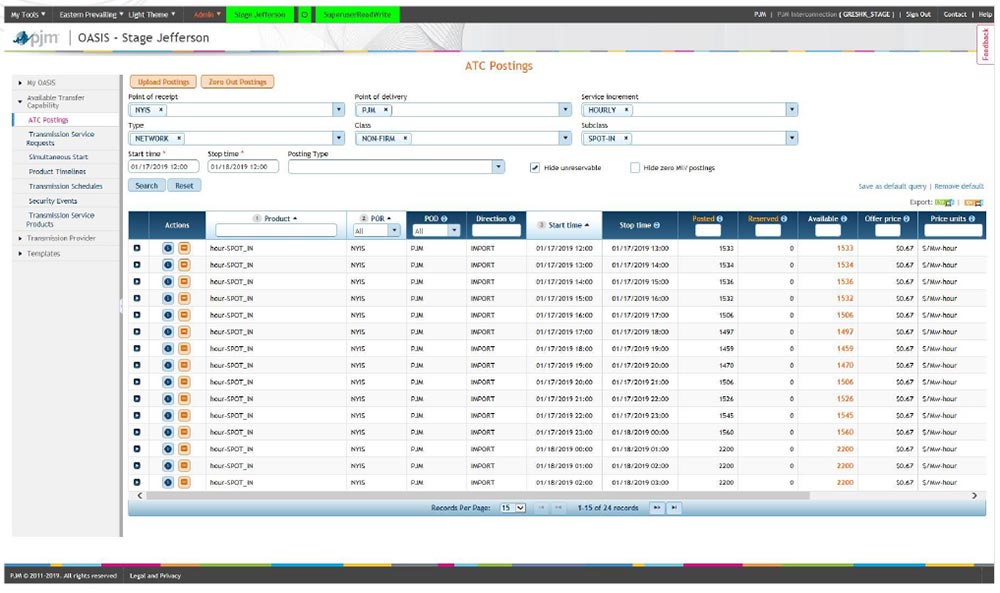
PJM’s OASIS transmission service tool | PJM

PJM employs an automated engine for processing non-firm transmission service requests where customers receive instantaneous evaluations, McLaughlin said, but the pre-emption established by the NAESB standards introduces “significant delays” to the process. McLaughlin said the changes could result in more than two-hour delays for hourly challenger requests and more than 24-hour delays for daily challenger requests.

“It makes the process pretty unmanageable for us,” McLaughlin said.

McLaughlin said transmission service reservations that are procured in smaller increments, such as hourly and daily reservations, are at greatest risk of being pre-empted. He said most of PJM’s service requests fall into this high-risk category, with more than 90% of the 45,000 confirmed requests in 2020 consisting of hourly or daily service granted within 24 hours of the service start time.

“There’s just not a lot of time for the customers to react if they were to be pre-empted,” McLaughlin said.

PJM proposed using section 13.2 of the tariff that already contains language to exclude pre-emption from the evaluation of short-term firm transmission service. McLaughlin said the proposed revisions will extend similar language to section 14.2 of the tariff, excluding pre-emption from non-firm request evaluation.

McLaughlin said the tariff revision will prevent processing delays, minimize “unnecessary customer uncertainty for little benefit” and avoid impacts to the day-ahead and real-time markets.

Once the tariff changes are approved at the MRC and MC, McLaughlin said, PJM will make a Section 205 filing at FERC for a ruling before the October implementation of the NAESB standards.

“We felt this accelerated approach was in the best interest of PJM stakeholders,” McLaughlin said.

Manual 13 Changes Endorsed

Members unanimously endorsed updates to Manual 13: Emergency Operations, making minor changes to several sections.

Brian Oakes, of PJM’s dispatch department, reviewed the proposed changes to Manual 13. Oakes said most of the changes revolve around section 3.2: Conservative Operations, PJM’s emergency protocols to ensure the bulk electric system remains reliable during extreme events.

The manual changes resulted from discussions at the System Operations Subcommittee (SOS) after three declarations of conservative operations were made within the last year.

The first conservative operation declaration took place in August when Tropical Storm Isaias moved through the region and PJM was experiencing unrelated “server issues” at the same time. A second conservative operation declaration was made when a severe winter storm dumped record snowfall amounts on parts of the RTO on Dec. 16-17.

The most recent conservative operations declaration came on Jan. 6 during the attack on the U.S. Capitol. The only other occurrence in the last 10 years of a conservative operations declaration in PJM was September 2018 when Hurricane Florence moved through the region.

The manual language changes include authorizing PJM to conduct SOS conference calls to review and coordinate operations with members.

Other manual changes include updates to Attachment J: Disturbance Reporting. Oakes said the updates were done to reflect changes made by the U.S. Department of Energy to OE-417: Electric Emergency Incident and Disturbance Report, which was updated and renamed to DOE-417 and effective June 1.

The manual changes will receive a vote at the July MRC meeting and will take effect July 28 if endorsed.

COVID-19 Update

PJM is starting to look at allowing dispatch staff to move back and forth the between its two control centers.

Paul McGlynn of PJM provided his monthly update on operation plans in response to COVID-19, saying the RTO is “backing out” of some of the protocols put in place at the beginning of the pandemic.

At the start of the pandemic, McGlynn said, dispatch staff were split between the control centers in Valley Forge and Milford, Pa. McGlynn said the split increased the commute time for some of the staff.

This month, McGlynn said, dispatchers will once again enter a rotation between the two control centers. He said PJM is still maintaining social distancing protocols put in place at the control centers and will continue to follow those protocols “well into the fall.”

“Our intent is to move cautiously,” McGlynn said.

PJM is also starting a pilot program this week to introduce staff back on to its campuses. McGlynn said about 100 employees will return to the Valley Forge campus to test and provide feedback on some of the institutional changes, including temperature-screening kiosks and new technologies employed for meetings.

Paul Sotkiewicz of E-Cubed Policy Associates again inquired if PJM plans on mandating vaccines for its employees, especially for operations and planning staff. Sotkiewicz said he has heard reports about private organizations around the country mandating vaccines for their employees.

“Given the critical nature of PJM’s mission, it just seems like a no-brainer to me,” Sotkiewicz said.

McGlynn said PJM has not changed its policy and will not mandate vaccines for employees. He said staff have been encouraged to get vaccinated, but it will not be mandatory.

McGlynn said there were “many factors” that went into PJM’s decision not to mandate vaccinations.

“It’s a personal decision that people need to make about whether they choose to be vaccinated,” McGlynn said.

NRBTMG Sunset

Terri Esterly, senior lead engineer in PJM’s markets automation and quality assurance department, reviewed the status of the non-retail behind the meter generation (NRBTMG) business rules issue charge worked on at the OC in 2019.

Esterly said through stakeholder efforts on the issue, PJM updated Manual 13: Emergency Operations and Manual 14D: Generator Operational Requirements. The manual updates were endorsed at the September 2019 MRC meeting. (See “Non-retail BTM Generation Rules Endorsed,” PJM MRC/MC Briefs: Sept. 26, 2019.)

The manual updates clarified the reporting, netting and operational requirements of NRBTMG, Esterly said, and included establishing an annual reporting process to determine the total amount of NRBTMG in PJM.

Esterly said PJM’s Capacity Exchange system enhancements were released in 2020 to help facilitate the administration of NRBMTMG requirements.

Stakeholders completed the first three key work activities in the issue charge endorsed in 2019, Esterly said, but key work activity 4 was designed to be triggered only when the total amount of NRBTMG in PJM approaches a 3,000-MW cap.

The total amount of NRBTMG in PJM is posted each year in November, Esterly said, and the totals haven’t approached the 3,000-MW cap. The NRBTMG was 1,171.5 MW in 2019 and 1,186.4 MW in 2020.

PJM is proposing to sunset the NRBTMG business rules issue charge with the intent to bring it back and resume work when the 3,000-MW cap is reached. Esterly said an additional work scope in the issue may be considered in the future if appropriate.

Members will vote on sunsetting the issue charge at the August OC meeting.

PJM PC/TEAC Briefs: July 13, 2021

Planning Committee

CISO Mitigation Language Affirmed

PJM stakeholders voted last week to affirm the amended Operating Agreement language from the RTO’s mitigation proposal endorsed in February to avoid designating projects as critical infrastructure under NERC reliability standards.

The revised OA language passed at last week’s Planning Committee meeting with 134 stakeholder votes in support (87%) and 20 opposing. PJM’s Critical Infrastructure Stakeholder Oversight (CISO) mitigation proposal was originally endorsed at the February PC meeting with 61% support. (See “Critical Tx Infrastructure Proposals Endorsed,” PJM PC/TEAC Briefs: Feb. 9, 2021.)

A group of stakeholders at the April Markets and Reliability Committee meeting voted to remand the mitigation proposal to the PC for further discussions to determine if the revised OA language corresponded with that in the endorsed matrix. (See “CISO Mitigation Update,” PJM PC/TEAC Briefs: June 8, 2021.) Members endorsed the avoidance portion of the PJM proposal at the May MRC meeting. (See “CISO Avoidance Endorsed,” PJM MRC Briefs: May 26, 2021.)

Michael Herman of PJM’s transmission planning department led a discussion on the approved mitigation proposal, including a review of the revised OA language. Herman emphasized that last week’s PC vote was to determine whether the OA language was “in alignment” with the approved matrix and not to rule on the substance of the language itself.

Herman said PJM conducted a review of the OA language with its subject matter and legal experts as part of the development of the mitigation proposal and reviewed changes resulting from stakeholder discussions. He said the RTO based its review on changes made between the first read at the March MRC meeting and discussions the following month, researching whether the concepts were “in alignment” with what was approved in the matrix by the PC. (See “CISO First Read,” PJM MRC/MC Briefs: March 29, 2021.)

Herman said PJM examined the OA language defining a critical substation planning analysis (CSPA) project as a regional or subregional Regional Transmission Expansion Plan (RTEP) project “with an anticipated in-service date of more than three years but no more than five years from the year” in which the RTO identifies the need for the potential CSPA project. Herman said PJM determined that the in-service date language didn’t need to be included in the draft OA language because the concept “respects existing competitive rules and exemptions” that already exist in other parts of the OA and corresponding manual language.

Based on its five-year analysis, Herman said, PJM expects to identify critical facilities prior to the need for any immediate-need projects and felt changes were unnecessary to the proposed OA language.

“We do not anticipate many, if any, immediate-need projects coming through this process,” Herman said.

Erik Heinle of the D.C. Office of the People’s Counsel asked what Herman meant by that statement, specifically the “many” part.

Herman said the mitigation portion of PJM’s proposal is the “second level of protection” of a CSPA process, with the avoidance portion serving as the first level in the process. PJM anticipates performing analysis on all projects that may be included in the RTEP moving forward, Herman said, so updates to the RTEP will be tested individually so that the RTO doesn’t create a critical facility.

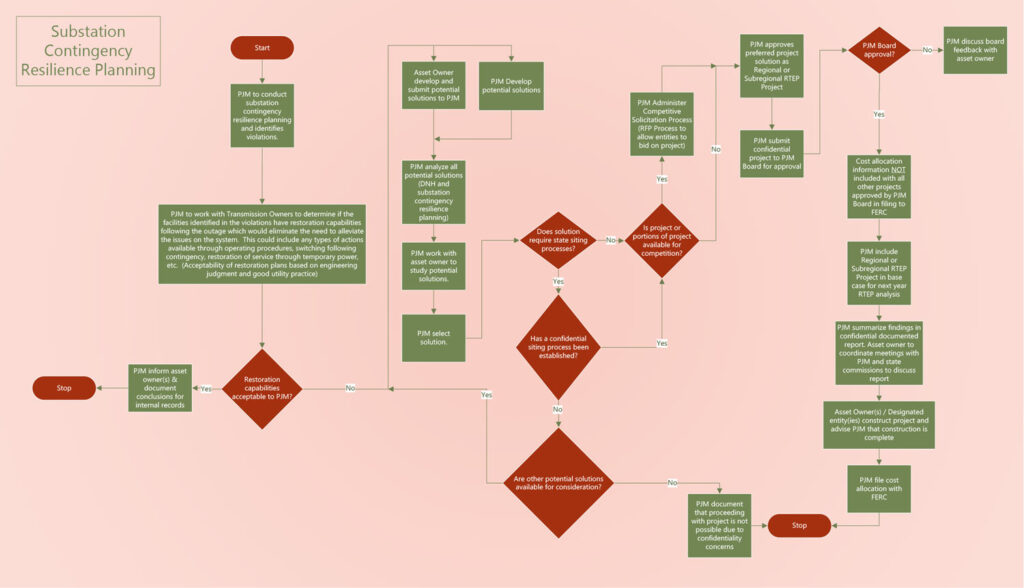
The second OA language piece PJM examined dealt with the RTO’s ability to determine if any component of a CSPA project can be included in a request for proposals window “without disclosing the location of or vulnerabilities associated with the critical substation contingencies and associated facilities.”

Herman said that as part of the competitive process and design component of the matrix, a project will be open to competition as part of an RFP process “if the mitigating solution does not disclose the substation associated with the substation contingency.” He said PJM recommended keeping the existing OA language.

Substation-Contingency-Resilience-Planning-PJM-Content.jpg
Flow chart for “Substation Contingency Resilience Planning” within mitigation efforts for the PJM proposal on future CIP-014 facilities | PJM

“PJM believes that this language is valuable, is helpful and is very much in line with the package approved by the Planning Committee back in February,” Herman said.

The OA language now heads to the MRC for a first read July 28.

Manual 14A Revisions Endorsed

Members endorsed revisions to Manual 14A: New Services Request Process in a “quick fix” process for the close of queue date and application review timing changes. The revisions received 154 “yes” votes (95%).

Onyinye Caven of PJM reviewed the conforming Manual 14A language changes that were originally recommended by the Interconnection Process Reform Task Force as “enhancements to the queue process.” The revisions were first presented at the June PC meeting. (See “Manual 14A Updates,” PJM PC/TEAC Briefs: June 8, 2021.)

Caven said the manual changes impacting the close of the queue window and the deficiency review clock are a result of the new service requests issue charge endorsed at the May PC and MRC meetings. (See “New Service Requests Approved,” PJM MRC Briefs: May 26, 2021.) The proposed tariff changes were reviewed at the PC and MRC and were officially endorsed at the June Members Committee meeting.

The Manual 14A changes were made to align existing documentation with the new service requests proposal, Caven said. Current tariff language states that new service queue windows stay open from April 1 to Sept. 30 and Oct. 1 to March 31, while the proposed tariff language moves up those closing dates to Sept. 10 and March 10, shortening the queue for each respective window.

Currently PJM must review the new service customer’s response to the RTO’s deficiency notice within five business days. The proposed update would require PJM to review the response within 15 business days or “use reasonable efforts to do so as soon thereafter as practicable.”

Changes in the tariff language also include the deletion of the definition of new service queue closing date.

Caven said the Manual 14A updates mirror the proposed tariff language changes. PJM is looking for a final endorsement of the manual language at the July MRC meeting and an effective date of Sept. 1.

Paul Sotkiewicz of E-Cubed Policy Associates said he appreciated the work done by PJM staff to try to find a solution to manage the growing number of new service requests in the queue, but he continues to have concerns about the RTO’s solution. Sotkiewicz said the language revisions don’t solve the existing problem of giving PJM staff more time to review applications and to issue deficiency notices.

Sotkiewicz continued to suggest PJM institute a sliding scale on the cost to review projects, with companies turning in a new service application earlier in the window receiving a discount.

“It’s a Band-Aid on a gaping, open wound,” Sotkiewicz said. “And we’re going to be back here talking about the same problems again.”

Load Model Selection

PJM is recommending a 13-year load model using data from 2001 to 2013 for the 2021 reserve requirement study (RRS), moving the model up one year from the RSS approved for 2020.

Patricio Rocha Garrido of PJM’s resource adequacy department presented the results of the RTO’s load model selection process, which analyzed 120 load model candidates for the 2025/26 delivery year RRS. Rocha Garrido said the analysis was based on the 2021 PJM Load Forecast Report released in January.

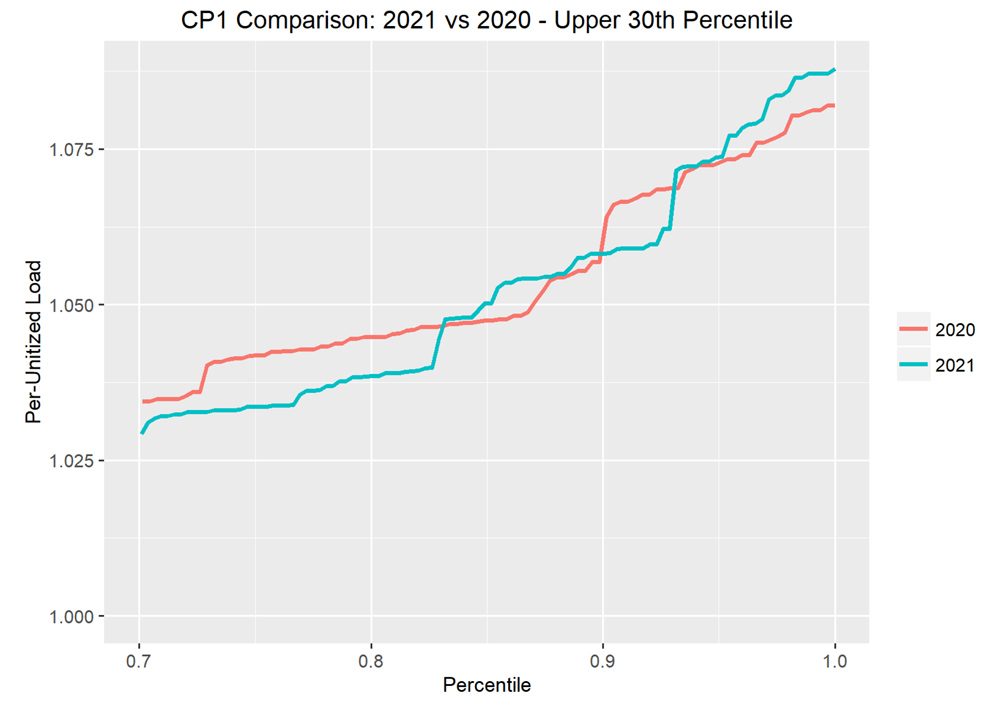
The load model candidates were compared to PJM’s “coincident peak 1” (CP1) distribution analysis, Rocha Garrido said, which represents the highest load expected for the forecast year, using two separate approaches. The previously selected load model, a 13-year model using data from 2002 to 2014, was not one of the top candidates this year, Rocha Garrido said, because of a new CP1 distribution analysis that was “similar, but not identical.”

“The 2021 curve is a little bit more conservative and has higher loads relative to 2020,” Rocha Garrido said.

PJM had used a 10-year load model (2003-2012) for several years in a row before switching to a 13-year model in 2020. Rocha Garrido said the load model selection must be done because the coincident peak distributions from the PJM load forecast cannot be used directly in the PRISM modeling software.

CP1-distribution-analysis-of-2020-vs-2021-(PJM)-Content.jpg
PJM’s “coincident peak 1” (CP1) distribution analysis of 2020 vs. 2021. | PJM

The RTO is also making the recommendation to switch the peak week for the MISO, NYISO, TVA and VACAR regions, known as the “world” in the analysis, to a different week in July that it doesn’t coincide with its own peak.

Stakeholders will vote on endorsement of the load model selection at the August PC meeting.

Manual 20 First Read

Rocha Garrido also provided a first read of a cover-to-cover review of Manual 20: Resource Adequacy Analysis. He said the proposed minor revisions included cleaning up outdated and redundant language and ensuring the manual language follows current PJM processes.

One of the more significant changes included removing the Reliability Pricing Model (RPM) timeline from section 1.2 of Manual 20 because it already exists in Manual 18.

“It’s important to have the clarifying language and to eliminate some unnecessary language, but nothing here is going to shake the Earth,” Rocha Garrido said.

Rocha Garrido said one complication in the Manual 20 changes is a parallel effort currently being conducted at the MRC to update the manuals resulting from discussions addressing the effective load-carrying capability (ELCC) for limited-duration and intermittent resources. (See “ELCC Manuals,” PJM MRC/MC Briefs: June 23, 2021.)

The proposed ELCC changes are in section 5 of Manual 20, Rocha Garrido said, and were not included in the presentation at the PC meeting. He said the changes will be reflected if stakeholders endorse the ELCC manual changes at the July MRC meeting.

The PC will vote on the manual changes at the August meeting.

Transmission Expansion Advisory Committee

Generation Deactivation Notification

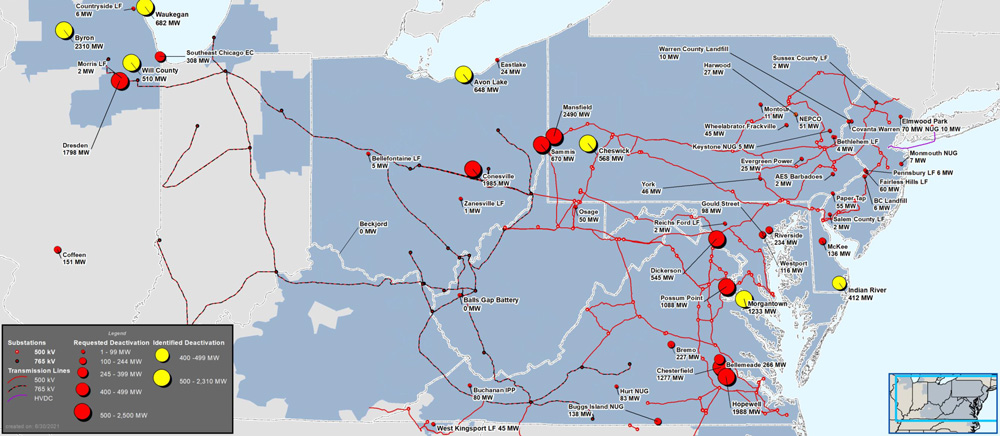
Phil Yum of PJM provided an update on 11 recent generation deactivation notifications totaling more than 6,000 MW.

Houston-based GenOn Holdings requested that Avon Lake 9 Generating Station, a 627-MW coal-fired unit, and Avon Lake 10, a 21-MW oil-fired unit, both located in the American Transmission Systems Inc. (ATSI) transmission zone in Ohio, and the Cheswick Generating Station, a 567.5-MW coal-fired unit in the Duquesne transmission zone in Pennsylvania, all be deactivated on April 1, 2022. GenOn had originally requested a deactivation date of Sept. 15.

GenOn also requested that Morgantown Generating Station Units 1 and 2, 613.3-MW and 619.4-MW coal-fired units located in the PEPCO transmission zone in Maryland, be deactivated on May 31, 2022.

Generation-deactivation-announcements-(PJM)-Content.jpg
Generation deactivation announcements in PJM between 2018-21. | PJM

Yum said PJM and transmission owners identified some reliability violations, but new and existing baseline projects will “resolve” the identified impacts and the units can retire as scheduled.

Reliability analyses are underway for six other generation units, Yum said.

Exelon requested that its two Byron nuclear units, both in the ComEd transmission zone in Illinois, be deactivated Sept. 14 and 16. The company originally announced in 2019 its intention to retire the units and reiterated its intention unless the Illinois legislature passed an energy package with support for the plant by June 15. (See Biden’s Support for Nuclear ‘Too Late’ to Save Exelon Plants.) The legislature did not, and Exelon notified PJM about the deactivation the following day.

NRG Energy requested that its Indian River 4 Generating Station, a 411.9-MW coal-fired unit in the Delmarva Power and Light transmission zone in Delaware, be deactivated on May 31, 2022. NRG also requested that the coal-fired Waukegan Generating Station Units 7 and 8 and the 510-MW coal-fired Will County Generating Station Unit 4, all located in ComEd, be deactivated the same day.

PJM MIC Briefs: July 14, 2021

Regulation Mileage Ratio Delayed

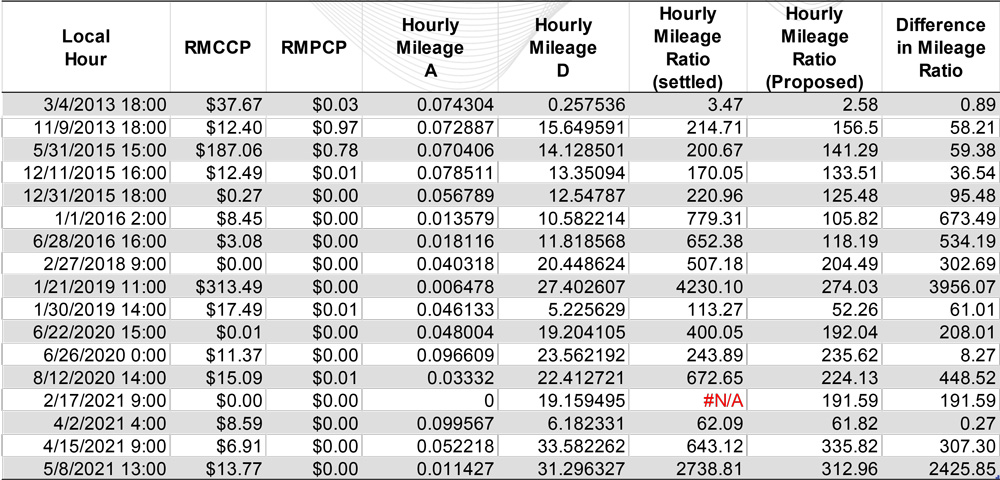
PJM stakeholders on Wednesday unanimously voted to amend the RTO’s issue charge seeking to address the calculation of regulation mileage ratio, asking for more time to discuss the issue.

Carl Johnson of the PJM Public Power Coalition requested to add a friendly amendment to the PJM proposal, amending the issue charge to remove the suggested “quick fix” process and instead handle discussions under an abbreviated consensus-based issues resolution (CBIR) process at last week’s Market Implementation Committee meeting. Johnson suggested working on the regulation mileage ratio issue over the course of two more MIC meetings and then take a stakeholder vote in October.

PJM had been seeking to work the issue through the quick-fix process in Manual 34 and take final votes at the July Operating Committee, Markets and Reliability Committee and Members Committee meetings. But several stakeholders challenged PJM’s proposed solution of updating values in the regulation mileage ratio. (See “Regulation Mileage Ratio First Read,” PJM MRC/MC Briefs: June 23, 2021.)

Instances of RegA hourly mileage rates less than 0.1 in PJM since 2013 | PJM

Johnson said the issue was too complicated to be addressed in the quick-fix process, and the impacts of PJM’s proposal were not addressed properly among stakeholders. “I don’t think this is something eligible for a quick fix,” he said.

Michael Olaleye, senior engineer with PJM’s real-time market operations, reviewed the problem statement, issue charge and RTO’s proposed solution.

Regulation mileage is the measurement of the amount of movement requested by the regulation control signal that a resource is following and is calculated for the duration of the operating hour for each regulation control signal. PJM’s performance-based regulation market splits the dispatch signal in two: RegA for slower-moving, longer-running units; and RegD for faster-responding units that operate for shorter periods, including batteries. If a signal is “pegged” high or low for an entire operating hour, the corresponding mileage would be zero for that hour.

PJM has seen increased frequency of RegA signal pegging and times the RegA signal is pegged for extended periods, Olaleye said, and the pegging highlights a potential problem in the regulation mileage ratio calculation. It can set the RegA mileage at zero for a given hour and create a divide-by-zero error in the calculation of the mileage ratio.

PJM is proposing to set the RegA mileage floor at 0.1 instead of zero, Olaleye said, which would allow for a “valid solution” for the ratio and still maintain market design objectives. He said the change would have no impact to the regulation signal design, operations or regulation market clearing.

Independent Market Monitor Joe Bowring presented a counterproposal, questioning PJM’s use of the 0.1 value. Bowring proposed a cap of 5.5 on the realized mileage ratio in all hours, indicating the cap would eliminate the current undefined mileage ratio result that PJM is attempting to address.

Bowring said the cap would reduce but not eliminate the market distortion resulting from the use of mileage ratios when they incorrectly represent regulation output. The change would affect less than 50% of impacted hours based on data collected by the Monitor over the last 15 months.

“We agree there is no magic number, but we believe 5.5 makes sense as an insurance policy against extreme cases,” Bowring said.

Gary Greiner, director of market policy for Public Service Enterprise Group, said the Monitor’s proposed cap seemed to be out of scope and impact too many hours.

Erik Heinle of the D.C. Office of the People’s Counsel said there seemed to be a “general agreement” among stakeholders that an issue exists that needs to be addressed in the regulation mileage ratio, but he said it’s “less clear” as to the potential solution. Heinle agreed with the suggestion to remove the quick-fix process from the issue charge in order to allow PJM and the Monitor to come to a possible solution on the value and for more stakeholder input.

Johnson said more stakeholder discussion would derive a better, “non-arbitrary number” to present to FERC in a filing that still fixes the ratio problem.

5-Minute Dispatch Manual Revisions

Aaron Baizman, PJM senior engineer, provided a first read of revisions to Manual 11: Energy & Ancillary Services Market Operations that would address changes and transparency to five-minute dispatch.

Members unanimously endorsed the proposed solution and associated tariff and Operating Agreement revisions at the April MRC and MC meetings. (See “Long-term 5-minute Dispatch Endorsed,” PJM MRC/MC Briefs: April 21, 2021.)

Multiple sections were updated and added in Manual 11, Baizman said, with some of the sections seeing major changes.

Baizman highlighted section 2.3.3.1: Capacity Resource Offer Rules, which includes a rule added that states hydropower capacity resources “shall meet the must-offer requirement by either self-scheduling or may allow the day-ahead market to schedule by offering the resource as a dispatchable resource.”

Section 2.5: Real-time Market Clearing Engine was “heavily edited,” Baizman said, with multiple diagrams updated and additional information added for real-time security-constrained economic dispatch (RT SCED) optimization concerning the marginal resource identification process.

Catherine Tyler of the IMM said “a lot of work” was put into the edits by PJM staff. When five-minute dispatch was first identified as an issue to tackle, she said, Manual 11 was “lacking transparency,” but the work done by PJM resulted in more transparency in the manual language.

“Not only are we improving the SCED process, but also creating a lot more transparency,” Tyler said.

Solar-battery Hybrid Resources

Stakeholders received a first look at two proposals emerging on solar-battery hybrid resources.

Scott Baker, PJM business solutions engineer, provided a summary of the solar-battery hybrid resources issue that has been worked through the DER and Inverter-based Resources Subcommittee (DIRS).

The solar-battery hybrid resources problem statement and issue charge was brought forward by PJM staff and approved by stakeholders at the June 2020 MIC meeting to clarify business rules. (See “Solar-Battery Hybrids,” PJM MIC Briefs: June 3, 2020.)

Baker said “two good packages” emerged from discussions at the DIRS and the development of the matrix. He said stakeholders in the subcommittee didn’t object to bringing two different proposals to the MIC for a first read.

Andrew Levitt of PJM’s market design and economics department provided a first read of Package A, which provides updates to the RTO’s governing documents and business manuals to clarify several aspects of market participation by solar-battery hybrid resources. It would introduce new definitions, including “mixed technology facility,” “hybrid resource,” “co-located resource” and “open-loop hybrid resource.” A “standalone energy storage resource” would be defined to draw a distinction between hybrid resources and other energy storage resources.

Levitt said the definitions are required to clarify new resource types, draw distinctions between different forms of hybrid resources and apply new or existing business rules to each resource type. For co-located resources, Levitt said, the proposal clarifies that market participation occurs separately for each underlying resource type and that metering and telemetry are required both at the point of interconnection (POI) and on one or all of the underlying resource types behind the POI.

Dominion Energy’s Jim Davis provided a first read of Package C, which was identical to Package A except for a provision pertaining to the regulation market. Package A proposes to measure regulation performance at the POI of the hybrid resource, while Package C proposes two ways:

  • battery output is used to balance out intermittent renewable output, where resource response is measured at the POI meter; or
  • resource response is measured independently for the battery component level using submeter output/telemetry.

Stakeholders will vote on the two proposals at the August MIC meeting.

Energy Efficiency Add-back

Monitor Bowring provided a first read of a problem statement and issue charge addressing the calculation of the energy efficiency add-back using the “quick fix” process.

Calling the problem “straightforward,” Bowring said the current treatment of the EE add-back in clearing the PJM Base Residual Auction does not require it to match the effect of EE on the capacity market’s variable resource requirement (VRR) curve. Bowring said the result of the treatment is an artificial increase in the BRA clearing price, when EE was originally designed to be neutral.

Work on the issue is expected to address the specific technical issue of the calculation of the EE add-back defined in section 2.4.5 of Manual 18: PJM Capacity Market, Bowring said, with new draft manual language to replace the section. Bowring said the manual language could be rewritten to permit PJM to calculate the EE add-back in the capacity market clearing engine so that it exactly offsets the level of cleared EE in the BRA and remains neutral.

Bowring said the quick-fix process was proposed to complete the work so that PJM can use the correct EE add-back data for the upcoming 2023/24 BRA in December.

Jeff Bastian, PJM senior consultant of market operations, said the RTO supported the Monitor’s problem statement and the objective of the proposed solution. Bastian said PJM would like to hear more details on the logic that would have to be implemented and that discussions are planned with the IMM before the next MIC meeting.

Sharon Midgley of Exelon said she believes the issue should be discussed, but she disagreed with using the quick-fix process to do it. Stakeholders would have a better understanding of what’s being changed with more discussions, she said. “There’s a lot of detail that I would like to have the group review and get comfortable with.”

Fast-start Pricing Manual Revisions

PJM introduced revisions to three different manuals addressing the implementation of fast-start pricing.

Vijay Shah, lead engineer for PJM’s real-time market operations, and Rebecca Stadelmeyer, manager of PJM’s market settlements development department, provided a first read of revisions to Manual 11: Energy & Ancillary Services Market Operations, Manual 18: PJM Capacity Market and Manual 28: Operating Agreement Accounting.

In an order issued in May, FERC accepted PJM’s filing on its fast-start tariff changes with an effective date of July 1. (See FERC Accepts PJM Fast-start Tariff Changes.) PJM filed a request to move the effective date to Sept. 1 to avoid implementation during the summer peak period, which FERC approved.

Shah said section 2.1 on Manual 11 was reorganized and includes new sections on fast-start-capable resources, fast-start-capable adjustment processes and eligible fast-start resources. The manual changes also feature new day-ahead sections, Shah said, including energy offers used in day-ahead price calculations and day-ahead integer relaxation.

The IMM’s Tyler called attention to section 4.2.9: Synchronized Reserve Market Clearing Price Calculation in Manual 11. The updated manual languages states, “In the pricing run, the cost of the marginal synchronized reserve resource may also include amortized start-up and amortized no-load costs due to integer relaxation for eligible fast-start resources.”

Tyler said the Monitor believes PJM should not be implementing fast-start pricing in this way “given this is a change that FERC didn’t ask for and PJM didn’t file Operating Agreement changes for.” She called it a “significant issue” that needs to be discussed by stakeholders.

Stadelmeyer highlighted the changes in Manual 28, including the dispatch differential lost opportunity cost credits and double counting of commitment costs. Stadelmeyer said the credits ensure resources dispatched to accommodate the “inflexibility” of fast-start resources follow PJM’s dispatch instructions to maintain power balance.

Stakeholders will vote on the manual changes at the August MIC meeting.

Manual Revisions Endorsed

The MIC endorsed changes to two different manuals as part of a periodic review:

  • Manual 6: Financial Transmission Rights. The revisions included updating section 6.8 to align language with the current approach for addressing a defaulting member’s financial transmission rights with various options, versus previously with settlement only. It now goes to the MRC for a first read in July and endorsement in August.
  • Manual 28: Operating Agreement Accounting. The revisions included the addition of the new section 3.10: Load Ratio Share. It now goes to the MRC for a first read in July and endorsement in August.

Overheard at 3rd Annual EBC New England Energy Leadership Conference

Energy policy leaders from Connecticut, Massachusetts, Maine and Rhode Island presented their plans and priorities at the third annual Environmental Business Council of New England Energy Leadership Conference.

Here are some of the conversations we heard during the virtual event last week.

Connecticut

Energy efficiency is “a huge part” of the strategy for reaching 100% zero-carbon electricity by 2040 in Connecticut, said Michael Li, bureau chief for Energy and Technology Policy at the Connecticut Department of Energy and Environmental Protection. That strategy is outlined in a 2019 executive order from Gov. Ned Lamont and the state’s draft Integrated Resources Plan, but energy affordability is important to the state as well. (See IRP Details Conn.’s Paths to Carbon-free Future.)

“Connecticut has the highest electricity rates in the continental U.S., and we realize that’s a significant challenge, particularly as we think about a future that includes a lot of electrification,” Li said. “There’s a natural economic disincentive to electrification when we have high electricity rates.”

Part of the challenge for Connecticut, he said, is making energy more affordable for residential and commercial ratepayers. The state’s investor-owned utilities, Eversource Energy and United Illuminating, are mandated by law to produce a conservation and load management plan with a demand management component. Residential participants in demand management programs increased from approximately 15,000 in 2020 to more than 20,000 this year, as the state asked utilities to expand participation, Li said.

During the 2019-2021 plan term, energy efficiency and demand management initiatives will result in electric lifetime savings of 8.9 billion kWh, natural gas lifetime savings of 28.4 billion cubic feet, oil lifetime savings of 70.9 million gallons, propane lifetime savings of 20.7 million gallons and a combined annual peak demand reduction of 213 MW.

The plan also produces significant environmental and public health benefits through reductions in GHG emissions with 7.3 million tons less of carbon dioxide and further reductions in other air pollutants, such as sulfur and nitrous oxides.

Carbon emissions in the transportation sector could have been on the path for reductions, he said. But the Connecticut General Assembly failed to pass enabling legislation for the Transportation and Climate Initiative Program. (See TCI-P Faces Uncertain Future in Connecticut.)

Maine

Maine needs to reduce emissions burdens in the transportation and heating sectors to reach its GHG emission reduction requirements, said Dan Burgess, director of the Maine Governor’s Energy Office.

The state has set reductions of 45% below 1990 levels by 2030 and 80% by 2050, in addition to carbon neutrality by 2045. Transportation is responsible for 54% of the state’s emissions.

“We need to embrace electrification of the transportation sector,” Burgess said.

The Maine Climate Council, in its four-year climate action plan, set targets to achieve transportation-related emissions-reduction goals by putting 41,000 light-duty electric vehicles on the road in Maine by 2025 and 219,000 by 2030.

Gov. Janet Mills set a goal of 100,000 new heat pumps in Maine by 2025 to help reduce the state’s dependence on home heating oil.

Burgess said that as Maine looks to reduce emissions through transportation and heating, “we need to make sure we get the clean energy there” to back up those efforts. In June 2019, Mills signed legislation that increased Maine’s renewable portfolio standard (RPS) to 80% by 2030 and set a goal of 100% by 2050.

Maine did a 10-year economic study that found the state needs to add 800-900 MW of renewable energy by 2030, Burgess said. In September, the Maine Public Utilities Commission announced the procurement of 546 MW of renewable energy. Solar will account for 482 MW of the 546 MW of the approved projects, with wind (20 MW), hydroelectric (4.5 MW) and biomass (39 MW) making up the remainder. (See Maine Makes Record Renewable Procurement.)

The economic study, Burgess said, showed that transmission “is a real key for us to meet our RPS,” as is the opportunity for resource diversity.

Massachusetts

In Massachusetts, energy leaders have done a significant amount of policy planning that the “long-term roadmap to decarbonization will require,” Patrick Woodcock, commissioner of the Massachusetts Department of Energy Resources, said.

The roadmap, he said, relies on significant clean energy developments in New England to spur decarbonization of the transportation and heating sectors “that could be dominated by offshore wind, as well as solar.”

Transmission planning is also a critical part of the equation, including how to foster regional cooperation to upgrade the system. Energy storage, Woodcock added, can also be “a big part” of balancing what type of distribution system upgrades are required.

“I think we’re only scratching the surface of how storage might be able to be used as a distribution system tool to manage interconnection and to provide a longer runway for our distributed resources,” he said.

Additionally, energy storage offers benefits to the transmission system that Woodcock said is starting to see “real constraints” of long-term planning on integrating OSW. Massachusetts, he said, has been working with ISO-NE on how energy storage may accommodate OSW resources at interconnection points.

“I do think we’re at the cusp of even utilizing storage in a way that manages our distribution and transmission system and mitigates the need for significant upgrades,” he said.

Rhode Island

Passage of the Act on Climate in Rhode Island this spring was “exciting” because it includes mandatory and binding greenhouse gas emissions reduction targets that set the state on a path to achieving net-zero emissions, said Carrie Gill, administrator of grid modernization and systems integration for Rhode Island’s Office of Energy Resources.

The law moves the state’s current emissions reduction target from 80% by 2050 to 2040. In addition, the 45% reduction goal is moved from 2035 to 2030, and Rhode Island must achieve net-zero emissions by 2050.

Like Connecticut, Rhode Island also failed to enact legislation for TCI-P. However, Gill said there could be a special session for TCI-P and she expects “to see some discussions” on it.