FERC on Thursday denied LS Power’s complaint against PJM seeking to block Dominion Energy’s decision to opt out of the May 19 capacity auction by electing to use the fixed resource requirement (FRR), saying it agreed with the RTO’s interpretation of its Reliability Assurance Agreement (RAA) (EL21-72).
The RAA requires that load-serving entities choosing the FRR must exit the capacity auction for at least five years and demonstrate the “commitment of capacity resources for the term of such election sufficient to meet such party’s daily unforced capacity obligation.”
In the complaint filed in May, LS Power, along with its 1,165-MW Doswell natural gas-fired generator in Virginia, argued that PJM has been approving FRR alternative elections based on capacity plans covering just the first delivery year of the elections. (See LS Power Challenges Dominion FRR Plan.)
Dominion Energy Virginia elected not to participate in PJM’s Base Residual Auction for 2022/23 over concerns the minimum offer price rule (MOPR) could undermine the company’s ability to meet Virginia’s renewable energy targets. More than 60 Dominion generating units totaling more than 18.1 GW were included on PJM’s posting of FRR units in April. (See Dominion Opts out of PJM Capacity Auction.)
LS Power argued that a reference to “2022/2023 FRR Capacity Plans” in the title of PJM’s FRR Resource List implied that “notwithstanding the requirements of the RAA, these FRR capacity plans covered just the 2022/2023 delivery year” and don’t meet the capacity resources commitment.
In its order filed last week, the commission said all parties involved in the filing agreed that the RAA requires a commitment to the FRR alternative for a minimum term of five years. But FERC said the only matter in dispute was whether the initial FRR capacity plan “must cover the entire minimum five-year term or if it may cover only the first delivery year.”
FERC said the RAA’s requirement to submit an FRR capacity plan “for the term of such election” is “ambiguous.” The commission said it agreed with PJM and other commenters in the filing that when the RAA is “read as a whole,” a “reasonable interpretation” is that the phrase “for the term of such election” means an FRR capacity plan “may be submitted every year for the term of an entity’s participation in the FRR alternative.”
“When interpreting tariff and contract provisions, the tariff or contract should be read as a whole, with meaning given to every provision,” the commission said in its order. “We find that, reading the RAA as a whole, other terms and provisions indicate that it does not require the submission of an initial FRR capacity plan that covers the entire term of the initial election.”
FERC said the RAA also requires that entities “annually extend and update” the FRR capacity plan. The commission said the requirement would be “redundant” if five-year plans were required as entities are already required to file annual updates.
The commission said many of the parameters needed for constructing an initial FRR capacity plan are not known for the delivery years beyond the one associated with the upcoming BRA, demonstrating that one-year plans for each year of the minimum term of five years “are more consistent with the overall expectations of the RAA.”
As an example, FERC cited the RAA requirement that an FRR entity “designate capacity resources in a megawatt quantity no less than the forecast pool requirement for each applicable delivery year times the FRR entity’s allocated share of the preliminary zonal peak load forecast for such delivery year.” According to the RAA, the commission said, the forecast pool requirement and the installed reserve margin are only updated three months in advance of each BRA, which would necessitate estimates to be used for a five-year plan.
“The absence of any detail in the RAA on how to estimate these parameters indicates that the RAA does not contemplate that five-year plans are required,” the commission said.
It also determined that concerns about the FRR process and the Independent Market Monitor’s complaint that PJM kept Dominion’s FRR election confidential to be “outside the scope of the complaint.” The Monitor had requested that FERC clarify that an entity’s notice of its intent to elect the FRR alternative “should not be kept confidential” and should be posted by the RTO.
Renewable Developers Applaud SPP’s Plan to Reduce GI Queue’s Backlog
Renewable developers were effusive in their praise as stakeholders endorsed SPP’s plan to resolve a four-year backlog of generator interconnection requests by 2024.
“You’ve set an example for the other RTOs to follow,” EDF Resources’ Arash Ghodsian said during last week’s virtual Markets and Operations Policy Committee meeting. “We see the light at the end of the tunnel.”
“When we started off this process, all of us in the development community said, ‘Naw, this isn’t going to work,’” NextEra Energy Resources’ Matt Pawlowski said. “Then we worked though the stakeholder process and came up with a proposal that works.”
The strategy is simple enough: reduce restudies through development milestones, increasing financial commitments, and simplifying and reducing study timelines.
“We are confident that advancing these recommendations will resolve the backlog within three years,” said SPP’s GI manager, Juliano Freitas.
Bold words, considering SPP’s GI queue has a backlog of just over 100 GW from 533 requests, some dating as far back as 2017. Staff have grouped those requests into seven study clusters. One cluster is already going through a restudy, while a second, with 112 active GI requests from 2017, has just begun the process.
“We don’t want to stop here. We want to push you guys. … We think we can beat this 2024 time frame by really focusing on getting those studies to be more efficient,” Pawlowski said.
Renewable resources make up the bulk of SPP’s GI requests. In March, the queue stood at 84.1 GW, with renewable and storage requests totaling 79 GW of that amount.
Antoine Lucas, SPP’s vice president of engineering, said GI request withdrawals trigger restudies, which extends the timeline. Market participants have blamed renewable developers in the past for using the interconnection queue as a means of determining their projects’ validity.
Withdrawals have “been the big driver for the backlog issue we have today,” Lucas said. “We could be more efficient, and we are working on it.”
“We’re trying to reduce the number of restudy requests. We have to reduce the uncertainty by imposing different rules in the process,” Freitas said. “Basically, we have to be more efficient in the restudies.”
The plan was developed in conjunction with and endorsed unanimously in May by the Strategic and Creative Re-engineering of Integrated Planning Team (SCRIPT). The team has been doing an in-depth evaluation and consolidation of the RTO’s various transmission planning and applicable cost-allocation processes.
Freitas said the proposal is only meant to reduce the current GI backlog and ensure FERC doesn’t create its own requirements for SPP.
SCRIPT recommended and approved doubling requests’ minimum financial security to $4,000/MW and making 25% of it at-risk after the end of the RTO’s definitive interconnection system impact study’s first decision point. Increasing the financial commitment is also expected to reduce the number of withdrawals and requests.
Staff are also developing a “transitional queue advancement” that will be vetted by SCRIPT. Eligibility would be expanded to include load-serving entities, offering requests a chance to move up into the 2018-19 cluster.
The plan is scheduled to be brought before the board in October and a filing made at FERC in November. The backlog-clearing proposal will also be filed at the commission the same time.
Tx Planning Mitigation Gets OK
The MOPC also endorsed approved staff’s recommended mitigation plan for transmission-planning work, which would clear up another long-running issue that has bedeviled the grid operator.
SPP’s planning staff, already swamped with other studies, have been trying to work on three Integrated Transmission Planning (ITP) studies at the same time. The 2021 ITP has been in red status since early this year, meaning it can’t meet its scheduled October 2021 end date even with mitigation efforts.
Staff reviewed the ITP processes and other planning initiatives and brought a mitigation plan to stakeholders. However, MOPC rejected that proposal by a couple of percentage points. (See “Overburdened with Tx Planning Work, Staff Looks for Help,” SPP MOPC Briefs: April 12-13, 2021.)
This time, the committee gave a revised version of the mitigation plan a 97% approval vote. It waives the requirements to perform all of the 2021 assessment’s benefit metrics, performing only the adjusted production cost metric. The plan also waives the tariff requirement that the 20-year ITP assessment be performed at least once every five years, pushing its due date to April 2023, skips some sensitivities and will reuse the 2022 scope in 2023.
“This keeps the 2021 ITP on track and within this calendar year,” Casey Cathey, SPP’s director of system planning, told the committee. “It will have nice ripple effects in 2022. We’re not starting from scratch … and it reduces consultants’ costs.”
February Storm Review Nearly Complete; MMU Issues Report
COO Lanny Nickell gave a high-level overview of SPP’s comprehensive review of its performance during the February winter storm, which will be presented in greater detail to the Board of Directors and Members Committee next week. (See “Winter Storm Review,” SPP MOPC Briefs: April 12-13, 2021.)
Nickell has been editing a report encompassing the work of five parallel workstreams that have been digging into February’s events, when SPP had to shed load for the first time in its 75-year history.
The teams, focused on operational, financial, communications, regulatory and market monitor reviews, have been meeting mostly behind closed doors in identifying 22 recommendations for preventing a similar event. The recommendations have been divided into three tiers: those that deal with the root cause, those that would improve SPP’s response and everything else. The categories include fuel assurance, resource planning and availability, communications, and emergency response process and planning.
Nickell declined to share much detail on the report, citing the ever changing data and the sensitive nature of documenting the findings. An executive session was held last month, drawing 254 staff members and stakeholders.
“If you haven’t reviewed the details of the report, there will be a lot of opportunities in the future,” Nickell said. “As we develop the policies and perform the assessments, there will be many, many opportunities for your involvement and feedback.”
The day after the MOPC meeting, SPP’s Market Monitoring Unit released a report it developed independently in conjunction with the RTO’s comprehensive review. The report covers lessons learned and offers recommendations in pointing a finger at the unavailability of natural gas supplies, as have similar studies on the storm’s devastating effects on the ERCOT grid.
“At the very heart of the cold weather event, natural gas plants were unavailable to generate,” the MMU’s report says. It notes gas-fired plants could not obtain fuel because they did not have enough credit when prices soared into triple figures, or there was not gas available at any price.
That led the Monitor to recommend accounting for “more granular approaches” to measuring capacity, including seasonality and forced outage rates. “Availability may require resources to have secondary or backup fuel sources, or alternatively storage capabilities,” the MMU said.
The Monitor also recommended “meaningful incentives” for availability, a seasonal or more frequent resource adequacy requirement and that SPP plan for shocks to generator availability.
Uncertainty Product Endorsed
The Market Working Group ended several years of work on an uncertainty product by gaining the MOPC’s strong endorsement of a revision request (RR449) that will add the product to SPP’s market offerings.
America Electric Power’s Richard Ross, who chairs the MWG, said his company still has some concerns over the product, “but at this point, we don’t have a better solution.”
“We’re ready to move forward and see about getting this approved at FERC,” he said.
Southwestern Power Service’s Bill Grant agreed that SPP doesn’t have a better product for the time being, but pointed out that it gives the operators another tool.
“I don’t think this is a finished product by any means. It will have to be monitored and modified,” he said.
The change, a Holistic Integrated Tariff Team recommendation, is designed to enable a market-based approach to manage uncertainty by procuring resource flexibility to respond to net load variations within a defined time horizon. The MWG said the product will increase reliability by factoring statistical uncertainty impacts into both commitment and dispatch; reduce make-whole-payments and the price suppression resulting from out-of-market actions to maintain reliability; and provide transparent prices and a new revenue stream for online and offline resources that participate.
The Strategic Planning Committee (SPC) unanimously endorsed the measure during its meeting Wednesday.
The MOPC also endorsed:
a joint recommendation (RR414) by the Operating Reliability Working Group and the Operations Congestion Management Task Force to develop recommended initial effective limits for reliability coordinators based upon previous experience or analysis that can be used for flowgates during congestion management events and reduce system operating limit exceedances. The revision’s 74% approval was the lowest of the votes taken.
the Regional Tariff Working Group’s revision request (RR432) that defines which generation outages qualify for compensation, removes opportunity costs from consideration for compensation, removes the preliminary transmission provider approval step prior to rescheduling an outage and specifies the provider’s use of revenue neutrality uplift to recover generation outage compensation costs.
the Supply Adequacy Working Group’s proposal to replace the planning criteria’s current accreditation methodology for wind and solar resources with effective load-carrying capability methodology (RR418). The change takes into account the variability of wind and solar resources during peak load hours.
Continental Resources, L&O Power Join MOPC
Continental Resources has joined SPP as its 105th member. | SPP via Twitter
The committee increased its membership to 93 with the addition of Continental Resources and L&O Power Cooperative. Both companies have been assigned a MOPC mentor as part of their onboarding process.
Oklahoma City-based Continental, a petroleum and natural gas exploration and production company, became SPP’s 105th member on May 1. It is the RTO’s third-largest retail customer, next to Walmart and Google.
Members approved RR430 by 89% after it was pulled off the consent agenda over concerns about the level of information it required from manufacturers of inverter-based resources. Without all the necessary data on the machines, SPP will have to use generic information that could result in more conservative operations and increased costs, MOPC Chair Denise Buffington, with Evergy, said in a report to the SPC the next day.
The Advanced Power Alliance’s Steve Gaw said the RR’s language implies the required data would pass through the developers to SPP, without a provision “that necessarily protects the manufacturer.”
“We’ve had multiple calls with members as well as the original equipment manufacturers. We handle confidential data all the time,” Cathey said.
Cathey said NERC staff believe they have the ability to require the data and they are working on a standard authorization request. In the meantime, the RR will allow SPP engineers to use a screening tool to analyze connecting the resources in weak areas of the transmission system to avoid control interactions leading to inverter instability.
The MOPC unanimously approved an otherwise light consent agenda that included four RRs:
CPWG RR446: provides an alternative method for a credit customer unable to meet SPP’s minimum capitalization requirements to participate in the Integrated Marketplace by including transmission congestion rights credit-exposure calculations in the financial security requirements.
MWG RR440: adds language to outline the registration process for dispatchable demand response resources.
RTWG RR439: resolves a conflict between business practice 7070, related to the assignment and novation of designated transmission owners in SPP’s competitive transmission process, and the tariff.
TWG RR438: corrects omitted revisions in the modeling policy for GI requests, adding that it should apply to off-peak periods during the light-load season.
New York regulators on Thursday approved Con Edison (NYSE:ED) and its Orange and Rockland subsidiary paying a record $82 million to settle eight cases of operating “imprudence” and emergency response violations since 2018 (20-E-0422).
The Public Service Commission unanimously approved the settlement, cleaning the slate for the state’s largest investor-owned utility of all investigative proceedings, including for its response to Tropical Storm Isaias in August 2020, for which the PSC also fined Central Hudson Gas and Electric $1.5 million. The commission also fined Internet service provider Frontier Communications of New York $2.7 million for failing to adequately prepare for and respond to emergencies, including Tropical Storm Isaias.
“These settlements of record size in record time, together with the greatly enhanced storm response requirements, reflect the governor’s determination to protect ratepayers by both holding utilities accountable for their failures and ensuring that they are better prepared for future storm events,” Rory Lancman, special counsel for ratepayer protection, said. “There is a laser focus at the department and throughout the administration on preparedness and accountability, and any utility doubting that does so at its peril.”
The settlements add to a previously announced $72 million settlement with broadband provider Altice and a $1.5 million settlement with New York State Electric and Gas related to those companies’ failures to prepare and respond to Isaias, and $30 million forfeited by PSEG Long Island to resolve litigation related to the utility’s management failures during the storm.
In a separate order, the commission also directed each IOU under its jurisdiction to develop, update and file a detailed emergency response plan (ERP) (20-E-0618).
“External and internal communication practices, personnel roles and responsibilities, and procedures implemented before, during and following emergencies, represent just a fraction of the numerous measures that are required to be in each electric utility’s ERP,” the commission said.
The regular session began on July 15 with the swearing in of three new commissioners on the PSC, which is newly expanded from five to seven members. The new commissioners are David Valesky, John Maggiore and Rory Christian.
Improved Readiness
The cases against Con Edison began with a July 2018 steam line rupture in Manhattan’s Flatiron district, the result of a flooding event, with reports inconclusive on the utility’s prudence in operating and maintaining the associated steam plant.
NYPSC Chair John B. Howard | NYDPS
Two cases concerned Manhattan and Brooklyn outages a week apart in July 2019. Department of Public Service staff determined the Manhattan outage resulted from Con Edison omitting ground (or neutral) wires for relays at a midtown substation. The investigation of the Brooklyn outage identified seven violations of Con Edison’s ERP related to municipal and customer communications, as well as other procedural violations, the PSC said.
Another two cases related to Isaias, one on Con Edison’s overall preparedness and response, and a second on four faults that occurred at Con Edison’s Rainey substation in Queens, an event investigators said was initiated by flashovers on 345-kV disconnect switch support insulators associated with four separate circuit breakers.
PSC Interim Chair John B. Howard asked, “Where is Con Edison today and have we seen improvement in their ability to handle these heat events, particularly in the outer boroughs?”
“We have seen a noticeable improvement,” said Kevin Wisely, director of the Department of Public Service’s Office of Resilience and Emergency Preparedness. “We’ve already had a few heat events, and we’re going into a couple hot days, but Con Ed’s use and implementation of voltage reductions may go into a second contingency on the networks in combination with the pre-deployment of generators to networks and stations. And the positive outreach to consumers to conserve in partnership with the city of New York has really shown improvements.”
“The basic premise of the measures and the penalties that we undertake are designed to improve future performance, and linking the findings of this case to improvements in the utilities’ emergency response plans is the corrective action that we seek,” Howard said.
Performance Audits
Commissioner Diane Burman asked about future storm preparation and performance audits by the DPS.
“Storm preparation and audit really is to get to the root of how Con Edison and O&R forecast their storms,” said Joseph Suich, director of DPS’s Office of Investigations and Enforcement. “Why is that so important? Well, proper forecasting leads to proper classification, which leads to proper storm staffing, which then leads to appropriate restoration time. On a big storm like Isaias, whether we like to say it or not, you’re never going to have restoration completely done in the next day. These things take time.”
Commissioner Tracey Edwards said that “when this [Isaias] investigation was commenced, there were two other open investigations,” referring to the steam line rupture and 2019 outage cases. “Do you think that the changes that were made are sustainable so we would be able to continue the speed of investigations?”
“Each investigation is different; some are small and get wrapped up in a matter of weeks, and some, like this one, take a year,” Suich said. “I think the speed which we initially started with may have been a little faster than we should have, but throughout we stayed and followed the facts. As we proceeded, we dug in, and when we dug in we found some allegations we made were right, some allegations we made needed to be dropped because they were not right, and some we needed further information on, which is why [the Isaias case] was going into trial. … I think a year on major storm investigations is our new standard.”
Making one comprehensive settlement was good for all parties, and “Con Edison also is looking for that same clean slate,” Suich said.
“The only unique thing that we did in regards to this investigation is, within a week after Con Ed and the various services were restored at the various utilities, we were deposing people, and the reason that’s important and I think it needs to be replicated is because people’s minds are fresh,” DPS General Counsel Robert Rosenthal said. “They knew what had happened, and they were already undertaking their own internal analysis about what had gone right and what had gone wrong. … We deposed and interviewed dozens of witnesses within two or three weeks after that storm.”
CAISO’s Board of Governors urged residents to wear lighter clothing Thursday and required a small older gas plant in Silicon Valley to stay online as part of a desperate search for every megawatt in California.
Chair Angelina Galiteva started the meeting by drawing attention to the aloha shirts the governors wore in place of business attire.
“You probably notice that we are all wearing colorful Hawaiian shirts, and I even have a lei on,” Galiteva said.
Galiteva and Governor Severin Borenstein suggested that Californians should dress more lightly on hot summer days when air conditioning can increase demand for electricity from roughly 30 GW to 45 GW (50%) during peak hours.
CAISO experienced rolling blackouts and energy emergencies last year during Western heat waves. Already this year, short supply has strained the grid during a hot spell in June, and the ISO was forced to declare an energy emergency when a wildfire nearly shut down two major transmission paths from Oregon this month. (See CAISO Issues Warning of Resource Deficiency and CAISO Declares Emergency as Fire Derates Major Tx Lines.)
“When we start to think about what we can do in our houses and our businesses to help get through the summer, the single biggest thing we can do is adjust our air conditioning,” Borenstein said. “So we here at the CAISO board … have all committed to address this in part by dressing lightly, as you can see we’re doing today, and turning up the air conditioning [by] a few degrees. We want to encourage everyone … to think about making a contribution by maybe not dressing so formally, dropping the suits and ties, and living in a slightly warmer temperature.
“I will just point out that this is what Japan did in the summer of 2011 after the Fukushima crisis, and they got through a summer that looked like they were going to be in real trouble by changing air conditioning settings [to 82 degrees Fahrenheit] and declaring a Hawaiian shirt summer,” Borenstein said. “So we hope you’ll join us, and we’re setting the example today, partially at the challenge of the [Western Energy Imbalance Market] Governing Body, which [wore Hawaiian shirts] at their last meeting, and we intend to continue it.”
Whether the encouragement could help ward off energy shortfalls is questionable. Most office workers are still working from home and dressing casually. Californians tend to dress lightly in warmer areas. And temperatures during heat waves have spiked near 110 F this summer in densely populated parts of the state.
Still, the governors pressed the case.
“Energy conservation is important,” Galiteva said. “Setting your air conditioner at a higher temperature, or not using it at all if you can and just using fans, is going to help and go a long way.”
Agnews Cogen
Later in the meeting, the governors voted somewhat reluctantly to designate Calpine’s 28-MW Agnews Power Plant in San Jose as a reliability-must-run (RMR) resource. “Little Agnews,” as Calpine workers call the plant, sits in the parking lot of a sprawling Cisco Systems campus, a short drive from the headquarters of Google and Apple. The region is one of California’s main economic drivers.
Agnews Power Plant in San Jose, Calif. | Calpine
The plant once powered a residential facility for 800 developmentally disabled residents, called the Agnews Developmental Center. When it was built in the late 1800s, Agnews was called the “Great Asylum for the Insane.” The developmental facility closed in stages in the 2000s, and the land was sold to Cisco and Sun Microsystems, a company later bought by Oracle. The main hospital building, now on an Oracle campus, is on the National Register of Historic Places.
Mark Smith, Calpine vice president for government and regulatory affairs, told the governors that the company intended to retire the 1980s plant in November because it is costly to maintain, with original parts no longer available.
“At this point it’s a 40-year-old project that has exceeded its economic life,” Smith said. “Every time something breaks, it’s a redesign and remanufacture of the equipment. It takes a ton of care and feeding.”
Calpine was planning to replace the plant with a 28-MW lithium-ion battery array but could lose that opportunity because the plant might be required to operate for as long as another five years, based on CAISO’s ongoing capacity shortfalls, he said.
Neil Millar, CAISO vice president for transmission planning and infrastructure development, said the plant is needed through at least next year because of an abrupt and unexpected increase in demand by data centers in the San Jose area.
The plant is the latest in a series of small, aging gas plants that CAISO required to keep running past their scheduled retirement dates in 2020 and 2021. California’s switch to carbon-free energy has left it short of capacity, especially on hot summer evenings when solar goes offline but demand stays high. Gas peaker plants are needed to fill the gap. (See FERC OKs CAISO RMR Agreement for 27.5-MW Plant and CAISO’s 1st System RMR Agreement Set for Hearing.)
The RMR designation of Agnews mainly for local capacity, a more traditional use of RMR, is different from the designations of other gas plants required for systemwide reliability, Millar said.
Several governors expressed their displeasure at the need for another RMR designation, especially because the Agnews plant was supposed to be replaced by nonpolluting batteries. But they acknowledged the tense situation in California that requires all resources to be available for local and system reliability.
“I 100% agree with you. I hate RMRs,” Vice Chair Ashutosh Bhagwat said. “It should never happen. It is a failure of planning. Having said that, I think we’re going to live with them for a while.”
SPP announced Friday it has hired Kentucky Public Service Commissioner Talina Mathews as its director of state regulatory policy, effective Aug. 16.
Mathews will be responsible for the RTO’s state regulatory policy efforts and support the organization’s work on related RTO policy matters. She was appointed to the PSC in 2017.
Mathews has served on the Organization of MISO States and as president of the Organization of PJM States Inc. She also served as president of the Southeastern Association of Regulatory Utility Commissioners.
In a statement, Mathews said she was excited to join SPP during an important time in the evolution of RTOs. “The issues have become more complex, but the mission remains constant: reliability of the bulk wholesale power system.”
Mathews is expected to focus her attention on the Eastern Interconnection. SPP late last year hired former Wyoming Public Service Commissioner Kara Fornstrom to a similar position in the Western Interconnection.
FERC has authorized two members recently appointed to FirstEnergy’s Board of Directors by the Icahn Group to have voting rights on the board, ruling that their appointment will not adversely impact business competition, electricity rates or state or federal regulations (EC21-77).
The commission ruled on Thursday that Andrew Teno and Jesse Lynn, both employees of Icahn Capital, will receive voting rights resulting from the board’s expansion from 12 to 14 members, which was announced in March. (See Icahn Capital Given 2 Seats on FirstEnergy’s Board.) Teno will serve on FirstEnergy’s audit and finance committees, while Lynn will serve on the corporate governance and corporate responsibility and special litigation committees.
In February, billionaire investor Carl Icahn disclosed in a filing with the Federal Trade Commission that his investment firm intended to acquire voting securities of FirstEnergy in “an amount exceeding $184 million but less than $920 million,” depending on market conditions. (See FirstEnergy Shares Jump on Icahn Investment.)
The decision to add two new board members came after FirstEnergy’s board fired five top executives in the last year, including former CEO Charles Jones, in the wake of a bribery scandal. (See FirstEnergy Fires Jones over Bribe Probe.)
“We look forward to working with our new directors and the rest of the board on the priorities for FirstEnergy and building on the meaningful steps we have already taken to drive performance, engage in an open dialogue with regulators and other stakeholders, and ensure a company-wide culture of integrity and ethical behavior,” said FirstEnergy CEO Steven E. Strah in a statement.
FirstEnergy and the Icahn Group requested that FERC authorize the new voting members and “assume, without deciding, that it has jurisdiction over the disposition of jurisdictional facilities resulting from the receipt of upstream board voting rights.”
Section 203 of the Federal Power Act requires FERC to approve “proposed dispositions, consolidations, acquisitions, or changes in control if the commission determines that the proposed transaction will be consistent with the public interest.”
FirstEnergy said that they were the only entity in the proposed transaction that currently own or control public utilities under FERC jurisdiction in the PJM market and that the Icahn Group does not have any generating units in its portfolio, limiting any possible effects on horizontal competition.
“Applicants demonstrate that neither FirstEnergy and its affiliates nor the Icahn Group and its affiliates currently conduct business in the same geographic market or that the extent of the business transactions in the same geographic markets is de minimis,” FERC said.
The commission also found that there would be no effect on electricity rates for wholesale ratepayers or transmission customers because FirstEnergy and Icahn “will continue to make all sales pursuant to the terms of existing long-term power purchase agreements and pursuant to their market-based rate authority.”
FERC dismissed arguments from utility watchdog groups, including Public Citizen and the Citizens Utility Board of Ohio, who maintained that the commission should rule on whether state regulators have the power to approve the deal between FirstEnergy and Icahn.
With FERC’s ruling on Thursday, the only obstacle possibly standing in the way of Teno and Lynn becoming full voting board members is regulatory approval in Maryland, home to FirstEnergy’s Potomac Edison. In May, the Maryland Office of People’s Counsel petitioned the Maryland Public Service Commission to investigate FirstEnergy over its alleged $61 million bribery and racketeering scheme involving former speaker of the Ohio House of Representatives Larry Householder (R) and House Bill 6. (See FirstEnergy Seeking Deal with DOJ in Bribery Case.)
Lawyers from Potomac Edison responded to the OPC’s petition with its own letter to the PSC, arguing that the petition should be denied because the allegations were “baseless or are built upon a misunderstanding (or misstating) of publicly-available facts.”
The Maryland PSC has yet to respond to the OPC or Potomac Edison or to begin an official proceeding.
Interconnection queues across the country are bursting with requests from battery energy storage systems (BESS) and hybrid power plants pairing storage with solar or wind. Because of their growing numbers and the differences in their operating characteristics from traditional synchronous generation, NERC issued a reliability guideline in March on the resources’ performance capabilities and how planners should model them in interconnection and planning studies.
Ryan Quint, NERC | NERC
Last week, the Inverter-Based Resource Performance Working Group (IRPWG) held an informational webinar with transmission operators, equipment manufacturers and other experts to discuss the importance of the guideline’s recommendations and how to implement them.
Although NERC has been updating the requirements for synchronous generators to make them relevant to inverter-based generation, hybrids and BESS offer more capabilities, said NERC’s Ryan Quint, one of two coordinators of the IRPWG.
“Those things behave differently, and you need to make sure those models are accurate and that the studies are conducted appropriately,” Quint said. “We need to be more proactive in addressing modeling challenges that the industry is facing, particularly if the number of these resources increase.”
New Concern for System Planners
Battery storage has not been a concern of system planners until recently, as states have set storage goals to take advantage of falling prices and technology advancements. Of the approximately 450 GW of solar power in U.S. interconnection queues as of the end of 2020, about one-third was paired with storage, according to the Lawrence Berkeley National Laboratory.
No place in the U.S. has promoted storage more than California, where growing solar power penetration and increasing wildfire risks have led state officials to tap storage to provide grid resilience and flexibility. (See CAISO Readies for Storage Scale-up.)
The California Public Utilities Commission expects to have 55,000 MW of new storage in the state by 2045 after meeting its 2020 energy storage goal of 1,325 MW early. The Gateway Project in the San Diego Gas & Electric service territory includes a 250-MW BESS providing energy and ancillary services in the CAISO market. In December, Vistra (NYSE:VST) began commercial operation of its 300-MW/1,200-MWh BESS at its Moss Landing natural gas power plant in Monterey County, the largest storage system in the world. The company said it may expand to 1,500 MW/6,000 MWh “should market and economic conditions support it.”
ERCOT expects more than 1,600 MW of BESS in service by the end of this year, NERC said.
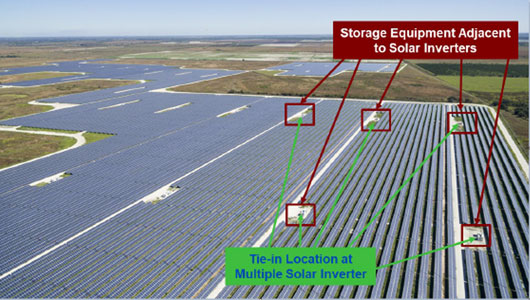
Integrating storage into existing DC-coupled solar is more complex, as room for the battery equipment must be available adjacent to each solar inverter. | NERC
While early BESS were primarily installed for energy arbitrage and mitigating renewable resource variability, the current wave of storage is seeking to provide short-term energy and reliability services, such as “ramping and variability control, voltage and frequency regulation and operation in low short-circuit conditions,” NERC said in the guideline. “It is imperative to have clear guidance on how BESS and hybrid power plants should perform when connected to the BPS [bulk power system] and also to have recommended practices for modeling and studying BESS and hybrid power plants for power flow, stability, short-circuit and electromagnetic transient (EMT) studies.”
NERC issued a 2018 reliability guideline on the recommended performance of BPS-connected inverter-based resources that included references to BESS, and a 2019 guideline recommending all transmission owners, transmission planners (TPs) and planning coordinators (PCs) improve their interconnection requirements and planning processes for new IBRs.
But the organization said “there are certain considerations and nuances to the operation of this technology that warrant additional guidance.”
“The recommendations in this guideline should apply to all BPS-connected BESS and hybrid plants and should not be limited only to bulk electric system (BES) facilities. Many newly interconnecting BESS projects and hybrid plants may not meet the BES definition; however, having unified performance and behavior from all BPS-connected inverter-based resources (including BESS and hybrid plants) is important for reliable operation of the North American BPS,” NERC said.
Recommendations
The guideline — which is applicable to TOs, TPs, PCs, balancing authorities, reliability coordinators, generator owners (GOs), generator operators (GOPs), developers and equipment manufacturers — make eight high-level recommendations, including:
Interconnection Requirements and Processes: TOs’ interconnection requirements should be “clear and consistent for BESS and hybrid power plants.” TPs and PCs should provide clear modeling requirements and ensure that their study processes consider the unique operational capabilities of those facilities.
Applicable entities should fully utilize the operational capabilities of BESS and hybrids to support reliability. “Capabilities like grid-forming technology, operation in low short-circuit networks, the ability to provide primary and fast frequency response and other functions more readily available in these new technologies should be fully utilized (as needed) and are essential reliability services for the BPS.”
BESS and hybrid plant GOs should coordinate with developers and equipment manufacturers to “ensure that the models used to represent BESS and hybrid power plants accurately represent the controls, settings and performance of the equipment installed in the field.” This requires “rigorous verification and testing by the TP and PC.”
Software Enhancements: Standardized library models do not capture the capabilities of BESS and hybrid plant controls. “Simulation software vendors should work with BESS and hybrid plant inverter and plant-level controller manufacturers to develop more flexible dynamic models to represent these facilities.” Software vendors should support use of “real-code” models — which implement the actual control code in the turbine controls, inverter controls, protection and measurement algorithms and plant-level controller — or other user-defined models “in a manner that does not degrade or limit the quality and fidelity of the overall interconnection-wide base case.”
Study Process Enhancements: TPs and PCs should improve their interconnection study and annual planning study processes to ensure they capture the increase of BESS and hybrid power plants, including the determination of stressed operating conditions, selection of study assumptions, inclusion of modeling practices and determination of appropriate dispatch conditions.
Expansion of Study Conditions: Although BESS and hybrid plants may help address some of the operational variability of renewables, “TPs and PCs may need to expand the set of study conditions used for future planning assessments as the most severe operating conditions may change over time.”
TOs should incorporate the recommended performance characteristics into their interconnection requirements per NERC FAC-001, according to the guideline; TPs and PCs are urged to incorporate the modeling and study recommendations into their interconnection processes under NERC FAC-002. NERC said entities should use the new guideline until the Institute of Electrical and Electronics Engineers’ P2800 project (Draft Standard for Interconnection and Interoperability of Inverter-Based Resources Interconnecting with Associated Transmission Electric Power Systems) is approved and fully implemented. IEEE’s Standards Association approved draft 6 of the standard with 84% support earlier this year.
Webinar Highlights
The webinar included a discussion of the difference between “grid-following” BESS — which require an external source to provide a reference voltage for locking the inverter phase — and grid-forming resources, which can operate in very low short-circuit strength networks and provide more support to the BPS.
Grid-following resources can be used to shift renewable generation to periods of high demand and provide grid stability through sub-second smart inverter responses. Grid-forming inverters can serve as black start resources.
“We probably don’t need every resource to be grid-forming in order to provide stability to the system,” said NERC’s Rich Bauer, another IRPWG coordinator. “However, if resources can implement grid-forming with not a lot of added cost, then it might be just a really good feature to have kind of as a standard product.”
Rachana Vidhi, a project director with NextEra Energy (NYSE:NEE), which has integrated battery storage into several existing wind and solar facilities, contrasted the difficulty of adding storage to AC- and DC-coupled renewables.
Adding storage to existing DC-coupled solar can be complicated because it requires space for the batteries adjacent to each solar inverter, Vidhi said. AC-coupled integration is simpler because the storage equipment can be placed adjacent to the solar collection substation, with little impact on solar operations. “This makes it a very easy retrofit to an existing solar plant,” she said.
Brad Marszalkowski, a senior engineer with ISO-NE, said batteries should be able to support system events regardless of their dispatch state.
“They should be able to respond to frequency and voltage excursions regardless of whether they’re in the charging or discharging mode at the time of the excursion. The same with providing dynamic voltage control during a transient. It’s also important that they have the capability to inject reactive power at zero active power. You can imagine a scenario where the battery is participating in, say, a regulation market and they’re [ready to respond to] frequency excursions. But they’re still connected to the system, so they can still have a voltage impact at that level. So if a voltage excursion happens — say there’s a fault or some other issue — they should still be able to respond to that.”
NERC’s Quint said BESS and hybrid plant owners should adopt those guideline’s recommendations into existing plants and new facilities where possible. “Some existing facilities that may have older technology may not be able to do some of the things we’ve highlighted in the recommendations, and that’s generally acceptable.”
For “new facilities, we really want to leverage these technologies and capabilities and make sure we’re utilizing them. All of that requires really close coordination with the GO, working with the transmission owner and balancing authority, reliability coordinators, transmission planners and planning coordinators. All those entities need to have an understanding of the operational capabilities and the limitations of the facility and how that thing is going to operate.”
“The developers need to work closely with the equipment manufacturers,” he added. “Almost all the [original equipment manufacturers] are actively involved in the IRPWG, so there’s a really clear, solid community here.”
Siddharth Pant, senior engineering manager for GE Power Conversion (NYSE:GE), noted that BESS and renewable resources have distinct limitations and capabilities. “Really the coordination of these different resource types is what makes it into a hybrid plant. Wind behaves quite differently than solar, and BESS is closer to solar but has even faster response times. All those have to be coordinated,” he said. “The parting message here is, please discuss with your manufacturers and developers: We have a solution for the problems that you’re facing.”
FERC set a base return on equity of 9.33% on the Mystic Generating Station’s reliability-must-run (RMR) contract, using the same methodology from Opinion 569-A last year (ER18-1639). The two-year contract begins in June 2022.
The commission voted 3-1 to adopt the order with Democrat Allision Clements dissenting and soon-to-depart Republican Neil Chatterjee not participating in the proceeding.
Plant owner Exelon (NASDAQ:EXC) advocated for an ROE of 12.8%, but the commission dismissed its arguments for adding the expected earnings model, use of market data inputs from other providers and its contention that the plant faces above-average risk.
It also followed the precedent established when FERC raised MISO transmission owners’ base ROE and allowed them to add the risk premium model (RPM) into ROE calculations along with the discounted cash flow (DCF) and capital asset pricing models (CAPM). (See FERC Ups MISO TO ROE, Reverses Stance on Models.)
Danly concurred with the order but wrote that he was concerned with the exclusion of Avangrid (NYSE:AGR) from the proxy group used in the DCF and CAPM analyses used by the commission. Danly said the fact that Spanish energy giant Iberdrola owns 81.5% of Connecticut-based Avangrid did not justify the company’s exclusion from the proxy group.
“I believe that those considering [an] investment in Avangrid were more likely to have considered Avangrid’s operations, revenues, expenses and risk profile — which support the inclusion of Avangrid in the proxy group — than they were to have considered Iberdrola’s ownership interest in Avangrid,” Danly said.
Danly said he did not believe that Avangrid’s proxy group exclusion rendered the resulting ROE unjust or unreasonable.
“However, I can imagine future cases in which such an exclusion may well do so and reserve the right to object at that time, should the facts so require,” Danly said.
Clements said she dissented because FERC’s current ROE policy “applies a flawed methodology that does not adequately protect consumers and does not yield just and reasonable rates.” Clements said she did not want to revisit the in-depth concerns she expressed in her dissent from the Entergy order. But she said the Mystic proceeding again highlights “significant flaws inherent in the commission’s use” of the RPM.
Clements added that few FERC policies “impact consumers as much as our policy for setting ROEs.” While Thursday’s order addresses the ROE portion of cost-based compensation to keep the Mystic units online for two additional years, the commission’s ROE policy extends to all cost-based rates in its purview, including transmission.
“Smart transmission investment not only enhances reliability and resilience, but it unlocks low-cost power supply, allows more efficient use of existing infrastructure, and minimizes the cost of meeting changing customer demand and public policies,” Clements said. “This investment can ultimately be a net win for consumers. But the value proposition for consumers is in no small part dependent on this commission’s rigorous scrutiny of the rates charged for transmission service, of which ROE is a central component.”
Clements said she appreciated that ROE policy has been “unsettled for years, a state that increases investment uncertainty and extends litigation.” However, Clements said near-term stability should not be to the “detriment of consumer protection, and I worry our current ROE policy does just that.”
Oahu’s latest Transportation Improvement Program (TIP) for 2022-2025 would allocate more than $2 billion for 73 projects, including rail and environmental measures.
Drafted by the Oahu Metropolitan Planning Organization (MPO), the TIP is awaiting final approval by the MPO’s policy board on July 27 before being sent for final approval to Gov. David Ige’s designee, Jade Butay, director of the state’s Department of Transportation.
Projects funded under the TIP must be consistent with the priorities set out in the Oahu Regional Transportation Plan and with the plan’s vision, which states that, “In 2045, Oahu’s path forward is multimodal and safe. All people on Oahu can reach their destinations through a variety of transportation choices, which are reliable, equitable, healthy, environmentally sustainable, and resilient in the face of climate change.”
Funds for the TIP would come from the Federal Highway Administration and the Federal Transit Administration. More than half of the $2 billion would go to the over-budget Honolulu Area Rapid Transit (HART) rail program, with the rest going to road maintenance, environmental mitigation, alternative transport, and transit system upgrades.
An estimated $70 million would go to the Statewide Shoreline Protection Program to “develop and construct shoreline protection measures to better protect roadways from flooding and erosion” on the island of Oahu.
Another $19 million would be used to realign a section of Kamehameha Highway on the North Shore of Oahu from its location alongside the shore to one that’s more inland. The section is in danger from shoreline erosion and is a notorious traffic choke point due to the abundance of tourists parking and crossing the street to Laniakea Beach, famous for its Hawaiian sea turtles who rest on the sand.
Eleven million dollars would go to phases 2 and 3 of the rehabilitation of native plant species in Halawa Valley, where the H-3 freeway was built. The project would “provide mitigation to help restore Halawa Valley to pre-H-3 conditions as much as reasonably possible.”
Several projects are aimed at improving alternative transit. About $3.5 million would go to the Oahu Bicycle Master Plan for “improvements, the development of new projects, and the upgrade of existing bicycle projects.”
About $3 million would go to the Transportation Alternative Program’s (TAP) Haleiwa Road Multi-Use Path Project, which would build a multi-use path along Haleiwa Road between Waialua Beach Road and Kamehameha Highway. TAP is a grant program providing funding for projects that provide transportation alternatives to driving one’s own vehicle, such as bicycle facilities and improved access to public transportation.
A similar program, the Transportation Alternatives Set-Aside Program (TA Set-Aside), would use about $47 million to build a pedestrian and bicycle bridge across the Ala Wai canal, which runs the length of Waikiki. TA Set-Aside would also get $43.3 million to build bicycle and pedestrian paths from Ewa Beach on the west of the island to downtown Honolulu.
The TIP also recommends funding for projects to improve Oahu’s freeways, such as $200 million for an upgraded freeway management system. The project consists of the installation of closed-circuit television cameras, vehicle detectors, cabinets and communication equipment on the Interstate H-1, H-2, and Moanalua Freeway. Minor interior modifications of the Interstate Route H-3 Control Center will also be done to accommodate system improvements.
In addition, $26.5 million would be used to bolster Oahu’s Freeway Service Patrol (FSP). The FSP provides free services to commuters such as towing, medical assistance, and debris removal.
Arizona regulators last week approved a demand management plan that includes up to $2,500 in incentives for homeowners who install battery storage with their rooftop solar system.
The incentive is part of the Arizona Public Service Company’s 2021 demand side management plan. The Arizona Corporation Commission approved the plan Tuesday on a 4-1 vote.
The commission’s two-day meeting, which ran from Tuesday to Wednesday, was interrupted when the ACC’s buildings were hit by a power outage on Tuesday.
Under the demand management plan, APS customers who install battery storage systems coupled with rooftop solar and enroll in a time-of-use rate plan, will receive a one-time incentive of $500 per kW, capped at $2,500 per home. Customers receiving the incentive must connect to an APS operating platform to share battery performance data.
In addition, customers may receive a one-time $1,250 upfront incentive, if they agree to use their battery storage to serve the grid. The incentive requires customers to share up to 80% of their storage-system capacity for up to 100 events per year, for three years.
Managing Demand
A demand side management plan (DSM) outlines strategies for saving energy and managing loads. Since 2016, in response to an ACC order, APS has placed more emphasis in its DSM plan on reducing peak energy use and demand.
APS serves more than 1.3 million homes and businesses in 11 of Arizona’s 15 counties. The company has set a target of providing 100% clean power by 2050.
Among the plan’s other initiatives is a program for existing homes, in which APS offers incentives for the replacement of old or broken HVAC equipment with more energy-efficient models.
Also on the residential side, APS said it is focusing on assistance for limited-income customers, including doubling its budget compared to 2019 levels for a weatherization program.
For non-residential customers, APS will introduce incentives for facilities without HVAC ducts to install ductless HVAC systems. Another incentive will be available to hotels for room occupancy sensors that will minimize energy use in unoccupied rooms.
APS plans to pay for the $64 million DSM plan with $20 million of DSM funding in base rates, $5.6 million in collected but unspent funds and $38 million from an increased demand-side management adjustor charge.
Ratepayer Impacts
In a proposed amendment, Commissioner Justin Olson called for scrapping the DSM plan and requiring APS to file a revised plan that reports findings of a ratepayer impact analysis for each of the proposed demand-side management measures.
The amendment failed on a 4-1 vote. Olson then was the lone vote against the demand-side management plan.
Commissioner Jim O’Connor proposed an amendment, which the commission approved, to add an advanced rooftop control pilot program to APS’ plan. The rooftop systems are intended to reduce energy use and improve ventilation in buildings.
The program will be for public, private and charter K-12 schools, as well as non-profit facilities serving the needy and homeless. It will be funded with $2 million a year and offer rebates of $50,000 per installation on average.
In a news release last week, the Southwest Energy Efficiency Project (SWEEP), commended commissioners who voted for the APS plan.
The plan will help customers “fix broken air conditioners, replace inefficient water heaters, install smart thermostats, and otherwise cut energy waste,” SWEEP said.