Washington’s King County Boosts EV Requirements

Washington’s King County Council passed a law Tuesday requiring the installation of charging stations and creation of set-asides for parking of electric vehicles at multi-unit dwellings in its unincorporated areas.

Most of King County’s 2.3 million people live in Seattle and its suburbs. The unincorporated areas are east of Seattle, creeping up into the Cascade Mountains.

The new law requires that new or substantially remodeled apartment buildings make 10% of their parking spaces capable of charging electric vehicles. It also requires that 25% of those buildings’ parking spaces have infrastructure in place to accommodate chargers in the future.

“As we continue to face the growing impact of climate change on our day-to-day lives, it’s vital that we think creatively and proactively about how to make eco-friendly choices accessible, such as electric vehicles,” Councilmember Jeanne Kohl-Welles said in a statement.

“The pace of transportation electrification is growing exponentially,” Councilmember Rod Dembowski said.

“With more charging stations, it will be much easier to own an electric vehicle in King County,” said Councilmember Reagan Dunn.

FERC Dismisses Dispute Between Colorado Co-op, Xcel over QF Practices

FERC on Thursday declined to take up a dispute between a western Colorado electric cooperative and an Xcel Energy subsidiary over how qualifying facilities are connected and counted.

Holy Cross Electric Association has been locked in a disagreement with Xcel subsidiary Public Service Company of Colorado (PSCo) since trying to add a solar-and-storage generation facility to its QF collection earlier this year. The 52-MW Hunter Mesa solar facility, with an additional 50-MW battery storage capability, has yet to receive QF certification under the Public Utility Regulatory Policies Act.

FERC said Holy Cross’ ask for the commission to make a sweeping decision on its and PSCo’s QF procedures based on the Hunter Mesa facility alone was inappropriate (EL21-65).

Using its conflict with PSCo over the Hunter Mesa interconnection, Holy Cross argued that FERC should affirm that the co-op has the authority to:

      • offset its capacity service obligations with PSCo through power purchased from QFs connected to its system;
      • use firm transmission service to transport power from QFs over the integrated system owned by both it and PSCo;
      • connect QFs to its system with its own interconnection procedures and to request new delivery points on the jointly owned system “as needed” to serve load on its system.

Holy Cross also asked that the commission find that Xcel’s interpretation of their power supply agreement (PSA) and transmission integration and equalization (TIE) agreement are flawed. The co-op said it has the “absolute right” to purchase capacity from QFs and have the purchases exempted from the PSA. The co-op argued that PSCo offers capacity offsets for its purchases from a nearby biomass QF.

But PSCo countered that in this case, Holy Cross will purchase QF output from Hunter Mesa that would exceed local load requirements and create an imbalance between generation and load. The company maintained that surplus power injections are not entitled to firm transmission service on the integrated system under the TIE agreement.

PSCo said “a new delivery point is not appropriate where Holy Cross’ loads are already adequately served under the existing delivery points and the express purpose is instead to inject power onto the grid.”

PSCo also said that because it operates the integrated system between itself and Holy Cross, it must process the Hunter Mesa interconnection request and determine whether a new delivery point is warranted. It further argued that the point of interconnection Holy Cross was eyeing for Hunter Mesa is located on a 138-kV line on its transmission system and that the facility would need to become an interconnection customer under the Xcel tariff.

Holy Cross countered that its QF purchases are for delivery to its own load. It also said there’s nothing in the PSA or TIE agreement that “limits the right to capacity offsets to the amount equal to or less than the local load.”

FERC dismissed Holy Cross’ petition without addressing the arguments.

“In its petition, Holy Cross provided its proposed arrangement with Hunter Mesa as an example of a QF located on Holy Cross’ system. However, Holy Cross’ petition actually seeks relief for QFs more generally, and the petition is not limited to Hunter Mesa. In this case, we find that, given the facts and circumstances presented, it would be improvident to make the more generic findings regarding QFs that Holy Cross seeks,” the commission said.

FERC also said it would not interpret the PSA and TIE agreement at this time.

“Even if we were to interpret the petition to seek relief regarding Hunter Mesa specifically, Holy Cross’ assertions are too speculative upon which to base a determination. With respect to Holy Cross’ request that the commission find that PSCo’s interpretation of the PSA and TIE agreement violates the filed rate, we similarly find on this record that it would be improvident to address whether PSCo by its interpretation has violated the filed rate.”

MISO Members Revive Debate over ‘Postage Stamp’ Cost Allocation

Everything old is new again. After initially appearing dead in the water, the postage-stamp cost allocation method for long-term transmission projects might be coming back in vogue in MISO.

The RTO’s Environmental Groups sector and a group of transmission owners breathed new life into the method at a teleconference Thursday when they advanced separate proposals on how to allocate the costs of MISO’s long-range transmission plan. (See MISO Analyses Show Reliability Woes Without Transmission Builds.)

The two groups suggested MISO consider a sub-regional postage stamp allocation for the Midwest and South regions if it can prove benefits are widely spread over the areas. The postage-stamp method, in which costs are recovered uniformly from all load in a defined area, has so far been generally unpopular with state regulators and stakeholders, especially those from MISO South. On the other hand, some Midwestern commissioners have said they support it.

MISO last summer overhauled its cost allocation procedures, eliminating a 20% postage stamp allocation for market efficiency projects (MEPs), lowering the voltage threshold from 345 kV to 230 kV and adding two new benefit measurements. (See MISO Cost Allocation Plan Wins OK on 3rd Round.)

The TOs also proposed that long-range projects cost at least $20 million, be 100 kV or higher and demonstrate a 1:1 or higher benefit-to-cost ratio over 20 years in order to be cost-shared. In addition to the 1:1 ratio and 100-kV minimum, the Environmental sector recommended a $5 million cost threshold and suggested benefits be measured over 40 years, rather than 20.

Stakeholders asked if it was even possible for MISO to gauge four decades of benefits. So far, the RTO is performing economic models that look 20 years ahead. Staff said they would have to find a way to extrapolate benefits over a longer horizon.

Sustainable FERC Project attorney Lauren Azar said reinstating a postage stamp rate for long-term transmission makes sense because the projects are intended to solve regional issues.

Madison Gas and Electric’s Megan Wisersky said a subregional postage stamp mechanism is a poor substitute to the more complicated task of singling out quantifiable benefits and assigning costs more accurately.

“The more we try to move away from it, it seems the more we’re coming full circle back to it,” Wisersky observed of the debate.

“This is a dance MISO has been doing as long as I’ve been engaged, and long before the [long-range transmission plan] was a glimmer in any one’s eye,” Union of Concerned Scientists’ Sam Gomberg said. He said the argument that the method is too speculative isn’t persuasive. “Utilities and regulators live in a world of speculation. We don’t wait for the system to crash before we build new facilities. I don’t know if I will live long enough to enjoy the bag of cherries I bought that is in my fridge, but I still bought them.”

Clean Grid Alliance’s Natalie McIntire said some stakeholders mistakenly believe that the long-range plan’s sole purpose is to facilitate new generator interconnections.

“We’re doing this planning study so we can reliably operate the grid with a very different mix of resources,” she said.

McIntire pointed out that even after long-term transmission projects are in operation, MISO will continue to perform interconnection studies and assign network upgrade costs to generator developers.

American Clean Power Association’s Daniel Hall agreed that a postage stamp treatment goes hand-in-hand with the long-term plan’s goal of “regional reliability in light of the resource evolution we all know is taking place.” He also said “parsing reliability and economic benefits” so meticulously becomes increasingly difficult as new players enter the MISO market.

Alliant Energy’s Mitchell Myhre said he didn’t see why MISO’s existing allocation for MEPs wouldn’t work for new long-range projects.

Jeremiah Doner, of MISO’s planning team, said the RTO isn’t convinced that simply using its current allocation for MEPs will be enough.  

“Given the types of projects we’re looking at, that method might be insufficient. But the MEP [allocation] is in the tariff, and it could be leveraged based on the circumstances of a project,” Doner said.

However, Doner said rapid decarbonization and electrification will most likely complicate the more cut-and-dried benefit identification of MEPs.

Stakeholders have also said MISO should consider one cost allocation method for transmission projects identified under a Future I analysis versus any new lines that come out of the upcoming Futures II and III analysis.

MISO is using its 20-year Future I — the most conservative of its three planning scenarios — in the first Midwestern study phase of the long-term transmission plan. Later phases of the study will examine MISO South under Future I and the entire footprint under Futures II and III, scenarios that predict more renewable penetration and electrification growth.

NREL’s SolarAPP+ Slashes Rooftop Solar Permitting Times

Permitting a residential rooftop solar project in Tucson, Ariz., used to take up to 20 business days; now thanks to a one-stop, online permitting platform developed by the National Renewable Energy Laboratory, it takes one day or less.

The Department of Energy rolled out the new platform ― the Solar Automated Permit Processing Plus (SolarAPP+) ― with an online webinar on Thursday and a challenge from Secretary Jennifer Granholm: to have 125 cities across the country using the platform by the end of September.

Fast, online permitting will, Granholm said, “cut the red tape that often delays the solar permitting process. In some parts of the country, customers have to wait weeks for approvals before they can get their solar installations online; in other places, it’s months, and all those days add up to distractions from larger projects [and] to dollars lost, obviously. It contributes to climate change because the more [solar] we can get online faster, the more we can do our part to reduce the impacts of climate change.”

Citing data from NREL, she said, project delays in the last year alone cost homeowners an estimated $16 million in energy savings.

After working with the solar industry, local governments and other stakeholders to develop the app, NREL started testing it at the end of 2020 with pilot projects in Tucson, Pima, Ariz., and Pleasant Hill, Calif. Preliminary results from the pilots show that the cities were collectively able to almost triple the number of applications processed. (See NREL Apps Accelerate Rooftop Approvals.)

The app has since been launched in Menifee, Calif., and is now being piloted in four more California communities and Montgomery County, Md. Initial tests are underway in 14 more communities in six states, according to DOE.

Tucson Mayor Regina Romero reported that the platform had allowed the city to approve “about 450 installations in the last 60 days alone, and because time is money, we can charge you less for the permit. What that means is that it becomes less expensive for the installation, and we make solar much more available to low-income communities in our city.”

In Stockton, Calif., one of the communities now piloting the app, Deputy City Manager John Alita said that rooftop solar applications now make up about one-quarter of the city’s permitting load, “so, a lot of intensive staff time goes into this.”

Permitting turnarounds used to be about four days, Alita said; now it’s “instantaneous,” saving significant staff time. The app is also going to help the city process the permits for a new state-funded project to install free solar panels on the roofs of more than 100 low-income homes and four multifamily developments. “We’re also trying to boost our promotion of state and federal [solar] incentives,” he said. “With that kind of campaign, we do expect to see a higher influx of applications.”

Lynn Jurich, CEO of residential installer Sunrun, sees the app as a catalyst for scaling and aggregating rooftop solar as a grid asset. “What this tool is going to enable us to do is really build out that distributed system to complement that centralized system,” she said. “[If] we put solar and batteries on 10,000 homes, that’s a 100-MW power plant that we can dispatch into the system.”

Jurich underlined the untapped potential of the rooftop solar market, noting that in countries such as Australia, where automated permitting is the norm, more than a quarter of all homes have installations versus 3% in the U.S. Citing figures from the Solar Energy Industries Association, Granholm said the U.S. market only recently passed the 100-GW mark, with close to 3 million installations across the country.

Reaching President Biden’s goal of a decarbonized electric system by 2035 will mean deploying “hundreds and hundreds of more gigawatts of solar capacity to the grid,” Granholm said. “The record-breaking heat waves and droughts and wildfires tell us the costs of delay are simply too high, and at the same time, the economics tell us that there’s simply no reason to wait.”

To further promote market expansion, DOE is also launching a “Summer of Solar” campaign, with events to be announced across the country, Granholm said.

‘No Human Touch’

As panel prices have fallen, the solar industry has increasingly focused on “soft costs” — customer acquisition, labor, permitting and inspection — which now make up about two-thirds of the cost of a system, according to SEIA. SolarAPP+ is aimed at cutting the permitting part of that equation.

The platform allows a licensed solar installer to submit a permit application online. The application is checked to ensure it complies with all relevant electrical and safety codes, and a permit is issued after the contractor pays a fee.

The app also checks the structural integrity of the home, said Jeff Cook, NREL’s lead developer for SolarAPP+. “We have compliance-related requirements for it. We’re also evaluating the wind and snow load requirements of the community, as well as the temperatures, all in the process of approving the project.”

Detailing more of the preliminary results from the pilot cities, Cook said that in addition to increasing the number of applications processed, the platform saved these jurisdictions about 186 hours in staff time, without adding time to project inspections.

“The inspectors in those communities have already mentioned to us that they expect in the future, having one standardized inspection checklist is going to making inspections a lot easier to do, as opposed to looking at the 1,001 different single-line or three-line diagrams they get today,” Cook said.

He also noted that during the pilots, only 5% of the projects approved through SolarAPP+ failed their initial inspections, and most of those were from miscommunication on the process. “There was confusion about what documents needed to be on-site for the inspection and which didn’t,” he said.

A bill now sitting in the California legislature, SB 617, would require cities to use an online permitting platform for residential solar and storage projects, with exemptions for counties with a population of less than 150,000.

NREL is working on expanding the system to permit storage projects, and eventually, it hopes to be able to handle larger commercial installations, Cook said. At present, however, it can only be used for residential rooftop installations. Cities or other local jurisdictions can sign up for free, and licensed contractors pay $25/application.

Going forward, Cook sees the system also integrating with utility interconnection processes. “We’re going to be working with utilities to make [interconnection] more seamless, so that in the future, a human doesn’t have to review the permitting process. They can have everything automated into the interconnection portal as well so that there’s no human touch, but we confirm the design is code compliant.”

NY Community Solar Sector on Shaky Ground, Developers Say

New York’s community solar industry has had a great run over the last five years, but new dynamics are shaking things up for the market.

Community distributed generation (CDG) solar in New York is grappling with challenges that “cast a bit of a question on the market’s future,” Shyam Mehta, executive director of the New York Solar Energy Industries Association (NYSEIA), said Wednesday.

New York was number one in the country for community solar capacity installed in 2020, and by the end of last year, it was second in terms of cumulative deployments, Mehta said during a NYSEIA community solar webinar.

Mehta expects the state’s pipeline of mid- to late-stage projects will put New York in first place for cumulative deployments next year.

Leaders in the state celebrated the success of New York’s solar program on Tuesday, announcing 3 GW of total installed capacity to date. That’s half of Gov. Andrew Cuomo’s 6 GW target for 2025. Cuomo’s office said an additional 2.7 GW of solar is under development, 90% of which is community solar.

New York finalized its current CDG program in 2015, opening opportunities for people to collaborate on community projects to realize the benefits of clean energy when individual ownership is not an option.

Reaching 3 GW is a huge milestone, much to the credit of state officials, Emily Flanagan, managing director at Carson Power, said during the webinar. But today, she added, community solar developers face a “drastically different” set of challenges from the ones they experienced over the last five years.

“We’re seeing zoning codes that are … becoming incredibly stringent,” she said. “In the last couple of months, I’ve seen so many municipalities file amendments to their codes that are making it incredibly difficult to permit anything more than even five acres.”

In some districts, she said, the company has seen “huge attrition” on its projects because of those zoning changes.

Developers also are losing clarity on the incentives they have counted on through the state’s NY-Sun Megawatt Block Program, which is close to being fully subscribed.

If the state discontinues the block program and moves to a competitive solicitation format for CDG, it will “create a lot of market disruption,” Flanagan said.

It’s not clear in which direction the state will go, but Kelly Friend, vice president of policy and regulatory affairs at Nexamp, agreed that solicitations could be a problem.

“We would be disheartened and disappointed to see … that really dramatic shift in the market,” Friend said.

The solar developer supports the block approach, which sets a target along with incentives and allows the market and competition to reach that target.

“Solicitations don’t always work very well, so if that is the future of the New York market, I think we’re going to be challenged there,” she said.

CDG in NYC

The market for community solar in New York City is much different than the rest of the state — or country for that matter, said Ellie Kahn, senior policy adviser for the Mayor’s Office of Climate and Sustainability.

“We have more multi-family housing than anywhere else,” she said during the webinar. “We’re much more built up, so there’s a lot less space to build on.”

The region has the highest demand and the most carbon-intensive generation resources, and the electricity prices there are among the highest in the country.

“We really need as much renewable energy and storage as we can possibly get,” she said, adding that community solar unlocks rooftops when a building’s demand does not merit a behind-the-meter installation.

A predictable incentive for community solar is critical for developers focused on the downstate region. Projects in the pipeline there have a median size of 200 kW, which is much smaller than projects sited elsewhere in the state, according to Kahn.

They simply would not survive without an incentive to support the project economics, she said.

The city built incentives for community solar development into Local Laws 92, 94 and 97, which are part of a package of climate laws passed under the city’s 2019 Climate Mobilization Act.

LL 92 and 94, Kahn said, require solar or green roofs on all new buildings and renovations in the city, but a building owner does not have to match installed capacity to the building’s load.

“We want to encourage people to build as much solar as can possibly be built on their roof and do community solar remote net metering if they can’t use up all of the power themselves,” she said.

In addition, building owners get credit toward their carbon budget just for hosting community solar under building carbon reduction targets set by LL 97.

The city, she added, is still working to determine the exact value of that credit.

Developers: Offshore Wind Will Transform Onshore Communities

East Coast states that have embraced offshore wind development will soon face wholesale redevelopment onshore — from rebuilding and expanding ports to constructing new roads and even demolition and reconstruction of entire parts of communities — all of it to accommodate the massive components that will be delivered, stored or manufactured for the sea-going turbines.

“The equipment is getting larger by the year. And these cities on the East Coast, they are small older cities, [with] small roads,” Will Roberts, president of Seattle-based Foss Maritime, a maritime services company, pointed out this week in a virtual webinar produced by Our Energy Policy Foundation, a D.C.-based nonprofit focused on U.S. energy policy issues.

Roberts, who has been involved in European offshore wind projects, said cities there have “spent a ton of money and resources” ensuring that the ports and roads can handle the components.

“I think it’s an exciting time with the infrastructure bills that are going into place, but we need to understand that our ports are not set up for the size and scale of what the wind market will bring,” he said. “We can say that we’re bringing everything in by water, but the roads piece is a very interesting piece. Just look at a map of New Bedford, Mass., and tell me which large piece of equipment you’re going to bring in through the roadways there.

“If you go to Belgium or to the Netherlands, you’ll see whole towns that have been reconstructed in order to move that equipment through the city. And you know they’ll shut down whole parts of the city in order to get that equipment through.

“That’s the commitment that the Europeans have made to their offshore wind, and that is something we need to focus on in the United States.” he said.

Still more to consider is that offshore wind development, beginning on the East Coast, is just one part of the Biden administration’s decarbonization drive to move the nation toward net-zero-carbon emissions by 2050.

Another is decarbonizing industry, and the webinar looked briefly at possibilities of decarbonizing the manufacturers of wind turbine components and vehicles: trucks, barges or any of the numerous other water vessels involved in building an offshore wind farm.

“Are there opportunities to approach that investment in a way that decarbonizes the associated industries with offshore wind?” asked webinar moderator Benjamin Huffman, a lawyer concentrating on energy and infrastructure projects with the Chicago-based law firm Sheppard Mullin.

It won’t happen if developers are looking for the lowest bid, Roberts answered.

“If you’re going to talk to an operator like Foss, and you’re going to ask us to do something that’s 30 to 40% more expensive in capital, then I hope you’re going to be with us for the next 20 years,” he said. “It needs to be deliberate and there needs to be a commitment.”

Developers planning the extraordinarily massive offshore projects have one “tailwind,” as the panel members referred to the expansion of the federal 30% investment tax credit by Congress in December 2020.

Aimed at boosting offshore wind, the credit gives developers until the end of 2025 to begin construction and then another 10 years from when construction begins to completion, said Samantha Buechner, a San Francisco-based director at Wells Fargo who specializes in renewable energy tax equity financing. The company in February announced that it had surpassed $10 billion in tax-equity investments in wind, solar and fuel cell industries.

“That is huge and provides a lot of runway,” Buechner said of the offshore tax credit. “And I think that really poises the industry for significant growth.”

She added that the ITC is less risky for financiers than the production tax credit used to finance onshore wind because “we’re taking a tax credit on the upfront fair market value as opposed to the ongoing [power] production.”

But even with that, offshore developers will need multiple investors because some of the projects will need as much as $1 billion in financing, she added.

Handling all of the power generated by offshore wind — the Biden administration has set an offshore target of 30 GW by 2030, or 1,000 times the current offshore capacity of 30 MW, at a cost of about $12 billion/year — poses a related capital expenditure question: How much will be spent on transmission upgrades?

Transmission and interconnection infrastructure is a challenging problem for the industry as a whole, not just for offshore wind, said Huffman, briefly stepping out of his role as the moderator.

“We all, I think, expect this to become, in relatively short order, a major constraint on the construction of offshore wind plants. How do we deal with it? What are we going to need to do in order to address this constraint?” he asked.

Major investments will be happening, said Joao Metelo, former CEO of Principle Power, a California-based global offshore wind company that has developed a floating foundation for deeper waters, such as those off the West Coast.

“We are already seeing big announcements from the administration to push transmission, both small projects and HVDC projects,” Metelo said. “This need is widespread across the country, and it certainly affects offshore wind and onshore wind, and solar as well.

“I think there’s going to have to be … integrated transmission planning, both onshore and offshore projects. We already saw [a request for information] from New Jersey,” he said.

The webinar opened with remarks from U.S. Rep. Jerry McNerney (D-Calif.), a long-time wind energy supporter who set the tone of the discussion by noting that offshore wind poses “huge engineering challenges.”

FERC Goes Back to the Drawing Board on Transmission Planning, Cost Allocation

FERC on Thursday opened a rulemaking to reconsider its rules on transmission planning, cost allocation and generator interconnection, acknowledging that Order 1000 has failed to provide interregional expansions to deliver increased renewables and meet the challenge of climate change.

Republican commissioners Mark Christie and James Danly joined Chairman Richard Glick and Commissioner Allison Clements, both Democrats, in supporting the Advanced Notice of Proposed Rulemaking (RM21-17). Republican Commissioner Neil Chatterjee, whose term expired June 30 and is now job hunting, did not participate.

“We are concerned that existing regional transmission planning processes may be siloed, fragmented, and not sufficiently forward-looking, such that transmission facilities are being developed through a piecemeal approach that is unlikely to produce the type of transmission solutions that could more efficiently and cost-effectively meet the needs of the changing resource mix,” Glick and Clements said in a joint statement. “Regional transmission planning processes generally do little to proactively plan for the resource mix of the future, including both commercially established resources, such as onshore wind and solar, as well as emerging ones, such as offshore wind. We are also concerned that current regional transmission planning processes are not sufficiently integrated with the generator interconnection processes, and are overwhelmingly focused on relatively near-term transmission needs, and that attempting to meet the needs of the changing resource mix through such a short-term lens will lead to inefficient transmission investments.”

Time-Queue-Region-Resource-(Lawrence-Berkeley-National-Lab)-Content.jpg
Completed projects with time in queue by region and resource | Lawrence Berkeley National Lab

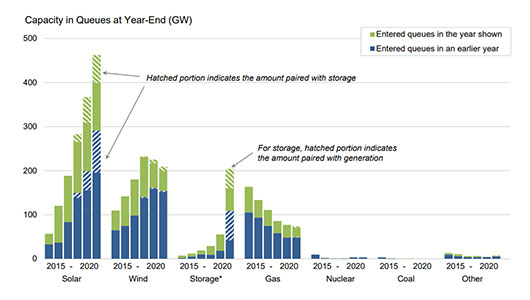
Glick noted that of the 750 GW of generation in interconnection queues in the U.S., 700 GW (93%) are renewable projects, many of which are located far from load centers to take advantage of strong winds and cheap land.

“In my opinion, we need a transmission planning process that better takes into account the various resources that are going to be built in the future and better recognizes the beneficiaries,” Glick said during the commission’s open meeting.

Clements said consumers are being denied access to wind and solar that is often cheaper than natural gas and other generation sources. “In most regions, transmission is the bottleneck right now, and it’s stifling competition,” she said.

Capacity-Queues-Year-End-(Lawrence-Berkeley-National-Lab)-Content.jpg
Capacity in queues at year end | Lawrence Berkeley National Lab

Clements said the ANOPR was “a product of compromise” with the Republican commissioners. “But in there, we are asking the important questions, and I am confident that the ANOPR will yield an informative record on which to assess the next steps. Addressing these challenges is not easy. But the need for action is clear and urgent.”

Christie noted it has been nearly 10 years since the commission approved Order 1000, which opened some transmission development to competition and required planners to consider transmission needs driven by public policy requirements. But it has been viewed as a disappointment by many because it failed to produce any interregional transmission projects.

“There’s been successes under Order 1000, everybody knows that. Everybody also knows there’s been problems under order 1000,” Christie said. “The interconnection queues are, I think to put it charitably, a mess. And that is a problem that needs to be addressed.“

Christie said the NOPR includes “a number of very good proposals” as well as some he said could “cause a massive increase in consumer bills and just transfer massive amounts of wealth from consumers to developer interests without ensuring that there is commensurate benefit.

“This is the beginning of a very long process,” he added.

Danly also expressed concern over potential costs.

The ANOPR solicits input on several questions:

      • how to accommodate anticipated future generation within the regional transmission planning and cost allocation processes;
      • whether the commission should require transmission providers to identify geographic zones with the potential for developing large amounts of renewables and plan transmission to integrate those resources;
      • whether changes are needed to improve the coordination between the regional transmission planning and cost allocation and generator interconnection processes;
      • how to allocate the costs of new transmission in a way that allocates costs “at least roughly commensurate” with estimated benefits; and
      • whether participant funding of interconnection-related network upgrades may be unjust and unreasonable and whether FERC should eliminate rules that allow RTOs/ISOs to use participant funding for interconnection-related network upgrades.

Comments will be due 75 days after publication in the Federal Register with reply comments due 30 days after that.

“We anticipate that this effort will be the commission’s principal focus in the months to come,” Glick and Clements wrote. “In addition to reviewing the record assembled in response to today’s order, we intend to explore technical conferences and other avenues for augmenting that record — including through the joint federal-state task force — before proceeding to reform our rules and regulations.” (See FERC Sets Federal-State Taskforce to Spur New Tx.)

Reaction

Rob Gramlich, executive director of Americans for a Clean Energy Grid, praised FERC’s action. “The world has changed, and transmission planners need to plan for today’s and tomorrow’s world, not yesterday’s,” he said.

“Today’s announcement begins a welcome process that, if carried through, will help catalyze the development of a modern and resilient clean energy grid,” said Gregory Wetstone, CEO of the American Council on Renewable Energy. “… As FERC starts tackling regional issues, we look forward to future commission action on interregional processes necessary to connect centers of high renewable resources with centers of high electric demand.”

Wetstone also urged President Biden “to expeditiously nominate a fifth FERC commissioner [to replace Chatterjee] to ensure the continuity and progress of the commission’s important work.”

Larry Gasteiger, executive director of the trade group WIRES, called FERC’s action “a monumental effort that has the potential to be very impactful and could amount to, as Chairman Glick pointed out, the most significant transmission reform in more than a decade.”

Gasteiger also endorsed Chatterjee’s dissent from the commission’s decision to reject Dayton Power & Light’s request for a 50 basis-point adder to its return on equity for participating in PJM (ER20-1068). The commission ruled 3-2 that  Dayton’s membership in the RTO is not voluntary because Ohio law requires it. Danly joined Chatterjee in dissent.

In April, FERC issued a rulemaking proposing to limit the adder to the first three years of RTO membership (RM20-10). That vote — also 3-2 — reversed Chatterjee’s proposal to double the adder to 100 basis points. (See TOs, Consumer Groups Clash over RTO Adder.)

Chatterjee said the commission needs to “finalize an incentives policy, including an RTO adder, to stimulate what [transmission] we need more than ever.”

“I implore the commission to move quickly to put in place a comprehensive transmission incentives policy, including an appropriate RTO adder, that advances the commission’s long-standing policy objectives and incentivizes what is needed now more than ever — investment in transmission infrastructure and robust organized markets,” Chatterjee said in his dissent in the Dayton ruling.

Solar Surpasses Wind in MISO, SPP Queues

Solar has overtaken wind in the interconnection queues of MISO and SPP as the declining costs of photovoltaic panels have made it more profitable even in the cloudier, windier areas of the U.S.

Panelists from the two organized markets discussed the trend with RTO Insider Editor and Co-Publisher Rich Heidorn Jr. in a panel called “Value of Solar: U.S. Roadtrip” at the Energy Storage North America-Intersolar North America annual summit Wednesday.

Jordan-Blake-(ESNA-Expo)-FI.jp
Jordan Bakke, MISO | Energy Storage North America

“What we’re seeing from an interconnection standpoint — facilities or developers requesting connection to the MISO system — is [that] of the 80 GW of overall capacity that’s seeking interconnection, 65% of that is solar right now,” said Jordan Bakke, director of policy studies with MISO. “There’s been a big growth in the amount of solar resources seeking interconnection to the system.

“That’s in comparison to the predominant wind growth that we’ve seen in the past,” Bakke said. “It’s really changed over in the last few years to be solar-dominated facilities seeking interconnection, and I think we expect that to continue going forward, at least for the time being, given the cost declines and tax treatment that the facilities see.”

Solar is spread relatively evenly over the MISO footprint, which stretches from the Canadian border to the Gulf of Mexico, with about 5% fewer arrays in the north than in the south, he said.

“We’re seeing that interconnection take place everywhere,” Bakke said. “Places that aren’t windy are building solar, and places that are windy are also building solar to help complement that resource.”

Casey-Cathy-(ESNA-Expo)-FI.jp
Casey Cathey, SPP | Energy Storage North America

SPP Director of System Planning Casey Cathey described a similar phenomenon in his RTO’s territory, which ranges from North Dakota to northern Louisiana. SPP is known for setting records for wind installations, with 13,000 turbines producing 26 GW. Now it is surging ahead with solar, he said.

“This year is the first year that we’ve actually seen the solar in the queue higher than … wind in our queue,” Cathey said.

SPP only has about 250 MW of solar installed and operational, but it has 35 GW of solar in its queue, he said.

About “500 MW of that is ready to go, and so the way we see it is solar and energy storage is really the next frontier for SPP,” Cathey said.

Solar is disbursed relatively evenly across SPP’s states even though irradiance levels are highest in New Mexico and the Texas Panhandle, “but we’re actually seeing valuable business cases for solar installs as well as hybrid solar-battery installs peppered across the SPP footprint,” he said.

Casey described the change as an “explosion” of solar in SPP territory.

“It’s really been a dramatic shift,” Heidorn responded.

Utility-scale solar has grown ninefold since 2013, when total capacity was around 4 GW; it is now about 38 GW, according to research by Lawrence Berkeley National Laboratory. With photovoltaic prices continuously declining, utility-scale solar represented about 73% of all new capacity added in 2020 and accounted for 63% of cumulative solar capacity by the end of last year, the lab found.

It was the second largest source of capacity additions in 2018 around 23%, with natural gas first at 55%.

That changed in 2020, said Joachim Seel, a senior scientific engineering associate in the Electricity Markets and Policy Department at the lab.

Joachim-Seel-(ESNA-Expo)-FI.jp

Joachim Seel, Lawrence Berkeley National Laboratory | Energy Storage North America

That changed in 2020, said panelist Joachim Seel, a senior scientific engineering associate at the Electricity Markets and Policy Department at the Lawrence Berkeley National Laboratory.

Last year “was just a terrific year for solar additions,” Seel said. Florida and Texas for the first time have overtaken California in solar additions, he said.

“There has just been this interesting trend over many years now,” as solar has spread from California, Arizona and other Southwest sunbelt states to the Great Plains, Midwest and the Southeast, he said.

State clean energy requirements and the market competitiveness of solar has driven large installations, many over 100 MW, he said.

“With the declining cost of PV, it has just become more attractive and economical in many other parts of the country,” Seel said. “And so in in recent years, we’ve seen especially strong growth among the regulated utilities in the Southeast … [Florida Power & Light] being a great leader there.”

NYISO Proposes Sweeping BSM Exemptions

NYISO on Tuesday proposed to exempt most new installed capacity (ICAP) suppliers from buyer-side market power mitigation (BSM) evaluation if they use solar, wind, storage or demand response.

“We think these technology types have a limited ability to impact ICAP prices over the long run, and that these technologies are really key and critical to achieving the state’s [environmental] policies,” Michael DeSocio, NYISO director of market design, said in delivering a presentation to the Installed Capacity Working Group.

The state’s Climate Leadership and Community Protection Act (CLCPA) requires the procurement of large amounts of renewable energy resources to get to zero-emission electricity by 2040, and the ISO wants to integrate these new resources into the capacity market while fulfilling its duty to maintain reliability with just and reasonable rates for all resources, he said.

The ISO proposes to retain the current mitigation regime, including the competitive entry exemption, the self-supply exemption and the supply-side mitigation construct, which with certain modifications continues to appropriately protect against the exercise of buyer-side market power, DeSocio said.

Making changes only to the BSM rules to exempt certain public policy resource types that are identified by the tariff and needed to meet the CLCPA mandates will allow the market to continue to produce just and reasonable ICAP prices needed to continue to meet the resource adequacy needs of the system while avoiding conflicts with state policy, he said.

Details

The BSM proposal would create a set of rules that allows the wholesale markets to be more compatible with the current state policies, DeSocio said. The ISO in June unveiled a plan and timeline for revising its BSM rules to expand resources’ exemption eligibility by the end of the year. (See NYISO Soliciting Stakeholder Input on Changes to BSM.)

As these types of resources enter service in increasing numbers, their capacity value decreases, whether participating as a special case resource or distributed energy resource, DeSocio said. The ISO is also considering whether external unforced capacity deliverability rights (UDRs) may be exempted from BSM.

NYISO actually addressed some of this effort as part of its existing capacity rules with respect to capacity accreditation for limited-duration resources, DeSocio said.

“However, when we devised those specific rules, that was before CLCPA became the law. … The current construct doesn’t actually get evaluated quickly enough to keep pace with where the market is going, with where the policies are driving the resource mix to go,” DeSocio said.

It’s important to re-evaluate the timing of the execution of the capacity accreditation rules, he said, but also to think more broadly to make sure the ISO is thinking about all the existing technologies and how their capacity values are measured and identified.

NYISO still believes the modifications to the Part A rules, which were originally rejected by FERC in 2020 and are being held in abeyance on appeal, will provide useful improvements regardless of any larger BSM proposal, he said. Part A exempts a new resource from BSM if the forecast of capacity prices in its first year of operation is higher than the default offer floor.

Some stakeholders questioned NYISO’s rationale for not including hydropower in its list of exemption-worthy resources. DeSocio said hydro resources are unlikely to be a source of new builds in New York.

DeSocio said the ISO is working with the Analysis Group to conduct a study on how the capacity market responds to meeting CLCPA goals and how to allow these resources to come in without any mitigation measures. The BSM analysis should be ready for stakeholder review by September, he said.

NYISO staff will return to the ICAP Working Group on Aug. 5 to respond to feedback and review current capacity accreditation practices, and again Aug. 9 to discuss the supporting BSM analysis and assumptions, as well as capacity accreditation principles and proposed changes.

Texas RE: Don’t Wait on NERC Cold-weather Standards

Texas Reliability Entity staff advised Texas entities recently that they won’t see NERC’s recently approved cold weather standards until 2023, but that they will continue to have reliability site inspections.

Mark-Henry-(Texas-RE)-FI.jpg
Mark Henry, Texas RE | Texas RE

“You’re not going to see the NERC standards in place this winter,” Mark Henry, Texas RE’s director of reliability services, said during a Talk with Texas RE webinar July 8, noting that it could take 18 months for them to become official.

“We will continue to go out and do these site visits in some form or fashion,” he told his virtual audience of 125 attendees.

NERC’s Board of Trustees in June approved three updated standards requiring generator operators (GOs) to protect their units against freezing and share their cold-weather operating parameters with regulators. Those standards now go before FERC for the commission’s review and approval. (See NERC Board OKs Cold Weather Standards.)

“These standards center around the operating authorities getting information about generator status and issues, and the generators providing that information,” Henry said. “The generation owner and generation operator is the new part … having plans and implementing them. It applies to the owner, as written, but whatever works best for your facility.”

NERC has been working on the updated standards since before the February winter storm that slammed Texas and nearly collapsed the ERCOT grid. Within the last decade, a similar, albeit smaller, winter event in the Southwest and a polar vortex in 2014 took place before a 2018 cold-weather event that affected SPP, MISO, the Tennessee Valley Authority and SERC Reliability.

EOP-011-2 (Emergency preparedness and operations) would require GOs to protect their units from freezing “based on geographical location and plant configuration”; identify operating parameters such as minimum-design temperature and fuel-switching capabilities; and to provide maintenance and operating personnel with unit-specific training on the plan.

IRO-010-4 (Reliability coordinator data specification and collection) would require reliability coordinators, transmission operators and balancing authorities to include information from their cold-weather plans in their data specifications.

TOP-003-5 (Operational reliability data) directs GOs to satisfy the specification using a mutually agreeable process.