FERC on Thursday denied a complaint by Hecate Energy that Central Hudson Gas and Electric and NYISO violated tariff-defined interconnection procedures and thereby delayed its 20-MW solar generation project in Greene County, N.Y., saddling the project with $10 million in unnecessary system upgrade costs (EL21-49).
Hecate alleged that the utility and NYISO violated the Open Access Transmission Tariff (OATT) and the Federal Power Act by failing to use reasonable efforts to process the interconnection request for its Greene County 3 project and violated the FPA by applying an “inclusion practice” related to the firmness of generator interconnection requests not delineated in the OATT regarding queue position.
Hecate argued that Central Hudson uses an “inclusion practice” to determine whether an interconnecting project in the queue is firm — that is, modeled in the base case for future projects for the purpose of queue coordination once the project has executed an interconnection agreement and has paid at least 25% of the project’s assigned interconnection costs.
Hecate said the actions of Central Hudson and NYISO resulted in six other projects becoming “firm” ahead of the Greene County projects, causing the interconnecting line to reach its 70 MVA rating and leaving the company to pay $10 million for upgrades.
The commission found that Hecate failed to satisfy its burden of proof under Section 206 of the FPA to demonstrate that respondents acted in an unjust or unreasonable manner, and said it “has explained that, while an RTO/ISO’s queue process may be intended to minimize delays, interconnection customers are not guaranteed that the RTO/ISO will meet its projected deadlines.”
The commission disagreed with Hecate’s “inclusion practice” argument and said it “has already determined in various proceedings if, and how, NYISO may take into account non-jurisdictional facilities that may affect the NYISO queue. Therefore, we find that the cases that Hecate points to in order to support its argument are misplaced and are distinguishable from the circumstances in this proceeding.”
NYISO said that Hecate’s argument based on the total number of days was “conclusory and ignores the unique difficulties and challenges associated with the project’s proposed interconnection.” The ISO noted that in August 2016, Hecate submitted an interconnection request for a 50-MW facility, which it subsequently withdrew and split into three separate projects, one of which is the subject of its complaint.
The commission said “we find the time expended was not unreasonable in light of the study time frame in the NYISO OATT. In addition, as noted by the respondents, many of the delays were caused by Hecate itself.”
FERC on Thursday ordered a hearing before an administrative law judge on allegations that Total Gas & Power North America (NYSE:TTE) manipulated the price of natural gas at several locations in the Southwestern U.S. between June 2009 and June 2012 (IN12-17).
The commission announced its investigation into the allegations in April 2016, when it issued a show-cause order that sought $213.6 million in civil penalties and disgorgement of $9.2 million in unjust profits, plus interest. It also sought civil penalties of $1 million from trader Aaron Hall and $2 million from trader Therese Tran.
The Office of Enforcement alleged that Hall and Tran made uneconomic trades of monthly physical fixed-price natural gas during bidweek at the regional trading hubs of Southern California Gas, El Paso Natural Gas, Permian Basin, West Texas, Waha, El Paso and San Juan Basin.
FERC said Total then reported those trades to Natural Gas Intelligence and Platts’ Inside FERC Gas Market Report to skew their monthly indexes to benefit company positions tied to the indices. Two former Total traders, Matthew Wilson and Stephen Callender, described the alleged scheme to investigators after becoming aware of it.
Total and the traders filed a response in January 2017 contending the evidence contradicted Enforcement’s allegations and that FERC relied “heavily on two witnesses who show strong biases against [the] respondents and have significant personal motivations to twist and falsify their testimony.”
“Enforcement staff argues that Wilson and Callender are credible because they corroborated each other and ‘described the same general mechanics of the manipulative scheme.’ But this conclusion ignores significant discrepancies between their testimonies, including that Callender claims he spoke with Wilson during the investigation, but Wilson flatly denies it,” Total said.
The company said Wilson did not allege manipulation until he knew that he was about to be fired and that Callender made his allegations nearly seven months after he was terminated.
Commissioner Neil Chatterjee said he supported the commission’s decision “to set the disputed factual issues for hearing before acting on the matter. However, I emphasize that this hearing is an impartial venue to consider the credibility of the evidence and the validity of the claims, not a freight train to prove the case against [the] respondents.”
A prehearing conference will be held within 45 days.
FERC on Thursday dismissed as moot an NV Energy complaint related to CAISO’s controversial plan to restrict certain wheel-through transactions when tight power supplies threaten reliability on the ISO’s grid (EL21-74).
Despite strong protests from CAISO’s neighbors and other Western Energy Imbalance Market participants, the commission last month approved that part of the ISO’s “summer readiness” proposal, ruling that the measure does not violate FERC’s open-access transmission principles (ER21-1790). (See FERC OKs CAISO Wheel-through Restrictions.)
CAISO developed the plan to help avoid the kind of capacity shortfalls that led to rolling blackouts during a severe heat wave in California last August, the first for the state since the Western energy crisis of 2000/01.
The plan allows CAISO to reprioritize wheel-throughs between the Northwest and Southwest to prevent them from taking precedence over the capacity needed to serve the ISO’s own load during supply shortages. Under the plan, non-CAISO entities can ensure delivery of energy through California by applying 45 days in advance to schedule high-priority wheel-throughs needed for reliability.
CAISO says the measure is intended as a short-term fix for this summer only and has kicked off a stakeholder initiative to develop a longer-term solution.
NV Energy’s complaint did not directly challenge the proposal but instead called on FERC to prevent CAISO from altering the penalty pricing parameters in its business practice manual (BPM) to achieve the same result as the plan in case the commission rejected the plan.
Penalty pricing is the mechanism by which the ISO sets priorities — including scheduling priorities — for supply and demand resources in order to effect “expected” outcomes its markets. While CAISO specifies penalty prices in its BPM, NV Energy asked FERC to clarify that it would not allow the ISO to modify those prices without commission approval.
“NV Energy contends that CAISO should not be permitted to change the scheduling priorities of wheeling through transactions, relative to resource adequacy imports, by means of a business practice manual revision rather than through [a Federal Power Act] Section 205 tariff amendment filing. NV Energy asserts that the commission should make clear that the penalty price parameters must be specified in the CAISO tariff,” the commission explained in Thursday’s order.
The utility further contended that if the commission did find it appropriate for CAISO to specify penalty prices in the BPM rather than the tariff, then it should at least prohibit the ISO from prioritizing resource adequacy imports on non-firm transmission over wheel-through transactions on firm transmission. The utility argued that the priority wheel-through proposal contradicts FERC Orders 888 and 890 and the commission’s open-access principles.
CAISO responded that its tariff authorizes it to change penalty prices through a BPM revision, and that the commission has not previously required it to specify those prices in its tariff. The ISO also argued that NV Energy failed to show how the penalty prices spelled out in the BPM contravene the scheduling priorities set out in the tariff.
Supporting the complaint were Arizona Public Service, Salt River Project, Tucson Electric Power, UNS Electric, Arizona Electric Power Cooperative, Idaho Power and Powerex.
In light of its June decision approving CAISO’s plan, the commission rejected NV Energy’s complaint as moot.
“As NV Energy states, the relief requested in the complaint is premised upon the commission’s potential rejection of CAISO’s proposal in Docket No. ER21-1790. … Accordingly, we find that we need not address the merits of the complaint and therefore dismiss it,” the commission wrote.
Washington Gov. Jay Inslee declared a drought emergency for nearly the entire state Wednesday, attributing the severe weather to climate change.
The declaration established a ban on outdoor burning. With some water use already curtailed weeks earlier, no new curtailments were announced, although state officials did not rule out additional actions in the future.
The measure also sent the state’s Office of Financial Management scrambling to find money to help local governments and boards buy or divert water or tackle other heat mitigation measures.
The declaration will speed up processing for emergency drought permits and allow temporary transfers of water rights. Washington’s available water supplies are expected to be 75% less than normal.
The cities of Seattle, Tacoma and Everett are not included in the drought emergency because they have significant amounts of stored water.
Inslee and several other state officials discussed the declaration Wednesday at a press conference in Olympia.
“Our state is under attack from the combined effects of climate change,” Inslee said.
“This year’s drought came as a surprise to many of us. … We’ve had our second driest spring since 1895,” said Laura Watson, director of Washington’s Department of Ecology.
State climatologist Nick Bond said statewide precipitation is six inches so far this year, five inches below average. Above average temperatures are predicted through September with below average rainfall.
Inslee, Washington Lands Commissioner Hilary Franz and Department of Agriculture Director Derek Sandison said 91 Washingtonians died during a record heat wave last month, and five major wildfires have flared up in the past seven days. So far in 2021, Washington has suffered roughly 900 wildfires burning about 140,000 acres, which almost equals the total for 2019.
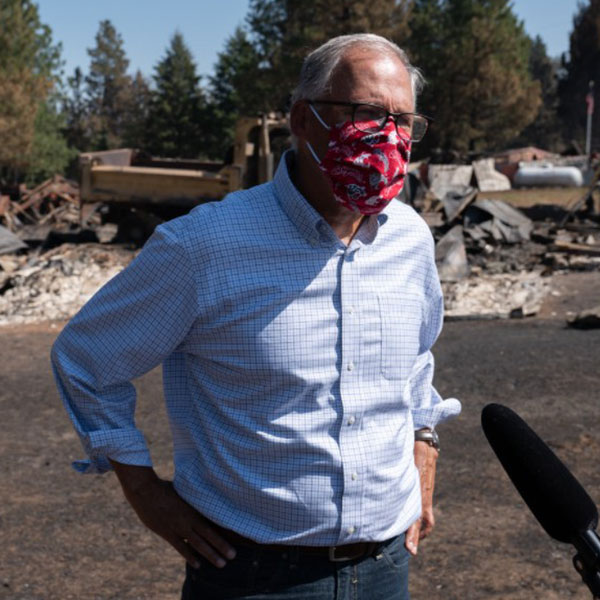
Gov. Jay Inslee speaks with reporters on Sept. 11, 2020, in the town of Malden, Wash., which had recently been destroyed by a wildfire. | Washington Governor’s Office
“What we experienced in the last few weeks is a preview of life to come. … We don’t have enough resource to keep up with the catastrophic fires that we face,” Franz said.
Water temperatures in the lower Yakima, Okanagan and Snake rivers have reached levels lethal to some fish, including threatened salmon species. Sandison said the drought conditions have led to a major decrease in berry and spring wheat yields and a 90% decline in shellfish harvesting.
So far, the state has identified about $300,000 available to be distributed to communities and public agencies for drought relief through the state’s Department of Commerce. In 2019, the state spent $600,000 for the same measures. Franz said $300,000 will not be enough for this year, but state officials did not have a figure calculated for Washington’s predicted needs in 2021. “We’re scrubbing some cash drawers to find it,” Inslee said.
Inslee and others blamed climate change for the heat wave, drought and wildfires. “The core problem is carbon pollution,” he said. He said measures such as a recent cap-and-trade bill and new low-carbon vehicle fuel standards are a way of attacking the heat and drought at their sources. (See Washington Becomes 2nd State to Adopt Cap-and-trade.)
The governor said his office is considering other anti-carbon measures, but added he is not yet prepared to publicly discuss them.
Maryland has several “technologically feasible pathways” to eliminate direct greenhouse gas emissions from its buildings by 2045, according to a study presented to stakeholders Tuesday.
Achieving the goal will require “technology commercialization and accelerated implementation,” said Charles Li, a managing consultant with Energy and Environmental Economics, Inc. (E3), who presented results of the study, at an online meeting of the state’s Greenhouse Gas Mitigation Working Group Buildings Ad Hoc Group. The group answers to the Maryland Commission on Climate Change.
Li cited 2017 data that building direct-use emissions account for 13% of economy-wide GHG emissions in Maryland; buildings also represent 90% of the statewide electric load, which contribute to upstream emissions in electricity generation. In response to a question from David Smedick of the Sierra Club, Li acknowledged those indirect emissions do not include upstream methane leakage. Methane is a far more potent greenhouse gas than carbon dioxide but has a shorter half-life in the atmosphere.
E3 analyzed three scenarios for building decarbonization:
High electrification, in which almost all buildings switch to air source heat pumps or ground source heat pumps, with heating supplied by electricity throughout the year, and efficiency improved through building retrofits.
Electrification with gas backup, in which “existing buildings keep using fuels for heating and are supplied with a heat pump combined with existing furnace/boiler that serves as a backup in the coldest hours of the year,” while new buildings would be required to have all-electric heat.
High decarbonized methane, in which “buildings keep using fuels for heating while fossil fuels are gradually replaced by low-carbon renewable fuels.”
Under the “high electrification” scenario, there would be a shift in peak electricity demand from summer, when it currently occurs, to winter, and that peak would be significantly higher. That would result in “high incremental electricity system costs.”
Under the “electrification with gas backup” scenario, the system cost for electricity would be 80% lower than in the “high electrification” scenario, leading to the lowest overall resource costs of any scenario.
The “high decarbonized methane” scenario would require large amounts of zero-carbon fuels, leading to “high incremental fuel costs with significant cost uncertainty.”
“In all scenarios, all-electric new construction is far and away the cheapest option” for buildings, Li said. Buildings’ electricity demand in all scenarios is lower than it would be under current policies (the “reference scenario”) due to energy efficiency gains. Natural gas demand declines in all scenarios due to energy efficiency gains and fuel switching. All scenarios reduce total energy demand from buildings. Natural gas expenses are hard to estimate under any scenario due to high uncertainty over commodity costs.
Maryland would have little electric peak load growth under the high decarbonized methane scenario, and that which did occur would be due to growth in the number of households and the economy, E3’s analysis indicates. The “electricity with fuel backup” scenario has much smaller winter peak load growth. Meeting electricity demand under the “high electrification” scenario would require about $2 billion to $3 billion in annual incremental system costs — “significant investments,” Li said. “High electrification” also would lead to more rapid rate increases compared to “electricity with fuel backup.”
In answering a question about how the form the U.S. electrical grid takes in the future might impact E3’s analysis, Li said E3 had followed the assumptions about Maryland’s grid from the 2030 plan for meeting the goals of the Greenhouse Gas Emission Reduction Act. Under these assumptions, he said, “Maryland would rely heavily on in-state solar generation, along with offshore wind, and will continue to rely on import resources.”
Christopher Beck, climate change program policy chief for the Maryland Department of the Environment, said at the end of Tuesday’s meeting that “Phase 2 of the process” is beginning and MDE will send out meeting minutes and updated questions. He encouraged members of the ad hoc group “to come back at the next meeting with some policy questions and recommendations, separated out by building category. Over the next three meetings, we will dig in a little deeper on policy priorities and make recommendations to the larger mitigation group.”
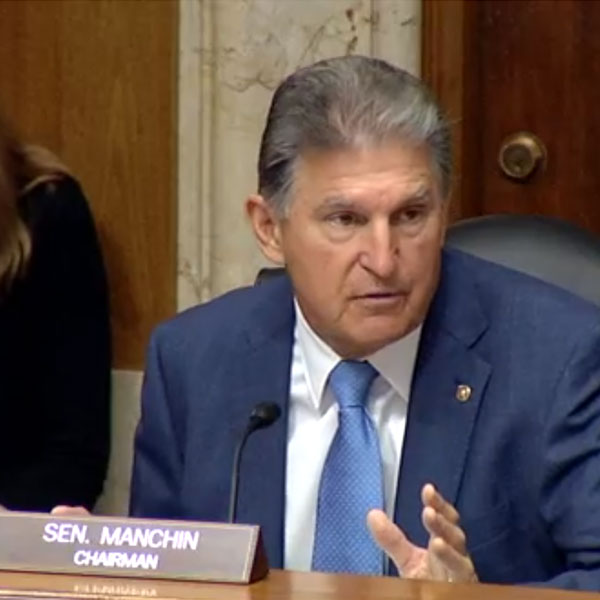
Sen Joe Manchin’s (D-W.Va.) effort to draft a modest energy infrastructure bill that can gain bipartisan support took a major step forward Wednesday, adding 48 amendments and winning a 13-7 vote before the Senate Energy and Natural Resources Committee.
Sens. Bill Cassidy (R-La.), Steve Daines (R-Mont.) and Lisa Murkowski (R-Alaska) voted with the committee’s 10 Democrats to move the bill forward.
The Energy Infrastructure Act, which committee Chair Manchin introduced last month, originally proposed $95 billion for a broad range of grid infrastructure, resilience and cybersecurity projects, clean energy supply chain development and low- and no-carbon technologies, as well as Western water infrastructure and wildfire prevention measures. An initial hearing on June 24 was largely overshadowed by President Biden’s announcement of the bipartisan agreement of a framework for a $1.2 trillion infrastructure package. (See Biden, Manchin Push Bipartisan Infrastructure Plans.)
Now with $98 billion worth of programs, the 495-page bill before the committee incorporated “suggestions made during and since our [June] legislative hearing,” Manchin said.
Many of the amendments were raised, and mostly voted down, on party-line votes. But closing the hearing, Manchin thanked both sides of the aisle for their efforts and not putting “roadblocks up that we couldn’t pass over.”
Even as the bipartisan working group, which includes Manchin, continues to hash out a larger $1.2 infrastructure package, “we’re the first committee that has absolutely a working document,” he said. “And to do a markup on this was something pretty spectacular in this quick, quick timeframe.”
In his opening statement, Manchin said, “This package not only includes provisions that have enjoyed strong bipartisan support in this committee, and bills like the SCALE [Storing CO2 and Lowering Emissions] Act for carbon capture infrastructure … which had been championed by my colleagues around the room, but also delivers on President Biden’s American Jobs Plan in many big ways and has earned the support of a wide swath of stakeholders.”
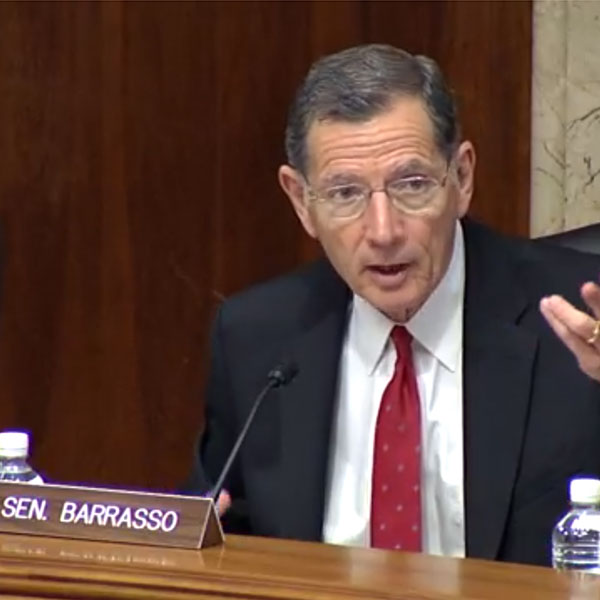
Senator John Barrasso | Senate ENR Committee
While acknowledging the bipartisan efforts, Sen. John Barrasso (R-Wyoming), the committee’s ranking member, voiced opposition throughout the hearing and was one of the no votes on the package. “The bill includes $95 billion [sic] in new spending authorizations. We’re told that prior to floor consideration. Majority Leader [Chuck] Schumer is going to turn these authorizations into mandatory appropriations, so it’s still unclear now how the majority is going to pay for this new spending.”
Going into the hearing, 37 amendments ― out of the 181 filed by Democrats and Republicans ― had already been agreed on and incorporated into the bill. More contentious and politically loaded issues were debated and received voice votes, with the majority failing on straight party lines.
Evoking recent heat waves that had melted power lines in his home state of Oregon, Sen. Ron Wyden (D) made an impassioned argument for an amendment allowing utilities repairing wires damaged in extreme heat to “work with all government bodies, but particularly both the Department of Energy and state governments.”
Manchin added his support, noting that the amendment would prevent “double-dipping” so that no project could receive funds from two different grant programs. Barrasso, however, opposed it, raising concerns that “this is going to result in California utilities drawing too much money from this underlying program.” The amendment failed on a 10-10 party line vote.
DOE as ‘Anchor’ Offtaker
Democrats were able to push back attempts by GOP senators to strike two key provisions aimed at accelerating the construction of new transmission projects.
Sen. Roger Marshall (R-Kan.) proposed an amendment to strike a section of the bill that would, he said, provide “federal backstop authority for interstate transmission lines” The section would allow the DOE to designate “national interest corridors” for transmission in areas experiencing or expected to experience transmission constraints. It would also give FERC the authority to approve projects in these corridors if a state failed to do so within a year of an application being submitted. Marshall said it would allow the federal government to “even override legitimate concerns expressed at the state level.”
Defending the provision, Manchin pointed to the urgent need to expand the transmission grid and the obstacles that now exist to project development. “We’ve had the current system in place for 15 years, and we know it’s not working,” he said. The provision “makes incremental progress in addressing some of the challenges facing development of transmission, specifically in the national interest corridors.”
Marshall’s amendment failed, again on a party line vote.
Sen. James Lankford (R-Okla.) proposed striking a second section of the bill which would give DOE the ability to help finance new transmission projects or upgrades to existing projects by becoming an “anchor” offtaker through a “capacity contract,” as well as by providing DOE loans. A contract could be terminated “as soon as practicable after determining that sufficient transmission capacity of the eligible project has been secured by other entities to ensure the long-term financial viability of the eligible project.”
The section also creates a Transmission Facilitation Fund, authorized at $10 million a year for 2022 to 2026. To qualify for such funding, a project would have to have a capacity of 1,000 MW or more for new transmission or 500 MW for line upgrades or expansions, and the DOE could contract for up to 50% of a line’s capacity.
Beyond representing a “dramatic shift” from the role of RTOs and ISOs in regional grid planning, Lankford said, the provision could inject partisan politics into project selection and development. A new Democratic or Republican administration could change which projects it favors, “and it’s going to bounce capital around,” Lankford said. “It’s a tremendous amount of capital to actually put into doing one of these projects, if suddenly you’ve got to wait until your party is in power to actually go get the next project.”
Murkowski crossed party lines to help Democrats defeat the amendment, saying it could provide help for remote communities in her state to develop microgrids. “We think it has the potential to provide some assistance in this area,” Murkowski said. “I’m exploring working with the committee here to help facilitate this. … So, I am at this point not prepared to support the motion to strike.”
Successful Amendments
Marshall was more successful, winning limited bipartisan support for two amendments, one requiring the DOE to undertake a “cradle to grave” analysis of the environmental impacts of electric vehicles and another mandating a study on “the impact of forced labor in China on the electrical vehicle supply chain.”
Daines won approval of an amendment requiring DOE to “conduct a study on the number of jobs that were lost and the effect on energy prices due to President Biden’s cancellation of the permit for the Keystone XL pipeline.”
Barrasso won support for an amendment requiring the secretary of energy to certify that no conflicts of interest are involved in granting of DOE loans. Invoking the 2011 loan default of solar startup Solyndra, Barrasso said, “Keeping political considerations out of the loan granting process is essential to restoring the integrity of these programs.”
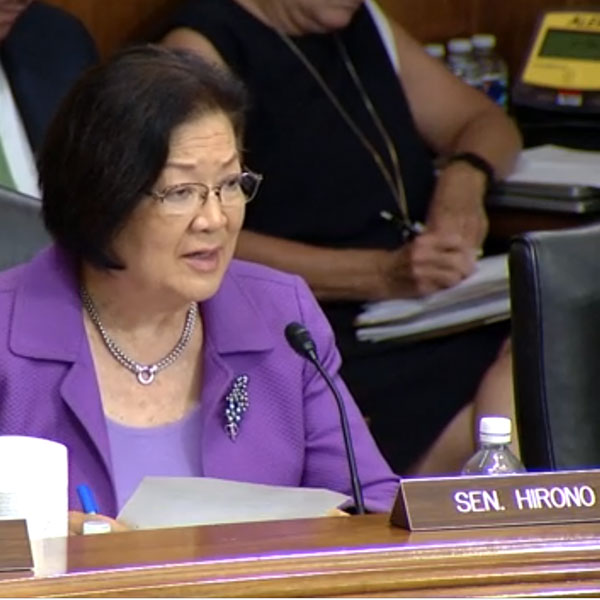
Senator Mazie Hirono | Senate ENR Committee
Murkowski crossed the aisle again to support an amendment by Sen. Mazie Hirono (D-Hawaii) requiring the DOE secretary “to establish a 21st century workforce advisory board to advise the secretary on the role of the department in the development of a skilled energy workforce.” The board would have 10-15 members selected by the secretary for their expertise in workforce development and both traditional and emerging energy technologies, she said.
A number of amendments were raised, but not voted on, signaling that further work and negotiations will continue as the bill moves to the Senate floor. One example was an amendment from Hirono that would give the federal government the ability to sign long-term power purchase agreements for renewable energy. “Right now, only the Department of Defense can sign power purchase agreements for 30 years, while the rest of the federal government is limited to 10 years,” Hirono said. “A 10-year contract would not be long enough for a project developer to secure financing to build basically any kind of power project.”
Everything Paid For
Energy trade and advocacy groups were quick to praise the bill and urge passage.
Paula Glover, president of the Alliance to Save Energy, called the bill “a concrete step by both parties to assemble an infrastructure package that values energy efficiency as one of the top solutions for an energy system that is more productive, decarbonized, and equitable.” The efficiency provisions touch “all sectors in our economy — from industry and manufacturing, to homes, buildings, and schools.”
Pointing to the bill’s funding for carbon- and direct-air capture technologies, Brad Crabtree, director of the Carbon Capture Coalition, said, “The Energy Infrastructure Act takes us an important step closer to securing the full suite of carbon management tools needed for our industrial, energy and manufacturing sectors to remain on track to reach net-zero emissions by midcentury. … [It] would also establish regional hydrogen and direct air capture hubs to facilitate widespread deployment of these critical technologies.”
A statement from Lisa Jacobson, president of the Business Council for a Sustainable Economy, focused on the bill’s “technology-inclusive approach. … Clean energy and energy efficiency drive a competitive economy, and the measures under consideration would create jobs and support American industry and prosperity.”
More Compromises Needed?
The question for Manchin is what further compromises may be required to gain the 10 Republican votes he will need to pass the bill in the full Senate, and what role it will play in the larger efforts to pass the bipartisan infrastructure deal that has yet to be completely translated into legislative language.
Speaking in support of the bill prior to the vote, Sen. Mark Kelly (D-Ariz.), called it “an investment in our nation’s energy and also Western water infrastructure; an independent, indispensable piece of the larger bipartisan infrastructure package.”
In a video posted to The Hill website on Tuesday, Manchin said both the infrastructure deal and reconciliation should be fully paid for. “I think everything should be paid for. We’ve put enough free money out,” he said.
ERCOT on Tuesday released a 60-point roadmap to improve the Texas Interconnection’s reliability and resource adequacy as the grid operator continues to address lawmakers’ concerns.
Interim ERCOT CEO Brad Jones guarantees Texas senators a more reliable grid. | Texas Senate Business and Commerce Committee
Interim CEO Brad Jones said the roadmap identifies the steps ERCOT and the grid can do better “to serve Texans, to improve reliability, to communicate, and also work with the [Public Utility Commission] in a more cooperative manner than we have in the past.”
The “Roadmap to Improving Grid Reliability” was released shortly before Jones and the PUC’s three members testified before the Texas Senate’s Business and Commerce Committee about June’s weeklong conservation appeal and Gov. Greg Abbott’s recent letter ordering the commission to take immediate action to increase the ERCOT market’s capacity and strengthen reliability.
“My guarantee to each of you is that we intend to communicate more clearly than we have in the past,” Jones said, “to remove industry jargon and speak to each other more clearly in a way that we understand each other; to serve all Texans and all Texas businesses in a reliable way that will continue to drive the growth of business and industry in Texas. That’s my promise to you.”
The roadmap, originally promised June 21, intends to strengthen ERCOT’s oversight of the market by creating unannounced inspections of power plant facilities and CEO certifications of weatherization. It also calls for a review of the market’s current and projected fuel mix, evaluating market changes that would incentivize “sufficient dispatchable resources” and improve fuel security, and considering on-site fuel supply.
Jones did offer some hope to renewable energy interests dismayed by Abbott’s directive when he said he’s been working closely with the PUC on those “specific items to attract and retain the type of generation we need to balance our wind and solar renewable fleet.”
“We’re also working to make sure we can provide an equitable market for all generators, that we recognize the benefits each generation brings to this market and that we provide the appropriate value for the attributes they bring,” Jones said.
Committee Chair Charles Schwertner leads Tuesday’s hearing. | Texas Senate Business and Commerce Committee
Committee Chair Charles Schwertner (R) opened the hearing by reminding the audience that the grid’s reliability remains a concern following the February winter storm, the April emergency alert and June’s call for conservation. He noted that Abbott’s two-page letter mentioned reliability 15 times and that this was senators’ chance to hear from the PUC and ERCOT about actions being taken to address their concerns.
When prompted by Schwertner, the commissioners — all three appointed in recent months by Abbott — said they believed they had the statutory authority from the recent legislative session to implement the new laws and the governor’s directives.
Sen. John Whitmire (D) told Jones it would have been helpful to have more time to review the report and asked why so many plants were on outages at the same time last month. Jones noted that the outages, three times above normal, were not maintenance outages and used the analogy of a flat tire to make his point.
“When you have a flat tire, you have to pull over to the side of the road,” Jones began.
“I’m not sure that’s the best analogy,” Whitmire said. “It’s alarming that the amount of maintenance outages caught you off-guard.”
Sen. John Whitmire | Texas Senate Business and Commerce Committee
Jones admitted that the number of outages did catch ERCOT by surprise, leading to a conservation notice that helped the grid operator meet demand without resorting to emergency measures.
“We need to find better incentives to make sure those generators make planned maintenance when they have that opportunity and make sure they have the revenues to support the maintenance,” Jones said.
“Y’all have the responsibility. We have to explain it [to our constituents],” Whitmire said. “We just don’t need any more surprises.”
“You’ve hit on the crux of the challenge,” Lake said. “At the same time we need more reliable generation, as clearly indicated in Senate Bill 3, we’ve got to provide economic incentives for those same companies to invest money not only in existing generation, but new generation in Texas.”
Lake referred to the ERCOT market’s $9,000/MWh price cap during scarcity conditions, designed to incent new generation investment in generation, as a “crisis-based business model.”
“The only financial award comes the closer you get to the crisis, which is not good for consumers. We need to have a market design so that if you provide reliability, that’s where the financial incentive is presented,” Lake said.
Cautioning the senators, he said, “Believe me: It’s not a small task that can be accomplished quickly. Nobody I’m aware of nationally or globally has figured out how to implement intermittent renewables with reliability.”
Jones noted 20 of the roadmap’s 60 initiatives have already been completed. The other 40, all on track, include:
eliminating barriers to distributed generation, energy storage and demand response so more resources can participate in the ERCOT market and also maintain adequate reliability;
addressing the Lower Rio Grande Valley transmission limitations, up to and including the construction of new transmission capacity;
assessing and developing a plan to improve the accuracy of generation reports to ERCOT;
assessing the potential costs and benefits of increased transmission, both internal and external to ERCOT; and
increasing coordination with other grid operators.
Stakeholders elected a new member of the PJM Board of Managers and vice chair of the Members Committee on Wednesday.
David Mills, owner and principal consultant of Eaglecap Energy Consulting in Seattle, was elected at a special Members Committee meeting to fill the board seat held by former InterGen CEO Neil Smith. Mills, whose term extends until 2024, was nominated for the position in June. (See Energy Consultant Nominated for Open PJM Board Seat.)
Charles Robinson, current board member and a member of the Nominating Committee, said Mills’ nomination was the result of a “very lively and engaged committee” that has been active for several months in looking for candidates for two other open board positions. The Nominating Committee’s sector representatives included: Susan Bruce (End Use Customers); Lisa McAlister (Electric Distributors); Alex Stern (Transmission Owners); Betty Watson (Other Suppliers); and Jeff Whitehead (Generation Owners).
In April, the committee nominated Paula Conboy, former chair of the Australian Energy Regulator, and Jeanine Johnson, vice president of product security at Netgear, to replace board Chair Ake Almgren and board member John Foster. Stakeholders elected the new members at the Meeting of Members in May. (See PJM Stakeholders Elect New Board Members.)
Mills is a former senior vice president of policy and energy supply with Puget Sound Energy, where he worked for more than 18 years and served as chief strategy officer. He earned a bachelor’s degree in economics from Portland State University.
“David is an energy consultant with a demonstrated track record of strategic leadership in the power and natural gas industry,” Robinson said.
MC Vice Chair
Stakeholders also unanimously elected Becky Robinson, director of PJM market policy at Vistra, to serve the remaining term of vice chair of the Members Committee. The position came open after Katie Guerry, head of regulatory affairs for Enel North America, took a leave of absence as MC chair at the beginning of the year and officially resigned from the position in June. Former Vice Chair Erik Heinle of the D.C. Office of the People’s Counsel, who had been serving as MC chair in Guerry’s absence, officially became chair of the committee last month.
To maintain the rotation among sectors required by Manual 34, the vice chair candidate was selected from the Generation Owners sector.
Robinson will serve as vice chair through 2022 and then become the chair of the MC in 2023.
Heinle thanked Robinson for volunteering for an “extended tour of duty” as vice chair.
“I know you’ll do a fantastic job as a member leader serving our stakeholder community,” Heinle said.
The cost of upgrading electrical panels is often a barrier to home electrification projects, but the Sacramento Municipal Utility District has found a less expensive alternative, a SMUD planner said during a workshop hosted by the California Energy Commission.
Scott Blunk, a strategic business planner with SMUD, said installing a device called a simple switch allows two devices to be wired together, such as an induction range and an EV charger. One of the devices is given priority, so that if the induction range is turned on, for example, EV charging is turned off.
Scott Blunk, SMUD | CEC
SMUD has so far installed about 25 simple switches, which cost around $250 each. In contrast, a panel upgrade costs $4,725 on average and can run to $9,000 or more, Blunk said.
“That’s an incredible barrier for us to overcome,” he said.
Blunk gave a presentation Monday during a workshop hosted by the CEC. The commission held a series of three workshops on building decarbonization this week as part of its process for developing the 2021 Integrated Energy Policy Report (IEPR).
Blunk said that SMUD has set a goal of 100% building electrification by 2045, with electrification for low-income customers by 2040. The district has committed $1 billion to its goal.
“We’ve talked so much about new construction at the CEC and other places, and we’re making great strides there,” Blunk said. “But we really need to … look at what we can do to emphasize existing buildings.”
Calculating Savings
Another workshop speaker, Ryan Gardner with Rincon Consultants, discussed a building electrification strategy that his firm developed for the city of Berkeley. The project focused on low-rise residential buildings. Rincon worked with the Rocky Mountain Institute and the Ecology Center, a local nonprofit, on the strategy.
Gardner said electrification challenges included the age of the buildings, which were mostly built before 1963, as well as poor sealing and insulation and the presence of asbestos.
In addition, the city’s mild climate means not much energy is used for heating and cooling.
“This is probably one of the harder places to do this work,” Gardner said.
The group ran a cost analysis for installing economy or mid-tier electric appliances in homes. For economy appliances, energy bills went up unless a solar system was added to the project, the analysis found. For mid-tier appliances, energy bill savings were only about $5 a year unless solar was added.
The project also included a public outreach component that led to the development of “equity guardrails” for building electrification, Gardner said. Those included providing financial assistance so that building improvements are available to all residents and taking steps to prevent resident displacement as a result of rising rents that may follow improvements.
Gardner listed several steps that could help make building electrification cost-effective in Berkeley, including reducing costs for electrical panel upgrades and establishing utility rates “that reflect our priorities.”
Bundling Upgrades
In another presentation, Stephanie Chen, senior policy counsel with Marin Clean Energy (MCE), discussed the agency’s Low Income Family and Tenants (LIFT) program. MCE is a community choice aggregator serving Marin, Napa, Solano and Contra Costa counties.
LIFT, which is available to low-income multi-family properties, offers electrification of HVAC systems and water heating as well as energy efficiency upgrades.
Chen said LIFT works in concert with other programs, including Healthy Homes and programs offered by BayREN, a nine-county collaboration focused on energy efficiency. The idea is to combine as many upgrades as possible into a single project for a multi-family property. That way, tenant benefits are maximized while disruption is limited.
Stephanie Chen, Marin Clean Energy | CEC
And to ease strain on property owners, Chen said, it’s “absolutely critical” to provide one point of contact for the projects, while coordinating the programs behind the scenes.
Chen said that electrification provided through the LIFT program has been “more popular than we had even anticipated.” Improving health and safety for tenants seems to be the main motivating factor for property owners, even more than the environmental benefits of the projects, she said.
A big selling point has been the ability to provide air conditioning when a furnace is replaced with a heat pump.
“That has proven to be a really compelling health and comfort benefit, especially with the recent record-breaking summers we’ve had,” Chen said.
Chen said MCE generally approaches property owners, rather than tenants, to ask if they’re interested in participating in the electrification programs. But after a project is completed, MCE works with tenants to train them on using new equipment such as heat pumps. Tenant education also focuses on ways to reduce energy bills through steps such as being aware of time-of-use rates.
MCE also surveys tenants after a project is finished to get their feedback on the upgrades, Chen said. Many residents comment that their new equipment is quieter, is better at maintaining a comfortable temperature and has improved indoor air quality.
Chen said one take-home message from the LIFT program is that building electrification has multiple benefits.
“We don’t necessarily need to convince customers to care about emissions … in order to convince them to make the switch,” she said. “We can message the benefits of electrification around improved quality of life, and we know that on the back end, the emissions reductions will follow.”
Shale gas, once called a “transition fuel,” and increasingly shipped overseas where prices are higher, is a key to achieving U.S. net-zero carbon emissions by 2050, a key Biden administration appointee said this week.
“We have to tailor the path forward for a decarbonized energy and industrial future based on the existing assets,” said Brian Anderson, director of the National Energy Technology Laboratory, who was appointed executive director of the administration’s Interagency Working Group on Coal and Power Plant Communities and Economic Revitalization in April.
Anderson was one of nearly a dozen speakers during a two-hour virtual program hosted this week by AFL-CIO President Richard Trumka and former Energy Secretary Ernest Moniz, now a principal with the Energy Futures Initiative think tank.
The mission of Anderson’s working group is to make sure the shift to a clean energy economy does not leave behind the existing industrial workforce and their local economies, whether they were based on coal mining, power generation or heavy industry — a centerpiece of Biden’s “Build Back Better” agenda.
“This region, blessed with a lot of natural gas, has a great pathway through decarbonized blue hydrogen,” Anderson said.
“When we look at the different pathways for decarbonizing the grid by 2035 and … the economy by 2050, a large component of that’s going to require the commercialization of carbon capture utilization and storage.”
Gas production in the Marcellus and Utica shales would be fed to an expanded “steam reforming” industry that pulls hydrogen out of methane in a high-heat process, leaving behind carbon dioxide that would have to be injected deep underground in another industrial process that would also create new jobs.
Anderson said hydrogen could substitute for natural gas in steel making, cement making and other industrial applications that require a lot of energy, and which today pump enormous amounts of CO2 into the atmosphere.
Noting that the Department of Energy has been working on carbon sequestration for 20 years, Anderson said the “blue hydrogen” made from natural gas is only a fraction of the cost of “green hydrogen,” produced through electrolysis of water, using electricity generated by wind or solar.
A fellow panelist, Brad Markell, executive director of the AFL-CIO Industrial Union Council, said workers employed in the natural gas industry have skills that could easily transfer to hydrogen as well as carbon capture and sequestration.
“Unions are ready to go for CCS and hydrogen. Our training programs [can] accommodate this,” he said.
“The fact is that we need baseload power. We need industrial heat. We need regionally focused solutions that are going to build on the strengths of the Ohio River Valley to preserve high-paying, good industrial jobs, heavy industry industrial jobs and energy-intensive industry,” Markell said.
Lee Beck, international director for carbon capture with the Clean Air Task Force, said the substitution of hydrogen for methane and carbon sequestration will be crucial in the coming decades as the nation attempts to decarbonize industry.
“From our perspective, we think that carbon capture and hydrogen are important for achieving net-zero emissions globally. The most important thing right now is to make sure that we can commercialize these technologies so we can start creating jobs in the near term,” she said.
Moniz agreed that hydrogen will have a star role in cleaning up heavy industry.
“We all know that we will need to clean our electricity system [and] will need to do some electrification in other sectors. But we also know we are going to have to supplement that by approaches that at least have the characteristics of today’s fuels. And that’s where we see hydrogen coming in as an essential compliment to low-carbon electricity,” he said.
Trumka focused on the impact that cleaning up heavy industry will have on ordinary people.
“We see working people who have suffered a long-term hollowing out of our country’s industrial base, but now we’re at an inflection point. We have an opportunity to define a 21st century industrial policy to modernize our energy and manufacturing sectors so that our children and grandchildren inherit a livable planet and broadly shared prosperity. And it starts now,” he said.
The overall thrust of event was “deployment, deployment, deployment,” said former EPA Administrator Gina McCarthy, now the White House National Climate Adviser, who made an appearance along with Ohio Sen. Sherrod Brown (D) and West Virginia Sen. Joe Manchin (D).
McCarthy said the administration wants to fund 10 “pioneer demonstration facilities using carbon capture retrofits” and 15 clean hydrogen demonstration projects.