PJM Board Approves MOPR Rollback

The PJM Board of Managers on Wednesday approved the RTO’s proposed replacement for the extended minimum offer price rule (MOPR-Ex), setting up a final decision on the contentious capacity market issue at FERC.

At a special Members Committee meeting last week, stakeholders strongly supported PJM’s proposal in an 87-18 vote, for a sector-weighted score of 4.18/5. The PJM proposal was one of nine proposals voted on at the meeting but the only one to receive majority support. (See Stakeholders Back PJM MOPR-Ex Replacement.)

In a letter issued by the board on Wednesday, Chair Mark Takahashi said voters selected PJM’s proposal because it “accommodates state policy and self-supply business models,” addresses “attempted exercises of buyer-side market power (BSMP),” and creates a “sustainable market design” by “keeping clearing prices consistent with supply and demand fundamentals.”

The board cited the “overwhelming member support” of PJM’s proposal during the critical issue fast path (CIFP) stakeholder process and the final vote as another reason for its selection. The board in April directed the RTO to use the CIFP process, which was designed to resolve controversial time-sensitive issues, marking the first time it was implemented.

PJM officials said they plan to work “diligently” to ensure the RTO files with FERC in time to have the changes incorporated into the 2023/2024 delivery year base residual auction scheduled for December. (See PJM Proposes Shifting MOPR Determinations to FERC.)

PJM CEO Manu Asthana said that, through the CIFP process, stakeholders “successfully tackled a complex issue in a compressed time frame, achieving both a workable solution and broad consensus behind that solution.”

“This proposal ensures that our capacity market accommodates state policy and self-supply business models, avoids customer costs of double-procurement, addresses attempted exercises of buyer-side market power and creates a sustainable market design by keeping clearing prices consistent with supply and demand fundamentals,” Asthana said.

PJM’s Proposal

The PJM MOPR proposal calls for “maximiz[ing] transparency and market confidence” through identification of BSMP by the RTO and the Independent Market Monitor. It also proposes to “further clarify the actions of a state” that may “improperly interfere with bidding in PJM’s capacity market and FERC’s rate-making authority.”

Market participants will be asked to sign attestations declaring they arenot exercising market power or receiving state funds tied to clearing in the auction. PJM and the IMM will conduct “fact-specific, case-by-case reviews” if market power is suspected, and referrals will be made to FERC for a final determination.

The new rules will eliminate both the expanded MOPR created by FERC’s December 2019 ruling and PJM’s prior MOPR, which was limited to new natural gas resources.

In its letter issued Wednesday, the board said discussions involved several items stakeholders had included in the matrix, including a request to delay a MOPR filing to FERC, the creation of an emerging technologies MOPR exemption, considerations related to self-supply proposals and increased reporting on capacity auction results.

The board said it ultimately decided against amending the PJM proposal because it “could alter the members’ intent as expressed in the vote” held on June 30. The letter said stakeholders can start further discussions on issues as they begin Phase 2 of capacity market discussions.

“We would like to sincerely thank the many stakeholders who invested time and energy to provide essential diversity of thought throughout this process,” Takahashi said. “We view the stakeholder process as a true strength of the organization, as it provides a venue for viewpoints across the industry to be heard and deliberated upon.”

PJM’s Response

Adam Keech, PJM’s vice president of market design and economics, said the MOPR proposal boiled down to three key points driving its design.

First, PJM wanted to ensure the proposal was “focused in” on BSMP, including attempts to exercise such market power.

The existing MOPR resulting from the December 2019 FERC ruling was too “broad” and went beyond the BSMP parameters, Keech said. Early in the CIFP process, he said, PJM received stakeholder feedback expressing the desire to refocus the MOPR on BSMP “the way it has been intended to since its inception and prior to the expansion” in December 2019.

Keech said the second driving principle was to accommodate state policy and self-supply business models. He said the existing MOPR “puts up challenges” for entities using those types of models and that PJM wanted to avoid creating “barriers” as long as they’re not attempting to exert BSMP.

The third proposal driver was to make market rules “sustainable,” Keech said, with PJM looking to move away from market designs that attempt to “reconstitute clearing prices” that aren’t consistent with the set of resources that cleared the auction.

“We felt in order to make the market rules sustainable, we had to make sure the markets adhere to the strict economic principles of making sure the prices reflect the supply and demand conditions in the market,” Keech said.

Keech said the PJM proposal advanced overwhelmingly because of the work done with stakeholders inside and outside the CIFP meetings, incorporating input, considerations and concerns while still focusing on the RTO’s three main drivers.

“It was a lot of work, a lot of listening and a lot of revisions to the proposal to try to address everybody’s concerns and give them confidence that their concern would be addressed with the proposal but not to the detriment of the effectiveness in terms of mitigating buyer-side market power,” Keech said.

Asim Haque, PJM’s vice president of state and member services, said in just three months members “tackled one of the most high-profile energy policy issues in the country.” Haque said PJM was “grateful” for the engagement by members in the expedited stakeholder process.

Haque said there was no trepidation in taking on the CIFP process even though it had never been implemented, saying the process was “highly negotiated” in Manual 34 and had a clear template for how to advance to the next steps.

PJM received “pretty clear signals” from FERC that some sort of MOPR reforms needed to be advanced quickly, and he knew the stakeholder body “would meet that call,” he said.

“Our stakeholders really stepped up and were participants in all of the different critical issue fast path stages and certainly met and exceeded our expectations of participation,” Haque said.

Overheard: Buttigieg on the Bipartisan Infrastructure Deal

Announcing a bipartisan infrastructure deal — even with 11 Republicans on board — does not guarantee a fully fleshed-out bill with billions of dollars for new transmission, electric vehicles and resilience will reach President Biden’s desk.

“You have things that are overwhelmingly popular on both sides of the aisle, across every ZIP code in America except Capitol Hill,” Transportation Secretary Pete Buttigieg said Thursday in an online conversation with Jason Grumet, president of the Bipartisan Policy Center. “I think the biggest threat is politics: some decision that it would be politically advantageous to fail. But by the same token, I can’t think of better politics than actually delivering something that the American people want.”

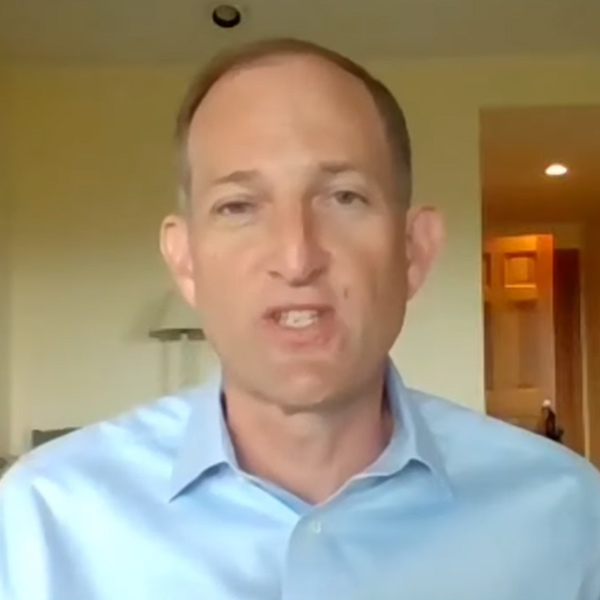
GJason Grumet, BPC founder and president | Bipartisan Policy Centerrumet pushed Buttigieg on whether, this time, an infrastructure package would get done.

“Just think about the alternative,” Buttigieg said. “What it would be like for a Republican and Democrat to go back to their districts and explain why we couldn’t do something that the vast majority of Americans, business and labor, governors and mayors, all said we ought to do. That would be a very difficult thing to explain.”

The need to maintain momentum for the infrastructure package — and get it done — was the main message of the BPC webinar, which in addition to Buttigieg also featured a panel with labor and energy business leaders. The organization is one of many now solidly supporting the bipartisan package, but Grumet still had probing questions for Buttigieg.

“There’s always been some asymmetry between what the nation needs in terms of infrastructure and what local communities want next door,” Grumet said, talking about equity in infrastructure planning. “How do we integrate the desire to build in these communities in a way that actually embraces their economic development aspirations but doesn’t exacerbate environmental justice concerns?”

Buttigieg acknowledged low-income and disadvantaged communities have often been either neglected, disrupted or displaced by infrastructure projects. “That’s particularly been true in the history of how our highways came to be where they are: going often through black and brown neighborhoods, either because it’s the path of least resistance, which itself reflected political or economic dynamics of racial disparity, or worse, with a very direct intent to remove what was considered an undesirable neighborhood, [which] was often, in fact, a thriving and very important neighborhood for a minoritized group.”

Ensuring that infrastructure funds will benefit such communities will require planning and development processes that are “legitimately inclusive, and at the same time, flowing in a swift way … so that no one feels like they need to stand in the way of a project or an effort at the last minute,” Buttigieg said.

Solutions, however, will differ from one community to another, he said. “I don’t think the answers for the most part ought to come from Washington, but what’s clear is more of the money should,” he said.

Mobilizing Capital

Audience members also had sharp questions of their own about automobile fuel efficiency standards and whether or when the administration might consider a phase-out of gas-powered cars.

Regulated by the Department of Transportation, the Corporate Average Fuel Economy (CAFE) standards are an essential part of transportation decarbonization, Buttigieg said. “No matter how good we get [with] EVs, there are going to be a lot of gas-powered cars on our roads for a long time … even when no gas cars are being sold, whenever that day might come, which is why having a high level of efficiency on the cars sold today, tomorrow, in 2026 and so forth is going to be so important,” he said.

At the same time, Buttigieg said, policy discussions on accelerating EV adoption should consider “the opportunity that electric vehicles represent in areas that maybe aren’t the first to leap to mind when you think about EV users — mainly rural [areas], where you’ve got people driving longer distances, which means almost by definition they’re going to save more money [with an EV]. It’s part of why we have got to make electric vehicles and electric pickup trucks affordable.”

With the bipartisan package providing only about half of Biden’s $2 trillion American Jobs Plan, another audience member asked about the role of public-private partnerships (P3) for infrastructure financing.  

“What we know is there is a lot of capital, a lot of cash out there looking for a place to go,” Buttigieg said. “If we can mobilize that capital to solve public problems, if we can mobilize that capital to enhance the infrastructure capacities of our country, that’s a really appealing opportunity. What can’t work is for P3 to be used as an excuse to make an end run around important labor or environmental and other public policy goals, basically outsourcing the responsibility for doing the right thing.”

Power Cables Melting

Liz Shuler, AFL-CIO secretary-treasurer | Bipartisan Policy CenterFollowing Buttigieg, Liz Shuler, secretary-treasurer of the AFL-CIO, started off the webinar’s panel discussion with a strong endorsement of the infrastructure deal, especially highlighting the $43 billion earmarked for resilience. Referencing the recent heat wave in her hometown of Portland, Ore., Shuler said, local power systems “were not designed for the extremes. There were power cables that were melting in the 115-degree heat. That’s not what they were built for.”

Shuler was also bullish on the jobs that infrastructure projects would create, pointing to offshore wind development as “a top-drawer example of how labor and management can work together to create a high-road, high-wage strategy for the entire sector, so that this promise that we hold out there of a clean energy future is actually growing good jobs, and it’s benefiting everyone.”

“To scale up offshore wind, the big need right now is to leverage the huge pipeline of projects that are on the horizon and translate that into the production of the major components in the United States,” Shuler said. “We are way beyond the volume needed to support turbine and blade factories. If we can produce the major [turbine] components here in the United States, the bill of materials is stupendous. It’s literally hundreds of tons of steel and copper and specialty metals.”

Robert Blue, chair, president and CEO of Dominion Energy | Bipartisan Policy CenterThe other two speakers, Dominion Energy CEO Robert Blue and EQT President Toby Rice, did not speak directly about the infrastructure deal, focusing instead on positioning their companies as integral parts of the clean energy economy.

Electric utilities are part of the “decarbonization narrative,” Blue said, pointing to Dominion’s Coastal Virginia Offshore Wind project, with 2.6 GW of turbines to be located 27 miles off Virginia Beach. Completion is slated for 2026, he said. The utility is currently building an all-American-made installation vessel.

At the same time, Blue said, getting to net-zero emissions by 2050 will mean “continuing operating our nuclear facilities, which are the only baseload, non-emitting sources of electric generation that exist today.”

Rice argued for natural gas as a cleaner alternative than the coal that still provides about 20% of U.S. power and as support for accelerated renewable energy deployment. “The more natural gas we use creates more opportunities for renewables and is going to be key for lowering emissions,” he said.

Rice also sees the growing hydrogen economy as creating a virtuous cycle for natural gas. “Hydrocarbons can be transformed into a decarbonized form of energy,” he said. “We’re talking about using natural gas as a feedstock to produce hydrogen and pairing that up with our wellbores that are depleted. Those can serve as carbon sinks, so not only do we have a low-cost form of natural gas that could be a feedstock for hydrogen, we also have a home to store the carbon.”

ISO-NE Presents Revised Market Design Approach for Order 2222 Compliance

ISO-NE’s revised proposal for FERC Order 2222 compliance was the singular focus for the NEPOOL Markets Committee on Thursday as it wrapped up a two-day meeting.

The RTO presented changes to energy and ancillary services (EAS) market participation, metering and telemetry requirements, distributed energy resource aggregation (DERA) registration coordination and Forward Capacity Market (FCM) participation.

Throughout its presentation, ISO-NE also responded to stakeholders who presented at the MC meeting in June.

Changes Outlined

Regarding EAS markets participation, the RTO added a demand response DERA model and expanded the existing participation models to allow for aggregations. The initial proposal did not allow demand response DERs to aggregate with other types of DERs.

ISO-NE said the demand response DERA model might include demand reduction, energy injection and energy withdrawal capabilities. The model also leverages most of the market features from the existing DR resource model to provide compensation for demand reductions based on Order 745 requirements.

The grid operator’s updated proposal now aligns the metering and telemetry requirements for aggregations with existing requirements for non-aggregated assets. This model ensures metering equivalence between aggregated and non-aggregated resources for market products being bought and sold, real-time situational awareness, accuracy, precision and latency. In addition, the utilization of existing meter data collection systems will also facilitate cost-efficient implementation.

Response to AEE

At the June MC meeting, Advanced Energy Economics said device-level metering is necessary for Order 2222 compliance and suggested that third-party meter readers be included in the design. AEE also noted that submeters are allowed for passive demand resources and that third parties are used to report revenue quality metering (RQM) and telemetry for active demand resources.

Data used for settling passive or active demand resources do not impact energy market settlement and are not subject to reporting by the meter readers.

Passive demand resources, including energy efficiency resources, and some behind-the-meter distributed generation, also do not participate in the energy market. Active demand resources, like DR resources, are economically dispatched, but any payment for demand reductions is funded through mechanisms outside of the market. The metered load reported for settlement includes any demand reductions achieved by demand resources, so the measurement of and payment for demand reductions must occur outside the market.

In New England, Participating Transmission Owners (PTOs) are responsible for reading the meters for energy market assets, based on the Transmission Owners Agreement and Manual M-28. For that reason, ISO-NE said it is not authorized to conduct meter reader functions or permit the use of a third-party meter reader, which would have to be approved by the relevant PTO. PTOs are responsible for providing RQM for generation, tie lines and load. Cost recovery of metering infrastructure is subject to state review and approval.

Because of these differences across utility territories and jurisdictional issues, the RTO said it does not find it appropriate to mandate a specific metering approach that requires reconstitution or parallel metering of behind-the-meter DERs.

Next Steps

The MC and other technical committees will continue discussion of the RTO’s proposal in August. In September, ISO-NE will present the final draft of its proposal and initial tariff redlines. Stakeholders who want to pursue alternative approaches should indicate their intentions to present at the October technical committee meetings.

Any remaining design refinements to the RTO’s proposal, continued review of tariff redlines and potential stakeholder amendments will occur in November. NEPOOL’s technical committees will hold votes on ISO-NE’s proposal and stakeholder alternatives at the technical committees in December, and the Participants Committee is slated to vote in January ahead of the Feb. 2, 2022, filing deadline with FERC.

ISO-NE, NEPOOL Continue to Conceptualize Capacity Market Sans MOPR

ISO-NE and stakeholders kicked off a two-day NEPOOL Markets Committee meeting Wednesday with a session strictly devoted to discussing removing the minimum offer price rule (MOPR) from the RTO’s capacity market.

The RTO presented its current thinking about the elimination of the MOPR and addressed stakeholders who sought clarity on two key issues discussed at the June 8-9 MC meeting: the rationale for proposing to eliminate the rule, and regional risk-related concerns with its removal. It aims to file a proposal to eliminate the MOPR with FERC in the first quarter of 2022 so that changes are in place for FCA 17, scheduled for February 2023.

Regarding the first issue, ISO-NE cited undercounting contributions to resource adequacy. High-cost resources developed to meet states’ policy objectives do not clear the Forward Capacity Auction when the MOPR is applied, which is inefficient over time and results in excess regional investment, absent any reform, it said.

It is a different situation from when the MOPR was developed a decade ago, according to ISO-NE. The original rationale for the rule was its ability to deter the development of high-cost, uneconomic resources.

As for the risk-related worries, the RTO said there is uncertainty for future capacity prices and the potential for inefficient retirements.

Investors in new and existing resources making capital expenditures face greater risk over future capacity prices without the MOPR. ISO-NE said that Potomac Economics, its External Market Monitor, will address this issue at the next MC meeting in August.

Imprecise measurement of technologies’ actual contributions to resource adequacy in the qualification processes and low-offer supplies without a MOPR could push premature retirement of resources whose flexibility, dependability and/or sustainability may be more valuable with high renewable penetration. ISO-NE said reliability risks are challenging to quantify. While addressable with new energy and ancillary service market designs, the RTO’s present concerns remain as inefficient retirements are irreversible.

The RTO is evaluating using the FCA market-clearing engine to simulate potential clearing impacts of the MOPR’s elimination and expects to have more specifics for stakeholder input in August to provide preliminary results for review in September.

Stakeholders Offer Ideas

Calpine and Vistra offered their initial conceptual approaches dealing with the removal of the MOPR.

Brett Kruse of Calpine discussed changing the market rule for capacity supply obligations (CSOs) by reducing capacity resources’ combined notification, start-up and minimum run and down times to 24 hours from 72 hours. Kruse said that regardless of what happens with the MOPR, ISO-NE should revise the rules for CSOs to reflect system needs better.

Kruse said CSOs are a tariff provision from the original Forward Capacity Market settlement in 2005 in which ISO-NE wanted to ensure that several limited generation resources exited the market. However, the requirement is administrative, and there was no analysis used to support it, he said. In 2005, the RTO wanted more flexible resources, because they are inherently more valuable. The need for flexible resources is more pronounced now than in 2005, and Kruse said that 24 hours is better for system reliability than 72 hours.

He added that the EMM reinforces a similar resource reliability assessment of the resources that may be affected by this potential rule change in its 2020 state of the market report.

Vistra’s Andrew Weinstein said that the capacity market must better accommodate state policy goals. While narrowing the MOPR is inevitable, durable capacity market design requires buyer- and seller-side market power mitigation. Weinstein said that eliminating the MOPR without replacement buyer-side market power mitigation is risky given FERC and court precedent.

Weinstein said that a Competitive Auctions with Sponsored Policy Resources (CASPR) transition that substantially accommodates state-subsidized resources while preserving investor confidence and avoiding cost shifts could be appealing as a permanent solution. He added that tying renewable technology resource exemption amounts to CASPR’s success will ensure the design is focused on material participation in the FCA by subsidized resources.

It would also give ISO-NE time to develop a durable market design, including effective load-carrying capability, a carbon solution and the required buyer-side mitigation rules that would need to be much narrower and more targeted than existing ones.

NREL: International Tx Critical for Emission Reductions, Resource Adequacy

A new study from the National Renewable Energy Laboratory says that the most effective way to cut at least 80% of greenhouse gas emissions from North America’s power systems by 2050 will be to put as much low-cost wind and solar on the grid as possible, electrify everything, and build hundreds of gigawatts of new transmission capacity.

The North American Renewable Integration Study (NARIS) also envisions a small but significant amount of those new transmission lines running across U.S. borders with both Canada and Mexico.

“Our big-picture, take-home messages are that we can maintain [resource] adequacy while going to these high [renewable] contribution scenarios,” said Gregory Brinkman, a senior engineer at NREL and principal investigator on the study. Another key takeaway: “Cooperation and transmission expansion are really, really valuable,” he said.

Brinkman said such findings are not particularly unexpected or shocking. Rather, the value of the report lies in its efforts to look at North America’s power systems holistically and its extensive modeling of the opportunities for system efficiencies and cost savings that may be available with different low-cost renewable, emission-reduction and electrification scenarios, and the transmission buildouts each will require.

Ramping-up-low-cost-wind-and-solar-(NREL)-Content.jpg
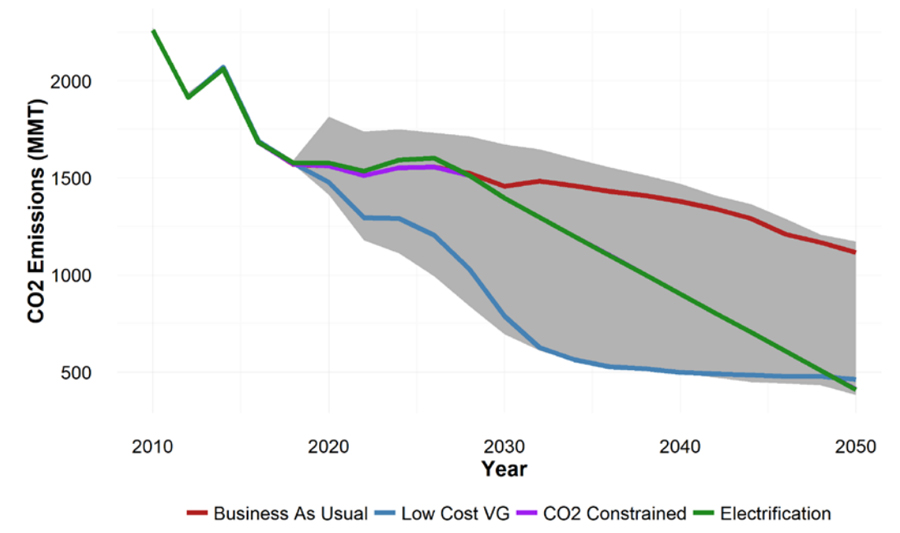
Ramping up low-cost wind and solar is the quickest, most effective way to cut carbon emissions, according to the NARIS report. VG = variable generation. | NREL

For example, the study finds that ramping up low-cost wind and solar over the next decade could provide deeper cuts in carbon emissions in the near term than either targeting an 80% drop in carbon emissions or electrifying transportation.

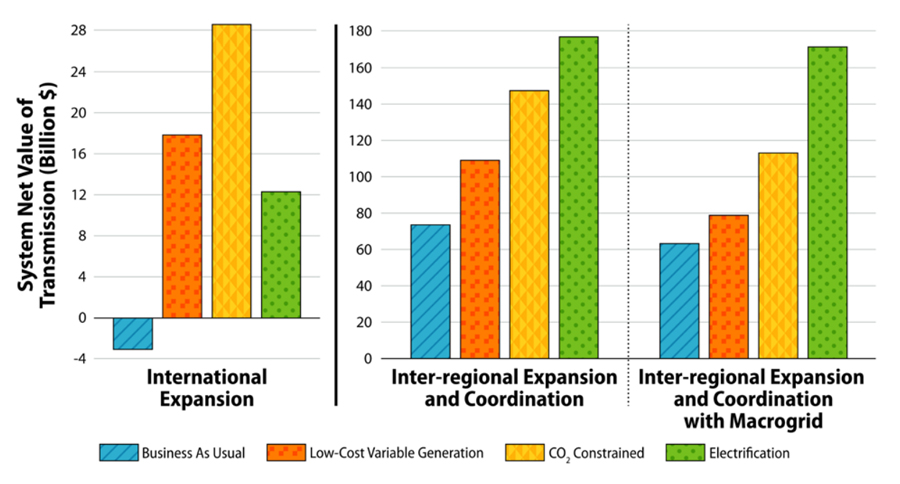
The report also estimates net benefits of new cross-border transmission at $10 billion to $30 billion between 2020 and 2050, based on total capital and operational costs, Brinkman said. The corresponding benefits of building out interregional transmission in the U.S. could pencil out at $60 billion to $180 billion, the report says. Those benefits do not include “externalities” such as the social and health benefits of lower emissions, Brinkman said.

The report, which includes parallel U.S. and Canadian versions, was released alongside a memorandum of understanding on cross-border cooperation signed at a June 24 meeting between U.S. Energy Secretary Jennifer Granholm and Canadian Minister of Natural Resources Seamus O’Regan. The nonbinding MOU includes a long list of potential areas for “sharing knowledge and exploring options” and best practices, such as vehicle electrification, grid reliability and cybersecurity, and improving energy access and resilience for remote and Arctic communities.

While the MOU commits neither country to providing any funds for collaborative projects or to even regular meetings, it is founded on mutual interests and needs that will likely intensify in the coming decades.

Cross-border-and-interregional-transmission-(NREL)-Content.jpg
Building new international and interregional transmission could provide up to $180 billion in net benefits. | NREL

“No two countries in the world have their energy sectors as closely linked as Canada and the United States do,” O’Regan said in a joint announcement of the MOU, emphasizing the economic benefits of cross-border energy exchanges between the two countries. According to the U.S. Energy Information Administration, Canada is the largest energy supplier to the U.S. and, after Mexico, the second largest market for U.S. energy exports.

In dollar terms, EIA pegged U.S. energy imports from Canada at more than $80 billion in 2019, about four times the exports from the U.S. to Canada.

Granholm framed the MOU as a bilateral commitment to “ensure that all pockets of North America have access to affordable, clean energy. We can’t tackle the climate crisis alone,” she said. “We must work together to accelerate the flow of low-carbon electricity across our borders.”

Transmission-Investments-(NREL)-Content.jpg
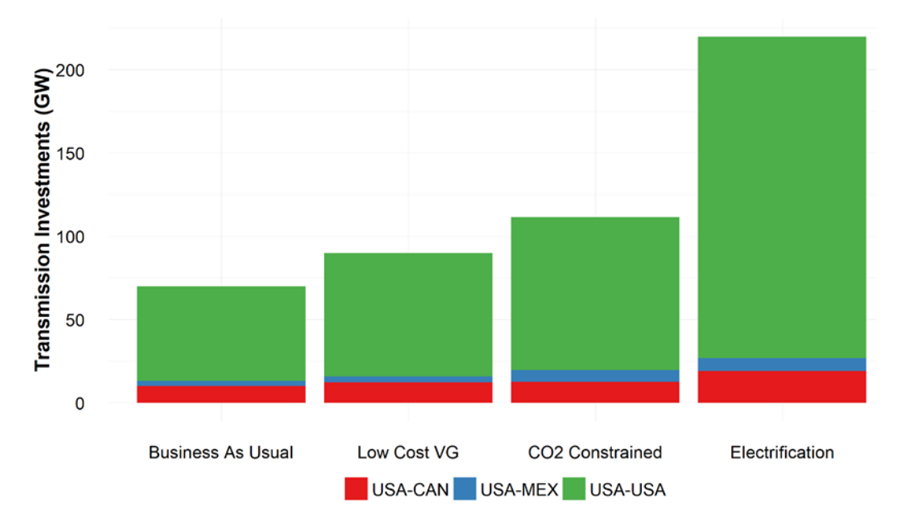
The most aggressive electrification scenario could require new transmission with up to 200 GW of capacity, most of it in the U.S. | NREL

Exactly how much energy will be crossing borders and how much transmission will be needed to ensure reliability and resource adequacy are more difficult to gauge. One of the weaknesses of the report is that it measures new transmission in terms of megawatts of capacity, not miles. Putting low-cost solar and wind on the grid could require about 100 GW of new capacity on the transmission system versus 200 GW required for electrification of buildings and transportation.

New wires going between Mexico and the U.S. would only need 3 to 8 GW of capacity, and U.S.-Canada lines would need 10 to 20 GW, the report says. Mapping out new transmission needed to increase renewables, cut emissions and electrify buildings and transportation, the report shows an increasingly thick web of new lines connecting regions across the U.S. itself.

Slightly Outdated Data

The self-acknowledged limitations of the NARIS report are significant, as seen in the four basic scenarios it covers.

The business-as-usual pathway is based on state and federal legislation enacted as of October 2018, meaning many of state emissions-reduction targets enacted in the past three years are not part of the modeling. Similarly, the low-cost variable generation (VG) scenario uses 2018 prices to model the costs of its high penetrations of wind and solar, again not capturing the ongoing cost reductions.

It is also the only model to envision a growing role for distributed rooftop solar, 160 GW by 2050 versus 60 GW in all other options.

The report’s carbon-constrained scenario works not toward a 2050 target of net zero emissions, but an 80% target in the U.S and Mexico and 92% in Canada. As a result, gas-fired generation remains online even in the report’s most aggressive pathway for electrifying transportation and building energy consumption. NREL’s Brinkman said the gas generation there, and in the business-as-usual and low-cost VG models, would be primarily for backup power.

Another problem: The scenarios’ modeling of solar and wind output is based on weather data from 2007 to 2014, and the impacts of climate change, or the extreme weather events of recent years, are not included.

Brinkman said the decisions on weather inputs were based on the need for “high-quality data,” defending the report’s findings as “robust” and not likely to change with future research.

“Climate change is really tough to model in terms of its impact on potential demand patterns and also potential wind and solar patterns,” he said. “It’s really important that we get all three of those things consistent with each other, because they are highly correlated.”

But the impacts of climate change could also affect the role of hydropower in the different scenarios, especially in Canada, where hydro is one of the country’s primary sources of exportable renewable power. Drought in the Western U.S. has already cut hydropower resources there — the Hoover Dam is currently running at about 66% efficiency — and similar reductions could occur in Western Canada.

At the same time, one study shows increased precipitation and snow melt could boost hydropower output in the eastern part of the country. Such an increase could bode well for a new transmission line, the Champlain Hudson Power Express, being developed to bring up to 1,250 MW of hydro power from Quebec to New York. The Canadian government also recently issued a final permit to begin construction of its portion of the New England Clean Energy Connect transmission line, which would bring hydro from Canada across Maine and into Massachusetts.

Both international and interregional connections will be essential for resource adequacy going forward. By 2050, the report shows such transmission will be critical for most U.S. grid operators to meet power and capacity shortfalls. More than 150 TWh of power could be moving across the Canadian-U.S. border, in both directions, the report says. In the low-cost VG scenario, for example, 32% of energy exports are from the U.S. to Canada.

FERC, ERO Issue Assessment Recommendations

North American electric utilities are generally prepared for minor problems with their systems for conducting real-time assessments, but new tools may be needed to deal with larger failures, according to a new joint report from FERC, NERC and the regional entities issued on Thursday.

The report is based on a review conducted in 2019 by a team consisting of representatives from FERC and the ERO Enterprise. The team conducted on-site discussions with nine participating reliability coordinators and transmission operators seeking information on their utilities’ performance during “events where the participants or its [RC/TOP] experienced a loss or degradation of real-time data or of primary tools used to perform real-time assessments.”

Real-time assessments are required by NERC reliability standards TOP-001-5 (Transmission operations) requirement R13 and IRO-008-2 (Reliability coordinator operational analyses and real-time assessments) requirement R4. These requirements, which the report refers to collectively as the “real-time analysis requirements,” mandate that TOPs and RCs perform an assessment at least once every half hour “to ensure that instability, uncontrolled separation or cascading outages that could adversely impact the reliability of the interconnection will not occur.”

NERC developed the requirements in response to its joint report with FERC on the outages in Arizona and Southern California in September 2011. That document recommended that TOPs “ensure that their real-time tools are adequate, operational and run frequently enough to provide … the situational awareness necessary” to plan for potential issues and smoothly operate the system. NERC was also inspired by the 2003 Northeast Blackout, which was primarily caused by “failure to assess and understand the real-time risks to the grid,” according to investigators.

Focus on Improvements, not Blame

The joint review team emphasized that their goal “was not a compliance review of prior activities” but to understand the strategies and techniques that utilities use to meet the real-time assessment requirements. The report covers seven key areas:

  • real-time assessment tools under normal operating conditions;
  • real-time data and data quality;
  • managing the loss of real-time data;
  • alternative real-time assessment and study tools;
  • model management;
  • control center hardware configuration; and
  • major system upgrades and vendor changes.

For each topic, the authors provided an overview of participating entities’ activities and recommended improvements, along with any beneficial practices they observed that other utilities might consider emulating.

The tools used for real-time assessment under normal conditions were of interest to the team because these assessments “are complex processes that involve a variety of computer tools and control room displays,” and hence a wide range of processes might be available to meet the real-time assessment requirements. The authors found that all participating utilities consider a state estimator and real-time contingency analysis (RTCA) “the most essential tools” for performing assessments, but they did not clearly define what other tools and data points might be needed.

This could represent an important oversight, the report said, because entities may not be prepared for out-of-the-ordinary situations such as an outage of the energy management system (EMS) or changes to the grid’s performance from the introduction of new generation resources. Authors recommended that utilities periodically review their tool suite to ensure they can complete real-time assessments within the required 30-minute span, while reviewing trends that might require new tools or updates to existing ones.

Utilities’ systems for capturing and processing real-time data are also essential to successfully performing assessments, and the team found that “all participants have processes for identifying problems with … individual real-time data points and … correcting the errors.” However, several did not have tools for aggregating errors, which could help utilities identify fundamental issues with data collection that might lead to flaws in the real-time assessment. The report recommended that entities “develop procedures and metrics that provide … the means to measure the degree to which data accuracy affects real-time assessments.”

Entities must also be able to cope with the loss of real-time data, which represents a leading cause of EMS issues and failure to conduct on-time assessments: According to the report, 172 of 521 EMS failures between October 2013 and April 2019 were caused by communication issues, including equipment failures.

The authors found that none of the participants had “feasible internal solutions for the complete loss of real-time data over an extended period,” despite acknowledging “the benefit of redundant communications to minimize the loss of real-time data.” In response, the report recommends that utilities develop criteria to identify when real-time data quality has degraded to the point that it is no longer useful while collecting and using redundant data sources that can be used to continue the real-time assessment process when the primary data source fails.

The team also suggested that utilities invest in alternate real-time assessment processes that could be done without the use of primary tools. This could include using an offline alternative to RTCA and pursuing backup communication processes to obtain the necessary data. Models and modeling processes also need to be updated and enhanced, with most participants identifying this as the biggest challenge with ensuring quality assessments.

Design and construction of control centers can also contribute to real-time assessment issues in unexpected ways. The report found that “single points of failure in the architecture of control center hardware or software represented a common cause of real-time assessment-related events,” whether the single point of failure was human, mechanical or software-related. Recommendations in the report include ensuring redundancy of all information paths and actively tracking down sources of personnel errors.

Finally, system upgrades can lead to difficulties with real-time assessments through disrupting information-gathering processes, either at the time of installation or even on an ongoing basis through unforeseen incompatibilities. The authors recommended testing EMS upgrades on an incremental basis on offline systems before moving to production systems in order to work out any kinks, while coordinating these changes with operations to take place during planned outages of generation or transmission facilities.

Solar on Landfills Becoming Part of Minnesota’s Clean Energy Solution

Redeveloping closed landfill sites into solar energy generating facilities could be part of Minnesota’s conversion to a carbon-neutral energy economy.

The omnibus Environment and Natural Resources Policy and Finance bill signed into law June 29 by Gov. Tim Walz includes language authorizing the state Pollution Control Agency to redevelop closed landfills with several specified new uses, including contracts to install solar arrays to generate commercial power.

Although the Minnesota Legislature’s 2021 session has been contentious, with battles over the budget, police reform and the governor’s emergency coronavirus powers, developing closed landfills into solar energy plants drew bipartisan support.

“This is a great opportunity,” Rep. Todd Lippert (D), who sponsored the measure, said in an interview with NetZero Insider. “I haven’t talked with anybody who doesn’t think it’s a good idea. We want to take advantage of the opportunity of putting solar on [closed] landfill sites.”

Hans Neve, closed landfill supervisor for the PCA, said in an interview that landfills have limited development opportunities because they are inappropriate for residential or commercial reuses. Developing closed landfills as solar power plants “fills a niche in the spectrum of brownfield redevelopment,” he said.

While waste coMinnesota’s closed landfills could produce 950 MW of solar power. | Minnesota Pollution Control Agencyvered for 10 years or less could present settlement concerns, a 2020 feasibility study found about 75% of the 8,500 acres of closed landfill property does not contain solid waste.

Landfills have little blocking access to the sun, Neve said, and adding solar panels presents no technical barriers. Neve said it has been done in other states with similar climates, such as Massachusetts.

“The concept is a no-brainer,” Lippert said. “It’s easy to do and has a low impact.”

The Anoka-Ramsey landfill in Ramsey will serve as a 5-MW pilot project for the program. Lease payments from a commercial solar developer selected by the state will be used to retire the landfill’s outstanding bond amount of $100,000.

The feasibility study by the Minnesota Environmental Quality Board said the pilot will provide information on challenges and barriers encountered, financials and expenses and legal agreements, allowing the state to determine the viability of future projects. The legislation gives a Jan. 15, 2023, due date for the pilot project’s report.

Lippert said the pilot will provide understanding of how well a bond retirement scheme will work to develop future landfill projects. “I think it’s a good plan, and we’ll be able to do it again,” he said.

Several closed landfills already have solar arrays, but they only provide energy for site operations, Neve said.

Lippert said commercial solar from closed landfill arrays has the potential to power 950 MW on 4,500 acres, “enough to power 100,000 homes in Minnesota.”

Neve said landfill solar reminds people that waste just doesn’t go away forever when it’s buried in landfills, discouraging “anyplace thinking.”

“It requires a shift in how we think about these things,” he said.

Consumer Groups Seek Congressional Study of Organized Markets

Eleven public interest and consumer groups asked congressional leaders Thursday to order an independent study of
FERC policies on wholesale markets, saying regulators need to understand the “relationship between market structure and the cost and reliability of electricity.”

The groups said there is no objective data on the impact of FERC’s policies, begun more than 20 years ago, to open wholesale markets to competition. “Many states also expanded competition at the retail level in search of consumer savings. This was a bold and unprecedented experiment in electricity regulation, but the impacts on customer bills appear to have been mixed,” the groups said, citing a 2015 working paper by the National Bureau of Economic Research (NBER).

The paper concluded that electricity restructuring improved generation efficiency, but that “electricity rate changes since restructuring have been driven more by exogenous factors — such as generation technology advances and natural gas price fluctuations — than by the effects of restructuring.”

The groups — including the R Street Institute, Electricity Consumers Resource Council (ELCON), Public Citizen, industrial customers in Pennsylvania and Louisiana, and conservative groups such as Heritage Action for America — said the study should be conducted by the Government Accountability Office (GAO) “or other independent oversight organization” and that Independent Market Monitors for each RTO and ISO should also be involved. The request came in a letter to the chairs and ranking members of the Senate Committee on Energy and Natural Resources and the House Committee on Energy and Commerce.

In 2008, GAO called on FERC to do more to analyze RTO benefits and performance, reporting that “there is no consensus about whether RTO markets provide benefits to consumers or how they have influenced consumer electricity prices.”

The groups said when they asked FERC for a meeting on the issue, “FERC staff replied that ‘the commission is not inclined at this time to commission that type of broader study.’” A FERC spokesperson declined to comment.

Although FERC has issued several reports on RTO performance metrics between 2010 and 2017 and NBER has reported that RTOs reduce production costs, “these lines of analysis are incomplete and do not address the central question of the impact of RTOs on customer bills,” the groups said.

“We need regulators who base their policy decisions on objective data and real-world impacts rather than assumptions by advocates,” they said. “The study we request should investigate the cost impacts of federal policy regarding market structure, namely the net benefits to retail consumers resulting from the formation of Regional Transmission Organizations (RTOs) and Independent System Operators. At minimum, it should examine how existing RTO market structures have impacted the cost of electricity to retail consumers. We also ask that the study explore the reliability impacts of wholesale market structure and, if resources allow, develop a set of best practices regarding RTO expansion.”

Potential RTO expansion in the West and Southeast and efforts to decarbonize the grid and electrify transportation “make it more important than ever that policymakers investigate the impacts of wholesale market policies on retail customers now,” they wrote.

They cited Duke Energy’s financing of a public relations campaign opposing a Southeast RTO as a “Really Terrible Option” that would raise customer’s bills.

Duke (NYSE:DUK) is one of the utilities that asked FERC in February to approve the Southeast Energy Exchange Market (SEEM), an expansion of existing bilateral trading, as an alternative to an RTO. (See Clean Energy Groups Pan Southeast Utilities’ SEEM Proposal.)

“The assertions made by both sides can and should be examined objectively using real-world data,” the letter said. “If both sides are right about the economics — that is, if there are substantial production cost savings from RTOs at the wholesale level, yet retail customer bills in RTO regions continue to climb — then Congress, FERC and the states owe it to consumers to understand the disconnect and address it.”

Travis Fisher, formerly of FERC and DOE | © RTO Insider LLCThe group said the variation among market structures in the U.S. — including utilities subject to traditional monopoly regulation, municipal and cooperative utilities and federal power marketing administrations — “presents a great opportunity to study the pros and cons of different arrangements.”

PJM and MISO each have reported savings of $3 billion to $4 billion annually, while SPP has put its savings at more than $2 billion. CAISO has estimated more than $1 billion in savings through its Western Energy Imbalance Market since 2014.

“Government studies published more than a decade ago regarding wholesale markets claimed to lack the necessary data,” ELCON CEO Travis Fisher said in a statement. “The time is right to revisit these issues with fresh data so we can have an informed debate about the impacts of wholesale markets on consumers.”

Connecticut Set to Pull Trigger on EV Charger Program

Connecticut regulators plan to make a final decision next week on the framework for a comprehensive statewide electric vehicle charger deployment program.

The Public Utilities Regulatory Authority (PURA) issued a proposed final decision for the program on June 9 under the zero-emission vehicles segment of its investigation of distribution system planning (Docket 17-12-03RE04). A vote on the proposed decision is scheduled for PURA’s July 14 regular meeting, Chairman Marissa Gillett said Tuesday during a hearing for oral arguments on the decision.

PURA proposed a nine-year EV charging equipment deployment program starting in January 2022, with reviews every three years. Eversource Energy (NYSE:ES) and United Illuminating (UI) would administer the program for their customers and recover the costs through rates.

As proposed, the program would enable infrastructure deployment to support adoption of 150,000 EVs by 2025 and 500,000 by 2030. By 2030 it aims to deploy 550 DC fast-charger ports and 62,000 level-2 charger ports, with 50,000 slated for residential single-family homes and the remainder directed across residential multifamily, workplace and destination/public segments.

To support charger infrastructure deployments, the utilities would invest in the infrastructure to enable charging while site hosts own and operate the equipment. In addition, Eversource and UI would provide incentives to offset the equipment and installation costs.

Demand Charges

Tesla and ChargePoint expressed concern this week that PURA’s proposed decision does not address billing issues for fast-charger owners in a timely manner.

During proceedings for the program’s development, stakeholders encouraged PURA to address demand charges that are causing high bills for commercial fast chargers, especially ones with low usage in initial deployment.

UI proposed making its small commercial customer rates available to commercial charging customers, but PURA rejected that option and directed the utility to submit a pilot EV rate this fall that mimics one approved for Eversource in 2019.

That option, however, does not provide an immediate-term solution to UI’s customers, Kevin Miller, director of public policy at ChargePoint, said during the hearing.

Accepting UI’s rate proposal also “would put all of Connecticut service territories that are overseen by [PURA] in a position to take advantage of any near-term federal [infrastructure] funding opportunities that may arise out of the 117th Congress,” Miller said.

Tesla agreed that reversing the denial of UI’s rate option would allow the utility to provide “demand charge relief immediately to customers, such as Tesla,” Bicky Corman, an attorney representing Tesla, said during the hearing. The company, she added, also shares UI’s concern that there is no evidence that customers would save more money with Eversource’s pilot rate than with UI’s small commercial customer rates.

That pilot rate, according to the proposed decision, “is based on a per-kilowatt-hour equivalent to the demand charges applicable to Eversource’s general service rate.”

Near-term solutions aside, PURA also proposed directing the utilities to take a year to develop “a more robust and permanent demand charge mitigation solution that reflects an appropriate allocation of distribution system costs.”

That tariff would include:

  • a fixed monthly charge;
  • on-peak and off-peak kilowatt-hour charges that are higher when a charging station’s load is low and decrease with station usage; and
  • kilowatt demand charges that are lower when a charging station’s load is low and increase with station usage.

The utilities would submit new tariffs for approval in August 2022.

Managed and Networked

In its proposal, PURA determined that residential and commercial chargers installed with an incentive from the program should be automatically enrolled in a managed charging program to optimize the distribution system. It also found, however, that implementing managed charging “introduces complex dynamics” that are not addressed in the docket to date.

To help with managed charging design, PURA proposed directing the utilities to initiate a working group on the subject in August, with a target program launch in January 2022. The working group would determine, among other things, program price signals for users.

Based on stakeholder input, PURA also determined that all chargers installed under the program should have networked charging capabilities. In addition, it said that deployment of statewide EV charging infrastructure requires examination of interoperability relating to open access, payments and network communications.

PURA expects to release a report on interoperability issues relating to EV charging this fall.

New Jersey Grid-scale Solar Bill Signed by Murphy

After a year of vigorous lobbying by environmentalists and the solar industry, a bill aimed at boosting New Jersey’s grid-scale solar capacity to help meet the state’s goal of deploying 17 GW of capacity by 2035 was signed into law by Gov. Phil Murphy on Friday.

The bill, A4554, which passed the Senate 24-12 on June 30 and the General Assembly by 57-16 on June 24, would create a new incentive program and competitive bidding process for projects over 5 MW to stimulate solar development investment in the state, opening the door to larger-scale projects.

How much that will help the state foster new solar capacity to combat climate change, and whether the costs stipulated under the bill are acceptable, is a bone of contention. While solar developers and environmentalists like the bill and say it will stimulate much needed solar capacity growth, the New Jersey Division of Rate Counsel says the legislation will add hundreds of millions of dollars in subsidies annually to the cost of providing solar energy by removing cost caps already in place.

The state is seeking to reach 32 GW of solar capacity  generating 34% of the state’s electricity by 2050. Yet to reach that goal, the state will need to make “critical” steps to simulate investment in “grid supply solar facilities, community solar facilities and net metered solar facilities,” according to the bill’s language. At present, no solar development — except pilot community solar projects — can be created solely to feed electricity into the grid. Projects can only do so to divert excess electricity generated beyond the needs of the warehouse, building or other facility that is the intended user of the power.

“It is imperative that we take steps to greatly expand our use of clean energy power sources,” Sen. Bob Smith (D), who co-sponsored the bill, said after its passage. “The use of utility-scale solar energy will keep us on track for our long-term goals, ensuring the successful transition to renewable energy sources.”

Competing Demands

The legislation would create a new program of solar renewable energy certificates, SREC-II, to be reimbursed by the New Jersey Board of Public Utilities (BPU) for each megawatt-hour of energy produced, with a goal of producing 3,750 of MW new power generation capacity by 2026.

The bill also sets down rules for what land developers can use for larger solar projects, in a section shaped in part by concerns among farmers and environmentalists that the agriculture industry would suffer if developers were able to buy or lease unlimited tracts of farmland.

Yet the bill also would weaken a cap, enacted by the legislature in 2019, that limits to $750 million a year the cost of solar subsidies paid by the BPU, according to Rate Counsel Stefanie Brand. In a June 29 letter to the Senate urging it to hold off approving the bill, she said it would override a legislative mandate that subsidies for solar projects could not amount to more than 7% of the annual amount that customers spend on electricity.

“This legislation redefines and effectively eliminates that cap,” Brand said. “By our estimate it would cost your constituents approximately $1.2 billion each year for what is a relatively small portion of our clean energy load.”

In testimony in May to a Senate committee, Brand expressed concern that the legislation would be shaped, and costs pushed up, by lobbying from solar developers seeking subsidies, and that the bill would still only create 20 to 30% of the solar capacity that the state is looking to generate.

Promoting NJ’s Solar Sector

“The passage of this bill sends a strong message to the utility-scale solar industry that New Jersey is now open for business,” said Tim Daniels, principal of Dakota Power Partners, a solar project developer with a Millville, N.J., office and several large solar projects in the state. “This new law creates the first incentive program in New Jersey for utility-scale solar, so this was really the missing piece to the renewable energy puzzle.”

Fred DeSanti, executive director of the New Jersey Solar Energy Coalition, said he expects the bill to “open the door to the installation of 300 MW of utility-scale solar each year for the next five years.” That would add to the expected addition of 450 MW expected each year from ground- and rooftop-mounted solar projects, for a total increase of $750 MW/year for five years, he said. “That would be a great start to rapidly expanding New Jersey solar market.”

Tom Gilbert, campaign director for energy, climate and natural resources for the New Jersey Conservation Foundation, said the organization still had concerns over last-minute changes that “weakened the bill and could pave the way for over 4,000 acres of solar on prime farmland.” However, he said, the legislation would “advance” the state’s goal of “rapid growth of low-cost solar.”

“Utility-scale solar is the lowest-cost solar resource within New Jersey,” he said.

Shaping Incentives

The bill outlines two different incentive structures, one for projects larger than 5 MW and one for smaller projects. It would:

  • create a competitive solicitation process for grid-supply or net-metered solar facilities greater than 5 MW in size that will seek bids every 18 months;
  • direct the BPU to develop a small solar facilities incentive program that will award SREC-IIs to the owners of community solar facilities and net-metered solar facilities less than 5 MW;
  • aim to provide SREC-IIs for the generation of at least 300 MW of net-metered solar facilities per year and 150 MW of community solar facilities per year, for each of the five years after the establishment of the SREC-II program;
  • leave the BPU to create the details of the creation and distribution of the SRECs;
  • prohibit solar projects greater than 5 MW in size from being developed on preserved farmland, forests, wetlands or other protected land; and
  • allow no more than 2.5% of the state’s prime agricultural land to be used for solar developments.

‘Dual’ Farmland Use

The bill’s passage comes as the BPU is pursuing its own process — known as the Solar Successor Program — to determine the best way to stimulate the creation of solar projects and what kind of subsidies to offer.

The state shut down to new entrants its SREC Program in April 2020, in part because of concerns that the subsidies for solar projects were too high. The state now operates a transition program, with lower subsidies, while the BPU crafts a new program. The agency’s proposal includes lower subsidies and a competitive bid process for projects above 2 MW. (See NJ Solar Proposal Seeks More Market Competition.)

In a parallel effort, A4554 passed to the desk of Gov. Murphy amid considerable debate, much of which centered on the use of farmland for solar projects. Farmers and some environmental groups sought to minimize the amount of farmland that could be used for solar developments. But developers, and some other environmentalists, said the need for solar is so great because of climate change that some use of farmland is necessary. They added that New Jersey farmland is already under threat from warehouse developers looking to feed the demand for e-commerce. (See NJ Solar Push Squeezes Farms.)

In a move related to those concerns, the legislature passed a bill, A5434, in the last week of June that would establish a pilot program to develop “dual-use” projects in which solar facilities are sited on land that “continues to be actively devoted to agricultural or horticultural use.” The bill, also signed by the governor on Friday, aims to stimulate the creation of pilot projects of 10 MW or less, and prohibits the use of prime farmland for the pilot unless approved by the BPU “in consultation” with the state secretary of agriculture.

The dual-use concept — now being tested in several states — promotes cultivating crops that can grow in the shade of solar panels, or grazing animals around the panels. Solar developers tout the dual-use concept as an example of how farms and solar developments can co-exist and support each other, and argue that the rise of solar facilities need not mean the decline of farms.

The BPU has also proposed a dual-use pilot program, with details to be developed with state agriculture officials, as part of its Solar Successor program.