Hawaii’s Public Utilities Commission last week approved Hawaiian Electric Company’s (HECO) plan to create an emergency demand response program (EDRP) to help cover the expected energy shortfall caused by the shutdown of Oahu’s coal-fired AES Hawaii Power Plant in September 2022.
Order 37853 approved the EDRP in the form of a scheduled dispatch program (SDP) that would encourage HECO customers to install solar PV and batteries at their homes in order to make up to 50 MW of DR available to the utility during Oahu’s peak energy usage hours of 5 p.m. to 9 p.m. The program also will be open to customers with existing DER resources. (See Hawaii PUC Approves DR Stopgap to Address Coal Plant Closure.)
At a June 28 conference to discuss the program, Yoh Kawanami, HECO co-director of customer energy resources, said, “Plenty of DER resources are out there. If we can put a battery on it and move that generation towards the peak [of the system’s energy use], we can resolve a lot of things.”
The PUC approved a $34 million budget for the program, which HECO will recover through a demand-side management (DSM) surcharge. The surcharge will add an average of $1.37 to customers’ monthly bills over the next three years, the utility estimates. HECO had sought $35 million for the program.
Customers participating in the program will be paid after a verification process that could take up to 90 days to allow HECO to confirm the performance of the equipment during peak hours. Although the PUC had targeted a 30-day verification, Kawanami said the process was being extended because “anyone who lends their system” can be eligible for benefits and that different DER systems may lengthen the verification process.
SDP payments will be considered income by the state, requiring customers to fill out a 1099 tax form to be submitted to the IRS.
HECO will start accepting applications for the SDP on Aug. 1.
Last week’s order also approved an addendum to Oahu’s fast demand response program, increasing authorized participation by 2.657 MW for a total of 7 MW by the end of 2022. HECO hopes to draw more participants to the undersubscribed program through an incentive of $250/kW.
“I know that opening the door [to the EDRP] is scary to a lot of people, but I’m a lot more scared that, come next fall, if we don’t have enough of these measures in place, we’re going to have a much different discussion,” PUC Chair James Griffin said during the June 28 conference.
The Texas Public Utility Commission’s rookie electric utility regulators last week stood in front of the proverbial fire hose, wielded by ERCOT staff, market participants and the grid’s Independent Market Monitor, as they try to get a grip on how best to respond to February’s disastrous winter storm.
In what the PUC billed as the first of many general information work sessions “directly oriented” around Texas’ recent legislative session, the commissioners heard from the market’s stakeholders as they explored ERCOT’s current ancillary services design and scarcity pricing mechanism, forward prices and their effect on investment decisions, and future technologies.
“This is a forum for a discussion of what’s working, what’s not working and how do we make it better,” Chairman Peter Lake said in opening the conversation during the July 1 meeting. “No one should take anything said up here as being written in stone or some grand intention of future action.”
But on Tuesday, Texas Gov. Greg Abbott gave the PUC marching orders when he directed it to “immediately” take action to increase generation capacity and ensure the grid’s reliability.
Saying the PUC has the ability to “redesign segments of the market,” he urged streamlining incentives to develop and maintain “adequate and reliable” sources of power. He suggested natural gas, coal and nuclear power, all of which were offline during the storm and contributed to ERCOT’s inability to meet record demand.
At the same time, Abbott ordered the market to allocate reliability costs to generation resources that can’t guarantee availability, a jab at wind and solar power. Similar language was struck from legislation that Texas lawmakers passed during their recent session.
Abbott also told the PUC to order ERCOT to establish a maintenance schedule for non-renewable generators and to accelerate development of transmission projects that increase connectivity between dispatchable generation plants and “areas of need.”
The PUC has been completely revamped since the storm’s freezing temperatures almost collapsed the grid. The commissioners at the time have all been replaced by industry outsiders Lake and Will McAdams. Lori Cobos, the newest commissioner, comes from the Office of Public Utility Counsel and sat on ERCOT’s Board of Directors.
The commission will expand to five regulators before September, the result of one of the numerous bills recently passed by the Texas Legislature, which adjourned May 31. The centerpiece was Senate Bill 3, an omnibus bill that focused on weatherizing facilities and increasing administrative and civil penalties. (See Texas Legislators Finish Work on Electricity Market — for Now.)
Pat Wood shares his thoughts with the PUC. | Texas Admin Monitor
Former PUC and FERC Chair Pat Wood pointed to SB3’s Section 18 as the legislation’s key language, calling it “the gem of Senate Bill 3.” The section focuses on ERCOT’s reliability responsibilities and directs the grid operator to determine and procure the ancillary or reliability services necessary during extreme weather conditions and during non-dispatchable power production.
The bill’s language defines non-dispatchable generation as any generation facility whose output “is controlled primarily by forces outside of human control” — in other words, renewable resources.
“Section 18 is the forward lane to how we make sure we fix the things that happened in February,” Wood said. “But more importantly, this grid is shifting faster than any grid in the world. We have these resources shining and blowing on us. There’s not a state like this. We’ve got to get this right.”
Wood said that in the future, nuclear, wind and solar energy will be setting prices. “That other 20% is going to be really spiky and really pricey,” he said, depending on how the grid’s intermittent resources respond.
Bill Barnes, NRG | Texas Admin Monitor
NRG Energy’s Bill Barnes told the commissioners that competitive power markets have long struggled with addressing the “inherent conflict” between reliability and markets. Allowing the market to work “means you have to take risks,” he said, none more so than relying on the energy-only market’s high scarcity prices that drive investment cycles.
“One of the disadvantages is involuntary firm load shed may occur more often than found acceptable. The requirement of a workable energy-only market is customers, regulators and policymakers must be willing to tolerate price spikes and firm load shed,” Barnes said, quoting a 2012 Brattle Group study on ERCOT investment incentives and resource adequacy.
“February told us we don’t,” he said.
Barnes, NRG’s chief Texas lobbyist, called for improving financial incentives for reliability and resource adequacy, “specifically, financial incentives for dispatchable resources.”
He noted that ERCOT’s most recent capacity, demand and reserves report indicates the grid operator has 65 GW of thermal capacity at its disposal. That means renewables are needed to meet demand when it exceeds 65 GW. That makes the management of variable resources’ reliability key to resolving ERCOT’s “root problem,” Barnes said. “Products that help procure additional ancillary services when you have low wind and low solar … are really what we think we need to supplement the existing market design.”
Barnes also called for additional changes to the market’s operating reserve demand curve (ORDC), which he called the No. 1 tool for maintaining ERCOT’s core market structure.
The ORDC was added to the market in 2014 following a report filed with the PUC by William Hogan, research director of Harvard University’s electricity policy group. It creates a real-time price adder to reflect the value of available reserves. It has been tweaked in recent years as coal-fired generation was retired, shrinking ERCOT’s reserve margin. (See Texas PUC Responds to Shrinking Reserve Margin.)
“We believe ORDC reform is so important,” Barnes said. “What drives investment? The forward [price] curve. What sets the forward curve? Prices. What sets the prices? The ORDC.”
IMM Director Carrie Bivens delivered a 101 presentation on ERCOT prices, beginning with the baseline energy price set by the marginal generating unit’s marginal cost, usually set by a gas-fired resource. The ORDC and reliability deployment price adder are then added on, yielding the total system price.
“So, the feature of the market design is no one wants to offer more than the marginal price,” Lake said.
“If you’re never in scarcity, then you don’t need more generation. If you’re in long-term scarcity conditions, that’s a signal we need more generation,” Bivens responded.
She explained that ERCOT’s real-time prices are incenting fast-responding resources, such as gas turbines and energy storage. With the grid’s current 15.7% reserve margin, the market is saying combined cycle units are not needed, Bivens said.
“The market is incenting investment,” said Katie Coleman, who represents Texas Industrial Energy Consumers, referring to the mountain of wind and solar resources in ERCOT’s interconnection queue. “It’s not the type of investment you want, because we can’t always rely on it.”
Cobos noted that the PUC has only “certain knobs we can turn” to drive scarcity prices, a reference to the ORDC, price adders and the ancillary services market. “We’ll have to work with what we have now.”
Russian military intelligence has conducted a coordinated hacking campaign against “hundreds of government and private sector targets worldwide,” including energy companies, since 2019 that is “likely ongoing,” according to an advisory issued last week by several U.S. agencies including the National Security Agency, the Cybersecurity and Infrastructure Security Agency (CISA) and the FBI, along with the U.K.’s National Cyber Security Centre.
The organization implicated in the hacking operation is Unit 26165 of Russia’s Main Intelligence Directorate (GRU), which has gained a variety of nicknames from cybersecurity firms including Fancy Bear, APT28 and Strontium. Fancy Bear has been accused of perpetrating a number of cyber actions worldwide, including interfering in the 2016 U.S. presidential election, for which it was indicted by the Justice Department in 2018.
Targets are predominantly located in the U.S. and Europe, the agencies said, and include a wide range of industries such as logistics, media, law and higher education. Government and military organizations, political consultants and parties, and defense contractors were also attacked.
According to the advisory, the hackers used an open-source application called Kubernetes for their campaign. Kubernetes, originally developed by Google and now maintained by the Cloud Native Computing Foundation, is used for automating the deployment, scaling and management of applications via logical units called containers. The software’s developers claim it allows organizations to scale their operations “without increasing [their] ops team” and “deliver … applications consistently and easily no matter how complex” their needs are.
Over the past few years, the Fancy Bear team allegedly conducted a massive “password spray” campaign — a brute-force hacking technique where automated software repeatedly attempts to guess passwords for protected systems, using various combinations of known or leaked usernames and variations on common passwords. The use of Kubernetes software, not seen in previous hacking campaigns according to the agencies, allowed Fancy Bear to “easily scale its brute-force attempts.”
The Kubernetes service used by Fancy Bear typically routed its infiltration attempts through a number of pathways in order to hide their origin, including virtual private network (VPN) services and Tor, a part of the “dark web” that directs users’ internet traffic through virtual tunnels rather than a direct connection. Tor is often used to evade law enforcement, both by criminals and by whistleblowers and activists, to communicate anonymously with each other or with journalists.
After Entry, Hackers Expanded Access
Identifying valid credentials was just the first step for the hackers: Once inside the target network, Fancy Bear used a number of tactics, techniques and procedures (TTP) to expand its access and evade defenses. Most, but not all, of the TTPs used by the hackers exploited weaknesses in Microsoft services, including Office 365 and Exchange, and served a variety of purposes, from simple espionage to planting its own software in targets’ servers:
Data collection — exfiltrating files from local systems, network shared drives and other information repositories
Command and control — transferring files into target environments
Defense evasion — renaming files containing stolen information and the apps used to spy on the target system in order to look like legitimate data
The agencies warned that detecting intrusions might be very difficult for organizations because of the attackers’ ability to disguise their origins and alter “specific indicators of compromise (IOC) … to bypass IOC-based mitigation.” Potential targets are suggested to block all inbound traffic from Tor nodes and VPN services unless such access is part of normal business use.
The agencies also recommended that organizations implement stronger credential measures, such as multifactor authentication, requiring regular reauthorization, and enabling time-out and lock-out features to prevent adversaries from making multiple guesses in a short time. Organizations can also use password services that warn users when they are using easily guessed passwords or passwords that have already been compromised, pushing them toward more complicated credentials.
Other useful mitigation measures include using network segmentation and restrictions to “limit access and utilize additional attributes (such as device information, environment, access path) when making access decisions,” with the goal of reaching a “zero-trust” model in which the organization treats all users, devices or traffic as inherently untrustworthy until proven otherwise. Organizations can also use automated tools to analyze access logs for suspicious access attempts.
Russia a Constant Cyber Threat
Cybersecurity has been a source of considerable tension in the U.S.-Russia relationship for some time, and GRU in particular is an ongoing irritant. In addition to the Fancy Bear indictments in 2018, the Justice Department last year indicted six officers from a different unit of the directorate — dubbed “Sandworm” or “Voodoo Bear” by some analysts — for multiple cyberattacks around the world, including the Ukraine power grid hacks of 2015 and 2017. (See Six Russians Charged for Ukraine Cyberattacks.)
In addition to state-sponsored cyberattacks, criminals based in Russia have been accused of several high-profile ransomware attacks this year, including the hack of Colonial Pipeline in May that led to the shutdown of the company’s entire fuel distribution network. (See Glick Calls for Pipeline Cyber Standards After Colonial Attack.) President Biden, meeting with Russian President Vladimir Putin last month, reportedly “laid down some clear markers” regarding his country’s willingness to respond should Russia “choose not to take action against criminals … attacking [U.S.] critical infrastructure from Russian soil.” (See King, Mandia Warn of ‘Unlimited’ Cyber Dangers.)
CISA is one of the key agencies in the struggle against these cyber intrusions, but its efforts have been complicated by the fact that Jen Easterly, Biden’s nominee to head the agency, remains unconfirmed by the Senate following her confirmation hearing in early June. (See Inglis, Easterly Define Roles in Confirmation Hearing.) The agency has been headed by acting Director Brandon Wales since former President Donald Trump fired founding Director Chris Krebs for refusing to back up Trump’s claims of fraud in the 2020 presidential election. (See After Contradicting Trump, Krebs Out at CISA.)
Easterly’s nomination has not advanced because of a hold placed by Sen. Rick Scott (R-Fla.), who pledged in May to block all the president’s nominees to the Department of Homeland Security until Biden or Vice President Kamala Harris visited the U.S. border with Mexico. Harris did so on June 25; Scott said he would lift his hold when she arrived at the border, but by that point the Senate had begun a two-week recess, meaning that Easterly’s confirmation vote cannot be held until next week at the earliest.
Not all of Biden’s cyber nominees have been stymied: Chris Inglis, the first national cyber director in the Executive Office of the President, started work last month after confirmation in the Senate.
Minnesota lawmakers agreed to spend $24 million to fund solar arrays at the state’s schools, a bid to reduce energy costs and provide students with STEM-based learning opportunities.
The “solar on schools” bill, part of an omnibus Commerce, Climate and Energy Finance bill signed June 26 by Gov. Tim Walz, provides school districts funding to install solar arrays on school grounds and roofs.
Rep. Patty Acomb, (D), one of the House sponsors of the legislation, said the cost of energy exceeds most line-item costs in her district’s schools. “Electricity is the second-highest line item in our budget” after teacher salaries, she said in an interview with NetZero Insider.
Low-income districts will receive priority for the grants, and recipients will be required to incorporate lessons on renewable energy into their curriculums.
“Along with being good stewards of our environment, we are stewards of children. It is a great learning opportunity for students to learn about solar energy,” says Chris Lindholm, superintendent of Pequot Lakes Schools. “Therefore, there is a fiscal benefit, and there is a benefit for teaching students.”
Acomb said teaching about solar energy as a part of STEM learning and career opportunities will promote student, parent and community interest in solar energy and how it benefits the local economy.
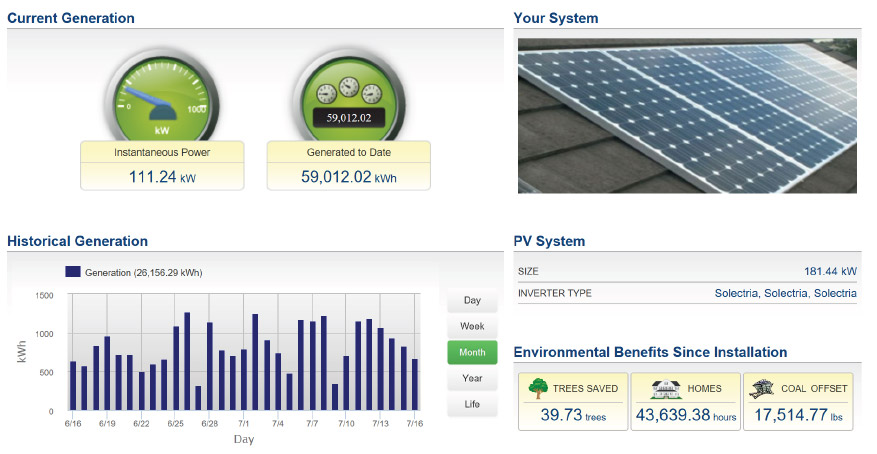
Real-time display shows the current and historical solar production. | New Energy Equity
“This is an opportunity I want young people to learn about,” she said. “With the curriculum in classrooms today, they are not necessarily learning about (renewable energy).”
Acomb said each school will determine how to develop its own projects. She envisions monitoring the solar panels’ output through an app or real-time displays at school entrances.
Schools in Xcel Energy’s (NASDAQ:XEL) service area will be eligible for $16 million from the state’s Renewable Development Fund, which is funded by Xcel in return for storing nuclear waste in Minnesota.
Schools elsewhere will be eligible for $8 million from the state’s general fund. The general fund will also provide $1.2 million for solar at state colleges and universities outside Xcel territory.
Acomb said it was important to put less-affluent districts at the top of the solar schools list. “We want to ensure all school districts have access,” Acomb said.
“We live in an area that has fairly significant poverty. So we have people who become energy poor,” said Dave Endicott, superintendent of Pine River-Backus Schools. “So I can see the benefits of having these kinds of projects that would perhaps reduce the stress on low-income families. By having solar they are not having to make choices between food and health care because of energy costs. So if we can find ways to do that and pull together resources to support that happening then I think we benefit our communities.”
Model Project in West Central Minnesota
The solar on schools concept already has proven successful in the Region Five Solar Schools Project started in 2018. Six arrays totaling 1.5 MW were installed at Pine River-Backus Schools, Pequot Lakes Schools and Central Lakes College in west central Minnesota, according to a July 2019 report done in part by the University of Minnesota Extension Service.
The $3.5 million project cost was funded by a U.S. Department of Commerce grant and a nearly $2 million contribution from Xcel through the Renewable Development Fund. The solar energy equipment was produced locally by Heliene in Mountain Iron, Minnesota.
Maryland-based New Energy Equity (NEE) was the financing partner providing tax equity and project financing. NEE owns the solar arrays and sells the electricity to the schools for $.063/kWh, an average of 2-4 cents less per kWh than state utility providers. Rural Renewable Energy Alliance (RREAL), a solar developer based in Backus, Minnesota, acted as the project construction manager for the project.
In the first two months of deployment, the Pine River-Backus site saved $10,000, putting it on a path to exceed the anticipated $30,700 first-year savings.
“We are estimating to produce about 80% of our electricity through the solar panels,” Endicott said.
The project also included demonstration of solar-powered electric vehicle charging stations at both the Pequot Lakes and Pine River-Backus school districts.
Local tribal college students participated in project construction as trainees in solar installation work. One of the two full-time interns now works at RREAL as site supervisor and safety director.
“We are not looking at this project just from the facilities side of it or the operational savings … but also the academic opportunities that come from establishing that program,” Kari Christiansen, vice president of Administrative Services at Central Lakes College, said in the Region 5 report.
Word of solar on schools has gone viral in his community, Endicott said: “The number of people who stop me on the streets or when I am out to eat or when I am at meetings regarding our district, the number of people who come to me and say, ‘Wow! It is so cool what your district is doing with the solar. We think it is a fantastic project. We love what you have done here.’”
The district is implementing curriculum to help students understand solar power and give them “a glimpse at potential job markets involving sustainable energies,” Endicott said. “There was no losing here in any way, shape, or form. We get the benefit of the solar power. We get the benefit of students learning about solar energy and technologies. We also get the benefit of partnering with other organizations.”
California’s efforts to boost the role that natural and working lands play in the state’s climate strategy are gaining momentum as officials draft strategic plans and allocate funding for programs including those aimed at reducing wildfire severity.
The California Natural Resources Agency (CNRA) expects to release for public comment this summer a draft Natural and Working Lands Climate Smart Strategy. The agency hopes to finalize the strategy in the fall.
Some hints of what the strategy might contain came in a report released last month by an advisory panel working with the CNRA. The group, whose members are mainly in academia, recommended accelerating “climate smart land management,” including practices to reduce wildfires.
“Immediately implement a shift from reactive fire suppression in forests to proactive vegetation management, prescribed and cultural burns, and managed natural wildfire to reduce the risk of catastrophic wildfire under climate change while taking steps to minimize the effects on air quality,” the advisory group said.
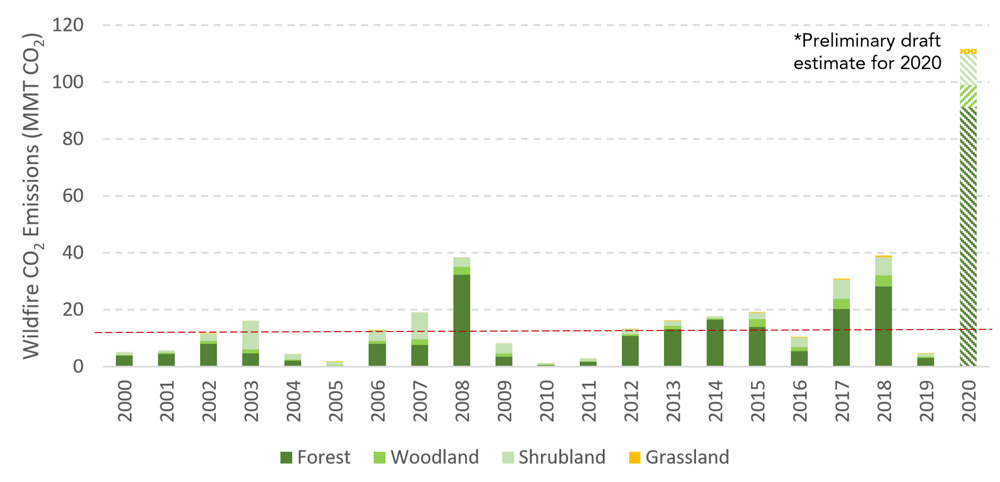
California has seen a steady, if uneven, growth in CO2 emissions from wildfires in the last 20 years. | CARB
The panel also recommended increasing reforestation efforts in areas hit by severe wildfires and encouraging sustainable forest practices in working forests.
Intertwined Plans
CNRA’s Natural and Working Lands Climate Smart Strategy comes as the California Air Resources Board (CARB) plans to increase its emphasis on natural and working lands in its upcoming 2022 scoping plan. The scoping plan, which is an update to a 2017 plan, will serve as a blueprint for the state to reach carbon neutrality by 2045.
The two agencies are following instructions from an executive order that Gov. Gavin Newsom issued in October. The order directs CNRA to develop a Natural and Working Lands Climate Smart Strategy within a year and also instructs CARB to use the strategy to update carbon-reduction targets for natural and working lands as part of the scoping plan process.
In a news release announcing the executive order, CNRA described the actions as “enlist[ing] nature to store carbon, protect biodiversity and build climate resilience.”
CARB hosted a series of workshops last month as part of its kickoff for the 2022 scoping plan, including a workshop on natural and working lands.
During the workshop, Jessica Morse, CNRA’s deputy secretary for forest resources management, said the state has dramatically boosted funding for fire resilience — from $75 million last year to $1 billion this year. Part of the $1 billion came as a $536 million emergency appropriation in April, she said.
Morse said the funding will cover areas including upgrading homes to make them more fire resistant, establishing defensible space and fuel breaks that will make it harder for fires to spread to homes, and investing in fire-resistant landscapes.
Some of the funds will go toward workforce development, Morse said, with training available for forest crews, fuel-reduction crews and prescribed fire crews.
In addition, some of the money will go into a climate catalyst fund, intended to spur innovation in uses for woody biomass. That material might include invasive shrubs removed from rangelands, forest undergrowth or small-diameter trees. Morse said traditional markets for those materials are lacking.
“Our goal is to ensure that all of this woody material coming off the forest, that we want as little of it pile-burned as possible,” Morse said. “We want as little of it chipped and landfilled as possible.”
Farmers Weigh In
Another piece of Newsom’s executive order from October instructed the California Department of Food and Agriculture (CDFA) to identify farmer- and rancher-led solutions during CARB’s scoping plan process.
During last month’s CARB workshop, CDFA Senior Environmental Scientist Michael Wolff detailed the agency’s progress. In February, the agency hosted six online listening sessions, focused on dairy and livestock, perennial crops, and annual crops.
Certain themes emerged among the comments from the 323 attendees. Farmers and ranchers support incentives but are worried about over-regulation, Wolff said. Smaller farms need financial assistance in order to take on the risk associated with new technology and equipment, according to the comments.
And some said they’d like to see more recognition of the climate benefits of keeping land in agricultural use rather than converting it to urban use.
Wolff said the next step is to further evaluate the suggestions to determine how soon each could be implemented and what resources would be needed.
Manufacturing and operating zero-emission electric buses, box trucks and tractor-trailers and their charging infrastructure has already generated billions in new economic activity and created hundreds of thousands of jobs, a supply chain analysis by the Environmental Defense Fund has found.
Based on a review of public records, supplier databases, other studies, SEC filings, investor notes and news articles the analysis found that since 2014 about 375 U.S. companies in 44 states have announced corporate investments of over $42 billion connected with zero-emission vehicles and infrastructure.
EDF’s study, released June 29, excluded manufacturers that make only electric cars but does include companies that historically have manufactured internal combustion engines that are now moving into electric drive systems.
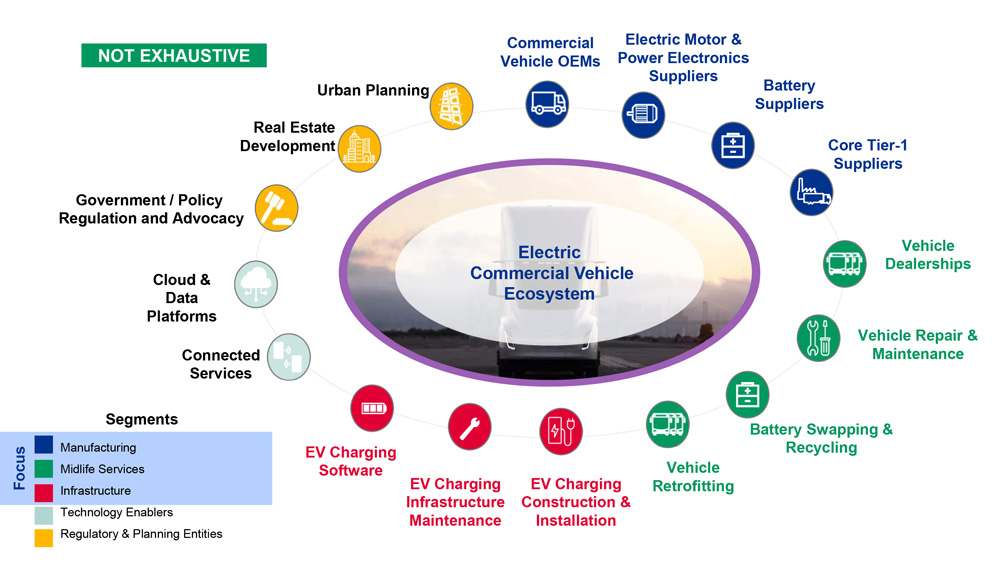
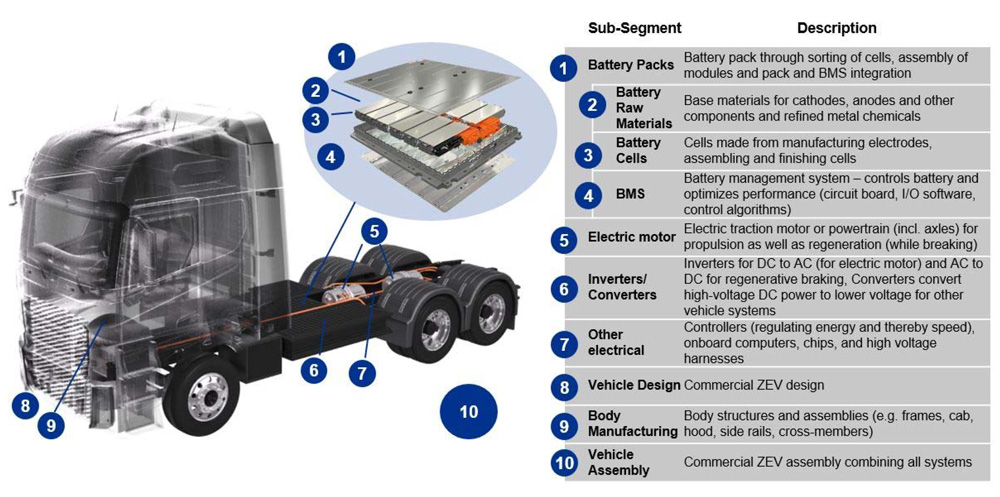
The MHD ZEV supply chain includes a wide range of players in a complex and rapidly evolving ecosystem. | Environmental Defense Fund
Calling the electric truck supply chain “a complex and rapidly evolving ecosystem,” the study found that:
Domestic manufacturing of vehicle components (e.g., body, motors, inverters, batteries) is by far the largest investment driver.
Battery cell production is the largest investment at $12.1 billion, and battery pack production accounts for another $6.6 billion.
Vehicle assembly investment is estimated at $6.9 billion.
Other segments in which investments are just beginning include:
vehicle dealerships, repair and maintenance, battery swapping and recycling and vehicle retrofitting;
companies involved in the construction and installation of charging stations, maintenance of the charging infrastructure and EV charging software development; and
technology “enablers” such as cloud and data platforms.
The industry is also prompting action by regulatory and planning entities including state public utility commissions as well as real estate development and urban planning.
EDF found that 44 states host companies involved in the truck and bus EV supply chain at more than 1,000 locations. Most of the companies are involved in manufacturing of the vehicles or components rather than the charging infrastructure. And at least 22 states host companies with a greater than $100 million in announced corporate investments. On a state-by-state analysis, at least 20 states have 10 or more companies involved in the electric truck supply chain, the study determined. The top five states are California, Michigan, Texas, Illinois and Ohio.
Electric vehicle and vehicle component manufacturers employ 272,343 people, while companies working on infrastructure employ 42,545, the study determined. At least 35 states have 1,000 or more workers involved in the electric truck and bus supply chain.
The key elements of MHD ZEV manufacturing are components of the battery pack, electric motor and other electrical parts. | Environmental Defense Fund
In addition to the release of the study, EDF sponsored a June 30 electric trucking and charging infrastructure podcast produced by The Hill in which Pam MacDougall, EDF senior manager of grid modernization engineering and strategy, briefly interviewed a key staffer at a California-based trucking company that has been running two Volvo electric trucks in a pilot program since September 2020.
“We’re amazed at the reliability that we’re getting from the vehicles,” said Troy Musgrave, director of process improvement at Dependable Highway Express. “We really think that there is a place for electric heavy-duty vehicles in our industry.”
“What barriers do you still see you’re facing?” MacDougall asked.
“The first thing is the cost of vehicles. They’re extremely costly compared to the diesel trucks that we’ve used today. And, you know, we have to be transparent about the technology as it is today. [Electric] vehicles take longer to fuel.
“They can’t go as far on a single charge as a diesel tractor,” he said, a reference to the 18-wheeler tractor-trailer rigs known in the industry as “class 8” vehicles. “They can’t carry as much as a diesel tractor because of the weight of the batteries and the other components that go along with electric trucks.”
But he said the company was “surprised to see that 70% of the vehicle routes that we’re running in the box trucks, the smaller regional vehicles, can be met by the current technology and battery electric truck … that we’re using today.”
A challenge facing any company choosing EVs is the lack of a charging infrastructure, he added
“You can’t run the battery electric truck without the infrastructure to support it. Right now, I don’t see a good solution for public infrastructure in our kind of business,” he said. Instead, the box truck the company is testing can make its daily deliveries and return to the company depot without recharging on the road.
Asked what public policies are needed to help trucking electrify, Musgrave said a California incentive program to help trucking companies buy EVs is crucial because their cost is so high. “For carriers to take this [cost] on by themselves would put us at a competitive disadvantage,” he said.
The study was based, in part, on real experience of two other trucking companies operating electric trucks in California and concluded most of their runs could have been handled by electric trucks, at lower fuel costs than running diesel trucks. It also looked at adding distributed energy generation, wind or solar, to a public truck charging infrastructure, concluding that such a system could strengthen local transmission systems.
As the most litigious region on climate change issues, the U.S. may find existing and future cases in its courts influenced by global trends in cases that relate to value chains, human rights and subsidies.
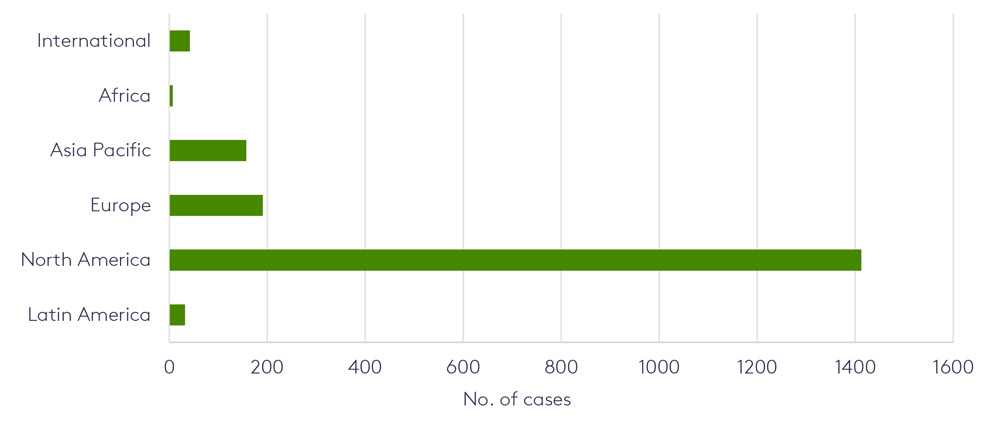
“Since the signing of the Paris Agreement, we have seen over 1,000 climate change cases, and nearly 200 of those were filed between May 2020 and May 2021,” said Joana Setzer, assistant professorial research fellow at the Grantham Research Institute on Climate Change and the Environment (GRI). “Whereas the majority of cases (150 out of 200) continue being filed in the U.S., we also see how litigation continues to grow and expand across the world.”
Setzer is co-author of a new GRI report on global trends in climate litigation, which said there have been 1,841 climate change cases identified globally between 1986 and May 2021. Of the total, three-quarters were filed before U.S. courts.
Strategic cases, or cases that try to bring about systemic change, are on the rise, Setzer said during a webinar on the report on Friday. They often are filed against corporations or governments, she said, adding that the recent landmark case, Milieudefensie et al. v. Royal Dutch Shell (Friends of the Earth v. Shell), is a stand-out example. In May, the Hague District Court found in favor of Friends of the Earth and ordered Shell to reduce its emissions by 45% relative to 2019 levels by 2030.
The win was significant on two fronts, according to the report.
First, the order to reduce emissions extended across Shell’s operations to those of its supply chain partners, pointing to a possible rise in cases related to value chains in the future. Because decarbonizing supply chains is viewed as a vital component to meeting climate goals, cases that force action on this front may come from a wide variety of sources.
One example, the report said, is a case that addresses deforestation to tackle both the release of carbon dioxide from the deforestation process and the protection of forests as carbon sinks. The case, which is unnamed in the report, claims that French supermarket chain Casino sourced beef from suppliers that practiced significant deforestation. It seeks to hold the company responsible for failing to conduct human rights and environmental due diligence in its supply chain, as required by French commercial code.
Second, the Shell case represents the first clear instance of a court using the Paris Agreement goal of limiting global temperature rise as a legal standard of conduct.
The Hauge court said that while the goals of the Paris Agreement are nonbinding, they represent a “universally endorsed and accepted standard” for preventing climate change. As such, the report said, the Shell case “may provide an important precedent for other ongoing actions where the Paris temperature goals and the need to reach net-zero emissions should inform legal obligations and standards.”
Duarte Agostinho and Others v. 33 States, a case filed last year before the European Court of Human Rights, is an example. Six Portuguese young people allege that the European Union member states and six other countries have not met their human rights obligations by not agreeing to emissions reductions that would limit global temperature rise.
The court fast-tracked the case in November.
Cases that are based on human rights, the report said, are another significant trend in global climate change litigation. Of the 112 documented human rights cases related to climate change, 29 were filed in 2020 and five in 2021.
The vast majority of climate change cases filed globally since the first example in 1986 have been in the U.S., as shown here. | Global trends in climate change litigation: 2021 snapshot. Grantham Research Institute on Climate Change and the Environment
“The majority of human rights cases have been brought against governments, and a small but significant minority brought against companies,” the report said. “In addition, human rights arguments have been used on at least one occasion by protesters seeking to defend their efforts to block new fossil fuel infrastructure.”
Early cases with a human rights focus put traditional rights in a new light.
The group of young plaintiffs in Juliana et al. v. United States, for example, sought the right to a stable climate under the U.S. Constitution. While that case was dismissed on appeal, a district judge ordered the parties to moved ahead to a settlement conference. And a similar case filed in October, Institute of Amazonia Studies v. Brazil, seeks to force the Brazilian government to meet emissions goals in line with a growing movement toward “climate constitutionalism,” the report said.
Additionally, human rights-focused climate litigation in some cases works to protect people from potential harms caused by climate policies or projects. The case Backcountry Against Dumps v. U.S. Bureau of Indian Affairs, for example, claims that renewable energy generation facilities threatened human rights, health and safety.
Subsidies
A possible new subject of climate change litigation could rise from the growing consensus that governments must help curb fossil fuel production and exploration.
The International Energy Agency’s Net Zero by 2050 road map released in May called for a complete cessation of investment in fossil fuel supply projects. Meeting that expectation would require a “rapid policy shift from governments around the world, which provided an estimated US$320 billion in fossil fuel subsidies in 2019,” the report said.
There could be an increase in cases over the coming year that target government policies that incentivize fossil fuels and contradict net-zero targets.
“Such cases demonstrate the need for government actors to develop mechanisms to show that potential climate and human rights impacts are adequately and consistently factored into all decision-making processes if they are to avoid the risk of litigation,” the report said.
Other Trends Post Paris
Of the 200 climate change cases filed over the last year, 70% were against governments, which co-author Catherine Higham, policy analyst at GRI, says is consistent with the rate in all the cases filed since 1986.
There has been, however, an increase in the diversity of government entities involved in the cases.
“We still see cases filed against central government, but we’re also seeing cases against specific entities and particularly financial market entities that are government owned or government controlled,” she said during the webinar.
Nongovernmental organizations (NGO), individuals or individuals acting with NGOs make up most plaintiffs, but Higham said there is “a creative move in who is being included as litigants in cases.”
Examples include people with disabilities and political parties.
Cases filed since 2015 that focus on government commitments on climate are evolving, Higham said. “They challenge not just the level of ambition of governments, but what they’re doing to meet that ambition,” she said.
The Council of State in France, for example, ruled on Thursday that the country is not on track to meet its emissions goals for 2030. The court ordered the government to make changes in the next nine months to meet those goals.
There also is a trend in cases that challenge specific government actions that are inconsistent with climate targets, Higham said.
In the U.K., the Transport Action Network brought a case against the Secretary of State for Transport. It claims that a 2014 national policy on transport and infrastructure is not consistent with the country’s economy-wide net-zero target for 2050.
Another group of cases challenge government decisions to authorize third-party activity that might contribute to climate change, according to Higham. Those cases, for example, often focus on approvals for new carbon-intensive projects.
Wins and Losses
The report questions whether climate change litigation to date has been net positive.
A favorable case outcome would be a ruling that results in more effective climate regulation, the report said. An unfavorable outcome, on the other hand, would undermine climate regulation or increase GHG emissions.
But while a case might have an unfavorable outcome, rulings of law within a case in some instances may have important implications for new rights and obligations in future cases.
“Litigation is a double-edged sword, and it does come with a hefty price tag at times,” Michelle Jonker-Argueta, attorney for Greenpeace International, said during the webinar. “Some wins are landslides, and some are so technical, it will take more action to enforce and bring about the accountability of polluters and the vindication of rights of affected communities.”
For the first time in more than a year, regulators from PJM and NYISO joined in person for the Mid-Atlantic Conference of Regulatory Utilities Commissioners’ (MACRUC) annual Education Conference at the Nemacolin Woodlands Resort in western Pennsylvania.
This year’s conference, “Policy, Process and People,” highlighted the challenges of planning for new infrastructure while simultaneously dealing with the worldwide impacts of the COVID-19 pandemic.
Willie Phillips, chairman of the D.C. Public Service Commission and outgoing MACRUC president, said the last 18 months were difficult. The pandemic “disrupted the lives of everyone we know,” but organizations like MACRUC have done the work necessary to take care of its consumers and also keep essential services running, he said.
Phillips said he also wanted to use the conference as an example of how important it is to come together and have face-to-face conversations.
“Even though the past year has been a tremendous loss for a lot of people, it’s also a story of resilience because we know what we can do when we’re tested and we all come together to help each other.”
MACRUC and FERC
The first panel of the conference, “MACRUC & FERC 2021: Policies in Perfect Harmony,” featured a conversation between Virginia State Corporation Commissioner Jehmal Hudson and FERC Chair Richard Glick on several topics, including implementation of Order 2222, resource adequacy and PJM’s minimum offer price rule (MOPR).
Conference participants chose the MOPR as the first topic. Stakeholders would later vote on the MOPR, shortly after the end of the conference on Wednesday, supporting PJM’s proposed replacement and sending the ultimate decision to the RTO’s Board of Managers. (See related story, Stakeholders Back PJM MOPR-Ex Replacement.)
Glick said it would be best for PJM to come up with a substitution for the MOPR on its own “organically through the stakeholder process.”
“It’s important that we do get something done before the next auction in December, and from that perspective the commission should be prepared to act if PJM fails to pursue modifications to the MOPR,” Glick said.
Stakeholders and officials who originally supported the idea of a MOPR tended to do so because of concerns about “price suppression” or that capacity prices weren’t high enough, Glick said, but he indicated that the reality has shown there doesn’t need to be a MOPR to address a market power problem. He said the MOPR was “aimed solely at raising prices,” and that is his greatest concern.
Glick said the MOPR has ended up inhibiting the ability of states to design what resources their generators should utilize. “We need to go back to a more rational approach.”
Hudson said some stakeholders believe that existing capacity markets are not well suited for meeting the adequacy and reliability needs of a decarbonized grid. He asked Glick what the role of capacity markets is in resource adequacy and if they’re still necessary.
Glick said FERC has had a tradition of deferring to the different regions about how they want to approach resource adequacy. He said the commission needs to continue to defer to regions “as much as possible” on the issue because there’s “not a one-size-fits-all approach.”
But Glick said the “jury is still out” if capacity markets are the correct approach for resource adequacy.
“I’ve got some concerns about capacity markets, and others do as well,” Glick said. “Others see capacity markets as a very necessary part of the whole resource adequacy regime. … We need to take a look at whether markets do what they’re supposed to be doing and whether they do it in a just and reasonable manner.”
COVID-19 Impacts
Phillips led a panel discussion on the impacts of COVID-19 on state commissions and utilities in the MACRUC region, focusing on how stakeholders dealt with emergency preparedness and the consequences of state-issued moratoriums on utility shutoffs.
Phil Moeller, executive vice president of regulatory affairs for the Edison Electric Institute, said it’s been “quite a 16 months” dealing with the pandemic. Moeller said many industry insiders had a “second full-time job” trying to coordinate for COVID-19.
Moeller said the full impact of COVID-19 emerged early for EEI, as its board meeting that occurred a week before the shutdowns featured Rebecca Katz, director of the Center for Global Health Science and Security at Georgetown University Medical Center, who talked about the serious nature of the pandemic. Moller called it a “sobering meeting” because the information was coming from one of the leading experts on infectious diseases.
EEI immediately started working with its member companies, Moeller said, setting up a single point of contact for COVID response. It eventually put out information in the form of a “playbook” that has morphed into a 100-page document in 11 different revisions that will be used for future disasters.
Besides the pandemic, Moeller said, the utility industry also had to deal with wildfires in the West, serious hurricanes in the Gulf of Mexico and the East, and the derecho in the Midwest last summer.
“It’s been a very challenging time, but the industry came together,” Moeller said.
Robert Powelson, CEO of the National Association of Water Companies and former FERC commissioner, said the development of protection protocols for customers who couldn’t pay utility bills during the pandemic was a serious challenge. Powelson said the industry recognized early in the pandemic that customers needed assistance and began supporting moratorium efforts around the country.
Powelson said programs like Low Income Home Energy Assistance Program have served as an important stopgap effort in paying utility bills, but he said similar initiatives are “layaway programs” that haven’t solved the problem of growing debt among customers. He said the industry doesn’t want to see the “socialization of those costs” through defaults by utility customers.
“The longer these moratoriums go on, we’re all going to face judgment day,” Powelson said.
State and Federal Relationships
The final panel of the conference included a discussion between Maryland Public Service Commission Chair Jason Stanek and FERC Commissioner Neil Chatterjee.
Chatterjee said logistical problems that came before the commission in the last year created a “perfect storm” that caused tension and concern between it and the states. Chatterjee said that after Powelson departed in June 2018, prior to the confirmation of Commissioner Mark Christie in November, there were no state regulators on the commission to give the granular perspective at the federal level.
“It’s important to have a state voice there,” Chatterjee said.
Chatterjee said he was “heartened” by the amount of collaboration between FERC staff and state officials during the pandemic and that officials came together quickly and “put the full weight of the regulatory community” behind the challenges. He said he is hopeful for more face-to-face interaction.
He pointed to the new task force that includes all five FERC commissioners and 10 state regulators appointed by the National Association of Regulatory Utility Commissioners aimed at increased transmission development. (See FERC Sets Federal-State Taskforce to Spur New Tx.)
Chatterjee said transmission is going to be “the central issue” before the commission in the coming years, and if the task force proves to be successful, it could be extended to other issues.
“In the absence of federal legislative action to address decarbonization, more and more of these decisions are falling to the states, and that is leading to these inherent tensions between states and federal agencies like FERC,” Chatterjee said. “And if Congress does not act in this regard in the coming years, there are still going to be obstacles and challenges that arise. And hopefully these increased levels of communication will help both FERC and our state colleagues and advocates.”
Chatterjee said he is regularly asked how to have serious and critical examinations of energy policies going forward with all the challenges and conflicts in the energy transition. He said his solution is to “make energy policy boring again.”
“When energy policy is boring and you allow the engineers and the economists to sort it out, you can get constructive outcomes,” Chatterjee said. “The more it’s boring and the less it’s politically salacious, then I think that durability can occur.”
The Western Energy Imbalance Market Governing Body saw one longtime member depart Wednesday as it elected a new member, chair and vice chair.
Carl Linvill, who has served on the EIM Governing Body since July 2016, decided not to seek another term and to focus on his work as a principal at the Regulatory Assistance Project.
“I enjoyed serving,” Linvill said in an email to RTO Insider. “I feel that an outstanding foundation for West-wide markets was built over my five-year tenure, and I am proud of the progress of the Western EIM. I chose to step down because I want to focus more effort on ensuring demand-side resources have the opportunity to fully contribute their capabilities to customers … to distribution utilities and to the CAISO wholesale markets.
“As always, I plan to help by serving as an objective facilitator of positive change in California and the West,” he said. “I do not plan to engage as an advocate. Rather, I plan to continue to help regulators and state energy policy leaders to build consensus around full participation of [distributed energy resources, including demand response and storage] in meeting Western clean energy, reliability and policy goals. I will continue to do this primarily from my vantage point as a principal with the Regulatory Assistance Project, where I have been serving concurrently while I served on the EIM Governing Body.”
Linvill’s colleagues elected energy attorney Jennifer Gardner to fill his spot. Gardner founded Envision Energy, an independent consultancy, last year. Previously she spent five years with environmental nonprofit Western Resource Advocates, where she directed its Regional Energy Markets Program, promoting market frameworks for decarbonization.
Gardner has served in various Western EIM leadership roles, including as a member of the EIM’s Governance Review Committee, vice chair of the Regional Issues Forum and chair of the Nominating Committee for Governing Body appointments. She also represented the EIM’s Public Interest Organization sector.
“Ms. Gardner is universally known for her market knowledge, commitment to learning and building a collaborative working relationship with all stakeholders,” said Pam Sporborg, a member of the EIM Nominating Committee and manager of the Transmission and Reliability Services Department at Portland General Electric.
Gardner could not immediately be reached for comment.
The Governing Body members also elected Vice Chair Anita Decker as their new chair, replacing John Prescott, who will remain on the Governing Body. Decker is the former executive director of the Northwest Public Power Association and COO of the Bonneville Power Administration. (See EIM Governing Body Gains Member, Loses Another.)
The chair and vice chair are rotating positions that change annually.
The members elected Robert Kondziolka as vice chair and appointed him to a second term. Kondziolka was named to the five-member Governing Body last year. He served out the term of member Travis Kavulla, who had to resign because of a job change. Kondziolka retired after four decades with Arizona’s Salt River Project. (See Western EIM Fills Last Board Vacancy.)
Kondziolka’s and Linvill’s terms expired Wednesday. The new terms for Gardner and Kondziolka run through June 30, 2024.
The Biden administration wants the U.S. to dominate the global market for clean energy technologies, part of an effort to rebuild the economy, address climate change and counter China’s growing success in energy manufacturing, Energy Secretary Jennifer Granholm said last week.
“The global market for clean energy technologies is going to skyrocket to $23 trillion at a minimum by the end of this decade, and this administration on the federal level wants America to corner that market. We want to see those investments in every pocket of the country,” Granholm said Wednesday during the virtual annual meeting of the Western Governors’ Association.
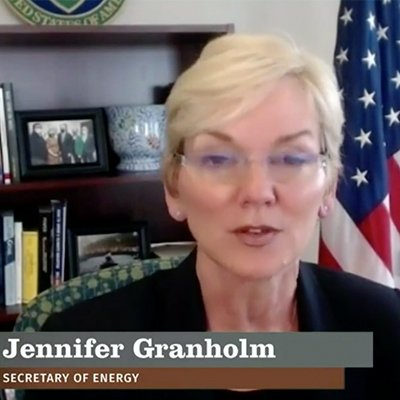
Energy Sec. Jennifer Granholm | Western Governors’ Association
The former Michigan governor said the administration has set goals to cut solar costs in half, reduce the cost of green hydrogen by 80% and develop a domestic supply chain for batteries while boosting the country’s electric vehicle industry. (See Hydrogen May Hold Key Role in Deep Decarbonization, EPRI Panel Says.)
Granholm said also that Biden has directed the Department of Interior to open up some federal lands for renewable development and “sustainable” extraction of minerals needed to supply the battery industry. About 47% of Western land is owned by the federal government.
“Know that this administration is committed to being independent of our economic adversaries who have had a five-year plan — China — to corner the market on these critical minerals,” she said. “We should be developing them, we should be recycling them, we should be looking from a research perspective at substitutes. But we’re not going to be able to do this unless we have some of our own supply.”
The WGA meeting brought together a handful of Biden administration officials with Western governors to discuss the most pressing issues facing the region. Following is more of what we heard at the event.
Drought, Wildfires
Speaking of the growing danger of wildfires in the West, Colorado Gov. Jared Polis said the term “fire season doesn’t even capture it because it’s a lot longer than it used to be.”
Through the U.S. Forest Service and Bureau of Land Management, the federal government owns about 40% of Colorado land, requiring a shared responsibility for wildfire prevention, Polis said. “And the states really need the federal government to step up big on forest health, fire mitigation.”
North Dakota Gov. Doug Burgum said the period from last fall through this past spring was the driest on record for his state, adding that the majority of the state is either in “extraordinary or extreme drought.” That has led to at least 1,000 grassland wildfires so far this year, including one of the most severe in state history. “We had our first fire this year in January,” he said. “That’s never happened before.”
“We all know that we’ve got to significantly upscale our preparation efforts in terms of our equipment and capacity to beat these fires,“ Agriculture Secretary Tom Vilsack, whose agency oversees the USFS, said Thursday. “That requires significant resources [included in Biden’s] American Jobs Plan. It does provide a significant amount of investment in what we refer to as green infrastructure that will enable us to do a much, much better and much more accelerated [hiring], which over time could minimize the risk of these horrific forest fires.”
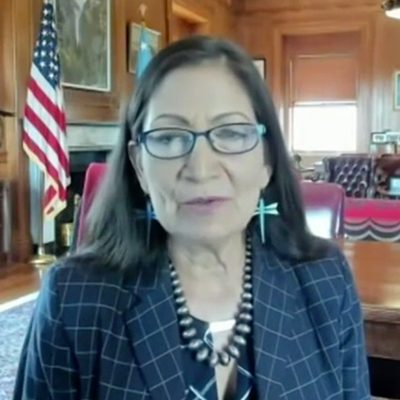
Interior Sec. Deb Haaland | Western Governors’ Association
“Where there is drought there is a greater risk of wildfire,” Interior Secretary Deb Haaland said, adding that she and Vilsack received a briefing in May by fire experts predicting a “very tough” fire season ahead.
“Quite frankly, wildfire has not always received the attention and resources that it deserves,” Haaland said. “The president’s budget reflects increases that demonstrate how seriously we take this issue, including providing a $100 million increase for fuels management and burned area rehabilitation work. In total, the budget proposal contains $1.1 billion for Interior’s wildland fire management program, as well as increases in funding for drought mitigation and science-based investments that will help the department and communities prepare for and address the aftermath of natural hazard events.”
Carbon Sink
Burgum touted his oil-producing state’s recently set goal of becoming carbon neutral by 2030 by using what he called its “geological jackpot.”
“And part of how we can do that is utilizing the incredible carbon sink capabilities we have in all of our ranch land and our farmland,” Burgum told Granholm on Wednesday. With North Dakota’s geology, he said, “we’ve got an opportunity to sequester and store 50 years’ worth of the nation’s CO2.”
Speaking to Agriculture Secretary Vilsack on Thursday, Burgum detailed his plans for all that sequestered CO2, saying North Dakota has a “big opportunity” to use geothermal or the heat produced by industry to use greenhouse technology to double its growing season to 12 months a year. Those indoor crops would “be enhanced by a pure stream of CO2,” which research has shown can increase crop yields.
“And then we can of course, as you know, transfer that CO2, turn it back into oxygen. Plants love doing that,” Burgum said. “That’s what they do for a living.”
Burgum told Vilsack that his state wants to continue to collaborate with the USDA on opportunities for farmers and ranchers to get paid for “smart” soil management practices that enable their lands to function as carbon sinks.
“I couldn’t agree with you more on the carbon opportunity, and we’re essentially establishing a variety of ways in which farmers and producers will be able to potentially benefit,” Vilsack said. “We want to make sure that as we do this, the programs we design are designed specifically for farmers, ranchers and producers [and] are not designed for somebody else outside of agriculture, [and] that they’re structured in a way that would allow even the smallest producer to participate.”
‘Just Transition’
Commerce Secretary Gina Raimondo said the transition to renewables must happen as quickly as possible because “climate change is here and unforgiving.”
“But it has to be a just transition. And that means providing significant support to folks who will be displaced. That means guaranteeing them that we’re going to be there for them to help find them another job and giving them the job training necessary,” Raimondo said, plugging the Biden administration’s $1.7 trillion American Jobs Plan.
“The truth is, there will be many jobs created in the move towards a cleaner energy future in solar, wind, battery, electric vehicles — all good jobs. But folks have to be trained to do those jobs,” she said. “And we have to make sure that those jobs are in our communities.”
Developments North of the Border
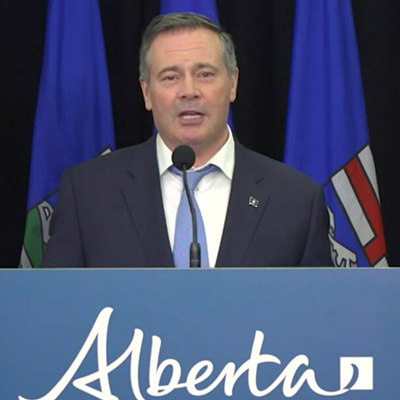
Alberta Premier Jason Kenney said in the past year his oil-dependent Canadian province endured a “triple black swan event” with the pandemic, global economic contraction and “absolute collapse” in energy prices, as oil prices fell from $60/barrel in February 2020 to less than $20/barrel for a short time last April.
Alberta Premier Jason Kenney | Western Governors’ Association
Kenney said the U.S. gets about 60% of its oil imports from Canada, most of which comes from Alberta, where producers have cut their carbon intensity by 21% over the past 10 years and are “on track” for another 23% reduction in the next decade.
“They’re committed to achieving net zero greenhouse gas emissions from their operations by 2050. So our energy, we believe, is produced at the highest environmental human rights and labor standards, and we’re doubling down to advance Alberta’s position as a leader in environmental, social and governance outcomes,” Kenney said.
Alberta is also seeking to diversify its energy economy, with plans to use its natural gas reserves to develop a hydrogen sector. In May, Suncor and ATCO announced a project to develop about 300,000 tons of “clean” hydrogen a year in the province using a process to capture 90% of emissions generated during production.
“Alberta is also making great strides in renewables,” Kenney said. “The province’s electricity market has drawn more than $2 billion worth of investment in the last couple of years. And we’ve got a new framework in place to promote renewable energy storage and generation with zero subsidies from taxpayers.”