MISO Leadership Says Transmission Expansion, Market Redefinition ‘not Optional’

MISO leadership at the RTO’s Board Week this month said that resource adequacy reforms and dramatic transmission expansion are necessary to the footprint’s future reliability.

“Right now, we’re seeing the electric industry changing in big and exciting ways,” Erica Stillson, of MISO’s business operations division, said at the Board of Directors’ Markets Committee meeting June 15.

Stillson said aging baseload generation being swapped for cleaner and more distributed generation has increased transmission congestion. Even if MISO is resource-secure into the future, the footprint doesn’t have sufficient transmission to transport supply, she said.

The need to act on both a resource adequacy redesign and long-range transmission planning is “not optional,” Stillson said. Reliability hazards are growing outside of summer months, which used to be traditionally the riskiest. MISO must review winterization standards and share more analytics with market participants, she said.

Stillson also said new emergency pricing, a seasonal capacity auction and stricter capacity resource accreditation — all projects already in the works — should help. (See MISO: Wintry Weather Vindicates RA Changes.)

“Modifying accreditation is never truly done,” she added.

MISO Executive Director of Market Operations Shawn McFarlane said capacity auction and accreditation changes will drive capacity prices up in future years. He said MISO probably wouldn’t see the likes of this year’s 1 cent/MW-day clearing prices in MISO South again.

At the Advisory Committee on Wednesday, stakeholders again asked for more analysis results from MISO to justify a seasonal auction.

“We don’t deny that MISO is experiencing a shift in loss-of-load risk, but we haven’t seen how a seasonal capacity auction will help that,” Clean Grid Alliance’s Natalie McIntire said, adding that the RTO’s proposal might leave some operational challenges unaddressed.

Independent Market Monitor David Patton said MISO’s leniency in its accreditation proposal will render it ineffective against improving resource availability. The grid operator has tweaked its proposal to include availability during non-risky hours in addition to risky hours as the basis for accreditation. (See MISO Softens Capacity Accreditation Proposal.)

“MISO’s current accreditation in the face of pushback from stakeholders … is not going to be something that solves the problem,” Patton said. “Accreditation is one of these areas where you’re not going to make members happy.”

Stillson said MISO must also rethink how it trains its control room operators to manage a transformed grid. She said the RTO’s large control room screens that display real-time information, in use for the past 15 years, need to be upgraded to keep pace with a rapidly changing fleet and furnish operators more data. “The old system is cumbersome, inefficient and sometimes manual.”

Director Barbara Krumsiek pointed out that MISO will “always be dependent on the human element, shift operators and leadership, especially during times of stress.”

Executive Director of Systems Operations Renuka Chatterjee also acknowledged that MISO will always rely to some extent on human decision-making, just as airplanes will always be manned by human pilots “even if the plane can fly itself.”

Transmission Development

In MISO’s most conservative transmission planning estimate, the footprint will add about 121 GW in new generation by 2040.

At a meeting of the board’s System Planning Committee on June 15, Executive Director of System Planning Aubrey Johnson said MISO will need to build interchangeable transmission lines that can handle higher HVDC voltages. He also said MISO will need to employ more power flow controls, like phase angle regulators and static synchronous series compensators.

Vice President of System Planning Jennifer Curran said that by September, MISO planners would have an idea of which long-term projects would be included in the 2021 Transmission Expansion Plan (MTEP 21). MISO planners have repeatedly said that unlike the long-term expansion package in 2011, this portfolio would be pieced together through multiple annual MTEP cycles.

Curran said the first set of models MISO released in its long-range transmission plan are the most complex the RTO has ever attempted.

WPPI Energy’s Steve Leovy and WEC Energy Group’s Chris Plante criticized MISO for not being upfront enough about the analyses it’s performing under the long-range plan.

“If MISO needs to spend $30 [billion] to $100 billion, so be it, but stakeholders need visibility into this process,” Plante told the board.

But several other stakeholders invoked separate letters to MISO from Midwestern states and the city of New Orleans urging the RTO to get a jump on long-term infrastructure planning. Arkansas, Iowa, Michigan, Minnesota and Iowa have all encouraged MISO to splurge on long-term transmission projects.

Early Summer Emergency

McFarlane said summer is already off to a rocky start with an early heat wave that spawned a brief maximum generation emergency on June 10. He said many market participants were still wrapping up spring maintenance outages when the hot spell struck.

MISO must declare a maximum generation emergency to access some of its 14 GW in load-modifying resources. Lately the grid operator’s market staff have said that they want to reorder emergency steps so they don’t have to declare an emergency before accessing LMRs.

“We really shouldn’t be surprised when we have to take that action,” McFarlane said. “I want to emphasize that we called on resources that are part of our planning processes.”

He said MISO ultimately asked for about 2.5 GW in load reduction and received about 5 GW more than that.

“Unfortunately, during these emergencies, our crystal ball isn’t very good,” McFarlane said, adding that MISO isn’t notified of how much in imports it stands to receive.

McFarlane said the emergency wasn’t a function of volatile renewable generation, but unavailable conventional resources through planned and unplanned outages.

Beyond early June, spring was relatively quiet, McFarlane said.

Patton said energy prices were up 40% from last spring because of a year-over-year jump in natural gas prices. The spring also brought a “remarkable level of congestion,” more than doubling up last spring’s, mostly because of higher wind generation in the footprint. “It’s just becoming increasingly difficult to get wind out of the North when output is high,” he said.

To better manage congestion, MISO should adopt dynamic line ratings, Patton said. He said wind tends to blow harder when air temperatures are lower, making the use of grid-enhancing technologies (GETs) ideal to transport more wind power.

“It will unlock a lot of transmission that we don’t make full use of,” he said.

Had MISO had GETs in place, it could have saved about $30 million in congestion costs over the quarter, Patton said.

“We’re heading to something like $2 billion in congestion this year,” Patton said, acknowledging that MISO has work ahead of it before it can use adjusted ratings in the day-ahead market.

Transmission Owners sector delegate Stacy Herbert said TOs believe that the Monitor’s saving estimates are overstated.

OMS President and North Dakota Public Service Commission Chair Julie Fedorchak called for more transparency into TOs’ ratings and calculation methods.

“A lack of transparency in this area has impeded progress,” she said of implementing GETs.

PJM MRC/MC Preview: June 23, 2021

Below is a summary of the issues scheduled to be brought to a vote at the PJM Markets and Reliability and Members committees on Wednesday. Each item is listed by agenda number, description and projected time of discussion, followed by a summary of the issue and links to prior coverage in RTO Insider.

Markets and Reliability Committee

Consent Agenda (9:05-9:10)

B. The MRC will be asked to endorse proposed revisions to Manual 14B: PJM Region Transmission Planning Process and Manual 14F: Competitive Planning Process conforming to tariff revisions accepted by FERC in December (ER21-162). PJM proposed including capacity constraints as inputs to the market efficiency analysis for market efficiency projects in the Regional Transmission Expansion Plan and to clarify when capacity benefits of such projects are calculated. (See “Manual 14F and 14B Updates,” PJM PC/TEAC Briefs: May 11, 2021.)

Endorsements (9:10-10:10)

1. Interconnection Construction Service Agreement Superseding Language and Automatic Termination Provision (9:10-9:25)

Stakeholders will be asked to endorse proposed tariff revisions to address concerns associated with the pro forma interconnection construction service agreement’s lack of superseding language and current automatic termination provision. PJM said the growing interconnection queue volume has created the need for improvements. (See “ICSA Addressed,” PJM MRC Briefs: May 26, 2021.)

2. Reserve Price Formation Issue Charge (9:25-10:10)

A. Members will vote on a problem statement and issue charge presented by Adrien Ford of Old Dominion Electric Cooperative and John Rohrbach, representing Southern Maryland Electric Cooperative, regarding the PJM operating reserve demand curve and transmission constraint penalty factors. The issue charge is designed to consider whether an administrative mechanism, such as a circuit breaker, should be established in PJM’s energy market to protect consumers and market participants from financial impacts resulting from scarcity price signals.

B. Sharon Midgley of Exelon will present an alternative problem statement and issue charge regarding a scarcity pricing circuit breaker for a vote.

Members Committee

Consent Agenda (12:40-12:45)

B. The MC will be asked to endorse proposed tariff revisions to address new service requests deficiency review requirements. Members unanimously endorsed the proposed solution and tariff revisions at last month’s MRC meeting. (See “New Service Requests Approved,” PJM MRC Briefs: May 26, 2021.)

C. Stakeholders will be asked to approve proposed Operating Agreement revisions to address the avoidance of future CIP-014 facilities. The avoidance proposal was approved by an acclamation vote at last month’s MRC meeting. (See “CISO Avoidance Endorsed,” PJM MRC Briefs: May 26, 2021.)

MISO Board of Directors Briefs: June 17, 2021

MISO CEO Addresses Industry Change

MISO CEO John Bear said the collision of more frequent severe weather events and the pace of resource portfolio change necessitate expensive operating and infrastructure changes.

“It’s clear that the tools and processes that have worked well for us for many years are no longer adequate in the future,” Bear said at the Board of Directors’ meeting Thursday. “We do have some time, but it’s less time than some may think. … The future is a lot closer than any of us think, and it’s coming faster at us than ever before.”

Warnings from MISO leadership about the need for market redefinition and new transmission paths is a familiar refrain this year.

Electrification will transition MISO into a winter peaking system with steeper peaks, Bear said, adding that February’s winter storm illustrated that generation needs to be more available.

Bear also brought up the near-daily, headline-grabbing cybersecurity events lately and said MISO must better secure its system.

“Reliability is the outcome of many years of forward preparation,” he said.

MISO will likely work with the Organization of MISO States, Bear said, to recalibrate their annual resource adequacy survey. Bear said the summer peak is no longer an appropriate measuring stick for year-round reliability. This year’s OMS-MISO survey, released this month, indicated a slight uptick in future supply. (See 2021 OMS-MISO Resource Adequacy Survey Shows Less Cause for Concern.)

Bear also said MISO is working on how it will track carbon emissions on a footprint-wide or zonal basis. He said members have approached the RTO about keeping tabs on emissions. Currently, more than 95% of MISO members have carbon-reduction goals.

MISO CFO: Expect Spending Increases

MISO is underbudget so far in 2021, but CFO Melissa Brown doesn’t expect it to last.

Brown said MISO is $1.6 million — or about 1.7% — below budget, stemming in part from technological upgrades that had to be deferred because of supply chain issues.

“I think we’re all aware of the shortages on the heels of COVID,” Brown said.

MISO expects to finish the year slightly over its $271 million base expense budget because of unbudgeted legal fees stemming from the February storm and higher telecommunication expenses, she said.

In the longer term, MISO forecasts it will face a 4.9% annual increase to its base operating costs from 2022-2026. Over the past three years, the RTO experienced a 3.5% average growth rate on actual costs. The rise in costs could translate into an additional $14.7 million in spending in each of the next five years.

Bear said MISO must work harder in the coming years to control costs, given expensive market renovations, control room upgrades, more extreme weather events, stepped-up cybersecurity and transmission expansion efforts.

MISO Director Todd Raba assured stakeholders that executives and the board are aware of looming costs and will do their best to contain them.

Board Promises More Stakeholder Interaction

In response to stakeholder calls for more access to the board, Chair Phyllis Currie suggested an additional meeting during future MISO Board Weeks.

She proposed an additional two-hour Monday afternoon session reserved solely for dialogue with stakeholders. She asked stakeholders for their thoughts on an additional meeting.

“We’re looking forward to going back to in-person meetings. And when we do that, the board is going to make a concerted effort to be … more available in an informal way,” Currie told stakeholders at the Advisory Committee’s meeting Wednesday.

NYISO Discusses FERC Order 2222 Compliance

NYISO on Thursday discussed its plans to comply with FERC Order 2222 with stakeholders, bringing the issue to the Installed Capacity/Market Issues Working Group ahead of a July 19 compliance filing deadline.

The ISO continues to outpace most of its counterparts, having two years ago proposed a participation model for distributed energy resources and aggregations, which FERC accepted in January 2020, nine months before it directed grid operators to allow DER aggregations to participate in their wholesale electricity markets. (See NYISO DER Participation Model Gets FERC OK.)

“Luckily we are already compliant with most of the aspects of Order 2222,” said Francesco Biancardi, market design specialist in new resource integration, who presented the topic.

Nonetheless, NYISO anticipates modest revisions to the existing tariff to prevent double counting of services, one area in which the commission said DER aggregations could appropriately be subject to “narrowly designed restrictions.” The ISO and New York’s investor-owned utilities are working to identify potential retail programs and wholesale revenue streams that may cause double counting.

Needed Updates

Biancardi said NYISO understands stakeholders’ desire for additional information regarding proposed tariff language, including what a utility review of DER aggregations might look like, and will try to provide updates to stakeholders ahead of July 19.

As required by the order, NYISO is developing a utility review process with the utilities that will enable each transmission owner to review DERs intending to participate in the markets and recommend that the ISO prohibit a particular DER from participating because of distribution-level reliability concerns.

NYISO’s approved DER market design defined a real-time operational coordination procedure to support compliance with related directives. The tariff already directs the ISO and TOs to coordinate “scheduling and dispatch for all generators, demand-side resources and DERs, giving priority to minimizing the magnitude of reliability impacts and to resolving actual impacts over predicted impacts. The ISO has the final authority to determine schedules for resources engaged in dual participation.”

Stakeholders expressed concern about ultimate control, which they said is not clear. The order says the grid operator maintains control of aggregations, but the entity (TO or NYISO) with the larger need will be allowed control of said resources.

NYISO Manager of New Resource Integration James Pigeon recalled discussing the same issue while crafting the DER rules in 2019: “If you have an aggregation and have distribution-level concerns, you have the right to control that resource.”

Michael DeSocio, NYISO director of market design, said that TOs likely will handle DERs on a case-by-case basis because of differing technical aspects for various configurations at various locations.

“We’re not prepared today or in this compliance filing to change the DER participation model that was already approved by FERC, because we know the model will comply with existing reliability standards,” DeSocio said.

The ISO’s compliance filing will include language supporting FERC’s directive that load-serving entities serving less than 4 million MWh of load annually will be required to opt-in to NYISO’s DER program, Biancardi said. In addition, NYISO will amend its tariff to support the 2222 requirement that a DER intending to participate solely via aggregation does not constitute a “first use” of the distribution facility.

In situations with an existing wholesale generator, the new resource will be subject to the NYISO interconnection procedures, and the ISO is now working to amend its interconnection tariff requirements for compliance.

SPP Accrues Another $13.25M in M2M Settlements

SPP continues to accrue multimillion-dollar settlements from its market-to-market (M2M) process with MISO following the one-time anomaly during the February winter storm.

“We’ve moved on from February,” SPP’s Jack Williamson told the Seams Advisory Group during its conference call Thursday.

Williamson said SPP recorded $13.25 million in M2M settlements from its seams neighbor in April, pushing its total to $146.63 million since the two RTOs began the process in March 2014. The settlements have been in SPP’s favor eight of the last nine months, interrupted only by MISO’s record $51.49 million haul in February.

SPP has totaled $30.34 million in settlements over the two months since.

Temporary and permanent flowgates were binding for 2,331 hours during April, 750 more hours than the previous month. Three flowgates, two north and east of Kansas City, accounted for $8.66 million of SPP’s positive settlements.

The grid operators exchange M2M settlements for redispatch based on the non-monitoring RTO’s market flow in relation to firm flow entitlements. The settlements have been in SPP’s favor 17 of the last 19 months and 56 times in the process’s 74 months.

Joint Queue Study Discusses Cost Allocation

Savoy-Clint-2017-10-19-RTO-Insider-FI.jpg
Clint Savoy, SPP | © RTO Insider LLC

Senior Interregional Coordinator Clint Savoy told the group that the SPP and MISO staffers involved in the RTOs’ joint targeted interconnection queue study have completed an initial draft of potential transmission solutions and a cost/benefit analysis.

Next up: cost-allocation discussions.

Savoy declined to say whether the team has identified any projects so far. He encouraged stakeholders to participate in the team’s next scheduled meeting on July 7.

SPP and MISO leadership have tasked staff with identifying “comprehensive, cost-effective and efficient” upgrade projects, with a focus on projects near their seam that support both organizations’ interconnection processes. (See MISO, SPP to Conduct Targeted Transmission Study.)

Savoy also said SPP has reached an emergency energy transactions agreement with Xcel Energy’s Public Service Company of Colorado. He said the agreement is similar to those SPP already has with MISO and Canada’s SaskPower.

Under the agreement, a party must be in a Level 2 or higher energy emergency alert and must formally request the transfer. The final settlement will include an energy portion and a transmission charge.

Many Next Steps to Follow Passage of Nevada Energy Bill

The Nevada governor’s office will soon be inviting interested parties to apply for a seat on a new task force that will advise the governor and lawmakers on bringing the state into an RTO.

The Regional Transmission Coordination Task Force is the product of Senate Bill 448, a wide ranging energy bill that Gov. Steve Sisolak signed into law on June 10.

The bill, by Sen. Chris Brooks (D), has many provisions that will be implemented in stages. One of the initial steps will be the formation of the task force, to be facilitated by the Governor’s Office of Energy (GOE).

GOE Director David Bobzien said the governor’s office will post a notice, likely over the summer, inviting applicants to serve on the task force. The group will have about 20 members representing an array of interests. (See list of task force membership below.)

The governor will appoint the task force members, who will not be paid. The group will meet at least twice a year. Its first report will be due by Nov. 30, 2022.

“We do anticipate there’s going to be a lot of interest,” Bobzien told RTO Insider.

The task force will help address issues such as the potential costs and benefits of joining or creating an RTO.

The group will look at policies to help bring transmission providers into an RTO by Jan. 1, 2030. Under SB448, the Public Utilities Commission of Nevada (PUCN) will require every transmission provider in the state to join an RTO by that date, although waivers will be possible.

Sept. 1 Deadline

While the task force is getting organized, the state’s electric utility, NV Energy, faces a Sept. 1 deadline for two key filings required by SB448.

The utility must file a plan with PUCN by Sept. 1 to build its Greenlink North transmission line. The project would connect northwest and northeast Nevada and form a triangle with the existing One Nevada transmission line and Greenlink West, a project that NV Energy received approval to build in March. (See Regulators Greenlight NV Energy’s Greenlink West.)

PUCN then will have 165 days to approve the plan. The goal is to have Greenlink North placed into service by Dec. 31, 2028.

Although PUCN in March approved conceptual designs, permitting and land acquisition for Greenlink North, Brooks said SB448 adds certainty that construction of the project will be approved.

“This shortens the time frame,” Brooks told RTO Insider. “That was the whole point — to expedite the process.”

And the increased certainty around Greenlink may spur other transmission projects, he said.

“That just opens up a lot more opportunities for other transmission developers,” Brooks said.

Sept. 1 is also the deadline for NV Energy to submit a plan for $100 million in electric vehicle charging infrastructure.

EV-Charging-(NRDC)-Alt-FI.jpg
SB448 provides $100 million for new EV charging infrastructure throughout the state. | NRDC

The plan, which will cover January 2022 to December 2024, will include investments in the following programs:

  • an interstate corridor charging depot program;
  • a public agency EV charging program;
  • a charging program for transit vehicles and school buses;
  • an urban charging program, geared toward drivers who can’t charge their EVs at home or at work; and
  • an outdoor recreation and tourism charging program.

At least 40% of spending in the plan must go toward investments made in or benefiting historically underserved communities.

NV Energy supported SB448.

“Senate Bill 448 will transform Nevada’s clean energy landscape, create thousands of good paying jobs, and ensure Nevada’s underserved and low-income communities benefit from this energy transformation,” NV Energy spokesperson Jennifer Schuricht said on Friday.

Rate Rider Revived

The Nevada legislature in 2013 established a program called the Economic Development Electric Rate Rider, which gave eligible businesses discounts on their electric bills for a number of years. The program’s purpose was to attract new commercial and industrial businesses to Nevada.

The program closed to new participants at the end of 2017, with about half of its 50 MW of capacity remaining. SB448 reopens the program, setting a new deadline of Dec. 31, 2024, for businesses to apply.

The Governor’s Office of Economic Development is in the process of developing guidance on how to implement the program, according to GOED spokesperson Greg Bortolin.

SB448 will also expand the Renewable Energy Tax Abatement (RETA) program that gives tax breaks to renewable energy generation projects. The bill will clarify that the tax break is also available to energy storage projects, or hybrid projects consisting of renewable generation and storage.

Bobzien expects rulemaking to start this summer for the expansion of RETA.

Task Force Membership

Nevada’s governor will appoint members of the Regional Transmission Coordination Task Force and choose a chairperson for the panel. Other seats on the task force will be filled with representatives of the following:

  • an electric utility serving densely populated counties
  • an organization that represents rural electric cooperatives and municipally owned electric utilities in the state
  • the Colorado River Commission
  • a transmission line development company
  • the large-scale solar energy industry
  • the geothermal energy industry
  • a data center business
  • the mining industry
  • gaming and resort businesses
  • a labor organization
  • an environmental organization
  • the Nevada Indian Commission representative
  • the Governor’s Office of Energy
  • the Governor’s Office of Economic Development
  • the Nevada state Senate: two members nominated by the Senate Majority Leader, including at least one minority-party member
  • the state Assembly: two members nominated by the Assembly speaker, including at least one minority-party member
  • the general public (up to three members)

In addition, the task force will include the following non-voting members:

  • a PUCN representative and
  • a representative of the Bureau of Consumer Protection in the Attorney General’s Office.

CAISO Issues Warning of Resource Deficiency

CAISO issued a grid warning Thursday after generators tripped offline during a record-breaking heat wave across the Southwest and much of California.

“CAISO is forecasting a resources deficiency with all available resources in use or forecasted to be in use for the specified time period,” the ISO said in its warning notice.

The warning was for 7 to 9 p.m., after solar dropped offline but demand from air conditioning remained high.

COO Mark Rothleder said “a couple of resources” totaling about 1,100 MW experienced forced outages earlier in the day but that 600 MW of resources unexpectedly came online, for a net loss of 500 MW.

The warning meant the ISO might have had to dip into its planning reserves, which the California Public Utilities Commission increased from 15% to 17.5% this year in anticipation of strained grid conditions. It allowed the grid operator to activate demand response programs to lower consumption and to call on neighboring balancing authority areas, including the Los Angeles Department of Water and Power, for emergency assistance with energy supply, Rothleder said in a call with reporters.

“At this point everything is looking good with those additional tools … and so we are expecting that we will be able to make it through the evening peak and net-peak hours without having to resort to further emergency efforts or any kind of power outages,” he said.

That’s assuming nothing changes to alter supply and demand, he added.

The next step after a warning is for the ISO to declare a Stage 1 energy emergency. Neither step has been taken since last September’s energy emergencies under similar weather and system conditions.

CAISO forecast peak demand at more than 42 GW on Thursday. It said it had more than 52 GW of available capacity.

The additional capacity would help, CAISO said in its system conditions bulletin for Thursday. The current heat wave is more limited than those in August and September, which also affected the Pacific Northwest. Temperatures in Seattle and Portland, Ore., have remained relatively moderate this week.

The early-season heat wave arrived sooner than expected.

After rolling blackouts last August and close calls in September, CAISO and the CPUC spent much of the past year instituting measures to avoid shortfalls this summer, including adopting market rule changes. (See CAISO Summer Measures Get FERC Approval.)

Hundreds of megawatts of additional battery storage are slated to come online this summer, but much of it has not been connected yet.

To prepare for the current heat wave, the ISO restricted grid maintenance this week and issued flex alerts calling for customers to conserve energy.

Temperatures hit 117 degrees Fahrenheit in Phoenix and 120 in Palm Springs, Calif., on Thursday, breaking records for the date, the National Weather Service said. Other cities that set triple-digit temperature records this week included Tucson, Ariz., Billings, Mont., and Albuquerque, N.M.

“The hottest day of the week is expected today, with excessive heat warnings and heat advisories in effect throughout the state, and record-breaking temperatures forecast in parts of the state and the Southwest U.S.,” CAISO said in its bulletin. “While the power grid operator is not anticipating rotating power outages, it has issued a Flex Alert for 5 to 10 p.m. today, Thursday, June 17, due to high heat increasing stress on the grid in the late afternoon.”

FERC Denies Citizen’s Complaint over Indian Point Closure

FERC on Thursday rejected a petition by Connecticut resident George Berka against NERC, the Northeast Power Coordinating Council, New York Gov. Andrew Cuomo, NYISO, Entergy, the New York Public Service Commission and Holtec Decommissioning seeking to prevent the closure of Unit 3 at the Indian Point nuclear power plant (EL21-61).

Unit 3 was the last operational reactor at Indian Point, having entered service in 1976. Entergy Nuclear, which owned and operated the plant, informed NYISO in November 2017 that it planned to deactivate it on April 30, a year after deactivating Unit 2.

This was several years after Entergy’s licenses for both plants expired; according to the Energy Information Administration, the utility had sought a 20-year license renewal but reached an agreement with the state of New York in 2017 to retire them in the face of public concerns about their age and safety, along with “low wholesale electricity prices and increased operating costs.” Unit 2 had a nameplate capacity of 1,299 MW, compared to 1,012 for Unit 3. Several natural gas-fired generating facilities have been installed over the last few years to make up the difference.

Berka filed his complaint in March of this year, calling himself a “private citizen concerned about climate change and grid reliability during events of extreme cold in the Northeast.” He said he will be “adversely affected by the closure of the Indian Point units” and asked FERC to order both units be restored to service until at least 2035. He also asked for three immediate temporary injunctions:

      • enjoin Holtec from demolishing or otherwise disturbing Unit 2;
      • enjoin Entergy from surrendering its operating license for Unit 3; and
      • order Entergy to keep Unit 3 operational until the conclusion of the matter.

In addition, Berka suggested that the commission work with other branches of the government to explore “options to nationalize reactors at risk of premature closure.”

He claimed standing to file his complaint under Section 306 of the Federal Power Act based on the fact that he is “likely an end-use customer” of Indian Point’s energy. Berka said that Indian Point’s energy helps to protect him during cold winter weather and extreme weather events because the gas plants that will replace Indian Point have to compete with natural gas demanded for heating while relying on pipelines that are subject to disruption from vandalism or natural events. Those gas units will also generate greenhouse gases that contribute to climate change, further negatively affecting him and other customers, he argued.

The complaint is therefore similar to one filed last year by the advocacy group Californians for Green Nuclear Power (CGNP) that sought to prevent the pending shutdown of the Diablo Canyon Power Plant (EL21-13). CGNP argued that CAISO, NERC and other respondents ignored likely adverse impacts to the bulk electric system and the bulk natural gas system from closing the plant. (See CGNP Fleshes out Diablo Canyon FERC Complaint.)

FERC Warned About Gas Bottlenecks

Berka is also not alone in his concern over the effects of Indian Point’s closure on reliability of the grid: FERC itself warned of potential natural gas bottlenecks last year because of the closure of Unit 2 in its 2020/2021 Winter Energy Market and Reliability Assessment. (See COVID-19, Weather Drive FERC Winter Outlook.) NPCC also noted that NYISO’s total installed capacity for this year’s summer peak week is expected to be down 1,052 MW from last year, mainly because of Unit 3’s retirement. (See NPCC Predicts Lower Peak in Summer 2021.)

But the commission found in its order that the respondents in Berka’s complaint, with the exception of NYISO, were not proper subjects for complaints under Section 306, which allows complaints against “any licensee, transmitting utility or public utility” for possible contraventions of the FPA. FERC agreed with Holtec’s and Entergy’s responsive filings that most of those named by Berka did not fall under any of these categories and therefore dismissed the complaint regarding them — similar to its reasoning for dismissing CGNP’s complaint in March. (See FERC Dismisses Calif. Nuclear Complaint.)

As for NYISO, the commission asserted that Berka had “not satisfied his burden” under the FPA, which requires complainants to “show that any rate, charge, classification, rule, regulation, practice or contract is unjust, unreasonable, unduly discriminatory or preferential.”

Berka, FERC said, claimed “summarily” that replacing Indian Point with fossil fuel units would increase rates and decrease reliability; however, the commission has previously found this type of “speculative allegation” insufficient to satisfy a complainant’s burden. Moreover, Berka did not “identify any relevant reliability standard” or otherwise support his claim that the local and regional power grid would become less reliable because of Indian Point’s closure.

Finally, the commission noted that it does not have jurisdiction over Indian Point at all, as the FPA “explicitly exempts” electricity generation facilities from FERC’s jurisdiction “unless specifically provided for.” As a result, Berka’s requested relief “goes beyond the commission’s jurisdiction” and, therefore, there are no grounds for FERC to grant it.

FERC Sets Federal-State Taskforce to Spur New Transmission

FERC announced Thursday it will create a task force with state regulators to spur increased transmission development to deliver renewable power, reduce congestion and improve reliability (AD21-15).

The task force, which will include all five FERC commissioners and 10 state regulators appointed by the National Association of Regulatory Utility Commissioners, is expected to hold its first meeting in the fall.

FERC Chair Richard Glick said the group would seek to improve current approaches to transmission planning, cost allocation and generator interconnections.

“It is difficult to imagine an effective transmission planning approach or a cost allocation mechanism without meaningful input from state regulators,” said Glick, who also noted the states’ authority over transmission siting. “This commission wants to encourage creative approaches to transmission cost allocation and planning to facilitate additional investments in the grid.”

NARUC President Paul Kjellander, who also heads Idaho Public Utilities Commission, called the task force “a much-needed opportunity for state and federal regulators to work collaboratively on transmission issues that affect all stakeholders.

“Our shared authority over how to plan and pay for transmission infrastructure and the rapid pace of the energy transition have made such collaboration an imperative for all of us,” Kjellander said in a statement

FERC also issued a policy statement clarifying that neither the Federal Power Act nor commission regulations prevent states from signing voluntary agreements to plan and pay for transmission projects that are not being developed under Order 1000 (PL21-2). The statement essentially reiterates FERC’s approval of PJM’s “state agreement” approach under Order 1000, which New Jersey regulators are pursuing to build transmission to deliver 7,500 MW of offshore wind to the grid. (See New Jersey Seeks OSW Transmission Ideas.)

The two actions are a recognition of the frustration over Order 1000’s failure to produce any interregional transmission projects since it was issued in 2011.

The task force order said that the shared jurisdiction over transmission makes it a topic “ripe for greater federal-state coordination and cooperation.

“We believe that a formal structure to jointly explore transmission-related issues is important in order to secure the benefits that transmission can provide,” FERC said.

FERC asked NARUC to make its nominations within 30 days and that it appoint two representatives from each of NARUC’s five regions, “recognizing that transmission-related issues may be viewed differently not only within, but also among different parts of the country.” The state representatives will serve no more than three one-year terms.

The task force will hold “multiple” formal meetings a year, which will be open to the public. Although not all states will be represented on the task force at any one time, FERC said all state commissions will be invited to suggest agenda topics, and the task force may convene regional meetings with participation by all commissions in the region.

Staff from FERC, NARUC and the state commissions will support the group.

The order said the task force may consider issues including:

      • solutions to obstacles inhibiting planning and development of transmission needed to achieve federal and state policy goals;
      • potential reforms to FERC rules on planning and cost allocation;
      • ways to speed the interconnection of new resources; and
      • ways to ensure that transmission investment is cost effective, “including approaches to enhance transparency and improve oversight of transmission investment including, potentially, through enhanced federal-state coordination.”

The policy statement addressed voluntary agreements among two or more states, states and public utility transmission providers, or multiple transmission providers. FERC said such agreements “may allow state-prioritized transmission facilities to be planned and built more quickly than would comparable facilities that are planned through the regional transmission planning process(es). Nevertheless, we are concerned that confusion regarding the relationship between voluntary agreements and commission rules and regulations may be deterring such agreements.”

“We clarify that voluntary agreements are not categorically precluded by the Federal Power Act (FPA) or the commission’s existing rules and regulations, and encourage interested parties considering the use of such agreements to consult with commission staff,” FERC said. “To the extent that states, public utility transmission providers, or other stakeholders believe that the relevant tariffs impose barriers to voluntary agreements, the commission is open to filings to remove or otherwise address those barriers.”

The statement quoted from FERC’s order approving PJM’s state agreement approach, which the commission said supplemented and did “not conflict or otherwise replace” PJM’s Order 1000 process to consider transmission needs driven by public policy requirements.

Cutting the ‘Gordian Knot’

FERC’s actions were welcomed by renewable energy advocates.

Gregory Wetstone, CEO of the American Council on Renewable Energy, said the policy statement “constructively clarifies that states wishing to cut the Gordian knot of transmission planning and cost allocation are able to do so.

“These two actions are down payments on the substantial transmission policy reforms we hope to see later this year,” he continued. “States are important partners in this work, and reforming transmission planning and cost allocation would be the most impactful thing the commission could do to accelerate the deployment of renewable power necessary to tackle our climate challenge.”

Sean Gallagher, vice president of state and regulatory affairs for the Solar Energy Industries Association, said the U.S. must add hundreds of gigawatts of solar power and energy storage capacity to reach President Biden’s 100% clean electricity goal. “We must also find a way to connect this load to the grid and deliver it to customers that want access to solar and storage,” he said.

Rob Gramlich, executive director of Americans for a Clean Energy Grid, called the actions “an important first step towards comprehensive reform.”

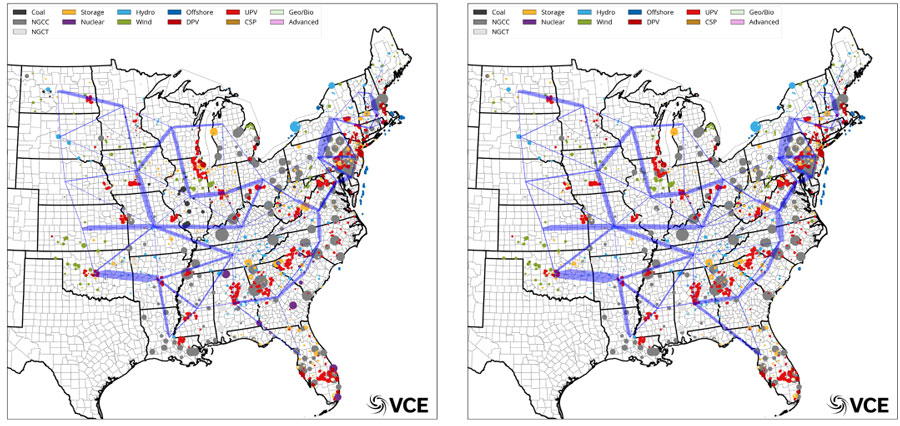
Transmission-Expansion-Strong-Carbon-Wind-vs-Solar-(Americans-for-a-Clean-Energy-Grid)-Content.jpg
Transmission expansion (2030) under a strong carbon/high solar deployment (left) and strong carbon/high wind deployment | Americans for a Clean Energy Grid

Earlier this month, Gramlich noted, the governors of Michigan, Illinois, Minnesota and Wisconsin sent a joint letter to MISO CEO John Bear saying the RTO’s long-range transmission planning process “is urgently needed to allow carbon-free and low-cost electricity to flow across the region” while maintaining reliability.

Chatterjee Recuses

Commissioner Neil Chatterjee, whose term expires June 30, did not participate in either the task force order or the policy statement. He also did not participate in two other orders Thursday, one of which approved a settlement between CAISO and Greenleaf Energy Unit 2 (ER20-1947-003) resolving issues over Greenleaf’s provision of reliability must run service. The second order addressed requests for rehearing of the commission’s March 18 order denying a petition by NextEra Energy (NYSE:NEE), Evergy (NYSE:EVRG), American Electric Power (NASDAQ:AEP), Exelon (NASDAQ:EXC) and Xcel Energy (NASDAQ:XEL) for a declaratory order regarding affiliation and passive interests (EL21-14-001).

Chatterjee’s office did not respond to a request for comment on why he did not participate.

Although his term expires at the end of the month, Chatterjee could serve through the end of the year if no one is confirmed to replace him before then.

But Chatterjee’s comments at the open meeting suggest that he may be actively looking for a new job in the industry, which could force recusals. He acknowledged his time at the commission is “winding down” but said he had not determined when his last day will be. “I commit to being as transparent as possible when I do make that decision,” he said. “In the meantime, I plan to stay constructive and remain active in the commission’s important work.”

It was Chatterjee who programmed the hold music that played on FERC’s audio connection before the meeting began. He said technology limitations reduced the playlist he had selected to a three-song loop, but said the full playlist included Johnny Paycheck’s “Take This Job and Shove It.”

“You all can read what you want into that,” he joked.

FERC Issues Show-cause Order on PJM Parameter-limited Offers

FERC issued a show-cause order to PJM on Thursday, saying that the RTO’s tariff appeared to be “unjust and unreasonable” based on the ability of sellers with market power to avoid parameter-limited offers when they should be subject to mitigation (EL21-78).

The commission said it made its preliminary finding that the tariff is “not adequately mitigating against the potential exercise of market power” based on information in the Independent Market Monitor’s 2020 PJM State of the Market Report; the Monitor’s protests of several market-based rate applications; and a PJM proposal to allow sellers to change their unit-specific parameter limits in real time. The commission rejected the RTO’s proposal last month (ER21-1591).

Offers in PJM’s energy market include economic components (price-megawatt pairs, start-up costs and no-load costs) and operating parameters (including notification time, start-up time and minimum run time).

FERC said it was concerned the tariff provisions dictating how PJM determines which offer is least cost are not just and reasonable because the tariff requires the RTO to commit and dispatch resources based on a lowest cost offer rather than selecting the resource offer with the lowest total cost among the parameter-limited offers.

“Sellers may be able to structure their market-based parameter-limited offer strategically to ensure that PJM chooses the market-based offer, which is not subject to parameter limits,” the commission said. “This undermines the purpose of parameter-limited offers, which is to ensure sellers are not able to exercise market power through the use of inflexible operating parameters.”

The commission also said the tariff appeared to lack provisions governing what happens if a seller is unable to meet its unit-specific parameters in real time. It said the tariff outlines “specific processes for exceptions requested in advance of the real-time market,” but it is not clear as to how to “treat sellers who are unable to meet their resource’s unit-specific parameters in real time.”

“While PJM needs accurate, timely information on resources’ operating capabilities, without a clear process for assessing changes to parameter-limited schedules in real time, PJM’s tariff may not adequately mitigate the potential for sellers to submit real-time values to exercise market power,” FERC said.

PJM was directed to show cause as to why its tariff remains just and reasonable or explain what tariff changes would fix the commission’s concerns within 90 days. Interested stakeholders were instructed to respond within 30 days of PJM’s filing.

Monitor Challenge

In its 2020 report, the Monitor said the current implementation of market power mitigation is “not consistent with the purpose of having parameter-limited offers, which is to prevent the use of inflexible parameters to exercise market power.”

Analysis done by the Monitor found that resources failing the three-pivotal-supplier (TPS) test in the day-ahead market were mitigated to market-based offers that were “less flexible than their cost-based offers in 30.3% of hours in 2020 during nonemergency conditions and less flexible than their parameter-limited market-based offers in 34.5% of hours in 2020 during emergency conditions.”

The IMM recommended that PJM always enforce parameter-limited values by “committing resources only on parameter-limited schedules when the TPS test is failed or during high load conditions such as cold and hot weather alerts or more severe emergencies.”

During FERC’s open meeting Thursday, Chair Richard Glick said the Monitor has argued several times in the past that PJM’s rules regarding parameter-limited scheduling enables generators with market power to successfully raise costs. Glick said the show-cause order “concludes that well may be the case.”

“I’m pleased that we’re finally taking a look at this issue,” Glick said. “As I have previously said, much of our regulatory framework depends on the existence of competitive markets. That depends on FERC aggressively overseeing the markets to ensure that those who have market power aren’t able to disrupt the competitiveness of the market. Today’s order is another step in that direction.”

Thursday’s order was the second time this year that FERC has questioned PJM’s protections against market power. In March, the commission ordered PJM to revise its market seller offer cap (MSOC), siding with the arguments made in separate complaints filed in 2019 by the IMM and several consumer advocate groups (EL19-47). The Monitor said the MSOC has been inflated by the “unreasonable and unsupported” expectation of 30 performance assessment hours annually. (See FERC Backs PJM IMM on Market Power Claim.)