ISO-NE Planning Advisory Committee Briefs: June 16, 2021

Eversource Outlines Rebuilding, Replacement Projects

Eversource Energy put forward a pair of transmission projects to the ISO-NE Planning Advisory Committee on Wednesday, including one in Connecticut to replace several lattice towers that are nearly 100 years old.

Line 690 is a 69-kV line that spans 1.87 miles from the Salisbury 21J substation in Northwest Connecticut to the New York border and consists of 11 lattice towers installed in 1926 that are among the oldest on the utility’s system, according to Eversource’s Chris Soderman.

Inspections revealed significant foundation damage, hardware rust and broken bells. Engineering analysis indicated that the current structures could not support the weight of reconductoring because of hardware rust, missing bolts, bent members and deteriorated metal at the structures’ base. The replacement for the conductor is 20% heavier.

Soderman said Eversource would rebuild 1.59 miles of Line 690 with 10 single-circuit lattice tower structures with single-circuit steel monopole structures. The utility will also replace conductors and shield wire. One lattice tower and 0.28 miles of conductors will remain in place until a future project to replace them is coordinated with Central Hudson Gas and Electric in New York. Line 690 will continue at 69 kV but configured for future operation at 115 kV. The project’s estimated cost is $11 million, with an in-service date in the second quarter of 2022.

The second effort is an addition to a December 2019 project. It identifies four additional projects based on recent inspections of 115-kV and 230-kV wood poles in Connecticut, Massachusetts and New Hampshire, plus a modified 2019 project, which ultimately replaced 208 structures.

Inspections show systemwide degradation, and replacing the structures resolves multiple structural and hardware issues. System data and recent hardware failures show a need for shield wire replacements. The existing shield wire consists of outdated industry materials with associated replacement hardware that is now obsolete. Replacing it allows for updated hardware, continued line shielding and increased communication and reliability throughout the system. All replacements and upgrades will be designed to meet current design criteria.

The proposed in-service dates range from the third quarter of 2021 to the fourth quarter of 2022 at an estimated $65 million.

Regional System Plan Updates

Kannan Sreenivasachar, ISO-NE’s technical manager for transmission planning, updated the PAC on the Regional System Plan, which details power system needs and resource and transmission facilities needed to maintain the grid’s reliability over a 10-year horizon. According to its tariff, the RTO must develop an RSP at least once every three years.

Among the highlights of the transmission project list were three significant downward cost estimate changes from the last update in March:

  • A reduction of $14.6 million on the Seafood Way 115-kV substation in South Boston, Mass., reflects approved pool transmission facility (PTF) costs.
  • Seacoast New Hampshire Solution will cost $12 million less to mirror updated PTF costs.
  • The Rhode Island portion of Eastern CT 2029 saw its price tag drop $8.9 million following the removal of asset condition costs from the total estimated costs.

One project since March in Massachusetts was also canceled — installation of a 115-kV breaker at the North Oxford substation and segmentation of the V-174 line — saving an estimated $3 million, as it is no longer needed.

Sreenivasachar added that Greater Boston-Central was the only project to change to in-service status after resolving thermal overloads.

The asset condition list featured eight new projects at an estimated $157.3 million, and 13 projects moved to in-service status.

Preliminary Results from Tx Planning Pilot Study 

ISO-NE’s Dan Schwarting, Andrew Kniska and Meenakshi Saravanan presented preliminary results from the RTO’s “Transmission Planning for the Clean Energy Transition” pilot study, which tested grid performance assumptions under high renewable penetration scenarios and quantified the tradeoffs between transmission investment and less system flexibility. The results could also inform future transmission needs assessments.

The goal was to identify the overall trend of system behavior and reliability concerns as more renewables are brought online, not to determine exact needs or potential upgrades. Thus, base cases represented a likely dispatch for a given condition rather than stressing any specific portion of the system through generator outages.

Some of the takeaways include:

  • Steady-state N-1 qualitative results showed marginally high voltages in Maine attributable to increased wind in Scenario 1. In addition, increased solar in Scenario 3 led to lower amounts of synchronous generation online, reducing voltage control.
  • Steady-state N-1-1 qualitative results for three minimum load scenarios had high voltages in Connecticut (1 and 3) and Maine (1-3), with more wind and solar leading to less synchronous generation online, reducing voltage control.

ISO-NE said it would provide more precise detail in future presentations and reports, but likely not at a typical Needs Assessment level.

MOPR Talk Highlight of ISO-NE Consumer Group Meeting

New England Power Generators Association President Dan Dolan said Thursday that his group is “a longstanding supporter” of the minimum offer price rule (MOPR) even as the NEPOOL Markets Committee began formal work last week to remove it from the Forward Capacity Market.

States want to remove the MOPR to eliminate what they see as a barrier to participate in the capacity market for their subsidized resources. But according to ISO-NE, the MOPR’s removal could also cause “greater uncertainty” for existing and new unsponsored resources.

That translates to greater financial risk. Left unaddressed, it potentially has two unintended consequences: the failure of the wholesale market to clear new entry when required and inefficient retirements if capacity prices from markets structured to be competitive are subject to persistent downward pressure from the entry of sponsored resources.

Speaking at the ISO-NE Consumer Liaison Group meeting Thursday, Dolan said the MOPR “is an important element of the marketplace overall,” though “there is a capacity value — that should and must be recognized — in the market of state-contracted resources.” 

When the market evolved, Dolan said, the compromise was the Competitive Auctions with Sponsored Policy Resources (CASPR) mechanism, which has not worked in a “fast-enough manner” to bring sponsored resources into the market, nor has it effectively matched the exit and retirement of some of the existing resources.

Dolan said “two fundamental elements” must be incorporated into the next evolution of the market. 

“The first is an analysis of what is the reliability situation of the market,” he said. “Now, part of that is what happens if MOPR goes away from a price and an operations standpoint? I think it is more pointedly about what are some of the flaws and cracks that exist in the market that the absence of MOPR will shine a brighter spotlight on.” 

Dolan said the reliability analysis that ISO-NE and NEPOOL started last year “has to be sped up fairly dramatically” as market changes “expose those cracks a little bit more directly.” 

He said the second element is to have the market incorporate the fundamental policies “driving the states to push more contracts and more fixed charges on a retail bill right now.” Dolan said decarbonization is the most prominent single policy across New England. 

“While I am a firm believer that putting a meaningful price on carbon is the best, most efficient way to drive that investment in both new and existing resources, it’s not the only one,” Dolan said. “We’re hopeful that as we make this big transition to a post-MOPR world, it provides further acceleration and momentum to also better link and incorporate the state policies into the market.” 

Dolan said that would create a sustainable market design that supports investment in new technologies while maintaining reliability and a stable investment environment. 

Graceful Retirements

Pete Fuller of Autumn Lane Energy Consulting said when the ISO-NE markets were set up, “nobody outside of a very small minority” thought of carbon emissions, climate change or other environmental aspects. 

“The markets were set up based on the technologies we understood at the time, with a goal of maintaining reliability at lowest practical costs,” Fuller said. “Now we have a new objective that the states are injecting into the energy equation.” 

The markets have not caught up, and nobody has figured out whether a carbon price or another mechanism will help the markets, Fuller said, adding that it is not simply a technical problem. 

“There’s a lot of legal and political aspects to this because FERC has appropriate and, I think, pretty clear authority over liability and costs, but not so clear authority or ability to do anything on the emissions side. That’s been the realm of the states.” 

That leads to many questions in the “gray area,” Fuller said, such as whether ISO-NE and NEPOOL stakeholders can create a consolidated market or set of markets that maintain reliability at the lowest cost and meet emissions targets. As states accelerate their renewable energy objectives, it creates a different investment path, which created tension with the MOPR, he said. Fuller said the structure should “perpetuate itself” on a trajectory toward “a decarbonized decentralized system that really does meet the cost and reliability goals.”

Erin Camp of Synapse Energy Economics said some in the industry assume that removing the MOPR will further deflate capacity prices. He noted that, at its June 9 meeting, the Markets Committee held a discussion about improving the retirement signal.

At that meeting, FirstLight’s Tom Kaslow highlighted that restoring a meaningful retirement signal is fundamental to efficient market function and achieving state policy goals. The benefits include climate-aligned reliability where market rules encourage efficient retirements to support outcomes that attract and retain resources needed to meet state policy objectives and the balancing resources required to integrate them. 

“Right now, we have more supply than we currently need, and that keeps capacity prices at a record-low level,” Camp said. “Interestingly, despite those record-low levels, we haven’t seen the retirements that we should be.” 

Camp said there might not be a need for a new mechanism to replace the MOPR but a way to enable and improve the way existing resources can retire. 

“It’s hard to be a complete predictor of the future, but the markets are fairly uncertain, and we won’t know exactly the impact of removing MOPR until we get there,” Camp said. “We could take the same stance as we did with CASPR. We let it sit. We let it operate as it was designed for a few years to see if it would do what it intended to do before we decided to take further action. That is an approach that could make sense here to see what happens after you remove the MOPR, combined with the enabling resources to be able to exit the market successfully.”

NC Republicans Roll out Bill to Close Coal Plants, Add Renewables

Five of Duke Energy’s seven coal-fired plants in North Carolina would be closed by 2030 and replaced with energy storage and a 900-MW simple-cycle natural gas plant under a bill given an initial public hearing before the state House Energy and Public Utilities Committee Thursday (H.B. 951).

The 47-page bill, which also calls for 5,000 MW of solar, is the result of months of negotiations with a group of industry stakeholders, led by the committee’s chairs Rep. Dean Arp and Rep. John Szoka, both Republicans.

But clean energy advocates have said the bill is the result of closed-door meetings — a claim Szoka rebutted in his opening statement at the hearing. The bill may not be perfect, he said, but “in my belief, everyone’s viewpoints were included in this process, even if they weren’t physically in the room.”

He pointed to the more than 5,000 MW of solar the bill would add to the state’s grid as being about “five to one” the capacity of the 900-MW natural gas peaker Duke would install to replace the 760-MW Marshall Units 1 and 2 coal plants.

But Maggie Shober, director of utility reform at the Southern Alliance for Clean Energy, said Szoka’s claim to inclusivity “just doesn’t fly” and, she said, the bill is “too prescriptive.”

“Why do we have a process to do an IRP [integrated resource plan] that’s overseen by a commission, which I’ll note is appointed by a Democratic governor,” Shober said in a phone interview with NetZero Insider. “Why go through all this, if the legislature is going to prescribe exactly how much of each resource that the utility needs to either retire or build?”

The bill specifically states that its provisions are “generally consistent with the electric public utilities’ current integrated resource plans,” that is, the IRPs submitted by Duke’s two North Carolina utilities, Duke Energy Progress and Duke Energy Carolinas. The plans have sparked wide opposition from environmental and energy organizations and have yet to be approved by the North Carolina Utilities Commission (NCUC). (See Outspoken Public Pushes for Duke to Lead on Climate.)

The South Carolina Public Service Commission on Thursday sent back Duke’s IRP for the state, which parallels the utility’s North Carolina plans, requesting modifications.

Performance-based Regulation

The coal plant closures are among the bill’s topline selling points, aimed at cutting carbon emissions from the state’s power sector by 61% from 2005 levels by 2030. Gov. Roy Cooper (D) has targeted a 70% cut by 2030 and net zero by 2050. Arp argued the lower figure, and additional natural gas, would balance the need for serious emissions reductions and grid reliability.

“God forbid that we are in a Texas situation where things froze over, or rolling blackouts like in California,” he said. “We don’t envision new technology that comes on that preserves the same dispatchability and reliability” as the coal plants.

Duke has also committed to a net-zero system by 2050, but its interim goal for 2030 has been a 50% reduction, and the utility’s IRP would keep 3,050 MW of coal and natural gas generation on the grid through 2035.

Other provisions in the bill include:

  • Coal retirements: The five plants to be retired are the Allen plant, by the end of 2023; the Roxboro plant, by the end of 2024; Marshall Units 1 and 2, by the end of 2026; and Cliffside Unit 5 and the Mayo plant, both by Sept. 1, 2027. In addition to the 900 MW of natural gas at the Marshall units, replacements for the Allen plant would be 20 MW/80 MWh of energy storage.
  • Renewable energy: Duke would be required to procure 777 MW of renewable energy per year through 2026, with 45% coming from third parties and 55% utility-owned projects.
  • Nuclear: The bill directs Duke to submit license extensions to the Nuclear Regulatory Commission for its six nuclear plants in the state. It also authorizes the utility to spend up to $50 million to apply for an “early site permit” to develop an advanced nuclear plant.
  • Performance-based regulation: The NCUC could approve performance-based regulation (PBR) that would decouple utility revenues and energy consumption, while providing incentives for “performance in targeted areas consistent with policy goals.”
  • Multi-year rate plans:  PBR would also include multi-year rate plans, under which the NCUC could approve a utility’s base rate for three years, with up to a 4% increase allowed each year without additional approvals.

Speaking at the hearing, Kendal Bowman, Duke’s vice president of regulatory affairs and policy, said H.B. 951 represents “collaboration and compromise.” The PBR and multi-year rate plans would “hold the utility accountable for investments that support the policy of North Carolina, as we help facilitate the energy transition at the right pace,” she said.

Why No Wind?

But Tyler Fitch, Vote Solar’s regulatory director for the Carolinas, called the bill an “attempted power grab by Duke Energy. … It erodes the ability of state regulators to provide oversight over Duke’s investments and their rate hikes,” he said in a statement to NetZero Insider. “We all know more solar power would benefit North Carolinians, and there are ways to do that without handing Duke a blank check.”

Peter Daniel, director of government affairs for the North Carolina Chamber, came out in support of the bill. The Chamber has “historically supported an all-of-the-above energy approach that supports grid modernization and improves access to a sensible mix of energy resources, such as natural gas, nuclear, renewables, biomass and others,” he said. “This forward-thinking bill is the all-of-the-above approach we need at this moment.”

Kevin O’Donnell, of the Carolina Utility Customers Association, said the 4% rate increases in the multi-year rate plans could add up to 50% over a decade. His solution: cut costs by having all of North Carolina join an RTO, such as PJM, which already serves the northeast corner of the state. Allowing large industrial customers to “shop the market and bring power in” would also reduce congestion on the system, he said.

Committee members also raised concerns. Rep. Zach Hawkins (D) questioned the “mandate to move toward gas versus open source or all source” procurements. Rep. Jimmy Dixon (R) said the thousands of megawatts of solar in the bill could result in the “probably indeterminable cost of excellent farmland. We have to give some consideration to a more definitive understanding of the end of life on these facilities,” he said.

Rep. Beck Carney (D) wanted to know why wind power was not part of the equation for coal plant replacements and pushed Arp and Szoka to increase the bill’s carbon reduction target to Cooper’s 70%. “I hope as this bill moves forward, to get buy-in from a lot more people, we move closer to that 70%,” Carney said. “That is important to a lot of us.”

Trio of Climate Bills Headed to Colorado Governor

Colorado’s legislative session ended last week with the passage of various climate bills now on their way to the governor’s desk.

After some debate, lawmakers passed three bills focused on electrification, air quality and environmental justice, which call on state agencies, including the Public Utilities Commission (PUC) and Air Quality Control Commission (AQCC), to monitor and aid utilities in the transition to net zero emissions.

SB21-246

This bill concerning building decarbonization and electrification would require the state’s utilities to create programs that encourage the use and purchase of electric appliances in both household and commercial applications. These would be voluntary programs that would not require the replacement of outdated equipment but would rather reduce costs for and encourage the purchase of their electric substitutes.

The PUC would “establish energy savings targets and approve plans under which investor-owned electric utilities will promote the use of energy-efficient electric equipment in place of less efficient fossil-fuel-based systems,” the bill states. The energy savings targets would ensure utilities maximize the potential GHG reductions from voluntary electrification.

When creating these programs, utilities also will have to consider disproportionately impacted communities. The bill states they must “include programs targeted to low-income households or disproportionately impacted communities, with at least 20% of the total beneficial electrification program funding targeted to programs that serve [these] communities.”

SB21-264

To reduce greenhouse gas emissions from “the built environment,” SB264 will require gas distribution utilities to file clean heat plans with the PUC and AQCC. The plans should demonstrate how each utility intends to achieve 4% GHG emissions reductions by 2025 and 22% by 2030 as compared to a 2015 baseline.

The “utility shall provide to the division an annual report of carbon dioxide emissions associated with customer end-uses and, separately, methane emissions associated with the utility’s distribution system,” the bill states.

In addition, SB264 calls on the Oil and Gas Conservation Commission to conduct a study “to evaluate the resources that would be needed to ensure the safe and effective regulation of injection wells used for sequestration of GHG.”

HB21-1266

Under threat of a veto, Colorado Democrats dropped controversial climate bill SB21-200 at the end of the legislative session, instead pushing through HB21-1266, which many considered a compromise. (See New Report Could Support Adoption of Colo. SB200.) While SB200 primarily focused on statewide GHG emissions targets and only touched on disproportionately impacted communities, HB1266 focuses on outreach to these communities.

While the bill still enforces emissions reductions in the electric, oil and gas and industrial sectors, it does not mandate specific targets like its predecessor.

The Environmental Justice Act, as it has been named, would create an environmental justice action task force in the Department of Public Health and Environment. The task force would “propose recommendations to the general assembly regarding practical means of addressing environmental justice inequities.” A report including the task force’s final recommendations would be due in November 2022.

The bill would also require the AQCC to find ways to engage with these disproportionately impacted communities. The commission would have to create “new ways to gather input from communities across the state, using multiple languages and multiple formats, and transparently sharing information about adverse effects resulting from its proposed actions,” the bill states.

Standards Committee Delays Action on AVR Standard

In its monthly meeting on Wednesday, NERC’s Standards Committee came close to rejecting the standard authorization request (SAR) for Project 2019-04 (Modifications to reliability standard PRC-005-6) before agreeing to give the project’s team more time to address complaints raised by industry stakeholders in multiple formal comment periods.

NERC initiated Project 2019-04 in May 2019 in response to a proposal from the North American Generator Forum (NAGF), which felt that the current standard does not clearly explain its applicability to protective functions within automatic voltage regulators (AVR) or prescribe appropriate maintenance activities for these devices.

The SAR drafting team has posted the draft request for industry comments three times and met serious pushback each time. Most notably, NAGF, despite providing the initial impetus for the project, has since backed off, saying after the second round that the updated SAR has “expanded the scope significantly from the original wording of the NAGF SAR and evolved into a draft that the NAGF can no longer support.” (See AVR Standards Team Faces Industry Pushback.)

Amy-Casuscelli-(NERC)-Content.jpg
Amy Casuscelli, Xcel Energy | NERC

This objection was clearly bothering consultant Philip Winston, who at Wednesday’s meeting mentioned NAGF’s withdrawal of support and other stakeholders’ concerns about the potential of the project to impact other standards beyond PRC-005-6. Winston also pointed out that while the drafting team acknowledged the negative comments, it did not seem to have addressed them at all in the latest round of revisions.

“In responses to comments, many of [them were], ‘Well, it will be up to the standard drafting team [SDT] to determine the direction.’ But it’s the same people, and they know where they’re going, in my opinion,” Winston said, referring to the proposal before the committee to appoint the SAR drafting team as the SDT (while soliciting one additional member). “I just don’t think that the industry … has a legitimate opportunity to continue to express their concerns on the direction this project has gone” unless the team undertakes further revisions and another comment period.

Multiple participants agreed with Winston that the SAR drafting team had not been fully responsive to industry concerns. John Babik, director of electric compliance at JEA — a publicly owned electric, water and sewer utility in Jacksonville, Fla. — even went so far as to move that the committee reject the SAR, which would close the project entirely.

Howard-Gugel-(NERC)-Content.jpg
Howard Gugel, NERC | NERC

There is recent precedent for ending a standard project over failure to address industry comments. The committee voted at its December meeting to reject the SAR for Project 2020-01 (Modifications to MOD-032-1) for essentially the same reason. (See NERC Standards Committee Briefs: Dec. 9, 2020.)

In this case members opted not to take such an extreme step just yet; Babik withdrew his motion after Winston made a counterproposal to “recommend that the SAR be reposted for industry comments.” After Chair Amy Casuscelli, of Xcel Energy, noted that NERC’s Standards Process Manual allows the committee only to accept a SAR, reject it or return it to the drafting team, Winston clarified that he wanted to return it for revisions.

Howard Gugel, NERC’s vice president of engineering and standards, recommended Winston modify his motion further to clarify that the committee was not actually taking any action at this time but wished the drafting team “to repost, with all the other caveats” raised at the meeting. Winston agreed, and the modified motion passed unanimously.

California Truck Buyers Snap up $84M in Clean Incentives

California truck buyers snapped up $84 million in state-offered clean vehicle purchase incentives within hours of their release last week, evidence of the state’s acceleration toward zero-emission medium- and heavy-duty vehicles.

The California Air Resources Board opened its Hybrid and Zero-Emission Truck and Bus Voucher Incentive Project (HVIP) to new requests on June 8. The program will offer $165 million this year to California-based businesses for the purchase of new zero-emission and near-zero-emission vehicles.

CARB is offering the funds in two phases. The first round of $84 million was released on June 8. That same day, the program announced it had received requests for all of the first wave of funding, covering incentives for more than 900 vehicles.

The remaining funds, up to $83 million, will be released on Aug. 10 at 10 a.m. But Class 8 trucks performing drayage operations as well as vehicles purchased by a public agency may apply for the incentive during the pause.

The HVIP incentive is available for vehicles ranging in size from Class 2B to Class 8, including tractors, straight trucks, delivery vans, garbage trucks and buses.

For tractors, for example, the program offers an incentive of $120,000 for six different models of battery electric vehicles. For heavy-duty buses, an incentive of up to $240,000 is available for certain models of battery-electric or hydrogen fuel cell vehicles.

HVIP is administered by CALSTART, a national clean-transportation consortium.

CARB launched HVIP in 2009. The program provided more than $400 million in incentives through the end of last year for the purchase of more than 7,000 vehicles. The incentive shaves an average of 20% off the cost of a clean vehicle, according to the program’s website.

Clean Truck Regulation

The latest round of incentives comes after Gov. Gavin Newsom in September issued an executive order that set a goal of having all medium- and heavy-duty vehicles in the state be zero-emission by 2045 “for all operations where feasible,” with a similar goal for drayage trucks by 2035. Drayage trucks are heavy-duty vehicles that transport shipping containers that arrive at ports.

Last year, CARB adopted what it called a first-in-the-world rule requiring truck manufacturers to move from diesel trucks and vans to electric zero-emission trucks starting in 2024. The Advanced Clean Truck regulation will require every new truck sold in California to be zero-emission by 2045.

“This requirement to shift to zero-emission trucks, along with the ongoing shift to electric cars, will help California meet its climate goals and federal air quality standards, especially in the Los Angeles region and the San Joaquin Valley — areas that suffer the highest levels of air pollution in the nation,” CARB said in a news release at the time.

This year, CARB is following up on its Advanced Clean Truck rule with a proposed Advanced Clean Fleets regulation.

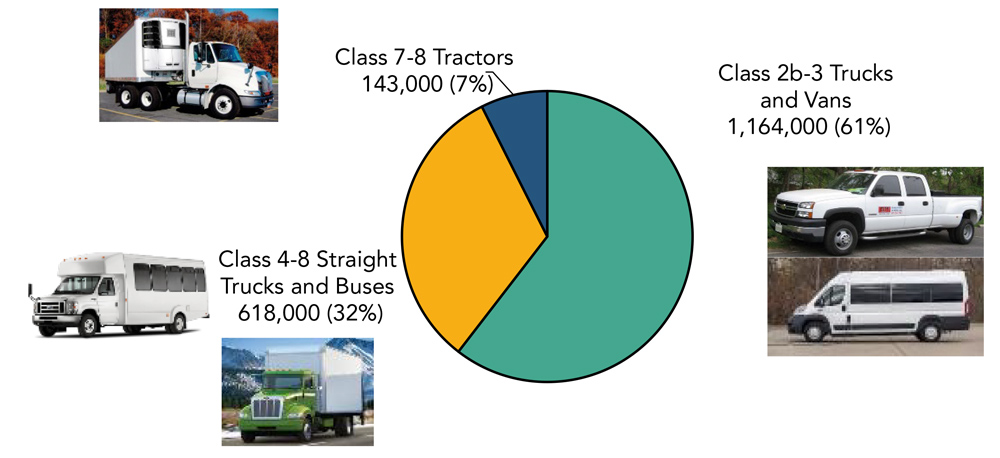
Calif-Truck-Population-Break-Down-(CARB)-Content.jpg
Graph shows the current breakdown of California’s truck population.
| CARB

The proposed rule would phase in zero-emission trucks and buses from 2023 to 2045 for state and local government fleets, drayage trucks serving ports and railyards, and federal agency and private fleets deemed “high priority.”

The Advanced Clean Fleets regulation would apply to on‐road vehicles with a gross vehicle weight rating of more than 8,500 pounds and off‐road yard tractors. A first hearing on the proposed regulation is expected in December.

In addition to the CARB regulations, 15 states and the District of Columbia signed a memorandum of understanding last year to support rapid expansion of the zero-emission truck market. The memorandum sets targets for the sales of zero-emission trucks: 30% by 2030 and 100% by 2050.

Olympic Dreams

CARB is not alone in pursuing clean-truck initiatives in California.

The Los Angeles Cleantech Incubator (LACI) and the Transportation Electrification Partnership (TEP) have set a target for 40% of drayage trucks serving the ports of Los Angeles and Long Beach to be zero emissions by 2028. The groups set the target in consultation with both ports, according to Michelle Kinman, senior director of transportation at LACI.

TEP is a regional public-private collaboration that formed with the goal of improving air quality by the time the Summer Olympics come to L.A. in 2028.

Thus far, TEP members have tried out zero-emission equipment in demonstration and pilot projects at the ports. That sets the stage for a significant increase in zero-emission deployments starting in 2022 and 2023, Kinman said.

The groups are also focused on finding funding for charging infrastructure for heavy-duty, battery-electric trucks along the Interstate 710 corridor and elsewhere in the region.

“Given the lengthy timelines for the permitting and interconnection of charging infrastructure, it is imperative to work now to install ample infrastructure in strategic locations to ensure that fleet owners and operators will have the confidence to make the transition to electric trucks,” Kinman told NetZero Insider.

Tom Ashley, vice president of policy and market development for Greenlots, discussed the LACI and TEP target for zero-emission drayage trucks last week during the annual meeting of the Western Conference of Public Service Commissioners (WCPSC). Greenlots, a provider of electric vehicle charging technology, is a LACI partner.

“We’re talking not just selling a certain amount of vehicles, but in 2028, 40% of the [on-road drayage] vehicles in operation are zero-emission,” Ashley said during a session on electric vehicles. “So very aggressive, and I think we’re going to be seeing more and more of that type of activity in other regions.”

Ashley said three factors are driving the transition to electric trucks: climate, air quality and economics. CARB, through regulation, has been a primary driver of the move toward zero-emission trucks in California, related to a combination of emissions and air quality, he said.

And regions that don’t meet air-quality standards set by the Environmental Protection Agency risk losing out on an array of federal funding, Ashley said.

“We’re really seeing the biggest fleets out there — including particularly the fleets that operate, yes, in California but also in a lot of other geographies — really start to ramp up their transition to either electrification specifically or zero emissions a little bit more broadly,” Ashley said.

E-ISAC Joins Dragos for Data Sharing Initiative

NERC’s Electricity Information Sharing and Analysis Center (E-ISAC) is partnering with cybersecurity firm Dragos for a joint initiative aimed at strengthening “collective defense and community-wide visibility for industrial cybersecurity” in the bulk electric system.

The initiative will allow E-ISAC staff to access information about threat analytics and indicators of compromise filed in Dragos’ Neighborhood Keeper threat intelligence system. Analysts will then share “insights and trends gleaned from this information” with E-ISAC members to ensure the latest intelligence is available as widely as possible across the industry.

Neighborhood Keeper is currently available as a free opt-in service to customers of the Dragos Platform, a network of sensors analyzing multiple data sources across users’ industrial control systems (ICS) and operational technology environments. Data collected through the platform is anonymized and will be aggregated before being provided to the E-ISAC for analysis and distribution

The program’s website lists one of its goals as “enabling trusted industry and government partners to leverage the system as a cyber national broadcasting service,” suggesting that additional partnerships beyond the E-ISAC are under consideration. Dragos said its electric industry customers “will benefit from access to a larger pool of E-ISAC cyber security experts” providing more insights into threats and vulnerabilities than utilities can produce on their own. 

“The electric community is keenly aware of the kind of cyber threats they face but to date has had to defend against those threats in isolation,” said Dragos CEO and co-founder Robert Lee in a press release. “Defending against state and criminal actors is entirely doable when the community operates as a collective and ensures that an attack on one member is seen by all of us. This new capability for the E-ISAC will amplify their important role and responsibility in helping our electric sector customers and members of the E-ISAC.”

Growing Urgency in ICS Security

Cybersecurity experts have warned repeatedly about the vulnerability of critical U.S. infrastructure, including the power grid, to ICS-targeted cyberattacks; Dragos issued a report last year noting attacks against the electric, oil and gas infrastructure of multiple countries and rating the bulk power system as facing a high risk of disruptive cyberattack. (See Report: Oil, Gas Hackers Expanding to Grid.)

The Biden administration announced in April an initiative aimed at improving the cybersecurity of electric utilities’ ICS over 100 days, to be coordinated between the Department of Energy, the electric industry, and the Cybersecurity and Infrastructure Security Agency (CISA). (See Biden Reinstates Trump Supply Chain Order.) In the wake of last month’s ransomware attack on Colonial Pipeline, which served as a graphic illustration of the vulnerability of critical U.S. infrastructure, Biden issued further orders expanding the role of CISA, creating a public- and private-sector cybersecurity review board, and launching a pilot for a software supply chain security information sharing scheme. (See Biden Directs Federal Cybersecurity Overhaul.)

In support of the 100-day initiative, NERC earlier this month released a guide to help ERO Enterprise compliance monitoring and enforcement staff review cybersecurity preparedness at utilities. (See NERC Releases CIP Audit Guide for Network Monitors.) The organization also praised Biden’s May executive order, particularly the information-sharing provisions, which it called complementary to the mission of the E-ISAC.

Additional information-sharing efforts in the private sector include the Asset to Vendor (A2V) Network for Power Utilities, a network launched last year by Fortress Information Security and American Electric Power that now also includes Southern Co., Hitachi ABB and NiSource. (See CIP Compliance: Don’t ‘Boil the Ocean’.) The network provides utilities with a platform for sharing information on cybersecurity risks in their equipment supply chain.

FERC Reverses State Opt-out on DR — for Now

FERC on Thursday announced that it would reconsider Order 2222-A, the latest episode in the commission’s debate on whether it should allow states to prevent demand response resources from participating in RTO/ISO markets (RM18-9-003, RM21-14).

In issuing Order 2222 in September 2020, FERC ordered RTOs and ISOs to open their markets to distributed energy resource aggregations. With March’s Order 2222-A, the commission clarified that a DR resource could participate in an aggregation that included at least one other type of DER, even if the DR resource was in a state that chose to opt out of Order 719. That order, issued in 2008, allowed states to block DR aggregations from participating in wholesale markets. (See FERC Limits State ‘Opt Out’ on DR.)

But at its open meeting Thursday, FERC set aside 2222-A. Chair Richard Glick opened the meeting by saying he was convinced by arguments in rehearing requests and by Commissioner Mark Christie “that we should not be putting the cart before the horse.”

“These issues are best considered holistically and in the context of” its Notice of Inquiry into whether it should rescind Order 719, he said.

Additionally, FERC extended the deadline for comments in the NOI, which irked Commissioner Neil Chatterjee. Though he concurred with Thursday’s order, he urged “the commission to eliminate this outdated and anticompetitive policy, an action I believe is necessary to fully unleash the power of DER and allow consumers to realize all the benefits demand response resources can provide in DER aggregations.”

The order also provided clarification that “payment of full LMP in the energy market to behind-the-meter distributed energy resources participating as demand response resources in distributed energy resource aggregations does not constitute double counting, so long as the requirements of Order No. 745, including the net benefits test, are satisfied.”

Christie concurred in part and dissented in part, saying “I would have voted against Order No. 2222 had I been a member of the commission at that time, and I did vote against Order No. 2222-A.”

In the latter order, Christie said the majority has sided “against the consumers who for years to come will almost surely pay billions of dollars for grid expenditures likely to be rate-based in the name of ‘Order 2222 compliance.’”

“To ameliorate at least some of the damaging effects caused by Order Nos. 2222 and 2222-A, I would authorize states and other RERRAs the right to exercise an opt-out from the requirements of those orders, if not permanently then at least for some period of years to enable them better to prepare for the impacts on retail customers and distribution grids they now face,” Christie added.

Commissioner James Danly issued a separate concurrence to “highlight that even if the commission is correct that it has jurisdiction over distributed energy resource aggregations — including those ‘aggregations’ comprised of a single resource — the commission still should have chosen not to exercise such jurisdiction in Order No. 2222.”

Abbott Taps OPUC’s Cobos to Fill out PUC

Texas Gov. Greg Abbott on Thursday appointed Lori Cobos, chief executive and public counsel for the Office of Public Utility Counsel (OPUC), to the Public Utility Commission for a term that expires in less than three months.

Lori-Cobos-(Texas-State-Directory)-Content.jpg
Lori Cobos | Texas State Directory

Cobos’ appointment fills out the current commission, which has completely turned over since February’s winter storm nearly flattened the ERCOT grid. The previous three commissioners all resigned under political and public pressure in March. (See D’Andrea Resigns from Texas Commission.)

Because her appointment comes between legislative sessions, she can begin serving without Senate confirmation once she is sworn in and completes her training. She will sit beside Chairman Peter Lake and Commissioner Will McAdams before her term expires Sept. 1.

State legislators passed a bill that would expand the PUC to five commissioners and require two of them to be “well informed and qualified in the field of public utilities and utility regulation.”

Cobos has led the OPUC, which represents residential and small commercial consumers’ interests in state utility proceedings, since April 2019. The organization has been credited with helping achieve more than $1.3 billion in utility bill savings before the PUC during her tenure, including an agency record of almost $1.2 billion in 2020.

“I know that she will draw upon her wealth of experience and knowledge to faithfully serve the people of Texas,” Abbott said in a statement. “Throughout her career, Lori has gleaned valuable experience in the power and utility industries. Her most recent leadership role at OPUC makes her a perfect choice for the Public Utility Commission.”

Cobos has more than 17 years of experience in the Texas electric power industry and previously served in several senior-level positions at the PUC. She advised two PUC commissioners and served as assistant counsel to the commission’s executive director and senior policy analyst in the policy development division. Cobos has also been an in-house counsel for ERCOT.

Cobos will give up a voting position on the grid operator’s board that is allocated to the OPUC. The PUC chair serves as a non-voting representative on the board.

She received her law degree from Texas Tech University, and her master’s in public administration and bachelor’s in business administration from Sul Ross State University.

FERC Opens 206 Proceeding Against Tri-State

FERC on Thursday opened a Section 206 proceeding against Tri-State Generation and Transmission Association following member utilities’ complaints that the proposed procedural requirements for leaving the cooperative’s membership continue to be unjust and unreasonable (EL21-75).

The commission gave Tri-State 30 days to show cause as to why its tariff remains just and reasonable or to explain what revisions it could make to address the identified concerns.

At issue is Tri-State’s proposed contract termination payment (CTP) methodology for calculating a member’s exit fee. FERC said several members have requested CTP calculations since November, but the cooperative has “so far refused” to provide the calculations.

Seven utility members filed a complaint over the lack of calculations in February. In a docket that is still pending before the commission, Tri-State responded by saying that utility members are entitled to a CTP calculation only upon actually leaving the cooperative (EL21-53).

FERC said Tri-State’s tariff does not provide “clear and transparent procedures” for members considering termination to obtain CTP calculations or for the cooperative to perform the calculations before the members made their decisions.

“Such a position, which would appear to be unjust and unreasonable, illustrates utility members’ inability to receive a CTP calculation pursuant to [required] ‘equitable’ termination procedures,” the commission said.

As part of a 2020 declaratory order that put Tri-State under FERC’s jurisdiction, the commission accepted bylaw changes that gave the cooperative’s board of directors authority “to prescribe equitable terms and conditions to be applied when a member withdraws from membership.” (See “Ruling Permits Tri-State to Become FERC Jurisdictional,” SPP FERC Briefs: Week of March 16, 2020.)

“However, the terms and conditions under which utility members may exit Tri-State have been a significant and contentious issue” before the association became subject to its jurisdiction, the commission said. It said the cooperative has had more than a year to file just and reasonable procedures governing the exit charges’ calculation, but it has failed to do so.

FERC also said the CTP methodology fails to provide for pre-termination calculations or any rules governing how such calculations are to be performed. It said it was concerned that a tariff rate schedule “may be impermissibly vague” because it lacks detailed procedures governing when and how a utility member may obtain a CTP methodology calculation.

“To date, the tariff has no provisions that explicitly provide for when and how pre-termination calculations should be carried out or any provisions detailing the process for requesting CTP calculations,” the commission said.

Tri-State, an SPP member based in Westminster, Colo., provides wholesale power and transmission services to 42 utility member-owners in Colorado, Nebraska, New Mexico and Wyoming.