A bill that would allow Maine to replace its two investor-owned utilities with a consumer-owned nonprofit passed both houses of the state legislature this week despite the concerns of Democratic Gov. Janet Mills.
Maine’s House of Representatives passed An Act to Create Pine Tree Power Company (LD 1708) 76-64 on Tuesday, and the Senate passed it 19-16 the next day.
The legislation would initiate a process to create Pine Tree and direct it to acquire all utility facilities in the state through the right of eminent domain, effectively replacing Central Maine Power and Versant Power.
Proponents of the bill say that the foreign ownership model of CMP and Versant is not delivering reliable service, low rates or superior customer service. CMP is owned by Spain-based Iberdrola via Avangrid (NYSE: AGR), while Versant is a subsidiary of Calgary, Canada-based ENMAX.
If Gov. Janet Mills signs the bill, the proposal would go to voters in November.
Prior to the House and Senate votes, however, Mills’ office sent a memo to legislators calling on them to “conduct more research and analysis before putting a stamp of approval on this version of the proposal.”
In the memo dated June 14, Mills’ office outlined specific concerns about the proposed utility’s governance and the effect the changeover would have on Maine’s progress on climate change.
Seven of the 11 members of the Pine Tree board would be elected as representatives of groups of Maine districts, but Mills is uncomfortable with that governance structure.
“The bill contains no assurance that the seven members of the board will share the legislature’s goals on climate change, reliability and rates, nor are the members required to have any expertise in finances, energy or utilities,” the memo said.
Mills also believes that the acquisition of assets from “unwilling sellers” would delay the work of addressing climate change in the state.
But the bill does require the board to report to the legislature on specific objectives, including meeting the state’s climate change goals, according to a June 16 response to the memo by Rep. Seth Berry (D).
“No single obstacle to our effort to decarbonize over the last two years has been greater than our investor-owned utilities,” he said, adding that a consumer-owned provider is a proven model for decarbonization.
Consumer-owned utilities serve “all six of the nation’s first six communities to reach 100% clean electricity,” he said.
Mills also sees the proposal as a risk to current property tax revenues from utility ratepayers, estimated at $90 million.
“Although the bill says that the new entity will make ‘payments in lieu of taxes,’ as a tax exempt ‘body corporate and politic,’ it is doubtful that the governing entity could be required to make any such payments,” the memo said.
Barry, however, agreed that property taxes are “crucial,” and said the bill “requires that all current and future property taxes, as paid for in our rates, are continued.”
Based on the House and Senate roll calls, the bill’s supporters currently do not have the votes necessary to override a veto by Mills.
FERC on Thursday approved an uncontested settlement on cost recovery and formula rates for LS Power Grid New York’s share of the $854 million Marcy-New Scotland transmission upgrade project, as well as various return on equity adders (ER20-716-004).
LS Power is developing the 93-mile Marcy-New Scotland project, also known as Segment A of NYISO’s AC Transmission Projects, in partnership with the New York Power Authority. NYISO selected the project in April 2019 in a competitive solicitation process to address a public policy transmission need approved by the state’s Public Service Commission. (See “Yes to Marcy-New Scotland” in NY PSC OKs Utility Storage Deployment, Cost Recovery.)
The commission accepted the revised tariff records filed on April 9, granted a waiver to make the changes effective May 27, 2020, and directed NYISO to make a compliance filing with updated revised tariff records in eTariff format within 61 days.
“We note that the settlement recharacterizes the adder for the RTO-Participation Incentive as a 50 basis-point incentive adder to account for ‘benefits to customers, including congestion relief,” the commission said, adding that approval of the settlement “does not constitute approval of, or precedent regarding, any principle or issue in this proceeding.”
The commission in May 2020 also granted LS Power a 50 basis-point ROE adder to reflect the risks and challenges associated with development of its portion of the transmission project (ROE Risk Adder).
At the time, FERC also granted LS Power’s requests for other incentives, including authorization “to create a regulatory asset to capitalize certain costs that would not otherwise be capitalized” and “to use a hypothetical capital structure, consisting of 47% debt and 53% equity, until the project achieves full commercial operation.”
The settlement provides for a base ROE of 9.65% and — in addition to the two 50 basis-point adders — a 100 basis-point adder to be applied to unforeseeable costs greater than 5% of the cost cap, third-party costs, and project development costs.
Planners expect the Marcy-New Scotland project to be in-service in December 2023.
The settling parties include LS Power, NYPA, NYPSC, Municipal Electric Utilities Association of New York, the City of New York and Multiple Intervenors, an unincorporated association of approximately 60 large industrial, commercial and institutional energy consumers with manufacturing and other facilities located throughout the state.
Days before Massachusetts’ landmark climate bill goes into effect, comments from residents poured into the state’s Department of Public Utilities (DPU) on reforming public outreach and engagement.
The agency opened the inquiry in April after it received criticism from the public for holding proceedings on energy infrastructure projects during the workday when most residents were unable to attend. Advocates also said DPU should double its efforts to make information available in other languages, such as Spanish, as many environmental justice communities are homes to immigrants.
The town of Hopkinton, 30 miles west of Boston, said in comments to DPU that the list of people notified about new project meetings ranges widely depending on the company involved, but not necessarily the type of project. The agency and the company involved are also not required to give reasons for the people included on the notify list.
Town leaders recommended DPU create a default list of people to notify based on the most “robust” notice that has been given in the past for similar projects. If a company or the agency deviates from the list, their reasons should be filed with the order of notice, town officials said.
Utilities should also be clear about the impact and benefits of a proposed project on the community in the notice. Those details would allow municipalities to know which residents to follow up with, and residents can participate meaningfully in the proceeding instead of finding out key aspects of the project along the way.
“The town cannot emphasize enough how these types of ‘plain English’ statements could help public participation,” Hopkinton leaders said. “Including short, direct, plain statements would better inform a much wider community audience about department proceedings.”
Hopkinton suggested DPU translate all notices and other vital documents into at least the five most common non-English languages in Massachusetts — Spanish, Portuguese, French, Chinese and French Creole, according to the census.
Under the Next-Generation Roadmap for Massachusetts Climate Policy, DPU is required to develop an environmental justice strategy to cut the amount of pollution in low-income and communities of color. Regulators must also involve those communities more effectively in their decision making on energy infrastructure.
Leadership in Boston would like regulators to connect with community-based organizations to improve communication efforts, according to comments submitted by Rev. Mariama White-Hammond, chief of environment, energy and public spaces for Boston.
Those organizations, White-Hammond said, have existing relationships with residents and they can spread the word about the proceeding, why it is important and what the timeline is for intervening.
Placing advertisements on public transportation, such as trains and buses, as well as in stations or stops within the utility could be an effective way to reach impacted customers, White-Hammond said.
DPU’s inquiry also asks for guidance on how the costs associated with the publication of notices or translation services not filed by a department-related company should be covered.
In her comments, White-Hammond warned against making those costs an additional burden that further reduces participation.
“The utilities serving Boston customers are multibillion-dollar companies, while non-governmental organizations and individuals often have very limited resources, which already places them at a disadvantage in proceedings,” White-Hammond said. “The department should provide funding for municipalities, nonprofits and individuals to meet whatever requirements the department establishes.”
Con Edison is staking its future on clean, emissions-free energy, going “all-in” on electric vehicles, energy efficiency and storage, CEO Timothy Cawley said Tuesday.
“Our transition to this clean energy future, that’s what’s going to mark the next few decades for us,” Cawley said. “We know that’s our path forward, so to the extent that certain change culturally is hard, our team has rallied around this and feels good about it.”
Con Edison is the largest investor-owned utility in New York, and its clean energy division is the second-largest solar energy producer in the U.S., he said.
Cawley made his remarks in an interview with Julie Tighe, president of the New York League of Conservation Voters (NYLCV), an event hosted by D.C.-based think tank Our Energy Policy (OEP).
System Adequacy
US Grid Company CEO Jacob Worenklein, also an OEP board member, kicked off the Q&A portion of the event by asking whether Con Edison’s transmission and distribution system is adequate for electrifying the bulk of transportation in New York City, including cars, buses and trucks.
“I’m thinking particularly about the Public Service Commission having turned down what I thought was a modest request by Con Ed a couple of years ago for some increase in transmission/distribution investment authority,” Worenklein said.
The PSC in April approved $800 million in cost recovery by Con Edison for three transmission projects needed for reliability in 2023 and 2025 because of the retirement or unavailability of nearly 400 MW of peaker plants. (See NYPSC OKs $800 Million Tx Cost Recovery for Con Ed.)
Transport and electrification of heating will also add tremendous demand on the grid, Cawley said.
“We are much more granular and specific about including line items for EVs and building heating into our forecasts over the years. So it won’t happen overnight, but we can’t build this stuff overnight either, so we’re going to carefully plan it,” Cawley said.
And the most successful deployment at scale for EVs includes some level of time-of-use rates that encourage people to charge during optimal periods for the grid, he said.
“If you park in a garage … in the outer boroughs or in Westchester or in Orange and Rockland [service territory], you might set a timer and say come on at midnight and charge through 5:00 a.m.,” Cawley said. “Our systems will have a lot of room for a lot of years at that time of day, so effectively we’re getting greater use out of the existing system if we get them to charge there.”
Con Edison’s SmartCharge New York program rewards owners of light-, medium- and heavy-duty EVs with “off-the-bill” incentives for charging during off-peak hours. (See NY Utilities Diverge on Managed EV Charging.)
On the subject of energy storage, Cawley said the company is using the technology to supplement the grid. Rather than investing heavily to reinforce transmission, the aim is just to shave a few megawatts. Even if storage is expensive on a per-unit basis, in the right application it can be cheaper than the alternative.
“So, we’re putting [storage] in Staten Island, and at Nevin Street in Brooklyn is where we’re doing the EV chargers,” Cawley said. “We’re also partnered with a company, 174 Power Global, and will install with that company the largest storage facility in New York state.”
The PSC this spring heard widespread support, including from NYLCV, for Con Ed’s plans to transform the defunct gas-powered Charles Poletti peaker plant on the East River into a 100-MW energy storage system to be built this year and next. (See “New York Supports Con Ed Project” in NYPSC Considers Two Utility Storage Petitions.)
The company puts carbon sequestration in the same category with green hydrogen as technologies that aren’t at scale yet to be economic, but “all of that is on the table for us,” Cawley said.
Customer Engagement
Nancy Najarian, a clean energy and sustainability specialist with NAJ Enterprises, asked, “How can citizens partner with utilities to move them faster towards using clean energy?”
“If you have a home that allows for solar installation, we have tremendous uptick in rooftop solar. I think 47,000 of our customers have installed rooftop solar,” which represents about 400 MW, an “important” amount given the utility’s peak load of 13,000 MW, Cawley said.
“But to me what’s more impressive is the broad interest by our customer base and actually doing this 47,000 times across our service territory,” he said, emphasizing that solar installations on New York City Housing Authority buildings help low- and moderate-income residents both join in the clean energy transition and train for related jobs.
An unidentified participant asked about the role of microgrids going forward, specifically in terms of avoiding major outages, facilitating green energy, reducing emissions and fostering economic development.
If a microgrid is “at the right spot under the right circumstances” it can be valuable for grid resiliency, Cawley said.
“One of the things we’ve done with our grid, really post-Superstorm Sandy, is implement devices and switches that allow us to portion off low-lying areas so we can isolate those without isolating large pieces of neighborhoods in the event of really lousy weather and flood conditions,” Cawley said.
Microgrids also can contribute in terms of emissions, depending on what’s fueling them. Solar with battery backup is a good source of emissions reduction, while some other fuels might not be as productive from that standpoint, he said.
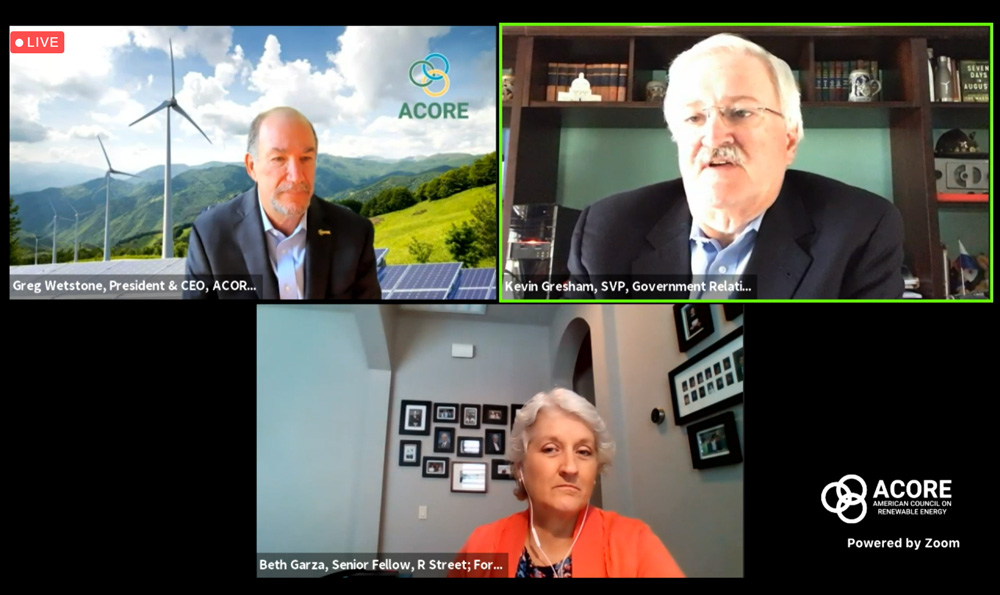
Kevin Gresham and Beth Garza are not overly concerned with ERCOT’s conservation call issued on Monday in the wake of unexpected outages at several thermal generation plants in the state. (See Generation Outages Force ERCOT Conservation Alert.)
Summertime heat and calls for conservation are not unusual in Texas, said Gresham, senior vice president of government affairs at RWE Renewables America and also a member of the ERCOT Board of Directors. Speaking at the American Council on Renewable Energy Finance Forum on Wednesday, Gresham said what makes the current appeal different is that it has come earlier in the season than expected and public concern about any outages is higher following the state’s dayslong blackouts in February.
Another difference: Summertime peaks are more transitory, said Garza, former director of ERCOT’s Independent Market Monitor. “It gets hot in the late afternoon, then builds to a peak, and then the sun will set; it will get cooler,” she said. “Winter is different. It gets cold, stays cold and nighttime gets colder, and you have competition for natural gas.
“It’s time for ERCOT to think about winter differently than summer and its different emergency procedures. You need more notice; you have to take actions earlier in the winter,” said Garza, now a senior fellow at the R Street Institute, a nonprofit policy research organization.
The past and present ERCOT insiders were at the Finance Forum for a frank conversation on the causes and lessons learned from the February outages and whether Texas Senate Bills 2 and 3, signed into law last week by Gov. Greg Abbott, would provide the technical and regulatory fixes needed to prevent future repeats.
Garza quickly nailed down three causes of the February blackouts. First, she said, was the lack of winterization across the power system — not only with transmission and generation facilities, but with homes, transportation and natural gas. Other contributing factors were the “dysfunctional” codependence of the electricity and natural gas industries, and “unbridled” reliance on markets during a clear emergency in which they were ineffective.
Electricity and natural gas “don’t communicate if the two industries work on different time frames, with different expectations, but somehow [they] are dependent on each other,” she said.
Words vs. Electrons
Both Garza and Gresham are taking a wait-and-see approach to the new legislation that came after February’s severe winter weather left hundreds dead and an estimated 4.5 million customers without power across the state. (See Texas Legislators Finish Work on Electricity Market – for Now.)
Gresham noted that SB3 directs the Texas Public Utility Commission to “determine whether or not ERCOT is procuring appropriate ancillary services and allocating them in the right way. So basically, the decision making has shifted venues.”
Stakeholders and advocates, such as ACORE, will “have to have the same level of representation and engagement,” Gresham said.
ACORE took part in industry efforts to oppose provisions in SB3 and other legislation that would have shifted the costs of ancillary services exclusively onto the state’s renewable resources. While the language was removed, the targeting of renewables could now be “moving to the regulatory round with rulemakings,” Gresham said. “There are going to be several that the Public Utility Commission is going to have to take up. The industry and its supporters need to be involved.”
Garza believes the laws will catalyze change, whether good or bad. “It is what it is, and we need to go forward with it,” she said.
At the ACORE Finance Forum on Wednesday (clockwise from upper left), Greg Wetstone, ACORE; Kevin Gresham, RWE; and Beth Garza, R Street Institute. | ACORE
SB3 could improve communication between the electricity and natural gas sectors, she said. The law mandates that critical gas facilities be mapped and registered with utility providers to prevent a repeat of the dayslong outages. It also creates a new statewide emergency alert system and brings together electric and natural gas regulators and market participants in a new energy subcommittee.
While requiring generation and transmission to be weatherized, the law limits natural gas weatherization to facilities that regulators consider “critical,” with penalties capped at $1 million a day.
“Continual service of electricity is a physical phenomenon; legislation is words written on paper,” Garza said. “Writing words is not going to necessarily directly affect the physical phenomenon. It takes time to get rules in place.”
Changes at the ERCOT board and the PUC could add more uncertainty and delay to that process. Following the February outages, seven ERCOT board members and all three PUC commissioners resigned. Abbott has since named two new commissioners.
Going forward, SB2 will slim down the ERCOT board from 16 members to 11 and directs that most of the members be appointed by politicians. Previously, a search committee picked five independent directors (those seats have been eliminated) with market segment members electing their representatives.
Another bill, SB2154, would expand the PUC from three members to five and only require two commissioners to be “well informed and qualified in the field of public utilities and utility regulation.” The bill is still sitting on Abbott’s desk.
Dispatchable vs. Renewable
Considering lessons learned — or perhaps to be learned — ACORE CEO Gregory Wetstone brought up a question discussed at length after the February outages: Should Texas expand its regional connections with other grid operators to allow the state to tap into extra power during emergencies?
Garza said her stock answer to that question is “maybe.”
“We wouldn’t build more capacity just to save ERCOT in the wintertime,” she said. “I think the opportunity to build bigger interregional connections is more fueled on the opportunity to sell our vast renewable resources elsewhere,” such as the West Coast, as neighboring SPP already has plenty of wind.
Wells Fargo’s Jordan Newman (upper left) makes a point during a panel discussion on post-Texas risk management with moderator Chris Gladbach, McDermott Will & Emergy, and Joan Hutchinson, Marathon Capital. | ACORE
Gresham said the current need is to upgrade or build out the grid to relieve congestion caused by the state’s growing population and economy. “We’re not designing the transmission grid for the past 10 years,” he said. “We’re trying to do it for the next 10, 20, 30, 40 years, which is the life of the investment. That’s a totally different way of looking at it.”
Gresham said the February outages also triggered “a debate here in Texas over dispatchable versus renewable generation, as [if] dispatchable was always exactly what it should be: you put fuel in, and you get X amount. That’s not always the case.”
Output can be affected by weather conditions or a plant’s operational issues, he said. “Those are the types of things grid operators deal with every day,” he said. “As we move forward in a policy sense, people need to recognize and understand that.”
Investors not Fazed by ERCOT
A separate panel during the forum agreed that developers will continue to invest in ERCOT, as evidenced by the 30 GW of renewable energy currently on the ground and with more on the way.
“Twenty thousand megawatts of renewables over the last 10 years … I don’t see that slowing down,” said Peter Freed, Facebook energy strategy manager. “ERCOT remains one of the most affordable markets in the country.”
For now, Facebook is focused on the “meat-and-potatoes regulatory work” taking place inside ERCOT and the PUC. The grid operator’s new board must be in place by Sept. 1, but the commission’s charge to ensure ancillary services are appropriately allocated is expected to last into 2022.
“We’re keeping a very close eye on market reforms at Texas to see how the market operates,” Freed said. “Anyone who’s been in the ERCOT market for a long time is comfortable with those high prices in the summer, though not necessarily in June. There are a lot of things that market participants are thinking about coming into summer and the concurrent regulatory process that’s going to be a big part of the next year, at least.”
Legislators and regulators have declined to take action on ERCOT’s $9,000/MWh cap for energy prices, which produced more than $47 billion in market transactions during the winter storm and sent some participants into bankruptcy.
Marathon Capital’s Joan Hutchinson said that the price cap — limited by rule to $2,000/MWh for the rest of the year after February — and the lack of a capacity market produced different results during the winter storm than would have happened in other grid operators.
“The $9,000 cap certainly makes it more impactful, but all these transactions were entered into by willing buyers and willing sellers and financiers. This was not a risk people were unaware of,” Hutchinson said.
“The key was really whether you were producing at the time. If you were selling at $9,000 or whatever your node price was, you were doing great,” Wells Fargo’s Jordan Newman said. “The problem was, so many generators were unable to produce at the time.”
“The price wasn’t volatile if you generated anything,” Hutchinson said, agreeing with Newman.
FERC last week rejected SPP’s proposed tariff revision establishing a cost-allocation waiver process through which remaining costs for one or more specific transmission projects with voltage levels between 100 and 300 kV could be fully regionally allocated on a case-by-case basis (ER21-1676).
SPP’s proposal would have allowed entities to request a waiver of the highway/byway cost-allocation methodology for a byway facility. However, the commission found that the proposal granted the RTO’s Board of Directors too much discretion in allocating costs and did not include clear standards for making decisions.
FERC said that without clear standards limiting the circumstances under which the board will approve waiver requests, “the proposed process creates a risk that the [board] may approve cost allocation waivers where there are limited power flows or benefits to other zones or may reach different cost allocation outcomes on waiver requests that demonstrate similar power flows or benefits to other zones.”
“We find that this lack of clear criteria gives the SPP board too much discretion to make decisions with significant cost and rate implications, without assurance that the cost allocation decisions will result in rates that are just and reasonable and not unduly discriminatory or preferential,” the commission wrote.
Commissioner Mark Christie concurred in a separate statement, saying SPP’s application provided “insufficient detail” with respect to the various roles of stakeholder groups, states and load-serving entities in reviewing the waiver requests.
“Approval of a cost-allocation waiver would result in costs being reallocated to consumers in states and to LSEs that would not otherwise bear those costs under SPP’s existing highway/byway methodology,” Christie wrote.
He said it would be helpful and relevant to know whether the process ensures that states and LSEs with consumers benefiting from the cost allocations would be able to “review and consent/dissent affirmatively to the re-designation and to the new costs that go along with it.”
SPP’s proposal stems from the Holistic Integrated Tariff Team, which recommended evaluation of a narrow process through which specific projects between 100 and 300 kV could be fully allocated regionally. Transmission owners largely opposed the proposal as it wound its way through the stakeholder process, saying it would shift byway cost responsibility from wind-rich areas to others.
Al Tamimi, vice president of transmission planning and policy for Sunflower Electric Power, which is in one of SPP’s wind-rich transmission zones, said he was disappointed with FERC’s decision.
“We have small system loads and, at the same time, have large penetration of renewables exceeding our load. We have been receiving [notifications to construct] while our system load is flat,” he said in an email, saying the NTCs were primarily used for “exporting largely unaffiliated generation from the Sunflower zone to the SPP region.”
“The SPP filing provided an appropriate solution to this inequality problem,” Tamimi said.
Under SPP’s highway/byway methodology, transmission costs are allocated on a voltage threshold basis. Highway facilities, or those above 300 kV, are allocated 100% on regional, postage-stamp basis. Byway facilities, those between 100 and 300 kV, are cost allocated on a regional basis (33%) and to the pricing zone (67%) in which the facilities are located. Facilities at or below 100 kV are fully allocated to the zone in which they are located.
SPP proposed a cost-allocation waiver process for byway facilities in which costs would be allocated 100% to the SPP region if the RTO granted a requested waiver. The grid operator said this would create a narrow review process for entities to demonstrate that certain byway facilities primarily benefit the region instead of a particular zone.
Under the proposed Tariff revisions, entities would request a waiver submit a request for waiver within 180 days after SPP issued the facility’s NTC. RTO staff would evaluate the request and make a recommendation to the Regional State Committee and Markets and Operations Policy Committee. The board would then either approve or deny the request.
Congressional advisers say that legislation that provides stability for federal tax credits is key to unlocking renewable energy growth through 2030.
“It’s our position that tax credits are an essential component of [meeting the President’s climate goals] and that generosity and the long-term nature of the credits are an essential component of that,” Alice Lin, budget and tax policy adviser for the U.S. House Ways and Means Committee, said Tuesday during the American Council on Renewable Energy (ACORE) Finance Forum.
The GREEN Act of 2021 (H.R.848) currently before the Ways and Means Committee provides for five-year extensions of the current investment tax credit (ITC) at the full 30% value and the production tax credit (PTC) at the current phaseout level of 60%. Another bill — the Clean Energy for America Act (CEAA) — before the U.S. Senate Committee on Finance contains a similar goal but approaches it through emissions-based provisions. It allows zero-emission facilities to choose a PTC of 2.5 cents/kWh or ITC at the full 30% value.
“Returning [tax credits] to their full value is a low-hanging-fruit type of approach that we can take to really drive deployment,” Bobby Andres, senior policy adviser for the Senate Finance Committee, said.
“We all agree that the start and stop on clean energy tax credits is not really helping anyone, and it’s making us less competitive, so that’s why we want to create long-term certainty so that energy companies can actually get projects built, which is what the [President’s] plan is about,” Candace Vahlsing, associate director of climate, energy, environment and science at the U.S. Office of Management and Budget, said.
Legislators, however, see tax credit extensions as one tool among many that will be necessary to expand renewables at the requisite pace and scale.
The GREEN Act and CEAA also include a direct pay function designed to overcome market realities, such as the pandemic, that have negatively affected the tax equity market.
“Tax equity is going to be stressed, and one thing that I think is celebrated among all of these proposals is a recognition that a direct payment option is going to be helpful for the people trying to build out the clean energy economy,” ACORE COO Bill Parsons said.
Unlike the current tax equity structure, direct pay allows developers to treat tax credits like a payment on their tax returns, eliminating any connection to tax liability.
CEAA allows taxpayers to receive 100% of the ITC or PTC value as direct payment, while the GREEN Act is currently at 85%.
“As we have come into this political moment … I think we have increasingly found that direct pay is a pivotal piece of the puzzle in order to ensure that as we make investments … we are not constrained by any limits upon the market to ensure that we meet our climate goals,” Lin said.
Storage and Transmission
The GREEN Act and CEAA have a 30% ITC for free-standing energy storage. In addition, the CEAA includes a 30% transmission ITC that is not in the GREEN Act. Another bill, the Electric Power Infrastructure Improvement Act (S.1016/HR2406) also has a 30% transmission ITC for projects above 275 kV and capacity of at least 500 MW.
The tax credit for transmission is relatively new and likely will evolve, according to Andres.
“It is not going to solve all the issues we have with transmission deployment, but it’s something we feel is additive and useful,” he said.
A similar credit could be added to the GREEN Act, Lin said.
“We are looking very closely at the same ways to ensure that [transmission] is targeted, and we are very interested in the potential of helping to unlock the true potential for renewables,” she said.
Clean Energy Standard
The pathway to passage of a clean energy standard is not clear, but work is underway to make it happen.
How tax credits interact with a federal standard is “going to be an important piece of the debate going forward,” Andres said.
The CLEAN Future Act (H.R.1512) would require 100% of U.S. electricity to be zero-emission by 2035.
It passed out of the House Energy and Commerce Committee, but the Senate has a “more complicated dynamic on a clean energy standard,” ACORE CEO Gregory Wetstone said.
There is a growing movement to pass a standard through the budget reconciliation process.
“In the end, it’s going to be up to the parliamentarian to rule on what fits there and up to our allies in the Senate to craft a version of the clean energy standard that is budget-based and can pass that test,” he said. (See 100% Clean Power by 2035 Needs Energy Standard with a Twist.)
The Illinois Senate spent most of Tuesday afternoon this week in a special summer session, much of it in closed-door party caucuses, in an unsuccessful effort to wrangle a new version of comprehensive legislation ending all power plant carbon emissions by 2045 while saving high-paying nuclear jobs with another bailout of Exelon’s nuclear power plants.
Illinois Senate President Don Harmon | Illinois General Assembly
In remarks after the session, Senate President Don Harmon (D) said he thought the Senate would return to the statehouse before August to vote on a compromise bill.
“We came up short today, but we will get it done. We are this close to getting it done, and I know some of the parties will be meeting again as soon as tonight,” Harmon said in a brief news conference.
The deal, broadly outlined in a memo from Gov. J.B. Pritzker on June 10, would have phased out all the state’s coal-burning power plants by 2035 and gas plants by 2045 while providing $694 million in new financial support over five years to Exelon’s Bryon, Dresden and Braidwood nuclear plants.
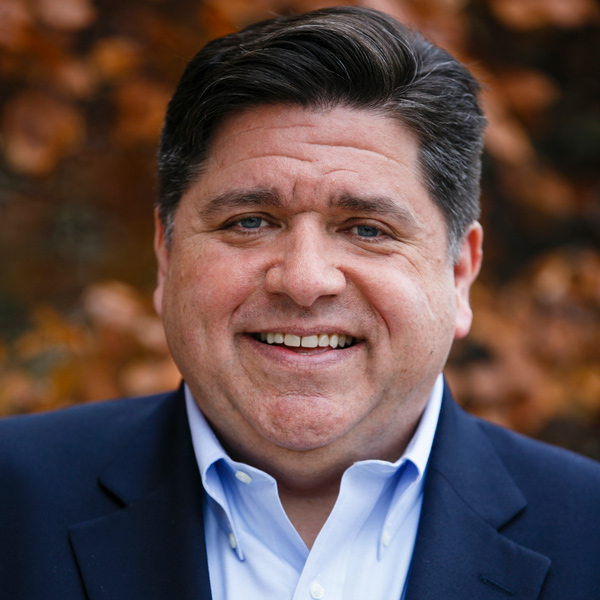
Illinois Gov. J.B. Pritzker | Gov J.B. Pritzker
Subsidizing Exelon — only 11 months after its subsidiary Commonwealth Edison agreed to pay $200 million in federal fines as part of a “deferred prosecution agreement” to resolve charges that it bribed Illinois public officials over several years — was expected to be a political obstacle. Exelon has threatened to close at least two of its nuclear plants immediately without the state subsidy because they cannot compete with fossil plants or renewable generation.
But the sticking point was reportedly a clash between environmental groups pushing for the carbon reductions and organized labor trying to protect jobs at power plants. Both groups are key supporters of Democrats in the state.
The governor’s plan as presented would have forced the early closing of the coal-fired Prairie State power plant, built by nine public power agencies and serving 285 communities across eight states. The municipal systems face long-term debt obligations beyond 2035, the year when all coal-fired plants would be forced to close.
The governor’s memo specifically noted Prairie State would not be spared: “An exemption for the nation’s seventh largest polluter remains unacceptable to the governor, as well as the nearly 50 legislators that have indicated they will not support a bill that does so.”
But Pritzker did propose allocating additional funding for development of carbon capture and sequestration, one way to keep Prairie State operating beyond 2035, assuming the geology in the region would accept the carbon dioxide injections under high pressure.
Following the Senate’s departure without voting, the Illinois Clean Jobs Coalition, a group of about 200 consumer, business, environmental, environmental justice, health care, faith-based and student organizations, issued its reaction.
“On May 31, there was a tentative deal on a comprehensive energy bill, but it was stopped at the last minute. On June 1, Senate President Harmon said he ‘stand[s] with the governor on decarbonization targets that need to be in a final deal,’ but now the Senate is headed home without action on that plan. Thousands of union workers and solar installers may now lose their jobs, while the climate crisis worsens, and Black and Brown communities continue to struggle.”
Hawaiian Electric Company (HECO) is asking Hawaii’s Public Utilities Commission for $25 million to install consumer solar and battery infrastructure to help mitigate the energy shortfalls expected to occur after AES shuts down its coal plant on Oahu next year.
The request comes three months after the PUC launched a proceeding that directed the utility, distributed energy resource providers and Hawaii’s Division of Consumer Advocacy (CA) to develop proposals for an emergency demand response program (EDRP) for Oahu in preparation for the closure of the 203-MW Hawaii Power Plant. (See Discontent Mounts over HECO Coal Plant Closure Plans.)
The PUC last week issued Order 37816, which approved the establishment of an EDRP and longer-term scheduled dispatch program (SDP) for Oahu, authorized to enroll up to 50 MW of resources. The order detailed the recommended proposals without approving any of them, instead directing HECO to use the recommendations to develop an implementation plan.
The order also denied HECO’s request to increase the enrollment capacity of its Fast DR remote dispatch program from 7 MW to 12 MW, noting that the program is under-enrolled with a current capacity of 4. 5MW. The commission said it would revisit expansion once the enrollment reaches 7 MW.
The requested $25 million in HECO’s proposal would be put toward two initial phases of a Bring Your Own Device (BYOD) program, a long-term effort to encourage customers to install DER equipment in their homes that would be available for demand response operations. The program would cover the acquisition of either battery-only (for existing DER customers) or battery-plus-solar systems.
“Participants in the initial Emergency DR (‘EDR’) phase of the long-term BYOD program who are delivering scheduled dispatch would be required to transition to a BYOD long-term solution with remote dispatch capability during the years of 2024-2025,” the order said.
The cost of the program would be recovered through a demand-side management surcharge.
The DER companies suggested three programs: scheduled dispatch (load-shift peak reduction), BYOD Level 1 (load-following peak reduction), and BYOD Level 2 (remote emergency dispatch). They said the scheduled dispatch and BYOD Level 1 plans can be implemented immediately. The companies also recommended a $750/kW upfront customer incentive, saying it “is the amount necessary to motivate a Scheduled Dispatch customer to elect to install a battery and set it to fully dispatch on a daily basis.”
The CA recommended a broader portfolio approach “which includes the consideration of new programs as well as the modification and expansion of existing programs.” It suggested new programs in either an export-only or export and grid services category, which amount to creating payment incentives for time-of-delivery (TOD) and critical peak value (CPV) pricing to reduce peak load.
The CA also recommended a “Scheduled Operation” program that would require DER customers to “charge their batteries daily at the ‘lowest-value’ hours and dispatch their batteries for a two-hour period during the ‘highest-value’ hours determined for each month.” This program would last 10 years and include an upfront enrollment incentive of $554/kW.
A modified Scheduled Operation-plus-CPV program would provide an upfront enrollment incentive of $372/kW plus the suggested CPV incentive rate of $291/kW for a total of $663/kW.
The PUC ordered HECO to use the recommendations to file an SDP Implementation Plan by June 18, to be reviewed for a launch date of July 1. It also ordered the utility to “commence replacement activities as soon as possible” to increase Fast DR capacity to 7MW.
A bill that would expand access to community distributed solar generation in New York awaits Gov. Andrew Cuomo’s signature.
The New York State Assembly passed the Community Solar for Disadvantaged Communities Act (A.3805-A/S.3521-A) 112-36 last week after Senate passage (46-16) in April.
“Community solar has emerged as a key avenue for New Yorkers to subscribe to cleaner and cheaper electricity generation, but until now downstate customers were barred from connecting to upstate solar projects by a regulation that prevented the transfer of bill credits across utility territories,” Shyam Mehta, executive director of New York Solar Energy Industries Association (NYSEIA), said in a statement.
The association says that without a policy change, community solar projects in New York City will fall short of the scale needed to serve a significant portion of the region’s residents.
Urban area siting constraints, combined with a requirement that customers and projects be in the same utility territory, have limited the benefits of community solar for city residents, according to a NYSEIA report released in April.
Further complicating the state’s community solar market is an inversion in the rate of projects to major population centers.
Upstate and western New York have 92% of the operating and pipeline project capacity and 42% of the population, according to the report. New York City and Westchester County just north of the city have 8% of the operating and pipeline capacity and 57% of the population. The average project capacity in the city also is much smaller than other areas of the state, the report said.
The bill would address those market issues by authorizing development of a tariff that allows bill credits associated with a community solar project in one utility’s territory to transfer to participating subscribers in another territory. It would also encourage community solar project development within New York City and authorize regulators to review compensation mechanisms for those projects to ensure the market reaches its potential.
Another goal of the bill is to ensure the benefits of community solar are directed to low-income communities in support of the environmental justice requirements of the Climate Leadership and Community Protection Act.
New York City, according to the report, has 55% of the state’s very low-income households, and they are not accessing community solar benefits at an equitable rate.
The bill would direct community solar project developers to designate which of their facilities are participating under the community solar tariff and provide 35% of the benefits from participating facilities to disadvantaged communities.
“For years, community solar has been unable to reach its full potential in New York because customers were unable to subscribe to projects outside of their utility territory,” David Gahl, senior director of state policy for the east at the Solar Energy Industries Association, said in a statement. “These rules unfairly affected New Yorkers living in heavily populated areas who arguably stand to gain the most from low-cost community solar.”
Utilities would have 90 days to develop a model tariff for cross-utility crediting after the act’s effective date. Following a public comment period, regulators would have nine months to approve final utility tariffs.