Small Reactors Can Compete on Cost, PNNL Study Finds

Small modular reactors appear to be cost-competitive compared to other energy sources in the Pacific Northwest, according to a recent national laboratory study.

In May, the Pacific Northwest National Laboratory and the Massachusetts Institute of Technology unveiled a joint study on the economics of two types of small modular reactors in scenarios in which they’re installed at three locations in Washington state. PNNL is in Richland, Wash.

“The feasibility study indicated that in a future carbon-free electricity sector, deployment of advanced SMRs would be competitive if the projected LCOEs [levelized cost of energy] for these designs can be attained,” the PNNL-MIT study found.

Small modular reactors are prefabricated facilities with parts manufactured in one location then transported to the reactor site for final assembly. A modular segment would consist of a mini reactor of 50 to 300 MW. The design allows for extra modules to be added as needed.

So far, only one design, by Portland, Ore.-based NuScale, has been approved by the U.S. Nuclear Regulatory Commission. (See NRC OKs NuScale’s Small Modular Reactor Design.) Grant County Public Utility District in Washington last month signed an agreement to explore use of NuScale’s reactors in a project. (See Wash. PUD, NuScale Sign MOU to Explore Use of Small Reactors.)

Meanwhile, GE Hitachi of Wilmington, N.C., is working on its own design — the BWRX-300. The primary difference between the two designs is that NuScale’s involves connecting small reactor modules in a series, while GEH’s design is a single 300-MW reactor.

The study looked at two adjacent partially built reactor sites at the Hanford nuclear reservation, both near Richland and next to Energy Northwest’s 1,200-MW Columbia Generating Station reactor. It also examined two adjacent Energy Northwest reactor sites at Satsop, Wash., where construction never seriously began. And the study checked out the Centralia, Wash., site of a TransAlta coal-fired power plant due to shut down in 2025.

The PNNL-MIT study targeted sites with infrastructure that would be compatible with nuclear reactors and have easy access to transmission lines, said Ali Zbib, PNNL’s manager for nuclear power systems. Zbib tackles nuclear economic and technological matters for the laboratory.

The study was prompted by the 2019 Washington Clean Energy Transformation Act, which set a target that all the state’s electricity would come from carbon-free sources by 2045.

“Climate change is an existential threat. This is the time to tackle it because time is running out,” Zbib said. “To do that successfully, we need to use every tool available. … We envision nuclear power to be competitive and to be an integral part of [Washington’s] climate change portfolio.”

The PNNL-MIT study looked at small modular reactors’ technology and potential market in the Northwest in relation to a regional power grid that is increasingly using solar and wind power, Zbib said.

“Nuclear energy is not there to replace the other non-emitting resources. It’s there to complement other non-emitting resources,” Zbib said.

He also noted that small modular reactors are a potential alternative to full-size reactors, such as those running behind schedule and over budget during construction at Georgia’s Vogtle plant, where the first of two new reactors is scheduled to go online in 2022, six years later than expected. Project costs have soared to $26 billion from the original budget of $26 million.

Cost Comparisons

Zbib cautioned that the study has reached a variety of apples-to-oranges comparisons because NuScale’s reactor design is essentially complete, while GEH’s design is in flux. Also, wind and solar power have a range of subsidies differing from area to area to affect the cost estimates of individual projects.

With those caveats, the study estimated that the LCOE for the current NuScale design is $51-$54/MWh, while that for the GEH BWRX-300 design is $44-$51/MWh, although that estimate is less solid.

In comparison, Columbia Generating Station produced power for $35.60/MWh in 2018 and $47.60/MWh in 2019, with fluctuations attributable to refueling outages and other activities. The report notes the plant is projected to have an LCOE between $47/MWh and $52/MWh over 2014-2043.

The study found that, with an LCOE between $35 and $45/MWh, geothermal is the only firm generating resource that can produce emissions-free energy more cheaply than the small reactors. However, geothermal sources are rare in the Northwest, while being more prevalent in the Southwest.

LCOE’s for the Northwest’s non-firm resources include about $40/MWh for hydroelectric, $39 to $55 for Columbia Basin wind (depending on capacity factors) and $30.40 for solar power (with some variation based on subsidies).

The report’s authors also speculate that small reactors might earn a price premium in the market because they would offer power for firm delivery.

The study did not address the reactor design for Bellevue, Wash.-based TerraPower. While the company had considered locating a reactor on Energy Northwest land on the Hanford Nuclear Reservation, it recently announced it has selected a Wyoming site instead. (See Wyoming Welcomes DOE-funded Advanced Nuclear Plant.)
North Carolina Panel Calls for Joining RGGI

North Carolina should join the Regional Greenhouse Gas Initiative (RGGI) the Air Quality Committee of the North Carolina Environmental Management Commission recommended Tuesday in a 4-1 vote. The recommendation will be passed on to the full commission for discussion at its July 13 meeting, but the Republican-controlled state legislature could seek to block the move, as GOP lawmakers have done in Pennsylvania.

The vote is an endorsement of a petition for rulemaking filed by the Southern Environmental Law Center on behalf of Clean Air Carolina and the North Carolina Coastal Federation. Joining RGGI’s carbon trading program would mean establishing a declining cap on CO2 emissions from the electric power industry.

“The threat of climate change to North Carolina is real,” Derb Carter, director of the Southern Environmental Law Center’s North Carolina offices, told the committee. He cited rising sea levels that threaten coastal areas and the increase of extreme weather, hurricanes and flooding events affecting the Tar Heel State. “We need to reach carbon neutrality by 2050,” he said.

While there was no dissent at the meeting regarding the goal of reducing carbon emissions, the petition did meet vocal skepticism from committee member Charlie Carter, as well as from an attorney who spoke on behalf of Charlotte Pipe & Foundry, a manufacturer of cast iron and plastic pipe and fittings. The latter said it would be “ill advised” for the state to join RGGI, arguing that it is not clear that the states that have joined it have reduced their carbon dioxide emissions as a result — and that if a reduction has occurred, it can’t be shown to be the result of RGGI policies. She also said the proposal could cost North Carolina ratepayers and taxpayers millions and that it is “inappropriate and potentially unlawful” for the state to join RGGI through an administrative rulemaking procedure instead of allowing the state legislature to weigh in. Charlie Carter agreed with the latter point.

But for Derb Carter, the goal is to get North Carolina to meet an electric power emission target of 23.8 million metric tons (MMT) of carbon dioxide by 2030, which would be a reduction of 70% from the 2005 level of 79.4 MMT. In 2019, before the COVID-19 pandemic lockdowns resulted in unexpected cuts in carbon pollution. The North Carolina electric power sector produced 48.4 MMT, according to a chart he displayed.

Derb Carter cited North Carolina Gov. Roy Cooper’s (D) 2018 executive order, which set a goal of reducing statewide greenhouse gas emissions to 40% below 2005 levels by 2025.

He also drew on a recent report by Duke University’s Nicholas Institute for Environmental Policy Solutions and the University of North Carolina’s Center for Climate, Energy, Environment and Economics, which argues that “RGGI policies drive some of the deepest in-state reductions by 2030, with RGGI providing the quickest reductions prior to 2030.” Additionally, the costs of RGGI, either as a change in net present value or costs per ton, “are among the lowest of the options,” according to the report.

Also speaking on behalf of the petition, Nick Jimenez, a staff attorney with the Southern Environmental Law Center, said it would reduce carbon dioxide emissions by about 10 MMT, or 28%, in the first year it would be in effect, followed by a gradual decline thereafter. He said the reduction in fossil fuel generation would also cut sulfur dioxide and nitrous oxide emissions, while residential electric bills would only go up $2 per month, an amount that could be offset by assistance programs.

The proposed North Carolina rule is mainly based on the RGGI rule, Jimenez said, but there are some differences. For example, biomass is not treated as carbon-neutral, and there is no exemption for industrial emitters.

Should the state proceed, Jimenez estimated the earliest date RGGI could go into effect would be Jan. 1, 2023.

RGGI’s current members are the six New England states, New York, New Jersey, Maryland and Virginia.  New Jersey and Virginia joined following legislation approved after Democrats won control of their statehouses.

North Carolina would be attempting to join through executive branch regulations, as Pennsylvania Gov. Tom Wolf (D) is trying to accomplish. On Monday, the Pennsylvania Senate approved — by a veto-proof majority SB119 — a bill that would stop Wolf’s rulemaking.

ClearView Energy Partners said in a note to clients Tuesday that the bill is unlikely to pass the Pennsylvania House with a veto-proof majority, but that the 2022 gubernatorial election and potential litigation are “material risks to the longevity of such a regulatory effort.” Wolf is term limited.

ClearView said it expects North Carolina’s Republican legislature to take similar action to block a RGGI rulemaking.

Tx, Environmental Justice Front and Center at EBA Northeast

Former FERC Chair Jon Wellinghoff last week said that four elements must be in place for the Biden administration to reach its stated goal of decarbonizing the electric grid by 2035.

The list includes more RTOs (including in the Southeast and West), integration of transmission planning with the interconnection queue, national transmission planning — and an entity to oversee that planning.

Speaking at the annual meeting of the Energy Bar Association’s Northeast Chapter, Wellinghoff joined state officials from Connecticut, Massachusetts, New Jersey and New York to discuss present and future transmission planning needs to reach a carbon-free electric grid.

Abe Silverman, general counsel for the New Jersey Board of Public Utilities, said that “we need to take transmission planning seriously like we intend to meet our clean energy targets.”

“New Jersey is just one state,” Silverman said. “We’re relatively small, we have very robust clean energy ambitions, but we shouldn’t have to be the ones spearheading what really is a national priority.”

Katie Dykes, commissioner of Connecticut’s Department of Energy and Environmental Protection, said that transmission is an essential and urgent topic. To reach decarbonization goals, she said it is vital to evaluate transmission as a resource to ensure the best use of existing assets while making needed transmission upgrades for offshore and onshore wind located far from load centers in New England. Dykes added that the grid’s topology requires reconfiguration to achieve full integration of distributed and behind-the-meter energy resources.

Judy Chang, undersecretary of energy in the Massachusetts Executive Office of Energy and Environmental Affairs, said there has been “a lot” of transmission investment in New England, “yet we don’t have a system that can absorb and integrate the clean energy resources that we need going forward.” Chang said the Biden administration’s goal of 30 GW of offshore wind means that “we can’t afford to develop this grid onshore and offshore in a piecemeal way.”

Energy for Environmental Justice

With the transition to cleaner resources, environmental justice has become an increasingly important subject in the energy industry. Crystal Pruitt, deputy director of the Office of Clean Energy Equity for the New Jersey Board of Public Utilities, created her office from scratch in the summer of 2020.

“I have a large task — so does my staff — integrating equity issues into energy issues because it’s not something that’s normally thought of hand-in-hand,” Pruitt said.

Pruitt said that in the process of discussing the policy implications of New Jersey’s 100% clean energy by 2050 target set by the Murphy administration, it became apparent the state could not ignore certain energy equity and environmental justice components.

“If any plans to have 100% clean energy were to be successful, discussions could not overlook the fact that there are communities, specifically Black and Brown communities, that have not been able to participate in the same clean energy programs or energy efficiency programs as their white neighbors,” Pruitt said.

Pruitt said equity is “not necessarily parity,” but about engaging communities historically kept out of the conversation, including people of color, low-income earners and non-English speakers.

“These people have not been left behind by accident,” Pruitt said.

Charles Lee, senior policy adviser for environmental justice at the Environmental Protection Agency, said he has been working on environmental justice issues since the 1980s, so “these are not new issues” and action is “long overdue.”

“We need to address the kind of systemic barriers to achieving truly healthy and sustainable communities,” Lee said.

Clements’ Keynote

In an opening keynote speech, FERC Commissioner Allison Clements referenced a Princeton University study that said reaching net-zero emissions by 2050 will require high-voltage transmission capacity to expand 60% by 2030 and triple through 2050 to connect wind and solar facilities with demand. The total capital investment necessary, according to the study, is $360 billion through 2030 and $2.4 trillion by midcentury.

Clements concedes that transmission upgrades are “wildly expensive,” but that FERC should not “stick our heads in the sand.”

“There’s going to be a sea of change in the amount of transmission that is going to be coming through, and we have to figure out how to best protect customers,” Clements said. “That requires a forward-looking approach to planning and review.”

Clements said that FERC Chair Richard Glick supports having states seated at the transmission planning table but added that “massive interregional transmission lines” require a whole-of-government approach, not just the commission’s efforts to “improve, reform and encourage” the planning process and cooperation. For example, while Clements thinks OSW development in Massachusetts and New York is “exciting,” she worries “a little bit” about the speed of interconnection.

“We will reach a point at which there’s a lot of investment required. We’ll get over some number of megawatts where we’ll run out of headroom on the onshore side, and we’ll have to figure how to support continuing [OSW] development,” Clements said.

Granholm Pitches DOE Budget to Senate Energy Committee

A strong federal commitment to nuclear energy, carbon capture, hydrogen and critical mineral extraction could provide a foundation for bipartisan support for President Biden’s $2 trillion infrastructure package — at least for Democrats and Republicans on the Senate Energy and Natural Resources Committee.

Those technologies were a key focus of the committee’s Tuesday hearing on the Department of Energy’s 2022 budget, with Secretary Jennifer Granholm promoting the American Jobs Plan as the vehicle for developing new and advanced carbon-free technologies to create jobs and drive U.S. leadership in global markets.

Granholm highlighted a new $12 million funding initiative for direct air capture technologies, rolled out on Tuesday; DOE’s recently announced Hydrogen Shot, aimed at cutting the cost of clean hydrogen to $1/kg over the next decade; and the $1.8 billion budgeted for nuclear energy programs.

However, she said, such spending represents only “a down payment on a cleaner, more prosperous future [that] truly would not be fulfilled without the American Jobs Plan, which would not only position the country to compete in the global clean energy market and confront the climate crisis, but would allow us to lift up our disadvantaged communities, tribal nations and other communities of color that have been historically burdened by pollution.”

Appearing before the full committee at a live hearing, Granholm dialed down her normal ebullience as she faced tough questions from both sides of the aisle and looked for potential points of agreement. The hearing is the third Granholm has faced on DOE’s 2022 budget thus far; a fourth is scheduled for June 23 before the Senate Appropriations Committee.

Congress has once again missed its nonbinding April 15 deadline for passing the next fiscal year’s budget, and hearings on departmental budgets are ongoing across different congressional committees.

The DOE budget numbers did not all add up for committee Chair Joe Manchin (D-W.Va.), whose vote will be critical for the passage of any infrastructure package in the Senate. While pleased with the budget’s increased funding for the department’s Office of Fossil Energy, Manchin queried Granholm on why the department has set 2022 spending for carbon-capture technology at only $890 million, when the bipartisan Energy Act of 2020 had authorized up to $1 billion.

Noting that the global fleet of coal-fired plants continues to grow in China and across developing economies, Manchin said, “It’s clear as day to me we need to remain focused on getting the cost of [carbon capture and sequestration] technologies down to be able to deploy them on a wide scale around the world because fossil is not going away, as much as some people would like that.”

While not commenting directly on the funding cut, Granholm said that DOE’s Office of Clean Coal and Carbon Management had seen a 19% increase in funding from the previous year, while nuclear was up 23%. “We are completely committed to these,” she said. “We just want to make sure we are prioritizing these within the context of the overall number in the budget.”

Ranking Member John Barrasso (R-Wyo.) took the hardest line against the Biden agenda, decrying an increase in gas prices and growing strains on the grid as “wind and solar energy displace reliable coal and nuclear power. Where we once worried about OPEC control over energy supplies, we’re now witnessing China and Russia dominate critical supply chains, and at the rate we’re going, America may soon face an energy crisis like we did in the ’70s,” Barrasso said.

He also pushed Granholm on Biden’s hold on new oil and gas leasing on federal lands, which she answered by noting “current lease holders are able to continue to operate under their current leases while the administration evaluates what it is going to do going forward. But I will say that the entire world is moving toward trying to find solutions to make sure that we have reliable power, whether it’s fuel for transportation or fuel for buildings and the built environment,” Granholm said. “That’s the kind of technologies that the Department of Energy is really interested in.”

Critical Minerals

Republicans and Democrats from Western states shared a common concern about building out a U.S. supply chain for critical minerals needed for clean energy technologies.

“The U.S. is far too reliant on foreign countries like China for the minerals and raw materials used for energy, defense, health care and more,” Sen. Steve Daines (R-Mont.) said. “They could become truly a single point of failure in the supply chain for the United States and the world if we don’t start creating domestic production.”

“Before we can recycle [materials], we have to cycle [them] in the first place, so we’ve got to get those minerals from somewhere,” Sen. Lisa Murkowski (R-Alaska) said, pitching her state’s “great mining opportunities” and the ability to co-locate mining and processing facilities.

Sen. Catherine Cortez Masto (D-Nev.) also said the U.S. should be looking at critical mineral extraction for domestic supply chains, while also “recognizing there is a way to still protect the environment and bring all the stakeholders in, in a collaborative nature so everybody is working on the same page.”

Granholm agreed across the board. Responding to Daines, she held up a copy of the DOE’s National Blueprint for Lithium Batteries, released earlier this month, which includes a call for mining lithium and other critical minerals in the U.S. (See DOE Wants US Lithium Battery Supply Chain in Place by 2030.)

Calling for a “philosophical conversation,” Sen. James Lankford (R-Okla.) suggested that the energy transition underway from fossil fuels to renewables and electrification is too abrupt, arguing for a more gradual transition with natural gas and hybrid vehicles as bridge technologies.

“The technologies that will help us to transition are really supported by this administration,” Granholm said. “What we want to do is assist natural gas, for example, in removing greenhouse gas emissions, whether it’s carbon dioxide or methane. We want to assist the baseload fuel power sector to remove those [emissions] so that they can still function in a zero-carbon environment.”

Whatever their common interests, Democrats and Republicans have yet to hammer out the bipartisan compromise on infrastructure, which Biden had hoped for. The president broke off talks with GOP lawmakers earlier this month but continues to explore avenues for passage of his plan, possibly by the budget reconciliation process that would circumvent strong Republican opposition in the Senate.

SERC Warns of Ever-evolving Insider Threat Landscape

At SERC’s “The Scoop on Insider Threats” webinar Tuesday, experts warned that employees at all kinds of businesses are more tempted than ever to use confidential information to benefit themselves or others — and organizations that seek to play a leading role in their fields must grapple with this danger eventually.

“Willie Sutton, a very famous bank robber … when asked why he robbed banks, said, ‘Because that’s where the money is,’” FBI Special Agent Greg Klein said. “Criminals go to where whatever they want is … and we have to understand now [that] people and systems are banks … of information, banks of things that other countries, especially, want. That’s a good thing: If you’re pushing the ball forward … on green energy [or] things like that, that’s great, you have something to give. If you don’t have those things, you won’t exist very long.”

States Sponsoring Industrial Spies

Insider threats are nothing new for statecraft. Nations have always tried to convince their rivals’ citizens to switch sides. Klein noted that Benjamin Church, the director of the medical service of the Continental Army, arguably qualifies as the “first American insider threat” for selling secrets to the British in February 1775 to pay off his gambling debts.

Greg-Klein-(SERC)-Content.jpg
Greg Klein, FBI | SERC

Industrial espionage likewise goes back a long way: the U.S. textile industry was jumpstarted by American manufacturers stealing weaving technology from their British counterparts in the 1700s.

What characterizes the modern era is a combination of the two, with nation-states sponsoring theft of trade secrets from overseas companies to help domestic enterprises catch up. China is frequently accused of this practice, and Klein noted the case of Xiaoqing Zheng as an example. The former engineer at General Electric, who was arrested in August 2018 for copying information from his employees’ computers onto a USB drive, told FBI agents that he was encouraged to steal the data and taught how to encrypt the files by agents from the Chinese intelligence service.

“What we have now, especially with China, is an economic war — we call it an asymmetric threat,” Klein said. “Everyone now can be a gatherer of information, and we’re looking especially in [the] tech fields, [the] energy fields — you name it, anything that’s going to give [China] an economic advantage, that’s what they’re after.”

Damage Not Always Done Intentionally

Making the threat mitigation job more challenging is the fact that employees can easily distribute confidential information without any malicious intent, or even the awareness that they are doing so. Klein identified several categories into which the FBI groups insider incidents, ranging from “stupid” — which includes mishandling sensitive data, oversharing on social media and networking sites, and speaking too freely to friends in the media — to “sinister,” which could mean actively seeking information to share with rivals or even seeking to sabotage the organization.

Samantha-Lee-Conroy-(SERC)-Content.jpg
Samantha Lee-Conroy, E-ISAC | SERC

In addition to stealing information, employees may also cause physical danger to their companies or colleagues either willfully or through carelessness. Samantha Lee-Conroy, a physical security analyst at the Electricity Information Sharing and Analysis Center (E-ISAC), recounted several incidents involving E-ISAC members that felt endangered. In one case, a former employee called in a bomb threat against the supervisor that fired them; in another, a contractor “made a threat to kill” two employees with whom they were on a conference call.

Other events involved no immediate physical threats but could have potentially put the company or staff at risk, such as when a worker’s housekeeper stole a set of keys that included keys to critical facilities, or when a terminated employee pawned clothing with the company’s logo instead of returning it. Lee-Conroy called these incidents reminders “that employees may be exposed to risks unrelated to the job, which then may become security issues later.”

Warning Signs of Potential Issues

Guarding against insider threats can be a delicate balancing act because the employees most able to hurt an organization are, by definition, those to whom a great deal of power has already been given and who are typically considered among the most trustworthy staff members. Accusing such employees of conspiring to harm the business, or even implying that they could do so through overly harsh security measures, could actually backfire by alienating them.

Nevertheless, Klein noted a number of warning signs that could indicate an employee is preparing to betray his company and should spark a reaction from management:

  • moving high volumes of data, either by printing, by USB drive, or by sending to a personal email address;
  • significant foreign travel or contacts, especially speaking engagements not coordinated through the company;
  • knowledge of potential layoff or termination; or
  • sudden resignation, particularly if it follows a trip overseas.

Lee-Conroy added that “the industry has a lot of different factors to consider when assessing industry threats” and suggested that utilities should think about the information that their employees have, how it could harm the company if exposed, and how to mitigate that damage if it occurs. In other words, they should assume the data will get out and plan accordingly, rather than trying to assess which individuals are most likely to cause a leak.

She also urged utilities to reach out to the E-ISAC on a white paper the organization is working on, with input from utilities and government, that will outline best practices for organizations seeking to build their own insider threat programs. The target audience is small and medium-sized utilities that “may not have access to resources or industry-specific examples” of effective approaches.

Mitsubishi Exec Sees Cheap Green Hydrogen Within a Decade

Green hydrogen produced with renewable power will be cheaper than blue hydrogen produced from methane with carbon capture within a decade, Paul Browning, CEO of Mitsubishi Power Americas predicted Tuesday.

“Right now green hydrogen is more expensive than blue hydrogen, but we and many others believe the cost of green hydrogen is going to come down rapidly in the next seven years or so and actually be below the price of blue hydrogen,” Browning told the H2Power conference, sponsored by the Smart Electric Power Alliance (SEPA) and the Electric Power Research Institute (EPRI). “… We plan to get there this decade. It’s not the distant future.”

The current cost of blue hydrogen is about $1.50/kg.

Mitsubishi, known for its gas turbines, is betting its future on hydrogen, Browning said, because there’s no way to get to net zero greenhouse gas emissions by 2050 without it.

Paul-Browning-(SEPA-EPRI)-Content.jpg
Mitsubishi Power Americas CEO Paul Browning | SEPA/EPRI

“Right now with the technologies that we see in front of us, we don’t see a way to get to net zero without hydrogen. We don’t know what new technologies are coming down the pike, and so there’s always the chance that some new long-duration energy storage technology or some new low-carbon fuel technology will come in that will supplant the need for either green or blue hydrogen going forward,” he said, during a panel discussion moderated by SEPA CEO Julia Hamm.

The year 2050 “is a long time from now,” he said. “But if you believe we’re headed to net zero in 2050, then you really have to believe in hydrogen. So, we’re all in. We’re planning on building the underground infrastructure — both salt dome storage and hydrogen pipelines — to … bring green and blue hydrogen to our customers throughout North America.”

Earlier this month the Department of Energy announced its first “Earthshot” project, which seeks to reduce the cost of green hydrogen by 80% to $1/kg by 2030. (See Granholm Announces R&D into Green Hydrogen as 1st ‘Energy Earthshot.’)

Eric-Miller-(SEPA-EPRI)-Content.jpg
Eric Miller, Department of Energy | SEPA/EPRI

Eric Miller, senior adviser at DOE’s Hydrogen and Fuel Cell Technologies Office, cited studies showing hydrogen could help reduce GHG emissions by up to 25% when used in heavy-duty transportation and industrial applications such as steel and chemical production.

“If you look at ammonia alone in the chemical sector, it accounts for up to 5% of the CO2 emissions globally. By transitioning to a clean hydrogen alternative, we can cut that by 90%.” Steel emissions could be cut by 30-40%, he said.

Joe Hoagland, vice president of innovation and research for the Tennessee Valley Authority, agreed that hydrogen will be part of the net zero solution. “But I don’t think it’s the only solution. I think at the end of the day it’s going to be all of the above. You’re going to need things like new nuclear [and] solar to produce green hydrogen,” he said. “I think by 2050 we can get there, but we’re going to have to use everything we’ve got and everything we’ve got has got to get to scale.”

Daniel-Brooks-(SEPA-EPRI)-Content.jpg""
Daniel Brooks, Electric Power Research Institute | SEPA/EPRI

Daniel Brooks, vice president of integrated grid and energy systems for EPRI, said hydrogen could be a boon for utilities by providing large-scale storage to aid grid reliability and absorb excess renewables while also providing a new source of electric demand.

Hoagland said that prospect is exciting. “Hydrogen production allows us the ability to better utilize all the other resources we’ve got on the system, which will help to reduce their carbon footprint, increase their efficiency, and reduce the cost.

“At the same time, it gives us the opportunity to sell something. We can either use hydrogen ourselves directly or we can put hydrogen out into the transportation system or other parts of the economy,” he added. “I will say it’s a bit of a challenge for a utility. Generally we like to make electricity. So, this is going to require some rethinking.”

Mitsubishi is building an 840-MW project with Intermountain Power that will initially burn 30% green hydrogen and 70% natural gas, transitioning to 100% green hydrogen over time.

Joe-Hoagland-(SEPA-EPRI)-Content.jpg
Joe Hoagland, Tennessee Valley Authority | SEPA/EPRI

It also signed a 10-year joint development agreement with Entergy with two projects planned: a 22-MW electrolysis demonstration project at an Entergy plant using Mitsubishi gas turbines and a 1.2 GW storage project in Texas.

“Entergy has the good fortune of sitting on top of the world’s largest existing infrastructure of hydrogen because hydrogen is used at the Gulf Coast to desulphurize motor fuels. They’re sitting on top of two existing hydrogen salt domes …  and 1,100 miles of existing pipelines.”

In North Dakota, Browning said, the company will build the world’s largest blue hydrogen hub. “And we think we’re going to be able to create blue hydrogen for less than $1/kg.”

It is also working on a project with a goal of delivering green hydrogen to the Los Angeles basin at $1.50/kg “with the idea of decarbonizing the city of Los Angeles.”

Neha-Rustagi-(SEPA-EPRI)-Content.jpg
Neha Rustagi, Department of Energy | SEPA/EPRI

Neha Rustagi, a DOE technology manager, said a high capacity factor “is one of the most crucial things to achieving low-cost hydrogen. So, scenarios where you do have abundant solar and wind are where I think optimal deployment” would occur.

Because of the predictions of reduced-cost green hydrogen, Browning said, some of his customers are asking whether they want to invest in blue hydrogen or leapfrog it for green.

“If you start today talking about putting one of these projects in the ground, you’re probably talking about a 2025-2026 COD [commercial operation date]. So, if it takes us seven years to get to cost parity between green and blue … then in COD space we’re already there,” he said. “On the other hand, if you’re in North Dakota and you’ve got a lot of natural gas available and you don’t have a huge amount of renewables on your grid and you don’t think you’re going to need long duration storage for a little while, maybe in North Dakota you start blue and you stay blue.”

Utilities Looking to FERC for GETs Incentives

Utility representatives at the American Clean Power Association’s virtual CLEANPOWER 2021 Conference & Exhibition last week agreed that so-called grid-enhancing technologies (GETs) would help facilitate increased interconnection and transmission of renewable power.

But they admitted that without any financial incentives, either from FERC or by congressional mandate, their companies were unlikely to make the huge investments needed to deploy the devices, which include dynamic line ratings (DLRs), advanced power control and ambient-adjusted ratings (AARs).

GETs provide a quicker, cheaper alternative to building more transmission lines. The technologies monitor the conditions of a line — which can include temperature, wind speed and precipitation, depending on the device — and adjust its rating accordingly, allowing for more electricity to flow more often than if its rating remained constant.

“We’re looking at the fact that the states that National Grid is operating in in the Northeast U.S. have very ambitious decarbonization targets,” Terron Hill, the company’s director of transmission network strategy, said during a conference panel Wednesday. “And at the end of the day, we can’t build the transmission fast enough. So [GETs are] all about how we capture that benefit or capacity that already exists in our system that we can utilize to get renewables onto the grid faster.”

The panel opened with a presentation by Jay Caspary — former head of transmission development at SPP, now vice president at consultancy Grid Strategies — on a report released in February by the WATT Coalition titled “Unlocking the Queue.” The report found that GETs could double the amount of renewable generation in SPP’s queue that interconnects by 2025 by alleviating transmission constraints in Kansas and Oklahoma. (See Report: US Needs Grid-enhancing Technologies Now.)

“GETs focus on operational improvements and can be implemented quicker and at a lower cost than traditional transmission technologies,” according to the report.

But “most utilities are a little bit risk-averse and a little bit change-averse,” Smart Wires’ Mark Freyman said. “It’s difficult to get them to try something new.”

Hill agreed. Deploying GETs by themselves may be quicker and cheaper than building transmission, but National Grid has been building transmission since its founding, he said. The devices still require utilities to update their operational and planning models and train their workforce in a new set of skills.

Amanda King, director of strategic transmission planning at Xcel Energy, echoed that sentiment. Training transmission operators “isn’t a minimal thing. We can say, ‘yes, we’re going ahead with these technologies’ … but to be realistic, the transmission planning models currently aren’t built for dynamic line ratings, for example, and the operators aren’t trained to operate that in real-time, on the fly. … Those are non-trivial items that take a while.”

So “we need FERC to give us the right incentives to” deploy GETs, Hill said, “because now you’re asking us to take on a whole bunch more risks. Because if something goes wrong, it’s the utility that has a violation. … I’m not saying that we shouldn’t do it, but we need to have the right incentives in order to give us that motivation.”

New FERC Initiative Incoming?

Elizabeth Salerno, economic adviser to FERC Chairman Richard Glick, pointed to the commission’s proposal to require all transmission providers to implement seasonal and ambient-adjusted ratings on their lines. (See FERC Proposes Requiring Variable Tx Line Ratings.)

She also noted that FERC is investigating what barriers exist to implementing GETs and how to properly incent their deployment. A workshop on performance-based ratemaking is scheduled for September, which is part of a docket that saw FERC propose to decrease its RTO participation adder. (See related story, TOs Won’t Give up RTO Adder Without a Fight.)

“We recognize it takes a long time for transmission to be built,” Glick told ACP CEO Heather Zichal on Thursday. “Even if we had the greatest planning processes, even if we had the best cost allocation approach and even if we had a much better approach to siting at the state level, it’s still going take a number of years before this new transmission is built, so we need to figure out a way to better use our existing transmission capacity.”

Still, getting more transmission built remains his highest priority. “If we’re going to meet the very ambitious targets set both by the Biden administration and a number of states in terms of reducing greenhouse gas emissions, we’re only going to do so if we massively build out electric transmission capacity,” he said.

FERC’s agenda for its upcoming open meeting, released Thursday, lists two new dockets: “Joint Federal-State Task Force on Electric Transmission” (AD21-15) and “State Voluntary Agreements to Plan and Pay for Transmission Facilities” (PL21-5).

With the first, “FERC appears poised to announce a new initiative to work formally with states to address potential challenges to transmission projects,” according to ClearView Energy Partners. The second policy statement docket “appears to be a step toward the commission formalizing new options for planning transmission cost allocation for offshore wind. However, we think it will be broader than offshore wind, as best-practices and a framework for resolving stakeholder concerns regarding multistate regional projects could be useful as more states pursue decarbonization strategies with prescriptive programs that drive certain types of clean generating resources.”

TOs Won’t Give up RTO Adder Without a Fight

Utilities that hoped to cash in on the Biden administration’s infrastructure plan and clean energy goals are now fighting a rearguard action to defeat FERC’s proposal to eliminate the transmission rate adder for remaining in RTOs.

Decarbonization of transportation and buildings is expected to greatly increase electric demand and integrating renewables will require much more transmission — potential boons to utilities that have seen little load growth for more than a decade.

But FERC’s proposal now has transmission owners seeking allies in Congress and state legislatures, along with threatening to litigate and withdraw from RTOs.

Reversal

FERC’s April 15 vote approving a supplemental Notice of Proposed Rulemaking that would limit the 50-basis-point rate for participating in RTOs to the first three years was a sharp turnabout from March 2020, when the commission advanced a proposal to double the adder to 100 basis points (RM20-10).

The potential loss of the adder was the subject of discussion at several utilities’ first-quarter earnings calls, with American Electric Power CEO Nick Akins threatening litigation.

Last week, the Edison Electric Institute (EEI), transmission interest group WIRES and the International Brotherhood of Electrical Workers (IBEW) sent the chair and ranking members on the House and Senate energy committees a letter “to raise concerns” about the NOPR, which the groups said, “run counter to the nation’s interest in a robust energy grid.”

That followed a letter Ohio Rep. Thomas Patton sent FERC on May 12 extolling the value of PJM and urging the commission to “consider any long-term impacts which may be incurred if decisions could lead to transmission operators ‘going it alone’ due to short-term financial motivations.”

WIRES Executive Director Larry Gasteiger called the supplemental NOPR “profoundly disappointing” and said it is causing TOs to re-evaluate their participation in RTOs.

While the benefits of RTOs to customers “are unquestionable and … significant,” it’s “much more of a mixed assessment” for TOs, he told RTO Insider in a recent interview.

“I am hearing increasing concerns from companies in a number of RTOs about the difficulties and the challenges associated with participating in an RTO for various reasons,” he said. “I think it’s, first of all, turning over control of your assets to an RTO, so you lose control over what happens with respect to those assets. I think it includes participating in stakeholder processes that can be lengthy, protracted and sometimes litigious. So, there are costs associated with those. And then in addition … there are additional compliance requirements and other activities that FERC imposes through participation in RTOs like Order 2222, like processes associated with various aspects of Order 1000. All of those wind up … requiring more resources from the companies to participate in them.”

Gasteiger said stable regulatory policy is essential for encouraging transmission investment. “Unfortunately, we’re not seeing that from FERC in recent years,” he said. “Their policies have not been stable and consistent with respect to base ROEs, much less things like incentives.”

Financial Impact

At an April 22 earnings call, AEP’s (NASDAQ: AEP) Akins told stock analysts the loss of the adder could cost the company “$55 million to $70 million pre-tax.” The company reported $435.5 million in earnings in 2020, up from $153.5 million in 2019. (See AEP’s Akins Lambasts FERC’s RTO Adder Proposal in Earnings Call.)

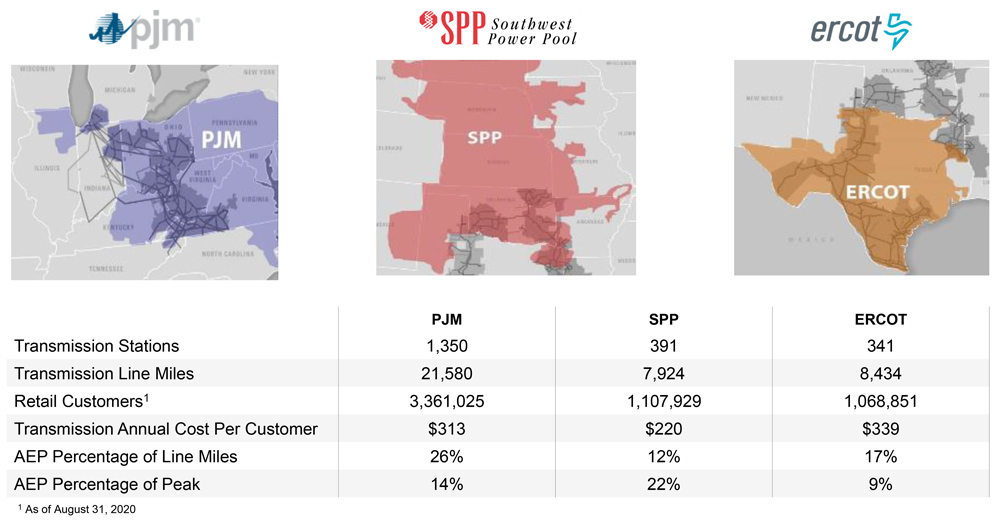
In 2019, FERC set return on equity (ROE) rates of 10.35% for AEP’s PJM transmission subsidiaries and 10.5% for those in SPP, including the 0.5% RTO adder. Last year, the commission set an ROE of 10.52% for AEP’s transmission assets in MISO. The company also has transmission in ERCOT, which is not regulated by FERC.

Congress directed FERC to offer incentives to promote capital investment and participation in RTOs in the 2005 Energy Policy Act, which amended the Federal Power Act: “The commission shall, to the extent within its jurisdiction, provide for incentives to each transmitting utility or electric utility that joins a transmission organization.”

AEP-transmission-by-RTO-(AEP)-Content.jpg
FERC’s proposal to eliminate the RTO adder after three years could affect AEP’s almost 30,000 miles of transmission in PJM and SPP. | AEP

Under Republican Chair Neil Chatterjee, the commission in March 2020 proposed doubling the RTO adder to 100 basis points, with Democrat Richard Glick dissenting in part. In the April 2021 vote on the supplemental NOPR, Glick, now chairman, was joined by Democrat Allison Clements and Republican Mark Christie. Chatterjee and Republican James Danly dissented.

Akins said, “FERC’s abrupt about face on incentives will certainly lead to litigation as is consistent with its previously well established and correct approach that incentives should not expire until the utility leaves the RTO.”

He added, “If you disrupt that net cost benefit opportunity, you will have people making different decisions about RTO participation.”

At FirstEnergy’s (NYSE: FE) earnings call, company officials said the loss of the adder would reduce earnings between $0.04 and $0.05 per share. CEO Steve Strah said the potential loss “is a concern obviously … but it’s not enough to throw our company off track.” FE reported 2020 GAAP earnings of $1.1 billion ($1.99/share) on revenue of $10.8 billion.

“We have a very large footprint of diverse transmission and distribution assets in which we can invest in multiple opportunities, should this development become a little bit more impactful to us,” Strah added.

“The bigger the markets are the lower the costs are, the higher the reliability and the more renewable energy that we can integrate into the system,” Fortis CEO David Hutchens (NYSE: FTS) said of the NOPR in a call with analysts. “So, we really think that that was the wrong direction to send.” (See Despite FERC NOPR, Fortis Optimistic About Transmission.)

Avangrid CEO Dennis Arriola (NYSE: AGR) told analysts that the loss of the adder could hinder some transmission projects but that the impact on earnings would not be material. “I think that there were definitely transmission lines for new projects where that adder makes a difference, because it’s difficult to get these done, and because the length of period that it takes to get the approvals adds risk,” he said.

A Bluff?

Whether utilities are bluffing or would actually leave could depend on state regulators. CAISO is unlikely to be affected because California’s three investor-owned utilities are required by state law to participate in the ISO — one reason that the California Public Utilities Commission has continuously advocated against the adders. (See CPUC Calls FERC Tx Incentive Plan ‘Atrocious.’)

The CPUC, the Maryland Public Service Commission and the Union of Concerned Scientists were among the intervenors to oppose the increase in the RTO adder in filings on the initial NOPR in July 2020. (See Tx Incentive NOPR Leaves Many with Sticker Shock.)

UCS noted that most RTOs and ISOs already had most of their current members in 2005. “Simply rewarding continued membership seems to provide additional revenue to member utilities without commensurate increase in benefits to consumers,” it said.

In a statement at the April open commission meeting, Glick said the proposed change was consistent with Congress’ direction.

“An incentive must incentivize something. If it does not do that, then it is a handout, not an incentive,” Glick said. Providing what is essentially a permanent payment for RTO membership is bad policy and inconsistent with the Federal Power Act.”

FERC last month extended the deadline to submit initial comments on the supplemental NOPR by 30 days to June 25, with the reply comment deadline extended to July 26.

Tom Kleckner, Robert Mullin, Jason York and Michael Kuser contributed to this article.

NY Developers, Enviros Oppose New Net Metering Charges

Clean energy advocates, environmentalists, and fuel cell and solar developers this week urged New York regulators to reject utilities’ proposals to incorporate new net energy metering (NEM) customer benefit contribution (CBC) charges in their tariffs (Case No. 15-E-0751).

The state’s Public Service Commission issued a successor NEM order last July and set a June 14 deadline for comments on the CBC issue. At a technical conference in March, the state’s investor-owned utilities presented proposed tariff changes to extend Phase 1 NEM through Jan. 1, 2022 and to assess CBC monthly based on the nameplate rating in kW (DC) of qualifying generating equipment, with final tariff filings due July 1.

Fuel cell developer Bloom Energy said the utilities “apparently ignored” the PSC’s directive to further evaluate utility filings in the Value of Distributed Energy Resources (VDER) Rate Design Working Group and fully analyze the appropriate CBC to apply to customers that pay demand charges. The company said the utilities “proposed the imposition of CBC charges at the same rate for demand metered customers as for non-demand metered customers.”

The filed draft tariffs “are therefore wholly unjustified as applied to demand metered customers,” meaning any aspects of the filings that apply CBC charges to those customers should be rejected, Bloom Energy said.

The CBC charge is meant to reflect the charges a utility would have collected from a customer for certain public benefit programs had the customer not relied on its DER to displace a portion, or all, of their volumetric billings. Solar developers objected that the utilities had based their CBC calculations on a paid solar installation rather than on the financed purchase prevalent in the market.

Sun Source Technologies said the calculated CBC charges would dramatically reduce Year 1 customer savings, which is the crucial determining metric in the marketing and sales of financed solar PV systems because “the overwhelming majority (over 60%) of our residential customers finance the purchase of a solar system via loan products … [and] the initial cash outlay associated with a financed system is minimal compared to a cash-purchased system.”

ETM Solar Works said the proposed CBC charge for New York State Electric and Gas “would drive a decline from $92 to $1, or 98% in Year 1 savings, which would dramatically reduce the value proposition for going solar and customer adoption rates.”

Solar developers in May urged the commission to help sustain PV growth by making simple adjustments to the VDER tariff based on environmental value rather than create complicated new processes. (See NY Officials Told to Stay the Course on CDG Solar.)

Exclude DLM, Help the Poor

The Clean Energy Parties asked the commission to exclude the dynamic load management (DLM) program from the CBC calculations “because it was not specified in the language of the order, has a meaningful impact on the size of the CBC, and will hurt customer solar adoption.” The group includes the Alliance for Clean Energy New York, Coalition for Community Solar Access, Natural Resources Defense Council, New York Solar Energy Industries Association, Solar Energy Industries Association and Vote Solar

The parties also asked the commission to require the utilities to rerun the calculations in the compliance filings to base the CBC only on the contributions from non-NEM customers, and for the commission to clarify that the CBC should not be applied to non-residential and demand metered customers.

CBC-by-utility-(Clean-Energy-Parties)-Content.jpg
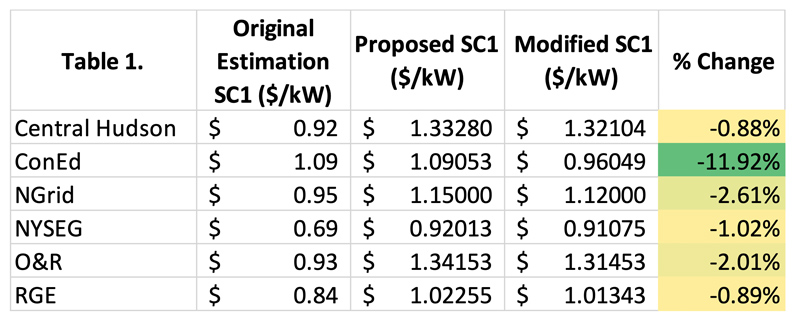
Graph shows the original estimation of the customer benefit charge by utility territory, the proposed CBC based on updated utility calculations, and lastly a modified CBC if the charge did not include programs not specified in the PSC’s July 2020 Order and an estimation of the existing contributions to public benefit programs from net metering customers. | Clean Energy Parties

New York City said the commission should reject the utilities’ proposals to allocate 100% of the CBC charge to specified customer classes taking value stack compensation and include DLM program costs in the CBC calculation.

For many of Con Edison’s large commercial rate classes, the draft tariffs apply 100% of the CBC charge for Phase One NEM customers to value stack customers of the same rate class, the city said; “To illustrate, the CBC charge for Con Edison SC 5 Rate II is the same for both Phase One NEM and value stack customers ($0.66).”

The city emphasized that CBC charges must be balanced against the city’s and state’s equitable decarbonization objectives, and it urged the PSC to exempt low-income customers and affordable housing projects from the charges.

“Access is a fundamental principle of rate design, and the low and moderate income (LMI) and nonprofit affordable housing customer segments, which already have lower DER adoption rates, should not face additional barriers to participating in and sharing in the benefits of greater solar deployment,” the city said. “Such disparities between solar business models serve to exacerbate inequality and jeopardize energy affordability objectives. Accordingly, the city recommends that LMI customers and affordable housing projects be exempted from the CBC charges.”

The city requested “that the CBC be a long-term solution, if not the successor tariff itself,” and said it supports the annual recalculation of the CBC charges based on changes to public benefit program costs. It also supports the adoption of a reasonable cap (such as 5% annually) on how much the CBC could increase in any given interval.

Absent additional evidence that there is an undue impact on non-participating customers, there is no reason to apply the CBC charge to demand-metered customers, the city said.

In addition, in order to eliminate any ambiguity around the applicability of the CBC charge to energy storage, the city requested that “in the case of distributed energy generation paired with energy storage, the resulting tariffs specify that the CBC charge applies to the capacity rating of the energy generation resource and not the capacity rating of any paired or standalone energy storage.”

NJ Lawmakers Back Local Override for Offshore Wind Transmission

A bill backed by a New Jersey Senate committee Tuesday would enable offshore wind developers to site power cables and equipment on public land regardless of local or state government opposition, casting aside the state’s vaunted “home rule” tradition in order to meet the threat of climate change.

The bill, S3926, would give a qualified developer the authority to put “wires, conduit lines and associated infrastructure” connecting an offshore wind project with the power grid on public streets, thoroughfares or any public property. “No municipality, county” or state body could prohibit the placement, according to the bill.

In response to concerns expressed before the meeting, the committee inserted an amendment to the bill that would require the wiring and equipment to be underground, except for the connecting equipment, which could be above ground.

The bill also states that if local authorities deny a qualified wind project an easement, right of way or “other real property interests” on public property that is needed for construction of the project, the developer could petition the New Jersey Board of Public Utilities (BPU) for help.

“If the board determines that the requested easement, right of way or other real property interest are reasonably necessary for the construction of the qualified offshore wind project,” the BPU can grant those rights to the project, the bill states. The developer must then pay “fair market value” for the property, the bill says.

The legislation drew praise from some stakeholders who say it is needed to prevent New Jersey’s clean energy projects getting derailed by bureaucracy, and concern from others that the bill is a heavy-handed response that gives too much power to project developers.

Committee Chairman Bob Smith (D), who co-sponsored the bill with Senate President Stephen Sweeney (D), called it a “pretty powerful bill if you want to get windmills off the New Jersey coast. And it’s powerful because it ain’t easy to get to do whatever you need to do on the land in New Jersey.

“It’s very hard to get this stuff up and running, not just because of the capital costs, but because of so many of the legal impediments as well,” he said. The bill “feels a little radical. And here’s what’s radical about it. We hold it sacred in New Jersey: home rule, mayors [and] the council, the planning boards [and] zoning boards of every town should be the deciders on what happens in their community.”

Lawmakers and state officials say that New Jersey’s high population density and 130-mile coastline make it particularly vulnerable to the effects of climate change, especially from rising sea levels. But such is the power of local sovereignty that construction projects in New Jersey routinely face opposition from area residents. And the offshore wind proposals are no exception, with opposition from residents of the Jersey Shore and the tourism and fishing industries. (See NJ’s Offshore Wind Project Faces Criticism, Support.)

‘Railroading Decisions’

The bill drew support from one of the biggest trade groups in the state, the New Jersey Chamber of Commerce, but split the environmental advocacy sector. The New Jersey Sierra Club backed the bill, as did Clean Water Action, saying the far-reaching measures were necessary.

Henry Gajda, public policy director at the New Jersey League of Conservation Voters, an environmental advocacy group, agreed that the legislation is much needed. But he said the organization opposed it, in part because “railroading decisions on permits through the local level sets a very problematic precedent.” He suggested that if a permit is not granted, there should be a public hearing into the issues, rather than a BPU ruling.

“We want to see turbines in the water; we just want to make sure that we’re not setting any problematic precedents as we go and do that,” he said.

The bill, which was introduced on Thursday, arrives as the BPU prepares this month to announce the developer of the state’s second offshore wind project. The agency in 2019 named Ørsted as the developer of the first project, the $1.6 billion Ocean Wind project that will put 98 wind turbines 15 miles off the Jersey Shore. The agency has two bids for the second project: one submitted by Ørsted, and the other by a joint venture between affiliates of Royal Dutch Shell and EDF. The project is expected to generate 1,200 to 2,400 MW.

The state expects to approve six offshore wind projects by 2035 in an effort to generate 7,500 MW as part of the target to achieve 100% clean energy by 2025.

Urgency Needed

Marc Reimer, project development director for Ørsted’s Ocean Wind project, welcomed the bill, saying that state officials “did not anticipate some of the problems that we are dealing with.”

“We believe this [bill] is one of the only ways for New Jersey to meet its 7,500 MW offshore wind goal by 2035,” he said. “We are quite serious about that.”

David Pringle, campaign director for Clean Water Action, agreed, saying, “We can’t move far enough, fast enough, on offshore wind.” The bill, he said, “removes barriers to offshore wind that need to go.”

But Tom Gilbert, campaign director for energy, climate and natural resources for the New Jersey Conservation Foundation, urged the committee to take more time to analyze the bill.

“We fully support responsible development of New Jersey’s offshore wind resources, with downsizing,” he said. “But as written, we don’t believe that this legislation contains adequate safeguards to meet those goals. And it tips the balance of balance too heavily in favor of offshore wind developers by taking away the power of local governments, and even state entities, to have a say regarding appropriate siting of transmission infrastructure.”

Responding to Gilbert, Chair Smith said the threat to the environment and to “your children and grandchildren” is too great to delay.

“We’ve got to get this stuff going,” he said. “And putting in more hurdles to it is going to mean that it’s going to be later, [and] the later it is, the less the chance that we’re going to be able to actually survive as a species. Every once in a while, you’ve got to go outside the box to try and get the job done.”