Study Finds Robust Appetite for Green Investing

Most renewable energy investors plan to increase their investments in 2021, with PJM, CAISO and NYISO seen as the most favorable markets, according to a survey by the American Council on Renewable Energy (ACORE).  

Investors and developers are “extremely confident” about the growth of renewable energy and energy storage over the next three years, with nearly all surveyed companies planning to increase their investment or development activity, according to the study, “Expectations for Renewable Energy Finance in 2021-2024.”

More than two-thirds of surveyed investors (68%) said they will increase their investments by more than 10% this year compared to 2020. Nearly all surveyed investors (90%) and developers (93%) said they had maintained or increased risk appetites in 2021 versus 2020.
Private-Sector-Investment-in-Renewable-Energy-(ACORE)-Content.jpg
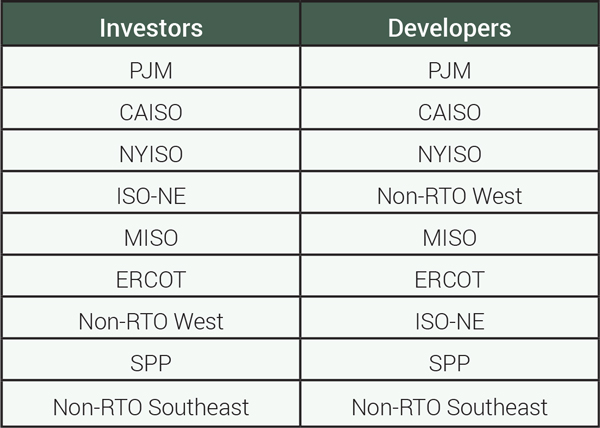
PJM, CAISO and NYISO are the most attractive regions for renewable energy investment and development in the U.S. over the next three years according to a survey by the American Council on Renewable Energy. | ACORE

The report is based on an April 2021 survey of companies that finance, invest in or financially advise renewable projects, technologies or companies and a second survey of those active in the development of renewable energy projects using financing from third parties. ACORE solicited responses from more than 100 financial institutions and more than 100 development companies, surveying 31 companies from each group.

Two-thirds of the financial institutions represented in the survey invest more than $100 million annually in the U.S. renewable energy sector. Almost 40% of the developers surveyed operate U.S. renewable energy businesses with  revenues greater than $100 million.

Most investors expect the attractiveness of renewable energy as an asset class to increase compared to other asset classes through 2024. The respondents said long-term extensions of renewable energy tax credits, and standalone tax credits for energy storage and “regionally significant” transmission could help fuel growth.

PJM, CAISO and NYISO were ranked as the most attractive markets by both investors and developers. The Southeast, which lacks an RTO, scored the lowest among both groups.

$1T 2030 Goal

ACORE reported that the U.S. has attracted $167 billion in investment for renewable energy, grid-enabling technologies and transmission for renewable integration since the group launched an effort to reach $1 trillion in private investment by 2030. Reaching the “$1T 2030” goal would require an average of $92.6 billion annually, an annual increase of 59% over spending in 2020, which showed a 12% drop over 2019.

The U.S. ranks second in renewable energy investment, behind China, which hit $101.5 billion in 2020, 1.7 times the investment in the U.S., according to Bloomberg NEF.

“If we are going to meet our $1T 2030 objective and achieve [President Biden’s] goal of decarbonizing the power sector by 2035, the status quo is no longer going to cut it,” ACORE CEO Gregory Wetstone said in a statement. “Renewable sector investors and developers seem to understand that this is the moment to accelerate investment in renewable energy and grid-enabling technologies to avoid the worst impacts of climate change.”

ACORE cited data from BloombergNEF that found wind and solar will replace coal and could replace three-quarters of existing gas generation by growing to 1,100 GW by 2030, from 215 GW as of the end of 2020.

“The remaining one-quarter of gas generation could be replaced by 330 GW of capacity from hydrogen, carbon capture and storage, geothermal or other `clean firm’ technologies,” the study said. “Just boosting wind and solar capacity to 1,100 GW by 2035 would require a capital investment of $1.1 trillion.”

On April 21, 43 banks with $28.5 trillion in assets committed to align their portfolios with net-zero emissions by 2050 as part of the United Nation’s Net-Zero Banking Alliance. About 69% percent of Fortune 100 companies have targets for either greenhouse gas reductions or renewable energy procurements.

Respondents’ Comments

The report included anonymous comments from survey respondents, including developers that said their efforts have been negatively affected by tariffs on solar panels and FERC’s rulings on the minimum offer price rule in PJM.

One developer said tariffs account for about 10% of its costs. “FERC’s unresolved decision-making in PJM has dampened our efforts on development in that market. We have a lot of stranded projects while we wait for a decision,” the developer said.

Although the investors and developers were largely bullish “some companies cite lingering challenges in tax equity availability and decreased appetites for hedge agreements after the Texas power crisis in February 2021,” ACORE said.

Developers said COVID hurt the availability of tax equity investors and that Texas’ February deep freeze had caused some companies to adjust their risk management strategies. “Electricity spot prices skyrocketed, leading to substantial company profits and losses, particularly those in hedge arrangements,” ACORE said.

Nearly half (46%) of investors reported that tax equity availability had “decreased” or “significantly decreased” in the last year with only 19% reporting an increase.

“Tax equity is always the piece of the capital stack that’s hardest to put in place and to pin down. The events in Texas have brought up questions for both tax equity providers and debt providers in that market,” said one unnamed investor.

“In terms of project finance, lenders and sponsors are getting more comfortable with [energy storage]. It is still in its early stage, but in five years, those issues will be solved,” said one investor.
Ranking-of-Sectors-Most-Attractive-for-Investment-(ACORE)-Content.jpg
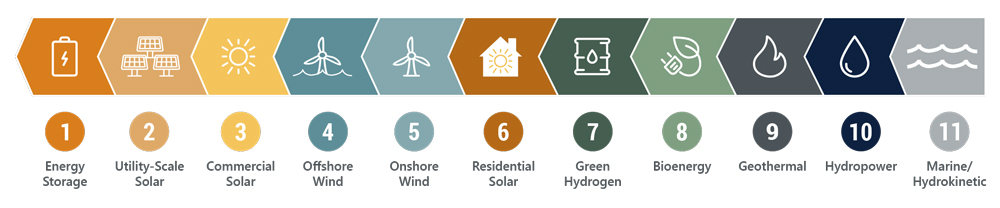
Investors say energy storage and utility-scale solar are the most attractive sectors for investment through 2024. | ACORE

Energy storage and utility-scale solar were the most popular investments over the next three years, followed by commercial solar and offshore wind.

The survey found increased interest in solar plus storage. One developer said its strategy is for “storage to be synonymous with our development pipeline. Pretty much everything we scope out these days is going to be solar plus storage.”

Investors generally favored proven technologies, such as wind, solar and energy storage, although green hydrogen ranked above bioenergy and hydropower, despite concerns about hydrogen’s scalability and costs.

“Hydrogen is extremely water-intensive, and we are far from the technology being scalable,” said one investor.
PJM PC/TEAC Briefs: June 8, 2021

Planning Committee

CISO Mitigation Update

PJM last week updated stakeholders on the next steps of a vote on the RTO’s mitigation proposal to avoid designating projects as critical infrastructure under NERC reliability standards.

Michael Herman of PJM’s transmission planning department led a discussion at last week’s Planning Committee meeting on the approved mitigation proposal, including a review of Operating Agreement language. Members endorsed the proposal with 61% support at the February PC meeting. (See “Critical Tx Infrastructure Proposals Endorsed,” PJM PC/TEAC Briefs: Feb. 9, 2021.)

Herman said the Critical Infrastructure Stakeholder Oversight (CISO) issue has resulted in a long stakeholder process dating back to an original endorsement of the issue charge at the December 2019 PC meeting. (See “Critical Infrastructure Mitigation,” PJM PC/TEAC Briefs: Dec. 12, 2019.) The mitigation portion of the issue is all that remains after stakeholders endorsed the avoidance portion of the PJM proposal at the May Markets and Reliability Committee meeting. (See “CISO Avoidance Endorsed,” PJM MRC Briefs: May 26, 2021.)

PJM is now looking to conduct a stakeholder vote at the July PC meeting to determine whether the proposed OA language reflects the CISO mitigation proposal approved in February. Some members at the April MRC requested that the mitigation proposal be sent back to the PC for further discussions to determine if the language corresponded with that in the endorsed matrix.

Herman said PJM conducted a critical review with its subject matter and legal experts to review the OA language presented as part of the development of the mitigation proposal and reviewed changes resulting from stakeholder discussions. He said the RTO based its review on changes made between the first read at the March MRC meeting and discussions the following month, researching whether the concepts were “in alignment” with what was approved in the matrix by the PC. (See “CISO First Read,” PJM MRC/MC Briefs: March 29, 2021.)

PJM examined the OA language defining a critical substation planning analysis (CSPA) project as a regional or subregional Regional Transmission Expansion Plan (RTEP) project “with an anticipated in-service date of more than three years but no more than five years from the year” in which the RTO identifies the need for the potential CSPA project. Herman said PJM determined that the in-service date language does not need to be included in the draft OA language because the concept is “well defined” in other parts of the OA and corresponding manual language.

Substation-Contingency-Resilience-Planning-PJM-Content.jpg
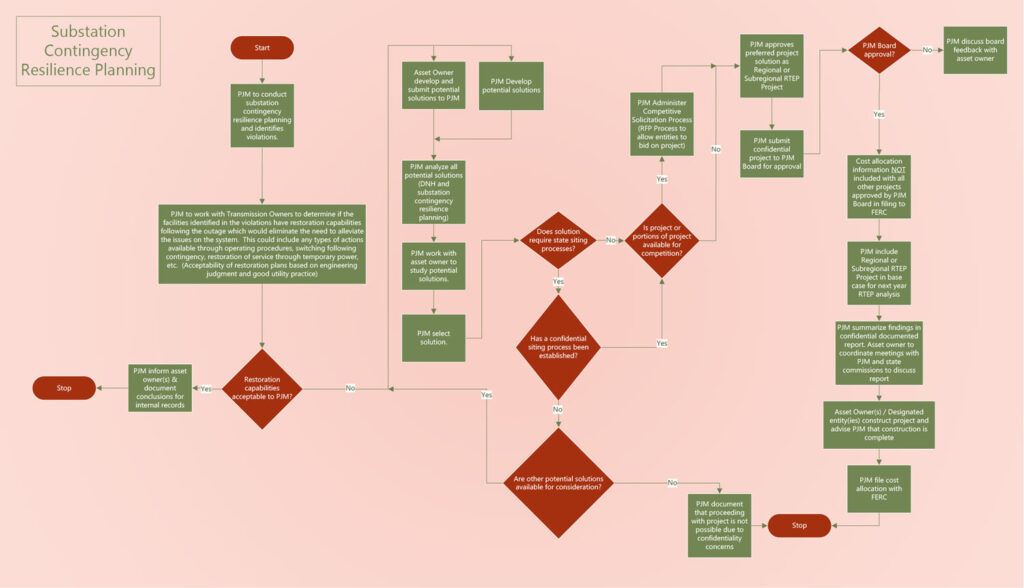
Flow chart for “Substation Contingency Resilience Planning” within mitigation efforts for the PJM proposal on future CIP-014 facilities | PJM

The second OA language piece PJM examined dealt with the RTO’s ability to determine that any component of a CSPA project “can be included in an RFP proposal window without disclosing the location of or vulnerabilities associated with the critical substation contingencies and associated facilities.”

As part of the competitive process and design component of the matrix, a project will be open to competition as part of an RFP process “if the mitigating solution does not disclose the substation associated with the substation contingency.”

Herman said that, based on its five-year analysis, the RTO expects to identify any critical facilities in advance of the need for any immediate need projects. It didn’t feel changes were needed to the proposed OA language.

“We don’t anticipate the need to place any immediate need projects based on the annual evaluation,” Herman said.

2021 RRS Assumptions Endorsed

Stakeholders unanimously endorsed the 2021 reserve requirement study (RRS) assumptions developed in the Resource Adequacy Analysis Subcommittee.

Jason Quevada of PJM’s resource adequacy planning department reviewed the 2021 RRS assumptions first brought to the PC last month. (See “2021 RRS Assumptions,” PJM PC/TEAC Briefs: May 11, 2021.) Quevada said the study results reset the installed reserve margin (IRM) and the forecast pool requirement (FPR) for the 2022/23, 2023/24, 2024/25 delivery years and establish the initial IRM and FPR for the 2025/26 delivery year.

Quevada said the 2021 RRS assumptions are very similar to those in the 2020 RRS except for the modeling of effective load-carrying capability (ELCC) resources. Because of a pending decision by FERC regarding a PJM proposal on ELCC, the 2021 RRS capacity model and results will be modeled in two different cases, he said.

In the first case, all generators except for ELCC resources will be modeled as capacity units per the modeling assumptions in Attachment III of the RRS assumptions letter. In the second case, all generators except wind and solar resources will be modeled as capacity units per the modeling assumptions in Attachment III.

The final RRS report will be presented to the RAAS and PC in September, Quevada said. PJM will seek approval in October.

Manual 14A Updates

Onyinye Caven of PJM provided a first read of conforming Manual 14A: New Services Request Process language for the quick fix of close of queue date and application review timing changes.

Caven said the changes impact the close of the queue window and the deficiency review clock. The issue charge and proposed changes were endorsed at the May 2021 PC and MRC meetings. (See “New Service Requests Approved,” PJM MRC Briefs: May 26, 2021.)

Proposed tariff changes have been reviewed at the PC and MRC, Caven said, with endorsement targeted for the June Members Committee meeting. She said the Manual 14A changes are being presented to align existing documentation with the proposal.

The existing tariff language stipulates that new service queue windows stay open from April 1 to Sept. 30 and Oct. 1 to March 31, while the proposed language moves up those closing dates to Sept. 10 and March 10 for each respective window.

Current tariff language requires PJM to review the new service customer’s response to the RTO’s deficiency notice within five business days. The proposed update requires PJM to review the customer’s response to the notice within 15 business days or “use reasonable efforts to do so as soon thereafter as practicable.”

Caven said the manual updates mirror the proposed tariff language changes.

Members will vote on the manual changes at the July PC and MRC meetings, and PJM is looking for an effective date of Sept. 1.

AMP Transmission FERC Form 715 Update

Ed Tatum, vice president of transmission at American Municipal Power, provided an update on the company’s FERC Form 715 criteria changes after it began reviewing the form and its interconnection requirements.

Tatum said AMP Transmission is proposing to remove the megawatt-mile — or delivery point — exposure criteria from the “adequacy criteria” section of its annual transmission planning and evaluation report. The objective of the criteria was to “quantifiably determine the necessity to provide a second delivery feed located on independent transmission structures to any load delivery point serving a load by, or through an AMPT-owned facility.”

“It’s important to us that the documents accurately reflect our reliability as well as resilience goals,” Tatum said.

AMPT determined that the megawatt-mile criteria was an internal design standard criteria, and that the delivery point exposure criteria projects do not address maintaining PJM system regional reliability, including voltage or thermal violations, or alleviate any specific bright line regional planning criteria violations of the RTO or NERC. Tatum said the criteria was more related to resilience rather than reliability.

Sharon Segner, vice president at LS Power, said she was “scratching her head” how the change would work legally. Segner said PJM has “explicit manual language” that supplemental projects can’t be submitted in the middle of open windows and requested that the RTO follow up to determine the impacts of the change on the open planning window.

Transmission Expansion Advisory Committee

Transource Reliability Analysis Update

Aaron Berner, senior manager with PJM, provided an update on the 2021 RTEP analysis, specifically highlighting the Independence Energy Connection (IEC) East and West transmission project in Maryland and Pennsylvania.

In May the Pennsylvania Public Utility Commission rejected siting applications filed by Transource Energy, putting the controversial project in jeopardy. (See Transource Tx Project Rejected by Pa. PUC.)

Berner said PJM is currently “preparing for a retool” of the 2021 RTEP to determine the impacts of any delays of the transmission project.

Transource’s plan for the eastern section of the project originally proposed extending 15.8 miles of transmission lines from a new Furnace Run substation in York County, Pa., to the Conastone substation in Harford County, Md. An updated configuration released in October 2019 increased the size of the new substation in Pennsylvania and added four miles of lines connecting to an existing right of way that would feed into two upgraded Baltimore Gas and Electric substations. (See Transource Files Reconfigured Tx Project.)

The western segment of the IEC project called for a 230-kV double circuit transmission line running 28.8 miles from Franklin County, Pa., into Washington County, Md.

PJM is updating modeling to perform a sensitivity study to determine any reliability impacts associated with the removal of the project from the case used to perform the 2021 RTEP, Berner said, and the RTO will have more information on the impacts at the August TEAC meeting.

The project is not officially completed, and there are “other means” of regulatory appeals, he said. The appeals process is underway and should be completed by the middle of July.

Segner pointed to Section 1.4.3 of Manual 14B relating to the scenario of a regulatory authority denying a siting application. The section states: “A project denied siting authority in a final regulatory order by the relevant regulatory siting authority will generally be removed from the RTEP base case as determined by PJM after discussion with the relevant transmission owner(s) or designated entity and vetting with stakeholders at the TEAC. A project will generally not remain in the RTEP base case during the duration of a court appellate action. Decisions to remove a baseline upgrade from the RTEP base case will be submitted to the PJM Board and decisions to remove a supplemental project from the RTEP base case will be provided to the applicable transmission owner.”

Segner asked whether the PJM Board of Managers will receive information in July related to the Transource project’s status.

Berner said he hasn’t spoken to other PJM officials to determine what will be brought to the board in July.

Segner asked what the PUC decision means to the Maryland portion of the project. The Maryland Public Service Commission approved a settlement last July allowing the project to move forward in the state. (See Md. PSC OKs Independence Energy Connection Deal.)

Berner said the project won’t move forward without approval of the Pennsylvania portion.

Generation Deactivation Notification

Phil Yum of PJM provided an update on a recent generation deactivation notification on the Oaks Landfill in the Pepco transmission zone in Montgomery County, Md.

According to Montgomery County records, the Oaks Landfill is approximately 545 acres with a waste disposal footprint of 170 acres. The county-owned site received mixed municipal solid waste beginning in June 1982 and closed in 1997, containing more than 7 million tons of waste.

A 2.2-MW landfill gas-to-energy facility started operation at the property in mid-2009.

Yum said a reliability analysis conducted by PJM and Pepco found no violations with the deactivation. The requested deactivation date is July 16.

DOE Wants US Lithium Battery Supply Chain in Place by 2030

The Department of Energy’s recently released National Blueprint for Lithium Batteries begins with a bold vision: establishing a “secure battery materials and technology supply chain” by 2030.

And public-private partnerships will be essential for weaning the U.S. industry off its dependence on China, according to Energy Secretary Jennifer Granholm.

“Right now, China is the only country with control over every tier of the supply chain for critical materials, including lithium,” Granholm said at Monday’s virtual industry roundtable to promote the plan. China has “80% of raw material refining capacity, and the U.S. has virtually none. If we remain reliant on imports, we just simply will not be able to compete in the global market for clean energy technologies,” she said.

Global-Lithium-ion-EV-Battery-Demand-Projections-(Argonne-National-Laboratory)-Content.jpg
Global Lithium-ion EV Battery Demand Projections | Argonne National Laboratory

“Offshoring our manufacturing jobs [should] not happen to the battery industry,” agreed Chuck Sutton, vice president of polysilicon sales at REC Silicon, which produces polysilicon used in solar panels and batteries. “Our country can’t wait for the supply chain to grow organically through market development alone. The government must step in and co-lead the effort with the industry, supporting the full supply chain from mining, material processing, cell production and on.”

REC’s $1.7 billion Moses Lake facility in Washington state has been closed since 2019, a victim of the U.S.-China trade war, Sutton said. The company last month said it plans to reopen the plant in 2023, based on growing U.S. demand in both the solar and battery storage markets.

Chuck-Sutton-(US-Department-of-Energy)-Content.jpg
Chuck Sutton, REC Silicon | U.S. Department of Energy

Other industry representatives said that to capture lithium-ion market share back from China, Japan and Korea, DOE should focus on next-generation, advanced technologies rather than the current supply chain.

“The U.S. should really aim to leapfrog [to] technologies that create the future, rather than just replicate what already exists in other parts of the world,” said Glen Merfeld, chief technology officer at Albemarle Corp., one of a small number of companies currently mining lithium in the U.S. “So, this really needs to span from resource extraction to advanced materials to end-of-life recycling. A robust U.S. economy and supply chain will need to emphasize speed, collaboration and innovation to be self-sustaining and globally competitive.”

Granholm reeled off a list of funding initiatives the DOE has launched in recent months, including a new $200 million grant program for research on next-generation battery and electric vehicle technologies, announced Monday during the roundtable. The department is putting $62 million into cutting emissions and improving vehicle efficiencies, and another $4 million for projects and technologies that can be used to extract lithium from geothermal brine, she said.

A “critical” public-private partnership will be rolled out soon, Granholm said, without naming names or providing further details.

Building the Mid-tier

Developing the mid-tier supply chain — material refining and cell manufacturing — is another priority in the National Blueprint — and was a focus for speakers at the roundtable, including Rep. Mike Doyle (D-Pa.).

Glen-Merfeld-(US-Department-of-Energy)-Content.jpg
Glen Merfeld, Albemarle Corp. | U.S. Department of Energy

“It’s critical that we ensure that we’re investing in the mid-tier supply chain — battery materials processing and component manufacturing,” Doyle said. “It doesn’t make any sense to me that we would continue shipping critical materials to China to be processed, only for those components to be sent back to us here in the United States to be put in cars. We have the technical know-how, the skilled workforce and the manufacturing facilities to do all of this in the United States.”

To ramp up material processing, the blueprint calls for “the development of materials processing innovations to produce low/no-cobalt active materials and enable scale-up,” as well as “improved processes for existing materials to decrease cost and improve performance that enables a $60/kWh cell cost,” both by 2025.

Tesla is “onshoring” its battery manufacturing with its Gigafactory in Nevada, said Joe Mendelson, senior counsel for policy and business development. “The batteries that are made in Nevada go into vehicles manufactured in California that are sold abroad,” he said. Partnerships for “sustainable extraction” of lithium and ongoing innovation for battery efficiency are also part of the company’s supply chain strategy, he said.

Joseph-Mendelson-(US-Department-of-Energy)-Content.jpg
Joe Mendelson, Tesla | U.S. Department of Energy

Echoing Merfeld, Lindsay Gorrill, CEO of U.S. battery manufacturer KORE Power, also urged DOE to plan for the continuing evolution of battery chemistries. “The technology and research may lead to different materials in two, five or 10 years,” Gorrill said. “Cathode, anode and electrolyte chemistry and design are evolving exponentially. One should assume that the associated mineral and chemical inputs will evolve as well. It would be beneficial for the government to work as closely as possible with battery cell producers as we look five to 10 years out.”

KORE will soon be announcing the location for its own “gigafactory,” Gorrill said.

Against China’s efforts to dominate the market via government subsidies and unethical labor practices, Sutton said, “the U.S. government needs to use tools besides trade or loan guarantees to stimulate a U.S. manufacturing base. We’ll need support like grants [and] refundable tax credits to build out a supply chain that’s robust enough and large enough to complete on both cost and scale.”

Doyle said he is working on a bill to provide $10 billion in grant funding for companies to build and retool factories to process materials and manufacture battery components. “We have factories all over the Rust Belt [that] with a little investment can be reopened as component manufacturing facilities.”

Recycling Versus Mining

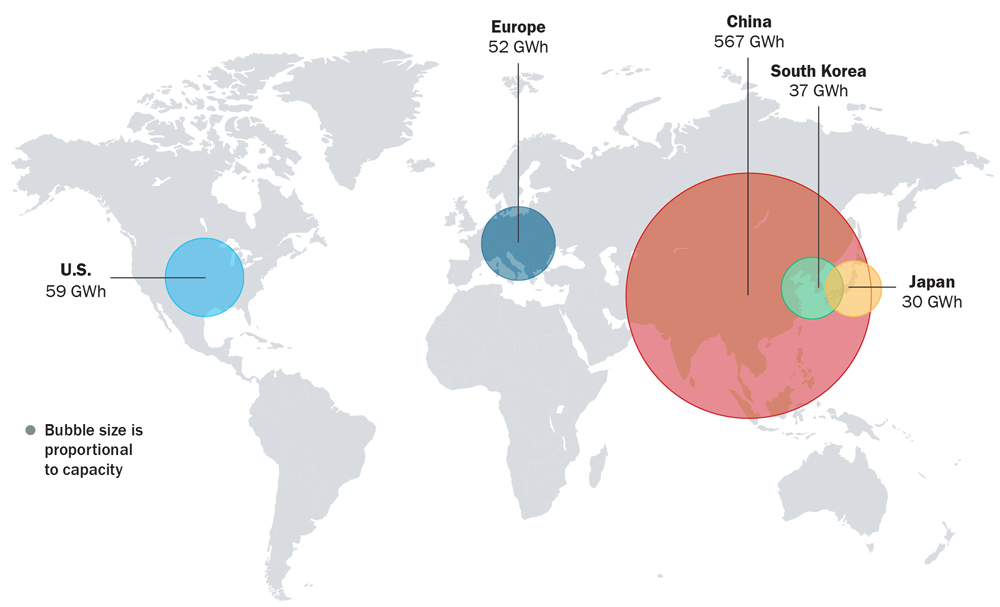
Lithium extraction may be the weakest link in the U.S. battery supply chain, but also the most critical. According to the National Blueprint, the U.S. has 750,000 metric tons of lithium reserves, a sliver of worldwide reserves of 21 million metric tons.

Current efforts to develop lithium mining in the West have run into environmental roadblocks. Lithium Americas has delayed plans to start excavation at its Thacker Pass mine in Nevada while a court decides whether the Bureau of Land Management’s approval of the project, just days before the end of the Trump administration, would violate federal protections for sage grouse habitat.

Cell-Manufacturing-Capacity-by-Country-or-Region-(Benchmark-Mineral-Intelligence)-Content.jpg
Cell Manufacturing Capacity by Country or Region | Benchmark Mineral Intelligence

Hawkstone Mining, an Australian company, is exploring a lithium site in Arizona, where the Hualapai tribe has already raised concerns about the project’s impact on water and sacred cultural sites. More than a decade of efforts to extract lithium from geothermal brine at the Salton Sea in Southern California have yet to fully commercialize and scale the technology.

The challenges of extraction could make battery recycling a key source of lithium and other critical minerals. JB Straubel, co-founder and CEO of Redwood Materials, said his company is “focusing very intensely on inventing the right technologies and scaling the technologies [for] how we most efficiently recover those materials from lithium-ion batteries. We’re using them again with a very high percent [of] utilization, and those materials can get reused dozens, hundreds of times.”

The company on Monday announced it would be expanding its footprint in northern Nevada — both at a new site near Tesla’s Gigafactory and almost tripling the size of its current site. “We’re hiring about 500 people here in the next one or two years,” said Straubel, Tesla’s former CTO. “Recycling is very economically competitive already in the United States. We can compete with prices of mined materials today. We’ve seen a massive amount of feedstock coming in our direction.”

Still another weak spot is the ongoing trade war between China and the U.S. Current trade policies have created “near-term barriers to investing in advanced battery manufacturing here,” Mendelson said. “The 301 tariffs frankly added a 25% tax on upstream inputs in batteries, and at the same time, those tariffs allow a finished lithium-ion battery to come in from China at 7.5%. It’s not exactly the stability and the investment atmosphere you want for folks to come in and expand advanced manufacturing here.”

PJM MIC Briefs: June 9, 2021

Reactive Supply Proposal Endorsed

After several months of debate, PJM stakeholders endorsed an issue charge aimed at addressing compensation for reactive supply and voltage control service.

The combined issue charge from Dominion Energy and the Independent Market Monitor won 73% support with 166 stakeholders voting in favor of pursuing work on the issue at last week’s Market Implementation Committee meeting.

Dominion’s Jim Davis and Monitor Joe Bowring reviewed the combined problem statement and issue charge. Davis agreed last month to delay a vote on Dominion’s proposal, combine it with the Monitor’s, and clarify the key work activities and out-of-scope items. (See “Reactive Supply Proposal Vote Delayed Again,” PJM MIC Briefs: May 13, 2021.)

The start date for work on the issue was pushed back until October because of other pressing issues being developed in the stakeholder process.

Davis said it was “hard to believe” the issue charge was brought back for the fourth consecutive MIC meeting for discussion. He expressed appreciation for stakeholders’ feedback on the issue and thanked the Monitor for the work done to merge the two issue charges. Davis said the resulting issue charge was a “well defined document” that will look closely at reactive power, a critical component of the electricity system.

“We believe this is a comprehensive issue charge that’s going to examine compensation for reactive supply,” Davis said.

Sotkiewicz-Paul-2013-10-15-RTO-Insider-FI.jpg
Paul Sotkiewicz, E-Cubed Policy Associates | © RTO Insider LLC

PJM transmission customers pay for reactive power as an ancillary service under Schedule 2 of the tariff, Davis said, and generation owners must submit a filing to FERC under Federal Power Act Section 205 to seek compensation. Davis said the existing rate mechanism is time-consuming for generation owners, developers and transmission customers, and exposes them to litigation costs in the defense or challenge of the requested rates.

Paul Sotkiewicz of E-Cubed Policy Associates questioned the meaning of the term “gaming” in the key work activities of the issue charge.

Davis said there were concerns from stakeholders that if a solution was developed allowing resource owners to have the option to elect either a stated rate or make a Section 205 filing to receive cost recovery, there would be a chance for the generation owners to flip back and forth to get the best rate.

“From Dominion’s perspective, we consider the possibility low, but it’s something to examine,” Davis said.

Calpine’s David “Scarp” Scarpignato said the issue charge should be careful using the language of “gaming.” Scarp aid there are certain business strategies of changing options depending on the environments that exists and that it’s not necessarily “gaming” the system.

Bowring suggested changing “gaming” to “market power and/or manipulation,” taking away the ambiguity and negative connotation of the term.

Sotkiewicz also questioned an out-of-scope item, “modifications to capacity offers.” Sotkiewicz said the item seemed to conflict with one of the key work activities examining “PJM market mechanisms that would provide the opportunity to recover reactive rates.”

Bowring said the point of the issue charge was to not rule any of the major approaches to the reactive rate process issue as out of scope. Bowring said he read the “modifications to capacity offers” as a narrow issue.

Gary Greiner, director of market policy for Public Service Enterprise Group, said he also had concerns with the language of the item. Greiner said there is a “fundamental incompatibility” with the language between key work activities and the out-of-scope items.

“I don’t want to have anything in here that triggers a six-month fuel-cost policy debate again,” Greiner said.

MIC Chair Lisa Morelli suggested incorporating the language into the first out-of-scope item, reading, “modifications to cost-based energy offers, fuel-cost policies and capacity offers beyond those needed to reflect the cost of reactive service.”

Sotkiewicz said the language change put the issue charge “in a very good spot,” and the conflict he saw was eased.

Proposed Rules for Market Suspension Endorsed

Stakeholders unanimously endorsed PJM’s proposed rules related to market suspensions.

Stefan Starkov, senior engineer with PJM’s day-ahead market operations, reviewed the RTO’s proposal first brought to the MIC last month. (See “Market Suspension Proposal,” PJM MIC Briefs: May 13, 2021.)

Starkov said PJM had limited business rules regarding how to handle settlements and other processes in the event of a market suspension for which market results and clearing prices cannot be determined. Starkov said the rules create an increased risk to PJM and stakeholders in the event of an emergency.

PJM and stakeholders reviewed existing practices and potential design options through multiple MIC special sessions from October through April after the issue charge was first passed at the committee’s September meeting. (See “Market Suspension Guidance Endorsed,” PJM MIC Briefs: Sept. 2, 2020.)

Starkov said PJM’s proposal represents a compromised solution providing clear definitions for a market suspension, along with the settlement impacts.

PJM added an additional provision to the proposal since the last MIC meeting, Starkov said, putting in language for the ability to recover costs when there are no day-ahead and no real-time markets for more than six consecutive hours if the submitted offers are below costs because of a separate settlement agreement.

Starkov said the provision was created through additional vetting between PJM and stakeholders after some members pointed out that some resources have a separate agreement with FERC requiring offers to be submitted below actual fuel or other incremental or variable costs in a scenario.

Sotkiewicz said that when work first started on the issue, “the world was a little bit different.” He said events like the recent cyberattack and ransomware threat on the Colonial Pipeline has demonstrated vulnerabilities on infrastructure in the U.S. Planning for unexpected contingencies needs to be looked at more closely because of the damage that can be done to infrastructure.

“This is something that could be long lasting, and God forbid that happens to us,” Sotkiewicz said.

2022/23 BRA Results

Pete Langbein of PJM provided an update on the results of the 2022/23 Base Residual Auction (BRA) from May. Langbein said the changes that took place in the auction since it was last conducted three years ago made it “complicated” to run, but PJM was satisfied with the results. (See Capacity Prices Drop Sharply in PJM Auction and Stakeholders Discuss PJM Capacity Auction Impacts.)

The BRA ultimately cleared 144,477 MW of resources for the June 1, 2022, through May 31, 2023, delivery year, at a cost of $3.9 billion. Langbein said the total was $4.4 billion less than the 2018 auction for 2021/22, after adjustments for an increase in those choosing to skip the auction by using the fixed resource requirement (FRR).

Langbein highlighted some of the significant price changes, including ComEd zone prices being down by $126.59/MW-day. There were several drivers for the lower prices, he said, including the reliability requirement being down by 3,086 MW and the load forecast by 2,418 MW. The installed reserve margin was also down 1.3%, the pool-wide average EFORd was down 0.8 percentage points, and the forecast pool requirement was down 0.3 percentage points.

“All those numbers are what drives that reliability requirement of what we’re going to look to procure,” Langbein said.

The variable resource requirement (VRR) curve changes also impacted prices, Langbein said, including a 19% drop in the RTO’s net cost of new entry value.

Langbein said one of the biggest price changes came with the FRR resources in the latest auction, specifically in the Dominion zone. (See Dominion Opts out of PJM Capacity Auction.)

When PJM started comparing the numbers of the resource mix changes, Langbein said, the RTO added the FRR resources in several categories, including nuclear, combined cycle natural gas and coal generators, while leaving FRR out in categories like energy efficiency and demand response.

Adjusted for FRR elections, combined cycle gas plants added 3,414 MW and nuclear increased by 4,460 MW. Cleared coal generation dropped by 8,175 MW.

Energy efficiency rose by 1,979 MW (70%), while DR declined 2,314 MW (-21%) to 8,812 MW.

Some stakeholders questioned why PJM included the FRR resources in some of the resource mix categories while leaving them out in others. Langbein said the RTO is still working on how to best determine the impact of FRR resources on the latest auction and will refine its data.

“There was such a large amount of load that went into the FRR plan,” Langbein said.

PJM Operating Committee Briefs: June 10, 2021

Fuel Security Update

Stakeholders last week challenged PJM on the methodology the RTO used in its 2021 fuel security analysis, saying it may not be capturing all risks from severe weather and that it was “fighting the last war.”

The discussion came at the June 10 Operating Committee meeting, where Natalie Tacka, an engineer in PJM’s applied innovation department, provided an update on the fuel security initiative the RTO began in 2015. She said fuel security is part of a broader set of resilience initiatives spanning infrastructure, supply and operational criteria.

The third phase of the initiative, which is still ongoing, includes work with federal and state agencies and other industry sectors to address specific security concerns, including physical and cybersecurity risks.

Tacka said PJM continues to develop its fuel security resource adequacy assessment, using a probabilistic “stress test” of the most recent five-year ahead Regional Transmission Expansion Plan (RTEP) portfolio utilizing data from historical cold snap events. Going forward, Tacka said, the assessment will be conducted during the first quarter of each year because the RTEP portfolio is developed in February. The 2021 assessment uses the 2026/27 RTEP portfolio.

Inputs to the assessment will be updated by December of each year, Tacka said, and the updates will involve applying data on each of the inputs from the previous winter season.

Tacka said inputs in the methodology includes winter hourly load shapes derived from historical cold snaps and wind and solar capacity factors.

Jason Barker of Exelon said he was appreciative that PJM is modeling load shapes based on historical observations but asked if any modeling is being done of load shapes exceeding historical observations.

Barker said his concern is that extreme weather events exceeding historical measures are becoming more prevalent and require more testing and scenarios to determine vulnerabilities.

Patricio Rocha Garrido of PJM said the RTO is using data from the last 40 years in the assessment. He said the 40 years of data is beyond what is used in the PJM load forecast, which is about 20 years.

Garrido said winter weather conditions from 30 or 40 years ago seem to be more severe than observed today. But, he said, PJM has examined “pretty extreme” peak load values in its assessment and that it could examine weather events outside of the last 40 years to see more extreme cases.

Calpine’s David “Scarp” Scarpignato said Barker raised a point of “critical importance,” saying there could be extreme weather events on the horizon that are not being accounted for in the assessment. Scarp said there needs to be a mechanism for PJM to capture potential extreme events not even imagined.

“We need to take a look at whether we’re adequately capturing things that are not really encapsulated in the load data,” Scarp said.

Paul Sotkiewicz of E-Cubed Policy Associates said PJM should go even further in its analysis to look at correlated outages from extreme heat, not just extreme cold weather events. Sotkiewicz said the RTO should also look at unusually warm periods in the shoulder months of the spring or fall, not just summer months, to get a better representation of fuel security issues.

Sotkiewicz said PJM’s assessment effort should go beyond just looking at fuel security, moving into issues like the impacts of generation and transmission maintenance outages. He said there could be enough fuel available in an extreme weather event, but if there are too many maintenance outages at the same time, it could lead to serious consequences.

Sotkiewicz-Paul-2013-10-15-RTO-Insider-FI.jpg
Paul Sotkiewicz, E-Cubed Policy Associates | © RTO Insider LLC

“I think we’re being too narrow minded in thinking about this as a fuel security issue,” Sotkiewicz said. “I think this is a much broader issue.”

Garrido said he agreed with broadening the scope of the assessment, but said the effort mainly revolved around forced outages resulting from fuel security because of the work done in the Fuel Security Senior Task Force. Garrido said PJM is trying to simulate as many scenarios as possible to have better data on weaknesses.

Sotkiewicz said it feels sometimes like PJM is “fighting the last war” when it comes to some issues, stressing the importance of being “proactive” so problems are taken care of the first time in an emergency.

Tom Hyzinski of GT Power Group said he agreed with Sotkiewicz’s comment about PJM “fighting the last war” and that the growing renewable generation penetration is already changing assumptions.

Hyzinski pointed out assumptions used by PJM in some of its portfolios in the presentation depict 40,000 MW of coal generation that may not be there soon. He said coal units are “dropping like flies,” pointing to the declining coal contribution in the most recent capacity auction, and that the retirement of coal units looks to be imminent. (See Capacity Prices Drop Sharply in PJM Auction.)

“Perhaps studying five years out is not good enough,” Hyzinski said. “You need to study it like the system that you could have with no coal and a lot more renewables.”

Manual 13 Changes

Rebecca Carroll of PJM reviewed proposed changes to Manual 13: Emergency Operations during a first read. Carroll said most of the changes revolve around Section 3.2: Conservative Operations, PJM’s emergency protocols to ensure the bulk electric system remains reliable during extreme events.

Carroll said the manual changes resulted from discussions at the System Operations Subcommittee (SOS) after three declarations of conservative operations were made within the last year.

The first conservative operation declaration took place in August when Tropical Storm Isaias moved through the region and PJM was experiencing unrelated “server issues” at the same time. A second conservative operation declaration was made when a severe winter storm dumped record snowfall amounts on parts of the RTO from Dec. 16-17.

The most recent conservative operations declaration came on Jan. 6 resulting from the breach of  the U.S. Capitol.

Carroll said the only other time in the last 10 years PJM declared conservative operations was September 2018 when Hurricane Florence moved through the region.

PJM concluded that it was “prudent” for the RTO to conduct SOS conference calls when conservative operations are declared to share information about the event and to review and coordinate operations with stakeholders, Carroll said.

The manual language changes include authorizing PJM to conduct SOS conference calls, as needed, to review and coordinate operations with members.

Carroll said PJM received stakeholder feedback after the manual changes were first presented at the SOS this month. She said the red line changes will be presented at the June Markets and Reliability Committee meeting.

The OC will be asked to endorse the changes at its next meeting.

COVID-19 Update

Paul McGlynn of PJM provided an update on the RTO’s operations plan in response to COVID-19.

McGlynn said at the start of the pandemic last year, PJM added an Attachment F to Manual 01: Control Center and Data Exchange Requirements, which describes the requirements for remote operation of a market operation center during the pandemic.

The attachment is set to expire on June 30, McGlynn said, but PJM believes it’s “prudent” to extend the sunset date of the attachment until Dec. 31 despite the falling number of infected people.

“I’m hopeful and feel like we have the pandemic in the rearview mirror,” McGlynn said. “I think it’s been a good representation of how we pull together when we need to and do what we need to do to keep the lights on.”

Scarp said discussions regarding market suspension issues in the OC and the Market Implementation Committee show the importance of having mechanisms in place to deal with extreme events. Scarp said PJM should reconsider sunsetting Attachment F in December and asked if the RTO would be open to modifying it so it can be recalled in certain emergency situations.

Scarp said he had hoped PJM and members would come up with a better long-term solution, but maintaining Attachment F could reduce risk because stakeholders are familiar with the process after using it for more than a year.

“We should be prepared for the next thing to happen,” Scarp said.

McGlynn said PJM will consider keeping Attachment F in place and facilitate further discussions at a future OC meeting on how to make permanent changes to the attachment.

Sotkiewicz said he agreed with Scarp’s idea of keeping the attachment in place, saying serious threats like cyberattacks seem to be proliferating and require a response.

“It’s a great idea to be forward looking on this issue and to be proactive rather than reactive,” Sotkiewicz said.

Generation Outages Force ERCOT Conservation Alert

Faced with an above-normal number of forced thermal generation outages and possible record demand, ERCOT called for conservation measures on Monday that will last through the end of the week.

The Texas gird operator said that as of 2:30 p.m. CT, it had 12.2 GW of forced outages. Thermal generation accounted for 9.1 GW of the outages, three times more than normal, staff said, because of either mechanical failures or repairs.

ERCOT was trending on Twitter on Monday as Texans, still jittery from the dayslong blackouts following February’s winter storm, retweeted the grid operator’s initial conservation call more than 6,000 times.

ERCOT-Conversion-Alert-Tweet-(ERCOT-via-Twitter)-Content.jpg
Jittery Texans helped ERCOT trend on Twitter Monday. | ERCOT via Twitter

“We completely share those concerns,” Warren Lasher, senior director of system planning, said during a media call. “We are deeply concerned with the issues about all these plants being offline. We will be doing a thorough investigation to assess the implications for the grid.”

Renewable energy’s output was also lower than normally seen during peak periods, Lasher said. Solar resources were providing 5.4 GW of energy, and wind resources were supplying 3.4 GW at 2:30.

Luminant confirmed that one of the two 1.2-GW units at its Comanche Peak generating station was offline. The unit shut down automatically when a fire broke out at the main transformer. A spokesperson said plant personnel are working diligently to repair the transformer.

With a reserve margin of 15.7%, nearly double that in recent years, ERCOT had assured the public this spring that it had more than adequate capacity to meet expected summer demand. (See ERCOT Resource Adequacy Hard Sell After Winter Storm.)

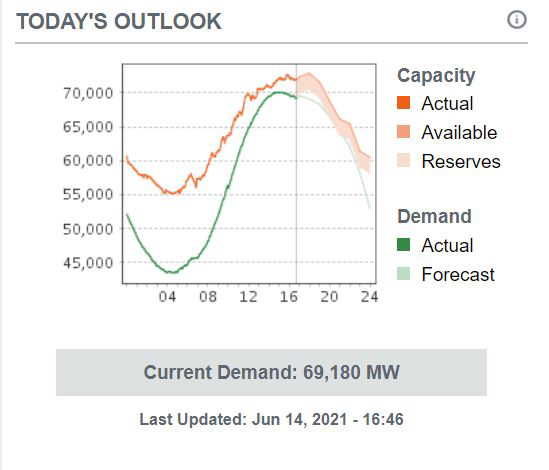
Load leveled off after reaching 69.9 GW during the interval ending at 4 p.m. following the conservation call. That broke the June record of 69.1 GW set in 2018.

ERCOT-System-June-14-(ERCOT)-Content.jpg
Demand plateaued after ERCOT issued its conservation notice. | ERCOT

Staff had forecasted a record demand of 70.1 GW but warned of a 73-GW peak before the conservation call. Temperatures reached triple digits in the Houston area and were in the high 90s elsewhere.

ERCOT said it had been told by generation owners that the number of outages would decrease during the week. Lasher still had some diplomatic, yet tough language for them, saying he found the number of units on forced outages to be “very concerning.”

“We’re not clear why we’re seeing so many unplanned outages at this time. We’ll be looking very hard at which units are offline and why they are offline and when they’ll be back online,” Lasher said. “It’s the responsibility of the generation owners to make sure their plants are available during the peak hours when customer demand is very high during the summer months. My concern is the resource owners need to make sure their plants are available during the summer months.”

February Storm Still a Hot Topic on the Conference Circuit

February’s winter storm, which threw much of the Midwest into a deep freeze and almost created a disaster of epic proportions in Texas, remained a hot topic last week during a pair of industry conferences.

During the Edison Electric Institute’s Road to Net Zero conference, SPP CEO Barbara Sugg discussed lessons learned from “The Big February Freeze” as part of a panel that also included MISO CEO John Bear.

Sugg said SPP staff learned “a ton” from the event, which required them to shed load for the first time in the RTO’s 80-year history. Staff took the normal steps to alert members and stakeholders as to what was coming, but fuel supply issues knocked out more than half of its accredited natural gas resources and a third of its accredited coal resources, she said.

“What we learned from the beginning of the event was monumental,” Sugg said. “We weren’t as good coming into the event as we thought we were. We definitely identified some gaps.”

SPP is conducting a review of its performance during the storm involving members, its Market Monitoring Unit and state regulators. Still, the grid operator has been caught off-guard by the political attention it has received in its 14-state region.

“They all want to have a say in what we do,” Sugg said.

No surprise, but load shed and customer outages have drawn much of the state politicians’ focus.

“We could improve the coordination with how we manage load-shed events,” Sugg said. “SPP has typically not been involved with how that’s managed. There were some challenges at the [transmission owner] level that exacerbated the problem along the way that are worth a look as to whether SPP should have a role in that.”

On Monday, SPP’s Regional State Committee, composed of regulators from its Eastern Interconnection states, met to review its portion of the work. The regulators agreed resource diversity will be a critical part of any solution, but debated who has the responsibility for directing utilities on what their fuel mix should be.

“Someone has to be responsible here,” North Dakota Public Service Commissioner Randy Christmann said.

Noting he spent 25 years in politics fighting for states’ rights, he said, “Between what the states have allowed in the last decades and the utility companies’ decision to join RTOs, a lot of the responsibility has been passed on to us.”

ERCOT’s Jones Looks to Future

Brad Jones, ERCOT’s interim CEO, made a rare public appearance during American Clean Power Association’s CLEANPOWER 2021 virtual summit on Wednesday. He took a glass-half-full approach to the Texas grid’s recovery from what he called a “rather severe winter storm.”

Brad-Jones-(CLEANPOWER-2021)-Content.jpg
ERCOT CEO Brad Jones | ACP

“It’s given us an opportunity to look at ways we can improve ERCOT and the ERCOT market,” Jones said during a keynote address. “My overall goal in my time here at ERCOT is to make sure we do things for not only today and not only the next winter story, but for the future of ERCOT.”

That future will rely heavily on renewables. The grid operator already has about 25 GW of nameplate wind capacity and 5 GW of solar capacity on the ground, Jones said, with another 10 GW of solar generation expected over the next few years. Many of those sites are also co-locating batteries, which moves energy “from the low-value time period to the high-value time period,” he said.

“Batteries … provide an opportunity to balance out the variable generation we receive from solar and wind generation,” Jones said. Noting the ERCOT grid’s lack of hydropower as compared to northern states, he said, “We don’t depend on the snows in Oklahoma to keep our system running. We don’t have the luxury of leaning upon hydro for our renewables. … Batteries will fill that gap for us.”

Monitor: Short-term Focus on Finances

Carrie Bivens, ERCOT’s Independent Market Monitor, used her CLEANPOWER keynote address to compliment the grid operator’s control-room staff for their “heroic job” in preventing the Texas grid from falling into a total blackout when surging demand exceeded available supply during the icy weather.

Carrie-Bivens-(CLEANPOWER-2021)-Content.jpg
Carrie Bivens, IMM | ACP

“As bad as things were those few days, it could have been worse,” Bivens said. “I never want to see it happen again. As an industry, let’s work together to make sure that doesn’t happen again. I never thought I’d see that in my lifetime.”

While the Texas legislature has passed a pair of bills designed to address the lack of weatherization and enforcement capabilities, Bivens said much remains to be done. (See Abbott Signs Texas Grid Legislation into Law.)

“This is one of those big events where there are a lot of points of failure to discuss,” she said. “Going forward, we need to work with the final impact of this event … that’s where we’ll be concentrating in June.”

Bivens pointed out that ERCOT’s prices, capped at $9,000/MWh for more than three days, affected all market participants. Whereas some utilities and generators ended up on the positive side of the money flowing to the market, she said, those same entities were on the losing side as well.

“It’s just a matter of how your generators performed and how well you hedged before the storm,” Bivens said. “It’s not so simple to say generation won and load lost. It doesn’t necessarily work that way.”

Still, she is not ready to pitch scarcity pricing overboard, saying it is essential to ERCOT’s energy-only market. The market designers have determined that $9,000/MWh is the grid operator’s value of lost load, although February’s long-term price caps have triggered an automatic reduction to $2,000/MWh for the rest of 2021.

“I can’t stress enough how important pricing is for this energy-only market. Prices should reflect the value of lost load. It’s not just about incentivizing generators to perform that day or that hour or that interval, but to provide long-term incentives for the generation necessary to keep us moving forward,” Bivens said. “One of the things about regulatory certainty, especially in an energy-only market, is stability of the market. It’s important for decisions being made long-term 20 years out.”

Renewable Advocates Survive Texas Legislature

A CLEANPOWER panel of Texas renewable lobbyists agreed they had dodged a bullet during the recent state legislative session when several bills targeting renewables failed to make it to the governor’s desk.

Now comes the hard part, they say: ensuring the rulemakings that come out of the Public Utility Commission don’t inflict further harm on ERCOT’s renewable resources.

Lynnae-Willette-(CLEANPOWER-2021)-Content.jpg
Lynnae Willette, EDF Renewables | ACP

“What will be done with the legislation? That falls to the [natural gas regulator] Railroad Commission and the PUC,” Advanced Power Alliance CEO Jeff Clark said. “Clearly, the attack that was made on us … will continue to unfold at the PUC. That is a key effort that we are all going to have to engage in.”

Given the new legislation and governance changes at ERCOT and the PUC, the panel was asked when things will return to normal.

“This uncertainty is our new normal,” said Lynnae Willette, EDF Renewables’ senior manager of regulatory and legislative affairs. “We have so much change up high. We have a new PUC, a new ERCOT CEO, a new ERCOT board, a lot of new legislation to implement and a lot of opposition we’re still facing. It’s important for us as an industry to rally and stay engaged.”

“The most important activity is the rulemaking at the PUC,” Clark said, referring to weatherization and a review of the ancillary services market. “There are specific mandates in the legislation, while not what they were, that will include an examination of the services and make sure they encourage a sufficient amount of fossil fuel. Our opponents smell blood in the water, so they’ll be more active in the next legislature.”

ACP Explores Western Transmission ‘Renaissance’

The need for new transmission lines to connect renewable resources to load centers could spur a “transmission renaissance” in the West, speakers said Thursday during the American Clean Power Association’s 2021 conference.

“As many of you know, a great deal of the Western transmission grid was constructed 40 or 50 years ago, well before the western United States became a leader in renewable energy technology,” ACP CEO Heather Zichal said. “Today, Western states are investing in new transmission construction in places like Utah, Wyoming, Colorado, New Mexico, California and Nevada.”

Renewable resources in remote areas need transmission to reach large cities and states with clean-energy mandates.

“We have private developers and utilities that are both spending a lot of time thinking about how to meet that challenge,” said panel moderator Johnny Casana, senior director of U.S. political and regulatory affairs with Pattern Energy. “We might be on the cusp of a Western transmission renaissance.”

Former Colorado Gov. Bill Ritter, head of the Center for the New Energy Economy at Colorado State University, talked about CNEE’s Western Interconnect Regional Electricity Dialogue (WIRED) program, begun last year to offer policy recommendations to Western governors. Promoting regional transmission and resource planning is a primary goal.

“You have the California ISO, and you have the Southwest Power Pool, and in the middle, you have a variety of states and utilities that are not part of a transmission organization or ISO,” Ritter said. States have different climate goals and economic needs, making consensus difficult, he said.

WIRED held working group meetings last year and issued three reports in November on resource adequacy, transmission planning and greenhouse gas accounting. The reports address potential areas of mutual benefit among Western states.

“It wasn’t likely that they would come to common ground on all things clean energy and climate, but that there were avenues forward, pathways on [which we could] have discussion about more regional planning … particularly in a time where there is added emphasis and hopefully added funding for the buildout of infrastructure,” Ritter said.

CAISO CEO Elliot Mainzer said California is focused on readying transmission and distribution infrastructure to connect more than 10 GW of new clean energy resources in the next six years.

“The challenge of transmission in the West is certainly a planning challenge, but even more so it’s a commercial subscription and construction challenge,” Mainzer said. “There are multiple key transmission lines in advanced stages of development in the West. In many ways the map has been drawn, and under virtually all scenarios California will need to import … significant amounts of renewable energy from adjacent states to meet its clean energy goals.

“So, the key question for California and other load-serving entities and resource developers is which of these proposed paths make the most sense in terms of resource access and diversification while further strengthening the economic and environmental value of our interregional market,” he said.

Tx in the Works

Major transmission lines are in the planning or pre-construction stages in the West.

Michael Lamb, senior vice president for transmission at Xcel Energy, said the company filed an application with the Colorado Public Utilities Commission in March to build the Colorado Power Pathway, a $1.7 billion project to connect wind and solar arrays on the plains of Eastern Colorado to cities, including Denver, on the Rocky Mountain Front Range.

The proposal includes more than 600 miles of double-circuit 345 kV lines and four new substations, “bringing roughly 5.5 GW of new renewable energy to our customers in Colorado,” Lamb said. The project “contributes greatly to our corporate objectives” of reducing carbon emission 80% by 2030 and supplying customers with 100% clean energy by 2050.

Xcel was the first large investor-owned utility to make such a pledge. (See Xcel Pledges to Go 100% Carbon Free.)

Berkshire Hathaway Energy owns PacifiCorp and NV Energy, which together supply energy to areas of Wyoming, Utah, Idaho, Oregon, Washington and California and all of Nevada.

The utilities see “transmission as a strong driver right now,” said Christina Hayes, BHE’s vice president for federal regulatory affairs. “It feels like this is a sudden moment that has been in the making for about 15 years.”

The company is pursuing 1,300 miles of high-voltage transmission projects in Oregon, Utah and Wyoming, Hayes said.  “They’re considered local projects, but it’s hard to see how 1,300 miles is local,” she said. “It’s not exactly a small area.”

The Public Utilities Commission of Nevada approved the first phase of NV Energy’s Greenlink Nevada project in March. It consists of a 525 kV line from Las Vegas to the northern part of the state. Planning for a subsequent phase is underway. (See Regulators Greenlight NV Energy’s Greenlink West.)

Nevada Gov. Steve Sisolak signed a sweeping energy bill earlier this month, Senate Bill 448, that contains provisions meant to accelerate construction of the Greenlink project, which would connect solar and geothermal resources to cities in an immense triangle of high-voltage lines. (See Far-reaching Energy Bill Sweeps Through Nev. Legislature.)

“These projects are designed to integrate hundreds of megawatts of renewables that are needed to come on to the system to support decarbonizing the system in a way that is cost-effective for customers and reliable for all involved,” Hayes said.

Resource sufficiency is a key goal after a prolonged Western heat wave caused rolling blackouts in California last August and threatened Nevada, too.

“Next week we’re expecting 115-degree weather in Las Vegas, and so I’m afraid our system is going to be tested again,” Hayes said. “This amount of [new] transmission is needed to provide resources on the system to ensure that we are all able to keep the lights on.”

The long-planned TransWest Express project is getting closer to construction, said Roxanne Perruso, senior vice president and chief operating officer of private developer TransWest Express LLC. The $3 billion project will connect wind farms in Wyoming to Las Vegas, Phoenix and Southern California.

“We’re going to be able to connect some of the best wind resources in Wyoming with some of the biggest load centers in the West,” she said.

“We’ve secured all the major federal, state and county permits and authorizations. We have acquired over 95% of the 732-mile right of way [across Wyoming, Utah and Nevada] and we have 99% of the private land easements,” she said. “We’re completing the transmission interconnection studies and, finally, just this week … we launched our first open solicitation process to allocate capacity on TransWest Express.”

“We’re putting everything in place to start construction next year, and I can’t wait to get out of what I’m going to call the paper phase and get into putting steel in the ground,” she said.

The line is expected to go live in 2025.

Formal Work to Remove MOPR Begins at NEPOOL Markets Committee

ISO-NE, stakeholders and the New England states formally started work on eliminating the minimum offer price rule (MOPR) from the Forward Capacity Market (FCM) at a two-day meeting of the NEPOOL Market Committee last week.

States want to remove the MOPR to eliminate what they see as a barrier to participate in the capacity market for their subsidized resources. But according to a presentation from the RTO, it could also cause “greater uncertainty” for both existing and new unsponsored resources. The uncertainty translates into greater financial risk and, if left unaddressed, potentially have two unintended consequences, it said: failure of the wholesale market to clear new entry when required; and inefficient retirements if capacity prices from markets structured to be competitive are subject to persistent downward price pressure from sponsored resource entry.

In terms of the potential failure to clear new entry, the RTO said to accommodate greater financial risk, “new entry offers will be higher than the cost we have estimated to date for new, unsponsored merchant resource entry.” For example, if the sloped demand curve does not adjust accordingly, the market would procure fewer new resources — and possibly at a higher price — while falling short of the one-in-10 resource adequacy requirement. ISO-NE added that this problem is unlikely to self-correct in the capacity market and would require further interventions.

As for the potential for inefficient retirements, the RTO said the implications of such an outcome are magnified if the resources choosing to shut down permanently are necessary to maintain reliability through an extended clean energy transition. ISO-NE said it is essential to work toward the dual objective of accommodating the entry of state-sponsored resources into the FCM while maintaining competitive capacity market pricing.

In a memo to stakeholders, the New England Conference of Public Utilities Commissioners (NECPUC) and the New England States Committee on Electricity (NESCOE), ISO-NE COO Vamsi Chadalavada said that David Patton of Potomac Economics, the RTO’s External Market Monitor, will help provide “a framework to assess and quantify the uncertainty and accompanying risk that capital markets may impose on new or existing resources in a market without a MOPR when merchant resource investment is necessary.” Chadalavada said Patton would have preliminary recommendations ready by the end of next month.

FirstLight Power, New England Power Generators Association (NEPGA) and Sigma Consultants were among a group that offered initial “conceptual approaches” from the stakeholders’ perspective.

NEPGA’s Bruce Anderson presented that removing the MOPR “without any substitute to evaluate non-competitive offers leaves the FCM at risk of producing unjust rates due to buyer-side market power.” NEPGA wants to develop a buyer-side market power screening tool “that satisfies the legal requirement that market-based rates must be free of the influence of market power to be just and reasonable.”

FirstLight’s Tom Kaslow highlighted that restoring a meaningful retirement signal is fundamental to efficient market function and achieving state policy goals. The benefits of that include climate-aligned reliability where market rules encourage efficient retirements to support outcomes that attract and retain resources needed to meet state policy objectives and balancing resources required to integrate them.

Sigma’s Bill Fowler offered a series of primarily standalone concepts, and while adopting all of them “would be ideal, that is not necessary to achieve much of the benefit.” These include eliminating the retirement track rule, delaying the retirement schedule for later submission, or allowing bids to be updated or withdrawn before auction within constraints set by an Internal Market Monitor review of workbooks.

Brian Forshaw of the Connecticut Municipal Electric Energy Cooperative submitted a white paper proposing replacing MOPR with a minimum balancing resource constraint in the FCM. In addition, Forshaw said New England should consider changing from a “Descending Clock” auction to a “Sealed Bid” structure for settling Forward Capacity Auctions. This approach also avoids challenges of integrating any Forward Clean Energy Market (FCEM) revenues into the FCM, to the extent that the region decides to pursue such that mechanism.

ISO-NE aims to file a proposal to eliminate the MOPR with FERC in the first quarter of 2022 so that changes are in place for FCA 17, scheduled for February 2023.

Massachusetts Clean Peak Energy Standard Off to ‘Slow Start,’ Experts Say

Energy storage experts are surprised by how few resources have qualified to participate in Massachusetts’s Clean Peak Energy Standard program compared to how many they thought were eligible.

“There’s not a lot of supply qualified at this point, and we are seeing those market dynamics on the buy side,” said Katherine Wilson, manager of wholesale electric supply for National Grid, during a panel last week on the Clean Peak Energy Standard hosted by the Northeast Energy and Commerce Association.

In 2020, there were 17 resources operating under the clean peak standard, totaling 37 MW.

The legislature passed the standard in 2018, but 2020 was the first year that utilities were required to comply with it. The standard directs the state’s utilities to procure energy storage generated by renewables to contribute to the grid when demand for electricity is at its highest to reduce emissions and lower ratepayer costs.

If a utility does not fulfill its procurement requirements, it must pay an alternative compliance payment (ACP) to the Massachusetts Clean Energy Center to support energy efficiency programs.

“When there is not a lot of supply, we would likely see an ACP payment,” Wilson said.

Because supply for the standard is low, the money energy storage projects are bringing in through Clean Peak Energy Certificates (CPEC) is high, said Ben Krupp, asset manager of Solar PV for Ameresco.

But it is “hard to read too far down the road on how things will develop,” Krupp said.

The state’s clean peak standard is the first in the country, and the Department of Energy Resources (DOER) is still working out program eligibility and long-term procurement details. Developers like Ameresco generally own an asset through its lifetime, so building projects to serve the program “has to be a reasonable investment long term.”

The methods DOER will use to measure and verify how much the standard reduces load will affect which resources will be eligible for the program and what kind of meter the energy has to come through.

“Even though it may not be the most lucrative program, I think especially for behind-the-meter systems that are going to be coinciding with [the demand response program] Connected Solutions, it’s definitely one we want to prioritize because of it being more financeable pricewise,” Krupp said.

Clean peak resources can participate simultaneously in the Connected Solutions incentive program. Co-participation is also allowed for solar and storage projects in the Solar Massachusetts Renewable Energy Target Program, but the CPECs would be owned by the utility.

“This is a complex program,” said Shawn Jones, managing director and head of storage development for BlueWave Solar. “We are all anxious to figure out this first set of CPECs.”

BlueWave develops community solar projects, so it is focused on siting projects where they can “serve the greater good,” he said.

As a former administrator for the Massachusetts Offers Rebates for Electric Vehicles (MOR-EV) program, Jones remembers when a new Tesla model caused rebates to skyrocket in 2018 because there was a spike in the number of eligible vehicles.

Jones is concerned about a similar phenomenon happening with the clean peak program.

“If we have larger assets and we’re developing projects anywhere from 5 MW to 200 MW, it takes a lot longer to interconnect those projects than smaller, aggregated projects,” he said. “We’re making sure we’re following closely and understanding what the program will look like two years from now.”