New regulatory frameworks for utilities in Massachusetts should include upfront public participation in decisions about energy infrastructure, rather than seeking feedback after the fact, former undersecretary of energy Barbara Kates-Garnick said on Thursday.
Otherwise, she said, the state will spend money on opposition lawsuits instead of the programs that will help Massachusetts reach its urgent climate goals.
“We think we have a public process for engagement of stakeholders, but we don’t,” Kates-Garnick said at a think tank hosted by Attorney General Maura Healey’s office. Communities that are overburdened the most by pollution end up having to oppose projects instead of being part of the development process.
The state’s new climate law, signed in March, is forcing state agencies to rethink regulatory frameworks to decarbonize the economy by 2050.
At the center of those changes is a “renewed understanding of the importance of equity and justice,” said Dale Bryk, director of state and regional policy at the Harvard Environmental and Energy Law Program, at the think tank.
The AG’s office organized a panel of policy experts and practitioners to help regulators think about how they will manage a declining fossil fuel system and reform regulations to make it happen.
But the current regulatory process is “expensive and opaque to those who are the most impacted by it,” Kates-Garnick said.
Without early input from environmental justice communities, the Department of Public Utilities (DPU) runs the risk of leaving those communities behind in the electrification process and putting the cost of maintaining the gas distribution system on their shoulders.
The climate bill mandates emissions reductions for specific sectors, including natural gas. The emissions cap will decrease over time, forcing state agencies to shift away from the fossil fuel and electrify home heating, cooling and cooking.
Public housing should be electrified first, Bryk said, because it will be the hardest building segment to decarbonize.
State agencies don’t need to delve into the details of projects too deeply to garner public feedback, but there should be a process, such as facilitated workshops, to educate people and help them be constructive participants in energy planning. Doing so will avoid litigation and protests down the road “because we got the rules right,” Bryk said. “We have these [hurdles] now because the rules are wrong.”
The workshops should include gas utility workers and labor organizations, said Mike Henchen, principal of Carbon-Free Buildings. Gas utilities are highly unionized, and the DPU will need to understand the implications that decarbonization will have for employment opportunities across the state.
Beyond retraining programs, there is a “huge world of benefits we should have our eye on” when it comes to program funding for decarbonization, Bryk said. The transition is a positive for reasons beyond mitigating climate change, which is important for workers to understand. It will “get gas cooking out of smaller, less well-ventilated housing units,” and lead to appliance upgrades, Bryk said.
The first step for state commissioners, she added, is to see if they can build agreement with utilities, labor organizations, environmental justice communities, the building sector and a broad swath of stakeholders on the principles their plans should meet moving forward.
To engage with stakeholders effectively, state leaders need to meet them where they are, Kates-Garnick said. “Where we hold the conversation is equally important as the conversation we hold.”
President Biden’s nominees to fill two top federal cybersecurity posts on Thursday emphasized the urgency of coordinating across the government to strengthen the nation’s cyber preparedness.
“If the past year has taught us anything, it is the obligation we have as leaders to anticipate the unimaginable,” Jen Easterly, nominated to head the Department of Homeland Security’s (DHS) Cybersecurity and Infrastructure Security Agency (CISA), told the Senate Homeland Security and Governmental Affairs Committee. “While the digital revolution of the past several decades enabled unprecedented growth and innovation, the increasing connectivity also introduced great peril.” (See Biden to Name Morgan Stanley’s Easterly as CISA Head.)
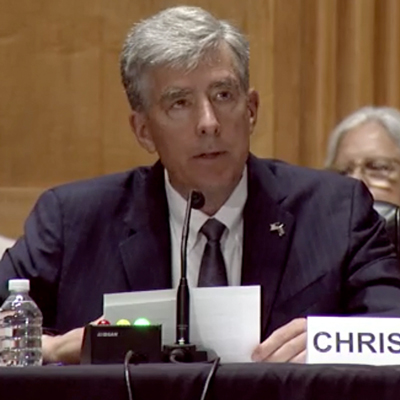
Chris Inglis, nominee for National Cyber Director | U.S. Senate
Joining Easterly at Thursday’s hearing was Chris Inglis, a retired Air Force brigadier general and former deputy director of the National Security Agency whom Biden nominated as the first National Cyber Director in the Executive Office of the President, and Robin Carnahan, Biden’s nominee for administrator of the General Services Administration.
Easterly and Inglis “are both firsts for this committee,” chairman Gary Peters (D-Mich.) noted in his opening remarks, referring to the fact that the committee has not held confirmation hearings for either post before. CISA’s founding director Chris Krebs did not require a hearing because he was already confirmed in his previous role as head of the agency’s predecessor when CISA was formed in 2018, while the National Cyber Director position was created just last year by the 2021 National Defense Authorization Act.
Senators Warn of Redundant Roles
Peters also remarked on the novelty of Inglis’ position during the hearing, pressing him to define the responsibilities of the new post and how he would avoid redundancy between his planned “Cyber Directorate” and established government organizations like CISA — a question on the minds of several other lawmakers.
Sen. Gary Peters (D-Mich.) | U.S. Senate
Inglis explained that he hoped to be a coordinating force across the cybersecurity landscape, bringing “coherence [and] unity of purpose across what are already impressive, deep and sharp capabilities within the federal enterprise.” He also expressed the desire to extend these collaborations into the private sector, creating a coherent cyber response strategy among all major stakeholders.
“I think that the premise for us within the United States and like-minded nations must increasingly be that if you’re an adversary in this space, you have to beat all of us to beat one of us. The National Cyber Director needs to make that true,” he added.
Easterly was also challenged to define her agency’s role and how she would avoid butting heads with Inglis and other federal cybersecurity players. In her opening remarks, Easterly characterized CISA as a “quarterback … leading asset response for cyber incidents” under the direction of the Cyber Director as a “coach … overseeing the implementation of cyber strategy and policy.”
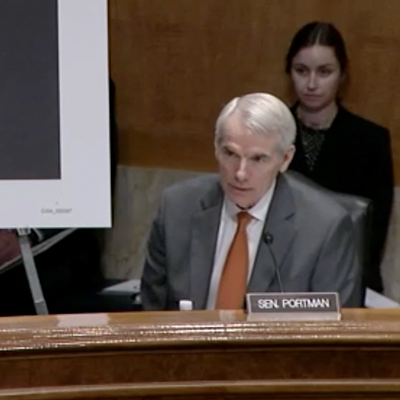
Sen. Rob Portman (R-Ohio) displaying a graphic received from CISA purportedly showing the mission needs of the agency’s Einstein program, with the entire content redacted. | U.S. Senate
This prompted ranking member Rob Portman (R-Ohio) to jokingly ask, “What’s the Deputy National Security Advisor? Is that a defensive player, a linebacker?”
“All joking aside,” Portman continued, “we have a real opportunity here, with real experts coming into these jobs, to be able to be sure we’re not duplicating efforts. And frankly, without … ultimate accountability, if everyone’s in charge, no one’s in charge.”
“I … agree with you that accountability is critical,” Easterly responded. “If I’m confirmed, I would expect you and [DHS Secretary-designate Alejandro] Mayorkas to hold me accountable for the very specific operational mission that CISA has, to manage and mitigate risk to our digital and physical critical infrastructure.”
Portman also took the opportunity to complain to Easterly about what he considered a lack of communication on CISA’s part. As an example he presented a printout of a document the committee recently received from the agency, in response to a request for information about CISA’s EINSTEIN threat reporting system, noting that the entire document was blacked out. Portman called this “not terribly useful” and urged Easterly to improve the agency’s responsiveness if confirmed.
“I absolutely believe in the strong oversight role that this committee has, and if confirmed, I would 100% commit to doing everything I possibly can to make sure that you get all of the information that you need to perform those important oversight roles,” she replied.
Nominees Address Cyber Talent Gap
Another major concern at the hearing was the cybersecurity talent pool. Senator Alex Padilla (D-Calif.) noted that the International Information System Security Certification Consortium’s 2020 Cybersecurity Workforce Study found that the U.S. cybersecurity gap — the difference between the number of skilled professionals that organizations feel they need to protect critical assets and the number of skilled workers available — stood at 359,000 last year, and asked for the nominees’ recommendations for boosting the nation’s talent level.
Sen. Alex Padilla (D-Calif.) | U.S. Senate
“We have found that the pipelines aren’t generating enough, either in the diversity [of talent] or in the literal numbers,” Inglis said. “We need to actually work those pipelines [and] start as early as possible, K through 12, creating awareness on the part of those up-and-coming students about what the possibilities are to take on very viable careers.”
Inglis also suggested rethinking “what the fundamental qualifications are to take one of these jobs,” noting that requiring university degrees may keep talented applicants out of positions for which “good critical thinkers [and] people who’ve got a good work ethic” are best suited.
The U.S. cannot afford to spin its wheels in developing its domestic supply chain for electric vehicles and the lithium-ion batteries that power them, say two new reports — one from Bloomberg NEF and the other from the White House.
Zeroing out transportation emissions by 2050 will require getting 218 million EVs on the road worldwide by 2030, says the BNEF Electric Vehicle Outlook 2021. But in a business-as-usual scenario with no major policy changes, the 2030 global fleet could max out at 169 million EVs, the report says.
At just 12% of the global market, the U.S. is already running a distant third behind China and Europe in EV adoption and is not expected to catch up, the report says, even with a growing number of “more compelling local models” on sale, along with incentives and other policy initiatives.
Annual EV Sales by Region | Bloomberg NEF
China’s leading role in battery production is also a key concern in the White House analysis of the need for federal action to help build out an extensive U.S. supply chain for lithium-ion batteries, which is part of a larger study on building resilient supply chains and revitalizing American manufacturing.
“It is critical for the United States to leverage our leading position in research and development (R&D) of new technologies with a comprehensive set of domestic and international initiatives to accelerate commercialization throughout the battery supply chain,” the report says. “This strategy would translate to well-paying jobs throughout the United States and represents a once-in-a-generation opportunity to position the United States as a global leader in the manufacturing of energy storage materials and technologies to protect both the environment and our economic and national security interests.”
Citing figures from the Department of Energy, the report says that jobs in the U.S. EV market grew from 198,000 in 2016 to 242,700 in 2019.
President Biden has been bullish on the need for the U.S. to win the global EV market, which the BNEF report estimates will be worth $7 trillion between now and 2030 and $46 trillion by 2050.
The challenge, the White House report argues, is that the playing field in global EV markets is far from even. The European Union has set a goal of having 30 million EVs on the road by 2030, and individual countries, such as the United Kingdom and Germany, are providing a range of incentives to spur sales, as well as government support to build domestic supply chains.
“China has positioned itself as a market leader in the manufacturing supply chain through the practice of questionable environmental policies, price distortion, state-run entities that minimize competition, and large subsidies throughout the battery supply chain,” the report says.
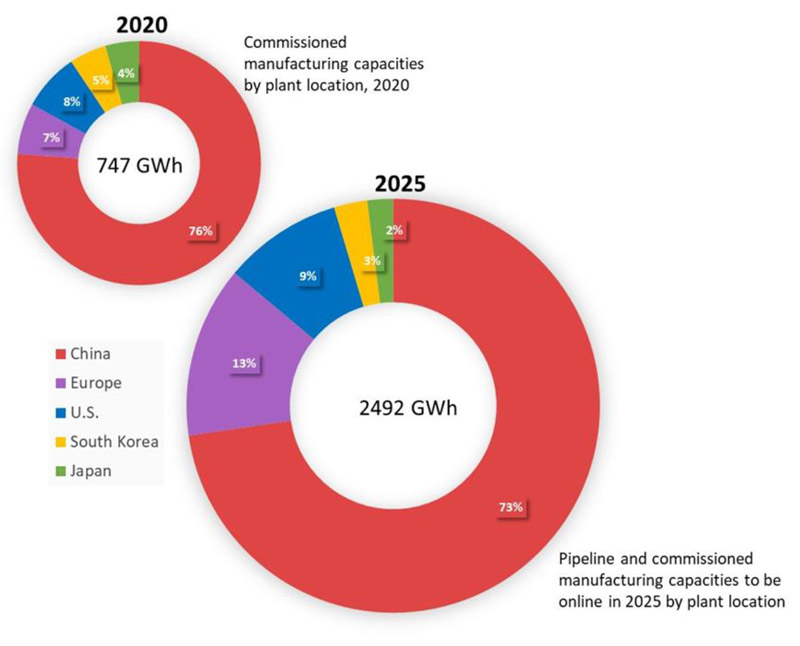
For example, the report projects that by 2025, China will account for 73% of global battery cell manufacturing, down just 3% from its 76% market share in 2020. Citing figures from Bloomberg, the report also notes that a U.S. EV market dependent on batteries manufactured abroad could result in import costs of $100 billion by 2040.
‘Fully Circular Industry’
BNEF calls for an “immediate increase in policy action” to bend the worldwide EV adoption curve toward net zero, especially in the medium- and heavy-duty vehicle sector where, the report says, 95% of all truck sales will need to be zero-emission by 2040.
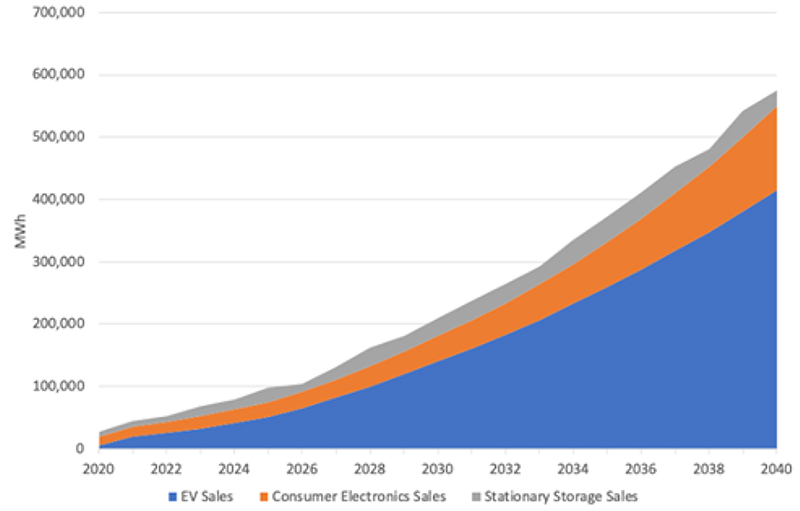
In terms of the battery supply chain, BNEF’s business-as-usual scenario anticipates global demand will grow 15-fold to 2,576 GWh by 2030. A net-zero scenario will require “universal battery recycling,” without which demand for lithium will exceed supply by 2050. A “fully circular battery industry” would provide a “supply of recycled lithium exceeding total annual demand by midcentury,” the report said.
Projected U.S. Battery Demand | Bloomberg NEF
Building a domestic supply chain in the U.S. will depend first on guaranteeing domestic demand, which is where the recommendations in the White House report begin, drawing on policies and priorities already outlined in Biden’s infrastructure plan and budget. Electrifying the federal, state, local and tribal fleets tops the list, with funding initiatives that would also support using domestically manufactured batteries.
Electrifying the 640,000 vehicles in the federal fleet would support 64 GWh of domestic battery production, while state, local and tribal fleet electrification would add another 200 GWh of demand for U.S. manufacturers, the report says. Procurement of stationary batteries for federal facilities should also be leveraged to build domestic manufacturing.
Cell manufacturing capacities | Benchmark Mineral Intelligence
But, domestic manufacturing, in turn, depends on a domestic supply of raw materials and processing capability. The White House report says the U.S. Geological Survey estimates the U.S. has 21 million tons of “economical lithium reserves in various forms.” It also cites a number of lithium extraction projects under way, such as the Rio Tinto demonstration plant in California, which is producing lithium from mining waste. If successful, the plant could be scaled to produce 5,000 tons of lithium per year, the report says.
Other recommendations include:
increased support to the USGS to improve resource mapping to help with policy and decision making;
investment in research, development and commercialization of technologies that improve lithium yield and processing and could be licensed to international customers; and
establishment of a national battery recovery and recycling program, with targeted incentives to increase recycling.
Similarly, the report calls on Congress to “establish a cost-sharing grant program to support cell and pack manufacturing in the United States. This model helps entrepreneurs who do not have the ability to access tax credits in the short run while ensuring the taxpayer shares in the upside of the investment.”
Losers and Winners
The BNEF report is heavy on numbers but also contains some interesting and unexpected insights. It notes that sales of passenger vehicles powered by internal combustion engines peaked worldwide in 2017 and are “now in permanent decline.” Although passenger EVs only account for 1% of global auto sales at present — about 12 million on the road — the report expects a more than four-fold increase to 54 million by 2025.
The gasoline industry is the big loser here. BNEF says gasoline consumption has already peaked in the U.S. and Europe, with a global peak coming in 2027. Even in the business-as-usual scenario, EVs and fuel cell passenger vehicles cut oil demand by 21 million barrels per day by 2050.
For government, this transition will mean a loss of tax revenues from fuel sales and the need to plan ahead. “Politically acceptable solutions for this will vary by region,” the report says.
The electric power industry gets a substantial boost, with global demand up 9% by 2040 in a business-as-usual scenario and 14% in net-zero — with the largest increase in demand coming from medium- and heavy-duty trucks. Full decarbonization of transportation would increase global electricity demand by 8,524 TWh by 2050, the report says.
BNEF also suggests that, over time, battery packs could get smaller, which could ease supply chain demand for critical minerals.
“There is a strong argument for governments investing heavily in public EV charging infrastructure networks because denser networks can help enable much smaller battery packs, leading to further economic and environmental benefits. Switching to vehicle regulations based on life cycle emissions could also help push the market to smaller battery packs,” the report says.
But the report also believes EVs are not the only way to get to net-zero emissions in transportation. “Investments in public transit and active mobility [such as walking or bicycling] are an important part of the solution mix for net zero, as they can reduce demand for vehicles and vehicle miles, while also delivering a public-health benefit. Even a modest 10% reduction in total kilometers traveled by car globally in 2050 can make the task of achieving net zero much easier.”
Organizers of the Edison Electric Institute’s Road to Net Zero conference knew the kind of “get” they had for their closing session Thursday. It was Sen. Joe Manchin (D-W.Va.), chair of the Senate Energy and Natural Resources Committee and a vote President Biden can’t afford to lose in the 50-50 Senate.
As EEI President Tom Kuhn observed, “If any clean energy legislation makes its way through Congress to the president’s desk, Sen. Manchin will have a lot to say about that.”
During an interview by American Electric Power (NASDAQ:AEP) CEO Nick Akins, taped in the committee’s hearing room, Manchin ruminated on power and the legislative process and shed some light on his legislative discussions with the White House.
He also called for speeding up infrastructure permitting and preventing nuclear plant retirements. He made a pitch for legislation he and Sen. Debbie Stabenow (D-Mich.) introduced in March to provide incentives to manufacturers of advanced energy technologies that invest in rural communities that have lost manufacturing and traditional energy sector jobs.
He also expressed opposition to widespread deployment of electric vehicles by 2035, saying supply chain issues would make the U.S. vulnerable to China and other nations. “I know there’s a change coming, OK? But I’ve always been very, very cautious about this. I have spoken out pretty loudly about it. I’m concerned that they’re setting a very aggressive timetable,” he said.
And he said the federal government shouldn’t be spending billions to install EV charging, though he would support low-interest loans to leverage private investment. “We can do something, but we don’t have to give it away,” he said. “We’re trying to filter that out: What would the market do? What won’t it do? The government should not be giving tax dollars away. I have a little bit of a difference, and I’m working with the White House on that.”
“I believe that Joe Biden is just really a good person. He has more knowledge about how the place is supposed to work than any president we’ve had since Lyndon Johnson,” Manchin said. “He’s been here 36 years. He understands, so when I talk to him, he knows what I’m going through. He understands the challenges that we have.”
“Especially you,” Akins laughed, perhaps referring to Manchin’s status as a Democrat in a heavily red state.
“He’s been very, very understanding, and I appreciate that very much,” Manchin continued. “And he has a vision. And he wants to go big. But there has to be a balance. … We cannot continue to put this much debt on. … Both [parties] have been horrible. Both sides have been irresponsible.”
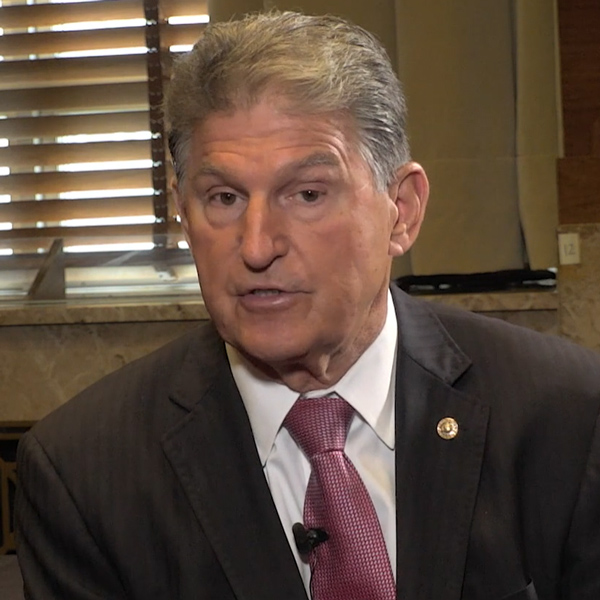
Sen. Joe Manchin (D-W.Va.) | Edison Electric Institute
Manchin said climate change advocates should be working to persuade foreign countries to use the kinds of emission controls U.S. coal plants have deployed rather than forcing the closing of the remaining U.S. plants.
“I just remind people all the time, this is called global climate. It’s not West Virginia climate. It’s not North American climate.” He said there are 504 coal-fired plants in the U.S. and 6,600 worldwide with more than 1,000 more under construction. “There’s 7,600. We have 504. Now come on. Be realistic.”
Asked about the prospects for getting climate change legislation through a Congress as bitterly divided as the current one, Manchin said, “The hardest thing is to get people to [agree] on the same set of facts. … We can agree that we want a cleaner environment and we have a responsibility and climate change is real. For anyone who’s still [climate change] deniers, they’re not going to be active in the decision-making process because they’re already set in their ways.”
He reiterated his support for the regular legislative process with committee markups to consider amendments and further amendments on the Senate floor. He repeated his vow that “I’m not going to blow this place up,” in an apparent reference to his opposition to eliminating the filibuster.
Manchin grew philosophical as he acknowledged his pivotal role in the divided Senate. “I’ve seen people who had power and abused it. And I’ve seen people who sought power destroy themselves by trying to obtain it. And then there’s a moment in time when you have a chance to make a difference. If I can bring the country together and make the process work in this committee room — we’re going to see if we can make it work. If that’s my moment in time, I think it’s well worth it.”
Interim CEO Brad Jones this week offered ERCOT’s Board of Directors a sneak peek of his 100-day strategic plan, which he said will be rolled out publicly later this month.
The plan consists of three elements designed to reinforce confidence in the grid operator’s ability to operate reliably and effectively, following February’s near-collapse during arctic conditions. Jones said he had been holding onto the plan until the Texas Legislature completed its session and passed its grid-related bills.
“Rest assured a lot of the elements in the plan are being worked on or are already complete,” Jones said during his report to the board Tuesday. “Our goal is to make this the most favored grid in the nation.”
The board meeting was briefly adjourned to allow Jones and Public Utility Commission Chair Peter Lake to attend a signing ceremony for the legislation. (See Abbott Signs Texas Grid Legislation into Law.)
The plan consists of:
restoring trust and confidence in ERCOT and returning to stability;
cooperating and communicating “thoughtfully and purposefully” through multiple channels; and
evaluating technical processes within ERCOT and then innovating through dialogue, technical leadership, engagement and expertise.
As an example of the last point, ERCOT recently announced a new flexible work policy it hopes will improve recruiting and retention efforts. Employees will have the option of working at either the grid operator’s facilities, from home anywhere in Texas, or a combination of both. Operators and other staff required to be on-site will continue to report to their offices.
Jones said almost half the staff indicated a desire to spend at least a few days in the office, and he said stay-at-home policies during the pandemic allowed ERCOT “to work through security issues.”
“We’ve been working remotely for a little over a year,” he said. “We’re now just stabilizing that with policies.”
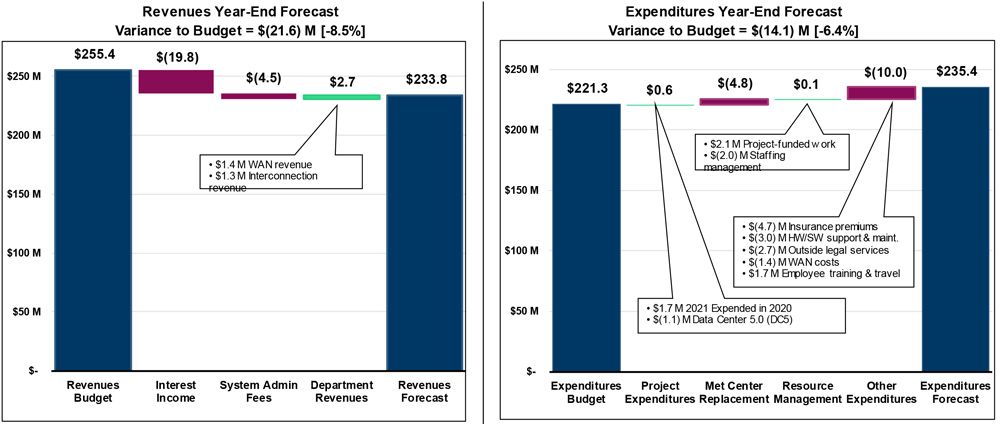
Jones said ERCOT faces pressures on its revenues, which are down 8.5% ($21.6 million) primarily because of a $19.8 million shortfall in interest income. The grid operator’s 2020-2021 budget was approved more than two years ago, before interest rates were pummeled by the COVID-19 pandemic.
The system administrative fee is off another $4.5 million because less load is being served. With expenditures more than $14 million over budget, ERCOT is looking at a negative net available year-end variance of $35.7 million.
2021 to be Hot, but not as Hot
ERCOT meteorologist Chris Coleman assured directors that the grid is unlikely to see a repeat of 2011’s long, hot and dry summer.
“Every year since I’ve been here, I’ve been asked, ‘Are we going to have another 2011?’” said Coleman, who joined the grid operator in 2012.
As happened 10 years ago, an intense La Niña led to a relatively mild and dry winter — with the exception of extreme winter weather in February that led to grid emergencies. Those events were the two coldest periods this century, Coleman said.
The difference this year is that while the spring of 2011 was the hottest and driest on record, dating back to 1895, this year’s spring has seen sometimes record-breaking rainfall in much of the state, “almost completely the opposite of 2011,” Coleman said.
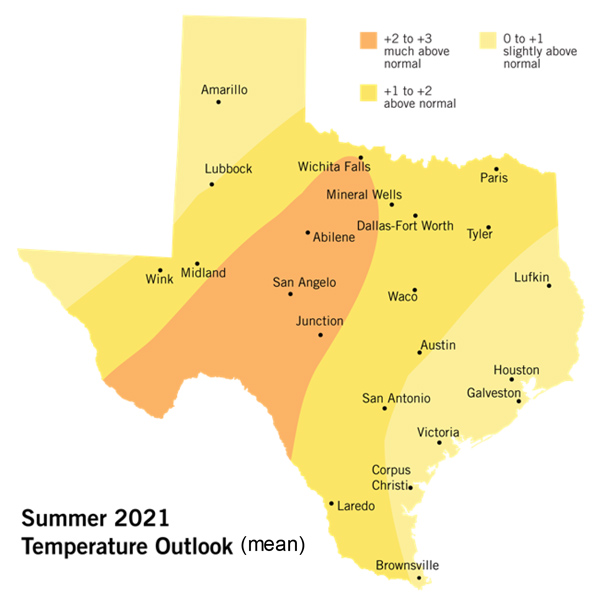
ERCOT’s weatherman is expecting slightly warmer temperatures for the state this summer. | ERCOT
“I had increasing concerns the similarities would carry over into the summer. Any summer, especially in Texas, is enhanced when the ground is dry,” he said. “Right now, a majority of the state is moist and has green grass. It’s very likely the ingredients for 2021 are not there to surpass 2011.”
Coleman expects this summer to rank between the 15th and 35th hottest summers. He said portions of West Texas show the highest potential for a hotter-than-normal summer, with Dallas expected to record more 100-degree days than the state’s other large cities.
With the past decade being the warmest in history, Coleman said, “that raises the bar for what is above normal in Texas.”
With sea temperatures running above normal over most of the Atlantic Basin, Coleman said, the hurricane season is expected to be among the most active. Forecasters project 18 named storms and eight hurricanes this year, with five listed as Category 3 or greater. Coleman warned directors they could be watching a storm in the Gulf of Mexico next week.
Staff Confronts Credit Issues
Kenan Ögelman, ERCOT vice president of commercial operations, said the market has reduced its short pays by about $30 million as of May 27, leaving an aggregate total of $2.991 billion.
ERCOT has seen an increase in ongoing non-payment of invoices from active market participants and less funds from participants on payment plans, he said. Applications of payments from short-paying market participants has also dropped.
ERCOT is facing a $35 million negative variance this year. | ERCOT
“Entities that stay in the market fall into two categories,” Ögelman said. “There are the ones that have nowhere to go, and the others are those that have agreed to stay on payment plans. As long as they meet the requirements of the payment plan, they are allowed to participate in the market.”
Staff are waiting to see what comes out of several securitization bills that passed the legislature. Customer-financed bonds will be issued to pay back billions in energy costs over 20- to 30-year periods. (See Securitization Offers Texas a Way Forward.)
“It’s critical to wait and see and follow the lead of the commission and other entities that have governance over the implementation of the bills before we decide to do anything,” Ögelman said.
Securitization will at least delay the need to uplift the market’s debt to all participants. Under ERCOT protocols, default invoice amounts are capped at a monthly total of $2.5 million, which would take almost a century to complete.
“With securitization, we would pay back short pays faster than the uplift process,” Ögelman said.
Fitch Ratings said Tuesday the coming months will be critical for the Texas grid’s public power utilities. The ratings agency in February placed 19 ERCOT-based utilities on negative watches shortly after the winter storm. Fitch has downgraded five and affirmed five so far and said it expects to resolve the negative watch on the remaining utilities and electric cooperatives by summer’s end.
“Increased pressure on operating costs is likely for ERCOT utilities as storm costs, winterization investment and market risk premiums are factored into energy prices,” Senior Director Kathy Masterson said in a release. “Downgrades are still possible for some ERCOT utilities if any plan approved by a city council or board of directors fails to recover costs on a timely basis, moderate effects on leverage or preserve liquidity.”
LP&L Transfer ‘Without a Hitch’
Jones told the board that the transfer from SPP of 70% of Lubbock Power & Light’s load, about 470 MW, “went off without a hitch” over the Memorial Day weekend. He complimented LP&L, Oncor and ERCOT staff for working “very closely together” in successfully completing the largest single transfer of customers in the grid operator’s history. (See Six Years in the Making: LP&L Migrates Load to ERCOT.)
“We’re very happy to have Lubbock join the rest of the republic,” said Jones, a West Texan. It was a reference to the Republic of Texas, a sovereign state that preceded the state’s entry into the U.S. in 1846.
Next up: migrating the remaining 30% of Lubbock’s load into ERCOT. Lubbock officials have approved terminating a contract with Southwestern Public Service for the remaining customers, setting up their possible move to the Texas grid by the summer of 2023.
“We’re very encouraged by that,” Jones said.
Tamby, Hobbs Earn Promotions
The directors ratified two promotions involving ERCOT’s leadership: Chief Administrative Officer Jeyant Tamby will serve as Jones’ chief of staff, and Kristi Hobbs was elevated to vice president of corporate strategy and Public Utility Commission relations.
Hobbs, who previously served as director of enterprise risk management and strategic analysis, will be responsible for strengthening the collaboration between the grid operator and the PUC, in addition to her current responsibilities, as well as project and portfolio management, business continuity planning, market rules development and the stakeholder process.
Following a marathon executive session that ended at 6:04 p.m. on Tuesday, the board also voted to approve hiring a search firm to find a permanent CEO.
ESR Measure Approved
In a one-off vote, the board approved an urgent nodal protocol revision request (NPRR1075) that allows energy storage resources (ESRs) to participate in grid reliability this summer.
The NPRR allows ESRs to update their high sustained limit (HSL) and/or maximum power consumption (MPC) in real time to maintain sufficient energy to meet an ancillary service resource responsibility. The carveout for ESRs will expire when either real-time co-optimization goes online or a mitigated offer cap for ESRs is implemented.
Gerdau Steel’s Sam Harper, representing industrial consumers, cast the lone vote against the measure on behalf of two of his segment members, who opposed it during the Technical Advisory Committee’s meeting in May. The industrials wanted to see more analysis and discussion before making the change.
The directors unanimously approved five other NPRRs previously endorsed by the TAC along with an other binding document revision (OBDRR) and single changes to the load profiling (LPGRR), nodal operating (NOGRR), planning (PGRR) and retail market (RMGRR) guides:
NPRR979: incorporates the OBDs’ “state estimator standards” and “telemetry standards” into the protocols.
NPRR1062: changes the metering requirement for premises connected at transmission voltage and/or with a peak demand greater than 700 kW/700 kVA from an interval data recorder (IDR) meter to one that also includes advanced meters. The change also eliminates the IDR meter requirement report.
NPRR1064: conforms ERCOT’s as-built systems protocol language with respect to the evaluation and reporting of chronic congestion. The revision also clarifies the grid operator’s expectations and processes for the verification of modeling information for elements included in the chronic-congestion report.
NPRR1071: modifies the threshold for retail electric providers’ (REPs) participation in the annual survey of aggregate customer counts from 95% to 98%; the timing requirement for REPs to provide information to ERCOT regarding demand response deployments from Oct. 15 to Oct. 31; and the posting date for the final report from Dec. 15 to Dec. 31.
NPRR1074: changes the definition of “mp” in the credit default allocation calculations substituting “existing” for “non-defaulting.”
LPGRR068: adds two new PROFILETYPECODEs for use on premises billed on a four-coincident peak (4-CP) where transmission and/or distribution service providers can support a 4-CP billing rate with an advanced metering system profile: BUSLRG will be for premises without distributed generation and BUSLRGDG for those with DG. The existing BUSIDRRQ will remain an option for premises billed on a 4-CP tariff.
NOGRR199: realigns references to state estimator and relevant telemetry standards with their move from OBDs to the protocols.
OBDRR029: modifies the Demand Response Data Definitions and Technical Specifications OBDRR’s Excel templates in Appendix B (NOIE Submission File Template) and Appendix C (REP Event File Template) to clarify that electric service identifier numbers are to be provided instead of ESI ID lists. Also combines error descriptions and suggested fixes into a single table.
PGRR088: includes the financial security amount necessary to fund the interconnection facilities in the monthly generator interconnection status report.
RMGRR164: removes language from the guide predating the implementation of advanced metering systems (AMS). It defines the business rules and processes to be followed when transitioning a customer from an IDR meter to an AMS profile type.
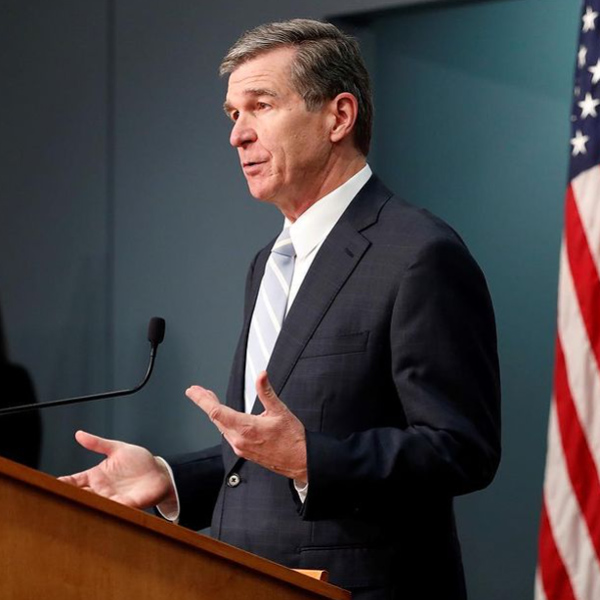
North Carolina Gov. Roy Cooper (D) issued an executive order Wednesday setting an offshore wind target of 2.8 GW by 2030 and 8 GW by 2040, citing both the state’s clean energy goals and economic development opportunities.
Cooper said the development would help the state reduce greenhouse gas emissions while claiming a share of the estimated 85,000 jobs and $140 billion in OSW capital expenditures along the Atlantic Coast by 2035. The state’s Clean Energy Plan calls for a 70% reduction in power sector GHG emissions from 2005 levels by 2030 and carbon neutrality by 2050.
Cooper emphasized that wind farms “can coexist with North Carolina’s military installations,” which he noted are responsible for 600,000 jobs and contribute $70 billion annually to the state’s economy. “The leadership of this state … would not jeopardize these important military installations,” he said.
Cooper directed the state departments of Commerce, Environmental Quality and Military and Veterans Affairs to coordinate OSW efforts and work with the Pentagon and the federal Bureau of Ocean Energy Management (BOEM). The state agencies will coordinate their work through the existing Offshore Wind Interagency Workgroup.
Cooper also ordered creation of the Taskforce for Offshore Wind Economic Resource Strategies (NC TOWERS) to advise the state’s efforts, with representatives from state and local government, the OSW industry, economic development, military, higher education, environmental protection and the marine and tourism industries.
The state also will seek to develop the supply chain for the projects through the Southeast and Mid-Atlantic Regional Transformative Partnerships for Offshore Wind Energy Resources (SMART-POWER), a partnership announced last October with Maryland and Virginia. (See Md., NC, Va. to Team up on Offshore Wind.)
Duke Energy, the state’s largest utility, included offshore wind in two of the potential pathways in the integrated resource plan (IRP) it submitted to the North Carolina Utilities Commission in September.
Three Wind Energy Areas
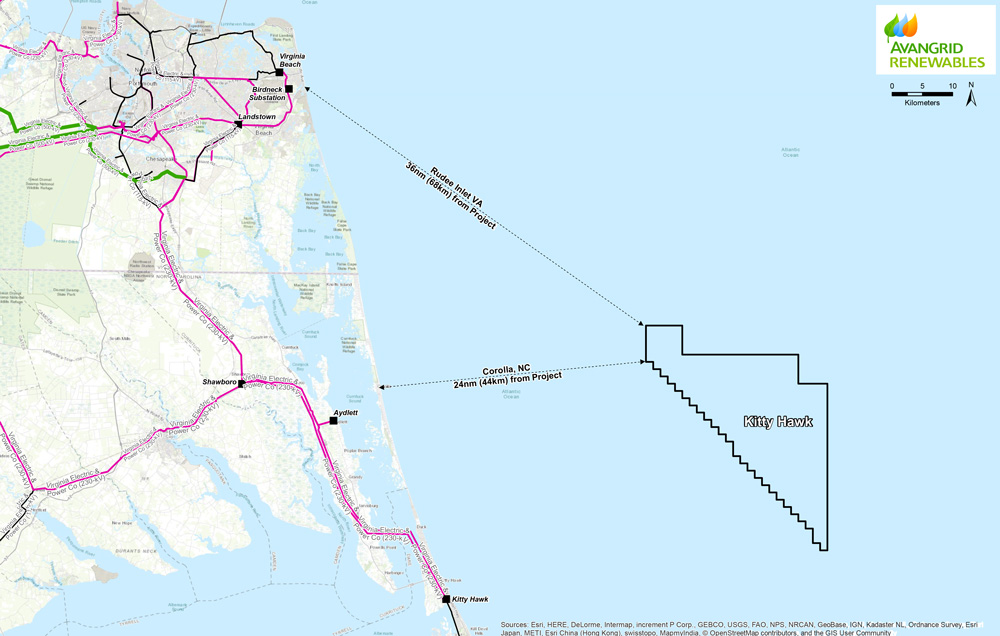
BOEM has identified three wind energy areas (WEA) off the state’s coast. In 2017, it awarded a lease for the Kitty Hawk WEA to Avangrid Renewables (NYSE:AGR), a 122,405-acre site the company says has capacity for 2.5 GW. Construction is expected to begin in 2025.
The Wilmington West WEA (51,595 acres) and Wilmington East WEA (133,590 acres) have not been leased, but a BOEM spokesperson told NetZero Insider Thursday the agency is planning an auction in the Carolina Long Bay region, which includes the WEAs, next year.
Avangrid Renewables won the lease for the Kitty Hawk wind energy area and hopes to begin construction in 2024. | Avangrid Renewables
The spokesperson said BOEM’s decision on future auctions will be informed by the Regional Carolina Long Bay Intergovernmental Renewable Energy Task Force, ocean users, and other stakeholders.
The Southern Alliance for Clean Energy said 8 GW of OSW would power more than 2 million homes, about one-fifth to one-quarter of the state’s total electricity demand. The group said the three existing WEAs could produce up to 6 GW of OSW, meaning new areas will need to be identified and leased to meet the goal.
President Biden has set a goal of adding 30 GW of OSW nationwide by 2030. On Tuesday, BOEM announced plans to assess potential OSW development on the Outer Continental Shelf in the Gulf of Mexico. In May it announced plans to offer leases for California’s first offshore wind areas. (See BOEM to Offer Leases for Calif. Offshore Wind.)
But OSW is expected to grow first along the Atlantic coast as New York, New Jersey, Massachusetts, Virginia, Connecticut, Maryland and Rhode Island have set OSW targets totaling more than 30 GW.
“Offshore wind can be a significant part of North Carolina’s transition to clean energy, as long as it is carefully developed to protect sensitive marine and coastal environments, from endangered whales and fisheries to onshore wetlands,” said Derb Carter, North Carolina Office director for the Southern Environmental Law Center, after Cooper’s announcement. “However, we need urgent action to reduce carbon pollution today and the multi-year process for wind will not achieve this, even though it is an important part of a long-term clean energy plan for our state.”
Carter asked Cooper to support her group’s petition for rulemaking seeking to have North Carolina establish a CO2 trading program and join the Regional Greenhouse Gas Initiative. The North Carolina Environmental Management Commission’s Air Quality Committee will hold a hearing on the petition, filed on behalf of Clean Air Carolina and the North Carolina Coastal Federation, June 15.
Xcel Energy’s Public Service Company of Colorado is postponing its efforts to join CAISO‘s Western Energy Imbalance Market after one of its partner utilities in a joint dispatch agreement decided to join SPP’s Western Energy Imbalance Service instead.
“PSCo has decided to pause our project work related to joining the California Energy Imbalance Market in April of 2022 in order to afford more time to fully consider the impact of the Colorado Springs Utilities (CSU) decision to depart the PSCo balancing authority area and CSU’s intention to join the SPP Western Energy Imbalance Market,” the utility told stakeholders in an email June 3.
“PSCo remains committed to participating in a regional market that benefits customers and helps integrate wind and solar energy,” it said.
In December 2019, the EIM scored a major win when Xcel (NASDAQ:XEL), Black Hills Colorado Electric, CSU and Platte River Power Authority announced they planned to join the EIM under a joint dispatch agreement as soon as 2021. (See EIM Lands Xcel, 3 Other Colo. Utilities.)
The four utilities serve almost 2 million customers and reported $3.7 billion in sales in 2018.
It marked the first time the EIM had expanded into Colorado, the last state in the Western Interconnection without an EIM member. The decision disappointed SPP, which had hoped to lure the utilities to its nascent Western Energy Imbalance Service (WEIS). (See Why 4 Colo. Utilities Joined CAISO EIM, not SPP WEIS.)
Then, on May 12, CSU said it was pulling out of the plan to join the EIM and would align itself with SPP by joining the WEIS and seeking full membership in the RTO. CSU said it decided the SPP market would save its customers more money and better allow it to meet its carbon reduction targets.
“Our current portfolio of solar complements SPP well,” CSU CEO Aram Benyamin said in a news release, noting the WEIS market will help the utility better integrate new solar projects.
After CSU pulled out, Xcel chose to re-evaluate its options, the company said in an email to RTO Insider on Wednesday.
“During the next year, the company will continue to evaluate different market options that could reduce costs, increase reliability and help promote its carbon-free vision,” Xcel spokeswoman Julie Borgen wrote.
Xcel had been drawn to the EIM partly because of CAISO’s plans to expand the real-time interstate market to a day-ahead market, “but following the rolling blackouts last summer in California, that initiative is a lower priority for the market operators,” Borgen said.
CAISO responded Wednesday with a brief statement saying that “although PSCo has decided to pause work on joining the EIM for now, the ISO continues to engage with them, Platte River and Black Hills to answer questions and looks forward to their entry into EIM in the near future.”
SPP did not respond to a request for comment.
Western RTO
Another factor that may have played a role in Xcel’s decision was the passage by the Colorado legislature of Senate Bill 72, which would require Xcel, the state’s largest utility, and other transmission owners to join an organized regional market by 2030, said Doug Howe, a director of Western Grid Group and former chair of the EIM Governing Body.
Xcel announced its decision on the same day the bill passed. Gov. Jared Polis is expected to sign it.
Nevada lawmakers approved a similar bill a few days before on May 31, requiring TOs in the state to join an RTO. (See Far-reaching Energy Bill Sweeps Through Nev. Legislature.) Gov. Steve Sisolak signed the bill into law Thursday.
TOs in Colorado and Nevada could join CAISO or SPP or form one or more new RTOs, Howe said. Creating a Western RTO is a goal that CAISO and Pacific Northwest utilities have pursued without success in prior years.
Stony Brook University hosted its 11th Advanced Energy Conference this week to explore the potential for new technologies to speed the transition to a cleaner power grid for New York and the rest of the world.
“We all know the outsize risks of not decarbonizing, but from an execution perspective, how much of these decarbonization efforts and these government policies are just another set of government priorities, or is the execution actually something much grander in scale or scope than traditional public policy and traditional change within the utility sector?” asked John Lochner, vice president of the New York State Energy Research and Development Authority (NYSERDA), who moderated a panel on clean tech innovations and meeting near-term climate goals.
The Advanced Energy Research and Technology Center (AERTC) held the two-day virtual event ahead of a return to in-person meetings in September 2022.
Market Transformation
Decarbonization is much bigger than just government policy, said Erik Steeb, head of an innovation incubator at the Electric Power Research Institute (EPRI).
“In fact, if I look at the federal side, government policy has probably lagged customer demand and local and state policies,” Steeb said.
Michael Voltz, director of energy efficiency and renewables for PSEG Long Island, agreed, saying that decarbonization affects every aspect of his business.
“Now we have energy flowing back from solar panels and battery storage; we have the potential of electric vehicles putting vehicle to grid energy back into the grid,” Voltz said. The public policy move to clean energy “affects so much of our business, from customer services to our electric system protection and reliability, so it’s very far-reaching; a major change, but in a good way. It’s helping us build a more efficient system overall.”
Will Toor, executive director of the Colorado Energy Office, said decarbonization is partly about using regulatory authority, but a big piece of it is also a much broader market transformation.
Hanna Grene, Microsoft | AEC
Microsoft’s director of energy industry for the Americas, Hanna Grene, gave a keynote speech describing the company’s work to couple massive cloud computing power with workforce training and investment in the energy industry to help accelerate decarbonization.
“We want to be the partner that helps future-proof technology investments and de-risks innovation,” Grene said. “Microsoft is really a fellow traveler on this journey … and I think there’s an opportunity for utilities and solution providers … to simplify that journey and to use machine learning and analytics to make it easier for the customer.”
“It’s about triangulating between utilities, technology and solution providers, and regulation,” Grene said. “I’ve worked a lot in that policy space and have so much empathy for the challenge our regulators are faced with today. We’re asking them to make wildly challenging decisions about new investment and new capabilities with sometimes really outdated historical models and precedents. We are going to need to change some of these frameworks. We have to make it easier for utilities to adopt technologies and to accelerate deployments.”
Unbiased Friend to Innovation
While FERC is not an innovation agency like the Department of Energy, one of the commission’s roles is to get rid of or at least reduce market barriers to new technologies in the wholesale electricity markets, Chairman Richard Glick said.
FERC Chairman Richard Glick | AEC
“FERC over the last 10 years has a pretty good record of acting to eliminate those barriers,” Glick said. “A little over 10 years ago, the commission acted to facilitate the participation of demand response in our wholesale energy markets. A couple years after that, there was a rulemaking related to intermittent generation, primarily wind and solar … aimed at eliminating some of the barriers related to market rules that were developed when a lot of these technologies weren’t necessarily foremost in peoples’ minds.”
“Regarding offshore wind, are there rules or tariff provisions in the various RTOs and ISOs around the country that make it more difficult for OSW either to be developed or to interconnect with the grid onshore? We’re going to be seeing a lot of this in the near future,” Glick said.
“I don’t think we’re going to achieve the ambitious greenhouse gas-reduction goals that have been set by President Biden or by a number of states around the country until we figure out a way to better access our remotely located renewable resources … and bring in the power from those remote areas to areas where a lot of people live, whether offshore wind or onshore solar in the Southwest or good wind resources in the Dakotas.”
David Hamilton, AERTC | AEC
David Hamilton, COO of AERTC, asked Glick “what role advanced technologies can play in modernizing the transmission system … especially in light of the limited rights of way and siting difficulties?”
The country certainly needs more transmission capacity and also has to figure out how to use that capacity more efficiently, Glick said.
However, the U.S. has “a very strange way of regulating utilities” in that return-on-equity provisions make it more profitable to invest a billion dollars in a new transmission line than to spend a couple million dollars on dynamic line rating sensors, for example, which might produce the same result but bring a relatively paltry return to shareholders, Glick said.
Community leaders and clean energy advocates in Massachusetts on Wednesday said that the state’s three-year draft energy efficiency plan should fast track heating, ventilation and air conditioning (HVAC) retrofits.
Rev. Mariama White-Hammond, chief of environment, energy and public spaces for the city of Boston, would like to see the Energy Efficiency Advisory Council (EEAC) allow people to access HVAC subsidies while educating and strongly encouraging people to weatherize and insulate their homes as well.
As written, the draft plan would phase in HVAC retrofits over three years.
“Anything we put before those systems might decrease the number of people who switch to heat pumps,” especially if the council is working to improve equitable access, White-Hammond said during a public comment session for the draft plan. Improving HVAC systems is a way to start the conversation around efficiency, she said, adding that focusing on just insulation initially might not seem as exciting for those who do not understand the science behind it.
In the recovery period from COVID-19, White-Hammond said, there might be an “uptick in those interested in updating these systems.”
Better air ventilation reduces the likelihood of spreading COVID-19, according the Centers for Disease Control and Prevention. The pandemic also heightened awareness of the importance of good air quality, she said.
With a heat wave sweeping over the state during the public comment hearing, White-Hammond also said it is “increasingly challenging to get through the summer without access to resources like HVAC systems.”
According to federal data, over 11,000 Americans have died from heat-related causes since 1979, with spikes in recent years. And 2021 is predicted to be one of the hottest summers on record.
The draft plansays that the energy efficiency program administrators will continue to encourage “weatherization measures prior to the installation of HVAC equipment.”
The need for new cooling systems or replacement of broken systems often leads people to electrify their HVAC system before their building envelope, which “creates challenges for program administrators who want to promote ideal sequencing,” the plan states.
The state Department of Energy Resources also wants to allow enough time for utilities to catch up on how to install these systems. Building the appropriate workforce, according to the plan, is necessary for a “sustained ramp up in electrification.”
But the transition from traditional to electric thermal HVAC systems needs to happen immediately, Adele Franks of Climate Action Now in Western Massachusetts said during the public comment hearing. The current three-year plan draft would phase HVAC system upgrades in over time.
“We are in a climate emergency,” Franks said. The EEAC should not use funding provided by ratepayers for programs that allow for the continuation of furnaces that last a long time, she added.
The council will hold another public comment session on June 15. The final statewide energy efficiency program plan is expected to come to a vote in the fall.
A bill before the Massachusetts legislature would create a legal route for gas companies in the state to sell heat instead of natural gas and allow utilities to transition to non-emitting, renewable thermal energy.
Gas companies are highly regulated and can work only in accordance with rules set by the Department of Public Utilities. Under current state laws, gas utilities are only allowed to sell gas; there is no regulatory framework for geothermal energy.
“We have to take on buildings,” said Ania Camargo, one of the founders and coordinators of the Gas Leaks Allies and a leader in Mothers Out Front. In addition to reaching net-zero emissions by 2050, Massachusetts also set a goal to retrofit 1 million homes to be energy efficient in 10 years. But the state still has more than 2 million homes that rely on oil, gas and propane for heat.
Installing air source heat pumps one building at a time would be too slow, and most of the people pursuing retrofits on their own have “the time and resources to figure out MassSave,” a complex state program, Camargo told NetZero Insider.
To accelerate the shift away from gas, An Act Relative to the Future of Heat in the Commonwealth (S.2148) includes incentives that halt the depreciation of fossil-fuel infrastructure after 2050.
The legislation also includes a provision that uses securitization to fund a thermal technologies training program for gas workers and provide retrofits and new appliances for low-income housing. Low-interest bonds secured by ratepayers would be used to reduce the financing costs of installing the new geothermal infrastructure. The bill mandates that any savings from the lower cost bonds are allocated for replacing gas appliances with electric appliances in customers’ homes and retrofitting the homes of low-income ratepayers.
Without an early focus on low-income ratepayers and environmental justice communities, they would be left to pay higher gas prices after high- and medium-income customers electrify their systems, Camargo said.
The bill would change the state’s gas system enhancement plan (GSEP), created by the 2014 Gas Leaks Act, to cover life extension technology for natural gas pipes instead of replacing them completely.
That switch would ensure that natural gas pipelines are used only until they can be replaced by a connected ground source heat pump system, Camargo said.
Under current GSEP rules, companies can spend 1.5% of their revenue to replace leak-prone pipes. With about 25% of Massachusetts gas pipes considered “leak prone,” the funding is going toward a “huge investment in infrastructure we don’t want,” Camargo said.
According to the Applied Economics Clinic, gas pipeline replacement is expected to cost between $15.5 billion and $16.6 billion.
The Joint Committee on Telecommunications, Utilities and Energy will hold a hearing on the bill sometime this year, according to Sen. Cynthia Creem, who filed the latest version of the bill earlier this year alongside state representatives Lori Ehrlich and Jack Lewis.
“It makes no sense to spend billions of dollars on fixing gas pipelines,” Creem told NetZero Insider. But the bill is “not an attempt to shut off the utilities”; it is a way to “incentivize them to upgrade their equipment” and create funding mechanisms gas companies can use to develop renewable thermal energy alternatives, she said.
Gas pipeline workers would continue working for the same companies as they transition to geothermal, Creem said. “They will still be working with pipes, only they are using pipes to provide geothermal.”