Wyoming Welcomes DOE-funded Advanced Nuclear Plant

One of Wyoming’s four coal plants will be closed, and the site repurposed for a 345-MW advanced nuclear reactor that will also include molten-salt storage and provide hundreds of permanent jobs for the former coal plant’s workers, officials said Wednesday.
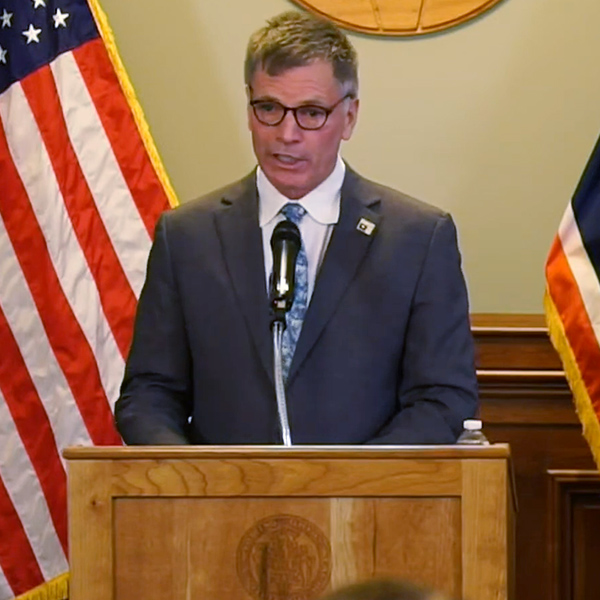
Secretary of Energy Jennifer Granholm
Secretary of Energy Jennifer Granholm | Wyoming PBS

A still-to-be-determined Wyoming site for TerraPower’s Natrium reactor was announced Wednesday at a high-profile event clearly intended to send a strong message of bipartisan support for nuclear. The project is one of two chosen to receive millions in federal funding from the Department of Energy’s Advanced Reactor Demonstration Project. 

Secretary of Energy Jennifer Granholm said the project will show “the future of nuclear energy is here. [The Natrium reactor] has got a simpler design that will hopefully result in faster construction and lower costs. It’s going to create a smaller footprint; it’s going to be equipped with next generation safety measures, and it’s going to run at temperatures high enough to produce efficient and carbon-free hydrogen on top of the usual power generation.”

Wyoming Gov. Mark Gordon
Wyoming Gov. Mark Gordon | Wyoming PBS

Republican Gov. Mark Gordon sees the project as a vital part of his goal, announced in March, of making the state carbon-negative while continuing to use fossil fuels, while also developing the state’s uranium resources. “This nation is a leader in uranium, and it makes sense to use Wyoming uranium to furnish feedstock for this plant,” Gordon said, adding that it will be “built and operated in a manner that supports our commitment to protecting and enhancing our wildlife and our environment.”

Advanced nuclear “is another way to diversify our already strong energy economy,” said Sen. John Barrasso (R-Wyoming), who sponsored legislation to allow for the licensing of advanced nuclear reactors, signed by former President Trump in 2019. “The energy is going to be affordable, reliable and carbon-free. This is what … energy innovation looks like in America.”

Sen. John Barrasso
Sen. John Barrasso | Wyoming PBS

Barrasso is the ranking member on the Senate Energy and Natural Resources Committee, where he has been an outspoken critic of President Biden’s clean energy initiatives. (See Barrasso: Biden Climate Plan a Retread of Obama Failures.)

 Ongoing commitments to coal and job creation were also strong themes at event. Gary Hoogeveen, CEO of PacifiCorp’s Rocky Mountain Power (OTCMKTS: PPWLM), a partner on the project, said it will create “hundreds of construction and permanent jobs in Wyoming coal communities. And I want to repeat something for emphasis here: We are not accelerating coal retirements or coal unit closures. By adopting this technology and building this demonstration project, it’s quite the opposite.”

He said it had not yet been decided which of the utility’s four coal-fired power plants in the state would be retired to make way for the Natrium project.

“We will need thousands of highly skilled workers to help us build the Natrium plant, and hundreds more workers to operate it for decades to come,” TerraPower CEO Chris Levesque said. “That’s part of why we’re here in Wyoming. Wyoming knows how to build and operate energy facilities.”

Designed to Support Renewables

While not yet at a tipping point, support for advanced nuclear reactors is gaining momentum across the country. President Biden’s 2022 budget includes a $5 billion line item for the federal government to procure advanced nuclear energy over the next decade. (See Clean Energy Wins, Fossil Fuels Lose in Biden Budget.) 

NuScale Power of Portland, Ore., recently signed a memorandum of understanding with the Grant County Public Utility District to see if its small modular reactor design can be used in what could be Washington State’s first reactor complex to go online since 1984. (See Wash. PUD, NuScale Sign MOU to Explore Use of Small Reactors.)

Bill Gates, founder and chair of TerraPower
Bill Gates, founder and chair of TerraPower | Wyoming PBS

Microsoft co-founder Bill Gates founded TerraPower in 2008 based on the belief that carbon-free nuclear is the only power source that can “solve the dual challenges of global energy poverty and climate change,” he said. “But nuclear power, like every other technology needs to innovate and adapt. It needs to become less expensive; it needs to provide an even stronger safety case.”

Whether the Natrium project will help build Wyoming’s uranium industry remains an open question. According to information on the TerraPower website, the Natrium reactor to be built in the state is a “liquid sodium-cooled fast reactor” that uses depleted uranium as fuel. One of the reactor’s selling points is that it will reduce the need for uranium mining and for facilities for storing spent fuel.

“The Natrium system is unique in that it is tailored to support electricity grids with a growing mix of renewables,” Levesque said. “It is the first nuclear concept to integrate large scale energy storage capability. This addition allows the plant to flex electricity production up and down with changing demand, and when faced with challenges or when faced with changes in the availability of wind and solar on the grid.”
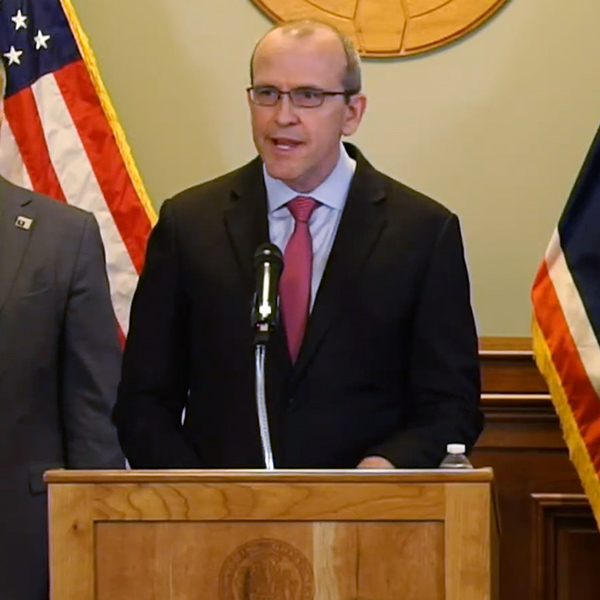
TerraPower CEO Chris Levesque
TerraPower CEO Chris Levesque | Wyoming PBS

The molten-salt storage can boost the plant’s capacity up to 500 MW for 5.5 hours, providing enough electricity to power 400,000 homes, a company press release said.

DOE is providing initial funding of $80 million for the Natrium plant in Wyoming and another $80 million for a demonstration project to be built by X-energy, another advanced nuclear company that has developed a high-temperature, gas-cooled plant. According to the October 2020 announcement of the awards, the department plans to spend an additional $3.2 billion to help build the two plants over the next seven years “subject to the availability of future appropriations.” 

PacifiCorp’s Rocky Mountain Power is another partner in the project. Hoogeveen said nuclear plants like the Natrium project will be essential for utilities to decarbonize their power supplies and maintain “24/7-365” reliability. “We are currently building a lot of wind and solar,” he said. “But we know you can’t do 100% renewable and battery power and serve 24/7 [power], not with the current technology.”

But, Hoogeveen cautioned, the reactor still has to get through rigorous permitting and the utility’s own due diligence. “This project needs to be cost effective for our customers in order to proceed,” he said. “We will show that through our integrated resource plan. We will bring that to our regulators and all the stakeholders that we have, and we will show them that this is in the best interest of our customers.”
Panel Examines Future for Green Hydrogen in West

Green hydrogen is one potential piece of California’s efforts to reach carbon neutrality by 2045, but the state is just getting started on evaluating the energy source, a member of the state’s Public Utilities Commission said during a conference this week.

“California is at an early state in examining how green hydrogen could fit into this long-term energy mix,” CPUC Commissioner Darcie Houck said Monday during the virtual annual meeting of the Western Conference of Public Service Commissioners (WCPSC). “And with the right technology in place, hydrogen has the potential to provide one option for long-term energy storage that could be a part of California’s toolkit to cut … carbon emissions by 2045.”

Houck was one of the panelists in a conference session on hydrogen.

So-called green hydrogen is produced through an electrolytic process in which water is split into its components, hydrogen and oxygen. The resulting hydrogen is considered green if the electrolysis was powered by renewable energy.

Houck said that one factor leading to California’s exploration of green hydrogen was Senate Bill 1369 by Sen. Nancy Skinner (D), adopted in 2018.

The bill instructs the CPUC, the California Air Resources Board (CARB) and the California Energy Commission (CEC) to consider green hydrogen as an eligible form of energy storage and contemplate other potential uses of green hydrogen.

A bill proposed by Skinner this session, SB 18, would take things a step further. It would require CARB to include a strategic plan for hydrogen as part of its Climate Change Scoping Plan. CARB is working on a 2022 update to the scoping plan, which will serve as a blueprint for how the state can achieve carbon neutrality by 2045.

SB18 would also require the CPUC to consider green hydrogen in resource adequacy requirements and energy storage proceedings. The Senate passed SB 18 last month on a 38-0 vote, and it’s now in Assembly committee.

Houck said the CPUC has committed to deploying 200 hydrogen fueling stations and also approved $24 million for the natural gas research and development program for fiscal year 2020/21. The research program is administered by the CEC.

A CPUC proceeding on biomethane has been expanded to examine the amount of renewable hydrogen that can be safely injected into the gas pipeline system, Houck said. The agency has brought in the University of California, Riverside, to conduct a study on hydrogen blending impacts. Results are expected in the fall.

‘Unique Variable’

The regulatory issues related to green hydrogen are not simple, Houck said. For example, questions around natural gas infrastructure need to be addressed.

“This question requires that we consider significant tradeoffs between reducing emissions, resource diversity and resiliency, and costs to customers, including stranded costs,” she said.

Blending hydrogen in the gas pipeline system could reduce the carbon intensity of gas but would require investment in and maintenance of natural gas infrastructure, Houck said. Another issue is that a growing number of California cities are banning natural gas hookups in new construction, she said.

Panelist Laura Nelson, vice president of Strategen and an advisor to the Green Hydrogen Coalition, noted that hydrogen is a globally traded commodity that’s used in industrial and manufacturing applications. But much of the hydrogen in use today is what’s considered “gray” or “brown” hydrogen, meaning it’s produced from natural gas or coal with a resultant carbon footprint.

“Green hydrogen, if we can scale it and produce it, then we can displace hydrogen that maybe has a much higher carbon intensity, carbon footprint, and really help to drive decarbonization of an already globally traded commodity,” Nelson said.

In addition, Nelson said, green hydrogen applications can potentially be expanded into sectors that have been difficult to decarbonize.

Oregon Public Utility Commissioner Mark Thompson, the panel moderator, explained why he is excited about hydrogen.

“I see some major trends, especially in the West, that point to the need for long-term, clean and reliable energy and energy storage,” Thompson said.

In addition, he said, there’s a need for dispatchable energy resources and making sure that renewable electricity resources are put to the best use.

“Hydrogen may represent a unique variable in solving that equation,” he said.

Vermont Governor Signs State Budget with $250M for Climate Mitigation

Gov. Phil Scott on Tuesday
signed a $7.3 billion fiscal year 2022 budget for Vermont  that includes $250 million for climate change mitigation.

A portion of the funds allocated for climate-related efforts will come from Vermont’s $1.05 billion American Rescue Plan Act aid to be spent over the next four years.

“With smart state investments and a very strategic approach for using federal funds, this budget puts us on a new path to a more prosperous and equitable future for all of Vermont,” Scott said in a statement.

The budget sets aside $50 million in federal aid for home weatherization, workforce development and renewable energy development, among other things. Weatherization funding includes $18 million for programs provided by the Department of Children and Families, Vermont Housing Finance Agency and Department of Public Service (DPS).

Efficiency Vermont will receive $2 million for workforce development and expansion of its Heat Squad program, which helps homeowners plan renovations and provides home and energy loans.

The DPS also is charged with using $10 million to support renewable energy project deployments that benefit low-income Vermonters.

Regional planning commissions in the state will be responsible for developing an allocation plan for $1 million from the state General Fund to provide energy planning services for municipalities.

The state also will pay $1.5 million from the General Fund through 2024 for financial and clean energy coaches that can assist low- and middle-income Vermonters to reduce reliance on fossil fuels.

Other Legislation

Scott also signed two bills last week intended to help reduce greenhouse gas emissions in the transportation sector and provide a regulatory framework for the use of energy storage in the state’s electric system.

H.433 sets budgets for alternative transportation initiatives and electric vehicle programs.

It includes $5 million for new park-and-ride facilities and $21 million for bike and pedestrian construction and expansion projects.

Opportunities for deploying EV supply equipment include $1 million for a pilot project at a multiunit affordable housing facility. An additional $5.5 million will be used for EV incentives, which includes the creation of a new Replace Your Ride program to encourage residents to remove older cars from the road.

H.431 provides clarity on the application guidelines for energy storage facilities, setting out obligations based on size. Anything larger than 1 MW must go through a full application process for a certificate of public good. In addition, the Public Utility Commission must update interconnection rules by March 2022 to incorporate energy storage facilities larger than 1 MW and simplify procedures for facilities between 100 kW and 1 MW.

The act also establishes a tax assessment of 50 cents/kWh on stationary, standalone, grid-connected energy storage facilities with an energy rating of 600 kWh or higher.

NY Officials Discuss Climate Change Resilience, Adaptation

The New York Climate Action Council (CAC) on Tuesday considered a dozen recommendations for adaptation and resilience to climate change, which focused on the themes of building capacity, addressing communities and infrastructure, and safeguarding living systems.

Mark-Lowery-(NYDPS)-Content.jpg
Mark Lowery, DEC | NYDPS

“Flooding is the main danger we face from climate change,” said Mark Lowery, assistant director of the state Department of Environmental Conservation’s Office of Climate Change.

Lowery made his remarks while presenting the recommendations from the Land Use and Local Government Advisory Panel, one of several such panels informing the 22-member CAC as it works to complete a scoping plan by fall to help achieve the state’s goals under the Climate Leadership and Community Protection Act (CLCPA).

The  panel urged the CAC to “develop policies, programs and decision support tools to reduce risks associated with coastal and inland flooding” and to “ensure the reliability, resilience and safety of a decarbonized energy system.”

Of Land and the Grid

Doreen-Harris-(NYDPS)-Content.jpg
NYSERDA CEO Doreen Harris | NYDPS

CAC Co-Chair Doreen Harris, CEO of the New York State Energy Research and Development Authority (NYSERDA), said the New York Green Bank in May issued a request for proposals “launching an expanded investment approach that focuses on projects prioritizing energy efficiency and electrification in housing found within disadvantaged communities across the state.”

In order to enhance grid resilience, New York Power Authority CEO Gil Quiniones said, “NYPA is about to launch a study of our assets, our power plants, our transmission system and customer-sited projects. We’re partnering with Argonne National Lab, the Electric Power Research Institute and Columbia University to study the impacts of climate change over the next few decades and ask how we change the design basis for our planning, engineering, design and construction, and maintenance.”

Gil-Quiniones-(NYDPS)-Content.jpg
NYPA CEO Gil Quiniones | NYDPS

The study will also encompass storage projects, energy efficiency programs and electric charging infrastructure, Quiniones said, citing a similar study done previously by Consolidated Edison.

NYPA operates the state’s canal system and is working on wetlands restoration, which aids in flood mitigation, he said.

John-B-Howard-(NYDPS)-Content.jpg
NYPSC Chair John B. Howard | NYDPS

Interim Public Service Commission Chair John Howard asked, “How do we undo the bad land use that we’ve inherited? … So that we don’t spend good money after bad, how do we increase the resiliency of inappropriately developed land? How do you duplicate what we did in Staten Island? We moved a whole neighborhood [after Hurricane Sandy] because we knew it couldn’t be protected and its value as a wetland was far better than as a neighborhood. Do we do this strictly on a voluntary basis? Or at some point are we going to have to say, ‘Sorry, these properties need to go?’”

Lowery said the focus should be on long-term recovery planning: “I think it’s going to be very difficult to convince people to sell out who are today sitting where they think is high and dry, especially if you’re trying to do a whole neighborhood.”

Paul Shepson, dean of the School of Marine and Atmospheric Sciences at Stony Brook University, asked, “in a limited resources world,” how to balance investment in renewable energy while maintaining resilience for the existing energy delivery systems.

Donna-DeCarolis-(NYDPS)-Content.jpg
Donna DeCarolis, National Fuel Gas | NYDPS

It’s increasingly common knowledge that society will need both systems over the next few decades, said Donna L. DeCarolis, president of the National Fuel Gas Distribution Corp.

“The existing infrastructure is already there; it’s already storm-resistant; it’s really great for cold weather events; and you can leverage it,” DeCarolis said.

“I don’t think we have a choice; we have to do both,” Quiniones said. “We have to transition to a cleaner energy system while keeping it reliable and resilient.”

Howard said he doesn’t believe the question is the feasibility of hardening the overhead electric system; rather, “is it affordable the way we do it today? … If we have to spend several billion dollars or more on that overhead system, the current mechanism to do that is exclusively through our rate cases; and [with] that on top of all the other ambitious things that we already are planning to do on the bulk transmission side, pretty soon it starts adding up.”

CAC Executive Director Sarah Osgood said that on June 28, the Climate Justice Working Group would give feedback on advisory panel recommendations, and that the council would meet July 22 to hear a presentation on a reference case of integration analysis, as well as an updated climate assessment.

Wash. High Court Hears Test Case for Inslee Climate Bill Vetoes

A Washington Supreme Court hearing on Tuesday provided a judicial practice run for possible upcoming court battles over Gov. Jay Inslee’s partial vetoes of recently passed cap-and-trade and low-carbon fuel standard (LCFS) bills.

The stakes: How fast will those climate change bills be implemented? And where is the red line between the powers of the state legislature and the governor?

On Tuesday, attorneys for the legislature and governor’s office argued before the state’s high court over a Thurston County Superior Court judge’s 2020 decision that Inslee illegally vetoed parts of a state transportation budget package in 2019. No ruling was made.

The arguments of Tuesday’s Supreme Court hearing are highly similar to those raised by Inslee and legislative leaders in mid-May when the governor vetoed pieces of the two climate change bills.

Democratic legislative leaders are angry that Inslee, also a Democrat, vetoed segments of the bills that were agreed on after complicated compromise talks within their own party to ensure enough votes would support passage of the two controversial bills. Democrats are the majority party in each chamber, and party leaders and a few newspaper editorial boards contend the vetoes sabotaged the trust needed to get the two bills passed. 

Unhappy with Inslee nullifying their internal compromises on the bills, Democratic legislative leaders have threatened a lawsuit to reverse the governor’s vetoes.

Consequently, the Supreme court’s ruling on the 2019 transportation package vetoes will likely be a major influence on the upcoming litigation on the climate change bill vetoes.

The May vetoes removed sentences and segments tying implementation of the two climate change bills to the eventual passage of a major transportation package — a plank required by some moderate Democrats in return for their support. No date has been set for discussion on that package. Possibilities include a special session later this year, or regular sessions in 2022 or 2023.

Inslee’s partial vetoes will kickstart implementation of the two climate change bills on July 1.

‘Little Bit Fuzzy’

In Tuesday’s arguments over he 2019 budget vetoes, Deputy Solicitor General Alicia Young, representing the governor’s office, said Inslee has the constitutional right to eliminate single sentences or subsections of bills, especially if the legislature deliberately wrote bills in ways to avoid partial vetoes.

Inslee said that the effective date of a bill is normally set out in its own single section, meaning it can be vetoed without affecting the rest of the bill. The governor said that the effective dates of the two climate change bills — whenever a transportation budget package is passed — are buried within bill sections covering other planks of the legislation.

Inslee wrote: “It strains the imagination to discern any reason for embedding into a single section a delayed effective date that impacts not just that one section, but also multiple additional sections, unless that reason is to prevent it from being vetoed. This type of legislative drafting demonstrates manipulation and a palpable attempt at dissimulation.”

Inslee added that a 1997 state Supreme Court decision ruled against this type of bill writing. During Tuesday’s hearing, questions from at least two Supreme Court justices appeared to support Inslee’s interpretation.

Jeffrey Even, attorney for the legislature, countered that the Washington Constitution limits partial vetoes to designated subsections of any bill — and that leaves individual sentences within subsections off-limits to partial vetoes.

Even also argued that the legislature is not obligated to write a bill to make it easier for the governor to veto any part of it

“At the margin, that standard can get a little bit fuzzy,“ Justice Debra Stephens said.

Chief Justice Steven González wondered how someone could prove that the legislature wrote a bill to avoid partial vetoes.

Sen. Reuven Carlyle’s (D) bill requires Inslee to appoint a task force by July 1 to lead brainstorming efforts on creating a cap-and-trade program administered by the Washington Department of Ecology.

The task force will create a system to annually set the state’s total industrial carbon emissions, a cap that slowly decreases through the years. Four times a year, large emitters would submit bids in an auction for segments of that year’s overall limit and be allowed to emit that amount in greenhouse gases. Companies will be allowed to trade, buy and sell those allowances.

An environmental justice panel would be appointed to ensure low-income neighborhoods and communities of color would not be disproportionally hit with excess pollution. The bill anticipates the auctions would raise several hundred million dollars that the state could allocate to disadvantaged communities.

Preliminary task force recommendations would be due by Nov. 1, with final recommendations ready to be sent to the legislature by Dec. 1.

Rep. Joe Fitzgibbon’s (D) LCFS bill requires that carbon emissions from gasoline and diesel fuel sold in Washington be cut by 10% below 2017 levels by 2028 and by 20% by 2035. It excludes emissions from fuel that is exported out of state or used by water vessels and railroad locomotives. The goals apply to overall vehicle emissions in the state and not to individual types of fuels. Northwestern Washington has five oil refineries. The rules go into effect Jan. 1, 2023.

Inslee has strongly pursued both concepts for years. His partial vetoes do not affect the bills’ main planks.

Dominion Criticized for ‘Slow Walking’ Demand Side Management

Dominion Energy (NYSE:D) found itself on the defensive Tuesday in a Virginia State Corporation Commission (SCC) hearing on its proposed update to its demand side management (DSM) programs — even though there was no opposition in principle to what the company says it wants to accomplish.

The programs are intended to meet the Virginia Clean Economy Act of 2020’s (VCEA) requirement that the company produce energy savings of 1.25% of its load in 2022, rising to 2.5% in 2023, and 5% in 2025. But the company acknowledged before the hearing that its existing programs and the 11 additional programs in the Phase IX proposal it made in December would only produce savings of 3% or less by 2025 (PUR-2020-00274).

“It appears with this filing that Dominion is officially slow-walking its deployment of energy efficiency resources in the commonwealth,” said Walton Shepherd, Virginia policy director for the Natural Resources Defense Council’s Climate & Clean Energy Program, calling the proposed $162 million in spending too small. “According to the company’s filing, less than four out of 100 Dominion customers were served last year by Dominion DSM programs.”

He criticized budget caps on the programs, which he acknowledged, in response to a query from a Dominion attorney, were imposed by the SCC. The agency must lift those caps, he said, while for Dominion’s part, “better marketing could better tap the full available potential.”

Nate Benforado, senior attorney with the Southern Environmental Law Center, representing intervenor Appalachian Voices, said that “we still have serious concerns” that Dominion has not met its responsibilities. “The company has continued to proceed in a piecemeal fashion,” he said. “We would like to see programs and budgets, and for the company to explain how they will meet these responsibilities.” The idea isn’t to push the company into developing a rigid plan, he added; instead, the plan should be changeable depending on future developments.

Virginia-Corporation-Commission-hearing-(Virginia-Corporation-Commission)-Content.jpg
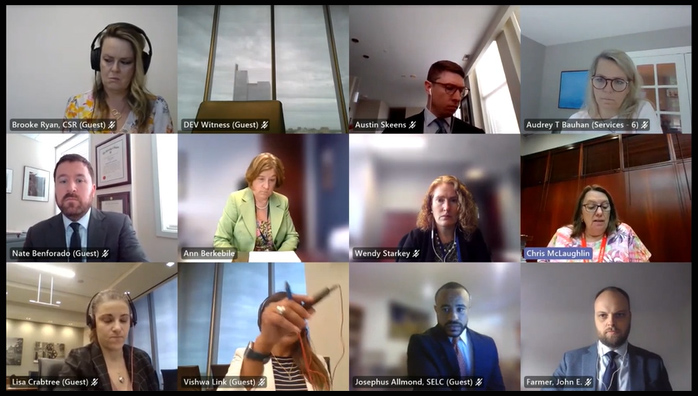
Participants in the Virginia Corporation Commission hearing on Dominion Energy’s proposed demand side programs | Virginia Corporation Commission

Nathan Frost, director of new technology and energy conservation for Dominion, agreed with Appalachian Voices consultant Jim Grevatt that there will be a significant savings shortfall beginning in 2023.

According to Frost, “the company currently projects that it will meet the VCEA savings target in 2022, but that more needs to be done for 2023 to meet the General Assembly’s targets, at least under the ‘net’ savings scenario.” The estimates the company has provided include both net and gross energy savings, he said, because state law does not say which is the appropriate standard.

Frost further testified that the company “is committed to doing everything practicable to achieve the applicable public policy goals in consultations with a full range of stakeholders,” and that “no party or staff opposes at least initial approval of the company’s programmatic requests in this proceeding.”

That last point appeared to be something of a refrain, with Dominion attorney Lisa Crabtree of McGuireWoods LLP saying that “there are few issues actually in contest” as to the company’s proposed programs.

“We’re really looking at probably the last opportunity the company has to change course to have a fair chance at meeting the requirements to comply with the savings targets established by the law,” Grevatt testified. He said Frost’s assurances were “not very specific. He says, `We’re committed; we’re going to work with stakeholders.’ He sort of says `we’re going to figure this out’ but doesn’t say how that’s going to occur.”

The new energy efficiency (EE) and demand response programs Dominion is proposing include: in-home energy assessments and installation of energy-saving measures for customers who meet age and income qualifications; incentives to residential customers for the installation of “smart communicating” water heating and pool pump technologies; incentives to purchase smart thermostats and other smart home technologies; an online, self-directed home energy assessment and incentives for installing solar panels. Other programs would offer incentives to farmers and businesses.

SCC attorney Austin Skeens said that “based on staff’s limited review,” Dominion’s projections seem reasonable.

But Andrew T. Boehnlein, a senior utilities analyst in the commission’s Division of Public Utility Regulation, said staff believes the design of the proposed low income and age qualifying (IAQ) program “inflates the program’s costs and minimizes the benefits for low-income, elderly and disabled participants,” noting the company estimated average customer savings of 67 kWh annually, or $7.39.

“Staff is concerned that the proposed Phase IX IAQ program, as well as prior iterations of low-income programs, exhibit a pattern of systemic bias that effectively denies access to participation in energy efficiency programs to large swaths of the company’s low-income, elderly and disabled customers,” Boehnlein said in written testimony. “Staff believes a new approach is needed to augment the effectiveness of the company’s current vendor-based program in order to expand access to these under-served customers and to increase the overall level of energy savings achieved.”

Staff also recommended that solar installations “be warrantied to shield low-income, elderly and disabled customers from incurring future costs due to these installations.”

MISO: Wintry Weather Vindicates RA Changes

MISO concluded this week that its current suite of resource adequacy solutions is the best path forward to coping with extreme cold snaps.

The RTO closed the chapter into mid-February’s pervasive arctic blast on Tuesday with a final report and stakeholder workshop. Staff said the winter event provides further justification to introduce a four-season capacity auction and corresponding reserve margin targets paired with a capacity accreditation based upon generators’ recent availability. (See MISO Underscores Need for RA Action in Winter Storm Review.)

MISO Vice President of Strategy Wayne Schug told stakeholders that the vast majority of lessons learned from the event are items already under consideration in the stakeholder process.

“Which is a good thing. It means we’re anticipating things to come,” Schug said.

MISO Senior Director of Operations Planning J.T. Smith said MISO has experienced four severe cold snaps in the past seven years, in 2014, 2018, 2019 and now 2021. MISO has amassed new preparations from each one, he said.

“We walked into this event about as prepared as we could be. …At some point, it’s about the availability of the fleet that is provided to us,” Smith said.

What set apart this cold weather, Smith said, is the freeze stretched from Canada to the Gulf of Mexico and affected MISO’s neighbors, making imports unworkable as load stayed stubbornly high.

“The cold wasn’t extreme. It covered the entire footprint,” he said. “…We were talking about the North, the Central and the South regions.”

By Feb. 17, 40% of MISO’s fleet was unavailable, most because of forced outages.

“You can’t operate the system with normal to high loads with 40% of your system offline,” Smith said.

MISO curtailed 700 MW in the South system Feb. 17 to match load to generation availability and ward off uncontrolled cascading outages. The RTO also ordered localized rolling blackouts because of transmission emergencies Feb. 15-16 in Louisiana, Central Illinois and Southeast Texas.

Control room staff could use more detailed and real-time data from members to make better informed decisions in the heat of the moment, Schug said.

“History is an insufficient guide to the future,” Schug said of MISO’s historical data. “…What we considered rare instances 10 years ago are now commonplace.”

He also said events considered impossible just five years ago are now plausible.

“We need to be planning for those in advance,” he said.

Schug also said ISOs might not be the best outlet for verifying any new weatherization standards are met.

MISO and the Organization of MISO States have lately been meeting about beefing up and combining generator fuel and weatherization surveys in anticipation of new industry weatherization standards.

Staff also said expanded transmission capacity can ease future winter storms. MISO leadership has repeatedly said the added transfer capability of MISO’s last long-range transmission portfolio, approved a decade ago, helped the footprint escape a more destructive emergency.

MISO Executive Director of Systems Operations Renuka Chatterjee asked stakeholders to picture the MISO management of a hypothetical 6,000 smaller generators versus its current fleet of approximately 1,600 generators.

“The fleet is continuously changing. Each quarter, it changes,” she said.

Again, several stakeholders pressed MISO to release a list of generator outages by fuel type during the event.

“My sense is we probably had more fuel supply issues this time than in past polar vortexes,” Schug said, adding that MISO will try to compile a list.

Southern Renewable Energy Association Executive Director Simon Mahan asked how much the event cost MISO overall.

MISO executives said they have yet to calculate total costs.

MISO plans to file its capacity auction changes in September. The grid operator is currently working through analyses on its proposed capacity accreditation. It will present results in July to a stakeholder community that has asked MISO to reinforce its proposal with research.

“The timing is tight,” Scott Wright admitted to stakeholders at a June 9 Resource Adequacy Subcommittee meeting. “…I’m aware we have a lot of big discussions in front of us to get to a filing.”

At the May Market Subcommittee, MISO Executive Director of Market Operations Shawn McFarlane said there was “decent likelihood” that MISO enters emergency procedures this summer.

One Bankruptcy Issue

MISO said the cold snap also triggered a first-of-its-kind bankruptcy and default predicament. Following the event, the RTO said it investigated its market participants to see if any had been exposed to adverse financial impacts in other markets. It found that the Brazos Electric Power Cooperative, also an ERCOT member, was hit with more than $2 billion in charges in the ERCOT market and declared bankruptcy. (See ERCOT’s Brazos Electric Declares Bankruptcy.)

However, MISO found that it had not been mentioned as a critical vendor in Brazos’ bankruptcy filing, despite it supplying transmission service to the cooperative. The RTO said bankruptcy law “puts an automatic stay in place in the action, which prohibits MISO from sending certain notices, such as a notice of default, to the party.”

MISO has intervened in the bankruptcy proceedings to try to recover some of the almost $9 million owed to it by Brazos (21-30725).

The grid operator said in light of this situation, it might pursue some Tariff changes “to protect the market” during volatile pricing events.

Health Experts, Climate Orgs Ask Eversource to Shift from Natural Gas

Public health experts, doctors and climate organizations in Connecticut and Massachusetts signed a letter sent to Eversource Energy last week, demanding the utility take immediate action to transition away from natural gas.

The letter also asks Eversource’s leadership to meet with the medical professionals and environmental organizations within two weeks to discuss a plan that the utility can take to urgently phase out natural gas and grow non-emitting, renewable alternatives, such as geothermal energy.

“I speak out because there is an attempt to obfuscate the truth about the health impacts of natural gas,” Regina LaRocque, an associate professor of medicine at Harvard Medical School, told NetZero Insider.

LaRocque is an infectious disease physician scientist, but she has been involved in public health advocacy on the detrimental effects of using natural gas as an energy source. She is also associate director of Massachusetts General Hospital’s Center for the Environment and Health and a member of medical and environmental advocacy group Climate Code Blue, one of the signers of the letter.

After witnessing the natural gas explosions in the Merrimack Valley in 2018, and more recently, five emergency shutdowns and gas releases from the Weymouth natural gas compressor station over a six-month period, LaRocque said “there are some real questions that need to be answered by utilities.”

Releases of natural gas from a compressor station operated by Enbridge, the same company that owns the Weymouth compressor station, in her hometown of Wellesley, Mass., without widespread public knowledge also inspired LaRocque to get involved.

“These are fundamentally health issues,” LaRocque said. Despite strong consensus in medical literature about the health impacts of natural gas, most people don’t know natural gas extraction, transport and combustion releases carcinogens that cause cancer and problems with pregnancy, LaRocque said.

Cooking with a gas stove releases nitrogen dioxide and other pollutants into household air, which is associated with increased risk of childhood asthma. The impact on children can be “substantial” because at least one third of households in the U.S. cook with gas stoves, children spend most of their time indoors and indoor air is unregulated, according to a report in Environmental Health.

Emissions from natural gas account for 40% of emissions in Massachusetts and Connecticut, the two states where Eversource sells gas, according to the U.S. Environmental Protection Agency. And a recent Harvard study found that in Massachusetts, air pollution from burning fossil fuels in buildings led to over 740 early deaths and $8.4 billion in health costs in 2017.

In Connecticut, fossil fuel combustion in buildings led to over 310 early deaths and $3.6 billion in health costs.

The utility’s leadership, however, says the company is taking action already.

Eversource is “leading the way toward a cleaner energy future” by “encouraging the use of renewable natural gas” and “continuing to expand affordable, reliable natural has for heating and cooling as an alternative to higher-emitting and more costly options,” William Akley, president and CEO of Eversource’s gas business, said in testimony to the Connecticut legislature last year.

But the letter to the utility stresses that the organization’s “lack of forthrightness on clean energy and climate is not just a benign marketing strategy.”

“It is harmful to our states’ ability to transition to a cleaner, more just economy.”

The Acadia Center, HealthLink and Greater Boston Physicians for Social Responsibility, among others, called for the utility to put a moratorium on new and expansion gas projects, discontinue rebates and subsidies that encourage new gas hookups and stop using ratepayer funds to pay for memberships in trade associations that oppose electrification, such as the American Gas Association.

“After making $1 billion in profits for their shareholders last year, Eversource is in a position to proactively shift its business model toward clean, combustion-free products,” the letter said.

Sierra Club Connecticut, another organization behind the letter, believes utilities have an opportunity to make a more significant difference in mitigating climate change.

“They should be worried about their business” because electricity will soon be cheaper than gas, Samantha Dynowski, state director at Sierra Club Connecticut, told NetZero Insider. Instead, the gas industry is “trying to squeeze every last drop of profit out of something that’s dangerous,” she said.

Setting the Flight Path to Zero-carbon Aviation in 2030

U.S. commercial aviation could exceed the industry’s 50% by 2050 carbon reduction target if the companies already testing fully electric small and medium aircraft have anything to say about it.

The heads of two of these small firms changed the direction of an ARPA-E panel discussion Tuesday with presentations focusing not only on their aircraft but also on the impact smaller passenger aircraft will have on the entire industry.

Zero-carbon Aviation
MagniX CEO Roei Ganzarski | MagniX

The bottom line: Electric aircraft will allow the industry to return to smaller airports offering more direct flights to locations now served inefficiently, if at all, by larger aircraft.

“By going to electric smaller airplanes, lower cost, lower noise, zero emission, we can actually utilize one of the 5,000, maybe even one of the 10,000, airports that exist in the United States alone, and change the way we fly,” said Roei Ganzarski, CEO of magniX, a Washington-based electric motor manufacturer for commuter aircraft headquartered near a Boeing assembly plant.

The company’s motors have been retrofitted into several aircraft and flown successfully, said Ganzarski, a former Boeing executive. “If 50% of our [U.S. commercial] flights are less than 500 miles of range, let’s do them out of smaller airports and to small airports. That makes the door-to-door experience better and eliminates the emissions of those aircraft,” he said.

“Out of all trips in the United States 500 miles or less, only 1.6 % are done by air. That means people in the United States will drive five … to 10 hours just to avoid the hassle and the cost of our current middle-mile aviation system.”

Cory Combs, co-founder of Ampaire, said his company has been testing a modified twin-engine Cessna Skymaster in Hawaii over a 62-mile commercial route.  The Cessna’s modification included an electric motor in the front and a different piston engine in the rear.

Zero-carbon Aviation
| Ampaire

Because the electric motor runs on batteries, the modifications cut emissions. Combs described his company’s hybrid modifications as “steppingstones” to larger aircraft manufactured as hybrids for short- to medium-range flights.

Zero-carbon Aviation
Cory Combs, co-founder of Ampaire | Ampaire

“What did aviation look like before the jet engine revolution? It was looking like the DC-3 [legendary two-engine passenger plane], smaller planes that operated from a wide variety of airports,” Combs said. “Why [commercial service] shifted to the large hub airports is not actually because of passenger demand. It was because of fundamental technical limitation of jet engines. You need to go large to be efficient. A small turbine [jet engine] is not very efficient. So, you want to go large.”

“I think there’s going to be an actual segmentation switching to smaller planes operating from more airports with lower cost, lower landing fees and with lower time spent on the ground, and you’re going to see something like what’s happened with the displacement of super large aircraft,” he said.

No Magic Bullet

Sean Bradshaw, technical fellow in sustainable propulsion at Pratt & Whitney, agreed with Combs and Ganzarski.

Zero-carbon Aviation
Sean Bradshaw, Pratt & Whitney | Raytheon

“Electrification will be part of our future but particularly in the regional aviation space. It is relevant and will make an impact within two years. I thought the arguments were compelling, the fully electric aircraft would reduce noise and eliminate emissions,” positively impacting human health near airports, Bradshaw said. “There’s certainly a market. There is no doubt about it.”

Bradshaw also emphasized the need for technology improvements both in aircraft design and jet and turbofan engine technology.  “Historically the aviation industry has improved efficiency by 1.5% per year, about evenly split between aircraft level technology improvements and engine technology improvements,” he said.

Another way to reduce the industry’s carbon footprint, he added, is to operate airports differently, including the time the aircraft spend on the tarmac.

Arjan Hegeman, GE Aviation | American Astronautical Society

Arjan Hegeman, general manager of the Advanced Technology Organization at GE Aviation, said he “could not agree more” with the need for electrification and the development of hybrid technologies for regional aircraft.

“Today we clearly see a big role for electrification in regional aircraft and even larger applications. The technical challenge that we’re working on overcoming as is the high amount of power to high power density,” he said, a reference to the need for high-power density batteries.

The role of hydrogen in future aviation got some discussion, including the limited supply of green hydrogen currently available.

“There is not one magic bullet; you’re going to need all solutions. You will need the alternative fuels, whether it’s [sustainable aviation fuel] or hydrogen,” Hegeman said. “It’s going to be both of them. There will be different timelines in which those are going to be introduced.”

Biden Pick for BLM Head Sidesteps Oil, Gas Leasing Questions

Four nominees for key energy and land management positions faced a group confirmation hearing before the Senate Energy and Natural Resources Committee on Tuesday, but the session was clearly focused on only one — Tracy Stone-Manning, President Biden’s pick to head up the Bureau of Land Management.

The agency oversees 247 million acres of public land — about 10% of the U.S. — which include 30% of U.S. minerals, as well as thousands of oil and gas leases and thousands of megawatts of solar and wind. The BLM was without a Senate-confirmed director throughout the Trump administration.

Tracy-Stone-Manning-(Senate-Committee-on-Energy-and-Natural-Resources)-Content.jpg
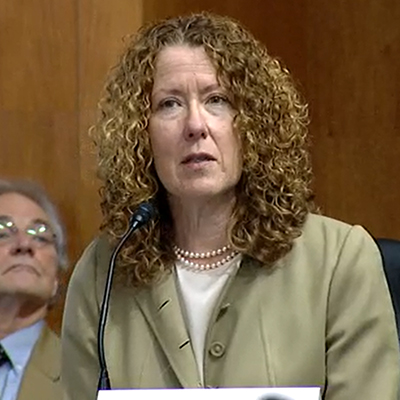
Tracy Stone-Manning, nominated as director of the BLM | Senate Committee on Energy and Natural Resources

Hailing from Montana, Stone-Manning said she is an avid outdoorswoman devoted to smart, multiple uses of public lands, with a resume of policy work based on bipartisan collaboration — as a senior aide to Sen. Jon Tester (D-Mont.), director of the state’s Department of Environmental Quality and chief of staff to former Democratic Gov. Steve Bullock. But she spent most of the hearing sidestepping hard questions from Republicans about Biden’s pause on oil and gas leasing on federal lands and her involvement with advocacy groups, such as Montana Conservation Voters (MCV).

Stone-Manning was board treasurer of the group, which is highly critical of Sen. Steve Daines (R-Mont.). Sen. John Barrasso (R-Wyo.), ranking member of the committee, pressed Stone-Manning hard on her role in what he called MCV’s 2020 smear campaign against Daines. According to information on the MCV website, the advertising campaign consisted of “a billboard in Belgrade, newspaper ads in Billings and Bozeman and aerial advertising in both Bozeman and Missoula.”

John-Barrasso-(Senate-Committee-on-Energy-and-Natural-Resources)-Content.jpg
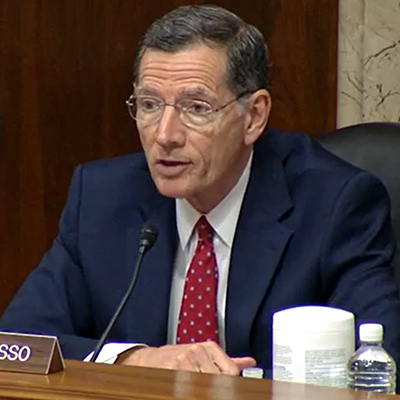
Sen. John Barrasso (R-Wyo.) | Senate Committee on Energy and Natural Resources

“On behalf of all the Republican senators, we want to know how members of this committee can have any confidence that you’re going to work with us in any kind of bipartisan way?” Barrasso said.

“Senator, I have led nonprofit organizations, and I have been on the board of nonprofit organizations, and I take very seriously the difference in those two roles,” Stone-Manning replied. “I was a voluntary board member who had a core belief of never micromanaging staff. I hope that you would look to my record in my day job on that issue and my approach to it.”

The other nominees at the hearing were Shalanda H. Baker, nominated as director of the Office of Minority Economic Impact at the Department of Energy; Samuel T. Walsh, nominated as DOE general counsel; and Andrew Light, nominated as assistant secretary of energy for international affairs.

‘Plenty of Room’

Introducing Stone-Manning to the committee, Tester himself answered Barrasso’s criticisms. Stone-Manning “listens; she works; she does the right thing,” he said. “There are places we can mine; there are places we can drill; there are places that are appropriate for resource extraction; there are other places that are not. Tracy Stone-Manning brings that understanding to the table.”

Barrasso did not let up, questioning Stone-Manning about her most recent job as senior adviser for conservation policy at the National Wildlife Federation. “You urged the Forest Service to abandon plans to expand oil and gas development in our national forests,” he said. “You said at the time [that] that the use of the proposed rule would create ‘deadline loopholes for oil and gas companies so they can avoid compliance with environmental regulation.’”

He also pushed Stone-Manning on Biden’s current pause on oil and gas leasing on public lands, which, he said, could lead to Americans importing fossil fuels from countries that do not have the same rigorous environmental standards as the U.S.

Shalanda-Baker-(Senate-Committee-on-Energy-and-Natural-Resources)-Content.jpg
Shalanda H. Baker, nominated as director of the DOE Office of Minority Economic Impact | Senate Committee on Energy and Natural Resources

Stone-Manning repeatedly finessed this and similar questions. “I think the president and [Secretary of Interior Deb Haaland] have been clear that this leasing pause is giving the department time to take a hard look at the oil and gas program and make sure that it is right for the century we’re living in,” she said. “If I have the honor of being confirmed, I look forward to digging in and helping with those discussions.”

When Sen. John Hoeven (R-N.D.) pressed Stone-Manning on whether she would commit to resuming quarterly auctions for energy development on federal lands, she cited her work at the Montana DEQ.

“I had a goal of providing certainty for folks, certainty for business, certainty for local communities,” she said. “I was clear with people that I would take as transparent and open and timely [an] approach as possible, and that no one would be surprised by the decisions that we made because everybody would be part of the decision making along the way. I commit to you that we’re going to work as efficiently as possible, as government should.”

Sen. James Lankford (R-Okla.) got a more direct answer when he asked Stone-Manning about a past statement she had made “that there’s plenty of room in the West for oil and gas development.” Stone-Manning quickly agreed.

According to information on the BLM website, as of 2020, the agency had 23,878 producing oil and gas leases on federal land, 7,372 of which are in Wyoming. Existing leases are not affected by the president’s pause on new leasing.

Significantly, Stone-Manning got no questions about renewable energy development on federal lands. According to the BLM, as of May 2021, 36 wind projects on federal land had a total capacity of 2,900 MW, while 37 solar projects had 7,000 MW. The agency recently approved the 350-MW Crimson solar project in California.

Lankford also raised concerns about long permitting times. “It’s one thing to say, it is available; it’s another thing to say, it’s really not available because it’s going to take a really long time to get to it,” he said. “Capital won’t flow to places that it takes a really long time to actually use the lands, and the taxpayers lose out and the country loses out in the long term.”

A Better Deal than China’s

Light got on better with Republican senators like Lankford who quizzed him on his views on LNG exports — and the need for the U.S. to compete with China and Russia in international markets.

Andrew-Light-(Senate-Committee-on-Energy-and-Natural-Resources)-Content.jpg
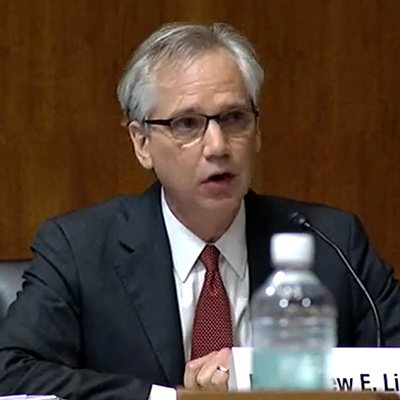
Andrew Light, nominated as DOE assistant secretary for international affairs | Senate Committee on Energy and Natural Resources

Introducing himself to the committee as the grandson of West Virginia coal miners, Light noted that LNG exports are now at an all-time high and expected to increase, “My job is to make sure U.S. gas is competitive around the world. More and more countries are looking for cleaner sources of gas. Russia’s got the dirtiest source of gas right now. We’ve got to make sure that ours is cleaner, and there are still those markets around the world.”

Sen. Bill Cassidy (R-La.) also queried Light about China’s massive Belt and Road Initiative, through which the country is building coal plants and other infrastructure in developing nations around the world.

“What China is doing is a threat not only to the climate, it’s a threat to U.S. national security,” Light said. “We’ve got to create a whole-of-government approach. We’ve got to be able to go into these countries and offer them packages that include funding. The packages could certainly include natural gas. We’ve got to go in and assess what is the best option for these countries, given what their commitments are with respect to their energy transition. We’ve got to offer something which is a better deal than China can.”

Light also sees a big role for the U.S. in carbon-capture and other emissions-free technologies. “We have to provide decarbonization. Energy is good; it’s the emissions that are a problem. We can become the leaders in abated natural gas technology around the world; we can become the leaders in abated coal technology around the world. We’ve got to innovate towards that.”