New Jersey Businesses Prep for Offshore Wind Expansion

For years, Alpine Ocean Seismic Survey plied its trade, providing marine geophysics services to offshore wind projects in Europe and to gas and oil projects in the Gulf of Mexico. The company’s home state of New Jersey, however, was “kind of dead,” for wind work, said President Robert Mecarini.

Times have changed. Now, as an experienced player, the 70-year-old Norwood-based company has worked on the development of wind projects off the Jersey coast and is preparing to bid on work for the construction phase as the projects advance.

“We’re the only native New Jersey company that is doing this kind of work at the moment,” Mecarini said. “A lot of companies like using us just because we’re local content.”

The rising demand for Alpine Ocean’s services reflects a growing anticipation in the New Jersey business community that the state’s massive commitment to offshore wind energy will soon yield opportunities for local businesses, and that now is the time for companies to position themselves to compete in the expanding market.

Gov. Phil Murphy has set an ambitious target of having 7,500 MW of wind energy off the New Jersey coast by 2035, as part of the state’s drive to 100% clean energy by 2050. The New Jersey Board of Public Utilities (BPU) has so far awarded about half of those megawatts, spread over three offshore wind projects.

The BPU’s first solicitation in 2019 was won by Ørsted’s 1,100-MW Ocean Wind 1, followed this June by the 1,148-MW Ocean Wind 2, another Ørsted project, and the 1,510-MW Atlantic Shores project, a joint venture between EDF Renewables North America and Shell New Energies US. (See: NJ Awards Two Offshore Wind Projects.)

With three more solicitations planned in the next six years, businesses are watching the sector’s evolution closely. State agencies are working hard to support local companies by funding and organizing wind sector training, holding informational forums and encouraging the major developers to look to in-state businesses — especially minority- and women-owned companies — to provide contracted services.

An Offshore Wind Supply Chain Registry set up by the New Jersey Economic Development Authority (EDA) includes hundreds of companies that can provide a range of essential hardware, from cables and conductors, to transformers, valves and other accessories. The challenge, however, is that many of them have little experience in the wind sector.

Creating A New Industry

“There’s no doubt that there’s a tremendous interest” among businesses, said Gerald T. Keenan, president of the New Jersey Alliance For Action, a bipartisan business advocacy group focused on improving the state’s infrastructure. “And it’s continuing to grow.”

The alliance organized a wind networking and informational event in August and has another one set for Sept. 17. The first one attracted around 200 people — including contractors, engineers, and labor and educational leaders — to a presentation on the two wind projects the BPU awarded in June, Keenan said.

“This is the creation of a new industry,” he said. “And I can’t recall an opportunity like this in my 24 years here.”

New Jersey officials envision the state creating a wind industry that will serve as a manufacturing and operational hub for the Atlantic coast offshore wind sector. Yet the success of that ambition may depend on New Jersey’s ability to compete with nearby states with similar goals.

The Port of Virginia announced a week ago that it has agreed to lease 72 acres of its Portsmouth Marine Terminal to Dominion Energy (NYSE: D) to serve as a staging and preassembly area to support development for the 2.6-GW Coastal Virginia Offshore Wind project. And US Wind Inc., which is developing a wind project off the coast of Maryland, recently announced plans to develop 90 acres of waterfront in Baltimore County into an “offshore wind deployment hub,” including a factory for monopiles, the foundations for offshore turbines. (See: Dominion Secures 10-Year Va. Port Lease for OSW Staging.)

In Connecticut, Eversource Energy and Ørsted agreed in February to help redevelop the State Pier in the City of New London into a modern facility capable of supporting offshore wind turbine staging and assembly. The partners are developing three wind projects, totaling 1,700 MW, off the coast of Connecticut and New York. (See: New London, OSW Devs Agree to Deal on Staging Area.)

New York, with wind projects totaling 4.4 GW already procured, is developing a tower-manufacturing plant in the Port of Albany and a turbine-staging facility and operations and maintenance hub at South Brooklyn Marine Terminal. Other support activities for the offshore wind sector are planned to take place at the ports of Coeymans and Montauk Harbor, and at Port Jefferson in Long Island. (See NY Awards 2.5-GW Offshore Deal to Equinor.)

But Mecarini is confident New Jersey’s efforts to build a wind sector will resonate beyond the state’s borders. In the last 12 years, Alpine Ocean has grown from 8 employees to about 60, largely driven by wind opportunities around the world. Future growth could stem from New Jersey’s industry, and its neighbors too, he said.

New Jersey efforts to jump-start a new wind sector include the development of a port and hub, the South Jersey Wind Port, on the Delaware River, which potentially will include two manufacturing facilities to make nacelles, the giant housings that contain the power-generating components of wind turbines. And German manufacturer EEW Group is building a monopile factory in nearby Paulsboro, also on the Delaware River. (See: New Jersey Shoots for Key East Coast Wind Role.)

“What New Jersey is doing very proactively to get people ready to be part of the supply chain is important,” Mecarini said. “But it’s not only the New Jersey industry that it’s going to impact. It’s the offshore wind sector.

“These companies in New Jersey, that have the skill sets are not only going to use them in New Jersey. They are going to use them on projects in Massachusetts, projects in Maryland, projects in the Carolinas. Wherever there is going to be work, those companies that have a niche are going to be used,” he said.

The state is also creating a WIND Institute, an independent authority that will “coordinate and galvanize cross-organizational workforce, research, and innovation efforts,” according to the EDA website. A report by the state’s Wind Council that recommended the creation of the institute said the state should also place a short-term priority on training wind turbine technicians and creating a pipeline of “trade workers with the skills and qualifications required for offshore wind.”

To that end, the EDA on July 6 awarded a $3 million grant to Atlantic Cape Community College to establish a Global Wind Organization (GWO) safety training program and facility. Based in Denmark, GWO is an international nonprofit that develops safety training and standards for the industry.

Stoking Business Interest

Partnering with the Business Network for Offshore Wind and New York City Economic Development Corporation, the EDA in June and July organized three online webinars — on manufacturing, professional services and the construction trades — aiming to stoke business interest in the sector and guide interested companies.

“We see this as critical to helping us transform our economy and move into the next generation of clean jobs,” Julia Kortrey, offshore wind project officer for the EDA, told the manufacturing panel. “We not only want to reach 100%, clean energy by 2050. We want to make sure that economic development and jobs come with that.”

Kortrey said Ørsted has committed to award grants to minority- and women-owned businesses, and EEW is “eager to have both local and diverse suppliers to support the development and construction” of monopiles.

“As part of our value-oriented approach to offshore wind development, we have a strong emphasis on local content and supporting economic growth,” she said.

Among those keen to provide local content is American Aerospace Technologies, which is positioning itself to tap into what it hopes will be demand for drones taking off from the company’s facility at Woodbine Municipal Airport in South Jersey.

The Pennsylvania-based company in the past has used drones to provide control and monitoring services in the onshore wind and solar sectors, including doing airborne wind tower inspections, said CEO David Yoel. For solar, the company’s drones can provide surveillance with infra-red equipment that looks for “hot spots,” indicating potentially weak connections in solar equipment, Yoel said.

For offshore projects, drones could monitor and surveil turbine construction and operations, and track ship movements, he said. With an 18-foot wingspan, the company’s aircraft can fly for up to 20 hours, while burning only a gallon of gas every three hours, compared to 15 or 20 gallons an hour for a conventional aircraft, he said.

“One use would be to monitor for marine mammals in the in the area of operation and to be able to warn ships that there are marine mammals in the area, so that they get their speeds down to minimize the chances of any injuries,” Yoel said. “We can provide communication services to construction teams that are going to be offshore … essentially a cell tower in the sky that they can use to communicate with people when they’re 40 miles offshore.”

To do that, however, the company needs approval from the Federal Aviation Authority (FAA) to use drones in commercial air space, Yoel said. The company in the past has worked under short-term waivers but needs a more permanent solution to do offshore work, he said.

“Our goal is 12 to 15 months” to secure FAA approval, he said. “We’re focused on breaking the bottleneck to get to the point where we can offer these services to the industry.”


‘Charge Up Hawaii’ Seeks to Pinpoint EV Charging Needs

In an effort to gauge community desire for electric vehicle charging stations, Hawaiian Electric Company (HECO) last week launched Charge Up Hawaii, a website and interactive web tool asking for public input on EV charging station locations.

Using the tagline “building a network of reliable electric vehicle charging stations,” Charge Up Hawaii allows respondents to place a pin on a map where they would like to see an EV charging station and explain why that spot would be a good location. There is also a $100 giveaway for those who answer a short survey about the difficulties they face when commuting.

When looking at potential infrastructure, Charge Up Hawaii points out several considerations, from equity, to the environment, to convenience. EV charging stations can be installed in a variety of areas, including parking lots, rail stations, and even private locations such as neighborhoods with houses that do not have the space or capability to install their own private charger — or apartment buildings.

The website notes that EV charging at private locations is “critical to encouraging widespread EV adoption,” that owners of private property could benefit from rebates and tax credits to lower the installation cost, and that “a robust and reliable network of public and private charging stations is essential to building range confidence and EV accessibility for all communities.”

The website represents yet another effort by HECO and the state to change all commuter vehicles to EVs by 2045. It notes that while there are 15,000 passenger EVs registered and that the number has been steadily increasing, “charging infrastructure has been identified as one of the key elements to accelerate EV adoption.”

Newer EVs can travel a few hundred miles on a single charge, but older models may only have a range of 100 miles or less. In addition, an EV battery’s storage capacity can diminish over time just like any other rechargeable battery. This can lead to range anxiety, which the website notes as being one of the “major barriers” to EV adoption.

HECO estimates that in 2030 there will be a need for over 3,600 public charging stations. HECO has already been testing a pilot program of 25 fast charging stations across the islands.

“This webtool is a great opportunity for us to hear from our customers as we work to strategically locate EV chargers to maximize their benefit. As more and more drivers make the switch to electric vehicles, we need to ensure there are sufficient EV charging solutions to support that growth,” said Aki Marceau, the utility’s director of electrification of transportation.

Hawaii currently has 542 publicly accessible EV chargers, including 473 Level 2 chargers and 69 DC fast chargers.

SACE Reports Record Year for EVs in Southeast

The Southern Alliance for Clean Energy (SACE) says 2020 was a banner year for electric vehicles in the southeastern U.S.

In a second annual progress report, the nonprofit advocacy group said EV manufacturing and employment, sales, charging station construction, and utility investment and government funding are all on the upswing in Tennessee, the Carolinas, Georgia, Alabama and Florida. The report was coauthored by D.C.-based data consulting firm Atlas Public Policy.

“When we look across these indicators, they’re all trending in the right direction,” SACE Electric Transportation Policy Director Stan Cross said during a Wednesday webinar. “There’s this virtuous cycle that’s occurring in the region.”

“I don’t see the word ‘decrease’ anywhere,” agreed Atlas Public Policy founder Nick Nigro. “I’ve been working on the electrification of transportation [and] climate change for over 10 years now, and this is hands-down the most exciting year that I’ve been involved in this space. It’s refreshing, and it’s giving me some good sense of optimism.”

Nigro said about 46% of all electric passenger vehicle sales ever in the Southeast have occurred in the past year. A third of the Southeast’s more than 15,000 charging stations were brought online in the last year.

“So, the momentum is there, and the evidence is in the data,” he said.

Cross said the Southeast “has clearly emerged” as a leader in manufacturing investment and employment.

Southeastern states currently account for 18% of all EV manufacturing jobs in the country and 37% of all manufacturing investment. Cross said those jobs figures were “outsized” considering the region’s population.

“Tennessee is really leading with announcements from General Motors and others … for manufacturing of EVs in the state. It’s going to be a big boost to that economy and hopefully lead to complementary polices to encourage consumer adoption,” Nigro said.

He also noted Florida’s recent large investments in school bus electrification.

Nigro said in SACE’s 2019 EV report he tracked just $32 million in approved investments in EVs from investor-owned utilities in Southeast states.

“A year later, we’ve added $100 million dollars, for [more than] $130 million dollars in investor-owned utility investments in charging,” he said.

Volkswagen settlement awards from its $1.45 billion civil penalty for using a defeat device to cheat on federally required emissions tests of diesel vehicles remains the largest source of funding for vehicle electrification, Nigro said.

Nigro also said infrastructure improvements are desperately needed to support the nation’s electrified transportation.

“To put us on that glide path, we’re going to need about $85 billion,” Nigro said. He said much of that investment must come from the private sector.

EV drivers don’t want to “cheat the system” by dodging a gasoline tax, Nigro added. He said policymakers need to decide “what is fair” for building roads and bridges.

“As the conversation here in Washington heats up and there is an actual chance … for an infrastructure bill, more people are recognizing how poor the state of our infrastructure is nationwide,” Nigro said. “So, Americans, I think, rightfully want to contribute to repairing our roads, bridges, transit … and make sure we have world-class transportation infrastructure.”

He pointed out that gasoline taxes are only a portion of road funding, and that general use and sales taxes also fund highways and roads.

“We are all already paying our share in a lot of ways,” Nigro said.

Ohio Senate Challenges PJM’s MOPR-Ex Filing

Members of the Ohio legislature are challenging PJM’s proposed replacement for the extended minimum offer price rule (MOPR-Ex), asking FERC to reject the RTO’s July filing.

Matt-Huffman-(Ohio-General-Assembly)-FI.jpg
Sen. Matt Huffman | Ohio General Assembly

In comments sent last week to the commission, Ohio Senate President Matt Huffman (R) and Sen. Rob McColley (R), majority whip and chairman of the Energy and Public Utilities Committee, requested that the PJM proposal endorsed at a special Members Committee meeting on June 30 and approved by the Board of Managers on July 7 be rejected (ER21-2582). (See PJM Board Approves MOPR Rollback.)

The senators said that PJM’s MOPR-Ex filing would “severely undermine Ohio’s efforts to promote robust and fairly administered competitive electricity markets in our state.”

“PJM’s new construct would freely allow states outside of Ohio to effectively export their policies to our state,” the senators said. “FERC must stand up to this overreach and discriminatory construct by rejecting the filing.”

Rob-McColley-(Ohio-General-Assembly)-FI.jpg
Sen. Rob McColley | Ohio General Assembly

PJM said its MOPR proposal would “maximiz[e] transparency and market confidence” through identification of buyer-side market power (BSMP). Market participants would be asked to sign attestations declaring they are not exercising market power or receiving state funds tied to clearing in the capacity auction. PJM and the Independent Market Monitor would conduct “fact-specific, case-by-case reviews” if market power is suspected. Referrals of BSMP would then be made to the commission for a final determination.

The comments from the Ohio legislators come on the heels of more than two dozen comments that came into the commission late last month as PJM stakeholders issued a mix of support and opposition to the RTO’s filing. (See Mixed Stakeholder Reception to PJM MOPR Replacement.)

PJM adopted the extended MOPR in response to FERC’s 2-1 ruling in December 2019 saying MOPR should apply to all new state-subsidized resources to combat price suppression in the capacity market. Then-Chair Neil Chatterjee and fellow Republican Bernard McNamee formed the majority, with Democrat Richard Glick angrily dissenting, calling it an attack on state decarbonization efforts. Glick asked PJM to undo the rule after he was named chairman by President Biden in January.

Disparate State RPS Policies

While several states in PJM’s 13-state footprint have enacted increasingly ambitious renewable energy targets in recent years, Ohio’s Republican-controlled government has not joined the trend.

In 2019, Gov. Mike DeWine (R) signed House Bill 6, which reduced the state’s renewable portfolio standard from 12.5% by 2027 to 8.5% by 2026, after which the RPS would be eliminated. Last month, DeWine signed a bill giving county governments the power to review and reject utility-scale wind and solar projects before developers can apply to the state Power Siting Board. (See Ohio Governor Signs Bill to Block Renewables.)

Huffman and McColley said PJM’s MOPR filing “represents a significant step backward for an RTO that has traditionally been a champion of just and reasonable competitive markets.” They said utilities in Ohio originally joined PJM expecting to participate in a regional market “in which reliability would be ensured by competitive resources vying to serve load at the lost cost.”

“Ohio desires a market based on competition, not subsidies, and FERC has a duty to protect that market from the disruptive actions of a one state that impact the outcomes for other states,” the senators said in their letter.

Senate Resolution

Huffman and McColley said the Ohio Senate will “shortly” consider a concurrent resolution by Ohio Sen. Mark Romanchuk (R) to “urge the preservation of the minimum offer price rule for the PJM capacity market.” The resolution calls on PJM and FERC to “evaluate whether state-subsidized generation resources have a material impact on price formation in PJM’s capacity market.”

Mark-Romanchuk-(Ohio-General-Assembly)-FI.jpg
Sen. Mark Romanchuk | Ohio General Assembly

Citing “billions of dollars of investment in new generation resources in Ohio since deregulation began in 1999,” the resolution said the state has rejected subsidizing generation resources “in favor of encouraging competition.”

“The elimination of the minimum offer price rule would increase the risk of a critical reliability problem within the PJM states and would force Ohioans to bear costs associated with other states’ generation resource preferences,” the resolution said.

Huffman and McColley said the full Ohio Senate will be “shortly” considering the resolution. Besides the resolution, the senators said the general assembly also intends to hold its own hearings on the MOPR and to “explore how to maintain Ohio’s commitment to competitive markets in the face of a PJM filing that is clearly antithetical to that cause.”

NV Energy Applies to Build Northern Nevada Line

NV Energy filed an application last week to build a 235-mile transmission line across northern Nevada — a $901 million project that would complete a transmission triangle around the state.

The Greenlink North project would run from Robinson Summit near Ely in eastern Nevada, to Fort Churchill near Yerington.

The 525-kV transmission line would ultimately connect NV Energy’s existing One Nevada line, which runs down the east side of the state, to Greenlink West, a yet-to-be-built line along the west side of the state. Greenlink West and One Nevada will meet in the Las Vegas region.

The Public Utilities Commission of Nevada in March approved construction of Greenlink West. NV Energy expects construction to be completed by the end of 2026.

In its application to build Greenlink North, NV Energy said its renewable portfolio has relied heavily on solar resources in Clark County because of transmission constraints.

“The presence of Greenlink North opens vast areas to other renewable energy resource development, as well as new geographically diverse solar resources,” the company said.

The Greenlink project will also increase electric reliability throughout Nevada, create jobs and help the state’s economy recover from the impacts of the COVID-19 pandemic, NV Energy said in a news release.

Legislative Mandate

NV Energy filed its application for Greenlink North last week as an amendment to the utility’s 2021 integrated resource plan. The transmission proposal is also called the Transmission Infrastructure for a Clean Energy Economy Plan (TICEEP).

NV Energy was required to file the TICEEP by Sept. 1 as part of Senate Bill 448, a wide-ranging energy bill that the state legislature passed in May. And SB448 requires the PUCN to accept the TICEEP as long as it meets certain requirements. (See Far-reaching Energy Bill Sweeps Through Nev. Legislature.)

Sen. Chris Brooks (D), who introduced SB448, said previously that one of the bill’s goals was to speed up completion of the Greenlink network, which in turn could spur other transmission projects.

Although the PUCN in March approved conceptual designs, permitting and land acquisition for Greenlink North, Brooks said SB448 adds certainty that construction of the project will be approved. The goal is to have Greenlink North in service by Dec. 31, 2028.

Meeting Demand

TICEEP includes another transmission component specified by SB448: a 32-mile, 525-kV line just north of Las Vegas. The line will follow an existing transmission path from the Harry Allen substation to the Northwest substation, through a federally designated renewable energy transmission corridor.

NV Energy said the line would potentially allow a second 525/230-kV transformer at the Northwest substation to serve increased demand in Las Vegas. The new line would also give the Las Vegas area greater access to renewable resources, the utility said.

“Without this line, new solar and geothermal resources located near Greenlink West may be constrained due to transmission limitations into the Las Vegas Valley, thereby impeding development of those renewable resources,” NV Energy said in its filing.

The utility estimated the cost of the Harry Allen to Northwest line at $143 million.

NV Energy noted in its filing that its proposal does not analyze alternatives to Greenlink North and the Harry Allen to Northwest segment because the legislature directed the utility to evaluate only the two projects.

RTO Mandate

Another section of SB448 will require transmission providers in Nevada to join a regional transmission organization by Jan. 1, 2030, unless the provider can show that such a move isn’t feasible.

NV Energy said in its filing that it plans to participate in a task force that will evaluate potential benefits of joining an RTO.

“[NV Energy] will continue to explore energy market possibilities that could benefit their customers and the state of Nevada,” the utility said. “However, it is too early to make any recommendation to joining an RTO.”

MISO Says Dicey Fall Operations Ahead

Normal fall conditions could beget an emergency declaration in September or October, MISO said in a seasonal outlook released Thursday.

The RTO also said excessive generation outages and high loads in autumn could exhaust every megawatt of its capacity and leave staff counting on non-firm imports to maintain system reliability.

Speaking during a Market Subcommittee teleconference, MISO Resource Adequacy Engineer Eric Rodriguez said this fall is projected to have “substantial risk,” particularly if there is an active shoulder maintenance season.

“Generation outages on monthly peak remain high during the fall, particularly in October and November,” Rodriguez said, referring to historical data. Last October, planned and forced outages on peak crept to more than 50 GW, a five-year high.

If outages are controlled and load doesn’t spike, staff said they could have at least November in hand this year.

Using probable peak forecasts provided by its market participants, MISO said it would be left with 108.8 GW of non-emergency resources to cover a 109-GW September peak; 88.8 GW in in non-emergency capacity that would fall short of a 90.2-GW October peak; but 92.7 GW of non-emergency capacity to cover November’s projected 87.3-GW peak.

Those totals don’t account for 12 GW of load-modifying resources and operating reserves, which are only available for use once MISO declares an emergency. The grid operator said there’s a chance it could deplete all emergency resources in September and October and come up short if it encounters a double whammy of unusually high generation outages and load.

However, Rodriguez said MISO can maintain system reliability with wind generation that comes in higher than its accredited value. He also said non-firm imports could help meet demand. The RTO has previously dodged emergency declarations through neighboring imports, thanks to its Middle America footprint.

The National Oceanic and Atmospheric Administration anticipates average temperatures and precipitation throughout MISO’s region this autumn. Its 115-GW all-time fall peak occurred in September 2017, when unseasonably hot temperatures prompted a maximum generation declaration.

The grid operator’s late summer has been a whirlwind of two sustained northern heatwaves, back-to-back conservative operations declarations, and record-breaking hurricane destruction in Louisiana. (See Entergy Re-energizes Small Portion of New Orleans.)

However, the summer’s only maximum generation event occurred in early June when a heat wave struck the northern footprint.  

June Pricing Evaluation 

MISO revisited its June 10 emergency declaration in its North and Central regions after some market participants criticized its decision not to use some offered emergency resources. (See “MISO Defends June Emergency Declaration,” MISO Market Subcommittee Briefs: July 8, 2021.)

Economic, non-firm imports responded to pricing signals during the emergency, making some members’ emergency offers unnecessary and boosting imports’ prices between MISO’s ex-ante and ex-post pricing calculations. Emergency resources do not participate in the RTO’s pricing.

“It’s the inflexibility of some of these out-of-market, emergency resources that drives this,” Kevin Vannoy, MISO’s director of market design, said. “When it comes to emergency-type conditions, MISO is in the position where a lot of its capacity supply stack are inflexible, emergency-only, out-of-market resources.”

Vannoy pointed out that MISO has emergency offer floors, not emergency price floors, and makes no guarantee of prices.

Staff said they only use emergency offers when its economic supply, including non-firm imports, is exhausted.

Vannoy said imports provide “more flexible and more economic” resources. He said if emergency-only resources want more certainty in pricing, they should register as market assets.

“We can and probably will see this in the future,” he said, predicting imports will supplant the need for MISO’s slowest emergency resources.  

ITC Holdings’ Marguerite Wagner said the emergency scenario raises the question of whether slow-moving emergency resources should be able to clear MISO’s capacity auction.

Shawn McFarlane, the grid operator’s executive director of market operations, said staff will hold more stakeholder discussions on the topic during upcoming Market Subcommittee meetings.

PG&E Value Lags as Dixie Fire Rages

The value of Pacific Gas and Electric’s (NYSE:PCG) fire victims’ trust fund has suffered from news that the utility’s equipment started fires last year and may have ignited the single largest blaze in California history this year, leading its trustee to warn victims that they may not receive the full value of their claims.

The fire victims’ trust, established on July 1, 2020, is $2.5 billion short of expectations, retired state appellate court Justice John Trotter wrote to victims of PG&E-caused fires in 2015, 2017 and 2018 on Wednesday.

Part of PG&E’s bankruptcy reorganization, the settlement “is unique in that its value was not a true lump sum but rather a combination of cash and PG&E stock,” Trotter noted. “It was reported to be $13.5 billion, $6.75 billion in cash and $6.75 billion in stock value. However, that never materialized.

“On the day the trust was established and became owners of approximately 477 million shares of PG&E stock, it was trading at $9 per share, for a value of $4.2 billion, approximately $2.5 billion less than promised. Over the last year, that value has fluctuated and today is close to its value” when the trust was funded, Trotter wrote.

The Dixie Fire has a lot to do with the predicament. By Sunday it had spread to 1,400 square miles, larger than the land mass of Rhode Island or Yosemite National Park. Only last year’s August Complex of fires in Northern California, which topped more than 1 million acres, exceeded the Dixie Fire’s current size. The California Department of Forestry and Fire Protection (Cal Fire) is investigating a PG&E power line as the possible cause of the Dixie Fire.

PG&E stock, which closed at $10.34/share on the day the trust fund was established, has remained below $13 since then. It closed at $9.79 on July 16, before the company informed the California Public Utilities Commission that it may have been responsible for the Dixie Fire. (See PG&E Says Its Line May Have Started Dixie Fire.) Shares closed at $9.15 on Friday.

As of Aug. 31, the trust fund had awarded $2.4 billion in determination notices and made payments of almost $740 million.

Meanwhile, PG&E said last week it had secured approval from the PUC to sell its San Francisco headquarters for $800 million and to return $400 million to ratepayers to lower their bills. PG&E announced in March it was moving across the San Francisco Bay to new headquarters in Oakland. (See PG&E to Sell San Francisco HQ for $800M.)

“In addition to promoting long-term savings for PG&E, the sale of our San Francisco headquarters will help to offset future customer rates at a time when we’re making significant safety and operational investments,” CEO Patti Poppe said in a statement.

In August, the utility asked the CPUC to increase its return on equity from 10.25% to 11% next year, which could increase its profits by $200 million.

The company also announced it would donate $1 million this year to wildfire relief and recovery efforts, including $300,000 to the American Red Cross and $100,000 “to assist communities impacted by the Caldor Fire in El Dorado County.”

The cause of the Caldor Fire, which forced the evacuation of the city of South Lake Tahoe last week, is under investigation.

“We all are blessed by the kindness of the many nonprofit organizations, volunteer fire departments and community groups that are opening their hearts and rolling up their sleeves in service to those who have been displaced temporarily or permanently by these terrible fires,” Poppe said in the statement.

It made no mention of the Dixie Fire or the Zogg Fire, which Cal Fire concluded was started by a tree falling on a PG&E power line. The Zogg Fire killed four people, including a mother and her young daughter unable to escape the flames, in rural Shasta County. (See PG&E Equipment Started Zogg Fire, Investigation Finds.)

If Cal Fire finds a PG&E line started the Dixie Fire, it would mark the fifth year in a row that PG&E’s equipment has been blamed for catastrophic blazes.

Cal Fire blamed the utility’s equipment for starting the devastating Northern California wine country fires of October 2017; the Camp Fire, which killed 85 people and leveled the town of Paradise, in November 2018; and the Kincade Fire, which tore through Sonoma County in October 2019.

The company filed for bankruptcy protection in January 2019 and emerged from Chapter 11 proceedings in June 2020, after agreeing to pay a total of $25.5 billion to fire victims, insurance companies and local governments for the 2015 Butte Fire, the wine country fires and the Camp Fire.

The insurance companies and governments received cash; only fire victims got stock — receiving more than one fifth of PG&E’s outstanding shares.

Before the wine country fires of October 2017, PG&E stock sold at more than $70/share, giving it a market capitalization of $36 billion. The current share price puts the utility’s market value at approximately $20.6 billion.

NEPOOL Participants Committee Briefs: Sept. 2, 2021

ISO-NE Proposes 5.9% Budget Increase 

ISO-NE presented its proposed 2022 operating and capital budgets to the NEPOOL Participants Committee last week, with increases to both.

The operating budget of $189.2 million before depreciation represents a 5.9% increase from the 2021 figure. The RTO will add nine full-time-equivalent positions to address the burgeoning workload for integrating clean energy and distributed resources in the market development, transmission planning, power system modeling and legal areas, and cybersecurity and information technology support.

ISO-NE expects its capital budget over the next five years to increase from $28 million to $35 million, including $32 million for 2022. The primary influences of the spending hike are the nGEM platform replacement, cybersecurity, the clean energy transition and reliability improvement projects, as well as IT asset and infrastructure replacement.

Although ISO-NE’s spending has never exceeded budget, it might happen in 2022, according to Robert Ludlow, the RTO’s chief financial and compliance officer. Situations like funding the next phase of the Pathways to the Future Grid project, constructing models to study extreme weather and contingencies, conducting studies, and integrating clean energy, distributed resources and emerging technologies could trigger more spending.

Other additional spending areas include:

  • legal costs;
  • federal and state policy directives, including multiple scenarios under the 2050 Transmission Study;
  • interest rates on tax-exempt debt, pension and post-retirement benefit plan liability costs, and interest income on settlement float balance; and
  • potential impact of workforce disruption because of continued uncertainty in remote versus on-site work.

The New England States Committee on Electricity (NESCOE) also presented its proposed budget of $2.49 million for next year, an approximately $57,000 increase over 2021 but below the $2.62 million projected in its five-year pro forma budget. NESCOE said the reduction reflected “continued rebalance” of technical and legal spending and declines in travel-related expenses and rent.

The budget timeline includes votes at the PC and the RTO’s Board of Directors, before filing with FERC by Oct. 15.

Tropical Storm Henri ‘Minimally Impactful’

In his monthly report to the PC, ISO-NE COO Vamsi Chadalavada said that Tropical Storm Henri — which made landfall at Westerly, R.I., on Aug. 22 — was “minimally impactful” to the bulk electric system. The RTO, local control centers, and transmission, distribution and generation entities were “well prepared” for the storm. As a result, no significant generation resources tripped.

Chadalavada added that ISO-NE declared an abnormal conditions alert on Aug. 20 and canceled it on Aug. 23. In addition, the RTO required no supplemental commitments before or during the storm as the day-ahead commitments met all expected needs, Chadalavada said.

The original peak load forecast was 17,100 MW at 7 p.m. on Aug. 22, but the actual was 16,440 MW for that hour. ISO-NE lost minimal load, with approximately 140,000 customer outages at the peak of the storm, mainly in Rhode Island. Two 115-kV transmission lines were also impacted during the storm, though Chadalavada said both were restored on the same day.

Energy Market Value Rises

In the opening portion of Chadalavada’s report, he noted that ISO-NE’s energy market value for last month was $534 million (through Aug. 25), up $71 million from the updated July valuation and $229 million higher than the same month in 2020.

Natural gas prices were 22% higher than in July. Average real-time hub LMPs were 37% higher at $48.83/MWh. Average natural gas prices and real-time hub LMPs were up 161% and 105%, respectively.

Daily uplift or net commitment period compensation (NCPC) payments totaled $2.3 million over the period, down $500,000 from the adjusted July value and $1.1 million less than in August 2020. NCPC payments were 0.4% of the energy market value.

Chadalavada said seven new projects totaling 951 MW applied for an interconnection study: two offshore wind, two solar, two solar with batteries and one battery. ISO-NE is currently tracking 296 generation projects, which total approximately 32,631 MW.

ERCOT: Sufficient Capacity to Meet Fall Demand

ERCOT quietly released its final resource adequacy assessment for the fall season Friday, saying it has sufficient installed generating capacity to serve peak demand under normal system conditions and several risk scenarios.

The grid operator expects a seasonal peak demand of 62.7 GW, unchanged from its preliminary fall seasonal assessment of resource adequacy (SARA), including 120 MW of forecast load reduction from rooftop solar.

The report was dropped in a market notice without the normal press release and media call. Going forward, ERCOT said it will eliminate the preliminary SARAs and publish only a final assessment.

A coal plant’s extended outage has cut reserve capacity by 868 MW since the preliminary fall SARA was released in May. However, ERCOT is expecting an additional 5.3 GW in planned gas, wind and solar capacity to be available to meet fall demand. It is also counting on another 644 MW of battery energy storage capacity to be available, though it is assumed to provide ancillary services.

ERCOT expects 14.8 GW of thermal outages during the fall season (October and November), based on historical outage data from the past three years.

The grid operator said a change in how it categorizes an “unavoidable extension” resulted in an increase in projected unplanned outages (previously called forced outages) and a decrease in planned outages (previously called maintenance outages). With the change, ERCOT said, unplanned outages increased for the high and extreme unplanned outage cases.

Beginning with this SARA, the grid operator expanded the low-wind output scenario to include low-solar output. It also includes an analysis of extreme scenarios that assume multiple severe system conditions occur. ERCOT said the report is intended to illustrate the range of resource adequacy outcomes that might occur. Staff studied high peak load scenarios with high and extreme generation outages and expected and low renewable output. They said load shed becomes a possibility when unplanned outages exceed their normal 10-GW threshold, combined with low renewable output.

Summer Peak Falls Short of Record

The Texas grid operator set a pair of new demand peaks last week as a late-summer heat dome settled over the state.

ERCOT set a new demand mark for September of 72.2 GW during the month’s first day, breaking a two-year old mark, Kristi Hobbs, the grid operator’s vice president of corporate strategy and Public Utility Commission relations, told the PUC Thursday. Wind and solar energy each produced about 5 GW during the peak.

Demand on the Texas grid reached a summer high of 73.5 GW on Aug. 31. Staff had projected a record peak of 77.1 GW this summer, but the August 2019 record of 74.8 GW stills stands.

Entergy Touts Restoration; NOLA Leaders Question Lack of Blackstart Service

A week after Hurricane Ida clobbered Louisiana, Entergy leadership said Monday that “near-miraculous” restoration work had returned power to 70% of New Orleans.

Entergy Louisiana CEO Phillip May said the utility had restored power “and a sense of normalcy” to 54% of the 948,000 total customers who lost power across Louisiana and Mississippi.

But for customers in outlying Bayou areas, most of September could be spent without electricity. Entergy said it could be Sept. 29 until the Lower Jefferson, Lafourche, Plaquemines, St. Charles and Terrebonne parishes regain power.

“In the hardest hit region, it’s going to be a rebuild, not a repair,” May again stressed in a Sept. 6 press call. “There is considerable damage as you get into the Bayou region.”

May said Ida was “one of the most destructive hurricanes to ever strike U.S. soil,” packing an “unprecedented level of destruction and devastation.”

“The damage in terms of pole counts is worse than Hurricane Katrina, Delta and Zeta combined,” said John Hawkins, vice president of distribution operations for Entergy Louisiana.

Hawkins said crews found damage beyond what was expected in some areas.

“Changing estimated restoration dates can and will happen in almost any restoration,” he added.

But Hawkins said some of Entergy’s restoration was completed earlier than originally anticipated, in the case of most of Baton Rouge, which was returned to service by Sept. 5, ahead of Entergy’s original Sept. 8 estimate. He said connecting Baton Rouge earlier than expected frees up crews to descend upon rural spots and areas that were initially inaccessible after the hurricane.  

“But I’m going to have to temper this good news,” Hawkins said, noting a tropical depression in the Gulf that has a slight chance of striking Louisiana this week.

“Unfortunately, it could bring rain to our already saturated area” and slow restoration work, he said.   

“This is a good day,” Entergy New Orleans CEO Deanna Rodriguez said, emphasizing that Entergy was able to restore nearly 70% of the 205,000 New Orleans customers without power within a week.

“I’m going to repeat that because it’s so monumental,” she said. “I think it’s near-miraculous the speed at which we’ve been able to return customers.”  

Rodriguez said nearly 90% of greater New Orleans should have lights by Sept. 8. She said Entergy will prioritize supply to pharmacies, banks, gas stations and grocery stores so more residents can return.

May said Entergy was able to restore key pumping stations for crude oil refineries along the coast. He declined to identify any stations that were restored.

May also announced an open-ended pause on late fees and shutoffs for all Louisiana customers

“We’re proud of what we’ve accomplished,” he said. “But we have a long way to go.”

Raised Eyebrows over Blackstart Decisions 

As more of Louisiana is lit, New Orleans leadership is questioning why Entergy didn’t tap the New Orleans Power Station to switch on a portion of New Orleans in Ida’s immediate aftermath.

May, on a Sept. 2 media call, insisted the power station “absolutely” has the ability to blackstart, but said it was not the “preferred path” in this case.

May said a nearly three-day wait to connect the power plant to a line from nearby Slidell in Cleco territory allowed the utility to use the plant as a “shock absorber” and restore New Orleans in “a more controlled and more robust way.” (See Entergy Energizes Second Tx Line, Generator.)

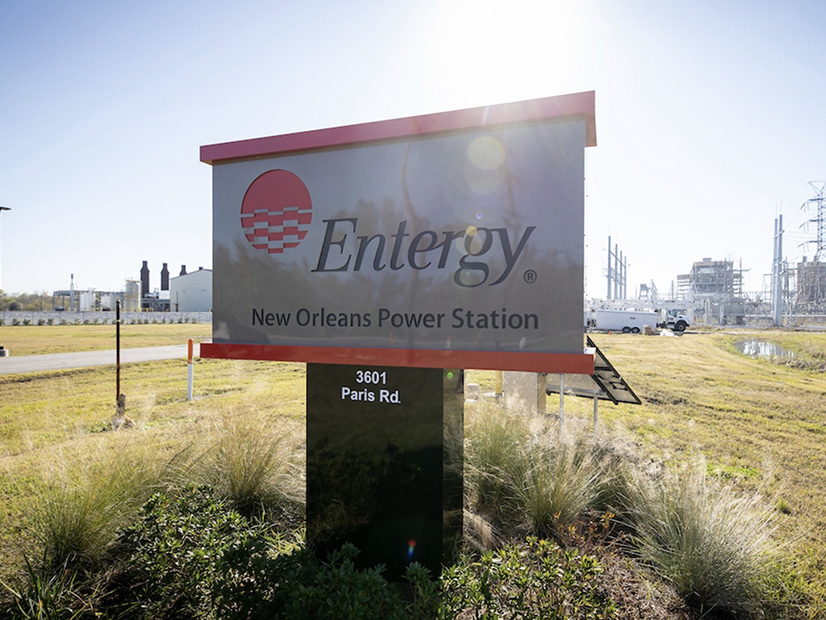
Entergy-New-Orleans-Power-Station-Sign-(Entergy)-Alt-FI.jpg
Entergy’s New Orleans Power station was brought online in May 2020. | Entergy

“It is not a question of whether it can or cannot. It absolutely can,” May said of the decision not to activate blackstart service. “The best way of assuring we can rapidly bring up power in the greater New Orleans region is the path we chose with a source out to the east.”

Entergy said it was “fully prepared” to generate within the islanded city but said “having the tie to the rest of the power grid provides a more stable and resilient supply to customers and allows us to bring in power from other sources.” It insisted the plant was functioning as designed.

However, New Orleans City Council President Helena Moreno said ratepayers who are paying for the plant “deserve answers.” She promised a “deep dive” into why the plant was not started without assistance from the MISO system.

Entergy executives repeatedly told the council that the plant could not start without connecting to the larger grid after the storm, Moreno said in a Facebook post.

“That’s contrary to all the testimony the previous council received when it approved the plant in 2018,” she wrote.

Entergy New Orleans ratepayers funded the New Orleans Power Station’s construction through an additional $11/month fee on their bills.

Four years ago, former Entergy CEO Charles Rice said in written testimony that the plant would “include black-start capability, which will enable the company to start the unit even when there is no power on the electric grid.”

“This will give the company the ability to restore electric service, should a complete loss of service occur. This could be a tremendous benefit if New Orleans is electrically ‘islanded’ from the rest of the interconnected transmission grid, as it was after Hurricane Gustav,” Rice said.

Hurricane Gustav in 2008 islanded the New Orleans-Baton Rouge from the grid for more than 33 hours when 14 transmission circuits tripped offline, requiring resynchronization.

Entergy also told the council in filings that the plant’s blackstart feature would be “critically important” given the area’s risk for extreme weather and that its “close electrical proximity to electric demand” could keep voltage and frequency in check during restoration activities.

The New Orleans Power Station can supply only about 10% of New Orleans’ more than 1 GW needs.