Investor appetite in the coming hydrogen economy is growing “more discriminating” as investors try to pick winners and avoid losers, much like what happened in the internet frenzy of the early 2000s, according to James West, senior managing director at investment advisory firm Evercore ISI.
But that appetite is still strong and the general interest from investors in green hydrogen is “enormous,” West said during the U.S. Department of Energy’s Hydrogen Shot Summit on Tuesday.
In the growing hydrogen market frenzy, West sees involvement with green hydrogen as a “critical success factor” for companies.
“We think that companies must be involved with green rather than gray hydrogen and minimal blue hydrogen, as this is where the market’s going to be the strongest,” he said. Companies also must focus on “products or industries where green hydrogen is the key viable alternative to fossil fuels.”
If green hydrogen producers can be cost-competitive, he added, they have a “massive opportunity” to compete in the industrial sector where gray hydrogen is in use already.
The types of customers and partnerships that hydrogen companies secure also will make a difference in their ability to succeed in the near term.
“We believe the scaling of this industry is going to take an all-hands-on-deck approach to meet deep decarbonization goals,” West said.
Hydrogen solutions provider Plug Power’s (NASDAQ:PLUG) joint venture with Renault, he said, is a good example of the kind of partnerships that the industry needs. HYVIA, announced in June, will focus on development of light commercial fuel cell vehicles, hydrogen charging stations and green hydrogen supply. Plug also will finalize a joint venture soon with SK Group to build out Korea’s hydrogen economy.
Plug has successful customers, and “that helps,” West said. The company has contracts with Amazon and Walmart to put its fuel cells in their warehouse lift trucks.
Other notable industry partnerships, West said, include Cummins’ (NYSE:CMI) memorandum of understanding with Chevron (NYSE:CVX), and Blum Energy’s (NYSE:BE) technology arrangement with Baker Hughes.
Cummins and Chevron announced in July that they will collaborate in the areas of hydrogen vehicle and infrastructure development and using electrolyzer and fuel cell technologies in Chevron’s refineries. Baker is looking to combine its gas turbine technology with Blum’s solid-oxide fuel cell technology.
Valuation
As investors try to sort out how to value hydrogen-related companies, they are turning to methods used for technology and software companies over traditional metrics, such as price-to-earnings or cash-flow yields.
“While the investor market uses those traditional metrics for mature industries, such as oil and gas, the hydrogen market is so nascent and rapidly growing, and therefore investors want to put very high price-to-sales [P/S] multiples in the shares of hydrogen-focused companies,” West said.
The P/S ratio will help investors understand how financial markets value a company’s revenue per dollar.
“Investors are also looking at metrics such as enterprise value-to-sales or enterprise value-to-total addressable market,” West said. Those metrics will show investors how a company is valued based on its sales, equity and debit.
The investor market for clean technologies is moving out of what West calls the “green hysteria of the post-election period,” resulting in a reallocation of “capital to companies with established customers, backbones and products.”
This year, he said, hydrogen-focused stocks have fallen by about 60% from their peak in the first quarter to the end of August. The broader group of clean energy stocks, which includes established hydrogen companies, fell about 25% in the same period.
Credit Ratings
With a sound framework for project finance still largely out of reach for hydrogen companies, they need creative ways to structure projects to achieve an investment-grade rating, according to Andrew Joynt, senior director at Fitch Ratings.
The ideal scenario to finance a project, he said, is an established technology operating with a long-term revenue agreement with fixed volume and pricing to create a stable cash flow profile.
Hydrogen technologies, however, often are supporting projects that tap into new markets, so near-term stability isn’t there.
“It’s going to be an uphill climb to get rating agencies … completely comfortable with taking a long-term view on some of these projects,” Joynt said during the summit.
Less well established companies, he added, will need to rely on independent experts to support the operating assumptions of new projects and technologies. And companies can look for ways to shift project risks to third parties.
“You can shift some of the risks to a manufacturer by getting a long-term, strong warranty or an operator who will provide a performance guarantee on the level of performance of a project itself,” Joynt said.
It’s harder, however, to shift risk on the revenue side.
Some project structures overcome that barrier by issuing shorter term debt. Those are “shorter-term loans that have some refinancing risk but allow you to right-size the debit as the market starts to evolve,” Joynt said.
While alternative finance structures can move the needle on project finance, they will come at a cost.
“Hydrogen companies that are going for financing are going to be faced with some choices of how much they want to try to lower the cost of debt, knowing that it may come at a lower rate of return,” he said. That tradeoff, he said, could be worth it for a company looking to establish its first project on the path to commercialization.
Entergy (NYSE:ETR) said Monday that it’s too early to make restoration estimates for the nearly one million customers without power after Hurricane Ida’s trek through Louisiana and Mississippi.
The eight transmission lines supplying the city of New Orleans remained knocked out of service Monday. In addition to the complete Orleans Parish blackout, the Jefferson, St. Bernard and Plaquemines parishes are all without power. Portions of the St. Charles and Terrebonne parishes are also dark.
On Sunday night the storm toppled an Entergy transmission tower on the banks of the Mississippi River near the Nine Mile Point power plant in Avondale, La., 15 miles west of New Orleans. (See Hurricane Ida Thrashes Louisiana; Storm Darkens New Orleans.)
Entergy said the same transmission tower was able to withstand Hurricane Katrina’s abuse exactly 16 years earlier. Hurricane Ida was smaller in size but stronger when compared to Katrina.
The utility said Ida retained hurricane status almost to the Mississippi state line. It reported nearly 900,000 power outages in Louisiana and about 45,000 outages in Mississippi. Entergy said it expected the Mississippi totals to increase as the storm crawled inland.
Entergy said Monday morning more than 2,000 miles of transmission lines and 216 substations were out of service throughout its service territory.
The restoration effort is certain to be lengthy and messy, with crews slow in being able to safely assess damage. Entergy said road closures and flooding make inspecting the destruction difficult.
Entergy New Orleans CEO Deanna Rodriguez told local news outlets on Monday that she had no restoration timeline to offer. Jefferson Parish Emergency Management Director Joe Valiente predicted it would take at least six weeks for customers in his parish to get power back. He called the damage “incredible.”
“With extensive damage, we have a lot of rebuilding ahead of us. We’ll be better prepared to give restoration estimates once assessments are done,” Entergy New Orleans announced in a Facebook post.
In a separate press release, the company added it would be “premature to speculate at this time when power will be restored given the extent of the damage.” It said it would learn more as the weather clears and that its crews were using infrared cameras, drones and satellites to survey damage in some inaccessible areas.
Even with the technology, Entergy said “lack of access in areas like waterways and marshes could delay” damage assessment.
The utility said it continued to provide some backup power service to the New Orleans Sewerage and Water Board to bail out floodwater and pump drinking water into the city.
The Sewerage and Water Board’s pumps are normally partially powered by Entergy. MISO recently approved Entergy’s expedited request to construct a new 230-kV substation to take on all load for stormwater drainage by 2023 and supplant the board’s own aging turbines. (See Entergy Expedites MISO Tx Project, Cancels 4 Others.)
By Monday morning, New Orleans City Council members were reportedly questioning whether Entergy’s plan deserves further scrutiny in light of the massive outages.
MISO spokesman Brandon Morris said the RTO is coordinating with Entergy on restoration efforts but echoed that it will probably take “days to determine the full extent of the damage to their transmission lines and electricity generators.”
“Our member companies are working hard to assess the storm damage under difficult circumstances,” Daryl Brown, executive director of MISO South, said in an emailed statement. “Once those assessments are completed, our control room team will be working closely with them to prioritize restoration efforts. This process will take time and the safety of personnel is paramount.”
MISO said Ida wrought the most significant damage in Southeast Louisiana. MISO South remains under a severe weather alert and conservative operations until 11:59 p.m. Tuesday. Morris said those declarations could be extended or new warnings issued “to safely support member utilities’ damage assessment activities.”
The dead buses around New Orleans likely won’t be priced at MISO’s $3,500/MWh value of lost load (VoLL) because the grid failure was brought on by a transmission emergency, not an insufficient capacity emergency.
MISO is in the middle of recasting its VoLL to a higher amount and getting a better handle on when it should be used in pricing. The RTO originally said force majeure events that lead to dead buses should not be priced using VoLL. (See MISO to Outline New Pricing Plan for Hurricanes.) Now MISO says VoLL is appropriate to price capacity emergencies, even when they’re caused by a force majeure. Local and systemwide transmission emergencies, the RTO said, are the events that should be shielded from VoLL pricing.
On close of business Monday, MISO’s Louisiana Hub was trading at a modest $36.23/MWh. The Mississippi Hub was priced even lower at $26.24/MWh.
Opponents of proposed transmission lines that would cut through the Hudson River say Avangrid’s (NYSE: AGR) Excelsior Connect proposal is a better option for reducing New York City’s dependence on fossil fuel-fired generation.
The environmental organization Riverkeeper, which originally supported the long-planned Champlain Hudson Power Express (CHPE), believes that running the line through the Hudson River to access Canadian hydropower will contaminate drinking water.
“Based on what we know now, Avangrid’s proposal is light years better than CHPE,” John Lipscomb, Riverkeeper’s patrol boat captain, told NetZero Insider.
Excelsior also would help build an in-state renewable energy economy instead of making New York rely on power from another country, according to the organization.
CHPE would stretch more than 300 miles through New York state before going under the river to meet electricity needs for New York City.
As New York attempts to cut its GHG emissions, the city’s energy market needs more high-voltage transmission lines to deliver renewable energy to its grid.
Hydroelectric dams in Canada are flooding arboreal forests, a process that emits methane, Lipscomb said.
“All the organic material that’s at the bottom decomposes and creates methane,” he said. “It’s not quite honest to say they are green.”
Riverkeeper withdrew its support for CHPE in 2019.
A Harvard University study found that when land is flooded to create reservoirs, microbes convert naturally occurring mercury in soils into methylmercury, a toxin that bioaccumulates in fish and poisons the food web of nearby Indigenous communities, which rely on the land for food in the remote Canadian wilderness.
CHPE received federal and state permits after it was “rigorously analyzed by regulatory experts during a multi-year process,” including the U.S. Environmental Protection Agency and Army Corps of Engineers, Jennifer Laird-White, vice president of external affairs for the company behind CHPE’s infrastructure, Transmission Developers Inc. (TDI), said in a statement to NetZero Insider.
Excelsior and CHPE are among a group of seven projects that were submitted in response to New York State Energy Research & Development Authority’s (NYSERDA) Clean Energy Standard Tier 4 request for proposals (RFP). Tier 4 projects must demonstrate that they can increase the penetration of renewable energy into New York City.
Excelsior would deliver 1,200 MW of wind and solar energy generated in upstate New York via an underground HVDC line to Queens.
Another project bid into the Tier 4 RFP, the Catskills Renewable Connector, also would run under the Hudson River.
The river is used as a drinking water source for seven communities in the mid-Hudson region. Those communities, which have termed themselves the “Hudson 7,” worry that pollutants could be churned up during construction.
CHPE’s cable would be laid along 200 miles in Lake Champlain and the Hudson River with a machine that uses high-powered water jets to blast away sediment to create a seven-foot-deep trench.
That process, according to Riverkeeper, could churn up legacy contaminants such as polychlorinated biphenyl, which were once used as dielectric and coolant fluids in machines and dumped into the Hudson by General Electric.
Riverkeeper also says that the electromagnetic fields generated by the cables could interfere with the ability of the endangered Atlantic sturgeon to navigate and forage in the water.
However, a document from NOAA Fisheries sent to TDI in March said that “based on the analysis that all effects of the proposed project will be insignificant or discountable, we concur with your determination that the CHPE project is not likely to adversely affect any Endangered Species Act-listed species or critical habitat.”
NYSERDA expects to award the Tier 4 renewable energy certificate contracts by the end of September for up to an aggregate 1,500 MW, but the authority also said it could exceed that total.
The revisions were first endorsed at the August Market Implementation Committee meeting. (See “Fast-start Pricing Revisions Endorsed,” PJM MIC Briefs: Aug. 11, 2021.)
FERC accepted PJM’s filing in May on the changes with an effective date of July 1. (See FERC Accepts PJM Fast-start Tariff Changes.) The RTO filed a request to move the effective date to Sept. 1 to avoid implementation during the summer peak period, which the commission approved.
Greg Poulos, executive director of the Consumer Advocates of the PJM States (CAPS), requested that the Manual 11 revisions be pulled from the consent agenda and voted on separately. Poulos said the Monitor identified a revision that concerned the advocates, pointing to section 4.2.9: Synchronized Reserve Market Clearing Price Calculation.
“We’re concerned it’s a step further than what was approved by FERC and would raise prices for consumers,” Poulos said.
The Monitor originally provided an overview of concerns regarding the formation of ancillary service market clearing prices under some fast-start conditions at the Aug. 11 MIC meeting. The updated manual language in section 4.2.9 states, “In the pricing run, the cost of the marginal synchronized reserve resource may also include amortized start-up and amortized no-load costs due to integer relaxation for eligible fast-start resources.”
The Monitor argued that PJM should not implement fast-start pricing in this way because it’s inconsistent with previous filings and the Operating Agreement, saying the result of the change will be that the commitment cost of the marginal unit for reserves is included in the reserve clearing price when there is no lost opportunity cost. It made a filing earlier this month requesting FERC to evaluate the revision. PJM responded on Aug. 23, saying the challenge was “beyond the scope” of the compliance filing proceeding.
Susan Bruce, counsel to the PJM Industrial Customer Coalition (ICC), said she supported Poulos’ perspective on the manual change and the reasoning of the Monitor for challenging the language. Bruce said the ICC was in “the uncomfortable position” of opposing a piece of a manual change that it otherwise would have supported.
Paul Sotkiewicz of E-Cubed Policy Associates said he believed the manual changes PJM made were consistent with what was filed before FERC and that a problem didn’t exist in section 4.2.9.
Poulos made a motion to defer the vote on Manual 11 until the September MRC meeting, but the motion failed in a sector-weighted vote of 2.08 (41.6%).
Initial Margining Solution
One of the last significant changes resulting from the GreenHat Energy default is set to be voted on by stakeholders next month.
Michele Greening, lead stakeholder affairs consultant for PJM, provided an update on the activities of the Financial Risk Mitigation Senior Task Force (FRMSTF). Eric Endress of PJM reviewed the proposed solution and tariff revisions endorsed by the FRMSTF to address rules related to initial margining.
Stakeholders endorsed a proposal provided by Duke Energy and Perast Capital Management on initial margining at the Aug. 4 FRMSTF meeting with 69% support. A related proposal from PJM garnered 37% support at the meeting and failed to be endorsed.
GreenHat acquired the largest financial transmission rights portfolio in PJM between 2015 and 2018 but defaulted in June 2018, leaving stakeholders to cover more than $179 million in the market. When the company defaulted, GreenHat had only $559,447 in collateral on deposit with PJM. (See Doubling Down — with Other People’s Money.)
Endress said the objective of initial margin under Duke and Perast’s proposed methodology is to have a collateral deposit collected for future contracts and posted by a trading participant to protect against the financial consequences of a default. Initial margin is specifically set to cover the period it would take to unwind a defaulted portfolio.
Endress said initial margin is not a fixed quantity based on the initial contract inception, but it is updated at the time of every auction to “ensure that the appropriate risk is captured” of potentially unwinding a defaulted portfolio.
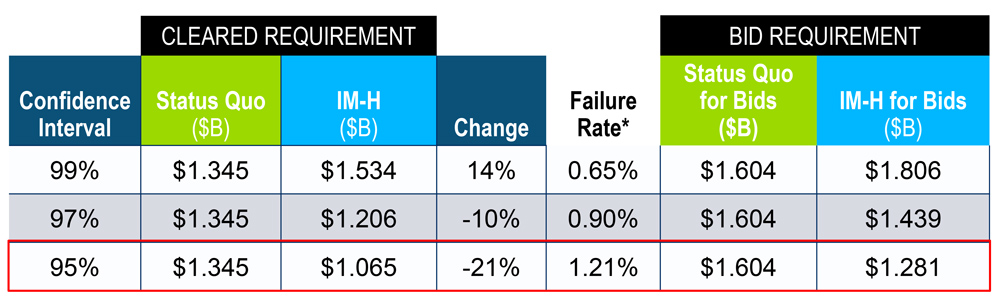
The initial margin method based on historical simulations methodology (IM-H) includes the confidence interval, which represents the range of values likely to include a population value within a certain degree of confidence. Endress said typically, the higher the confidence interval, the higher the resulting initial margin. PJM conducted analyses at confidence levels of 99%, 97% and 95% when evaluating the IM-H calculation.
In PJM’s testing of total FTR collateral, Endress said, the status quo had a failure rate of 8% based on backtesting, which represents the percentage of instances when collateral was insufficient to cover actual market moves. Endress said the 95% confidence interval, which Duke and Perast settled on, had a failure rate of 1.21%. PJM’s proposal used the 97% confidence interval, Endress said, which resulted in a failure rate of 0.9% in backtesting.
Estimated confidence intervals for total FTR collateral | PJM
Both positive and negative mark-to-auction (MTA) would be part of the FTR collateral credit calculation in the proposal, and all bids would be considered during the bidding window and have IM-H calculated for them. The adjusted historical values based on the modeling of future transmission upgrades would no longer be included.
The methodology also uses the liquidation period, which represents the number of periods a defaulted portfolio can be liquidated. Endress said a two liquidation period was recommended to stakeholders and aligns with the potential unwinding of defaulted positions.
Several stakeholders questioned PJM, Duke and Perast over the proper confidence interval to use, with some pushing for 99% used by other RTOs.
Perast’s James Ramsey said the endorsed proposal suggested the 95% confidence interval because the failure rate was reduced to 1.21% from the status quo of 8%. Ramsey said the 97% interval proposed by PJM would cost an extra $140 million to achieve a failure rate improvement of 0.3%.
“We just think the cost-benefit of that doesn’t make any sense,” Ramsey said.
Bruce said both the Duke and Perast proposal, along with the PJM proposal that wasn’t endorsed at the FRMSTF, represented improvements over the status quo. She asked if there was a “comfort level in a hardwired relook” by Duke and Perast of the 95% confidence interval in the future to move closer toward industry standards on the number.
Duke’s Matthew Holstein said they would be open to re-examining the confidence interval at a future date if there’s a better methodology to reach the number or if there’s changing market conditions. He said given the data provided by PJM, the 95% confidence interval seemed better than the 97% of 99% numbers on a cost-benefit analysis.
“We want to make the best decisions for the market,” Holstein said.
The committee will be asked to endorse the proposed solution and tariff revisions at its next meeting.
Natural Gas and Electric Markets Issue Charge
Jim Davis, regulatory and market policy strategic adviser for Dominion Energy, reviewed a problem statement and issue charge related to natural gas and electric market coordination, saying they were the result of “continued concerns over the misalignment between the natural gas and electric markets.”
Fueling gas-fired units is fundamentally different from units with on-site fuel sources, Davis said, because they require close coordination with pipelines. There are more restrictive operations for gas-fired generation with a greater frequency of localized operational flow orders, which can also create greater imbalance penalties with more restrictive imbalance provisions, he said.
Davis said the primary problem with the current market design is that it discourages fuel procurement at the time generation is most needed. He said corporate structures regarding authorization, protocols and trading limits during extreme pricing events can prevent fuel purchases, leading to system failures like the ones seen in ERCOT during the winter storm in February.
Secondary problems involving coordination and operations include greater limits on pipeline flexibility. High-demand events, Davis said, combined with decreased flexibility and the growth of intermittent resources on the grid will require greater coordination to maintain reliable operation of the electric system.
Key work activity in the issue charge would include providing education on topics such as the history of pipeline and electricity coordination, pipeline tariffs, products, procurement, imbalance charges and penalty structure; and the impact of intermittent generation on the system.
Davis said a goal is to take a “deep dive” into examining the recent grid emergency events in Texas by looking at the gas-electric coordination failures.
“We recognize that this is a broad and complex issue to address,” Davis said. “That’s why we believe education is going to be key in the scope of the work.
A second key work activity would include identifying potential improvements to the PJM market to mitigate the impacts of misalignment. Davis said the issue charge calls for examining possible improvements to coordination and emergency procedures, looking at PJM’s situational awareness of the fuel supply and exploring improvements to PJM’s economic dispatch model.
Davis said out-of-scope items are issues that can only be resolved by FERC or the North American Energy Standards Board taking action to reform the gas market.
“We’re trying to keep this in the confines of what PJM has authority over,” Davis said.
The expected deliverables are accounting for natural gas transportation, gas procurement and oil reserves in PJM’s economic dispatch signal and reserve calculations, and developing market rules that can address the challenges of procuring gas over non-peak hours, weekends and holidays.
Davis said the goal is to begin the review process in October with a year set aside for work and reforms.
“I believe we’re at a critical point in history in the evolution and transformation of the energy industry,” Davis said.
Monitor Joe Bowring said the IMM agreed with the “broad statements” from Dominion about the issues with misalignment between gas and power and that it has been a topic of discussion for several years. But it disagreed that the gas side of the issue should be out of scope. Bowring said stakeholders should be allowed to express their views about the structure of the gas industry and make suggestions to FERC.
“If we simply accept the limitations of the gas side, that means ultimately imposing all the risks on PJM and PJM customers,” Bowring said. “That doesn’t make sense.”
Davis said Bowring’s comments will be considered before the next MRC meeting.
Bruce said the issue charge covers an important work effort, calling it a “pervasive issue” and challenging to solve. Part of the challenge as stakeholders is not having “the right people in the room” to start the conversation and that it’s not just a PJM issue but a regional and national issue.
She said she wanted to know how pipeline operators would be involved in the conversation and expressed concern about PJM customers shouldering the costs of any changes while other industries and regions may reap the benefits of changes.
The committee will be asked to endorse the proposed issue charge at the September MRC meeting.
‘Know Your Customer’ Tariff Changes
Members unanimously endorsed two different tariff changes related to PJM’s implementation of changes last year to the “know your customer” requirements and procedures.
Steve Pincus, associate general counsel for PJM, reviewed the proposed tariff revisions to address making cure periods uniform across the tariff and OA. Pincus said appropriate cure periods defined in section 15.1.5 of the OA were originally updated in that document, but not in section 7.3 of the tariff, which involves provisions limited to transmission service customers.
The new revisions eliminate duplicative specification of cure periods for transmission customer payment violations in section 7.3 of the tariff by referencing section 15.1.5 of the OA.
“The purpose of the change is to eliminate the confusion that could be caused if there’s two different sets of rules applicable to a transmission customer,” Pincus said.
Jessica Troiano, senior counsel for PJM, reviewed the proposed solution and tariff revisions to address making the definitions of working credit limits uniform across the tariff.
Troiano said PJM requires all participants to maintain credit equal to the highest exposure experienced in the past year, which is usually the sum of the highest three consecutive weekly bills during that time called the peak market activity requirement. Participants’ current obligations may not exceed 75% of the unsecured credit allowance as established by PJM settlement, or the working credit limit requirement.
The revisions eliminate duplicative definitions of “working capital limit,” Troiano said, leaving only the definition in the definitions section of the tariff and removing the additional definition in Attachment Q of the tariff to remove ambiguity.
The changes now go to the Members Committee for a vote at the Sept. 29 meeting.
Market Suspension
Stefan Starkov, senior engineer for PJM’s day-ahead market operations department, reviewed the proposed solution and tariff and OA revisions to address rules related to market suspension. The proposed rules were first endorsed at the June MIC meeting. (See “Proposed Rules for Market Suspension Endorsed,” PJM MIC Briefs: June 9, 2021.)
Starkov said the revisions are designed to provide clear business rules in PJM markets to account for a market suspension where the RTO cannot clear or produce market results.
PJM has several current versions of the tariff and OA reflecting approved and pending language before FERC, Starkov said, but the current draft does not reflect any pending language on five-minute dispatch pricing, reserve price formation and fast-start pricing. He said the language would be updated after FERC approval.
The RTO is looking to have an endorsement at the Sept. 29 MRC and final approval at the Oct. 20 MC meeting.
Calpine’s David “Scarp” Scarpignato said the market suspension issue has “been a hole in the tariff.” He requested that the final endorsement be pushed back by one month because of timing issues and that he had several proposed changes to bring to the stakeholder body.
PJM officials said Scarp would be able to introduce changes as friendly amendments at the next MRC meeting.
Consent Agenda
The committee unanimously endorsed several manual changes as part of its consent agenda. They included:
revisions to Manual 6: Financial Transmission Rights resulting from the periodic cover-to-cover review. The changes include an update to section 6.8 to align language with the current approach for addressing a defaulting member’s FTRs with various options. (See “Manual Revisions Endorsed,” PJM MIC Briefs: July 14, 2021.)
revisions to Manual 20: PJM Resource Adequacy Analysis resulting from the periodic cover-to-cover review. PJM said the minor changes included cleaning up outdated and redundant language and ensuring the manual language follows current processes in the RTO. (See “Manual 20 Endorsed,” PJM PC/TEAC Briefs: Aug. 10, 2021.)
The California Air Resources Board has started designing a program that will distribute up to $10 million in incentives for the purchase of electric bicycles.
Funding for the program is included in the state budget that the governor signed in July. CARB was directed to establish the program by July 1, 2022.
CARB held a workshop Monday to hear from the public on how to implement the e-bike incentive program.
Questions yet to be answered include the amount of the incentive, who will be eligible and what types of e-bikes will be included in the program. The amount of the incentive could vary based on a recipient’s income, CARB staff said.
Up to 10% of the project’s funding may go toward related programs such as safety education. One suggestion from CARB was to require individuals to complete a safety training course in order to be eligible for an e-bike incentive.
Some workshop attendees opposed a safety-training requirement, calling it a “double standard” since California offers rebates for electric cars without a similar requirement. One idea was to make the safety training optional, but offer an incentive such as a free helmet to those who complete it.
Online Sales Debated
Another question CARB raised is whether the program should require the purchase of an e-bike from a brick-and-mortar store to qualify for the incentive.
Some workshop attendees said the requirement would be a way to support retailers hard hit by the COVID-19 pandemic. But others said the selection of e-bikes might be more limited at a conventional retail store.
And someone interested in buying an e-bike might not have a way to get to a retail store selling the bikes, others said.
Another issue is that someone who buys an e-bike online might have trouble finding a place to get the bike serviced. One suggestion was to require online sellers to partner with a brick-and-mortar service location.
Even if e-bikes purchased online were eligible for the incentive, one person said, the program could require the seller to be based in California.
Another concern discussed during the workshop was that someone could use the incentive toward the purchase of an e-bike and then immediately sell it.
“People will absolutely buy $5,000 e-bikes designed for recreation/trail riding then flip them on the secondary market,” one participant said in an online comment, which suggested restricting the incentive to “utility” e-bikes.
Another participant said it’s irrelevant if the e-bikes are resold.
“How much does enforcement really matter to our climate goals? A sold e-bike is still going to be reducing [vehicle miles traveled],” the participant said.
One workshop participant noted the need for secure storage of e-bikes. People living in apartments or mobile homes might have the greatest need for an e-bike but lack a safe storage spot, the participant said.
GHG Reductions
The e-bike incentive program had been proposed in Assembly Bill 117 introduced in December by Assemblywoman Tasha Boerner Horvath (D). The California Bicycle Coalition (CalBike) sponsored the bill.
After the bill stalled in the Senate, the e-bike incentive program was rolled into the state budget for fiscal year 2021/22.
According to CalBike, 60% of all car trips in California are 6 miles or less. E-bikes can be used for commuting, running errands and other short trips, proponents say.
CalBike Executive Director Dave Snyder said California’s focus has been on electric cars. But e-bikes “can be the centerpiece of California’s strategy to replace gas-powered car trips to reduce air pollution and greenhouse gas emissions,” Snyder said in a news release.
The price of e-bikes generally starts around $1,000. But “safe electric bikes of respectable durability” cost from $2,000 to $5,000, CalBike said.
CARB’s e-bike program will join other incentive programs offered in the state.
Peninsula Clean Energy this year launched an “E-Bikes for Everyone” program, which gives a discount of up to $800 to San Mateo County residents who buy an e-bike at a participating shop. Income restrictions apply.
Sonoma Clean Power offers a $1,000 incentive to income-qualified customers for the purchase of eligible e-bikes at participating retailers.
CARB plans to host a second workshop on the e-bike incentive program, although a date has not been set.
Feedback split along predictable lines on Washington’s efforts to adopt California’s strict standards on zero-emission medium- and heavy-duty trucks.
At least 20 activist and environmental organizations supported the move in written comments submitted to the Washington Department of Ecology, which is tackling the new regulations.
Also backing the change are the Puget Sound Clean Air Agency and the ports of Seattle and Tacoma. Several zero-emission automotive ventures strongly support the concept, including the troubled electric vehicle company Nikola Corp.
Critics include the Northwest Pulp & Paper Association and the Truck and Engine Manufacturers Association. While not specifically saying it opposes the new rules, the Western States Petroleum Association opposed adopting California’s standards.
The state Ecology Department is working on implementing a law that the state legislature passed in 2020 to adopt California’s standards, the strictest in the country. The agency is aiming to finish the new regulations by November to meet a Jan. 1, 2022, deadline. The regulations will go into effect Jan. 1, 2024, before 2025 models hit the street.
Under the federal Clean Air Act, most states are restricted from enacting their own emissions standards for new motor vehicles. California is the only state allowed to adopt state standards for vehicle emissions. Other states are allowed to adopt the federal or the stricter California emissions standards.
California maintains two programs for low- and zero-emission vehicles, which have criteria for pollutants and greenhouse gas emissions. Zero-emissions vehicles include battery-powered and hydrogen-fueled vehicles.
In 2005, the Washington legislature adopted the California emissions standards for passenger cars, light-duty trucks and medium-duty passenger vehicles. It did not adopt California’s standards for ZEVs or low-emissions vehicle standards for medium- and heavy-duty trucks. The 2020 law adopts California standards for ZEVs and adds standards for medium- and heavy-duty vehicles — Washington’s Advanced Clean Trucks (ACT) rule.
The new Washington rules being mapped out tentatively divide the zero-emission medium- and heavy-duty vehicles into three categories.
One category covers vans and large pickup trucks. Washington is tentatively looking at requiring 7% of those vehicles sold in the state to be ZEVs by 2025, increasing to 55% by 2035. A second category covers bucket trucks, delivery trucks, school buses and transit buses. Eleven percent of the 2025 models are to be ZEVs, growing to 75% by 2035.
The third category covers tractor-trailer rigs, cement trucks and dump trucks. Seven percent of the 2025 models are to be ZEVs, increasing to 40% by 2035.
If a manufacturer cannot meet those goals in Washington sales, it will be allowed to buy and swap for credits with companies exceeding those targets, similar to cap-and-trade credits.
Under a 2020 law, Washington is required to reduce its overall greenhouse gas emissions 45% by 2030, 70% by 2040, and 95% by 2050. Almost 45% of Washington’s annual greenhouse gas emissions come from transportation, according to the Ecology Department.
For and Against
Supporters of the upgrades in standards cited concerns about greenhouse gases but focused more on air pollution causing health problems.
A group of 45 disparate businesses — from Washington and elsewhere — joined in a letter that said: “Transportation is a major source of harmful air pollutants that disproportionately impact low-income communities. Improving air quality is not only the right thing to do for public health and for these communities, it also makes economic sense. Fewer instances of respiratory illness, missed days of work and hospitalizations will increase personal disposable income and help reduce the financial pressure on our healthcare system.”
The letter also said: “A growing number of clean vehicles offer significant cost savings through lower fuel and maintenance costs, and reduce the risk associated with the volatility of fossil fuel prices and supply. However, commercial vehicle electrification still faces significant challenges due to higher upfront costs, weight, charging time, battery range, and the availability of charging infrastructure. Market-enabling policies like the ACT will rapidly unlock the long-term savings, climate, and clean air benefits of medium- and heavy-duty vehicle (MHDV) electrification, while spurring the much-needed widespread deployment of charging stations.”
A group of 10 Washington activist, environmentalist and union organizations joined in another letter that cited preliminary findings from a M.J. Bradley & Associates’ report. The report said Washington’s ACT rule is estimated to reduce annual medium- and heavy-duty truck greenhouse gas emissions by 42% by 2050. The study also found that the cost savings to Washington from avoiding negative effects of climate change associated with the rule are worth $8.6 billion.
The letter said: “The upfront costs for electric trucks may be high today, but these costs are rapidly declining as battery costs decline. Upfront vehicle costs are expected to drop concurrently with most zero-emission trucks expected to reach cost parity with their internal combustion counterparts by 2030.”
The Alliance for Automotive Innovation, a coalition of 21 major domestic and foreign vehicle manufacturers plus their suppliers, submitted comments noting that almost every automaker is developing ZEVs, with several aiming to produce 100% ZEVs in the 2035-2045 time frame. About 130 different models of electric vehicles are expected to be available by 2026, the letter said.
The alliance supports the new rules.
The comments also noted that current credit systems vary from site to state, making it difficult for manufacturers to keep track of the rules in each state. Consequently, the letter suggested a push for a uniform credit system across the nation.
Tesla and Rivian sent in comments that largely echoed several points raised by the Alliance for Automotive Innovation.
The Nikola Corp. — another electric and hydrogen-fueled vehicle manufacturer — submitted a letter supporting the proposed new rules.
Nikola also said agency and private truck fleets should be given targets to purchase ZEV vehicles. And it called for financial incentives to be provided to individuals and fleets to buy the vehicles.
“Incentive programs could jumpstart market transformation by giving fleets the funding required to become early adopters of ZEVs and help manufacturers reach production scale,” Nikola wrote. “However, ZEV adoption must extend well past early adopters for Washington to reach a 30% (medium and heavy truck) ZEV sales target by 2030. This requires not only sustained incentive availability beyond currently available funding in these programs, but also a transition to more flexible and innovative models that can effectively channel incentive dollars into resale MHD markets, where many small and minority-owned fleets procure new trucks.”
Nikola is facing scandal and an investigation. In late July, the U.S. District Attorney’s Office in Manhattan charged Nikola founder Trevor Milton with criminal and civil securities fraud, alleging he misled investors about the capabilities of much of Nikola’s technology.
The Western States Petroleum Association voiced concerns that the proposed new rules do not mesh with the U.S EPA’s New Source Review standards adopted in 2020. The NSR standards cover increases and decreases in pollution emissions. The association requested that the state align its new rules with federal NSR standards.
The Truck & Engine Manufacturers Association submitted a 15-page document with criticisms and suggestions.
“Programs designed to meet California’s unique air quality needs and economic capabilities are not well-suited to the shared goal of accelerating the deployment of ZEV trucks in Washington and elsewhere across the country,” the association wrote.
The association called for Washington to delay adopting the new rules by a year, to late 2022, in order to study the ramifications — and to wait to see the effects of modifications in the California regulations.
The association also argued that the proposed Washington rules require manufacturers and dealers to meet quotas in selling ZEVS, but do not provide quotas or financial incentives to the people and businesses buying the trucks — especially since the medium-duty and heavy-duty zero emissions trucks are priced much higher than their conventional counterparts.
“In light of the foregoing, the zero-emission (medium-duty) and (heavy-duty) vehicle market in Washington will require significant incentive funding until zero-emission trucks are profitable for trucking businesses. Incentives must be sufficient to offset all of the ZEV truck life-cycle costs that will exceed current commercial vehicle costs,” the manufacturers association wrote.
The letter also noted that zero-emission trucks will need infrastructure such as fueling and recharging stations, which the private and public sectors need to start addressing in depth. That includes finding funding to pay for the needed infrastructure.
The Northwest Pulp & Paper Association opposed the Washington rulemaking on this subject in general terms and requested the state adopt the less stringent federal standards.
The developer of software that makes the electric grid more reliable and efficient received a $250,000 grant from the Massachusetts Clean Energy Center (CEC)
to begin planning for its deployment in the Northeast.
The support software, developed by NewGrid in Somerville, Mass., maps ways to reroute power on the grid to mitigate congestion and move more power.
As more renewables come online in New England, such as offshore wind, more transmission infrastructure is needed to move the electricity to demand centers. But until those transmission lines and electrical substations are built, congestion on the grid is handled like tolls on a highway — users pay a higher cost for electricity.
However, NewGrid’s software technology analyzes existing infrastructure to provide options that reconfigure a new pathway for the electricity.
“We make the old grid look like a new grid every time,” Pablo Ruiz, co-founder, CEO and chief technology officer of NewGrid, told NetZero Insider.
Ruiz predicts the support software could move 40% more power on the ISO-NE grid.
He originally developed the technology at Boston University, where he is a professor of mechanical engineering, with funding from the U.S. Department of Energy’s ARPA-E and additional support from Mass CEC.
NewGrid was one of 23 companies to receive a grant from Mass CEC, with over $2.6 million in funding to support innovation in clean energy research.
Before the technology is deployed on the ISO-NE grid, Ruiz said he will work with the organization to hone the technology.
“Each regional operator will have different needs,” he said. But the end result will allow grid operators to “take advantage of the flexibility they already have,” instead of relying entirely on building new transmission infrastructure, Ruiz said.
Advancements in computational technology over the last few years can adapt and optimize the grid to be a “flexible and agile resource,” Ruiz said.
Grid operators would have more of a supervising role, while the software provides options for rerouting electricity in the same way a GPS app provides options to drivers.
The software is useful “not only in real time but in planning for weeks or even months ahead” to help grid operators avoid or deal with outages, Ruiz said.
ERCOT uses a similar technology, and NewGrid is already working with National Grid in the U.K. to deploy the software.
ISO-NE said in a statement to NetZero Insider that it is looking forward to investigating how the new technology can help mitigate the challenges of integrating renewable energy resources by automating some procedures that are now manual.
“The potential for efficiency could benefit the region, especially as more wind and solar resources are integrated onto the grid,” an ISO-NE spokesperson said.
NewGrid’s technology will help grid engineers “improve the decisions they make and the speed at which they make those decisions,” Ruiz said.
Texas regulators last week got their hands dirty by popping ERCOT’s hood and discussing with stakeholders potential changes to an energy market that powers the state’s economy but has been virtually untouched for almost 20 years.
It became evident that the market needed a tune-up (or an overhaul) after February’s devastating Winter Storm Uri nearly crashed the grid and resulted in several days of non-rotating outages, hundreds of deaths, and billions of dollars in damage. The disaster led to leadership resignations at the Public Utility Commission and ERCOT and legislative bills that would alter the status quo.
“We’re tackling an enormous challenge,” PUC Chair Peter Lake said in kicking off the Thursday workshop. “We need and appreciate all the insight we can get.”
Lake, one of four new commissioners who have replaced the previous three, had words of caution for ISO stakeholders. Noting comments in the docket (52373) that he characterized as “focused on preserving profits and incumbent business models,” Lake said Senate Bill 2 and SB 3, the Texas legislature’s key bills in response to Uri, were “very much related to preserving reliability and accountability.”
“We don’t need comments telling us this crisis-based business model is just fine and we don’t need any changes,” he said, using his previous description of the ERCOT market. “That’s not the direction we got from the legislature and certainly not the changes the people of Texas are demanding. You can save your breath.”
At issue is the market’s reliance on scarcity pricing, capped at $9,000/MWh, designed to encourage new generation to take advantage of those prices. However, during the storm, about half of ERCOT’s thermal generation was forced offline, leading to the market’s inability to meet record winter demand.
Among the changes discussed during the workshop were tweaks to the operating reserve demand curve (ORDC), lowering the price cap, including renewables with firming capability in dispatchable generation, and adding new ancillary services to address ERCOT’s current use of reliability unit commitments.
Exelon echoed numerous comments in the docket when it suggested lowering the cap and widen the ORDC’s tail. Texas energy consultant Doug Lewin, who live-tweeted the workshop, said that proposal would “spread revenues out over more hours of the year, but provide less revenue” during extreme scarcity or crisis periods.
“Great ideas today,” Commissioner Jimmy Glotfelty said. “Whenever we do some improvements, there’s going to be some reaction by the market. Hopefully positive, but maybe negative, too, but I believe the market will adapt. We have a good blackboard of ideas we’re going to end up coalescing around that will improve this market for the good of reliability.”
The Texas PUC’s (left to right) Jimmy Glotfelty, Will McAdams, Chair Peter Lake and Lori Cobos discuss potential market changes. | Texas Admin Monitor
ERCOT’s “wish list” of reliability initiatives, supplied by Woody Rickerson, vice president of grid planning and operations, included attracting and retaining flexible, dispatchable resources and encouraging resource owners to maintain dual-fuel capability and on-site fuel storage or energy storage.
Rickerson said the grid operator considers batteries to be a dispatchable resource and it will change its systems before the year is up to incorporate energy storage.
Lake and Commissioner Will McAdams both pushed back several times against renewable resources, bending to Texas Gov. Greg Abbott’s directive to incentivize thermal generation and allocate reliability costs to resources that can’t guarantee availability. ERCOT has almost 30 GW of installed wind capacity, and it expects utility-scale solar to grow from 7.8 GW to more than 28 GW by 2024.
“My term runs out Sept. 1, 2025. I do not want to be catching a falling knife of 70% renewables on our system as the dominant fuel source and trying to back it up,” McAdams said. “Me, personally, I don’t expect lot of significant changes come Jan. 1, but I do expect us to start conversations as this market adapts to the resource mix’s evolution to where we don’t suffer reliability issues moving forward.”
The PUC has set a schedule that includes four more workshops and contemplates a draft design by Oct. 21 and a final market design by Dec. 19.
Kenan Ögelman, ERCOT’s vice president of commercial operations, cautioned the commission about ERCOT staff’s ability to move quickly in making changes. He said ORDC changes could be implemented quickly, but a substantial rule change would be needed to lower the price cap from $9,000/MWh.
“The ancillary service type changes … will take longer as I try to get those into my system so that they move from the day-ahead market system into dispatch,” he said.
Commissioner Lori Cobos suggested the commission set up as many guardrails at the PUC as it can to shorten the timeline.
“All products are in ERCOT market rules,” she said. “The only difference here is to consider whether these new products would be better housed in PUC rules to provide more regulatory certainty. We set up the framework and let ERCOT implement the details.”
“The problem is, things tend to die in the stakeholder processes at ERCOT, and they die for a long time,” McAdams said. “Nothing ever comes out of them sometimes.”
The PUC’s next market design work session is scheduled for Sept. 16 and will focus on demand response, including residential.
“The big unknown,” Lake said of residential DR.
“We need to know what demand response in the residential world is already happening so we can get a better sense of how much is being addressed by market forces,” he said. “We don’t want to jump in and regulate something if market forces are already solving a problem.”
Weatherization Rule Published
The commission took time from the workshop to approve for publication a weatherization rulemaking that requires ERCOT generators and transmission service providers to complete by Dec. 1 “all actions necessary to prevent a reoccurrence of any cold weather critical component failure” that occurred during Winter Storm Uri (51840).
The first phase of the PUC’s development of “robust” weather emergency preparedness reliability standards is designed to “ensure the generation fleet is more resilient this winter than it was last winter,” Lake said, and to comply with statutory deadlines set by the state legislature.
The draft rules require generators to implement the winter weather readiness actions identified after the 2011 winter weather event. TSPs are directed to put in place key recommendations contained in a separate report following the 2011 storm.
The generation and transmission entities must file winter weather readiness reports detailing their compliance activities with ERCOT and the PUC by Dec. 1. Those forms must include a notarized attestation from the entities’ highest-ranking “representative, official, or officer with binding authority.”
ERCOT is required to conduct inspections of resources and transmission facilities for this winter, prioritizing the inspection schedule based on risk level. Violations are to be reported to the PUC for enforcement.
Stakeholders have until Sept. 16 to comment on the draft rules. The PUC is planning to have the rules in effect by Nov. 3.
The commission will work on the second phase of reliability standards, “a more comprehensive, year-round set” following an in-depth weather study currently being conducted by ERCOT and Texas’ state climatologist that is due early next year. (See Texas PUC Faces Sticky Issue in Setting Weather Rules.)
Securitization Hearings Conclude
The PUC on Wednesday wrapped three days of hearings on ERCOT’s request for a pair of debt-obligation orders to finance $2.9 billion in market debt stemming from high prices during the winter storm’s Feb. 12-20 emergency period.
After spending barely 90 minutes on the grid operator’s application to finance the $800 million owed to the market by its participants (52321), the various parties spent the following afternoon and morning digging into ERCOT’s proposal for a $2.1 billion market uplift to cover short pays to the market (52322). (See Texas PUC Hearings Begin on $2.9B ERCOT Securitization.)
ERCOT said it cannot “readily quantify” the uplift balance as it has “no way of knowing” which load-serving entities (LSEs) were exposed to real-time deployment adder (RDPA) charges and ancillary services costs in excess of the systemwide offer cap. The grid operator said it will have to rely on the LSEs themselves to quantify their exposure to those charges, as it does not have a way to quantify that amount.
“Accordingly, the final uplift balance will be the sum of all documented exposure by LSEs that is ultimately approved by the commission,” ERCOT said.
Asked by Cobos what data ERCOT could provide to help unwind the costs, Ögelman said staff knows which qualified scheduling entities (QSEs) could have affiliated LSEs and the headroom allocated to QSEs as a whole.
“That type of information could be useful in calculating exposure,” he said. “However, the unique circumstances with how that QSE fits into an LSE will make that an accurate number or an extremely inaccurate number. It’s hard to tie that back when there’s so much under the QSE umbrella.”
Ögelman said staff could likely share with PUC staff the number of QSEs that have affiliated LSEs, but they would be unable to break down the latter group.
“It’s almost like a candy shop,” he said. “There are lots and lots of flavors to how folks do their business arrangements.”
Adding to the complexity is the number of disputes among ERCOT and market participants over the February charges that could result in additional costs.
Among the parties to the uplift proceeding is Rayburn Country Electric Cooperative, which owes the market $640 million. The cooperative is involved in a dispute with ERCOT over $260 million in AS and RDPA charges. All disputes must be settled before bonds can be issued, according to House Bill 4492.
Rayburn also has an opportunity to securitize Uri costs under Senate Bill 1580, which applies only to cooperatives. Rayburn is searching for clarity as to whether it can opt out of SB 1580 and remain a party to HB 4492.
“What it will really boil down to is ability to securitize the full [amount] and whether the market will allow us to do that,” Rayburn CFO David Braun said. “That’s the biggest unknown at this point: trying to securitize all of this so ERCOT gets paid in full. The challenge is the timing doesn’t work well together.”
As of Aug. 2, the ERCOT market was short $2.98 billion from transactions during the storm.
Administrative Law Judge Hunter Burkhalter directed the parties to file their initial briefs Wednesday, with reply briefs due Sept. 8. McAdams asked parties who shared similar viewpoints to coordinate their comments so the commissioners could more easily digest their arguments.
The California Energy Commission is looking harder at decarbonizing buildings by reducing carbon “embodied” in construction materials, such as concrete and steel, during the manufacturing process.
The commission has been aware of the environmental harm from embodied carbon for some time, but stakeholders have pressed the CEC to get more involved as part of its role in drafting the state building code, Commissioner Andrew McAllister said at a workshop Thursday.
“This is a global issue, not just California, and there are very smart people thinking about this across the globe,” McAllister said.
Proponents say it is time California joined the ranks of European nations such as Denmark in weeding out carbon from building materials.
So far, the CEC has focused primarily on electrification and energy efficiency to decarbonize buildings but has not “looked at all at the impacts of embodied emissions, which is to say the energy consumed, the environmental damage created, by making the physical building materials, equipment and other pieces of our built environment,” Rebecca Dell, industry program director at the San Francisco nonprofit ClimateWorks Foundation, told workshop participants.
“This is an opportunity for the California Energy Commission to double the impact of its building energy codes,” Dell said.
She likened it to California’s “profligate use of energy” before it began regulating appliance energy efficiency decades ago, a relatively low-cost solution that yielded large energy savings.
The state’s efforts to increase efficiency slowed energy demand, even as its population grew, so that it now has one of the lowest per capita consumption rates of any state, the U.S. Energy Information Administration says.
“Managing for embodied emissions” could reduce waste and cut greenhouse gasses at a relatively low cost, too, Dell contended.
That would mean, for example, eliminating carbon from cement manufacturing. Cement is a primary component of concrete, the world’s most common building material.
There are still eight coal-burning cement kilns in California that produce inordinate amounts of pollution, she said. The plants are primarily in the Mojave Desert and the Central Valley, near lower-income communities.
“These are the only facilities left in California that still burn coal as their primary source of fuel,” Dell said.
The International Energy Agency estimated in 2019 that about 11% of global carbon dioxide emissions come from manufacturing steel, cement and other building materials, as well as on-site building construction.
In California, cement production accounted for 1.8% of GHG emissions in 2017, according to the California Air Resources Board.
California has begun addressing embodied carbon through its Buy Clean California Act, which requires the state Department of General Services to establish and publish the maximum acceptable “global warming potential” for certain construction materials such as structural steel, flat glass and mineral wool board insulation. Senate Bill 778, by state Sen. Josh Becker (D) of San Mateo, would add concrete to the list.
Other states, including Colorado, are pursuing similar courses of action.
Dell said it’s essential to reduce embodied carbon in building materials in California, with its ambitious GHG reduction goals, because clean energy, energy efficiency and building decarbonization through electrification of major appliances is already underway.
Moreover, California has a relatively mild climate that doesn’t require as much energy for heating and cooling as other parts of the world, necessitating GHG reductions in other areas, she said.
“We have a relatively clean electricity grid, so one unit of electricity is associated with fewer greenhouse gas emissions than in most places,” Dell said. “And we already have quite an energy efficient stock of buildings compared to a lot of places.”
“All of those things are driving down our operational energy and greenhouse gas emissions, which means that the embodied emissions are even more important here in California than in other in other places, so you have an opportunity, as I said, to double your impact,” she told CEC commissioners and staff.
Sen. Bernie Sanders (I-Vt.) assured local energy leaders in Vermont on Wednesday that he is “working night and day” to pass the $3.5 trillion budget reconciliation bill so they have the funding they need to make the state a model for climate initiatives.
“I love the concept of town energy committees,” he said. “This is the kind of grassroots activism that we’re going to need, not only in Vermont, but around this country, to deal with what I think all of us recognize is an existential threat not only to our state and our country, but to the entire planet.”
The bill “will put more by far into addressing climate than any piece of legislation in the history of the country,” he said during a Climate Town Meeting for municipal energy committees hosted by the Vermont Energy and Climate Action Network (VECAN).
The U.S. Senate and House of Representatives have already passed the budget blueprint, and congressional committees are working now on the final bill text. Sanders said he hopes the final bill will be ready by the time Congress returns from its summer break.
The bill, he said, would unlock billions of dollars for energy efficiency, renewable energy and transportation electrification.
Vermont has about 130 volunteer municipal energy committees, according to VECAN. Sanders heard from representatives of the Sunderland, Peacham and Bristol committees during the meeting about what they are doing to help the state meet its emission-reduction goals and the challenges they face.
Sunderland and Peacham have been supporting residents with weatherization programs and subsidies for home energy audits to help reduce energy burden.
While Peacham is having success with its home audits, energy committee member Allison Webster said it’s difficult to incentivize homeowners to follow through with the weatherization recommendations that come from those audits.
Funding in the budget bill, according to Sanders, could help with that.
A weatherization loan, he said, would cover the high upfront costs of energy-saving renovations, and homeowners would pay back the loan at a rate that is no higher than the amount they are saving on their energy bills.
Peacham also has hosted electrification events for residents to learn more about electric vehicles and e-bikes, as well as other electric equipment, such as lawnmowers. Sunderland wants to duplicate that model, according to Jeff Dexter, a member of the town’s energy committee, to show residents that electric cars and equipment help the environment and save money.
While a few Peacham residents own EVs, Webster said the small town does not have any public charging stations.
“We would love to be able to have a public charging station, but unfortunately it’s not something that our town budget can handle,” she said. There are incentive programs for public charging, “but it seems like they’re geared towards larger businesses and not small groups like our nonprofits that might want to host one.”
If the budget bill passes, there will be “billions of dollars coming in to make sure that we can charge EVs and people can travel efficiently,” Sanders said.
In addition, the bill would have significant rebates to help working-class families purchase EVs, he said. The goal, he added, is for buyers to receive the rebates at the point of sale instead of as a tax credit.
The energy committees in Peacham and Bristol currently are developing community solar projects in their jurisdictions.
In Bristol, the committee embarked on a plan to develop a solar array on a shuttered landfill. The committee selected Acorn Energy to develop the 500-kW project, according to committee member Richard Butz, who said 40% of the solar from the facility is guaranteed for residents who cannot install rooftop solar.
But he also expressed concern that a step-down in net-metering rates recently authorized by state regulators is a disincentive to residents who would like to put panels on their homes. Sanders shared Butz’s concern.
“When we are all talking about the need to aggressively move to sustainable energy and we can put solar up on our rooftops, why is the [Public Utilities Commission] making that less attractive for people to do?” Sanders asked. “I don’t understand that myself, and I will talk to the PUC.”
If the federal government were to subsidize the high cost of solar panels, Butz said, it would be a better alternative to the complicated rate incentive structure currently in place. Federal solar loans, like weatherization loans, could be possible with funding from the budget bill, Sanders said.