Transmission Upgrades for PJM OSW, Renewables Could Cost $3.2 Billion

PJM said transmission upgrades to support state renewable portfolio standards (RPS) could cost upwards of $3.2 billion by 2035, according to a study released this week to stakeholders.

Matthew Bernstein, a policy advisor in PJM’s state government and policy department, provided an update on the RTO’s offshore wind scenario study at the Transmission Expansion Advisory Committee meeting on Tuesday.

Bernstein said the study, which the Organization of PJM States Inc. (OPSI) originally requested in late 2019, consisted of modeling five different scenarios related to the integration of renewable resources — and especially offshore wind — in PJM. The first phase of the study was intended to estimate the transmission costs required to support all the PJM states in meeting their clean energy goals.

Bernstein said the study is meant to be a starting point and baseline analysis that “holistically” looks at the integration of offshore wind throughout the region. While the study identified costs and the location of upgrades, it does not identify the ratepayers responsible for the costs of upgrades.

“This is not any indication of cost allocation,” Bernstein said.

Background

PJM and interested state agencies began meeting in October 2020 in an effort independent from the normal stakeholder process to consider offshore wind public policy needs, Bernstein said. The effort also looked at factoring in all PJM state RPS requirements in the study, even those located far away from the coast.

Preliminary results of the study were presented to stakeholders at the April TEAC meeting. (See “Offshore Transmission Study Update,” PJM PC/TEAC Briefs: April 6, 2021.)

PJM estimates that reaching state RPS goals will require 74.2 GW of new renewable energy by 2035, including 14.2 GW of offshore wind, 14.5 GW of onshore wind and 45.5 GW of solar. The states’ current RPS standards also call for nearly 7.2 GW of energy storage by 2035.

Bernstein said the study was meant to be advisory, providing information to states as they move forward on renewable integration and offshore wind policies. It will be up to individual states to determine how to use the information and whether they want PJM to conduct further analysis in a second phase of the study, he said. A final report is expected by the end of the year.

Nothing in the study prevents offshore wind projects from integrating into the system through PJM’s normal generation interconnection queue, Bernstein said.

Phase 1 of the study only looked at the onshore impact from offshore wind, omitting considerations of the cost of building offshore or mesh grid networks to handle the new generation. The study also didn’t account for the impact to neighboring grid systems, instead focusing on a high-level overview of impacts.

PJM examined the impacts on transmission lines 100 kV and higher across the entire footprint, identifying thermal violations as part of the first phase. The study does not include any generation deactivations announced after Oct. 1, 2020, including those after the 2022/23 Base Residual Auction.

Bernstein said the modeling in the study does include the Transource Independence Energy Connection (IEC) transmission project that was expected to be built between Pennsylvania and Maryland. The project was rejected by the Pennsylvania Public Utility Commission (PUC) in May, but Transource is challenging the decision in court. (See Transource Tx Project Rejected by Pa. PUC and Transource Challenges Pa. PUC Decision in Court.)

Study Results

Jonathan Kern, PJM principal engineer, presented study results that examined two different timeframes for development: a short-term window looking at goals to 2027 and a long-term window extending to 2035.

Scenario 1 was the only short-term study conducted by PJM, modeling RPS targets across the RTO along with six different onshore wind injection points designated to handle 6,416 MW of offshore wind. The scenario also looked at utility-scale solar, onshore wind and storage units, along with distributed solar, electric vehicle (EV) and energy efficiency (EE) values included in the 2020 PJM Load Forecast Report.

Scenario 1 estimated transmission upgrade costs came in at $627.34 million, Kern said, with the largest expenses in the PECO Zone at $311 million and the BGE Zone at $173.5 million. Kern attributed those high costs to the necessary upgrade of an overloaded 500 kV tie line that required reinforcement.

Kern said the market efficiency analysis for Scenario 1 demonstrated decreased gross load payments, especially for coastal states.

“For the most part, the costs were relatively uniform for Scenario 1,” he said.

The four remaining long-term scenarios involved minor variations in the modeling, mostly around changes in the offshore wind assumptions.

Scenario 2 modeled offshore wind injections of 14,416 MW at nine different onshore injection points, Kern said, calling it a “substantial increase” in the amount of offshore wind set to come online between 2027 and 2035.

Scenario 2’s estimated cost was about $2.46 billion. Each state with RPS requirements had increased renewable penetration in the scenario, Kern said, with the Dominion Zone expected to take on 16,000 MW of added solar by 2035. Along with the additional offshore wind, Dominion Zone transmission upgrade costs exceeded $1 billion.

Scenario 4 modeled 17,016 MW of offshore wind injections, including an additional 2,600 MW at the Fentress Substation in Virginia. Costs under the scenario jumped to more than $3.2 billion, with the Dominion Zone accounting for $1.8 billion.

Kern said PJM identified possible opportunities for regional solutions to reach goals, especially in the long-term scenarios. More than 150 network upgrade requirements would be necessary in the long-term scenarios.

“This is a very high-level analysis,” Kern said. “It didn’t include all PJM tariff facilities, and we didn’t consult local transmission owners to examine their systems.”

Stakeholder Reaction

Tom Rutigliano, an advocate with the Natural Resources Defense Council’s Sustainable FERC Project, said PJM’s renewable study should serve as a model for grid operators across the country as they begin to make plans for the grid of the future.

Rutigliano called the study an “important first step” that showed the advantages of coordinated planning among PJM and its states instead of independently building projects. He said current planning procedures can become “piecemeal” as transmission upgrades are done and paid for by each new project developer.

“PJM’s new big-picture look should allow for much more efficient and cost-effective planning, consolidating many small projects into fewer large ones,” Rutigliano said. “This type of planning, done in consultation with the states driving clean energy in the region, offers a much clearer vision of how to cost-effectively meet state goals.”

Rutigliano said the multi-billion-dollar price tags for line upgrades may seem large, but the totals are “surprisingly low” considering the amount of work needed to account for the new renewables. He said the transmission upgrades will represent only a small fraction of the total cost for the clean energy projects.

Transmission upgrades resulting from the necessary improvements could lead to other benefits, Rutigliano said, including addressing the estimated $528.6 million in congestion costs for 2020 cited in Monitoring Analytics’ State of the Market Report. Rutigliano would like to see PJM conduct more market analysis to determine how much money can be saved through transmission investment.

“We expect FERC to pay close attention to this problem as it works on its major transmission reform effort,” Rutigliano said. “Work like this recent PJM study shows us that large-scale planning and coordination between states and grid operators has much to offer.”

US Way Behind China in Deploying Heavy-duty EVs

While Washington debates the funding the Biden administration is seeking to electrify U.S. transportation, battery electric buses and trucks are already running commercially in cities around the globe, particularly in China.

And those foreign fleets are growing as governments fund commercialization in order to cut air pollution.

In Shenzhen, a city of 12.6 million on the southeast coast of China, there were more than 70,000 electric step vans and box trucks operating at the end of 2019 — up from 300 in 2015, according to the Rocky Mountain Institute (RMI).

“That’s growing at almost 300% a year,” said Dave Mullaney, a principal on RMI’s Carbon-Free Mobility team, during a webinar Tuesday held by the North American Council for Freight Efficiency (NACFE), which has partnered with RMI since 2010 to bring efficiency to U.S. trucking.

NACFE is keeping track of 13 companies that have been running preproduction prototype trucks in their businesses for months and have agreed to participate in a three-week efficiency monitoring project in September.

The organization has since April hosted a series of webinars examining funding and other electric truck issues. The most recent webinar took a global perspective, including a look at China, where the government launched initiatives years ago to stimulate commercialization of electric trucks.

“There were four big ideas that enabled that,” Mullaney said of the growth in Shenzhen. They are similar to the kind of stimulus programs the Biden administration is attempting to launch. (See DOE Offers $100M for Electrification of Heavy Trucks and EDF: Electrifying Heavy Trucking Could Save Money Strengthen the Grid.)

“One was the financial incentives provided by the government. Another was the rental and leasing models that grew around this market; also the deployment of charging infrastructure, and the quality and capabilities of the vehicles themselves — all were really important to catalyze this growth,” Mullaney said.

“No matter where you are in the world, the ability to generate a return is critical,” he continued. “And so the government stepped in and began to incentivize the purchase and use of these vehicles.”

Those incentives were designed to allow an electric truck user to earn a somewhat higher profit than would have been earned using a conventional truck of the same size, he said. But even with that, ownership of an electric truck was considered risky, as the manufacturers were small startups with sketchy futures.

At that point leasing companies moved into the equation, Mullaney said, minimizing the risk to the delivery companies and making the switch to electrics less daunting. Better batteries and extended driving distances also fueled growing acceptance.

Initially electric trucks were leased by companies large enough to have a charging depot, he said, but the appearance of public charging stations enabled “owner-operators” to convert to electric.

Shenzhen has about 80,000 public charging stations, he said, of which 30,000 are higher voltage and able to charge batteries faster.

About 90% of all deployed electric trucks and buses are in China, said Cristiano Facanha, global director at CALSTART, a Pasadena-based clean transportation advocacy group with offices across the U.S. and worldwide.

CALSTART’s Drive to Zero program includes 270 member companies. Its mission is for electric vehicles, particularly electric trucks and buses, to dominate the market by 2040. Facanha said light-duty electric vehicles will reach cost parity with conventional vehicles by 2025 and heavier vehicles by 2030.

India, nearly as populous as China, with a burgeoning economy and a GDP measured at $2.8 trillion in 2020, is also heading for EVs, though in many cases much smaller than what is typically seen as a truck.

“Urban demand is typically met by two-wheelers or three-wheelers,” said Samhita Shiledar, RMI’s manager of India programs.

“Those two-wheelers have the carrying capacity of 200 kg [about 452 lbs]. The three-wheelers and four-wheelers have payloads of about 502 to 1,000 kg [~1,107 to 2,205 lbs]. These small vehicles typically are powered by a 2.5-kWh battery and can travel 125 km [~78 miles] on a charge.”

Bigger trucks with capacities between 5 and 40 tons ply between cities and states, she said, and large manufacturers have begun to move into the EV and infrastructure markets, joining the small startups.

Another advocacy group, the D.C.-based International Council on Clean Transportation, has been working to persuade bus companies in Latin America to replace diesel and gasoline-powered buses with electric fleets.

Oscar Delgado, manager of the zero emission fleets center at the council, said buses share some of the components found in trucks. He noted that bus companies are risk averse but have been willing to listen.

“Electric buses provide lower total cost of ownership than their diesel or natural gas counterparts,” he said. “But they are more expensive up front. So there is a need to establish … financial mechanisms. Our goal is to secure more than $1 billion in public commitments from investors.

“In terms of business models, our best practice example is Santiago, Chile, which happens to have the largest fleet of electric buses outside of China. They have achieved this without the need of government mandates or special subsidies for electric buses. It was driven mainly by private entities and … a suitable business model. This model works because it allocates risk to the entities that can absorb them. About 4,000 buses will be procured with this model in the coming couple of years,” Delgado said.

Port of NY-NJ Unveils Fleet of 10 EV Trucks

NEWARK, N.J. — The Port of New York and New Jersey unveiled a fleet of 10 electric yard tractors Wednesday in a clean energy initiative that officials portrayed as a major step forward for the port and New Jersey’s effort to cut carbon dioxide emissions.

The 10 trucks, made by Chinese manufacturer BYD, will replace diesel vehicles in use at the Port Newark terminal operated by Red Hook Container Terminals. The fleet of BYD Model 8Y vehicles is by far the largest advance in EV trucks at the port, where officials say only a handful of electric trucks are in use.

Speaking at an event in Newark to show off the trucks, Mike Stamatis, CEO of Red Hook Container Terminals, also pledged that the small terminal would reach the goal of 100% clean energy by 2025. That would require the replacement of six diesel reach stackers, which are used to put containers on trucks and electrification of two diesel mobile cranes, he said.

Stamatis said that he hoped the introduction of the trucks “will mark the beginning of a transition for the Port of New York and New Jersey, the industry around the country.”

The terminal loads containers on and off barges that move cargo across the New York Harbor between the New Jersey terminal and the port’s Red Hook terminal in Brooklyn. The service can carry 400 containers in one move, eliminating separate truck trips and the resulting carbon dioxide emissions. The yard tractors will move containers around the terminal or within the port from other terminals.

While the containers handled by Red Hook amount to a relatively small number for a port that in June moved nearly 750,000 twenty-foot equivalent units (TEUs), state and port officials, as well as environmentalists, hailed the introduction of the trucks.

“In no way do we look at these 10 trucks, the BYD electric trucks, as the finish line,” said Sam Ruda, ports director for the Port Authority of New York and New Jersey. “It’s an early first step.”

“That first step is telling us something: that we’re really now beyond the ‘what if’ (stage) in terms of technology,” Ruda said.

“The technology is here; the technology is improving,” he said, adding that New Jersey “will be first movers.” The port and marine industry share the state’s goal of reducing carbon emissions, he said.

Incentivizing EV Truck Use

Transportation accounts for 42% of carbon emissions in New Jersey. Gov. Phil Murphy’s goal is for the state to reach zero carbon emissions by 2050. Emissions from heavy trucks are a big contributor, and the state’s energy master plan, released in 2019, assumes that 75% of medium-duty trucks and 50% of heavy-duty trucks will be electric by 2050.

Port and trucking officials say there are few EV trucks on the road in New Jersey. The first two yard tractors were put into service at Newark-based trucking company Best Transportation, where owner Tom Heimgartner said the electric yard tractors made by Kalmar Ottowa, have so far performed well.

“They pull well, and they are perfect for port operations,” he said of the trucks, which were purchased, in part, with a state grant.

While yard tractors work well for short container moves within the port, truckers say the electric trucks on the market that are suitable for delivering cargo over longer distances are too expensive and can’t go far enough without needing to recharge. The maximum range is at present about 250 miles. In addition, truckers say, there are too few recharging points around the state.

Murphy’s administration has launched several programs to encourage truckers, businesses and government agencies to use EV trucks. The governor in February outlined grants of nearly $20 million for the purchase of electric cargo equipment and medium- and heavy-duty trucks to reduce carbon and other emissions in or around ports. The funds included $5.9 million for a planned project in which port trucking company International Motor Freight would purchase 16 electric trucks made by Daimler Trucks North America and two yard tractors. (See: NJ Targets Ports for EV Incentives.)

The New Jersey Department of Environmental Protection (DEP) in April unveiled proposed rules that would require manufacturers to meet increasing sales targets for medium- and heavy-duty electric trucks in the state after 2025. And the New Jersey Board of Public Utilities (BPU) is considering proposals on how to encourage the creation of more EV chargers for heavy duty vehicles. (See: NJ Outlines Plan to Boost EV Truck Sales.)

Shawn LaTourette, commissioner of the state Department of Environmental Protection, said the DEP’s next step to encourage EV truck use will be rules requiring fleets to include a certain percentage of EV trucks if they replace vehicles. Proposed rules will be released later this year, said LaTourette, speaking at the event.

Protecting Communities

Emissions from port truck traffic have long been a contentious issue because the port’s four biggest terminals are near the cities of Newark and Elizabeth. Hundreds of trucks pass through them each day to reach the port.

Kim Gaddy, a Newark resident and New Jersey and national environmental justice director for Clean Water Action, said it is “so important” that Red Hook had committed to 100% electrification in the terminal. She urged other port terminals to “make the same commitment.”

The 10 Red Hook trucks, which cost about $350,000 each, were funded with a grant of about $2.5 million from the state’s Volkswagen settlement fund. Red Hook paid the rest, about a third of the cost, which is about what the company would have spent on a new diesel truck, Stamatis said.

Red-Hook-Aug-112021-B-(RTO-Insider-LLC)-Alt-FI.jpg
Mike Stamatis (right), CEO of Red Hook Container Terminals, stands on the back of one of the 10 electric yard tractors showcased Wednesday in Port Newark, NJ. | © RTO Insider LLC

The trucks will be used only to move containers around the port, so range is not an issue. The vehicles can operate continuously for 12 hours before recharging, which can be done in two hours with a fast charger, if the truck starts at 20% charge, Red Hook said.

Stamatis, who operates the smallest terminal in the port, said he embarked on the EV truck initiative in response to the damage wreaked by Superstorm Sandy in 2012. He expressed the hope that the other terminals would follow suit.

“Doing nothing is simply not an option when the technology exists and is improving every day,” he said.

Cortney Worrall, CEO of the Waterfront Alliance, which advocates for good public use of area coastlines, said “Red Hook Terminals’ investment set the standard for other industry investments.” She cited the report released this week by the UN’s Intergovernmental Panel on Climate Change that concluded the world is at “code red for humanity.” (See Too Late to Stop Climate Change, UN Report Says.)

“The message for all and especially the many stakeholders in the maritime and port industries, is that we have time to end fossil fuel-based emissions to prevent the worst-case scenarios,” she said. “But we must make those commitments now.”

Maine Judge Vacates Public Land Lease for NECEC Tx Line

A Maine judge vacated a 1-mile lease of state public land to Central Maine Power (CMP) on Tuesday, threatening the entire 145-mile New England Clean Energy Connect (NECEC) transmission corridor through the western side of the state.

The Maine Superior Court ruled that state park land, along with other land owned by the state for conservation or recreation, cannot be “reduced” or its uses “substantially altered” unless the Maine legislature approves the changes with a two-thirds majority, according to the state constitution.

The judge also concluded that the Maine Bureau of Public Lands (BPL) did not provide notice to the legislature or the public of the lease contracts.

“Given the subject matter at issue here — constitutionally protected public lands — the need for transparency and public process is heightened,” the court wrote in its decision.

Environmental groups that oppose the transmission corridor argued in court that construction of the transmission line in the Upper Kennebec Region is destructive to the largest undeveloped forest east of the Mississippi River.

Many of the people involved in the opposition against the project work as river guides on the Moose and Upper Kennebec Rivers, which cross the rugged landscape threatened by different kinds of development over the last few years.

A large swath of trees will be cleared for the project, posing a barrier to wildlife crossings and affecting forestry operations in the area, Tom Saviello, a volunteer with the advocacy group No CMP Corridor, said in a phone interview with NetZero Insider.

The line would also cut between two ponds that hold 95% of the remaining native trout. Water runoff from the transmission construction could warm the water in the ponds, changing the ecosystem for the trout, Saviello said.

Thorn Dickinson, head of NECEC Transmission, issued a statement saying the company is “reviewing the Superior Court’s decision to determine our next steps on the matter.”

CMP currently holds the lease of public land but is transferring it to NECEC Transmission. Both companies are owned by Avangrid (NYSE: AGR).

The $1 billion NECEC project is intended largely for the benefit of Massachusetts residents, who are paying for the construction of the 1-mile, 300-ft wide corridor.

November Vote

The NECEC project faces an even greater risk in November, when Maine residents vote on whether to approve three new potential requirements for transmission line construction in the state that would effectively halt the hydroelectric energy transmission line.

The Maine legislature would have to approve the construction of any high-impact electric transmission lines under the potential requirements by a two-thirds majority, according to a report by independent research firm ClearView Energy Partners. Second, the legislature would have to approve any use of public lands for transmission lines and related facilities. The state would also entirely prohibit the construction of high-impact electric transmission lines in the Upper Kennebec Region.

The mandates would be retroactive to 2014, including the NECEC transmission line.

CMP can appeal the ruling that vacates the lease, but it is not likely a higher court would rule differently if the state constitution requires two-thirds approval from the legislature.

The BPL could also issue a determination that the lease does not reduce or substantially alter the public land in question, but opponents could still challenge the lease and the determination, the report said.

CMP will “have no choice but to negotiate the terms of this public lease in an open and transparent way,” Saviello said.

California Energy Commission Adopts 2022 Building Code

The California Energy Commission on Wednesday approved a major update to the state’s building code that establishes leading-edge requirements for electric heat pumps for space and water heating, solar paired with battery storage in commercial buildings, and wiring that makes homes ready for all-electric appliances.

“The future we’re trying to build together is a future beyond fossil fuels,” CEC Chair David Hochschild said. “We all have a role to play in building this future.”

Lead Commissioner Andrew McAllister called the update “monumental” and said California was again leading the way for the rest of the nation by using its huge consumer market to influence the decisions of manufacturers and investors. The state has previously encouraged new lighting, insulation and window-and-door standards nationally.

“California is being forced to lead even more than before, and that’s a good thing,” McAllister said. “The winds are blowing through California. They start here and blow elsewhere.”

The code’s most significant provisions require developers of new single-family homes to install either an electric heat pump water or space heater.

The current market share for heat pumps in California is less than 6% in new home construction; the requirement is expected to greatly increase demand and make heat pumps more affordable and widely available.

“This will juice the market for heat pumps,” McAllister said.

The updated code also requires new commercial structures such as hotels and office buildings to have solar arrays paired with battery storage that meet certain minimum requirements. The mandate also includes new grocery stores, restaurants and high-rise apartment buildings.

The CEC projects that the requirement will add 400 MW of battery storage and 280 MW of solar generation statewide.

Another component requires new homes to be wired for all-electric appliances including stoves and ovens, clothes dryers and water and space heating.

The requirements will reduce greenhouse gas emissions by 10 million electric tons, the equivalent of 2.2 million internal combustion passenger vehicles, in the next 30 years, the CEC forecasted. Reductions in energy consumption will save consumers $1.5 billion in the same time frame, it said.

The five commissioners’ unanimous adoption of the 2022 update to the state’s building energy efficiency standards came after more than two hours of often impassioned public comment from residents, environmentalists and industry advocates.

“Mothers are asking for a strong code for our children’s health,” resident Jenny Green said, echoing other commenters.

A number of speakers said the update does not go far enough and said they hoped the commission will require new buildings to be all-electric in the CEC’s next three-year update for 2025.

The natural gas industry opposed the mandates to bolster electric appliances, Hochschild noted. The chair, however, contended the changes were appropriate given the state’s energy and climate crises. He called the update “bold” but “pragmatic.”

“We’re going to see amazing buildings that are healthy, that people want to live in,” he said.

“This is a landmark code,” Hochschild said. “In my judgement, the code we’re going to adopt today is the most significant we’ve done.”

The 2022 update must still be approved the California Building Standards Commission, which is scheduled to consider it in December. If approved by the CBSC, as expected, it will take effect on Jan. 1, 2023.

Studies Present Case for Domestic Cleantech Boosting US Economy

The “Made in America” stamp that once appeared on myriad industrial and consumer products could resurrect the U.S. manufacturing economy if it accompanies the shift toward renewable energy and electrification, two new studies conclude.

Presented by Advanced Energy Economy, one of the studies is the work of Princeton University associate research scholar Erin Mayfield and concluded that paying higher wages to workers building massive wind and solar projects would not significantly affect the cost of the power produced.

A second study by Guidehouse Consulting for AEE looked at eight advanced energy products — such as heat pumps, electric vehicles and solar panels — with annual sales of $61 billion, backed by foreign and domestic supply chains. The analysis projected sales over the coming decade if the products’ parts were made in the U.S.

The analysis concluded that moving the supply chains to the U.S. would cost billions but create tens of thousands of good-paying jobs and boost the national GDP by tens of billions of dollars.

Both studies were presented in a public webinar by AEE just hours before President Biden on Aug. 5 announced that he was setting a national goal of EVs accounting for 50% of new car sales by 2030. (See Biden Executive Order Sets 50% EV Goal by 2030.)

The webinar also included appearances by executives of two U.S.-based companies involved in burgeoning renewable energy technologies — businesses that would benefit from massive federal programs the president is considering boosting.

Jeff McNeil — COO of Enphase, a California-based manufacturer of inverters used in solar arrays, battery storage and energy-management technologies — said that while his company was founded and remains headquartered in the U.S., its manufacturing is done offshore.

But “I’m really excited about the potential of our industry bringing manufacturing to the U.S.,” he said. “The U.S. is our largest market, where we have the largest market share … of any company in the residential space, and Enphase products are helping to power roughly 800,000 U.S. homes and businesses. …

“Moving the entire supply chain to the U.S. will take significant time and resources. … It’s important to recognize the time and effort that will be involved.”

Paul Francis — CEO and co-founder of KIGT (“Keep it Green Tech”), a minority-owned, California-based startup that manufactures components for EV charging stations, including the operating software — said his company has been able to work with utilities and competitors to build advanced charging stations in communities that might otherwise be overlooked.

“You see our projects right now are in seven of the top 12 states” for chargers installed, “and we don’t expect to be the only Level 2 charging provider in locations where people are parked for more than two hours,” he said, adding that entrepreneurial companies like his are on the leading edge of the shift to electrifying transportation.

“What we’re doing in San Bernardino County is getting ready to create the largest factory to have the capacity of up to a million charging stations manufactured a year in California, with the opportunity to produce up to 2,000-plus jobs in our own community, just by the funding resources that the current administration and our state have made available,” he said.

ERCOT Board of Directors Briefs: Aug. 10, 2021

Jones Defends Roadmap to Grid Reliability, TAC Shakeup

What began as another hum-drum CEO’s report to ERCOT’s Board of Directors on Tuesday devolved into a battle over words between interim CEO Brad Jones and Director Shannon McClendon, who represents the market’s retail electric provider (REP) segment.

Speaking for her members — “I’ve got a segment that is really chewing on me,” she said — McClendon repeatedly questioned why load resources are being excluded from the ancillary services ERCOT is purchasing to guard against emergency conditions.

She said the REPs are unhappy with the grid operator’s approach to conservative operations, which includes procuring up to 7.8 GW of operating reserves, after they had committed to and hedged their contracts for the year.

Noting one slide in Jones’ report referred to “PUC/ERCOT collaboration,” McClendon said it should be changed to “PUC/ERCOT staff collaboration,” as stakeholders were not included. She asked that the minutes reflect that ERCOT’s 60-point “Roadmap to Improving Grid Reliability” was never approved by the board or the Public Utility Commission, though she did concede that many people, including board members, provided input.

McClendon, a former director who rejoined the board after the flurry of resignations in the wake of the February winter storm, has been one of its most vocal members in the months since. She was supported by Oncor’s Mark Carpenter, the investor-owned utility segment’s representative, when the discussion turned to No. 36 on the roadmap, “ensure the Technical Advisory Committee is comprised of senior-level members from each member organization to promote timely decision-making.”

The 30-member TAC, representing seven different stakeholder segments, works on protocol changes and makes recommendations on ERCOT policies and procedures to the board. Last month, it pushed back on Jones’ proposed change during its regular monthly meeting. (See ERCOT Technical Advisory Committee Briefs: July 28, 2021.)

“That particular group is a highly functional, technical group. It has broad knowledge of the committees and subcommittees that report to it,” Carpenter said. “The makeup seems to be working very well. I think there’s quite a bit of concern … there’s going to have to be some discussion at some point.”

Jones agreed with Carpenter and said his proposal to restructure the TAC is “controversial.” As he did before the committee last month, Jones said the state government has lost confidence in ERCOT’s stakeholder process following the storm, but he said the committee is “working through that.” The TAC has scheduled its first workshop for Aug. 18 to discuss alternatives.

Texas lawmakers passed several pieces of legislation in responses to the ERCOT’s near collapse during the storm. None was more important than Senate Bill 2, which replaces the board’s market participant representatives with independent directors from outside the market.

A three-person selection committee appointed by the state’s political leadership will select the new board members; the first board members aren’t expected to be seated until September.

“That’s what I want to see improved,” Jones said, referring to politicians’ lost trust. “I want to see we are reacting to that sentiment so they have trust in TAC that the new board may not have. Changes need to be made to improve the way [committee members] work with the new board, whenever that new board is seated.”

McClendon, who sat on the TAC before joining the board, said she “adamantly” disagreed with Jones’ perception of politicians’ level of confidence in ERCOT stakeholders.

“You’re leaping to conclusions when you say they’ve lost confidence in the stakeholder process,” she said. “For everyone you say that has lost confidence, I can give you two [who haven’t]. I will need to see that in writing, from whomever you need to get it from.”

“Very good,” Jones replied.

PUC Chair Peter Lake, who has also chaired board meetings in the absence of a chair, jumped into the conversation. He said SB2 clearly made “substantial changes” to ERCOT’s governance with its removal of market participants on the board.

“Leadership is moving forward with that transition process,” he said. “While we’ll have to defer to the yet-to-be named ERCOT board, rest assured that while the stakeholder process may look different, depending on how the new board approaches it, I am confident there will be a robust stakeholder process going forward, and the new board will work with the membership to identify the best version that we can deliver for Texas.”

McClendon did wrangle a commitment from Jones that ERCOT staff would consider including contributions from load-serving entities as they continue to increase operating reserves with ancillary services. Jones said that when load resources are used, it results in a drop in ERCOT’s physical responsive capability, which must then be replaced by generation.

“We think this is the most conservative approach in meeting the needs of all Texans,” Jones said.

When McClendon continued to contend that ERCOT staff are making the decisions on procuring ancillary services without the board’s input, Jones reminded her that staff spent two sessions before the TAC explaining their actions.

But McClendon responded, “It was a directive. It was a one-way conversation. I don’t think we necessarily want to get into the politics of how that was approved.”

“We want to stay out of [energy emergency] alerts [EEAs]. We want to stay out of emergency conditions,” Jones said. “That’s our goal.”

There, he found agreement.

“We don’t want the public to think we can’t manage a grid by sending out EEAs or conservation messages,” McClendon said. “Load can keep that from happening.”

Board Signs off on 2022-2023 Budget

The board agreed with the Finance and Audit Committee’s recommendation to approve the 2022-2023 biennial budget and to keep the administrative fee at its current 55.5 cents/MWh rate.

The approval authorizes operating expenses, project spending and debt-service obligations of $322.2 million and $287 million for 2022 and 2023, respectively. The committee said the budget will fund additional costs resulting from the February storm and the Texas Legislature’s numerous bills addressing the event.

The budget is an increase over the current 2021 budget of $275.2 million, which is currently projected to be off by $35.6 million at year-end. Revenues are projected to come in under $24.1 million and expenses $11.5 million over budget.

ERCOT expects to take a $6.9 million hit from insurance premiums and legal costs stemming from the winter storm, Jones said. Staff’s move to a new office space early next year is also forecast to come in $4.7 million over budget.

ERCOT CFO Sean Taylor said staff shared the committee’s recommendation to leave the administrative fee untouched, saying the grid operator could recover costs in future years “when market participants have the ability to absorb the increase.”

The city of Dallas’ Nick Fehrenbach, who chairs the FAC and represents the commercial consumer segment, voted against the measure over previously disclosed concerns that the market’s uncertain future design and deficit could put the new board in a position where a fee increase will be necessary. (See “‘Strong Upward Pressure’ on Budget,” ERCOT Briefs: Week of July 19, 2021.)

Garland Power & Light’s Tom Hancock, who speaks for the municipal segment, also voted against the budget’s approval. McClendon abstained.

Passport Program ‘Uncoupled’

Staff delivered a final board update on the Passport Program, which bundles together several high-profile initiatives but has been thrown off schedule by the work needed to address the winter storm’s effects.

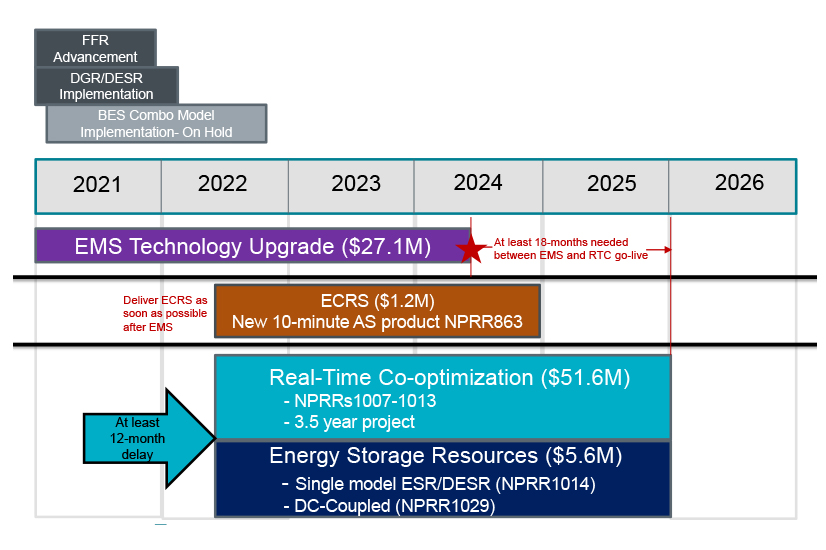
The program has been “decoupled” into “manageable pieces,” ERCOT’s Matt Mereness said, to keep the focus on the energy management system’s (EMS) technology upgrade. The upgrade, the first since 2017, is scheduled to be completed in mid-2024; Mereness has previously said the upgrade is “non-negotiable.” (See “Passport Pushed Back 18 Months,” ERCOT Technical Advisory Committee Briefs: April 28, 2021.)

Passport-Scope-(ERCOT)-Content.jpg
Real-time co-optimization will be pushed back at least a year while staff complete an energy management system upgrade. | ERCOT

However, staff will need at least 18 months after the EMS project to add real-time co-optimization (RTC) and its $51.6 million price tag to the ERCOT market. Real-time co-optimization, which clears energy and ancillary services every five minutes in the real-time market, accounts for the biggest chunk of Passport’s $85.5 million cost.

“We’re on at least a one-year delay,” Mereness said. “We’ll put [RTC] on the shelf. When it’s time to bring it off the shelf, we can do so.”

Staff will ask the TAC next month to formally retire the RTC Task Force.

New Wind, Solar Generation Highs

ERCOT has set new instantaneous records for wind and solar generation this summer, Jones told the board. Wind energy reached 23.6 GW at 10:32 p.m. on June 25, while solar peaked at 6.9 GW at 10:30 a.m. July 31.

The grid operator also set a new peak for June when demand hit 70.2 GW during the afternoon on June 23.

Staff have said they have sufficient capacity to meet a projected peak demand of 77.1 GW this summer. That would break the record of 74.8 GW set in August 2019, but demand has topped out at 72.9 GW on July 26 so far this summer.

ERCOT is expecting demand to near 74 GW later this week.

SCT Directive, 14 Changes Approved

The board approved the latest in a series of directives tied to Southern Cross Transmission, a proposed HVDC line in East Texas that would ship more than 2 GW of energy between the Texas grid and Southeastern markets. (See “Members Debate Southern Cross’ Bid to be Merchant DC Tie Operator,” ERCOT Technical Advisory Committee Briefs: Feb. 22, 2018.)

Directive 9 required staff to evaluate whether the project would require any modifications to existing or additional ancillary services. In a white paper, staff said NPRR1034, approved in February, gives ERCOT authority to establish limits on DC tie transfers and to curtail their schedules when necessary to address the risk of unacceptable frequency deviations. They found there was no need for other changes to accommodate the project.

The board also passed eight Nodal Protocol revision requests (NPRRs), a single change to the Nodal Operating Guide, two modifications each to the Planning Guide (PGRRs) and the resource registration glossary (RRGRRs), and a system-change request (SCR), all previously endorsed by the TAC in June and July:

        • NPRR995: sets the term “settlement-only energy storage system” (SOESS) and further defines it as transmission-connected or distribution-connected; relocates the settlement-only generator (SOG) term from under resource to standalone as its own unrelated term; and incorporates the relevant SOESS terms into the market information system (MIS) reporting created for SOGs.
        • NPRR1005: redefines point of interconnection (POI) to refer to any physical location where a generation entity’s facilities connect to a transmission service provider’s facilities; removes references to load interconnections; introduces the term “point of interconnection bus” (POIB) for the bus in the substation closest to the resource’s POI or any electrically equivalent bus in the substation; and changes POI to POIB throughout the protocols, among other revisions.
        • NPRR1063: requires ERCOT to post dynamic rating approval information to the MIS secure area.
        • NPRR1073: prevents a market participant from exiting the market to escape uplift charges and then trying to re-enter under a different name.
        • NPRR1078: ensures only amounts owed to ERCOT by counterparties through the default uplift process can be collateralized.
        • NPRR1079: separates ERCOT contingency reserve service, which will come in a future release, from fast frequency reserve project language being added to the 48-hour day-ahead market report requirements.
        • NPRR1083: prohibits uplift charges to qualified scheduling entities acting as central counterparty clearinghouses in wholesale market transactions or regulated as derivatives clearing organizations as defined by the Commodity Exchange Act.
        • NPRR1086: aligns the protocols with the PUC’s recent order eliminating the market’s pricing mechanism link to natural gas prices and adds a provision to ensure a resource, through its qualified scheduling entity, can recover its marginal costs during scarcity pricing situations while the low systemwide offer cap’s is in effect.
        • NOGRR210: clarifies language in the revised POI term and NPRR1005’s POIB.
        • PGRR089: revises the list of data sets posted to the MIS by removing the planning horizon transmission capability methodology and adding long-term system assessment postings, geomagnetic disturbance vulnerability assessments and the monthly generator interconnection status.
        • PGRR091: gives interconnecting entities 60 days to complete an application for a full interconnection study.
        • RRGRR025: clarifies language for NPRR1005’s defined POIB term by modifying the existing POI term to conform to the generation agreement’s conception of the POI as the point of ownership change. The revision also removes the generation agreement’s reference in that definition.
        • RRGRR028: adds transformer manufacturer test reports to the data collection requirements and clarifies the required transformer information.
        • SCR815: aligns market guides, streamlines processes, increases transparency and tracking, and improves communication among market participants in the MarkeTrak tool used to resolve retail market issues.

California Renewables Could Cover 813,000 Acres

California’s push toward 100% clean energy by 2045 will require building solar arrays, wind farms and other infrastructure on more than 1,270 square miles of in-state land, an area about the size of the cities of Los Angeles, San Diego and San Francisco combined.

Scott Flint, manager of renewable energy policy and planning at the California Energy Commission, on Thursday told leaders of the CEC, the California Public Utilities Commission and CAISO that utility-scale solar arrays will cover the largest share of that area at nearly 600,000 acres to accommodate 85 GW of new generation and storage by 2045.

Wind farms will require more than 200,000 acres for 5,000 MW of capacity, and geothermal plants will take up almost 12,000 acres for 2,300 MW. The total area needed for new renewables is 813,319 acres, Flint said.

The CEC has been developing maps that show optimal locations for the resources along with protected lands, prime farmland and areas important for biodiversity, Flint said.

The goal is to make that information readily available to CAISO for long-term transmission planning and to other state agencies responsible for siting generating resources.

“For purposes of the ISO’s 20-year transmission look, we are going to hand them a map,” Flint said. “This map will help them in deciding where to assign resources.”

Most solar arrays will likely be built in the Mojave Desert, areas of the San Joaquin Valley and its surrounding hills that are less desirable for farming, and on the Carrizo Plain, a vast flat valley traversed by the San Andreas Fault in Central California.

Wind turbines must be scattered around the state in wind-prone areas such as the North Coast and Tehachapi Mountains.

The process of acquiring and building on so much land is rife with the potential for conflicts with farmers, environmentalists, the state and federal governments and local communities, Flint acknowledged. Mapping potential zones of conflict and off-limits areas in advance will help avoid long legal battles.

“It helps to accelerate the overall process of deployment,” he said.

Thursday’s resource build workshop was the third in a series of joint sessions intended to determine the requirements for generation, transmission and land needed to meet the mandates of Senate Bill 100. The landmark 2018 measure, signed by then-Gov. Jerry Brown, requires the state’s load serving entities to serve retail customers with 60% renewable energy by 2030 and 100% carbon-free energy by 2045.

Prior workshops and reports found California needs to triple its in-state generating capacity and embark on a program of transmission construction to meet the ambitious mandates. (See Calif. Needs New Tx for 100% Clean Energy and Calif. Must Triple Capacity to Reach 100% Clean Energy.)

The state must build 6 GW of new generation per year — compared with the 1 GW it built in 2019 — for each of the next 25 years, a report by the CEC, the CPUC and the California Air Resources Board found.

PSEG to Sell Fossil Units to ArcLight Capital

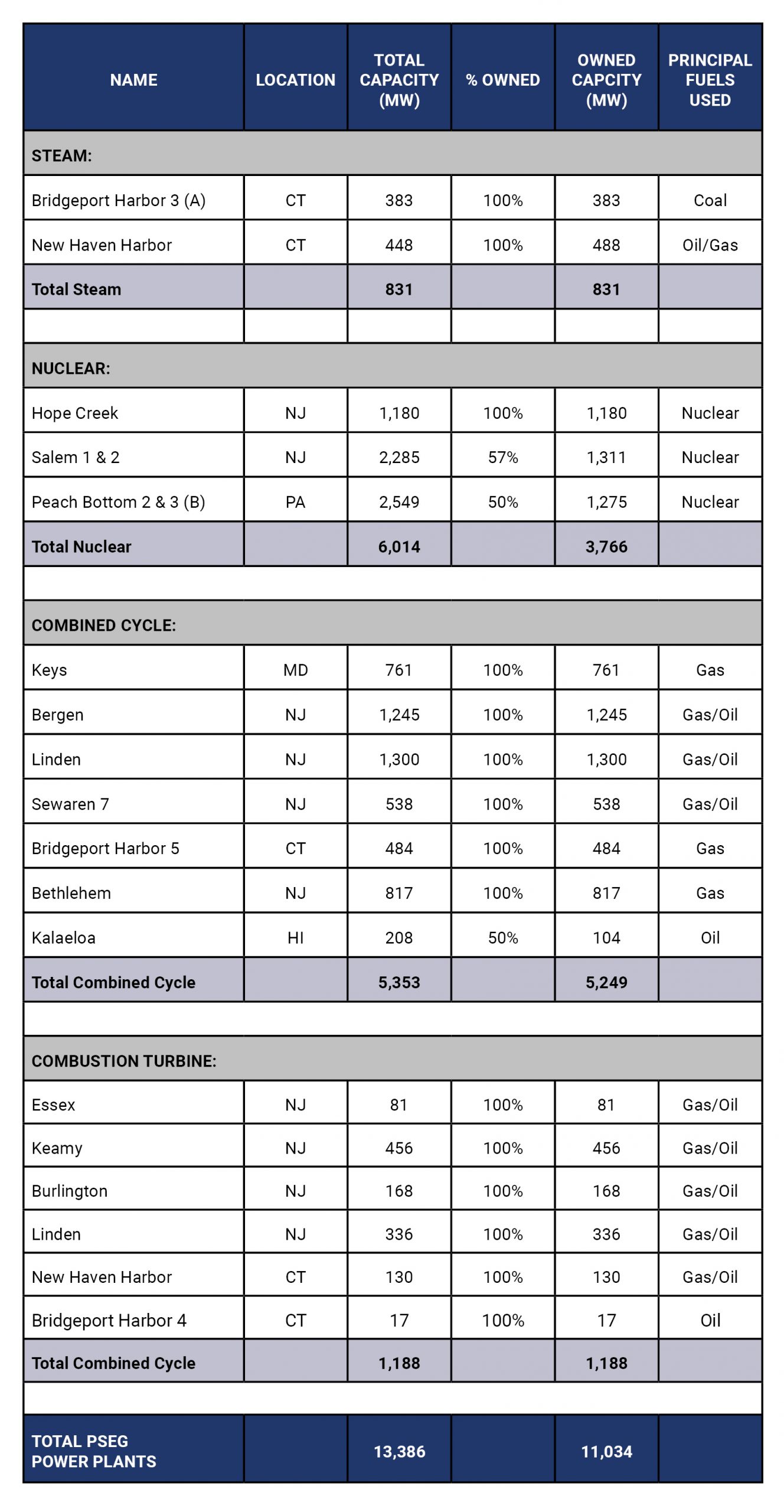
Public Service Enterprise Group (NYSE:PEG) agreed to sell its 6.7-GW fossil fuel fleet in New Jersey, Connecticut, New York and Maryland to ArcLight Capital Partners for $1.92 billion to further its transformation to a primarily regulated electric and gas utility.

The announcement, coming only two months after PSEG sold off its solar generation unit, will eliminate virtually all the company’s generation except for its 3.8 GW of nuclear capacity in New Jersey and Pennsylvania.

PSEG-Table-(PSEG)-Content.jpg
ArcLight Capital Partners agreed to purchase PSEG’s 6.7-GW fossil generation fleet, 13 units in New Jersey, Connecticut, New York and Maryland. The sale does not include the Bridgeport Harbor 3 combustion turbine, which retired May 31, or the Kalaeloa combined cycle plant in Hawaii. | PSEG 10-K filing, March 2021

“A year ago, we announced the strategic review of PSEG’s non-nuclear generating assets in line with our long-term focus on regulated utility growth, improving our business mix and enhancing an already compelling environmental, social and governance profile,” PSEG CEO Ralph Izzo said in a statement. “With today’s agreement, which is the result of a robust sale process, PSEG is on track to realize a more predictable earnings profile. Further, this transaction continues our evolution toward a clean energy, infrastructure-focused company that will enable our increasingly low-carbon economy.”

Escaping the uncertainty of merchant generation business will come with a substantial write-down from the power plants’ $4.5 billion book value. PSEG said it will record a pre-tax impairment charge of $2.15-$2.225 billion, employee severance and retention costs up to $25 million, debt redemption costs — including a make-whole premium — of approximately $280-$340 million, and “potential impacts on employee pension and other post retirement plans, environmental remediation costs and other items.”

Sale proceeds will be primarily used to pay down PSEG Power’s debt, company officials told stock analysts in the second quarter earnings call last month. (See PSEG Seeking to Sell Fossil, Solar Generation.)

The deal does not include Bridgeport Harbor 3, a 383-MW coal-fired combustion turbine in Connecticut, which retired May 31.

Also excluded is PSEG’s 50% share in the 208-MW oil-fired Kalaeloa combined cycle plant in Hawaii. PSEG spokesperson Marijke Shugrue declined to comment on the company’s plans for the plant, which is co-owned by limited partner Harbert Power Fund V, a unit of Harbert Management Corp.

In its Aug. 9 10-Q filing, PSEG disclosed that it had already taken a pre-tax charge of $519 million to recognize that the cash flows and fair value of its fossil units in ISO-NE were less than their carrying value as of June 30. The company’s “impairment assessment” found that its fossil units in PJM and NYISO did not require a write-down as long as they remained classified as “held-for-use.” PSEG reported its combined cycle plants had a 44.3% capacity factor in the first half of 2021, the same as a year earlier.

Sewaren-(PSEG)-Alt-FI.jpg
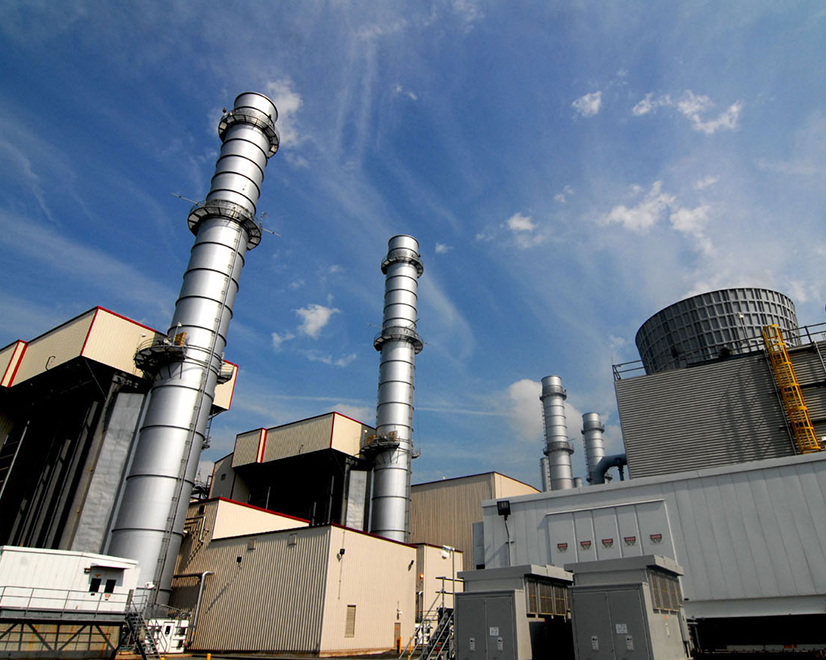
PSEG’s 538-MW Sewaren combined cycle plant in New Jersey | PSEG

As a result of the sale, PSEG said it was updating its full-year 2021 non-GAAP operating earnings guidance to $3.50 to $3.65/share, from $3.40 to $3.55/share, “reflecting the cessation of depreciation expense and lower interest expense related to the sale of the PSEG Fossil assets and repayment of PSEG Power’s outstanding debt.”

PSEG shares closed Thursday at $63.85/share, up 40 cents on the day.

The sale to ArcLight, which is subject to review by the Justice Department and FERC, is expected to be completed late in the fourth quarter of 2021 or the first quarter of 2022.

For ArcLight, a Boston-based private equity firm, the deal is just the latest in a series of more than 110 acquisitions and 69 exits since its founding in 2001. The company invests in energy infrastructure assets with “substantial growth potential, significant current income and meaningful downside protection,” including renewable and fossil generation, oil and gas production and midstream operations such as pipelines, storage and gathering and processing.

The company did not respond to a request for comment.

PSEG-Linden-(PSEG)-Alt-FI.jpg
PSEG’s Linden, N.J., generation complex includes a 1,300-MW combined cycle plant and a 336-MW combustion turbine. | PSEG

In March, Generation Bridge, a unit of ArcLight Energy Partners Fund VII announced it would purchase 4.85 GW of generation from NRG Energy (NYSE:NRG) for $760 million. The company also has purchased generation from AEP and Exelon as they have also sought to reduce or exit their merchant generation. (See Blackstone, ArcLight to Purchase AEP Merchant Plants for $2.2B and Exelon Selling Last Major Coal Generation in Fleet).

Reuters reported that ArcLight and its limited partners, including pension funds representing Maine teachers and NFL football players, lost several hundred million dollars in their ill-fated investment in the Limetree Bay refinery in the U.S. Virgin Islands, which was shut down by environmental regulators in May.

Wind and Solar to Make up Half of Virginia Electricity by 2040

Virginia is on track to meet its goal of zeroing out carbon emissions from electricity generation across the state by 2050, as set out in the Virginia Clean Economy Act (VCEA) of 2020, according to a preliminary report presented to the Virginia Council on Environmental Justice on Aug. 5.

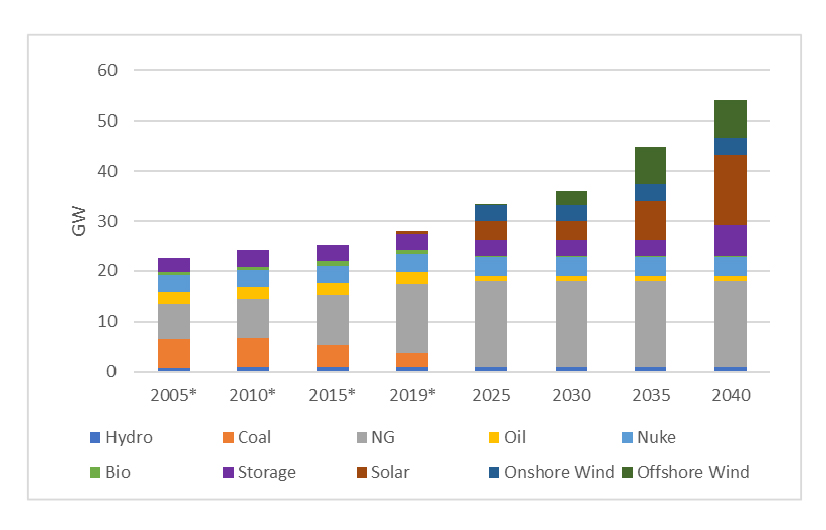
“By 2040, wind and solar end up constituting about half of all Virginia’s electricity generation, and zero-emissions electricity generation, including nuclear, is much more than half,” said Maya Domeshek, a research analyst with Resources for the Future (RFF), a nonprofit research group that co-authored the report. “Coal generation continues to fall rapidly and is almost gone by 2030.”

Domeshek added that renewable energy capacity in Virginia will grow along with the VCEA’s capacity targets. Natural gas generation will remain part of the state’s energy mix through 2040 but will be used less, she said.

Expected-PowerPlant-(Resources-for-the-Future)-Content.jpg
Expected Power Plant Capacity in Virginia Through 2040: Renewable energy capacity grows, but natural gas stays in the mix. | Resources for the Future

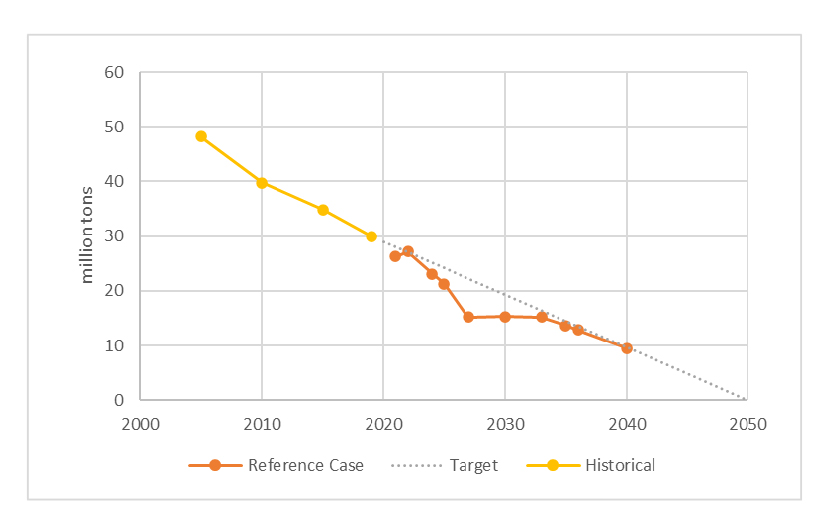
“The VCEA seems to be getting us where we need to go through 2040,” Domeshek said, noting that carbon emissions from electricity generation will drop to 10 million tons at that time, compared to about 27 million tons today.

The figures Domeshek and other researchers presented to the council were built on a preliminary “reference case” based on targets in the VCEA. These findings will in turn be used as the basis of a more comprehensive report — to be delivered to the state legislature by Jan. 1, 2022 — on how Virginia can achieve its zero-carbon goals at the least cost to ratepayers,

“The report will contain recommendations to the General Assembly as to whether to permanently ban construction of new fossil fuel-based generating plants,” said Carrie Hearne, associate director for energy equity at the Virginia Department of Mines, Minerals and Energy (DMME). “DMME is taking the lead on the project by coordinating research, conducting key consultations, engaging the public, drafting recommendations and working with DEQ [Virginia Department of Environmental Quality] … to finalize the submission to the General Assembly.”

Expected-CO2-Emissions-(Resources-for-the-Future)-Content.jpg
Expected CO2 Emissions in Virginia Through 2040: With VCEA, emissions drop to 10 million tons from current level of about 27 million tons. | Resources for the Future

In addition to RFF, other partners in the project include the Virginia State Corporation Commission, the University of Virginia’s Weldon Cooper Center for Public Service and the Georgetown Climate Center at Georgetown University Law School. Additional public comment will be gathered in the coming weeks.

However, the group will not be addressing the specific concerns of the Virginia Council on Environmental Justice until next year. Under the VCEA, beginning on Sept. 1, 2022, and every three years thereafter, DMME, in consultation with the council and others, is to “determine whether implementation of the VCEA imposes a disproportionate burden on historically economically disadvantaged communities.” A final report covering such issues is due to the General Assembly by Jan. 1, 2023, and every three years thereafter.

Getting to Zero Carbon

The VCEA “greatly expands the construction of solar, onshore wind, offshore wind and energy storage, with 35% of these facilities owned by entities other than Dominion [Energy],” Franz Litz of the Georgetown Climate Center said. The law also establishes a schedule for retiring all carbon-emitting generation by 2045 and a standard of 100% renewable electricity sources by 2045 for Dominion and by 2050 for Appalachian Power.

It also contains an energy efficiency standard for all customers, growing to 5% per year for Dominion and 2% per year for Appalachian Power by 2025, after which efficiency standards will be adjusted every three years.

The report team started with these targets and standards and developed a computer model, dubbed Haiku, “designed to simulate the electricity grid, including emitting and non-emitting power plants, transmission lines, consumers and industry, in the future,” Litz said. The model also accounts for the number of plants that will be built, how many will be retired, and fuel and maintenance costs, based on a least-cost model for the U.S. as a whole.

The reference case the team presented on Aug. 5 analyzed Virginia’s electricity generation through 2040. But according to Domeshek, “sensitivity cases” are also being developed to integrate evolving natural gas prices, varying levels of demand for electricity, and differing federal policies into the model. The team will also work on “policy cases,” to analyze any possible additional measures that might be necessary to achieve the VCEA’s zero-by-2050 emissions goal.

Domeshek said the reference case factors in the Regional Greenhouse Gas Initiative (RGGI), which now includes 12 states, including Pennsylvania. The analysis shows the VCEA helping the entire RGGI region achieve its cap on carbon emissions, if extended at the current pace beyond 2030, a year that is currently the limit of the coalition’s goal setting.

“The VCEA is really positioning Virginia well for those later reductions, and maybe Virginia could even do more than just those 3% reductions per year indefinitely,” Litz said.

By the end of September, the modeling team will complete the sensitivity analysis and evaluation of other scenarios to develop policy options for possible inclusion in the report. Then the Weldon Cooper Center for Public Service will take the lead in completing a draft report for DMME, which in turn will report the results and recommendations to the General Assembly.

“This is a work in progress and will be a work in progress for the next 30 years,” said Bill Shobe of the University of Virginia, who is also on the modeling team. “But the pathway is starting to be clear.”