Duke Highlights Renewable Efforts in Q2 Call

duke-energy-logo-duke.png

Duke Energy (NYSE:DUK) on Thursday touted its ongoing “clean energy transformation” through its five-year, $59 billion growth capital plan during the company’s second-quarter earnings call, highlighting decarbonization and renewable development efforts across the country.

Lynn-Good-Duke-Energy-FI.jpg
Lynn Good, Duke CEO | Duke Energy

CEO Lynn Good said the company is continuing construction on about 250 MW of new solar projects in North Carolina and Florida and expects to bring them online by the end of the year. Duke also recently commissioned the 144-MW Pflugerville Solar and 182-MW Maryneal wind farm projects in Texas, Good said, pushing the company over 10,000 MW of solar and wind resources.

Good said that at the current pace, Duke is on track to pass 16,000 MW of renewable resources by 2025 and about 24,000 MW by 2030. She said that by 2050, renewables will represent 40% or more of Duke’s energy mix.

“With the completion of these two projects, we hit a significant milestone,” Good said. “In addition to carbon reduction and the benefits of creating a diverse energy infrastructure, solar and wind investments foster economic development, tax revenue and job creation in the areas we serve.”

Net-zero Steps

Besides its solar and wind efforts, Good pointed to nuclear energy remaining a “foundational component” of Duke’s clean energy strategy, which currently provides the largest source of carbon-free energy in its system.

Duke-Energy-Wind-Turbines-(Duke-Energy)-Alt-FI.jpg
Duke Energy’s Maryneal wind farm in Texas came online in July. | Duke Energy

The company submitted its application in June to the Nuclear Regulatory Commission to renew the operating licenses of the Oconee Nuclear Station in South Carolina for an additional 20 years. The license renewal application marks the first submitted among Duke’s six nuclear units in the Carolinas, Good said, and the review process is expected to last 18 months.

Oconee is Duke’s largest nuclear station, with three generating units producing more than 2,500 MW of generation. Good said Duke’s nuclear fleet provided 83% of the company’s carbon-free generation in 2020.

“We’ll pursue similar extensions for each of our remaining reactors as they approach the end of their respective licensing periods,” Good said.

Duke is continuing to develop its electric vehicle infrastructure through eTransEnergy, a subsidiary introduced in February aimed at offering energy transportation services to logistics and last-mile delivery companies, along with school districts and transit agencies. Good said eTransEnergy was recently named a preferred provider by General Motors to help its fleet customers transition to EVs.

Duke asked North Carolina regulators in June to approve $56 million in spending to fund more than 1,000 EV charging ports and aid school systems to purchase 60 electric school buses. (See Duke Proposes $56M EV Charging Plan in N.C.)

“Electrifying vehicles is a win-win approach to reducing carbon emissions from both the electric and the transportation sectors,” Good said. “Our ambitious climate strategy also puts us in a strong position to help other sectors, such as transportation, meet their emission-reduction goals.”

Legislation

Good said Duke is monitoring developments in North Carolina as the House of Representatives recently passed House Bill 951. The legislation calls for the retirement of 12 coal units at five locations in the state, replacing them with “cleaner forms of generation, renewed solar programs and modern ratemaking tools to better align clean energy investments with customer needs.” (See NC Republicans Roll out Bill to Close Coal Plants, Add Renewables.) Good said Duke supports the initiatives in H.B. 951.

She also addressed the infrastructure bill currently making its way through Congress. She said the company is “engaged” with federal lawmakers and the Biden administration on several issues in the bill, including tax and climate policy. (See Bipartisan Infrastructure Bill Offers Funding for Grid, EVs.)

With the bill’s funding for a large-scale expansion of charging infrastructure to “prepare for and further drive adoption of electric vehicles,” Good said, investments in the grid will also need to grow. Funding for innovation in the bill is also a “critical part of the journey to net-zero” emissions, she said, because existing technologies won’t be enough.

“We’re pleased to see the framework includes funding to accelerate the development of next-generation clean-energy technologies such as hydrogen, carbon capture and advanced nuclear,” Good said. “Robust and sustained government support is vital to ensure the commercialization of these advanced technologies. It’s critical for us to tackle this issue today so the technologies are scalable when we need them.”

Earnings

Duke reported second-quarter adjusted earnings per share of $1.15, up from $1.08 during the same period in 2020. Unadjusted earnings per share were 96 cents compared to -$1.13 in 2020.

CFO Steve Young said the difference was because of “onetime impacts of the initiative to redefine workspace usage” resulting from COVID-19, including the consolidation of corporate office space and accommodating a hybrid work environment. Young said the office space initiative resulted in a 60% reduction in square footage and annual savings of approximately $25 million to $30 million.

“Overall, we had strong results compared to last year, supported by our continued execution and the rebounding economy,” Young said.
California PUC Orders Independent Safety Monitor for PG&E

California regulators last week ordered Pacific Gas and Electric (NYSE:PCG)
to hire an independent safety monitor (ISM) for five years, rejecting the utility’s request for a shorter period of oversight and insisting shareholders pay the $5 million annual bill.

The California Public Utilities Commission required the monitor as a condition for approving PG&E’s plan for exiting bankruptcy in May 2020.

The commission said its staff will hire the ISM based on responses to a request for proposals. The monitor will be responsible for ensuring that PG&E “prioritizes and implements the highest level of risk reduction across all levels of the company, from senior officials to field personnel,” the PUC said in an order Thursday. (Resolution M-4855)

The monitor will begin work before the term of the federal monitor, appointed in PG&E’s federal criminal probation proceeding, expires on Jan. 26, 2022. The federal monitor, law firm Kirkland and Ellis, was appointed following the utility’s 2017 criminal conviction for violating the U.S. Pipeline Safety Act and obstructing an agency proceeding in connection with the 2010 San Bruno gas pipeline explosion, which killed eight people and destroyed dozens of homes. The monitor’s work was expanded to include PG&E’s wildfire preparedness after the utility’s equipment was identified as the cause of catastrophic wildfires in 2017.

The CPUC said the ISM will be “functionally equivalent” to the federal monitor, with responsibility for both electric and gas safety, including wildfire mitigation plans, public safety power shutoffs and monitoring safety-related recordkeeping and record management.

“The ISM shall serve as the commission’s consultant, dispensing reports, materials, advice, opinions and recommendations to the commission,” the order said. “Consistent with the contours of the federal monitorship, the ISM’s work is directed by the commission and shall be performed for the commission’s benefit as well as PG&E’s.”

“In order to fulfill its role and effectively perform the areas within this scope of work, the ISM must be embedded within PG&E and have ongoing and regular access to PG&E’s non-privileged, every-day decision-making at all levels,” the order said. “The ISM must be able to raise safety concerns with PG&E and the commission immediately as they arise.”

The PUC said it would balance transparency with the need to protect from public disclosure utility confidential information and some communications, with the monitor required to produce a public report on its activities every six months.

“To the extent the ISM seeks access to materials that PG&E asserts are subject to attorney-client privilege or attorney work-product, PG&E shall use its best efforts to provide the ISM with comparable information without compromising the asserted privilege or protection,” the commission said.

The commission rejected conflict-of-interest provisions recommended by The Utility Reform Network (TURN), saying they were too broad and “could significantly reduce the pool of qualified vendors.” Instead, the commission’s Safety Policy Division will evaluate applicants’ potential conflicts and consult with its Legal Division to prevent conflicts that could jeopardize the monitor’s independence.

PG&E asked the commission to set an annual budget of $2 million to $5 million, arguing that setting a “static budget amount” would incentivize applicants to submit estimates that reach $5 million.

“But given the enormous task of effectively monitoring PG&E’s high-risk and expansive territory, we agree with TURN that ‘the distinctions among proposals will likely relate to the amount of work that can be performed within a $5 million budget — as well as the quality of the ISM team — and not on whether the work can be performed for less than $5 million,’” the commission said.

It also rejected PG&E’s request to hire the monitor for only two or three years, saying “five years is a reasonable amount of time considering the enormous task of developing a thorough understanding of PG&E’s lines of business and the numerous and complex safety risks associated with it.”

The utility also was rebuffed on its request to establish a “memorandum account” for ISM costs for potential cost recovery from ratepayers.

“These costs should be paid by PG&E shareholders and that PG&E may not seek cost recovery of ISM Plan costs in the future,” the commission said, noting its earlier description of PG&E’s safety performance “as ranging from ‘dismal to abysmal.’”

NEPOOL Participants Committee Briefs: Aug. 5, 2021

NESCOE Advances its Vision of ISO-NE

The New England States Committee on Electricity (NESCOE) on Thursday presented its “Advancing the Vision” report to the NEPOOL Participants Committee.

Initially submitted to New England’s governors in June, the report refines the October 2020 joint statement issued by five of the region’s governors, who demanded reforms from ISO-NE in wholesale market design, transmission planning and governance.

The report is also the product of technical forums held earlier this year and stakeholder comments collected since October. Some of the report’s recommendations include:

  • participate in the phaseout or replacement of the minimum offer price rule (MOPR) and ensure that any changes that ISO-NE seeks are thoroughly evaluated and justified based on verifiable data;
  • work with stakeholders to implement a proactive, state-led, scenario-based transmission planning process for long-term analysis of state mandates and policies as routine practice;
  • shape other efforts, such as updating rules to provide states with a more meaningful role in evaluating and selecting public policy-driven projects and seeking ways to improve the interconnection process for clean energy;
  • enable state officials’ efforts to integrate equity and environmental justice considerations into decision-making on infrastructure;
  • establish a standing committee on state and consumer responsiveness on ISO-NE’s Board of Directors; and
  • schedule annual public meetings of the board to allow states and the public to hear from board members on current issues and priorities.

Monitor Presents Annual Report

Record-low wholesale energy prices and demand in New England produced an average LMP of $23.30/MWh in 2020, the lowest since the implementation of the energy market construct 17 years ago, according to Jeffrey McDonald, ISO-NE vice president of market monitoring, who discussed the Internal Market Monitor’s Annual Markets Report.

A milder winter in 2020 brought low gas prices, wholesale demand and energy costs, which accounted for almost 70% of the $1.1 billion drop in energy costs, McDonald said. COVID-related restrictions reduced demand, but the mild weather and growth in energy efficiency and retail solar generation had a more considerable impact. There were not many significant system events and no shortages because of high capacity and reserves, he said.

The Monitor added three new market recommendations to this year’s report. Two relate to the requirement to not reduce peak load by the output of behind-the-meter generation for transmission charges. The third centers on developing an offer review trigger price (ORTP) for co-located solar/battery facilities.

Energy Market Value Drops

ISO-NE’s energy market value for last month was $427 million (through July 28), down $51 million from the updated June valuation and $100 million higher than the same month in 2020, according to COO Vamsi Chadalavada’s monthly report to the PC.

Natural gas prices were 14% higher than in June. Average real-time hub LMPs were 0.6% higher at $36.04/MWh. Average natural gas prices and real-time hub LMPs were up 99% and 60%, respectively.

Daily uplift or net commitment period compensation (NCPC) payments totaled $2.7 million over the period, down $1.2 million from the adjusted June value and $900,000 more than in July 2020. NCPC payments were 0.6% of the energy market value.

Chadalavada said five new projects totaling 410 MW applied for an interconnection study — two battery, two solar and one wind — with in-service dates ranging from 2022 to 2024. ISO-NE is currently tracking 292 generation projects, which total approximately 31,884 MW.

FERC Approves Tri-State’s 1st Major Rate Case

FERC last week approved a settlement in the first major rate case filed by Tri-State Generation and Transmission Association since the power supplier became subject to the commission’s jurisdiction (ER20-676).

The Aug. 2 letter order resolves several issues from regulatory filings that Colorado-based Tri-State made in 2019 and 2020 regarding rates and terms for wholesale power service to its 42 utility members in Colorado, Nebraska, New Mexico and Wyoming.

The uncontested settlement provides for an immediate reduction in members’ current wholesale rates, with a total decrease of 4% by March 1, 2022. It also establishes a rate moratorium through May 31, 2023, with Tri-State agreeing to file a new rate case no later than Sept. 1, 2023.

Tri-State has already implemented a 2% rate decrease that went into effect on March 1, and it will lower rates another 2% next March.

FERC found the settlement to be fair, reasonable and “in the public interest.”

“This is a crucial step forward to achieve our goal of making Tri-State the most competitive option to meet the power supply needs of our utility members,” Tri-State CEO Duane Highley said in a statement. “We also hope it paves the way to successful resolution of our other pending cases before FERC as we complete our transition to being a federally regulated public utility.”

Tri-State became FERC-jurisdictional last year. (See FERC Affirms its Jurisdiction over Tri-State G&T.) It and United Power, a member, have asked FERC to resolve four discrete, or “reserved,” issues that weren’t included in the settlement, the association said.

Two of the issues involve rate design and cost-allocation principles that will help Tri-State develop new wholesale power rates when it makes its rate-case filing in 2023. At issue is whether the cooperative is required to unbundle rates for wholesale service under its contracts and whether it must directly assign members costs associated with transmission services. Tri-State said it has used a rolled-in rate applicable to all members for nearly 70 years.

The others concern United Power’s challenge of a transmission demand charge for on-peak discharges from its battery storage devices and its protest of Tri-State’s Community Solar Program.

Rulings on the reserved issues will apply to Tri-State’s 2023 rate filing, except for that of the demand charge.

Tri-State has also said it would file by September with FERC a “simpler and more transparent” methodology for member’s exit fees, or contract termination payments (CTPs) (EL21-75).

The commission in June preliminarily found that Tri-State’s tariff was unjust and unreasonable in the barriers it imposes on utility members considering whether to terminate their memberships. It directed Tri-State to show cause as to why the tariff remains just and reasonable and to explain revisions the association believes would remedy the concerns.

“The lack of clear and transparent exit provisions has allowed Tri-State to impose substantial barriers for its utility members in evaluating whether to remain in Tri-State,” FERC, said.

Tri-State said that under its modified CTP methodology, a departing member’s exit fee would be the greater of the net present value of Tri-State’s estimated lost revenues resulting from the departure, minus the incremental revenues the association would receive from selling the departing member’s load into the wholesale market; any subsequent revenue Tri-State would receive if the member becomes a tariff customer; the present value of the member’s accrued, unpaid patronage capital balance; or the member’s pro rata share of Tri-State’s total debt and other obligations.

The association has shared a list of members’ CTPs, with United Power topping the list at $1.5 billion. Poudre Valley REA is next at almost $728 million, followed by Mountain View Electric Association and La Plata Electric Association (nearly $540 million and $450 million, respectively). Another 22 members have nine-figure CTPs.

Exit fees and the CTP methodology have long been bones of contention between Tri-State and its members, who are required to purchase 95% of their electricity from the association. Nine Tri-State members have asked for estimates of their exit fees. However, the association has argued that supplying the estimates would be premature, as the commission was still reviewing the tariff.

The commission in May rejected Tri-State’s proposed procedural requirements for members seeking to cancel their power contracts and leave the association, saying the proposal imposes “excessive and unjustified barriers” to members seeking information on their CTP costs. (See FERC Rejects Tri-State Exit Fee Proposal.)

The CTP methodology calculates the cost for early termination of a utility member’s power supply contract with Tri-State, “without financially harming other members,” the association said.

SEEM Critics Repeat Call for Technical Conference

Opponents of the proposed Southeast Energy Exchange Market (SEEM) blasted the market’s supporters last month in a filing that sought to “clarify the record” while renewing calls for FERC to initiate a technical conference on energy market policy in the Southeast (ER21-1111, et al.).

The July 29 filing — by a group including the Sierra Club, Southern Alliance for Clean Energy, Georgia Conservation Voters, the North Carolina Sustainable Energy Association and the Natural Resources Defense Council, identifying themselves as “Public Interest Organizations” (PIO) — was in answer to an argument filed by SEEM’s sponsors two weeks earlier. (See Southeast Utilities Urge FERC Action on SEEM.) The sponsors themselves were responding in part to the PIOs’ original criticisms and call for a technical conference, filed in June. (See Clean Energy Groups Pan Southeast Utilities’ SEEM Proposal.)

While the PIOs acknowledged that FERC’s “procedural rules generally do not allow for answers to answers,” they said an additional filing was necessary because the SEEM sponsors “refuse to modify the proposal” beyond “tweaks around the edges” that fail to address the issues they have raised previously.

Following the PIOs’ filing, FERC staff on Friday issued a second deficiency letter with three questions, including a request for assurances that the SEEM administrator and auditor would be independent of members and their affiliates.

Staff asked how SEEM’s operating agreement would ensure that members cannot access competitors’ transmission function or commercially sensitive information through reports or information provided by the administrator or auditor.

They also asked about SEEM’s proposal to post confidential information to a dedicated confidential portion of its website to which designated employees would have access. They asked whether the availability of redacted documents posted to the confidential portion of the website would vary depending on the identity of the participant accessing the documents to avoid divulging commercially sensitive information to a participant’s competitors.

Serious Market Power Concerns

The complaints raised in the July 29 filing mainly echo those of the PIOs’ previous arguments against SEEM, which is intended to reduce friction in bilateral trading in 11 Southeastern states by introducing automation, eliminating transmission rate pancaking, and allowing 15-minute energy transactions. SEEM’s proponents, which comprise more than a dozen utilities and cooperatives including the Tennessee Valley Authority, Southern Co. and Duke Energy, also claim that the market would promote “better integration of diverse generation resources” such as wind and solar.

First on the PIOs’ list of issues with the proposal is the potential for transmission-owning utilities to “favor their own generated electricity and to exclude competitors from the market.” Though SEEM proponents assert that they have no intention of preventing access to transmission by competitors, the complainants said it is likely that SEEM participants will feel “an incentive to maintain their monopoly power at the expense of their customers.”

Average-retail-prices-for-utilities-(SEEM)-Content.jpg
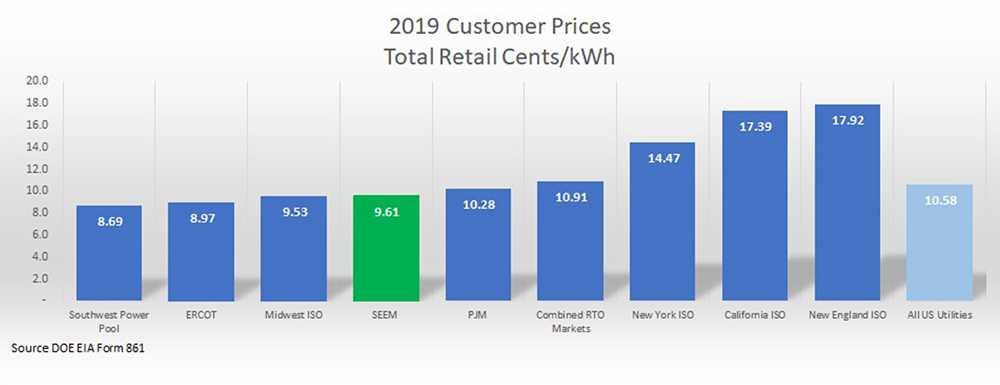
Average retail prices for utilities in SEEM versus the RTO markets | SEEM


“Applicants’ blustery denials have done little to dispel the applicability of this fundamental principle of economics,” the PIOs said. “In fact, some applicants have used their considerable power to undermine efforts to introduce meaningful competition to the Southeast energy markets in ways that do little to allay PIO concerns regarding the potential for market power abuse in the proposed SEEM structure.”

The complainants cited “considerable efforts and questionable tactics” allegedly expended by Duke Energy to block a study on the impact of an energy bill in North Carolina backed by the utility. The bill, HB 951, originally included a provision that would examine the benefits of forming or joining an RTO, but according to a report from the Energy and Policy Institute, Duke worked with the North Carolina Utilities Commission to remove this language from the finished bill.

Potential for Discrimination

The PIOs also assert that the SEEM proposal “presents structural opportunities for undue discrimination,” as well as being inconsistent with open access transmission tariffs.

Pointing to the lack of a standardized enabling agreement in the SEEM rules, complainants said there is no guarantee that parties interested in participating in the market will “have rights to an enabling agreement.” While SEEM’s supporters have suggested that the 181 separate enabling agreements between proposed SEEM utilities show a robust network of trading partners, the PIOs replied that this only shows “some existing bilateral trading” between those members, not that others will be able to join on the same terms.

“Under other market structures and joint dispatch agreements, the commission has allowed some limitations on access to free transmission service to those with resources and/or loads located on the utilities’ systems,” the PIOs said. “However, at a minimum, those market structures provide imbalance service — that is, balancing loads and resources to meet needs reliably in real time. As applicants are fond of repeating, SEEM is not an energy imbalance market and has no imbalance or reliability requirements.”

No Action on Previous Complaints

In addition to these issues, the PIOs complained that SEEM proponents have “continuously failed to remedy” several points they have raised previously, including an alleged preference in the governance structure for transmission-owning members over participants, and the lack of an independent market monitor. Complainants said that “any one of these flaws” should be enough to torpedo the proposal, but that none have been addressed despite repeated attempts to raise supporters’ attention.

As a result, the PIOs urged FERC once again to reject the proposal and call a technical conference that would provide “an opportunity for meaningful stakeholder involvement.”

“Contrary to the applicants’ self-congratulatory claims, the existing bilateral energy market dominated by monopoly utilities is not working for families in the Southeast. And as explained in the PIO’s previous filings, SEEM will not help and may hurt,” the PIOs said. “A technical conference or joint regional meeting is a critical step towards a real solution that increases competition and lowers customer bills throughout the Southeast.”

DOE Invests $34M to Advance Biofuels Research

The U.S. Department of Energy (DOE) said last week that it will invest almost $34 million in bioenergy technology in a bid to lower the country’s reliance on fossil fuels.

The investment will pay for 11 projects managed by both universities and private companies to explore using municipal solid waste (MSW) and algae to create low-carbon biofuel, biopower and bioproducts.

“From food waste to yard trimmings, biomass technology is converting our everyday trash into low-carbon fuel for planes and ships while cutting costs and supporting our critical transportation sector,” Energy Secretary Jennifer Granholm said in a statement Tuesday. ”The companies and universities leading these projects will ensure that our cutting-edge biofuel technologies reduce carbon emissions, create new jobs up and down the supply chain, and are made in America by American workers.”

A total of $18.7 million will go to six projects researching algae farming. The projects “will look into diverse strains and farming practices of algae and explore new ways to improve their growth.”

According to Global Algae Innovations of Hawaii, a beneficiary of the funding, algae can be used to create products such as polymers, protein for human consumption, spirulina and biofuels. The company says that use of algae can also reduce deforestation, save water and reduce reliance on pesticides. The funding will help the company research “enhanced algae productivity in CO2 direct air capture cultivation.”

“We need transformational, innovative technology to mitigate the most severe impacts of climate change,” Sen. Mazie Hirono (D-Hawaii) said. ”Global Algae Innovations on Kauai is at work on technology that would create energy from algae, and this new federal funding will help this local company continue its groundbreaking work.”

About $15 million will go to five projects researching conversion of MSW, which typically includes materials such as household trash, construction waste and wastewater treatment sludge. The DOE release notes that using MSW “has significant potential to divert large volumes of garbage from the landfills to the refinery.”

The DOE’s Bioenergy Technologies Office website says one benefit of utilizing MSW is that it is “available now without land-use change, and in many cases their utilization helps to address the unique and local challenges of disposing of them.” It also notes that the current level of waste in the U.S. is “unlikely to diminish in volume in the near future,” making MSW a dependable investment.

In addition to creating biofuels, the conversion process of MSW and algae can also produce other valuable materials for industrial use, such as plastics, fertilizers, lubricants and chemicals.

The transportation sector generates the largest amount of greenhouse gas in the country, the DOE said, and certain sectors, such as aviation and marine transportation, “face barriers to electrification” because of the difficulty of powering them with electricity.

The use of sustainable aviation fuel (SAF), made from MSW, is one solution to the problem. “SAF currently results in an emissions savings of up to 80% compared to conventional jet fuel,” Airlines for America President Nicholas Calio said. SAF is similar in chemistry to traditional jet fuel.

The $15 million in MSW funding will go to five institutions.

Cascadia Consulting Group will research a “statistically rigorous, deep dive nationwide characterization of municipal solid waste and selection of technologies enabling production of conversion-ready feedstocks.” University of Maryland will research a “systematic characterization of variability in MSW streams to identify critical material attributes for fuel production.”

Lehigh University will study an “integrated LIBS-Raman-AI system for real-time, in-situ chemical analysis of MSW streams,” while North Carolina State University will research “AI-Enabled hyperspectral imaging augmented with multi-sensory information for rapid/real-time analysis of non-recyclable heterogeneous MSW for conversion to energy.” AMP Robotics will receive funds to study an “artificial neural network for MSW contamination characterization.”

The algae funding will go to the University of California, San Diego for research into “enhanced production of algae lipids and carbohydrates for fuel and polyurethane precursors;” Colorado State University will research “advancing algal productivity through innovation in cultivation operation and strain traits (ADAPT-COST);” Scripps Institution of Oceanography at UC San Diego will research “ecological monitoring technologies to enhance large-scale microalgae cultivation, stability and productivity;” Arizona State University will research “direct air capture integration with algae carbon biocatalysis;” and the University of Toledo will research “minimizing organic carbon losses to improve net productivity in direct air capture cultivation.”

The funding is part of the Biden administration’s commitment to getting the U.S. to net-zero emissions by 2050.

National Grid Diversity Officer Calls out ‘Talent Bias’ in Energy Sector

Creating a truly diverse, equitable and inclusive workforce for the coming clean energy economy will require a shift in how companies currently perceive talent.

“We make assumptions about people based off what they look like, their identity or their background, but we also make assumptions about people based off of what they’ve done before,” Natalie Edwards, global diversity officer at National Grid (NYSE:NGG), said Thursday at the New England Women in Energy and the Environment (NEWIEE) 2021 Women Shaping the Agenda event.

If someone is a utility line worker, for example, there’s a tendency to think that person will be a line worker forever, she said.

“We have to check our assumptions, which are biases about what we think is possible for the people around us,” she said, adding that it’s imperative for businesses to see their workforce and potential talent candidates “as having infinite possibility.”

National Grid has one of the most female leadership teams in the energy industry, and some of its business units have more women on the leadership team than men, according to Edwards.

The company has commissioned research that will help the industry understand how bringing “women to the table, particularly leadership, ties to” achieving net-zero emissions, she said. “We know having more women at the table leads to more innovation, and it’s time for us to prove it and tie it to energy results.”

Senior and leadership levels of energy companies are not diverse in terms of race or gender, Annelies Goger, a David M. Rubenstein Fellow in the Brookings Metropolitan Policy Program, said during the event.

Women make up 25% of the energy workforce and 47% of the general labor force, while only 8% of the energy workforce is black and 16% is Latino or Hispanic.

“Diversity and inclusion isn’t just about hiring people into a job,” Goger said. “It’s about creating pathways into leadership both within the organization and also allowing opportunities for people to transfer to do something different.”

Federal Support

Support at the federal level for a diverse energy workforce is coming from a fresh approach to job creation within the U.S. Department of Energy.

“Part of what we’re looking to do is not recreate existing inequities in our energy system, both in terms of where we are generating our energy, and in terms of who is working on our energy,” said Jennifer Jean Kropke, director of energy jobs at DOE.

The Office of Jobs, she said, is thinking about labor standards as a way to help transition equitably to a clean energy workforce. That approach might include attaching labor standards to funding streams, she said. Her office, she added, also is educating other DOE offices on the power of collective bargaining agreements for the industry.

“With entities like unions, there are clear pipelines in place to make sure that we are getting more of our folks who live around projects, and who haven’t had opportunities in the past to work on projects, the skills and the training they need to get onto those projects — not one time, but every time,” she said.

Another DOE strategy for diversity is to establish apprenticeship-based career pathways that look beyond equating one new technology with one new job type.

“People who are only doing solar installation cannot make a living in most places of the country,” Kropke said. “However, an electrician who starts a career doing solar installation and then moves on to more advanced work throughout their apprenticeship can make a living doing these things.”

Education and Training

The innovation that is happening within the energy sector needs to translate to workforce education, training and funding, according to Aisha Francis, CEO of Benjamin Franklin Institute of Technology.

Society, she said, puts the onus on students to navigate a complex system from high school to college to training and then finding a way to get a job. That’s a system that may have worked for the last 100 years, but it needs to change for the energy workforce to grow quickly, she added.

Really effective colleges and companies are finding ways to collapse that system into one pathway so it is easier for people to navigate, she said. The pandemic recovery movement also is offering funding opportunities for energy job training and education, but it will require an extension of benefits.

“We’re not trying to just move people from $15/hour to $18; that’s good, but it’s not good enough,” she said. “We need folks to move from $15 to $30, and that type of shift takes longer-term training than most of our social service programs will support.”

Intentionality

Representation for women in the workforce is critical, but National Grid’s Edwards said women at any level of an organization can be advocates for other women and fuel a cycle of intentionality.

Employees need to ask questions about the policies and processes that are “running behind the scenes,” she said. Those policies and processes, she added, outlast any individual employee and have “ripple effects going forward.”

Conversations about gender equality also need to include men, according to Edwards.

“At many of our organizations, [men] still are over-represented at the top, so they need to be aware of what it is like to be a woman and a woman in energy,” she said.

She also encouraged attendees of the event to always be thinking about the women who are under-represented.

“We need to think about intersectionality and remind ourselves that there are literally billions of women in the world,” she said. “If you’re in a room where gender equality is being talked about … ask, ‘What do we all look like?’ and ‘How can we make sure that the conversation next time includes more voices?’”

Stakeholder Soapbox: Advancing Grid Parity

Three priorities for FERC became clear this year: transmission reform, decarbonization and grid resilience. To address all three, FERC should provide true open access and competition for transmission development in RTO markets. Leveling the playing field for new transmission entrants in RTO markets would quickly provide needed reliability, clean energy and consumer benefits.

Deep anti-competitive flaws in RTO transmission policy deter both reliability and clean energy improvements. Current FERC policy permits incumbents in RTO markets to retain a blanket right of first refusal (ROFR) for projects meeting local reliability needs, but projects planned to meet regional needs must be competitively bid. To avoid this competition, incumbents in RTOs are building an increasing number of smaller local reliability projects which exclude larger regional projects. The result is higher transmission costs with little corresponding reduction in transmission congestion, interconnection delays and suppressed innovation, as demonstrated at FERC’s 2019 grid-enhancing technologies workshop and further detailed by industry participants in post-workshop comments.[1] Consumers would benefit from new, innovative regional and interregional transmission solutions that eliminate congestion and unlock renewable generation resources.

Despite billions of dollars in potential consumer savings, only 3% of new transmission investment in the U.S. was subject to competition between 2013 and 2017. In many of these cases, incumbents in RTOs blocked winning bidders from moving forward with projects by successfully lobbying for the enactment of ROFR statutes at the state level.[2] Such laws give incumbents the exclusive right to build, maintain and own transmission lines within their service territories. ROFR proliferation since FERC issued Order 1000 has inflated costs and harmed interstate commerce. All the while, consumers’ electric bills have continued to rise as transmission costs have doubled, and the reliability effects of transmission-related events have increased.[3]

With billions in transmission investment needed to meet aggressive clean energy goals, maintain reliability and enhance resilience to severe weather and cybersecurity threats, incumbent transmission owners are seeking to reinstate the federal ROFR that was eliminated by Order 1000. Some argue that transmission competition is a failed experiment that hinders the grid of the future by leading to inefficient and unnecessarily costly development. Industrial consumers and state consumer advocates adamantly disagree. They warn that giving incumbent transmission owners free rein without the downward cost pressure offered by competition will lead to even higher bills, further suppress innovation and increase delays in unlocking renewable generation. Instead, FERC should correct deficiencies in the existing Order 1000 competitive framework to spur innovation and reduce costs while promoting reliability and decarbonization efforts.

At a granular level, retail customers of incumbents in certain regions often experience more reliable service than the same incumbent’s wholesale transmission customers, perpetuating unreliable “holes” and economic “dead zones” within regional grids. This is especially evident in smaller municipal utilities and rural electric cooperatives. The unequal transmission service quality and rate treatment these underserved communities sometimes receive also results in the hindrance of renewable energy development, especially in wind- and solar-rich areas like MISO, SPP and the Southwest.

There is ample evidence that the disparity in reliability performance and clean energy access within certain RTO regions is not random. Peer-reviewed studies have found that “unequal resilience” between communities is driven by institutional bias and bureaucratic rules.[4] This will continue under the status quo, as many incumbent transmission owners in RTOs work to shield their transmission cap-ex budgets from competition.

Thankfully, the winds of change are upon us. Industrial consumers, state consumer advocates, renewable developers and new entrants are increasingly recognizing that their fates are intertwined. They are beginning to rally against anti-competitive behaviors, promoting the expansion of transmission competition under Order 1000 and fair RTO zonal cost allocation rules, such as equivalent cost recovery for incumbents and new entrants. They are calling on FERC to either preempt state ROFR laws or change the regulatory presumption of prudence for transmission projects subject to a state or federal ROFR.

Regional consumer and new entrant interests, especially in SPP and MISO, are identifying additional transmission options that benefit wholesale customers. This includes allowing customers to contract with non-incumbent transmission providers to plug the “holes” in the electric grid and remedy the chronic “dead zones” that incumbents and RTOs refuse to address. To enable this, FERC could declare that RTO zonal cost allocation practices treat all networked transmission facilities — whether owned by new entrants or incumbents — equally.

Effective transmission reform can produce cleaner energy and more reliable service that benefits all customers. But first FERC must remedy incumbency bias and reduce the barriers to new entrants. Tactically, FERC can start by revisiting and undoing the most egregious RTO-specific competitive carve-outs granted since Order 1000 was issued. There is no doubt that FERC has a broader vision of transmission reform that will require extensive rulemaking and the reversal of the competitive exemptions enshrined in Order 1000 itself. But FERC leadership should prioritize remedying zonal placement and eliminating Order 1000 carve-outs to enhance competition without delay.

Devin Hartman is director of energy and environmental policy at the R Street Institute.

Abbott Names Glotfelty as 4th Commissioner on Texas PUC

Texas Gov. Greg Abbott on Friday expanded the Public Utility Commission beyond its traditional three-person membership by appointing Clean Line Energy Partners co-founder Jimmy Glotfelty as its fourth commissioner.

Glotfelty, managing director for ICF Consulting (NASDAQ:ICFI), was selected to a term that expires Sept. 1, 2025.

State lawmakers passed legislation earlier this year that increased the PUC to five members, one of several bills in response to ERCOT’s near collapse in February. The commission has regulatory oversight of the grid operator.

Senate Bill 2154 expanded the PUC from three members to five and only requires two commissioners to be “well informed and qualified in the field of public utilities and utility regulation.” Glotfelty brings a solid industry background to the position, unlike Chair Peter Lake and Commissioner Will McAdams, who came to the commission from other sectors. He and Mike Skelly founded Clean Line, and he was director of government solutions for Quanta Services.

Jimmy-Glotfelty-(ConservAmerica)-Content.jpg
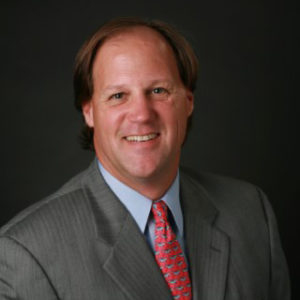
New Texas PUC Commissioner Jimmy Glotfelty | ConservAmerica

Glotfelty also directed the U.S. Department of Energy’s Office of Electric Transmission and Distribution and was a senior policy adviser to Secretary Spencer Abraham during the George W. Bush administration. He chaired the American Wind Energy Association’s Transmission Committee and was a member of the White House Task Force to Streamline Energy Permitting, also during the second Bush administration.

Prior to his federal service, he served as director of energy policy for Bush when he was governor of Texas.

Also on Friday, Abbott appointed Arch “Beaver” Aplin III as his representative on the ERCOT board selection committee, which will select the eight independent board directors, a result of another piece of legislation passed this year. The new law replaces market participants with the new directors, who must be Texas residents, and are selected by the state’s key legislators.

The board is to be seated by Sept. 1, though not all the positions are likely to be filled by then.

Aplin is CEO of the popular Buc-ee’s convenience store chain and chair of the Texas Parks and Wildlife Commission.

Lt. Gov. Dan Patrick last month selected G. Brint Ryan as his representative on the three-person committee. Ryan is the founder and CEO of his eponymous global tax consulting firm.

House Speaker Dade Phelan has the third pick for the committee, but he has yet to announce it.

Utilities Still Dealing with Feb. Storm Aftermath

CEO Morgan: Vistra’s Thermal Resources Still Valuable

Vistra-Logo.jpg

While continuing to rebound from February’s winter storm and a disastrous first quarter, Texas power producer Vistra (NYSE:VST) said Thursday there is still a home in ERCOT for its fleet of dispatchable resources.

Vistra CEO Curt Morgan said the company has been hardening its assets and participating in the state’s legislative and regulatory processes to redesign the ERCOT market after its near collapse in February.

“It is difficult at this time to speculate on what form these reforms might take,” Morgan told financial analysts during the company’s second-quarter earnings call, “though very clearly ERCOT and the [Texas Public Utility Commission] are focused on ensuring that Texans have reliable electricity going forward, reinforcing the importance of dispatchable resources like Vistra’s.”

Morgan said the most likely changes will be to ERCOT’s operating reserve demand curve and its price adders, as well as additional ancillary services to incent new investment and maintain existing dispatchable generation.

In the meantime, Vistra is also investing nearly $50 million this year and another $30 million next year to further harden and weatherize its generating facilities for colder temperatures and even more extreme weather. The company is also contracting for a “meaningful amount” of additional gas storage and installing dual-fuel capabilities at its gas steam units.

Morgan-Curt-2017-Oct-RTO-Insider-FI.jpg
Vistra CEO Curt Morgan | RTO Insider LLC

Morgan said the actions are necessary “to address the risk we were exposed to during Winter Storm Uri,” referring to The Weather Channel’s name for the February storm. Vistra’s share price lost almost a quarter of its value in February when the company said it expected to take up to a $1.3 billion financial loss because of its market losses during the massive ERCOT power outage. (See Vistra Stock Plunges After Market Losses.)

“There is no question the temperatures have been on the rise in 2021, as have the extremes in weather conditions,” Morgan said. “These weather extremes, coupled with the greater percentage of renewable resources backing up the supply stack in various markets, have resulted in a heightened sensitivity to scarcity conditions by the system operators, reinforcing the importance of thermal resources.”

Vistra has also completed a review of its renewable and battery business, which Morgan said is “one of the best.”

“We’ve got a great pipeline,” he said, noting the company’s use of sites with access to transmission. Capital costs will likely force Vistra to find a partner, Morgan said, as management takes “a real hard look at how we can accelerate the growth in that business.”

Vistra reported second-quarter ongoing operations adjusted EBITDA of $909 million, which excluded the effects of the storm but was in line with management’s expectations. Including the storm’s effects, the company’s ongoing operations adjusted EBITDA was $825 million.

A year ago, Vistra’s ongoing operations adjusted EBITDA was $929 million. The company uses adjusted EBITDA as a measure of performance because it says that analysis of its business is improved by visibility to both that metric and net income prepared in accordance with GAAP.

The Irving, Texas-based company’s stock price dropped 5%, from $18.89 to $17.94, after it announced earnings, but it recovered somewhat to finish the week at $18.56.

OGE to Retire 850 MW of Gas Generation

Oklahoma-Gas-and-Electric-Logo.png

OGE Energy (NYSE:OGE) said during its second-quarter earnings call Thursday that it expects to retire about 850 MW of “aging, less efficient, less reliable gas plants” built more than 50 years ago.

CEO Sean Trauschke said the company has filed draft integrated resource plans in Oklahoma and Arkansas that call for replacing the gas units with solar- and hydrogen-capable combustion turbines and successful energy efficiency and demand-side management programs.

“This plan is a significant step forward to meet our objectives of fuel diversity and provide our customers with cleaner energy solutions while maintaining our affordable rates,” Trauschke said. He said OGE’s transition plan is to add 100 to 150 MW each year, beginning with solar, “to really smooth out the customer impacts.”

OGE also plans to recovery 85% of its total costs from the February winter storm through a securitization filing with the Oklahoma Corporation Commission. A hearing is expected in the fall.

The Oklahoma City-based company released earnings of $200 million ($0.56/share), compared to the year prior of $200 million ($0.43/share). That beat analysts’ expectations by 4 cents.

OGE’s share price opened at $34.18 on Thursday and twice came within 12 cents of its 52-week high Friday when it hit $35.34 on Friday. It closed the week down at $35.04.

CenterPoint Hits ‘Stride’ Under Lesar

CenterPoint-Energy-logo-web.jpg

CenterPoint Energy (NYSE:CNP) CEO David Lesar celebrated his one-year anniversary with the utility, saying the company is “now hitting the fast-paced organizational stride I want us to have.”

The Houston company reported second-quarter earnings Thursday of $221 million ($0.37/diluted share). That compared favorably with CenterPoint’s second quarter the year before, when earnings were $59 million ($0.11/diluted share).

Lesar said CenterPoint has invested about $1.5 billion in the first half of the year and is on track to spend about $3.4 billion for the entire year. He said new Texas legislation for transmission and distribution utilities to improve the grid’s resilience “helps minimize the risk of prolonged outages and allows us to put all of this into rate base.”

The company has also requested that the Texas Railroad Commission approve borrowing $1.1 billion in bonds to help pay for gas costs incurred during the February winter storm. If approved, CenterPoint said customer bills could go up as much as $5/month; if not, it would levy a fee as high as $40/month to pay for the costs.

Lesar replaced interim CEO John Somerhalder in July last year. Somerhalder replaced Scott Prochazka, who resigned after seven years at the helm in February 2020. (See Prochazka Steps down as CenterPoint CEO.)

CenterPoint’s share price set a new 52-week high of $26.92 on Friday and closed at $26.48. It opened Thursday at $25.90.