PJM MRC/MC Briefs: July 28, 2021

Markets and Reliability Committee

Non-firm Transmission Service Pre-emption Endorsed

PJM stakeholders last week endorsed tariff language revisions to exclude the right of first refusal (ROFR) process from the evaluation of non-firm transmission service requests. The changes were driven by the RTO’s concerns around new federal standard requirements.

One member objected to the revisions in an acclamation vote held at Wednesday’s Markets and Reliability Committee meeting, while the tariff language was approved on the consent agenda at the Members Committee meeting held later in the afternoon. The revisions were originally approved at the July Operating Committee meeting. (See “Non-firm Transmission Service Pre-emption,” PJM Operating Committee Briefs: July 15, 2021.)

Jeffrey McLaughlin, senior lead engineer in PJM’s transmission service department, reviewed the “quick fix” problem statement and issue charge to modify language in section 14.2 of the tariff related to pre-emption of non-firm transmission service.

McLaughlin said the quick fix was necessary because of compliance requirement changes within version 3.2 of the North American Energy Standards Board’s (NAESB) Business Practice Standards, which FERC adopted in January 2020 and becomes enforceable on Oct. 27. (See FERC Adopts NAESB Business, Communication Rules.)

McLaughlin said an accelerated timeline in the stakeholder process was necessary to ensure FERC responds to PJM’s proposed filing under Federal Power Act Section 205 prior to the October enforcement date. Because the MC has no meeting scheduled for August, McLaughlin said, the vote needed to take place in July to allow for a 60-day window for a FERC ruling.

“We do understand this is an aggressive timeline,” McLaughlin said. “We didn’t take the decision to move forward with it lightly.”

McLaughlin said PJM staff determined that the changes to the ROFR process caused by the NAESB standards could cause significant problems for the RTO’s non-firm transmission service processes and OASIS customers. He said the changes could create uncertainty for the most frequently used transmission products and have detrimental impacts on the day-head and real-time energy markets.
Transmission-Service-Products-page-of-the-OASIS-application-(PJM)-Content.jpg
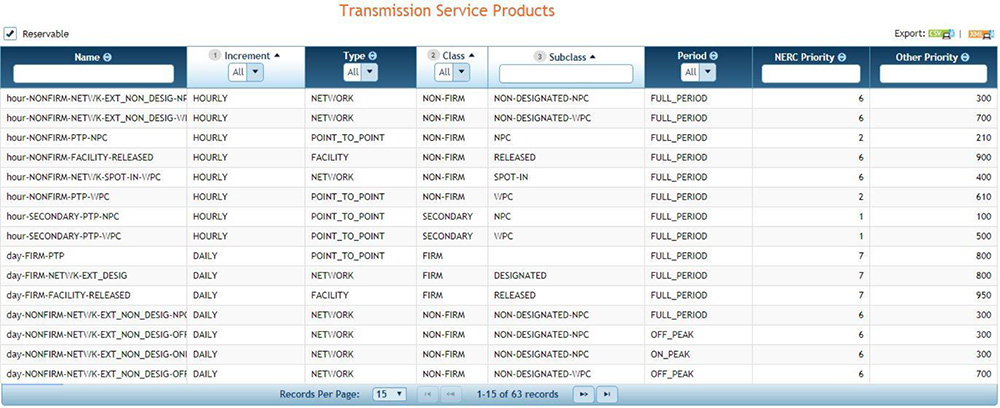
The Transmission Service Products page of the OASIS application | PJM

PJM employs an automated engine for processing non-firm transmission service requests where customers receive instantaneous evaluations, McLaughlin said, but the pre-emption established by the NAESB standards introduces “significant delays” to the process through “back-and-forth negotiation” involved in the evaluations.

McLaughlin said the NAESB changes could result in more than two-hour delays for hourly challenger requests and more than 24-hour delays for daily challenger requests depending on the specific scenario being evaluated.

He added that PJM staff were also concerned that transmission service reservations procured in smaller increments — such as hourly and daily reservations — could be at greatest risk for pre-emption. Most of PJM’s service requests fall into this high-risk category, he said, with more than 90% of the 45,000 confirmed requests in 2020 consisting of hourly or daily service granted within 24 hours of the service start time.

“Unfortunately, because hourly is the shortest in duration, it’s also at the highest risk of being pre-empted,” McLaughlin said. “It leaves customers with little time to react and to make alternate arrangements.”

PJM’s proposal included using section 13.2 of the tariff, which already contains language to exclude pre-emption from the evaluation of short-term firm transmission service. McLaughlin said the revisions extend similar language to section 14.2 of the tariff, excluding pre-emption from non-firm request evaluation.

He said the tariff revision will prevent processing delays, minimize “unnecessary customer uncertainty for little benefit,” and avoid impacts to the day-ahead and real-time markets.

Bruce-Susan-2020-02-20-RTO-Insider-FI.jpg"
Susan Bruce, PJM ICC | © RTO Insider LLC

PJM will make a Section 205 filing this month to get a ruling before the October implementation of the NAESB standards, McLaughlin said. The RTO made a separate compliance filing with the commission on July 27 to comply with the NAESB standards and to request a continued waiver of certain standards.

“We feel strongly that this solution is in the best interest of stakeholders,” McLaughlin said.

If FERC does not approve the Section 205 filing, McLaughlin said, PJM’s backup plan includes implementing the pre-emption process with its July 27 compliance filing, but the process would be conducted in a “customized and more streamlined way” with stakeholders to avoid delays in OASIS.

Susan Bruce, counsel to the PJM Industrial Customer Coalition (ICC), said some ICC members were struggling to understand the “urgency” on the ROFR process as the issue hasn’t been discussed much in stakeholder meetings. Bruce wanted to know what market segments were directly impacted by the issue and asked whether the Independent Market Monitor thought the change would cause any problems.

Joe-Bowring-Monitoring-Analytics-RTO-Insider-FI-1.jpg
Joe Bowring, IMM | © RTO Insider LLC

McLaughlin said the change primarily impacts OASIS users and could create too much uncertainty for them. After reviewing with its legal team, the RTO realized a Section 205 filing was necessary to modify the existing tariff language in order to avoid the uncertainty the NAESB standards could create.

Market Monitor Joe Bowring said the IMM supported PJM’s changes “both on the substance and the speed” in which they were being implemented. He said gaming opportunities could be “more severe” under the NAESB rules than under the PJM approach.

“We don’t see unintended market power consequences or gaming issues associated with PJM’s approach,” Bowring said.

Fast-start Manual Revisions

The Monitor questioned PJM about potential manual revisions resulting from the implementation of fast-start pricing.

PJM’s Vijay Shah, lead engineer for real-time market operations, and Rebecca Stadelmeyer, manager of market settlements development, reviewed proposed revisions to Manual 11: Energy & Ancillary Services Market Operations, Manual 18: PJM Capacity Market and Manual 28: Operating Agreement Accounting to address PJM’s filing of its fast-start tariff changes approved by FERC in May. (See FERC Accepts PJM Fast-start Tariff Changes.) The manual changes were introduced in a first read at the July Market Implementation Committee meeting. (See “Fast-start Pricing Manual Revisions,” PJM MIC Briefs: July 14, 2021.)

Shah said section 2.1 in Manual 11 was reorganized and includes new sections on fast-start-capable resources, fast-start-capable adjustment processes and eligible fast-start resources. Manual 11 changes also feature new day-ahead sections, Shah said, including energy offers used in day-ahead price calculations and day-ahead integer relaxation, along with real-time sections on how energy offers are used in the real-time price calculation.

Multiple sections were updated to provide clarity on how fast-start pricing will impact current business rules in PJM, Shah said.

“There’s a slew of changes throughout the manual with fast-start,” Shah said.

stadelmeyer-rebecca-pjm-2018-10-12-rto-insider-fi.jpg
Rebecca Stadelmeyer, PJM | © RTO Insider LLC

Stadelmeyer highlighted the changes in Manual 28, including the dispatch differential lost opportunity cost credits and double counting of commitment costs. She said the credits ensure resources dispatched to accommodate the “inflexibility” of fast-start resources follow PJM’s dispatch instructions to maintain power balance.

The Monitor originally called attention to section 4.2.9: Synchronized Reserve Market Clearing Price Calculation in Manual 11 at the July MIC meeting. The updated manual languages states, “In the pricing run, the cost of the marginal synchronized reserve resource may also include amortized start-up and amortized no-load costs due to integer relaxation for eligible fast-start resources.”

The Monitor noted that FERC required PJM to implement fast-start pricing for locational marginal pricing by relaxing the eco min constraint for fast-start units. Integer relaxation relaxes both the eco min and eco max constraint for fast-start units.

PJM’s filings do not state that integer relaxation applies fast-start pricing to reserve prices, the Monitor said, and the Sept. 1 implementation includes application of fast-start prices to reserve prices in some situations. This change to reserve prices was not included in PJM’s filings or accepted by FERC, according to the IMM.

The Monitor said it believes PJM should not be implementing fast-start pricing in that way because FERC did not approve that change in its fast-start order issued in December.

Bowring said FERC did not approve PJM’s approach to “integer relaxation” in section 4.2.9 that the proposed implementation must be modified to reflect what the commission issued in its order. He said the Monitor believes the existing manual language in the section is adequate and doesn’t need to be updated.

Bowring said he will provide more comments for stakeholders on the section at the August MIC meeting.

5-Minute Dispatch Revisions

Baizman-Aaron-at-PJM-OC-2018-05-01-RTO-Insider-FI.jpg
Aaron Baizman, PJM | © RTO Insider LLC

Aaron Baizman, PJM senior engineer for real-time market operations, provided a first read of revisions to Manual 11: Energy & Ancillary Services Market Operations that would address changes and transparency to five-minute dispatch at the MRC, calling it a “heavily edited version.”

Baizman provided a first read of the revisions at the July MIC meeting. (See “5-Minute Dispatch Manual Revisions,” PJM MIC Briefs: July 14, 2021.)

PJM updated and added a “significant amount of sections” in Manual 11, Baizman said, with some of the sections seeing major changes. He highlighted section 2.3.3.1: Capacity Resource Offer Rules, which includes an added rule stating hydropower capacity resources “shall meet the must-offer requirement by either self-scheduling or may allow the day-ahead market to schedule by using the pumped storage optimization model.”

Baizman said the hydropower resources section had minor language changes based on stakeholder feedback at the July MIC for consistency throughout the tariff.

Section 2.5: Real-time Market Clearing Engine was “heavily edited” with multiple diagrams updated and additional information added for real-time security-constrained economic dispatch (RT SCED) optimization concerning the marginal resource identification process. Section updates also include additional inputs for RT SCED and information for transparency.

The MRC will vote on endorsement of the revisions at its August meeting, Baizman said, and PJM is looking to have the revisions effective by Nov. 1.

Consent Agenda Manual Endorsements

Several manual changes were endorsed on the MRC consent agenda with one stakeholder objecting. The endorsements included:

Members Committee

Manual 34 Revisions

Stakeholders are looking to update Manual 34 regarding media and photography rules at PJM meetings.
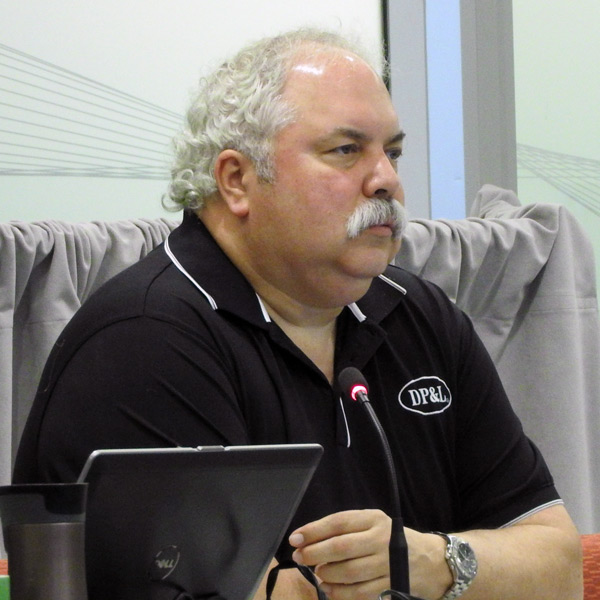
Horstmann-John-2017-06-06-RTO-Insider-FI.jpg
John Horstmann, Dayton Power & Light | © RTO Insider LLC

John Horstmann, director of RTO affairs at AES Ohio, presented the proposed revisions to Manual 34: PJM Stakeholder Process addressing photography in meetings and media guidelines.

Horstmann said both changes resulted from feedback by members and have been discussed extensively at the Stakeholder Process Forum. He said the photography issue was initially introduced for discussion in June 2019 at the forum.

The photography manual change states, “All photographs must be approved by the subject(s) of the photo for use in print, newsletters, advertisements, marketing materials, electronic and social media. Photographers must obtain a written release from the subject(s) prior to taking their picture.”

“It’s nothing more than a courtesy to ask somebody before publishing their photograph,” Horstmann said.

The PJM media relations team brought manual changes to clarify what constitutes a media outlet after some stakeholders challenged information being disseminated by members after meetings.

The media change states, “Any individual or organization that disseminates information on a public platform from a PJM stakeholder meeting that includes direct quotation and attribution of any comments, and/or images, is subject to the rules pertaining to media regarding the quoting of individuals and/or their companies and photographing meeting participants. ‘Public platform’ includes but is not limited to publicly accessible social media, website, blogs, audio, video, or electronic and hard copy print media.”

Horstmann said when Manual 34 was originally written, social media was in its infancy. He said stakeholders don’t want a running dialogue of conversations from meetings ending up on social media because the information could stifle discussions.

The MC will be asked to approve the proposed revisions at its September meeting.

Consent Agenda

Two different revisions were approved on the MC consent agenda. They included:

  • Revisions to Manual 34: PJM Stakeholder Process to address clarifications within the newly revised section 9.5: Motion Amendments. The changes give committees the chance to defer a main motion or an alternate motion on an issue to the next meeting through a two-thirds sector-weighted vote if they’re “not timely published” before a meeting.
  • Tariff revisions to address concerns associated with the pro forma interconnection construction service agreement’s lack of superseding language and current automatic termination provision. The revisions were endorsed at the June MRC meeting. (See “ICSA Revisions Endorsed,” PJM MRC/MC Briefs: June 23, 2021.)

Washington Company Scales up Fusion Energy Efforts

A Washington-based fusion reactor project is radically expanding its operation.

Last week, Helion Energy broke ground in Everett on a 154,000 square-foot research and manufacturing facility to be accompanied by a 30,000 square-foot auxiliary building with completion dates expected in early 2022.

Helion currently operates out of a 33,000 square-foot building in the nearby Seattle suburb of Redmond. The company expects to increase its workforce from 60 to 150 employees along with the physical expansion. In 2015, Helion had 11 employees.

“We fundamentally need more space,” Helion co-founder and CEO David Kirtley told NetZero Insider.

Helion is one of at least 10 ventures worldwide that are trying to develop a commercially viable fusion reactor to produce electricity.

“We need fusion energy now to halt the worsening impacts of climate change. … That’s where the innovative work being done by organizations like Helion comes into play,” Gov. Jay Inslee said at last Tuesday’s groundbreaking. “Some call fusion energy ‘the holy grail’ of energy, because it has zero carbon emissions, its production is not hindered by changes in the weather, and it is fueled by the most abundant element in the universe: hydrogen. I am proud to support Helion Energy and your goal of becoming the first to commercially provide fusion-made carbon-free electricity.”

Last fall, Helion’s prototype reactor finally produced a temperature of 100 million degrees Celsius for a fraction of a second — a threshold that scientists believe is needed for practical fusion power. While government and academic fusion ventures have hit that benchmark, Helion is the first private operation to do so, Kirtley said.

Commercial-fusion-power-plant-(Helion-Energy)-Alt-FI.jpg
Helion Energy last month said it became the first private company to exceed 100 million degrees Celsius in it sixth fusion generator prototype, a key milestone in developing a commercial fusion power plant. | Helion Energy

A fusion reactor ideally will be smaller, cheaper and safer than the huge fission power reactors that currently dot the world, but so far no one has been able to create nuclear fusion outside of a hydrogen bomb, in which nuclear fission sparks the explosion that leads to fusion. Nuclear fusion occurs naturally in our sun and the stars.

Fusion slams together the cores of two atoms to create the core of one new atom. In today’s fusion efforts, the cores of two hydrogen atoms are crunched to create a new helium atom — with the resulting energy being eyed to create electricity. The hydrogen atoms are actually deuterium, an isotope of hydrogen that includes a neutron.

Fusion is supposed to be dramatically cheaper than fission reactors because of the relatively small amount of deuterium needed — as opposed to processed uranium fuel used for fission. Water is cheaper compared to uranium, and the waste disposal problem is tiny compared with trying to find places to put used nuclear waste and spent fuel rods.

But the physics and engineering of splitting an atom is much simpler than slamming two atoms together to create a new one. Also, a fundamental problem with today’s fusion effort is that it takes more energy to create potential fusion than is generated by the reaction. Fusion won’t be successful until the reaction produces a significant net gain in energy.

Missing the Right Stuff

Fusion has existed on the drawing board since the 1920s, but it has been missing the right temperatures, the right atomic cores, the right slamming speeds, the right conditions of the plasmas to envelope the colliding atom cores, the right oscillating magnetic fields enclosing the reaction, the right balance of these forces and other factors.

A major safety factor in fusion is that achieving it takes a finicky house of cards in which the slightest glitch shuts down the process.

The new Everett site will hold Helion’s seventh prototype. Helion had named each reactor incarnation after bigger and bigger Starbucks coffee sizes, topping out with “Trenta.”

“We ran out of Starbucks sizes,” Kirtley said.

The seventh reactor will be named “Polaris” after a helium-burning star. The Everett site will be named “Antares” after another helium-burning star.

Kirtley declined to say how fast Helion hopes to create commercially viable fusion power, saying numerous practical engineering issues remain.

In a 2019 newsletter of the physics-oriented American Physical Society, fusion power skeptic Daniel Jassby, a retired Princeton Plasma Physics Lab scientist, wrote that he did not believe practical fusion power is feasible.

He noted that Helion, General Fusion, and Tri-Alpha Energy (now TAE Technologies) all said several years ago that they would have practical fusion by 2019 or 2020 — and none have hit those targets.

The world’s largest fusion project is ITER in southern France, which is tentatively aiming at producing viable fusion power by 2040. This project is backed by 35 nations, including the U.S.

Kirtley believes Helion’s project can get commercially online quicker than many other projects because it is a smaller set-up with a different approach.

Many fusion reactor projects call for a steady maintenance of the 100-million-degree Celsius threshold. Helion’s approach works vaguely like pistons in an engine — producing 100-million-degree temperatures in pulses. Helion’s reactor can produce such a nanosecond pulse once every 10 minutes. The company is aiming to produce a nanosecond pulse every second.

“We have quite a few engineering hurdles we are working on,” Kirtley said.

Attracting Funders

In its most recent round of fundraising, Helion picked up $40 million. Its main investors are billionaire Dustin Moskovitz, a co-founder of Facebook; Reid Hoffman, a co-founder of LinkedIn; the U.S. Department of Energy; Capricorn Investment Group; and Mithril Capital Management.

In 2018, Mithril released a report on fusion reactors that said: “Private companies are performing cutting-edge research. The scale of private investment means that some private efforts are further along than academic, and by some measures, national laboratory, teams.”

“For fusion to be commercially viable, not only does it have to ‘work’, but it must be ‘better’ than the alternatives in one or more dimensions. Among those are operational flexibility, reliability, environmental impact, proliferation impact, the balance of capital/operating costs, and non-technical factors such as public acceptance, aesthetics, or technological prestige,” the report said.

The report also said that the time needed to achieve commercial fusion exceeds the 7-to-10-year timescale of many venture capital funds, “suggesting that some investors’ interests may not align with long-term goals.

“Such investors may be motivated to achieve key milestones that lead to an increase in perceived value and liquidity, regardless of whether these milestones genuinely advance the effort; others may redirect resources toward ancillary uses of fusion technologies (e.g., particle-beams for materials processing and medical applications).”

Wildfires Raise Concerns for Western Transmission Lines

The near shutdown of the California-Oregon Intertie by a wildfire last month renewed concerns about the vulnerability of major transmission pathways to wildfires and the disruption of vital supply lines in the Western Interconnection.

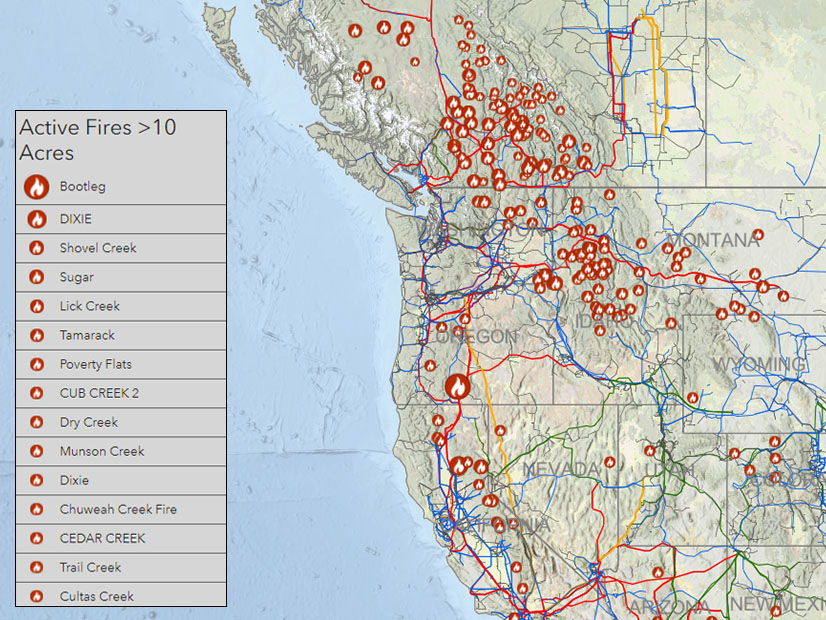
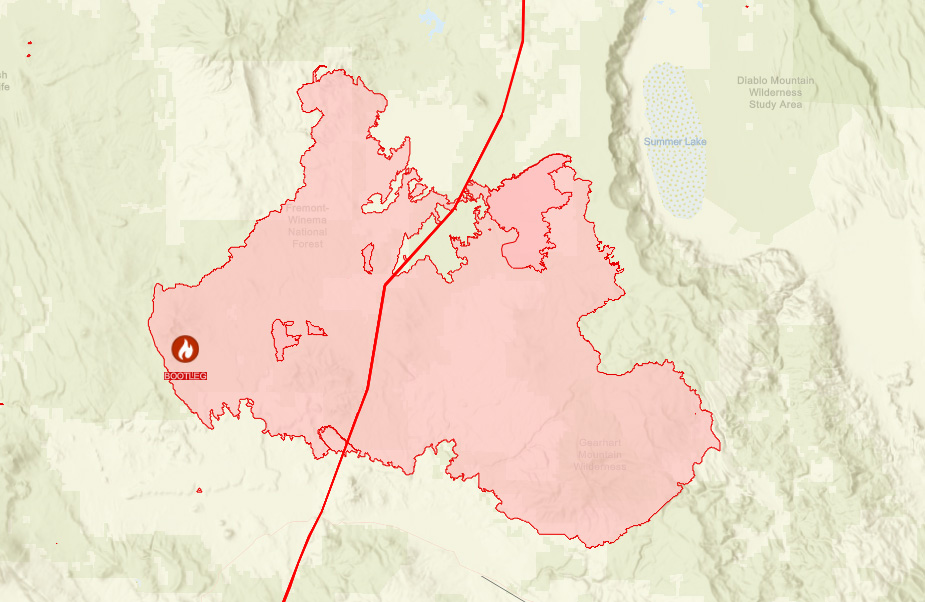
The Bootleg Fire in southern Oregon burned under and around the Pacific AC Intertie (PACI) in early July, severely derating it. The PACI consists of three parallel 500-kV lines that deliver power from Columbia River hydroelectric dams to Northern California.

The PACI’s towers are 125-150 feet tall, on average, in a right-of-way wide enough to be seen from space. The safe distance keeps conductors clear of fire. The derate was caused by thick smoke, which can cause arcing on the lines, and the need to protect the safety of fire crews on the ground, officials with CAISO and the Bonneville Power Administration, which runs the lines, said at the time.

The incident also limited transmission on the Pacific DC Intertie (PDCI) connecting Oregon to Southern California via Nevada. The derate was meant to prevent overload on the PDCI, which can serve as a relief valve for the PACI.

Bootleg-Fire-map-(WECC)-Content.jpg
The burn area of the 414,000-acre Bootleg Fire encircled the Pacific AC Intertie on Friday. | WECC

As a result, CAISO declared a Stage 2 energy emergency on July 9 while it grappled with the loss of nearly 4,000 MW during a moderate heat wave, narrowly avoiding blackouts. (See CAISO Declares Emergency as Fire Derates Major Tx Lines.)

“The fire in Oregon which took out the big transmission lines leading down to California was a very extreme event,” CAISO CEO Elliot Mainzer said Friday in a media briefing on supply issues. “It didn’t last very long, but it was an event that we think is likely to become more frequent in the future.”

As of Monday, the Bootleg Fire was still burning at about 414,000 acres and was about 84% contained.

‘Disasters that Reduce Transmission’

Fires affecting transmission lines are nothing new. In the past, such blazes were a prime concern for stakeholders in the West. But lately, the danger of wildfires to transmission lines has taken a back seat to concerns about power lines starting fires and the need for public safety power shutoffs (PSPS).

The July incident raised old concerns anew, said Dede Subakti, CAISO vice president of system operations.

“We saw firsthand on the weekend of July 9 that wildfires, even those in another state, can affect supplies in California,” Subakti said. “Because we are in an interconnected grid, natural disasters that reduce transmission capability can impact our system.”

WECC-Wildfire-Dashboard-(WECC)-Alt-FI.jpg
WECC’s wildfire dashboard showed fires burning near transmission lines in the Western Interconnection on July 28. | WECC

The Western Electricity Coordinating Council (WECC) maintains a wildfire dashboard that coordinates information about fires from official sources with a map of high-voltage lines in the West. Last week, for instance, it showed 71 transmission lines threatened by wildfires, including seven 500-kV lines in the Western U.S. and the Canadian provinces of British Columbia and Alberta.

WECC, which has primary responsibility for ensuring Western reliability, declined to make any of its experts available for interviews. Spokesperson Julie Booth sent RTO Insider an email referencing the reliability organization’s recent webinars on wildfires, which focused primarily on public safety power shutoffs, and said it had begun an information-gathering process among some of its stakeholders.

“In addition to our two wildfire preparedness webinars in May that included best practices and lesson learned, we have also initiated a wildfire data request to select entities within the [Western Interconnection],” Booth wrote. “The request is an attempt for WECC to better understand how wildfires and public safety power shutoffs have affected the reliable operation of the Western Interconnection. We expect to analyze and discuss the findings in early October.

“Additionally, we will continue to closely monitor wildfire activity and its impacts on the bulk power system through our situation awareness function,” she said.

Drought Dangers

At about the same time as the Bootleg Fire was advancing toward the PACI in Oregon, large wildfires were burning in Arizona, where transmission lines cross the state in a big “X” centered on Phoenix.

In WECC’s wildfire webinar in May, Wade Ward, fire mitigation specialist with Arizona Public Service (APS), warned of a potentially dangerous summer after years of drought.

“If you look at any of the indices across the Southwest, certainly the potential is there for some very large and frequent fires this year,” Ward said.

The state’s vast ponderosa pine forests sit atop the Colorado Plateau, the site of massive wildfires in prior years. The blazes included the state’s largest wildland blaze, the 538,000-acre Wallow Fire in 2011, and the 469,000-acre Rodeo-Chediski Fire in 2002. Both fires derated APS lines, Ward noted. (See Western Drought Increases Wildfire Risks.)

Trees on the Mogollon Rim, which marks the southern edge of the plateau, are so stressed by drought that they are bursting into flames during controlled burns by the U.S. Forest Service intended to reduce ground fuels near power lines, Ward said.

Mainzer said Friday that the West faces daunting challenges from drought, wildfires and tightening supply as states transition from fossil fuels to renewable resources.

“Earlier this year I expressed guarded optimism that our grid was more prepared for the summer, while acknowledging that extreme West-wide heat was still a significant risk,” Mainzer said during Friday’s briefing to discuss an emergency proclamation by Gov. Gavin Newsom to free up resources and increase generation. (See related story, Calif. Governor Proclaims Emergency as Blackouts Loom.)

“But over the course of the past three months,” he said, “as we’ve experienced worsening drought conditions, a declining hydro production, unprecedented heat throughout the West and increasingly dangerous wildfires impacting key transmission lines, it’s become clear that we’ve entered a new normal and that extraordinary action is required.”

EIM Governance Review Committee OKs Power Share with CAISO

The Western Energy Imbalance Market’s Governance Review Committee (GRC) on Monday unanimously approved its proposal for a new delegation of authority between the EIM Governing Body and the CAISO Board of Governors.

The GRC said the provisions would increase the EIM’s authority over matters affecting it. CAISO tariff changes that apply to the EIM and its stakeholders, for example, would also require Governing Body approval.

The proposed shared authority would be exercised at joint meetings of the two groups, with decisions requiring majority approval by both. In the event of a deadlock, the Governing Body could file separately with FERC, asking it to resolve the dispute. The EIM could seek its own outside attorneys in such a case.

Therese-Hampton-(CAISO)-Content.jpg
EIM GRC Chair Therese Hampton | CAISO

“The proposal expands the scope of issues over which the EIM Governing Body holds formal approval authority and puts many of the [EIM’s] real-time market issues under joint authority of the two boards,” GRC Chair Therese Hampton said. “It provides a strong incentive for both boards to resolve differences before going to FERC while also recognizing that there may be some circumstances where a filing is needed.”

Stakeholders generally supported the changes, though some expressed concern about FERC settling potential disagreements. The California Public Utilities Commission and other commenters cited a recent controversy over wheel-throughs in CAISO as a matter in which EIM participants were at odds with the ISO, and FERC intervened. (See (See EIM Governing Body Rejects Part of CAISO Summer Plan and FERC OKs CAISO Wheel-through Restrictions.)

Monday’s recommended changes still require approval by the Governing Body and CAISO board in a joint session scheduled for Aug. 20.

The proposed governance updates are the result of a three-year stakeholder process. The EIM charter, adopted in 2015, required “a review of EIM governance in light of accumulated experience and changed circumstances” within five years of the market’s launch.

The delegation-of-authority provisions are the second phase of the GRC’s efforts. The first phase — involving the selection of Governing Body members, stakeholder engagement and other matters — passed without disagreement. (See CAISO Board Approves EIM Governance Changes.)

The second, more controversial phase of changes seeks to bolster the independence of the EIM, a CAISO-run interstate market whose voluntary participants reap financial benefits without being subject to ISO authority.

Idaho Public Utilities Commissioner Kristine Raper, a frequent California critic, said that as the GRC’s representative of the EIM Body of State Regulators (BOSR), she supported the joint authority proposal.

“We are pleased with the way this joint authority looks in this final proposal,” Raper said on behalf of the BOSR. “I look forward to this being presented to both the Governing Body and the Board of Governors.”

The expanding EIM now includes 14 participants in addition to CAISO, with more scheduled to join in the next two years. Its footprint encompasses portions of 10 Western states.

CAISO announced Monday that the EIM had set a new quarterly record of nearly $133 million in benefits in the second quarter of 2021, bringing the total benefits for market participants to $1.4 billion since the EIM launched. The benefits represent cost savings achieved through market optimization and grid efficiencies.

By 2023, there will be 21 market participants, representing more than 78% of load within the Western Interconnection, CAISO said.

Competition from SPP’s start-up Western Energy Imbalance Service and hesitation from Colorado entities that had been set to join the EIM have cast some doubt on the CAISO-led market, however. (See Xcel Delays Joining EIM to Examine Options.)

SPP has also made a recent push to start a Western RTO, after repeated attempts in California to expand CAISO to other states failed. (See Commitment Deadline Set for SPP West Participation.) The momentum for a Western RTO has increased, as multiple states have passed bills to consider the benefits of joining one. (See Arizona to Weigh RTO Membership.)

FERC Rejects Challenges to Decision on EOL Projects in PJM

FERC rejected two different challenges related to its decision in December regarding end-of-life (EOL) transmission projects in PJM, keeping its original ruling in place.

Though it ended up modifying its original order, the commission still denied a rehearing request by a group of PJM stakeholders concerning its December order (ER20-2308-001). FERC also dismissed a complaint filed by Duquesne Light Co. that requested the commission to prevent PJM from submitting proposed amendments to the Operating Agreement the RTO deems to be unlawful (EL20-59).

In December, the commission rejected a stakeholder proposal to move EOL projects under the RTO’s planning authority, siding with transmission owners who argued that it would violate their rights (ER20-2308). (See FERC Rejects PJM Stakeholder EOL Proposal.) FERC said the proposal, initiated by American Municipal Power (AMP) and Old Dominion Electric Cooperative (ODEC) and passed by the PJM Members Committee in June 2020, went “beyond the scope of planning responsibilities” delegated to the RTO.

The proposal created lengthy and heated debates among stakeholders and a protest by the TOs, who claimed in a letter and discussions that the amendments violated their rights under the Consolidated Transmission Owners Agreement (CTOA). (See PJM Stakeholders Endorse End-of-Life Proposal.) The commission accepted the TO sector’s own tariff amendments concerning EOL projects in August 2020, rejecting arguments in rehearing requests by more than a dozen load-side stakeholders (ER20-2046). (See FERC Accepts PJM TOs’ End-of-life Revisions.)

Rehearing Denied

In the rehearing request, the stakeholder group argued that the commission erred in its December ruling by “reading the CTOA too narrowly in finding the provisions delegating to PJM rights to plan ‘enhancements’ and ‘expansions’ of the PJM system did not cover ‘replacement decisions’ such as EOL projects.” It said the regional planning obligations delegated to PJM through the CTOA is “broad enough” to consider EOL projects.

It also argued that the proposal “respected the PJM transmission owners’ retained rights to make decisions to maintain and retire transmission assets” and that the commission’s “narrow reading” of the CTOA “rendered meaningless PJM’s regional planning authority over ‘enhancements’ to the transmission system.”

FERC said the “central question” to the proceeding was whether the TOs delegated consideration of EOL projects to the RTO under the CTOA. The commission said that upon further consideration, it found the CTOA to be “ambiguous regarding whether consideration of EOL projects was a matter delegated to PJM.”

“Consideration of EOL projects is not directly addressed in the CTOA,” FERC said in its ruling. “Rather, as discussed in the December 2020 order, under the CTOA, PJM is limited to ‘conduct[ing] its planning for the expansion and enhancement of transmission facilities,’ while the PJM transmission owners retain the right to ‘maintain’ their transmission facilities, the right to determine when facilities should be retired and any rights that are not ‘specifically transferred’ to PJM.”

FERC said several relevant terms, including “expansion” and “enhancement,” are not defined in the CTOA, but that the terms “enhancement of transmission facilities,” “maintain” and “retire” can “reasonably be read to reserve consideration of EOL projects to the PJM transmission owners.”

“Viewed through the lens of the general reservation providing that the PJM transmission owners gave up only those rights ‘specifically transferred’ to PJM, we are not able to conclude that the CTOA provides for the transfer of responsibility for the consideration of EOL projects,” the commission said in its ruling. “Indeed, the clarity and specificity with which the CTOA parties addressed other issues, particularly responsibility for rate design, further demonstrates that the CTOA does not clearly indicate whether the PJM transmission owners ‘specifically transferred’ responsibility for the consideration of EOL projects to PJM.”

But the commission said it continued to disagree with the group’s interpretation of the CTOA, stating the goal of the interpretation of an agreement is to “decipher the intent of the parties to the contract.”

“Here, the signatories to the contract are PJM and PJM transmission owners, and the wording of the CTOA read in light of extrinsic evidence suggests they did not intend for PJM transmission owners to delegate consideration of EOL projects to PJM,” FERC said in its order. “At the time the CTOA was signed, the status quo was for the PJM transmission owners to retain responsibility for EOL projects.”

Concurring, but Differing, Opinions

The order elicited strongly worded concurrences from two commissioners.

Commissioner James Danly said he agreed that the stakeholder group’s request for rehearing should be denied, but he said he disagreed with FERC’s clarification, specifically that the CTOA is “ambiguous” as to which parties have the responsibility for EOL projects.

“There is no ambiguity regarding whether the PJM transmission owners delegated authority over ‘end-of-life’ or ‘replacement’ decisions to PJM,” Danly said. “PJM transmission owners retained the right to ‘maintain’ or ‘retire’ their facilities. While PJM transmission owners delegated ‘planning for the expansion and enhancement of transmission facilities’ to PJM, a decision to replace an existing facility is not an ‘expansion’ and would only be an ‘enhancement’ in the limited sense of extending the useful life of the transmission facility.”

Danly said it was wrong for the commission to “resort to extrinsic evidence when the contract language is unambiguous” and that the language could open a “Pandora’s box that could undermine even further the incentives the PJM transmission owners have to remain in PJM.

“Now that we have found the Consolidated Transmission Owners Agreement to be ambiguous, we have arrogated to ourselves the power to ‘interpret’ that agreement in the future to take away rights that the owners unambiguously reserved to themselves,” he continued. “I can imagine that power becoming a sore temptation down the road. While the ultimate outcome in this case is correct, the path by which the majority arrives at its decision is not. I guarantee the PJM transmission owners will take note.”

Clements-Allison-2018-01-23-RTO-Insider-FI.jpg
FERC Commissioner Allison Clements | © RTO Insider LLC

While also concurring, Commissioner Allison Clements took the opposite opinion of Danly, saying the order misinterpreted the CTOA “in a manner that inappropriately constrains the commission’s authority to ensure cost-effective, holistic transmission system planning in the PJM region.”

Clements said rejection of the proposal and rehearing request was warranted only because it “painted with too broad a brush advancing an amendment to the PJM Operating Agreement that would require PJM to plan for both regional and certain local EOL projects.” Clements said the CTOA “clearly grants authority to PJM to plan for regional EOL projects,” but it is “ambiguous” regarding local EOL projects.

She said arguments made by the TOs that building entirely new facilities to replace old ones constitutes “maintenance” was a “bald assertion” and lacked “common sense.”

“When a decision is made to retire and replace something, the act of preservation ends,” Clements said. “When a driver sends an old car to the junkyard and buys a new one, no reasonable person would ever say such an action is ‘maintenance’ of the junked car, even if the new car is the same or a similar model.”

FERC’s decision is “highly consequential,” Clements argued, because EOL projects in PJM are set to become a significant portion of new infrastructure projects because of the RTO’s aging transmission system. It will allow TOs to retain authority over regional EOL projects in PJM “so long as they plan to exactly replace those facilities.” She said a holistic assessment of the grid needs to be considered to ensure customers do not overpay and have PJM retain the responsibility for planning the grid with regional benefits.

“While transmission planning reform can and must continue to better ensure the development of a grid that cost-effectively serves customers, today’s order is unfortunately a step in the wrong direction at a time when more holistic, forward-looking transmission planning is desperately needed,” Clements said.

Duquesne Challenge

Duquesne requested last year that FERC direct PJM to refrain from filing amendments to the OA that the RTO has determined violate the CTOA. Duquesne said PJM must comply with the Federal Power Act and may not “circumvent” contractual obligations under the CTOA by “unilaterally filing with the commission amendments that are ‘inconsistent with those obligations.’”

PJM originally filed additional comments after it filed the EOL proposal in July 2020, saying it believed the proposal violated its governing documents and commission precedent on the RTO’s and the TOs’ roles in transmission planning. (See PJM Files EOL Proposal over TO Protest.)

PJM and stakeholders filed motions to dismiss Duquesne’s complaint, with the RTO saying an approval of the request “would bar future filings pursuant to Section 205 of the FPA by PJM that an individual transmission owner may argue violates the CTOA in ways not specified or that violate commission precedent in ways not explained.”

They also argued the complaint was “speculative and premature and that Duquesne has failed to identify any issue that is ripe for review.” The RTO contended that the best course of action was to “present to the commission its views on the stakeholder proposal so that the commission could resolve the legal conflict regarding the validity of the proposal.”

FERC ultimately granted to motion to dismiss Duquesne’s request.

“We see no general obligation for PJM to prejudge the legality of a particular filing before determining whether to make that filing either on behalf of the members or the PJM transmission owners,” the commission said. “The onus of determining the legality of a filing falls on the commission, and PJM’s evaluation of the merits of a filing should not operate to bar PJM from making a filing before the commission from the PJM transmission owners or on behalf of the members.”

ERCOT Technical Advisory Committee Briefs: July 28, 2021

Members Push Back Against Revamped TAC Structure, Conservative Ops

ERCOT stakeholders, somewhat overlooked in the political and regulatory sausage-making taking place in the aftermath of February’s winter storm, took advantage of two opportunities to express themselves last week.

First, they pushed back against interim CEO Brad Jones’ plan to convert the Technical Advisory Committee into an officer-level group. TAC members then critiqued ERCOT’s use of ancillary services and reliability unit commitments to create additional operating reserves and reduce the risk of emergency situations this summer. (See ERCOT Stakeholders Sign Off on More Ancillary Services.)

“I view the ancillary services [procurement] as a completely political move to ensure we don’t have scarcity again this year,” Luminant’s Ian Haley said during Wednesday’s virtual TAC meeting, speaking to some members’ view that Texas political leadership wants to avoid another grid emergency while the legislature is still in session.

But there’s little doubt that ERCOT’s governance structure is under the microscope right now. That’s why Jones addressed the TAC on Point No. 36 in his 60-point roadmap to grid reliability: “Ensure the Technical Advisory Committee is comprised of senior-level members from each member organization to promote timely decision-making.”

“If you don’t think TAC is in the crosshairs, you’re not paying close attention,” Jones said. “There is a significant level of focus on TAC and the reliability of TAC in the future. I sense that; I feel it; and I want to ensure TAC has every opportunity to succeed.”

Jones, who sat before the TAC six years ago as the grid operator’s COO, said that with eight new independent directors — politically appointed and likely without ERCOT ties — joining the board as soon as Sept. 1, he’s hoping they will recognize the value the committee provides. Under new Texas law, the board will exclude market participant representatives.

“It’s uncertain to me what support the board will want from a stakeholder-led TAC,” he said. “I hope to put TAC in the best position to survive and thrive.”

Jones said a committee composed of officer-level representatives will have a big-picture view and be able to make quicker decisions without checking in with their superiors.

Several TAC members noted they are already relied upon to make those decisions and that they represent market segments, not companies, but Jones held firm.

“Do you believe that with a group of eight board members — who have not been around ERCOT before and with a government that has lost some level of confidence in the stakeholder process — do you believe TAC can continue to fill that role without raising its profile?” Jones asked.

“Absolutely,” said Morgan Stanley’s Clayton Greer, a long-time TAC member.

“I have a concern with that,” Jones said.

“It’s style or substance,” Greer responded. “If they want substance, they’ve got it. If they want style, I’m not very stylish.”

Jones suggested the committee could become an advisory group, saying he has heard concerns about the lack of stakeholder involvement in ERCOT’s governance structure. He said his end goal is to have the TAC “valued by the new board,” but how that is achieved is up to the committee’s members.

“We can’t assume we can do things like we have in the past,” Jones said.

“I think TAC will become more important than it’s even been,” Reliant Energy Retail Services’ Bill Barnes said. “Those [independent] board members are going to need to hear from TAC. These are billion-dollar decisions. The market is designed to promote competition. It’s complicated; it’s technical. Every decision we make at TAC affects the market in a certain way.”

TAC Chair Clif Lange, of South Texas Electric Cooperative, said he will work with ERCOT staff to further the discussion in a series of workshops.

TAC Asks for More Data on AS Procurement

TAC members left staff with a short list of to-dos following their discussion on ERCOT’s use of conservative operations during the summer.

The committee asked staff to report back with the number of times the additional resources have kept the grid out of emergency situations this summer; whether the high rate of generator forced outages has continued into July; and the market costs for procuring additional ancillary services.

“As we’ve said, we’re going to operate in a more conservative manner, but we’re also committed to working with stakeholders to make sure the market works,” said Jeff Billo, ERCOT’s director of forecasting and ancillary services.

Since June, the grid operator has been maintaining at least 6.5 GW of operating reserves by more than doubling greater amounts of ancillary services, with the costs uplifted to load. Billo said the grid operator’s goal is to keep 65 GW of generation online and available into September.

“It’s giving us 50 cents in one pocket and taking $2 out of the other pocket in energy costs,” Haley said, noting that Luminant is one of the largest ancillary service providers. “We do still think this is a very bad idea.”

Just Energy’s Eric Blakey took off his vice chair’s hat to stand up for the retailer electric providers (REPs) “who get the calls during outages.”

“We seem to be doing this without any consideration of the costs. ‘Oh, the REPs will take care of that,’” he said. “I’m not sure that’s going to be a sustainable market design. ERCOT needs to realize they’re taking dollars out of the market. We need help from ERCOT to identify the cost increase so we can work with the commission to get that recovery.”

$47 Million Market Resettlement

ERCOT staff told the committee that about $47 million will be uplifted to the market for an incorrect dispatch instruction that ordered a generating resource to ramp down Feb. 17-19.

Staff said the error will result in a resettlement on a load-ratio share following the market participant’s dispute resolution. The resource was paid $4 million for Feb. 17, $28.4 million for Feb. 18 and almost $15 million for Feb. 19, said Kenan Ögelman, ERCOT’s head of commercial operations. “The amounts are significant.”

The error took place after the ERCOT grid nearly collapsed during the winter storm, when prices were held at $9,000/MWh in an effort to keep all available generation online.

ERCOT will post market notices for each resettlement.

Members Side with PUC Order

Members voted to approve a nodal protocol revision request (NPRR1086) that aligns ERCOT protocols with the Public Utility Commission’s recent order to eliminate the market’s pricing mechanism link to natural gas prices (51871).

The measure adds a provision to ensure a resource, through its qualified scheduling entity (QSE), can recover its marginal costs during scarcity pricing situations while the low systemwide offer cap (LCAP) is in effect.

The PUC in June approved a rulemaking that revises the grid operator’s pricing mechanism by eliminating a provision that ties the LCAP value to the natural gas price index and replaces it with a make-whole provision. (See “Commission Nixes Gas Index Link,” Texas PUC Briefs: June 24, 2021.) Previously, the LCAP had been set daily to the higher of $2,000/MWh or 50 times the natural gas price index, as calculated by ERCOT. The PUC order eliminates the gas price index component and sets the LCAP at $2,000/MWh without an alternate calculation.

The TAC first rejected a proposed amendment modifying a multiplier that decreased costs allocated to capacity-short QSEs and increased costs spread to all loads. Katie Coleman, who advocates for Texas Industrial Energy Consumers, filed comments saying the smaller multiplier does not meet the PUC’s directive that the make-whole costs are allocated “in a manner that encourages market participants to fully hedge their loads.”

“But for the LCAP, entities that are not hedged would be exposed to any costs above $2,000/MWh but below $9,000/MWh,” Coleman wrote.

The amendment failed, 12-13 with four abstentions, over concerns the language would result in more costs shifted to loads. The TAC then approved the NPRR by a 20-3 margin, with six abstentions.

Southern Cross Directive Passes

The committee approved six revision requests, taking separate votes on two of them when some members said they would abstain.

Luminant and CPS Energy abstained from a vote on NPRR1083, which passed 27-0 and prohibits uplift charges to QSEs acting as central counterparty clearinghouses in wholesale market transactions or regulated as derivatives clearing organizations as defined by the Commodity Exchange Act.

Shell Energy North America abstained from NRR1073 over concerns that another NPRR under development would provide a better approach. NPRR1073 prevents a market participant from exiting the market to escape uplift charges and then trying to re-enter under a different name.

The committee’s unanimously approved combination ballot included the latest in a series of directives tied to Southern Cross Transmission, a proposed HVDC line in East Texas that would ship more than 2 GW of energy between the Texas grid and Southeastern markets. (See “Members Debate Southern Cross’ Bid to be Merchant DC Tie Operator,” ERCOT Technical Advisory Committee Briefs: Feb. 22, 2018.)

Directive 9 required staff to evaluate whether the Southern Cross project would require any modifications to existing or additional ancillary services. In a white paper, staff said NPRR1034, approved in February, gives ERCOT authority to establish limits on DC tie transfers and to curtail their schedules when necessary to address the risk of unacceptable frequency deviations. They found there was no need for other ancillary service changes to accommodate the Southern Cross DC tie.

The combination ballot also included an NPRR, single changes to the planning (PGRR) and retail market (RMGRR) guides, and a system-change request (SCR):

    • NPRR1079: separates ERCOT contingency reserve service, which will come in a future release, from fast frequency reserve project language being added to the 48-hour day-ahead market report requirements.
    • PGRR091: gives interconnecting entities 60 days to complete an application for a full interconnection study.
    • RMGRR165: gives ERCOT additional discretion in scheduling and conducting a mass transition project for defaulting REPs and involving volunteer REPs accepting their customers.
    • SCR815: aligns market guides, streamlines processes, increases transparency and tracking, and improves communication among market participants in the MarkeTrak tool used to resolve retail market issues.

Legislators Call Proposed Mass. Biomass Regs Unfair

A proposed regulation that would disincentivize the siting of biomass energy generation facilities near environmental justice communities in Massachusetts has put legislators on edge.

The provision appears to push the burden of biomass siting to a small group of non-environmental justice towns, an outcome legislators say would be “patently unfair.” They would prefer to see the state’s environmental regulator extend a ban to the entire state.

Under the proposal, new woody biomass facilities sited within 5 miles of environmental justice communities would not be eligible for renewable energy credits through the state’s renewable portfolio standard.

In June, the Department of Energy Resources (DOER) filed the amendment with the legislature as part of biomass-specific regulations in its draft RPS class I and II update. Only certain wood byproducts are eligible for the biomass program.

The amendment is a response to public comments on the impact biomass combustion would have on environmental justice communities in the state, DOER Commissioner Patrick Woodcock said during a hearing of the legislature’s Telecommunications, Utilities and Energy Committee on Friday.

It’s also in response to the stronger stance on carbon emissions that the state took in climate legislation passed earlier this year, Woodcock said.

In addition to the siting provision, the DOER proposed increasing the biomass facility efficiency level from 50% to 60% to qualify for RPS credits. The biomass regulations are founded on a set of principles about the resource, including that its combustion is not carbon-neutral, Woodcock said.

While committee members were supportive of the DOER’s amendments, they pushed back on the environmental justice provision.

“One of the side effects of the policy … is that 90% of Massachusetts towns will not be eligible based on this regulation, leaving 10% — or 35 towns out of the commonwealth — as eligible to host a biomass fuel facility under this RPS system,” Sen. Adam Hinds (D) said. “It would seem that this regulation is systematically pushing plants into very specific areas.”

With that side effect in mind, six senators and three representatives sent a letter to the DOER encouraging it to “provide the same protections to all Massachusetts communities” as those for environmental justice communities, according to Sen. Michael Barrett (D), who read the letter for the record during the hearing.

“Please endorse formally what you are already promoting informally by supporting legislation disqualifying any new in-state biomass generation from qualifying as an RPS class I resource under state law,” he read.

Woodcock said the proposed change to the RPS is not likely “in itself” to lead to any new biomass facility proposals. And, he said, a pending biomass study mandated by the state’s new climate law is the right place for a “healthy discussion” on how to think about the resource under the state’s “increasingly ambitious” climate policies.

As proposed, however, the RPS changes give the impression that regulators have omitted the possibility of any new biomass facilities in the state, Barrett said.

Woodcock did not concur. He said that biomass is legislatively eligible for the RPS, and the new regulations would only apply to a facility’s eligibility for credits.

In addition, he said, out-of-state biomass facilities still would be able to participate in the RPS, and those facilities help to reduce natural gas use in the ISO-NE system.

The committee must return a report to the DOER shortly on the biomass-specific amendments. The department will then file its final regulations with the committee and the secretary of the commonwealth.

Utility-scale v. CHP

The DOER earlier this year revoked a nine-year-old permit for a 35-MW biomass facility in Springfield, citing a failure to begin construction activities. In its decision on the permit, the department noted growing public concern about biomass combustion and its effects on public health. It did not point specifically to those concerns as influencing its decision on the permit, however.

The new RPS provisions would prohibit the proposed facility from qualifying for credits because Springfield is an environmental justice community. It also would not meet the efficiency standard, Woodcock said.

Based on the current efficiency of the technology, there will not be any utility-scale biomass facilities built in Massachusetts, Chris Egan, executive director of the Massachusetts Forest Alliance, said during the hearing.

“What’s left under the regulations is high-efficiency biomass [combined heat and power (CHP)],” he said.

Those systems are most often designed to produce heat for a facility, with a bonus of making power from waste heat.

“Small, one-facility CHP units are a fraction of the size of the utility-scale plants,” he said.

Massachusetts currently has two facilities that qualify for credits under the RPS, and both are CHP plants. Those facilities have “operated without any issues or complaints for a long time,” Egan said.

In the RPS amendment, the DOER included a waiver to the efficiency requirement for existing facilities with the provision that they use primarily a non-forest derived feedstock.

Massachusetts Needs to Sell 45,000 ZEVs per Year by 2025

Sales of new zero-emission vehicles in Massachusetts will need to reach 45,000 per year by 2025 to be in line with the state’s clean car mandate.

Rebates alone may not be enough to get the state there, according to Robert O’Koniewski, executive vice president and general counsel for the Massachusetts State Auto Dealers Association.

The association represents the state’s new car and truck dealerships, which O’Koniewski said sell 300,000 cars every year. Massachusetts adopted California’s ZEV mandate to make 15% of new car and truck sales zero-emission by 2025.

MOR-EV, the state’s current rebate program, provided $43 million in rebates for 21,000 EVs from 2014 to the end of July, according to the Center for Sustainable Energy. That “just barely scratches the surface” of what’s going to be needed in the coming years, O’Koniewski said during a hearing of the legislature’s Telecommunications, Utilities and Energy Committee on Wednesday.

Gov. Charlie Baker also committed the state to adopting California’s Advanced Clean Cars program, which requires all new car and truck sales in that state to be zero-emission by 2035.

State legislators are considering a sales incentive bill (S. 2129) that would establish a $5,000 rebate for an EV purchase. Two other bills before the legislature propose a rebate of $2,500 (H. 3321 and H. 3368).

Based on EV sales growth rates for Massachusetts and the state’s current annual car sales, the state could sell an estimated total of 290,000 ZEVs over the next 8.5 years. And given the potential for 300,000-plus EV sales per year starting in 2035, O’Koniewski said “there are a lot more pieces to this puzzle than just the rebate program.”

He called for more affordable vehicles and an expanded menu from manufacturers on EV choices. The market also will need a significant charging infrastructure buildout, a better charge life for batteries and consideration for costs on charging, he said.

Charging Needs

Legislators also heard testimony on bills proposing the adoption of buildings codes that require parking spaces to be wired for EV charging (S. 2192 and S.2151).

The codes would ensure that new construction and renovations of commercial and residential buildings and parking facilities include the wiring necessary for some parking spaces to offer EV charging access.

Charging infrastructure provider ChargePoint (NYSE:CHPT) spoke in favor of the code change at the hearing.

“From an upfront capital cost perspective … it costs more to retrofit an existing parking space for the installation of a charger than it does to buy or lease the charger itself,” said Kevin Miller, director of public policy at ChargePoint. “It’s important to require that the Board of Building Regulations and Standards adopt EV-ready requirements in the state building code to avoid the significantly higher cost for retrofitting a parking spot.”

S. 2151 would also direct the Department of Energy Resources to study priority locations for public EV charging installations. Environmental justice communities and their proximity to transportation infrastructure would be among the criteria for determining priority locations.

That study, Miller said, should identify how to leverage private capital resources for building out public charging infrastructure.

Eversource Energy’s (NYSE:ES) director of energy efficiency, Michael Goldman, told the committee that the utility’s EV goals align with the bills considered during the hearing. The company recently submitted an updated EV infrastructure program to the Department of Public Utilities (DPU) that would provide for the installation of 25,000 charging ports, Miller said.

National Grid (NYSE:NGG) also filed an updated EV program with the DPU this month, said Kevin O’Shea, the company’s director of Massachusetts government affairs.

That plan includes incentives for deploying 7,200 public level 2 charging ports and 32 MW worth of fast-charging ports. The wattage target, according to the filing, would accommodate fast chargers that range from 24 to 350 kW.

Probing the Pros and Cons of Enacting a Federal Clean Energy Standard

Proponents of a federal clean electricity standard (CES) say it would be a potentially powerful tool in reducing greenhouse gas emissions and meeting the Biden administration’s goals of reaching 100% clean electricity generation by 2035 and net-zero carbon emissions by 2050.

The idea’s opponents range from those who support carbon pricing, to those seeking changes to planning process regulations. As part of its energy leaders webinar series, OurEnergyPolicy brought in experts on both sides of the debate Wednesday to discuss the benefits and drawbacks of adopting a national CES.

Decarbonizing the power sector is a “crucial piece” of reaching net-zero emissions by 2050, said Lindsey Walter, deputy director of climate and energy Third Way, a D.C.-based think tank.

A well designed CES could be a very efficient way of achieving low-cost emission reductions, according to Arne Olson of Energy and Environmental Economics. He said that a CES “lines up very well” with studies he has been a part of, including one on PJM in October that recommended a carbon pricing regime. (See Study Recommends Carbon Price for PJM.)

However, a CES could stimulate artificial demand for clean energy, especially when state policies and organic market demand are already driving deep decarbonization, posited Devin Hartman, director of energy and environmental policy at R Street Institute.

“The regulatory state simply isn’t letting us deploy capital and manage it in an efficient way sufficient to meet that existing demand,” Hartman said. “What we need to do, if we’re serious about the clean energy transition in a results-oriented way, is to start talking about how to reform the regulatory apparatus, especially things tied to the planning, permitting and siting processes, and anything that ultimately fuses competition into the generation and transmission components of electric supply.”

Any CES design has to be technology-inclusive, Walter said, to ensure that all zero- or low-carbon technologies can compete.

“Nuclear and carbon capture are going to be fundamental toward ensuring we’re not only decarbonizing our grid, but we also still have those firm dispatchable resources that we need to ensure reliability,” Walter said.

While it is not the “ideal policy,” enacting a CES is something that Congress can do now, Olson added. When it comes to specific design elements, a CES “needs to be simple,” starting with technology inclusivity and some quick math.

“It’s megawatt-hours and clean energy generated, divided by megawatt-hours of retail sales,” Olson said. “That’s very simple. You can generate a [renewable energy certificate] by generating a megawatt-hour of clean energy anywhere, and those can be traded in the secondary market very efficiently.”

There is “no silver bullet policy” to address climate change, Walter said, but a CES would allow for complementary policies such as building out of transmission lines.

“We have a lot of room for improvement in market design … to let that transition occur in a way that’s cost-effective and reliable and also gives reliability authorities the confidence that we can manage this transition in a reliable fashion,” Hartman said.

Smith Talks About ‘Pivotal Moment’

Whether it is droughts, floods, fires or lack of a federal CES, U.S. Sen. Tina Smith (D-Minn.) said the country is at a “pivotal moment on climate action.”

“The cost of inaction on climate is too high,” Smith said in remarks opening the webinar.

Many Democrats, including Smith, favor a federal CES, which she sees as a straightforward way to mandate 80% carbon-free electricity by 2030 and reach net-zero emissions on the grid by 2035. The CES is also part of the budget that Senate Democrats will likely have to pass through the reconciliation process. In addition, Smith said a CES provides the “right kind of incentives for utilities” because “anything that is clean counts” toward the incentives envisioned in the budget.

Utilities face no penalty or gain any advantage to being at “40% clean energy versus 10% clean energy,” according to Smith, who ultimately wants them “to see a path for adding clean energy.”

Hawaii’s PBR Efforts Get Conference Spotlight

Hawaii’s recent move to performance-based regulation (PBR) is still “a work in progress,” state Public Utilities Commission Chair James Griffin told participants at the Smart Electric Power Alliance (SEPA) Grid Evolution Summit last week.

“None of this is easy. I want to be clear: It was contentious,” Griffin said Wednesday. Hawaii switched from cost-of-service regulation to PBR in June, an effort “two-and-a-half years in the making,” with some programs still being implemented.

Hawaii’s PBR framework includes “four big sections,” Griffin said, including revenue adjustment mechanisms, performance incentive mechanisms (PIMs), grid services incentives and a collaborative effort between the PUC and energy efficiency providers to provide programs for low- to moderate- income residents.

Noting Hawaii’s “high electricity cost environment,” Griffin said, “From the outset of this, [the PUC] did want to see Day One savings for customers.”

Moderating the discussion with Griffin, SEPA Managing Director Janet Gail Besser pointed to a key feature of Hawaii’s PIMs: “The focus is on outputs or outcomes for customers to set rates, rather than inputs on the part of the utility — what it costs to serve the customer.”

Griffin said the PUC wants to ensure cost savings by setting a key productivity factor for utility companies at zero. “Our prior experience with this did inform us that this was a sufficient factor to meet our goals.”

But speed is of the essence for the PUC. “The timing aspect of this is really important for us, and I think that’s where we’re still looking for improvement. We’re wanting to see the projects come online sooner. The incentive structure here is front-loaded, but I haven’t quite seen the urgency yet to move the timelines up, so we’re still working on that.”

Griffin referred to the PUC’s contentious proceeding around the looming shutdown of a critical coal plant on Oahu, with the commission repeatedly expressing frustration at Hawaiian Electric’s halting efforts to replace the plant with renewable resources. “Our near-term needs enough replacement resources for when our power plants go offline.” (See Hawaii PUC Weights Coal Plant Closure Options.)

Besser asked Griffin about the PUC’s pilot process for the PBR framework, “because that’s something that SEPA has been encouraging and sees as very important for grid modernization — in particular, how to really expedite the review of pilots so that utilities can get new pilots and new operating practice out there quickly to see if they’re actually going to benefit customers.”

Griffin explained that the commission has 45 days to review a pilot plan once it has been submitted. Investors and developers need to have their “homework done” so that the review process does not become bogged down, he said. “We hope to see more of this in the next five years.”

“This has been a cultural change internal to the commission as well,” Griffin said. “One of my observations is that this is what it’s going to take for this to be successful. What the tradition has been is, we’ve received some pilot applications in the past, but generally they follow through our normal regulatory framework. So, a $1 million request for a short-term pilot would be treated, in our former process, similar to a $400 million dollar [advanced metering infrastructure] request.”

Griffin said the commission can accept that some projects will fail, “and it’s better to learn that and avoid the long, protracted fight over something that you learned, that you shouldn’t be doing. That’s been a cultural discussion internally … We need to allow the utility the flexibility to do these pilots, learn, and even find out where things don’t work out perfectly.”

Griffin pointed to the PUC’s experience with Hawaii Gas. “We had a good case with our gas utility, trying to look at different renewable gas technologies a while ago. And we learned that it wasn’t [commercially viable] yet, and to me, that was a decent learning experience. So, we can see some of this on the electricity side too,” he said.

No Easy Shortcuts

All this change has been noted by crediting agencies, who have since raised their outlook for Hawaiian Electric.

“We weren’t quite on a watch yet, but this docket and these decisions were being closely watched through the entire period,” Griffin said, referring to the utility. “As we worked through the process, we were put on an upgrade watch. The outlook was upgraded.” He said that before the upgrade, the utility was not doing well, with its S&P rating “one notch above junk status.”

Asked what lessons or key takeaways he would share with other states, Griffin said “the incentive mechanisms can be very powerful” and that the PUC is seeing “actual results delivered.”

“Taking the time to set it up right, it’s been a very resource-intensive process for our commission. There’s no easy shortcuts here if you want to do the type of comprehensive review, comprehensive stakeholder engagement that we’ve done … Don’t underestimate the undertaking,” he said

The PUC chair also made clear that the decision to switch from a cost-of-service regulation to a PBR framework was resolute. “It’s something that we see is a strong part of our future. We’re not intending to return back to a traditional cost-of-service regulatory framework, and it was important to signal that from the outset.”