What is Formula E? And Why is it so Important for EVs?

The fastest race cars you’ll never hear coming flew through Brooklyn over the weekend in the ABB FIA Formula E World Championship New York City E-Prix.

British driver Sam Bird won the race in the Jaguar I-TYPE 5, an electric single-seat car that has a maximum speed of 174 mph and a maximum power of 250 kW (330 horsepower).

Anyone with even a passing fancy in Formula racing knows that Formula One race cars can trounce their electric counterparts, with a top speed of about 230 mph and a maximum horsepower of 1,000. So why is Formula E, the first and only EV racing series in the world, even a thing?

“We’re trying to use the sport as a way to promote electric mobility and to tell the story around what we think a brighter future can look like,” Jamie Reigle, CEO of Formula E, said in an ABB-hosted pre-race webcast on Friday.

Consider that, as compared to the Chevrolet Bolt, the I-TYPE 5’s top speed is 81 mph faster and its maximum power is 100 kW higher. Formula E is a testing ground for technologies that has put advancements in e-race cars on the fast track and bound for commercial electric vehicles.

That’s a paradigm already in place in traditional formula racing, which is defined by the regulated open-wheeled, single-seater cars used in the motorsport. Paddle shifters and carbon fiber construction are among the many road car technologies that started in formula race cars.

When Formula E launched in 2014, the cars’ batteries had only enough capacity for about 25 minutes of racing, which meant the teams had to swap cars during the race, Reigle said. Today, the races are longer, the battery capacity is much more significant, and there is no need to swap cars, he said.

All the races in the World Championship take place in cities to help promote the technology. The New York E-Prix was the latest race in the eight-city series that heads to London on July 24 and finishes up in Berlin in August.

“We bring electric mobility and electric racing into the heart of cities [because] we believe that electric mobility will be catalyzed most quickly by consumers in cities,” he said. “We can do that because the cars are quiet … they have zero emissions, and they’re environmentally friendly and work in that environment.”

The sport has attracted some of the biggest names in car manufacturing and racing — Porsche, Mercedes, Nissan and Jaguar — and Reigle said those companies are “making bets” on their ability to compete in the electric car racing environment.

Formula E also has a clear technology roadmap.

“Right now, we’re in what we call Gen2, and we’ll be moving to Gen3 in 18 months,” he said.

The next generation of cars will be about 200 pounds lighter because of advancements in battery technology, and the maximum power will increase by 100 kW. Gen3 also will push the limits on charging with an anticipated flash-charge at 800 kW. By comparison, top-tier commercial charging ports — direct-current fast chargers — supply power at between 50 and 350 kW.

Those technological advancements offer a sneak peek into how the consumer EV market will change in the coming years, as the technology trickles down from the racetrack to the road.

Granholm v Buemi

U.S. Energy Secretary Jennifer Granholm compared notes on EVs during the pre-race webcast with Swiss driver Sebastien Buemi, a veteran of Formula E currently driving for Nissan’s e.dams team.

Buemi took 15th place during the New York E-Prix driving the Nissan IM03. He joined Formula E in 2014 from the traditional Formula racing circuit.

“As a racing driver, I’ve been attracted by the fact that this for me was the future from the very beginning,” Buemi said. “But I was not expecting this kind of improvement in the technology over the years.”

He credits Formula E with targeting the environmental and technical elements of EVs in its core purpose.

“The FIA [International Automobile Federation] and Formula E have tried to come up with a regulation that can keep the cost down because the idea is to be sustainable,” he said. “It’s an amazing platform, but at the same time, we want to make it sustainable in terms of budget and also being a laboratory for the normal road car manufacturer.”

Granholm said the Department of Energy shares that purpose through its focus on R&D that will make manufacturing and deploying EVs easier.

“Since January we … have already invested about $362 million in EVs and batteries,” she said.

DOE’s research also is targeting battery charging capabilities with a goal of achieving a 300-mile range with 15 minutes of charging for all vehicles. And the department wants to scale up U.S. battery manufacturing across the entire supply chain.

“That’s going to help us to procure and deploy EV batteries at the speed and the scale that we need to reach our climate and clean energy goals,” she said.

Buemi sees a similar focus on EV advancements in Europe.

“In my city, I see more and more electric charging points; the technology is improving; and the time to recharge the cars is getting faster,” he said. “I want to use Formula E to bring a message across that people should not be scared to buy an electric car today.”

With plenty of charging stations already in place and EVs that have a “good range,” he said, “it’s not a question of if; it’s just a question of when everyone will drive an electric car.”
Western Drought Puts Hoover Dam Hydropower at Risk

Prolonged drought is threatening hydropower production throughout the West, including at the iconic Hoover Dam on the Colorado River, which provides power to Las Vegas and other cities in Arizona, California and Nevada.

The level of Lake Mead, behind the dam, has dropped to its lowest since the lake filled in the1930s. If it keeps dropping, the dam, with a maximum capacity of 2,074 MW, could cease generation altogether — a first.

At a conference on reliability held Thursday by CAISO, the California Public Utilities Commission and the California Energy Commission (CEC), Mark Cook, manager of Hoover Dam with the U.S. Bureau of Reclamation, said the lake is now at 1,070 feet above sea level. The dam will stop generating power at 950 feet above sea level because its 17 turbines run too problematically at such low flow levels, he said.

“That’s where we predict that everything is going to run rough enough that we’re just not going to be able to produce any electricity,” Cook said.

“All of our units have a rough zone in them,” he said. “There’s a band … in the middle of the operating region, where we don’t like to operate very long because it’s rough and vibrates and [it’s] hard on the equipment.”

With every foot that Lake Mead drops, the dam loses about 6 MW of generating capacity, he said.

Hoover Dam is generating about 1,500 MW, 25% less than capacity, Cook said.

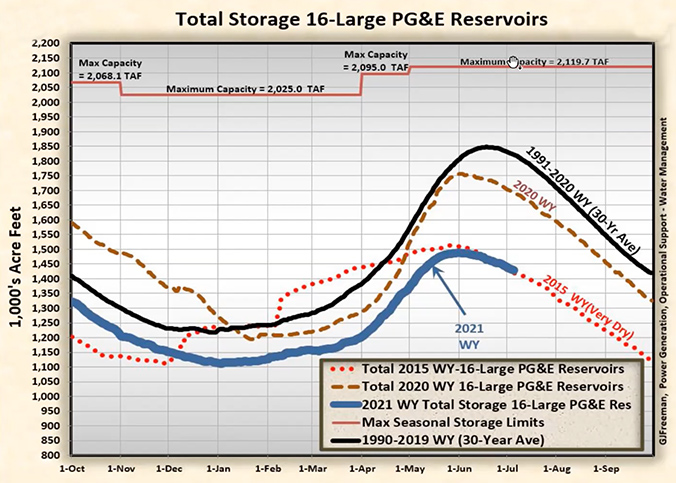
PG&E's large reservoirs are at their lowest level in 40 years, except for 2015
PG&E’s large reservoirs are at their lowest level in 40 years, except for 2015. | PG&E


“Hoover typically generates 4,500 GWh a year,” he said. “In the last year it was down to more like 3,500 GWh, and so it’s in the neighborhood of a 22% decrease [in] … energy output over the course of the year.”

The drought in the Southwest, which some call a “megadrought,” has been going on for years.  California has been in a severe drought since last year, and normally wet Oregon has seen less precipitation, too. (See Western ‘Megadrought’ Curtails Hydropower.)

Hydropower generation in California, which normally meets about 14% of peak summer load, will drop by at least 1,000 MW — one-tenth of in-state production — starting this month due to low reservoir levels, said Angela Tanghetti, a CEC electric generation specialist. Generation could be further limited by wildfires in the rugged terrain where most dams operate, she said.

Pacific Gas and Electric, which operates dozens of dams in the Sierra Nevada and foothills, expects to see a big dip in generation this summer. Its 16 large reservoirs account for 95% of its hydro generation, and the storage in those reservoirs is at its second lowest level in the past 40 years, said Eric Van Deuren, director of power generation engineering at PG&E.

The only dryer year was 2015, but only slightly, and 2021 could eclipse it, he said.

“As to the amount of water available in terms of the total generation, we are forecasting for our system …. approximately 45% of historic annual generation, which is pretty much the same number as the percent of precipitation … that we saw within the hydro area.”

Snow water content in California peaked at 60% of normal in 2021 after a similarly dry winter last year, CAISO said in its annual summer resource assessment. The average water level in large reservoirs was 70% of normal earlier this year. (See CAISO Could See More Outages this Summer.)

FERC focused on the California hydropower crisis in its Summer Energy Market and Reliability Assessment. Snowpack, the state’s main source of dry-season water, was critically low at 6% of normal levels May 11. Earlier-than-normal runoff will worsen the situation, FERC said. (See FERC Summer Assessment Spotlights Western Drought Risks.)

CAISO has said low in-state hydro could cause problems meeting peak demand this summer. In a meeting last month hosted by the U.S. Energy Association, CAISO CEO Elliot Mainzer said the hydropower situation adds volatility to resource planning and needs to be accounted for.

Whether drought conditions will abate or continue in future years is a big unknown, Mainzer said.

“The uncertainty … is absolutely something that we now need to bake into our planning,” he said.

Discord Persists over MISO Seasonal Capacity Accreditation

The seasonal accreditation of MISO capacity resources continues to be a point of contention among the RTO, its Market Monitor and the stakeholder community.

MISO restored some of the bite to its accreditation proposal when it announced Wednesday that the riskiest 3% of hours will be assigned an 80% weight in accreditation, while the non-risky hours will have the remaining 20% weight. MISO’s Independent Market Monitor recently warned board members that MISO’s leniency in the accreditation proposal would do nothing to strengthen resource availability.

MISO last month softened its accreditation proposal to include availability during non-risky hours in addition to the tightest 3% of hours in a year as the basis for accreditation. (See MISO Softens Capacity Accreditation Proposal.) The RTO wants to file in September to introduce a seasonal capacity accreditation based on generators’ availability over the last three years. The seasonal accreditation will be used in a four-season capacity auction and corresponding reserve margin targets. The RTO plans to begin holding four independent seasonal auctions by the 2023/24 planning year.

“We’re very motivated for a September filing,” Executive Director of Market Strategy and Design Scott Wright told stakeholders during a Resource Adequacy Subcommittee teleconference on July 7. However, MISO agreed to a stakeholder request to collect a round of stakeholder feedback on the 80/20 weighting.

MISO selected the riskiest 3% of hours for the Midwest and South regions separately. Included were hours that contained maximum generation events and warnings and other hours across seasons with tight operating conditions. The RTO excluded all hours that contained a more than 25% supply margin. The 25% threshold means some seasonal accreditation will be based on fewer than the 65 hours that make up 3% of a season.

“Stakeholders need to be personalizing the impact on their portfolios as a result of the changes,” Wright said.

Monitor has Harsh Words

During a July 8 Market Subcommittee meeting, Monitor chief David Patton said he will likely register a protest with FERC over MISO’s accreditation filing, which he said would award a bloated capacity credit to inflexible and slow-moving resources.

“It’s important to provide adequate credit to resources that can respond with short lead times or are always on,” he said. “It’s one of the reasons we’re unhappy with MISO’s filing.”

Patton said generators with up to two-hour lead times are “probably close enough” to the response time of an online unit. He also proposed a sliding scale for the capacity credits of units with lead times up to 12 hours.

The Monitor said MISO’s current proposal is risking creating a system that doesn’t reward the most efficient contributors to reliability.

“It’s such an important proposal that we ought to be doing the right thing, not the popular things,” he said. “I’m concerned that stakeholders are worried that this accreditation proposal is going to harm them. … If you own gas resources or pumped storage or anything that’s flexible, you should really be advocating for a more principled accreditation.”

Patton added that MISO’s proposed suite of resource adequacy solutions is “a poor way to deal with the fact” that MISO’s Planning Resource Auction provides paltry compensation for capacity. He repeated his longstanding recommendation that the RTO use a sloped demand curve instead of a vertical demand curve in the PRA.

MISO Analysis Shows Less Capacity, Lower Requirements

The grid operator said an analysis of the new accreditation method showed a system-wide reduction in accredited capacity, which is offset by lower seasonal reserve margin requirements. It said nearly all local resource zones should have adequate capacity to cover seasonal clearing requirements. Senior Manager of Resource Adequacy Coordination Lynn Hecker said the only exception is wintertime in Mississippi’s Zone 10, which stands to face a smaller seasonal capacity supply and lower capacity import limits. MISO said Zone 10 could find itself about 700 MW short of its winter requirement.

Mississippi Public Service Commission counsel David Carr called for a special meeting between MISO and the PSC to discuss the RTO’s transfer limit analysis using the seasonal values and the potential shortfall it found. Hecker said MISO could schedule such a meeting.

He said the RTO found that thermal capacity resources will see the biggest changes in wintertime under the seasonally adjusted accreditation. It also found that about 35% of thermal capacity units in the winter experience an increase in accreditation, while 65% have their accreditation decreased.

MISO is still deciding whether it will still use its effective load carrying capability (ELCC) values for intermittent generation in a seasonal capacity paradigm. Wright said ELCC already gets at some of what the grid operator is trying to accomplish for thermal generation in its seasonal capacity filing.

The RTO also took stakeholders by surprise by including September back in its fall definition, rather than summer. Stakeholders have said warmer Septembers coupled with fall maintenance outages are a breeding ground for maximum generation emergencies.

Hecker said MISO may reevaluate the merits of a September in the summertime categorization.

Stakeholders also asked how the RTO will split up calls for load-modifying resources by season. Beginning in the 2022/23 planning year, demand response resources receive a 100% credit if they can be available within six hours or less to 10 calls or more in a planning year, while resources that can respond to five to nine calls receive an 80% accreditation. Until then, LMRs must respond the requisite five times per year.

Hecker said MISO is considering dividing a minimum of “10 or so” calls for LMRs by season.

DC Circuit Rejects FERC Logic on PJM 10% Adder

The D.C. Circuit Court of Appeals on Friday rejected FERC‘s logic for approving a 10% cost adder in PJM‘s capacity market but declined to vacate the commission’s 2019 ruling (No. 20-1212).

Circuit Judge Karen LeCraft Henderson wrote the opinion for the three-member panel, ruling that the commission’s approval of the 10% adder was not just and reasonable and that it “did not provide a satisfactory explanation for its approval, which reasoned decision-making requires.”

FERC approved the adder and other revisions to PJM’s capacity market rules in an April 2019 order following the RTO’s quadrennial revision. (ER19-105). (See FERC to PJM: Clarify Allowable Costs for Energy Offers.)

A report by The Brattle Group the previous year had suggested PJM change its capacity reference resource from a combustion turbine plant (CT), the standard used since the beginning of the capacity market, to a combined cycle plant.

Despite recommending the combined cycle plant, Brattle also acknowledged the rationale for staying with a “[combustion turbine]-based curve if PJM and stakeholders are highly risk-averse about ever procuring less than the target reserve margin.” PJM ultimately decided to keep the CT as its reference resource but updated the energy and ancillary services (E&AS) markets revenue estimate by increasing the value of the reference resource’s estimated offer to supply energy in the energy market by 10%.

The Sierra Club and consumer advocates for Delaware, Maryland and D.C. challenged the commission’s approval of the 10% adder and the continued use of the CT reference resource. FERC denied the petitioners’ request for rehearing. (See “Next Steps,” FERC: RGGI, Voluntary RECs Exempt from MOPR.)

Use of Adder Unlikely

In her ruling, Henderson said evidence brought to FERC indicated that CTs may not utilize the 10% adder in their energy market offers.

The court cited research by economist James Wilson that found that if the reference resource incorporated the 10% adder, its net E&AS revenues would decline by up to 32% because it would reduce its competitiveness in the energy market. Wilson also said that most CTs “would face the uncertainties that underlie the 10% adder ‘relatively rarely, if at all.’”

PJM’s Independent Market Monitor said that many gas-fired generation resources, like the reference resource, exclude the 10% adder from their offers.

Brattle said its research found “mixed reactions” as to whether combustion turbine plants would face costs requiring an offset from the 10% adder. In the report, Brattle recommended that “PJM investigate this further and consider applying the 10% cost offer adder.”

The court said if no or few CTs ever use the 10% adder, then it “makes little sense” to include the adder for a hypothetical combustion turbine plant’s E&AS revenue estimate.

“The net [cost of new entry] should estimate the costs and revenues of the reference resource based on accurate market signals and data,” the court said. “Whether the type of supplier the reference resource is based on would utilize the 10% adder, then, is a relevant consideration. Simply because suppliers are permitted to utilize the 10% adder — and recognizing there are good reasons for them to be so permitted — we do not think it reasonable to assume the suppliers will utilize the 10% adder, especially when the evidence here indicates that the use of the adder would run counter to a combustion turbine plant’s economic interest.”

The court said FERC found that utilizing the 10% adder “improves [the] accuracy” of the E&AS revenue estimate. But it said the commission did not assess whether CTs would utilize the 10% adder or explain why such an assessment would be unnecessary.

“The commission’s response to the contrary evidence can be described as little more than a hand wave,” the court said. “It approved the use of the 10% adder because the adder’s general use was already approved as just and reasonable and because including the adder would make the E&AS revenue estimate ‘consistent with existing energy market rules.’”

The court did side with FERC in approving PJM’s proposal to keep the CT as its reference resource. The petitioners suggested the use of a CT as the reference resource is unjust and unreasonable because a combined cycle plant would be “more just and more reasonable.”

But the court said it’s not its role to ask “whether a regulatory decision is the best one possible or even whether it is better than the alternatives.” It said FERC found that combustion turbine plants “continue to serve a role in PJM’s region,” with more than 1,600 MW of CT capacity built in the RTO since the capacity market was adopted.

“The commission articulated a satisfactory explanation for its decision that the use of a combustion turbine plant as the reference resource is just and reasonable and substantial evidence supports that decision,” the court said.

NYISO Q1 Prices Return to Pre-COVID Levels

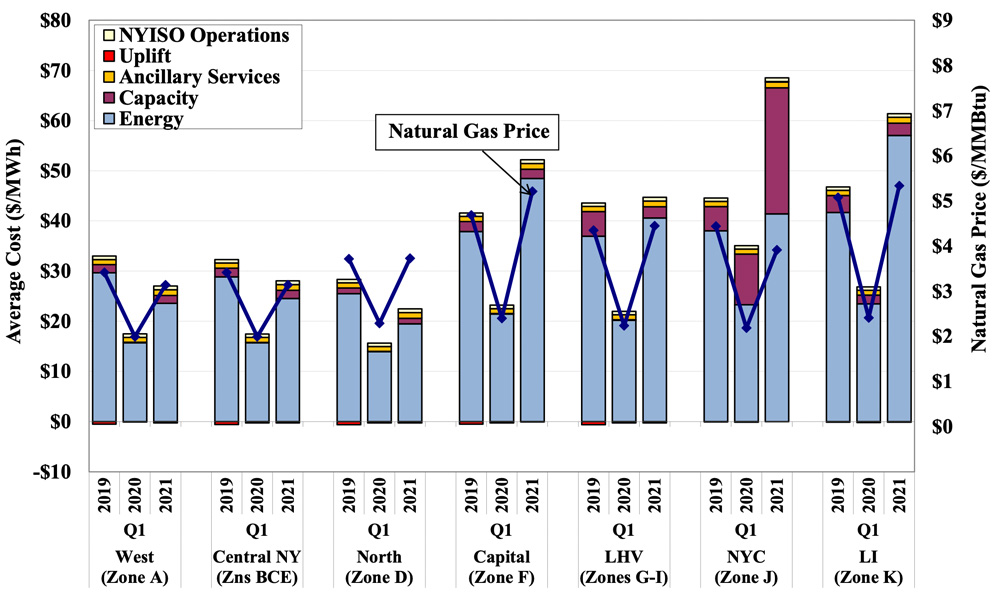
NYISO energy markets performed competitively in the first quarter of 2021, and energy prices rose 40% to 143%, primarily because of higher gas prices, the ISO’s Market Monitor reported.

All-in prices ranged from $22 to $69/MWh, up from the very low values observed in the first quarter of 2020, but “consistent with prices we saw in quarters before last year,” Market Monitor Pallas LeeVanSchaick of Potomac Economics told the Installed Capacity/Market Issues Working Group Wednesday in presenting the State of the Market report for the first quarter.

Congestion increased because of larger gas price differences between regions and lengthy transmission outages along the Central-East interface and into Long Island.

“We saw capacity prices rose significantly in New York City as a result of the higher locational capacity requirement (LCR),” LeeVanSchaick said. Prices also increased outside the city “but were still quite low.”

Oil-fired generation rose notably from late January to mid-February as gas prices in East NY rose to the oil price level because of cold weather conditions. However, the weather was not severe enough to put significant strain on the gas supply and oil inventories.

NYISO-All-in-Prices-(Potomac-Economics)-Content.jpg
The graph summarizes the total cost per MWh of load served in the New York markets by showing the “all-in” price that includes components of energy, capacity, uplift and ancillary services. | Potomac Economics

Spot capacity prices averaged $0.61/kW-month in Long Island, the G-J Locality and Rest of State, and $8.68/kW-month in New York City in the quarter.

The rest-of-state prices rose sharply in percentage terms, but prices were very low in 2020-Q1. The price rose primarily because of supply offer changes. The spot price rose substantially from $0.06/kW-month in January to $0.89/kW-month in February and March, with unsold capacity rising to ~580 MW.

Reliability commitments rose modestly in NYC because of higher load and more transmission outages, leading to higher bid production cost guarantee (BPCG) uplift. But LeeVanSchaick said NYISO and Con Edison have made procedural changes for N-1-1-0 requirements in the city in recent years, which have improved the efficiency of these commitments and reduced uplift.

“They have reduced the incidence of commitments that were not necessary for reliability,” he said. “For example, previously, we had seen instances where they committed a unit for 24 hours when it was only needed for two or three hours.”

Emission Signals

Nuclear and hydro generation fell by an average of 1 GW collectively from a year ago, reflecting the retirement of Indian Point 2 and more frequent freezing conditions. Consequently, gas-fired generation rose by more than 7% despite higher natural gas prices.

Gas-fired steam turbine generation rose by 660 MW on average. Most of the increase occurred on Long Island, where steam turbines were used more often during lengthy transmission outages to serve load, satisfy reserve needs, and support contractual requirements to export to New York City.

However, gas-fired combined cycle generation fell by 250 MW in the Hudson Valley. Increased gas pipeline constraints limited production from gas-fired units in the region during many cold days in the quarter.

Oil-fired generation on Long Island rose significantly on many days in January and February as cold weather drove gas prices to the level of oil prices.

These changes led to increased CO2, SO2 and NOx emissions from the same period a year ago, despite the retirement of coal generation in 2020. Long Island accounted for most of the increases in emissions, which are an anomaly from long-term trends and show how difficult it will be going forward to achieve incremental reductions in emissions from power generation, LeeVanSchaick said.

Congestion Patterns

Day-ahead congestion revenues totaled $179 million, up 222% from the first quarter of 2020.  The increase was driven by higher gas prices, especially in February, and lengthy transmission outages along the Central-East interface and into Long Island.

The Central-East interface accounted for the largest share (77%) of day-ahead congestion revenues in the first quarter of 2021.

Long Island accounted for 7% of congestion, primarily on 345-kV paths from upstate to Long Island because of lengthy transmission outages. NYC congestion was relatively low, accounting for only 5% of total congestion in the first quarter of 2021.

NYC congestion has been relatively low in recent years since generation there has become more economic because of lower Transco Zone 6 NY gas prices relative to gas prices in other parts of East NY.

NYISO has greatly reduced the use of out-of-market (OOM) actions to manage low-voltage transmission constraints in the past two years by modeling most 115-kV constraints in the day-ahead and real-time market models, he said. OOM actions to manage lower-voltage network congestion were most frequent in the North Zone (13 days) and Long Island (10 days) this quarter.

Oil-fired peakers were dispatched out-of-market on eight days for 69-kV constraints in Long Island. NYISO began to represent certain 69-kV constraints on Long Island in the market models in mid-April 2021, which should improve the efficiency of congestion management and investment incentives.

Reliability commitments in NYC accounted for roughly 84% of all reliability commitments in the quarter and rose 19% from a year ago. The increase reflected higher load levels and more transmission outages in the 345-kV system and around the Freshkills load pocket.

Nonetheless, NYISO and Con Ed have implemented several procedural changes for N-1-1-0 reliability commitment in NYC load pockets in recent years.

For instance, since January 2021, NYC load pocket requirements assume the use of 300-hour ratings rather than normal transfer limits after the second contingency, which have improved the efficiency of these commitments and lowered the associated uplift.

Performance Test

NYISO routinely audits 10- and 30-minute non-synchronous reserve providers to ensure that they can provide the services that they sell. However, units that perform well during audits may still perform poorly during normal market operations, and it may be appropriate to suspend or disqualify poor performers, LeeVanSchaick said.

Using performance during reserve pick-ups or economic starts in lieu of audits would reduce out-of-market actions and uplift costs (~$105K of uplift in 2021-Q1), LeeVanSchaick said.

Ransomware Becoming Part of Business, Panelists Warn

U.S. companies may have to learn to live with ransomware attacks, experts told California lawmakers on Thursday — even if that means giving attackers the payment they’re demanding to release control of vital systems.

“We’re not an advocate for paying the ransom, but the reality is that you may need to think about that,” NERC Senior Vice President Manny Cancel, the CEO of the Electricity Information Sharing and Analysis Center (E-ISAC), told the California State Assembly’s Select Committee on Cybersecurity. He suggested that utilities may have to consider preparing to pay a ransom ahead of an attack — for example, by buying stocks of cryptocurrency, which are often demanded in ransom payments and may be hard to acquire at a favorable exchange rate on short notice.

The question of whether and when to pay off ransomware attackers has become increasingly salient following recent high-profile ransomware attacks against Colonial Pipeline and JBS USA, the U.S. branch of Brazilian meat packing giant JBS. The Colonial hack attracted particular attention from regulators, lawmakers and the public because it forced the company to temporarily shut down its entire network, which delivers nearly half of the U.S. East Coast’s supply of gasoline, diesel and other fuel products. (See Glick Calls for Pipeline Cyber Standards After Colonial Attack.)

Randy-Rose-(California-State-Assembly)-Content.jpg
Randy Rose, Center for Internet Security | California State Assembly

Both Colonial and JBS admitted to paying the ransom demanded of them, using cryptocurrency valued at $4.4 million and $11 million respectively. Such payments are against the official recommendation of the FBI, as multiple lawmakers pointed out to Colonial’s CEO Joseph Blount when he testified before the U.S. Senate last month. (See Colonial CEO Welcomes Federal Cyber Assistance.) Blount said that authorizing the payment was “one of the toughest decisions I have had to make in my life” but “the right thing to do for the country” because of the possible effects of a long shutdown.

Several participants in Thursday’s hearing said that electric utilities and other owners of critical infrastructure assets have lower leverage against attackers than many other private organizations, since these systems are vital to everyday life. For this reason, attackers are increasingly likely to see such victims as an easy target.

“The criticality of these systems puts pressure on victims to pay the ransoms and to pay them quickly,” said Randy Rose, senior director of cyber threat intelligence at the Center for Internet Security. “We expect to see more targeting of critical networks and operational technology … because the goal of these actors is a quick payday, and few organizations have the uptime requirements of those who operate in critical infrastructure.”

Payment Still the Last Resort

Appeasement was by no means the only strategy discussed at the hearing: Cancel said that paying a ransom should be only one option in a response plan that is thoroughly worked out and drilled before any breach occurs. “You don’t want to figure out how to respond to a ransomware attack when you’re actually experiencing it,” he said. Preparations should also include preparing backups and practicing restoring from them; reducing the number of accounts with administrative privileges that attackers can take advantage of; and enhancing cyber hygiene of management and staff.

Assemblyman Ed Chau asked several questions about potential government actions that could mitigate the threat of cyberattacks and, particularly, ransomware. First Chau turned to Cancel, wondering whether the fact that many critical infrastructure assets are privately owned makes it harder to coordinate and share information in the event of a security breach.

Ron-Bushar-(California-State-Assembly)-Content.jpg
Ron Bushar, FireEye | California State Assembly

“There is occasionally some reluctance, particularly where there are concerns about attribution, penalty, or other liabilities that may occur,” Cancel acknowledged. He said that the E-ISAC allows members to share information anonymously, describing this as “a powerful way of getting the information and then allowing us to share that information with other members of the sector, and even with our government partners as well.”

Chau then asked whether federal action against the cryptocurrency markets could help make ransomware less attractive, prompting Ryan Kovar, a security strategist at information technology firm Splunk, to warn that the complex and shadowy nature of cryptocurrency means that attempts to disrupt it could just give rise to new types of digital coins that are even harder to track.

Ron Bushar, senior vice president and government chief technology officer at FireEye, suggested that it might be more effective to try and remove some of the stigma around paying ransoms. This could help law enforcement by making companies more willing to admit that they have paid their attackers and share information about the payments that could lead to arrests of the perpetrators or even recovery of the funds, as when the FBI recovered a large portion of Colonial’s ransom payment in June.

“I think in the short term, some sort of potential liability protection or shielding along with disclosure, either prior to or immediately after a ransom payment, in order to enable law enforcement to better track and prosecute these sorts of payments, may be a middle ground that makes sense to stem the tide,” said Bushar.

MISO Market Subcommittee Briefs: July 8, 2021

MISO Defends June Emergency Declaration

Stakeholders last week questioned MISO’s decision to call an emergency to access load modifying resources on June 10 as it contended with above average temperatures and forced outages.

A premature northern heatwave during the end of spring generator maintenance season set off a brief maximum generation emergency in MISO’s North and Central regions. MISO ultimately asked for about 2.5 GW in load reduction and received about 5 GW more than requested. (See MISO Leadership Says Tx Expansion, Market Redefinition ‘not Optional’.)

Jason Howard, MISO manager of day-ahead commitments, said the RTO managed the emergency reliably. He said it began taking steps June 7 to prepare for tight operating conditions.

“One of the attributing factors is 32 GW in outages, 22 GW of which was unplanned and derates,” Howard said at a Market Subcommittee meeting July 8. “This is an unexpected number of outages.”

Howard said some northern points of the footprint experienced temperatures that were 15 degrees above average. He also said MISO’s data showed that imports would be sparse during the day.

MISO Senior Director of Operations Planning J.T. Smith said MISO operators realized by 10 a.m. that units’ emergency outputs wouldn’t cover a projected shortfall and that LMRs were needed.

Several stakeholders said they weren’t convinced that MISO exhausted the full ability of its non-emergency units and imports before turning to emergency-only resources.

Some questioned the two-hour notification time, which was enshrined in the MISO tariff last year in response to stakeholder calls for more warning ahead of emergencies. Under the new rule, MISO must declare an emergency “at least two hours prior to the anticipated emergency event.”

Smith said MISO couldn’t bank on an increasing supply of non-firm imports at the time. He also noted that MISO’s resource adequacy construct means that LMRs exist to cover summer peak load.

“We were really right on the cusp. … We have more than 10 GW of capacity sitting behind a Max Gen step 2a call,” Smith said.

“The reason why we call ahead of time is we will exhaust our short-lead time LMRs very quickly, and we’ll never use the two, four, six-hour [lead time] LMRs,” MISO Executive Director of Market Operations Shawn McFarlane said.

David-Patton-(FERC)-Content.jpg
David Patton | FERC

MISO Independent Market Monitor David Patton said it’s not surprising that the unseasonably hot weather and outages sent MISO into a tailspin.

Patton said MISO should use more realistic assumptions when calculating reserve margins.

“We keep reporting margins that seem high and seem to cover everything,” he said.

But Patton said MISO doesn’t fully account for unscheduled summer outages and derates.

“The reality is we have outages and derates that average 10 GW,” he said.

MISO’s current 19.3% reserve margin is above 2021’s 18.3% requirement, Patton said, but likely forced outages reduce the margin to 17.1%. If MISO modeled a more realistic scenario that included expected outages and derates, a 2,300-MW transfer limit between MISO South and Midwest and, accounted for its LMRs with long lead times, the expected reserve would fall to 10 to 13%, he said.

But that still leaves abnormally hot conditions unaccounted for, Patton said. If MISO assumed high demand from a sweltering day, the margin could drop to 1% or less.

MISO’s frequent maximum generation events are “really not as big a mystery as it appears,” Patton said.

However, Patton said MISO’s saving grace is non-firm imports during times of need from its neighbors.

“It’s why we probably don’t need to carry as much capacity as other areas,” he said.

Howard agreed that MISO has a high dependence on imports and said unusual weather patterns can throw imports into doubt.

Market User Interface Launch Delayed

MISO is delaying the launch of its new market user interface, part of the RTO’s market platform replacement.

MISO IT Senior Director Curtis Reister said the notifications feature of the new interface has problems that the vendor is working on. He said MISO will delay the planned July 6 parallel operations of both the old and new interfaces for an unspecified amount of time.

“We don’t have a new [start] date. We want to give ourselves time to apply this patch,” Reister told stakeholders. He said MISO will use the time to ensure the solution works before opening the interface to stakeholders.

He said MISO still plans four months of parallel operations and will delay the old user interface’s retirement date. Market participants use the market user interface to submit bids and offers in the MISO markets.

The new interface test environment has been open for testing by market participants since April. Parallel operations of the new and old interfaces were originally expected to take place July through October.

Reister said MISO will know more about the length of the delay in mid-July.

The new market platform will accommodate 30-minute reserves and energy storage participation and provide better modeling for combined cycle units. MISO has put those products on hold because its current monolithic platform isn’t sophisticated enough for them.

Monitor Says Congestion Worsening

The Monitor also appeared before the Market Subcommittee to again warn of MISO’s increasing congestion costs.

“There’s a trend in MISO of increasing congesting that we don’t think is going to slow down,” Patton said. The Monitor told MISO’s Board of Directors in June that the grid operator needs to address increasingly expensive congestion. (See MISO Monitor Warns of Ramping Needs, Tx Congestion.)

Patton told stakeholders that congestion is a major “cost generator” in MISO, with congestion costs doubling from last spring to Spring 2021.

MISO is on track to incur $2 billion to $2.5 billion worth of congestion costs this year, he said.

“That’s a level of congestion we haven’t seen on an annual basis over the last three years,” he said.

He added that Spring 2021’s average real-time congestion was the highest it’s been since 2014, owing to a 58% year-over-year increase in natural gas prices, higher market-to-market congestion with SPP and PJM, and growing wind output.

“As wind generation ramped in the fall of 2020 and the spring of 2021, we saw huge amounts of congestion on constraints … in the Midwest region,” Patton said.

The Monitor said in some intervals, wind generation can serve up to 40% of the RTO’s Midwest load.

BOEM Reviews Empire Wind COP Environmental Impact

Labor unions, environmentalists, state residents and energy professionals told federal officials Thursday they largely support the 2-GW Empire Wind project in the New York Bight. A clam fishery representative, however, accused the developer and state and federal governments of being insensitive to their special needs.

The Bureau of Ocean Energy Management (BOEM) on July 8 held the second of three public hearings, as the agency begins to review the project’s environmental impact with data from the developer’s construction and operations plan (COP). BOEM has scheduled the third hearing on July 13 at 1 p.m. for the project of Norwegian state-owned energy company Equinor Wind US.

Michelle-Morin-(BOEM)-Content.jpg
Michelle Morin, BOEM | BOEM

“As we emerge from the COVID crisis … the economy, environmental justice and climate change are interwoven with offshore wind development,” said Mariah Dignan, the Long Island organizer for Climate Jobs New York (CJNY), a coalition of labor unions representing 2.6 million working New Yorkers. “We have a once-in-a-generation opportunity to put ourselves on the path to a low-carbon future, while creating new quality careers that provide family-sustaining wages and benefits for communities across the nation.”

Empire Wind consists of two separate projects, 810-MW Empire Wind 1 and 1,260-MW Empire Wind 2, awarded under different state solicitations and which will be electrically isolated and independent from each other, according to Laura Morales, Empire Wind’s environmental permit manager. The facilities will connect via offshore substations to separate points of interconnection onshore, she said.

BOEM will issue a draft environmental impact statement next summer and expects to issue a final decision of record in mid-2023, said Michelle Morin, chief of BOEM’s environmental branch for renewable energy. Comments for this round of review should be submitted no later than July 26.

Equinor plans to bring the Empire Wind project into service by 2025.

Clams and Piles

The clam industry would be negatively affected by installation of thousands of wind turbines in the mid-Atlantic and New England, said David Wallace, who spoke on behalf of the North Atlantic Clam Association.

The clam industry is unique in that it’s a directed fishery “that can only exist with being able to drive piles deep into the substrates and soft bottom without a lot of heavy rocks.”

OSW technology has developed since Equinor first acquired the lease in December 2016 for $42.5 million. The developer’s new COP proposes reducing the number of turbine foundations from 240 to 176, spacing turbines at least 0.7 nautical miles apart, and laying out the array in a Southwest-Northeast orientation that considers the dominant net fishing activities in the lease area, Morales said.

The Army Corps of Engineers insists on burying the export cables at least 15 feet below the seabed, she added.

Laura-Morales-(BOEM)-Content.jpg
Laura Morales, Empire Wind | BOEM

Clammers have “proposed on numerous occasions to separate those turbines two nautical miles apart in straight lines, so that we could operate within those turbine arrays,” Wallace said “However, we have found that none of the developers are interested or willing to spread their turbines out … we are not interested in being collateral damage to very high rates of electric utilities.”

Stakeholders at a public hearing on the 800-MW Vineyard Wind project last July urged BOEM to approve the 1-nautical-mile turbine spacing advocated by developers and recommended by the U.S. Coast Guard, which the agency did earlier this year. (See Developers Seek 1-Mile Spacing for Vineyard Wind.)

The Empire Wind 1 export cable will make landfall in Brooklyn at the South Brooklyn Marine Terminal. After the energy is converted to AC, it will run through a cable underground to the point of interconnection, which is the Gowanus Substation, across second Avenue, Morales said.

For Empire Wind 2, the developer is looking at landfall alternatives to host two separate export cables to the point of interconnection at Oceanside, on the National Grid property in Island Park.

Tom Barracca, a career energy professional based in East Meadow, New York, said he was involved as a program manager in the 2002 Long Island Power Authority (LIPA) offshore wind study co-sponsored by the New York State Research and Development Authority.

“Although the offshore wind economics and technology wasn’t there 20 years ago, it is today, and Equinor and the Empire Wind team have done a tremendous job in planning these projects and making the necessary studies and due diligence,” Barracca said.

Supportive of the plan to deliver 2,000 MW of clean power into Consolidated Edison (NYSE: ED) territory, Barracca said the plans to feed into the LIPA load pocket in southwest Nassau County are especially useful for the region.

“As many people might know, there’s an aging power plant [the 610-MW E.F. Barrett Power Station] in Island Park that’s been upgraded many times and is still operating,” Barracca said. “National Grid is committed to make the best use of that, but quite frankly, it’s time for renewable power to be brought into Long Island and into New York City, and Empire’s plan to inject clean power into those load pockets is perfect timing.”

Urgent, Scenic Views

BOEM heard from members of the public about urgent action on climate change and the viewshed off New York’s coast.

“[A]fter yet another record-breaking and deadly month of heat waves, it seems to me that our absolute No. 1 priority for all energy projects should be simply, ‘Do they help us get to a carbon-neutral future?’” said Tara Noble, a lifelong New York resident.

If the answer is yes, she added, “we are obligated to pursue them without delay.”

The visual impact of the turbines is of deep concern to artist and Long Beach, N.Y., resident Michael Halpern.

Seeing wind turbines on the horizon would disturb him emotionally, aesthetically and spiritually, interfering with his visits to his late mother’s memorial bench on Riverside Boulevard, Halpern said.

The wind turbines, he said, would take “the magic of going to the beach away,” and when he paints, he added, “I’m not going to be looking out at eternity and God’s presence, I’m instead going to be looking at an industrial wasteland.”

While “not totally against clean energy,” Halpern said, he supports building solar panels and “wind turbines in specific places, but not here off the coast of Long Beach and New York City.”

Clean Energy Investments Near $20B in NC

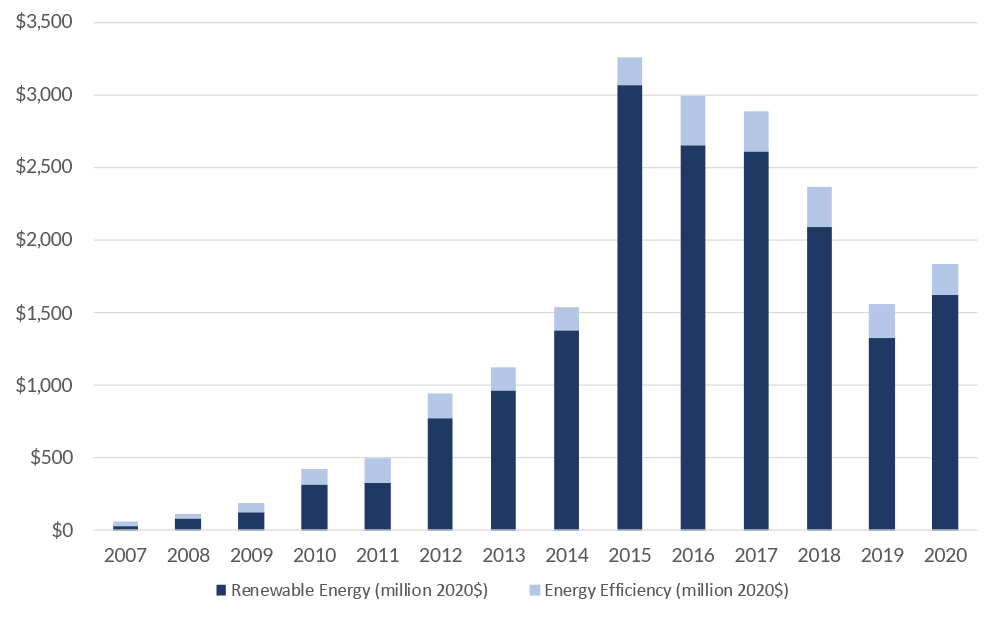
Clean energy investments in North Carolina ballooned from $56.5 million in 2007 to $19.8 billion in 2020, according to a report by RTI International for the North Carolina Sustainable Energy Association.

The study looked at the impact of the Renewable Energy and Energy Efficiency Portfolio Standard enacted in 2007, which required investor-owned utilities to meet up to 12.5% of their retail electricity sales through renewables or energy efficiency by 2021; for rural electric cooperatives and municipal electric suppliers, the requirement is 10%. By now, the report states, “utilities have accumulated sufficient renewable energy credits to satisfy the targets.”

The $19.8 billion includes $17.4 billion spent on the construction and installation of renewable energy projects, including solar PV ($15.8 billion), biomass ($764 million) and wind ($430 million). Another $2.4 billion was spent on energy efficiency.

NC-Clean-Energy-Spending-(RTI-International-for-NCSEA)-Content.jpg
Clean Energy Investment in North Carolina, 2007–2020 | RTI International for NCSEA

Spending peaked at $3.1 billion in 2015 — when renewable energy investment tax credits expired — then dropped sharply for the next four years. It bottomed out at $1.3 billion in 2019 before rebounding last year to $1.6 billion.

The North Carolina government contributed about $1.5 billion to clean energy development from 2007 to 2020, less than one-thirteenth of the total. Almost all the state aid was in the form of tax credits, though the state also funded $19.6 million in energy efficiency projects.

Economic Impact

The spending generated $1.4 billion in state and local tax revenues, added $22.5 billion to gross state product and supported 291,183 annual full-time equivalents. Including secondary effects, total economic activity from clean energy efforts came to $40.8 billion.

In a state that includes both the advanced high-tech Research Triangle Park area, where RTI has its headquarters, and impoverished rural areas, the report noted that “renewable energy projects are widely distributed across North Carolina, bringing investment to both urban and rural counties.”

Renewable energy facilities generated 63.4 GWh of power, which “resulted in a total of $3.9 billion in avoided cost and retail energy savings no longer spent on conventional energy,” researchers said. Just over half (52%) of those savings came from solar PV, 32.4% from biomass, 8% from landfill gas and 4.1% from wind.

Utility companies’ energy efficiency programs saved 42.9 million MWh in North Carolina from 2007 to 2020, which amounts to $2.6 billion in savings, assuming electricity costs about 6 cents/kWh. To this should be added energy savings of $1.7 billion documented by the state government’s Utility Savings Initiative, for “total energy efficiency savings of $4.3 billion,” the report states.

CAISO Declares Emergency as Fire Derates Major Transmission Lines

CAISO declared a Stage 2 energy emergency Friday evening as an out-of-control wildfire in Oregon nearly shut down one of two major transmission pathways between California and the Pacific Northwest while significantly reducing transfer capacity on the other.

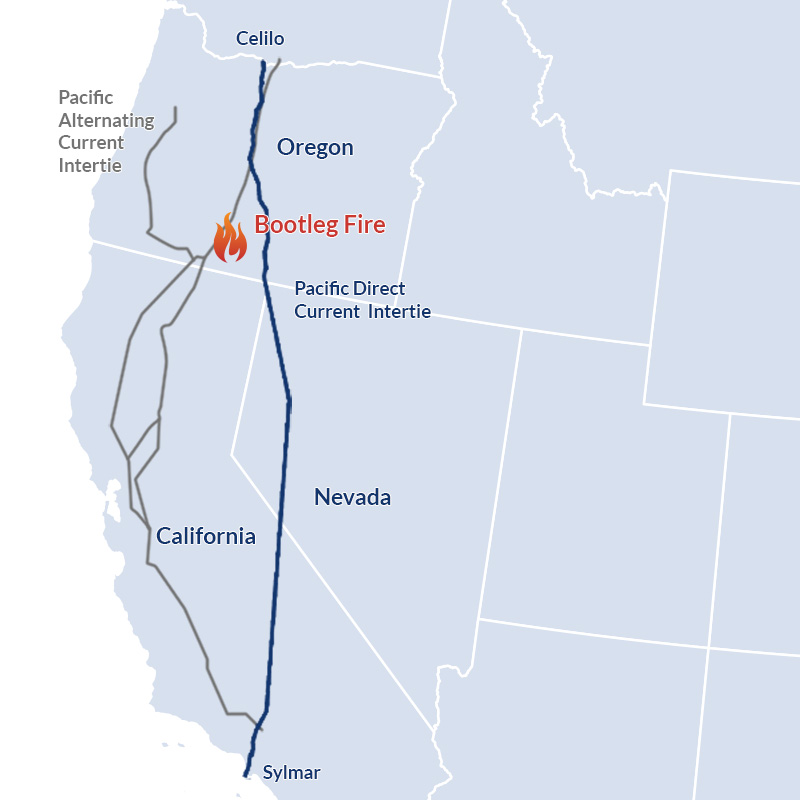
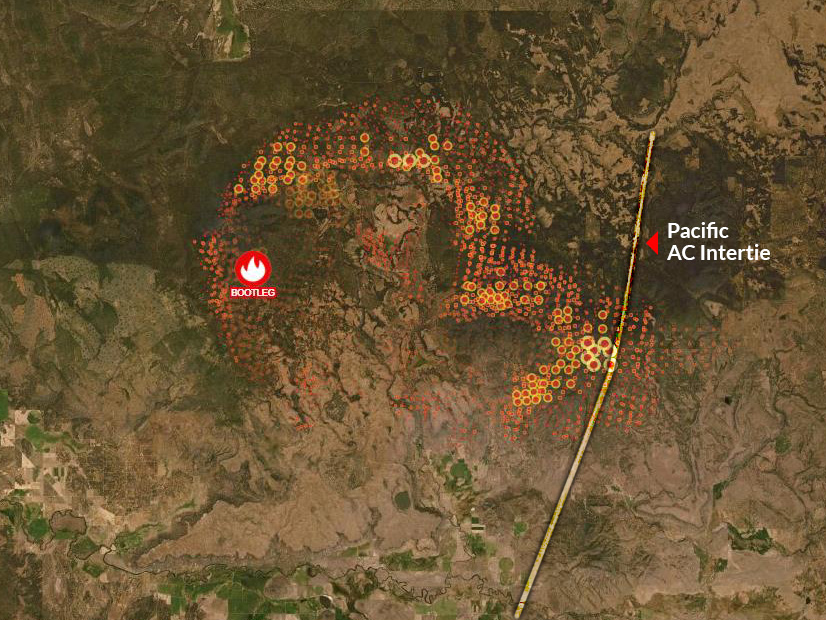
By Saturday morning, the Bootleg Fire in south-central Oregon had doubled in size to 77,000 acres and was burning under the Pacific AC Intertie (PACI), three parallel 500-kV lines that transport hydropower from Columbia River dams to population centers in California.

“Fire is on the AC Intertie right-of-way,” Bonneville Power Administration spokesman Doug Johnson told RTO Insider.

The U.S. Forest Service called the fire’s behavior “extreme.”

“The fire will continue to move unchecked in all directions, with unstable air conditions and extremely dry fuels,” it said. “Energy release components in fuels are at an all-time high.”

Bootleg-Fire-Map-(RTO-Insider-LLC)-Content.jpg
The Bootleg Fire was burning just east of the Pacific AC Intertie on Friday. | © RTO Insider LLC

The 500-kV PACI lines owned by BPA, PacifiCorp and Portland General Electric, partially originate at the BPA-operated John Day Dam on the Columbia River. From there they extend south, traveling through the fire zone, and connect to the Captain Jack and Malin substations just north of the California border. The lines then split off to feed power to customers of Pacific Gas and Electric, the Western Area Power Administration and multiple municipal utilities in Northern and Central California, including the Sacramento Municipal Utility District.

BPA derated the Oregon portion of the PACI from 4,450 MW to 428 MW by 7 p.m. Friday.

Around the same time, the southbound segment of the Pacific DC Intertie (PDCI), which sends power from the Columbia River Basin to Southern California through Nevada, was derated to less than half its 3,100-MW capacity, while the northbound segment was shut down altogether.  Co-owned by BPA and the Los Angeles Department of Water and Power, the PDCI cuts a similar course as the PACI through much of Oregon but lies farther to the east.

The unexpected limits on imported electricity forced CAISO to issue a grid warning and to later declare the emergency as solar power waned but demand remained high amid triple-digit temperatures in interior California.

Sacramento, for example, hit a high of 106 degrees shortly before 6 pm. Friday; the capital city’s forecasted high on Saturday is 109 degrees, the National Weather Service said.

CAISO said its initial warning indicated “that grid operators anticipate using electricity reserves [and activating] demand response programs to decrease overall demand.”

“The ISO has been requesting additional energy from its neighbors and may call upon dispatching emergency demand response programs from 6 p.m. to 8 p.m., which is the peak and net peak,” CAISO spokeswoman Vonette Fontaine said Friday. “That reduction in demand may be sufficient to avoid further emergency levels and avoid outages.”

Bootleg-Fire-Map-(RTO-Insider-LLC)-Content.jpg

Fire and smoke engulfed part of the Pacific AC Intertie in southern Oregon. | NOAA Esri Earthstar Geographics

At 6:32 p.m., however, CAISO suddenly skipped a Stage 1 emergency and proceeded straight to Stage 2.

The emergency announcement stated that the ISO “has taken all mitigating actions and is no longer able to provide its expected energy requirements.”  CAISO avoided escalating to Stage 3, which could have led to rolling blackouts like those the ISO ordered last August amid a severe Western heat wave.

On Friday afternoon California Gov. Gavin Newsom signed an emergency proclamation to free up additional capacity, citing the loss of 4,000 MW of electricity supply.

At that time, the derate had not yet affected real-time operations of the Oregon portion of the line, BPA’s Johnson said.

But the loss of supply appeared to be driving volatility in CAISO’s real-time market, as prices at the Captain Jack and Malin nodes breached $1,000/MWh Friday evening.

At the same time, real-time prices at CAISO’s NP-15 hub — the pricing point for Northern California — spiked to about $1,035/MWh, while the southern SP-15 hub topped $990/MWh.