Northwest Summers Now Include ‘Huge’ Energy Flows from California

For decades, Portland General Electric watched electricity move from north to south through its system during the summer, as relatively cheap hydroelectric power from the Pacific Northwest flowed to California.

But now, the flow on a typical summer day has reversed, with electricity moving from south to north, PGE officials told the Oregon Public Utility Commission.

“With the 10,000 MW of batteries and 20,000 MW of solar that California has, we see a reversal of paths, where there is a huge northbound flow from California — cheap energy — up into the Northwest,” said Lee Recchia, PGE’s senior manager of the grid control center.

Recchia spoke during a special OPUC meeting on summer readiness on June 24.

The flow reversal has created issues that PGE “didn’t really see coming,” Recchia said, particularly on the North of Pearl transmission path. The Bonneville Power Administration owns the Pearl flowgate, and PGE partially owns some 230-kV lines out of Pearl.

“We’ve seen some overloads that we hadn’t seen in the past years, and it’s one of our big congestion points,” Recchia said.

PGE has developed a North of Pearl action flow chart for operators and a forecasting tool. The utility also is in regular discussions with BPA.

“It strikes me as one of those places where there will be really important coordination, as they move forward with their Markets+ decision,” OPUC Chair Letha Tawney said. “This could get hairy.”

PacifiCorp Preparations

Weather forecasters predict higher-than-average temperatures for most of the West this summer.

But PacifiCorp’s predicted summer peak of 11,163 MW is not a significant jump from its 2024 summer peak, according to Ben Faulkinberry, senior originator in the company’s energy supply business unit.

Since summer 2024, PacifiCorp has added 1,000 MW of wind resources and 320 MW of solar while also completing a 75-MW natural gas plant expansion. Another 400 MW of wind and 500 MW of solar are expected by the end of this summer.

PacifiCorp also energized the Gateway South transmission line, a 500-kV line that will carry electricity from the company’s wind power projects in Wyoming to the load center in Utah.

With the new line in service, curtailments of Wyoming wind are down by about 70%, Faulkinberry told the commission. And during the summer, when there’s less wind in eastern Wyoming, Gateway South gives PacifiCorp greater capacity to transact with market participants on the east side of the Rockies, he said.

“Our load requirement has not jumped substantially. We’ve added new resources. We’ve added new connectivity,” Faulkinberry said. “So we’re feeling, on the whole, pretty well-situated going into summer 2025.”

Still, PacifiCorp faces potential summer threats. One concern is the possibility of extreme heat simultaneously hitting the Pacific Northwest, Desert Southwest and California regions.

“That really puts a stress on our system as well as for the region as a whole,” he said.

Another worry is wildfire, which could affect transmission across the grid. Southern Oregon and southern Idaho, areas where PacifiCorp has “some pretty key connectivity,” are particular concerns, Faulkinberry said.

PacifiCorp also is expanding its demand response programs, including Cool Keeper, which has been a longstanding program in Utah.

Through the program, which PacifiCorp now is rolling out in Oregon, a technician installs a device that curbs power to the air conditioner compressor of a residence or small business. The company controls the device, and the customer can’t bypass it.

A typical Cool Keeper event lasts 5 to 15 minutes — enough time to stabilize the grid when it gets out of balance.

Because the fan and air handling components of the air conditioner keep running, customers generally don’t feel uncomfortable. Customers receive a bill credit for participating.

PacifiCorp forecasts that participation in Cool Keeper, along with a battery incentive program called Wattsmart, will offset the need to build three natural gas peaker plants within four to five years.
New CAISO-Powerex Dispute Centers on ‘Voluntary’ Nature of EDAM

CAISO has dismissed Powerex’s contention that the ISO only recently has “revealed” that participation in its Extended Day-Ahead Market is voluntary at the balancing authority level but not voluntary for “individual customers” operating within the BA participating in the market. 

“Powerex’s claim is incorrect and directly at odds with the factual record,” CAISO wrote in a June 17 “limited answer” filed in the FERC docket for PacifiCorp’s proposed revisions to its Open Access Transmission Tariff, intended to facilitate the utility’s participation in EDAM (ER25-951). 

In February, PacifiCorp’s OATT proceeding had opened yet another front in the competition between EDAM and SPP’s Markets+. 

That’s when Powerex — a strong Markets+ backer — published a paper arguing that PacifiCorp’s revisions showed the EDAM contained a “design flaw” in how it allocates transmission congestion revenues in situations when congestion results from loop flow. (See Powerex Paper Sparks Dispute over EDAM ‘Design Flaw’.) 

CAISO and PacifiCorp initially rebuffed that characterization, but the ISO and its stakeholders did move to quickly address the matter with congestion revenue allocation rule changes developed through an expedited stakeholder process. (See CAISO Approves New EDAM Congestion Revenue Allocation Design.) 

But the issue spelled out in CAISO’s June 17 answer represents a new twist in the running dispute in the OATT proceeding. 

In its answer, CAISO was responding to a June 11 comment Powerex submitted in the docket in which the Vancouver, B.C.-based power trader said the ISO has long promoted the EDAM as “voluntary and incremental” — a “natural evolution” of the Western Energy Imbalance Market (WEIM). 

But, Powerex went on to contend, in a May 19 filing, CAISO for the first time “revealed” a “radically different approach” in which “EDAM could no longer be described as voluntary at all because only PacifiCorp (or other prospective balancing authorities) will be offered the choice to participate in EDAM.” 

Powerex was pointing specifically to CAISO’s statements around an EDAM provision that allows a participating BA to “carve out” the embedded transmission of nonparticipating transmission service provider (TSP) from EDAM’s market optimization. In the May 19 filing, the ISO said it agreed PacifiCorp had the right to take that action but added that “any such carveouts should be an option of last resort.” 

Instead, CAISO argued, a “similar and more efficient” option would be for the nonparticipating TSP to self-schedule the use of its own transmission within EDAM and directly settle the associated energy schedules, including congestion price differences, with the market operator.” 

Powerex said this showed CAISO was seeking to “achieve this compulsory participation” and create a “captive market” along the lines of an RTO, but without providing the full benefits of an RTO. 

That would mean PacifiCorp’s decision to join the market would “in turn, require every electricity transaction and every delivery by every customer in PacifiCorp’s area to take place through EDAM,” Powerex wrote. “In addition, once PacifiCorp joins EDAM, all of its own transactions and all of its own deliveries will also be required to occur entirely through EDAM.” 

Powerex went on to warn that “if CAISO’s new vision for EDAM is accepted, it would effectively make all activity in the electricity sectors of Wyoming and Utah, as well as significant portions of Idaho, Oregon and Washington, captive to CAISO’s authority and ongoing decision-making under CAISO’s governance structure, as a result of PacifiCorp’s election to join EDAM.” 

‘No Recognizable Reason’

In its June 17 answer, CAISO retorted that, although Powerex “professes surprise” at the ISO’s statements in its May 19 filing, those comments represented “nothing new, surprising or radically different” from the ISO’s previous description of EDAM. 

“In fact, … CAISO was explicit in its 2023 tariff amendment filing to implement the EDAM design — on which Powerex submitted comments not even raising this subject — that participation in EDAM is voluntary at the balancing authority level but that all supply and demand in each EDAM balancing area must participate in the day-ahead market,” the ISO wrote. 

CAISO noted FERC approved this “foundational concept” of the EDAM in its December 2023 order approving the market’s tariff and “should reject Powerex’s factually inaccurate claims and its arguments based on those claims.”  

It pointed out that the transmittal letter accompanying the EDAM tariff filing stated the tariff included three options for the use of OATT transmission service rights in the market but that CAISO “had rejected proposals for other options involving broad or automatic opt-outs or carveouts of transmission capacity from the market.” 

The transmittal letter noted that CAISO and its stakeholders had determined that carveouts would create market inefficiencies, in part by potentially creating congestion in situations when a carveout leaves a path underused despite the availability of sufficient transmission capacity. 

“In addition, Powerex contradicts history in claiming the CAISO is in 2025 announcing a ‘radically different approach’ under which every electricity transaction and every delivery by every customer in PacifiCorp’s area will take place through EDAM. The CAISO made this requirement clear multiple times in its 2023 filing of tariff amendments to implement EDAM,” the ISO wrote. 

“In short, there is no cognizable reason for surprise on Powerex’s part,” it said. 

Lauby Says U.S. ‘On the Right Track’ After Iberian Blackout

NERC Chief Engineer Mark Lauby told FERC commissioners that two recent reports on the Iberian Peninsula outages of April suggest the U.S. is “on the right track” regarding necessary steps to protect the grid from similar incidents.

Speaking at FERC’s monthly open meeting, Lauby reviewed the reports released June 17 by the Spanish government and June 18 by grid operator Red Electrica on the blackout that left the entire population of Spain and Portugal — as well as parts of France — without power for up to 18 hours. The reports concluded that traditional synchronous generation could not adequately control high voltage resulting from frequency oscillations on the grid. (See related story, Expert Says Spain Blackout Unlikely in U.S.)

“Initial thoughts were that this event was maybe driven by reduced inertia or frequency ride-through,” Lauby said, referring to speculation in the days after the blackout that the high proportion of solar, wind and battery resources on the Spanish grid made it difficult for Red Electrica to manage the oscillations. “But it’s become clear — from the Spanish reports, anyway — that the challenge was the ability to manage the grid’s static and dynamic voltage.”

Reviewing the sequence of events, Lauby said the frequency oscillations began around noon April 28, first with local oscillations between the Spanish and Portuguese systems and then an inter-area oscillation that “raced … all across the continent.” Red Electrica activated its mitigation measures in response to the oscillations, after which voltage began to rise.

According to the government report, 11 thermal generation plants and an unspecified amount of hydraulic generation were available for voltage control at the time of the blackout. Spain’s electricity regulations do not allow renewable energy resources and battery energy storage systems to be used for voltage control. Red Electrica attempted to combat the voltage fluctuations with static reactive devices, which reduced system voltage but left the operator with less flexibility because of the stepwise “all-or-nothing” nature of the devices.

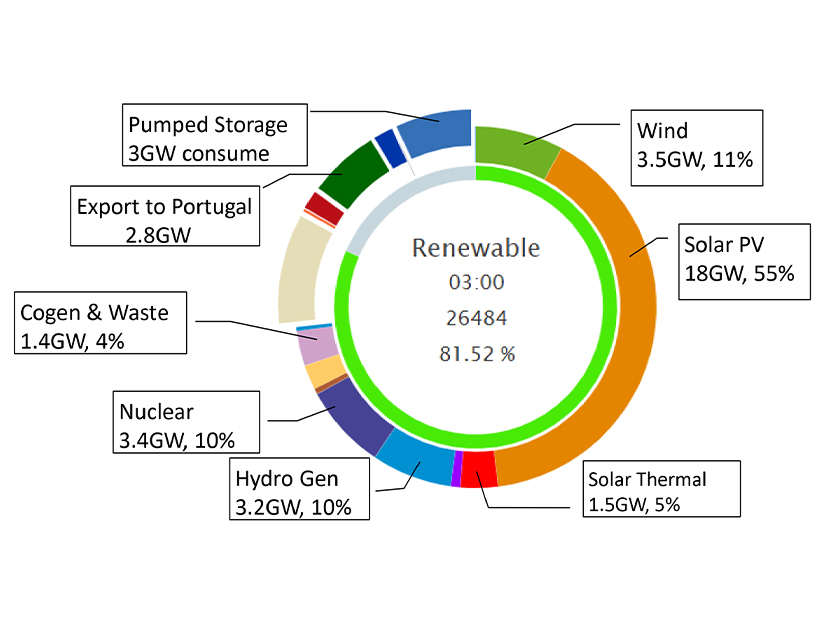
At 12:32:57, about 10 minutes after the voltage began to rise, 355 MW of generation of unknown type left the grid after a collector substation tripped offline due to overvoltage. Within the next 20 seconds, an additional 1.5 GW including four wind farms and four solar installations was lost. After another two seconds, as the Iberian grid began to lose synchronization with the rest of the European system, the AC lines between France and Spain were disconnected, and the Spanish and Portuguese systems collapsed at 12:33:24, less than 30 seconds after the initial generation loss.

Resources on the Spanish grid the morning of the incident, according to Red Electrica | Red Electrica

Reviewing the recommendations in the Red Electrica and government reports, Lauby noted that several of them are measures that U.S. grid operators already are required to follow.

“Some of the standards we have in place, for example our voltage and reactive standards, along with FERC Order 827, ensure sufficient dynamic reactive support is planned and operated,” Lauby said. He noted that Red Electrica’s recommendation of a review of overvoltage protection settings is similar to efforts already underway in the form of a Level 3 alert approved by NERC’s Board of Trustees in May setting out essential actions regarding inverter-based resource performance and modeling. (See NERC Warns Summer Shortfalls Possible in Multiple Regions.)

Lauby also pointed out that unlike Spain’s regulator, FERC and NERC already require that all generation units capable of voltage regulation, including IBRs, provide such service. In addition, the reports mention tools like synchronous condensers, static VAR compensators and static synchronous compensators that already are present in the U.S. grid.

Asked by FERC Commissioner David Rosner whether the reports suggested any “gaps in [NERC’s] reliability standards” that could lead to similar incidents, Lauby said he didn’t see any “glaring gaps” but emphasized the importance of continuing to work with experts and equipment manufacturers to identify vulnerabilities.

Lauby also told attendees that the European Network of Transmission System Operators for Electricity, an association of 40 transmission system operators spanning 36 European countries, is preparing its own analysis of the Iberian blackout, to be released in September. He said NERC “will wait for that report to gain any [further] insights” into the incident.

NEPOOL PC Briefs: June 24-26, 2025

Annual State of the Market

HARWICH, Mass. — Amid extreme temperatures and the highest peak demand experienced in years, ISO-NE and stakeholders discussed market performance, capacity auction reforms, the RTO’s 2026 budget and asset condition spending at the summer meeting of the NEPOOL Participants Committee on June 24-26. 

The three-day meeting at a luxury resort on Cape Cod was preceded by the news that CEO Gordon van Welie, who has led the RTO since 2001, will retire by the end of the year. He will be replaced by COO Vamsi Chadalavada. (See ISO-NE CEO Gordon van Welie Announces Retirement.) 

David Patton of Potomac Economics, ISO-NE’s External Market Monitor, presented his annual assessment of the region’s markets, which found they “performed competitively” but concluded that “key improvements will be increasingly important in the coming years.” 

ISO-NE had the highest overall wholesale market costs of all RTOs in 2024 because of high gas costs, Patton said. New England’s reliance on natural gas generation has increased in recent years; according to ISO-NE data, gas generation hit a record high in 2024, accounting for 51% of net energy for load in the region. (See New England Gas Generation Hit a Record High in 2024.) 

Patton added that New England faced inflated capacity costs because of overforecast demand in its Forward Capacity Auctions, which is “slow to correct in the [Forward Capacity Market].” 

The region also continues to have extremely high transmission rates, which were “more than double the average rates in other RTO markets,” Patton said. He noted that the region’s transmission investments have led to low congestion costs. ISO-NE continued to have the lowest congestion costs of all RTOs in 2024, estimated to be “8 to 17% of other RTOs per megawatt-hours of load,” Patton added. 

However, some stakeholders said this calculation of congestion costs does not appear to fully account for transmission constraints in Maine, which have limited the development of renewables and are the target of the first ISO-NE Longer-Term Transmission Planning solicitation. (See ISO-NE Releases Longer-term Transmission Planning RFP.) 

Patton also expressed concern about a lack of liquidity in ISO-NE’s day-ahead market because of “inefficient allocation of costs to virtual transactions.” 

Patton supports ISO-NE’s ongoing efforts to overhaul its capacity market, which are focused on improving resource accreditation, reducing the time between auctions and capacity commitment periods (CCPs), and splitting CCPs into summer and winter seasons. 

He also called for a reduction in ISO-NE’s Pay-for-Performance (PFP) rate, which he said often overstates the value of reserves and could cause the premature retirement of some fossil units. He said the RTO should align PFP charges with the severity of reserve shortages and charge exporters the PFP rate. 

Reflecting on two capacity deficiency events in the summer of 2024, Patton said “extraordinary prices” caused significant charges imposed on steam turbine and combined cycle plants, “most of which were available but not committed in the day-ahead markets.” 

High PFP charges on resources that were not committed in the day-ahead market could cause “lower net revenues that may lead to premature retirements” and “inefficient incentives to self-commit such resources,” Patton said. 

As states look to transition away from fossil generation, Patton concluded that the region is “well positioned to handle the renewable transition” but recommended that the RTO develop a “a look-ahead dispatch model to address ramp needs and [the] optimization of storage resources.” 

Multiyear Road Map

Chadalavada outlined some “key future focus areas” for the RTO over the next few years, including the development of “forward-looking intraday market-clearing and pricing systems,” intended to help optimize storage deployment and meet increasing ramping requirements. 

“To cost-effectively address operational uncertainties in a dynamic power system, costs will need to be incurred now to position the system with sufficient flexibility later,” Chadalavada said. “This will require new real-time, ‘multi-interval’ optimization and pricing algorithms incorporating probabilistic forecasts.” 

Chadalavada said ISO-NE aims to develop probabilistic forecasts for load and renewable production, which should help the RTO manage increasing uncertainty on the system.  

He said ISO-NE is researching methods for multi-interval pricing and probabilistic forecasting, and said the RTO “may recommend a sequence of phased and interdependent market enhancements over the course of this initiative.” 

Other focus areas Chadalavada highlighted include system planning coordination, modeling of inverter-based resources, resource adequacy and cybersecurity.  

2026 Budget

ISO-NE outlined its initial 2026 budget proposal: a revenue requirement of $315.2 million, which would be a $4 million increase over the 2025 requirement. 

This includes a $15.6 million reduction associated with the annual revenue true-up. Without the true-up, the 2026 budget is 1.8% lower than ISO-NE initially projected in 2024. 

“The budget for 2026 represents the ISO’s commitment to supporting the region as it continues to experience an evolving resource mix and changing customer use patterns, ensuring that markets and grid operations are efficient and reliable,” said Kelly Reyngold, director of accounting. 

Notably, the budget “includes ‘placeholder’ funding for asset-condition review work that will only be used for this purpose and, if not needed, will not be reallocated for use elsewhere.” 

Earlier in 2025, ISO-NE announced that it is open to taking on a nonregulatory role in reviewing asset-condition spending, responding to state and consumer advocacy concerns about a lack of transparency and oversight on the projects. (See ISO-NE Open to Asset Condition Review Role amid Rising Costs.) 

Chadalavada said it likely will take about 18 months to develop in-house asset-condition review capabilities but that ISO-NE hopes to hire a consultant to help review the most important projects in the interim period. He said the RTO is working with transmission owners to establish the criteria for reviewing projects in this interim period and eventually will include all stakeholders in these discussions. 

PJM Exceeds Forecast Summer Peak Load During June Heat Wave

PJM experienced a preliminary peak load over 160 GW on the afternoon of June 23, surpassing the RTO’s summer forecast of 154 GW and requiring the deployment of pre-emergency demand response. (See PJM Summer Forecast Reports Sufficient Supply.) 

The heat wave blanketing much of the region brought temperatures of around 100 degrees Fahrenheit, leading to an RTO-wide hot weather alert being issued between June 22 and 25, which was extended to include the 26th as well. Several pre-emergency load management reduction actions were taken June 24 across the RTO, while DR also was called for the Mid-Atlantic and Dominion regions June 23 and 25. 

Two maximum generation/load management alerts were issued on June 24 and 25, a notification instructing resource owners to be prepared to operate above their economic parameters if emergency actions are taken. The alerts also put PJM into NERC’s Energy Emergency Alert (EEA) 1 status for their duration. 

PJM spokesperson Daniel Lockwood said the June 23 and 24 peaks are the highest PJM has seen since 2011 and both place in the top five for all-time peak demand. 

PJM also reported that it has dispatched Eddystone Units 3 and 4 throughout the heat wave. The generator is being operated past its requested deactivation date of May 31 under a Department of Energy emergency order expiring Aug. 28. Eddystone Unit 3 ran for 16 hours on June 23 and all day on the 24th, while Unit 4 operated 14 hours on the 23rd and 20 hours the following day. Both units ran all day on June 25. (See DOE Orders PJM, Constellation to Keep 760-MW Eddystone Generators Online.) 

CAISO Opens Bidding Process for $900M in Transmission Projects

CAISO is soliciting bids for two transmission projects in the San Francisco Bay Area to prepare the state for more data center load anticipated in the coming decade.  

The projects are part of CAISO’s approved 2024/25 transmission plan, which includes 31 projects. Two of these projects are eligible for a competitive solicitation process — the 230-kV San Jose B-Northern Receiving Station (NRS) line and the 500-kV Metcalf-Manning line — CAISO said at a June 25 transmission planning workshop.  

The Metcalf substation, located in the South Bay Area, is one of the primary supply sources of energy for the San Francisco Bay Area. Load in the area is projected to increase 2.5 GW between 2026 and 2039 — or about 40% of the total load growth over those years. Most of the load growth will be from data centers, CAISO said.  

The Metcalf project includes about 100 miles of new 500-kV AC transmission line between the 500-kV Manning and Metcalf substations. The expected cost of the project is $500 million to $700 million, with a required completion date of June 1, 2034. The project is critical for maintaining reliability in a “major portion of the ISO-controlled grid,” CAISO said in the meeting. 

In the 2024/25 transmission plan, CAISO completed a study of constraints that might have a large impact on the bulk system or the heavily congested areas. The study found that minor congestion was observed on the recommended 500-kV Manning-Metcalf line, which indicates the high use of the 500-kV upgrade, CAISO said. 

The second project — the San Jose B project — is a new, 7-mile transmission line expected to cost $150 million to $200 million, with a planned in-service date of June 1, 2030. 

In less than three years, the load forecast in the San Jose area increased from 2,100 MW in the 2021/22 transmission plan to between 3,400 and 4,200 MW in the 2024/25 transmission plan. The San Jose B project will provide the extra energy. The project also will support two previously approved transmission projects in the area, which have designs that no longer are sufficient because of the increased load forecast. In the future, the San Jose B project will connect to a 115-kV load interconnection switching station owned by Pacific Gas and Electric. 

For this cycle’s bid process, CAISO revised certain parts of its application, including changes to its cost and cost-containment workbook and its project sponsor requirements. If only a single project sponsor is qualified for a project, that sponsor is automatically selected, CAISO said. 

PJM Board Selects Cost Allocation for Eddystone

The PJM Board of Managers is pursuing an approach that would spread the cost of continuing to operate Constellation Energy’s Eddystone Generating Station to all PJM consumers. (See PJM Stakeholders Propose Cost Allocation Models for DOE Emergency Orders.) 

In a June 26 letter to stakeholders, Chair David Mills said the board selected a proposal sponsored by Gabel Associates through the Critical Issue Fast Path (CIFP) process initiated to determine how Constellation should be paid for keeping Eddystone online under a Department of Energy emergency order. 

Mills noted that the package was the only one to receive a supermajority of sector-weighted support during a June 18 Members Committee (MC) meeting. The board has directed PJM staff to file the proposal at FERC by the end of June. 

Gabel’s proposal was set apart from five other packages sponsored by PJM and the East Kentucky Power Cooperative (EKPC) by its RTO-wide allocation and focus on the current DOE order. Some of the alternatives contemplated how PJM should proceed if more generators are ordered to remain online by the federal government. The cost allocation would expire Aug. 28 along with the conclusion of the emergency order. 

The proposal would determine the charges for each entity by multiplying its share of the RTO monthly unforced capacity (UCAP) obligation by the monthly credit paid to Constellation. The costs to be included in that credit are subject to review by the Independent Market Monitor (IMM). 

A new line item will be included on billing statements showing the cost of that credit, and PJM will post information on its website about the credits and guidance on how they are settled. The proposal carries a June 1 implementation date to capture costs Constellation may have incurred since the DOE order took effect.  

During the MC meeting, Constellation Vice President of Wholesale Market Development Adrien Ford said the company did not vote for the proposal out of concern it would allow cost allocation to lapse if DOE issues subsequent orders to keep Eddystone operational. Some speakers encouraged the board to modify the Gabel proposal to apply to either additional orders on Eddystone or orders that may be announced in coming weeks. 

Carl Johnson, representing the PJM Public Power Coalition, said some of the proposal’s support came from a belief that more orders should be addressed as they arise. 

Mills wrote that the board deliberated on modifying the proposal but opted against making any changes due to mixed feedback it received. He also noted that the Markets and Reliability Committee endorsed a PJM issue charge to consider a long-term cost allocation framework for deactivations delayed under the Federal Power Act (FPA) Section 202(c) orders. 

“Recognizing there may be further DOE 202(c) orders related to generating units in the PJM region in the foreseeable future, the board is encouraged by the fact that the stakeholders have endorsed an issue charge to work on a cost allocation methodology for future DOE 202(c) orders that may require resources to remain operationally available beyond previously anticipated deactivation dates. PJM will announce the commencement of that stakeholder discussion in the near term,” he wrote. 

PJM reported that it has dispatched Eddystone during a heat wave affecting the PJM region on June 23, 24 and 25. Unit 3 ran for 16 hours on June 23 and all day on the 24th, while Unit 4 operated 14 hours on the 23rd and 20 hours the following day. Both units ran all day on June 25. 

Expert Says Spain Blackout Unlikely in U.S.

Six weeks after a mass outage that stopped electricity for nearly the entire population of Spain and Portugal, along with parts of France, the Spanish government and grid operator Red Electrica have released separate reports detailing the cause of the event and recommendations for future preventive measures.

The outage lasted 18 hours, starting on the afternoon of April 28. In the immediate aftermath of the event, many asked what could have caused such a sudden loss of power. Some speculated that a cyberattack was to blame, while others suggested the disaster occurred because of the high proportion of renewable energy on Spain’s grid at the time, leaving insufficient traditional synchronous generation to provide voltage control. (See NERC Offered to Help with Iberia Outage Investigation, Robb Says.)

Speaking with ERO Insider, Michael Goggin, vice president of Grid Strategies, noted the reports — whose authors he said “did a really good job with the data they [had] available” while producing “solid engineering analysis” — largely laid such ideas to rest. According to Goggin’s analysis of both reports, the blackouts occurred because traditional synchronous generation could not provide adequate control of high voltage resulting from the grid operator’s efforts to control frequency oscillations that were exacerbated by a faulty power plant controller.

At the time of the blackout, 11 thermal generation plants were available for voltage control — four nuclear, one coal-fired and six natural gas-fired — along with an unspecified amount of “hydraulic generation,” as noted in the government report. The plants had trouble managing the grid’s voltage, which experienced swings of about 10% in the hours leading up to the blackout. Some of the worst voltage control performance was at a thermal plant in southern Spain.

To combat the fluctuating voltage, Red Electrica reversed a switch for static reactive devices, which reduced system voltage but left the operator with less flexibility because of the stepwise “all-or-nothing” nature of the devices. The grid operator also ordered two gas combined cycle plants to start up in hopes of dynamically managing voltage; however, the start-up process would have required 1.5 hours at one plant and at least two hours at another. The process was interrupted by the beginning of the blackout 10 minutes later.

Renewables out of Voltage Control Picture

One surprising item in the reports, Goggin said, was the fact that Spain’s electricity regulations do not allow renewable energy resources and battery energy storage systems to provide voltage control. Currently only synchronous generators can provide this function in Spain.

“That was kind of amazing,” Goggin said. “I wasn’t aware that, given the amount of renewables that Spain has, and particularly on this day [when] two-thirds of generation was wind and solar … they’re still not letting those resources regulate voltage. They’re basically keeping the thermal resources online purely to regulate voltage.

“It’s very inefficient,” he continued. “You’re having to pay these … thermal plants to run even though … the generation is not needed or economic.”

Goggin noted in his analysis that battery resources “can start up and begin controlling voltage or frequency almost instantly. Moreover, many modern [inverter-based resources] can be configured so that their power electronics can regulate voltage without even generating real power.”

He further observed that FERC Order 2023’s “strict generator ride-through requirements … ensure IBRs remain online for voltage disturbances of this magnitude in the U.S.”

Goggin also pointed out NERC reliability standard PRC-024-3 (Frequency and voltage protection settings for generating resources) forbids generator protective relays from tripping any type of generator for voltages 10% above normal, while PRC-029-1 (Frequency and voltage ride-through requirements for IBRs), currently awaiting FERC approval, requires IBRs to remain online indefinitely for voltages up to 10% above normal and for one second for voltages 10 to 20% above normal.

These measures are one reason this type of event is unlikely to occur in the U.S., he said. Another is the absence in the U.S. of what the Spanish government referred to as a “Christmas tree” arrangement, in which multiple unaffiliated generators are connected to the grid via a single transformer. This type of setup is common in Spain “for economic and environmental efficiency … and to minimize impact and costs,” but the disconnection of one such transformer caused a significant loss of generation, causing a chain reaction that ultimately led to the blackout.

Goggin said he believed the government and Red Electrica reports will not be the final word on the Iberian outages, particularly in the U.S., where NERC Chief Engineer Mark Lauby is scheduled to present the ERO’s findings on the event at FERC’s open meeting June 26.

The report’s recommendations included several ideas that U.S. regulators may consider. One of these is to retool how generators are compensated for providing reactive power services to counteract voltage fluctuations through a market approach. Another is to examine the role that transmission expansion can play in helping to maintain reliability.

“I think [we] can be doing better at both of those. … The reactive compensation doesn’t really exist here. It’s … something [utilities are] supposed to provide, but if you don’t pay people to provide it, they’re not going to do a very good job of it,” Goggin said.

“Also, as we expand interregional transmission, most of the focus has been on localized shortfalls of generation. But there’s a similar story on the voltage-control capabilities with HVDC lines and how to use that to improve stability,” he added. “I think we can learn the value of those things for preventing a whole host of reliability concerns, including the ones that were the problem here.”

Constellation Moves Reactor Restart Target Forward to 2027

Constellation Energy said the former Three Mile Island could come back online as the Crane Clean Energy Center a year earlier than initially expected.

PJM approved an early interconnection request, hiring and training are going well, and significant progress has been made on major equipment purchases, the company said June 25 during a celebratory event at the southeast Pennsylvania facility.

When Constellation went public with its plans in September 2024, it targeted a 2028 restart. (See Constellation to Reopen, Rename Three Mile Island Unit 1.)

The company now says the facility could come online as soon as 2027.

Crane is roughly two-thirds staffed, with nearly 400 full-time employees hired and 58 more scheduled to start soon. Technical milestones include the successful inspection of the main generator and turbines and other major systems. The new main power transformers are scheduled to be delivered in 2026.

Importantly, the facility was among those fast-tracked in May through PJM’s Reliability Resource Initiative. (See PJM Selects 51 Projects for Expedited Interconnection Studies.)

Constellation CEO Joe Dominguez spoke of the confluence of factors working in favor of the project: PJM’s actions; financial support from Microsoft, which will buy 835 MW of output for its data centers; community backing; and support from Pennsylvania Gov. Josh Shapiro (D), who also spoke at the ceremony.

PJM President Manu Asthana told the crowd about the project’s importance to the region, the nation and the grid, which is wrestling with resource adequacy.

“I’m here to say ‘thank you’ for that,” he said. “PJM understands the importance of bringing this project and other projects like it online quickly, and our engineers are back in the office, working as hard as possible to accelerate that.”

The heat wave did not pause for the ceremony: The temperatures climbed into the 90s under blazing sun at the Crane Clean Energy Center, and public demand for electricity rose with the heat.

Asthana said two days earlier, the PJM control room observed an all-time high peak, 9 GW higher than last summer’s peak.

“Now let me put that in context,” he said. “That is 11 Crane Clean Energy Centers from last year’s peak to this year’s peak. What we’re talking about here is not hypothetical. Our country needs this power.”

Dominguez marveled at the turn of history at one of the best-known nuclear facilities in the world.

“Boy, what an incredible, incredible moment,” he said. “The comeback of this plant, the comeback of the industry. It’s just kind of amazing.”

The partial meltdown of Three Mile Island Unit 2 in 1979 energized popular opposition to commercial nuclear power. Unit 1 was undamaged and came back online several years later, but Constellation’s corporate predecessor, Exelon, shut it down in September 2019 due to uneconomical market and policy conditions. Other reactors nationwide were retired for the same reasons.

Just a few years later, nuclear power is poised for a renaissance, with politicians and industry willing to help subsidize nuclear generation in return for its steady, emissions-free output. Plenty of critics remain, but even some former opponents of nuclear power now offer support.

Unit 1 is among the oldest reactors in the aging U.S. fleet, first licensed in 1974. But the anticipated $1.6 billion cost of the restart project would be a small fraction of the cost of building a comparable facility.

The easiest step forward into Three Mile Island’s next chapter also was the most literal: Constellation renamed it after the late Chris Crane, Exelon’s CEO from 2012 to 2022.

The Nuclear Regulatory Commission approved the change in May.

Extreme Heat Triggers Capacity Deficiency in New England

ISO-NE declared a capacity deficiency, implemented a Power Caution and took extra actions to maintain grid reliability during what may have been the highest peak load since 2013, driven by extreme heat and humidity, on the evening of June 24. 

ISO-NE entered the day with a slim reserve margin and declared a Power Caution in the early evening “after the unexpected loss of generation left the region short of the resources needed to meet both consumer demand and required operating reserves.” 

A Power Caution indicates that the RTO can no longer maintain its reserves through “normal measures.” ISO-NE lifted it at 9 p.m., after the evening peak had subsided, but maintained a precautionary alert of abnormal system conditions, which was instituted June 23 because of the heat.   

Demand peaked at 26,024 MW around 7 p.m. June 24, according to preliminary data from the RTO. This would be the highest peak demand in the region since 2013 and about 200 MW higher than the forecast peak for the day. 

Heading into the summer season, ISO-NE projected a 24,803-MW seasonal peak in typical weather conditions and a 25,886-MW seasonal peak with above-average temperatures. 

The sudden generation loss that triggered the Power Caution may have come from a gas resource; just before ISO-NE issued the power caution, gas generation in the region declined rapidly by about 1,000 MW, according to RTO data. During the peak-load period, natural gas accounted for about 45% of the region’s fuel mix, followed by nuclear at 12%, oil at 12%, net imports at 11% and renewables at about 5%. 

Behind-the-meter solar also contributed to a significant peak reduction. ISO-NE estimates demand would have peaked at over 28,400 MW without its contributions. BTM solar pushed the peak multiple hours later in the day, from midafternoon to midevening. At 6:50 p.m., with solar production on the decline, BTM solar still contributed to an over-600-MW reduction in the peak.

Locational marginal prices spiked during the capacity deficiency, with the hourly Hub LMP reaching $1,110/MWh between 6 and 7 p.m., more than doubling the day-ahead Hub price of $475/MWh for the same hour. 

The extreme temperatures affected most of the country and caused tight system conditions throughout the Northeast on June 24. NYISO issued an Energy Warning late in the day, while PJM issued a Maximum Generation Alert and MISO remained under a Max Generation Warning. (See related stories, NYISO Issues Energy Warning as Heat Wave Boils New York and MISO Declares Max Gen Emergency in Heat Wave.) 

Across New England, thousands of distribution customers faced power outages amid the heat wave, which brought temperatures as high as 102 degrees Fahrenheit in Boston, marking the fourth-hottest day on record in the city.