Glick Hypes Biden Admin’s Transmission Promotion

FERC Chairman Richard Glick on Wednesday said that the increasing frequency of extreme weather events like the Pacific Northwest heat wave is making transmission planning an issue of national importance.

“The Biden administration is giving enormous priority to transmission,” Glick said. “Have you ever heard a secretary of energy go around the country talk about electric transmission like Secretary [Jennifer] Granholm is doing? When have you seen legislation, infrastructure legislation for instance, that has billions of dollars proposed for building out additional transmission lines?”

Glick made his remarks at a webinar Wednesday hosted by the Energy Policy Institute at the University of Chicago.

“They know that the clean energy transition that’s underway isn’t going to succeed unless we build out the grid. I think the problem is, of course, we have to get Congress to agree on an infrastructure bill, and they’re working on that right now,” Glick said.

Glick described the process of building grid infrastructure as a three-legged stool consisting of siting, planning and cost allocation.

On siting, some states don’t necessarily have the incentive to approve a transmission line that’s going to cross their state without delivering any power to its residents, he said.

“That is certainly one of the big issues, but there are other issues as well,” Glick said. “For instance, transmission planning. How do we plan for transmission? And that’s something that FERC does have jurisdiction over. And we are not necessarily planning in the best way so far. Essentially, a lot of times we look at local lines to address a local reliability issue.”

The commission isn’t necessarily considering what’s really needed or what the grid is going to look like in the future, he said.

“Probably the biggest impediment in addition to siting is cost allocation,” Glick said. “Everyone wants transmission, but no one wants to pay for it. Courts have told FERC that we are the agency essentially responsible for allocating the cost of interstate transmission; that we have to allocate those costs roughly commensurate with the benefits.”

The commission has been looking at beneficiaries in a very narrow way, defining them as only people who get power from a particular line, he said.

“But the fact is people are benefiting greatly when transmission is built, even if they’re not necessarily accessing directly the power that’s transported along those lines,” Glick said. “For instance, transmission lines certainly enable states and others to achieve their carbon-reduction goals. But transmission lines also reduce congestion on the grid, and that actually increases reliability for consumers and also allows them to access cheaper sources of power elsewhere if congestion on the grid is reduced. So one of the things we need to do is figure out if there is a better approach to how we allocate cost of transmission.”

Reporter Robinson Meyer of The Atlantic asked what role FERC should play in the energy transition or in helping states achieve their carbon-reduction goals.

“We’re not an environmental regulator,” Glick said. “Our role is not saying that you should be reducing emissions, but our role under the Federal Power Act is to get rid of barriers. One thing we do is try to figure out the market barriers out there that are preventing these newer technologies from being developed.”

Rep. Sean Casten (D-Ill.), a member of the Select Committee on the Climate Crisis and the House Science, Space and Technology Committee, had a different take on FERC’s role.

“The single most impactful agency in Washington right now to address CO2 emissions is the Federal Energy Regulatory Commission,” Casten said. “If we are going to electrify everything, and if we are going to get to zero CO2 at the pace that science says we must, then we’re going to have to build probably about at least 1,000 GW of new generation, which is about as much as we already have. We’re going to have to install several hundred billion dollars of transmission, which is huge.”

Any transition to a clean economy is a massive wealth transfer from energy producers to energy consumers, for if homeowners install solar panels, they don’t have to pay for fuel anymore, Casten said.

BOEM Beginning Environmental Review on Virginia OSW Project

Interior Secretary Deb Haaland announced Thursday that Interior’s Bureau of Ocean Energy Management (BOEM) will begin its environmental review of Dominion Energy’s (NYSE:D) Coastal Virginia Offshore Wind project.

BOEM’s Notice of Intent, which is scheduled to be published in the Federal Register July 2, begins a 30-day public comment period. BOEM will hold virtual public scoping meetings for the environmental impact statement (EIS) on July 12 at 5:00 p.m., July 14 at 1:00 p.m. and July 20 at 5:00 p.m.

Haaland announced BOEM’s review of Dominion’s construction and operations plan (COP), the first major milestone in the federal permitting of the 2.6-GW project, during a tour of The Port of Virginia with U.S. Sen. Tim Kaine (D-Va.) and Gov. Ralph Northam.

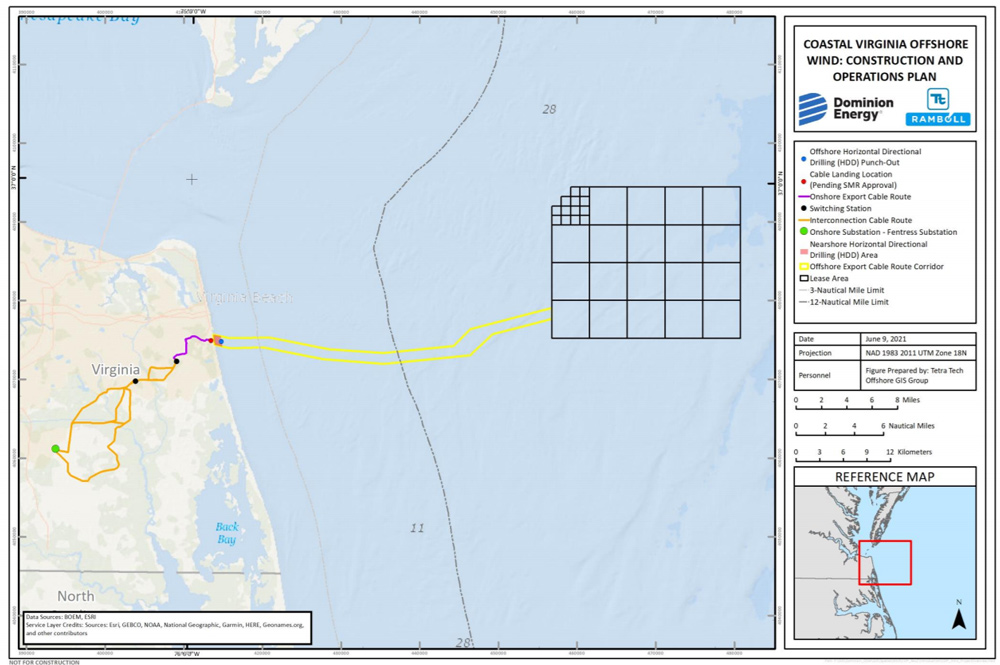
The project, with up to 205 turbines, will be located 27 miles from Virginia Beach.

It will require up to 300 miles of “inter-array” cables between turbines and up to nine submarine HVAC offshore export cables. The COP envisions up to three offshore substations and two cable landing locations at the State Military Reservation or Croatan Beach in Virginia Beach, or both.

CVOW-Construction-and-Operations-Plan-map-(Dominion-Energy)-Content.jpg
Map of the construction and operations plan for Dominion Energy’s Coastal Virginia Offshore Wind project | Dominion Energy

It will connect to the PJM grid at Dominion’s existing Fentress Substation.

BOEM’s EIS will evaluate positive and negative impacts to air quality, water quality, bats, fish habitat, wetlands and commercial and recreational fishing. “Based on a preliminary evaluation … BOEM expects potential impacts to sea turtles and marine mammals from underwater noise caused by construction and from collisions with project-related vessel traffic,” it said.

BOEM expects to make the final EIS public in May 2023, with a record of decision issued at least 30 days later. Based on the EIS and consultations with stakeholders, BOEM will decide whether to approve, approve with modification, or reject the COP.

Last month, BOEM announced the North Atlantic Division of the United States Army Corps of Engineers (USACE) will assist it in planning and reviewing renewable energy projects on the Outer Continental Shelf (OCS), starting with the Dominion project and Avangrid’s (NYSE:AVR) Kitty Hawk project off North Carolina.

The partnership resulted from President Biden’s Executive Order 14008, which directed interagency consultation between Interior and the Department of Defense to increase renewable energy production on public lands and  offshore waters.

Last year, Northam and the Virginia General Assembly set a target of 5.2 GW of offshore wind by 2034.

The state’s Department of Mines, Minerals and Energy (DMME) has created a Division of Offshore Wind to work with stakeholders and coordinate economic development opportunities.

The Port of Virginia, located 30 nautical miles from the Dominion project, is being upgraded to accommodate the heavy loads involved in the construction of offshore wind projects.

A report conducted for DMME found the Port’s Portsmouth and Newport News marine terminals are best prepared for roles in the OSW buildout. “They each have sufficient space to accommodate multiple, co-located offshore wind activities, making them candidates for a future offshore wind manufacturing and deployment hub. The necessary upgrades to meet offshore wind requirements would cost up to $10 million at each port,” it said.

Minnesota Utilities Struggling to Meet Low-income EE Goals as Legislators Boost Targets

Minnesota’s electric utilities will be required to meet increasing energy efficiency targets under a bill signed by Gov. Tim Walz in May. But a recent report by the state Department of Commerce shows some utilities are not meeting all of the old, lower targets.

The Energy Conservation and Optimization (ECO) Act (HF164) raises the annual energy savings goals for the state’s electric investor-owned utilities from 1.5% to 1.75% and quadruples their low-income spending requirement to 0.4% of gross operating revenues. It also requires utilities to file Conservation Improvement Programs (CIP) with the Minnesota Public Utilities Commission for programs funded by ratepayers but administered by the utilities.

The Department of Commerce’s Energy Policy and Conservation Quadrennial Report 2020, released March 1, says that electric utilities exceeded the original 1.5% goal in both 2017 and 2018, the most recent data available, and that natural gas utilities exceeded the statutory minimum of 1%. The programs saved 15.2 trillion BTU of energy — equal to the annual energy demand of 160,000 Minnesota homes — and reduced CO2 emissions by 1.79 million tons, equivalent to the annual emissions of 350,000 vehicles.

Falling Short on Targets

But the department said a separate dataset for 2019 found that some electric and gas utilities failed to meet their low-income targets.

Xcel Energy (NASDAQ:XEL) met its $2.49 million spending goal on low-income plans, but it saved only 2.39 GWh, a 27% shortfall from the 3.26-GWh goal. Otter Tail Power (NASDAQ:OTTR) and ALLETE’s Minnesota Power (NYSE:ALE), by contrast, spent somewhat less than their goal but exceeded their savings targets.

Of the state’s five natural gas utilities, only one — WEC Energy Group’s Minnesota Energy Resources (NYSE:WEC) — met its low-income savings goals, although three of the five met or exceeded the spending goals.

Low-income programs typically fund energy audits that identify and pay for improvements such as air sealing, weatherization, and replacements of furnaces and other equipment. There also are customer rebates for purchasing and installing energy-efficiency measures in multifamily buildings or nonprofit affordable housing.

“Administering low-income programs can be challenging for utilities and their vendors,” the report acknowledges. “Challenges include finding eligible and interested customers, perceived challenges in meeting U.S. [Department of Energy] WAP [Weatherization Assistance Program] requirements, accommodating the needs of both WAP and CIP, and working with many different Community Action Partnership agencies throughout the utility’s service territory. Commerce continues identifying areas of improvement and working with stakeholders to effectively deliver these programs.”

One challenge, Commerce told NetZero Insider, is that the client needs to be a customer of the utility delivering the program; if the client is a renter, landlord involvement may be necessary. Homes also need to be in a safe condition to weatherize and not in need of major structural repairs.

“CIP contracts are with individual utilities and each service provider, and each utility is unique,” a spokesperson said. “Some combinations are a great match and others are not. All can be affected by changes in funding sources, workforce trends and organizational capacity.”

The ECO Act will boost spending on low-income programs. IOUs’ (defined as “public utilities”) minimum spending increases from 0.1% to 0.4% of its gross operating revenues. “Consumer-owned utilities” (municipal utilities and cooperatives) must spend at least 0.2% of gross operating revenues on such programs, up from 0.1%. Natural gas utilities’ minimum increases from 0.4% to 0.8%.

Consensus Took 6 Years

Government and private clean energy groups across the state hailed ECO as the biggest clean energy win since 2013, when the state enacted several laws boosting solar power. The new bill did not come easily. Bipartisan and diverse special interest consensus required six years of hard work and deep collaboration, according to Mike Bull, director of policy and external relations for the Center for Energy and Environment (CEE), a Minnesota-based clean energy research and implementation nonprofit.

In 2015, the House of Representatives passed a bill that would have repealed the CIP program.

“There was grumbling from some stakeholders that … CIP was not delivering value to Minnesota ratepayers, despite all of the checks and balances in the regulatory system to ensure that value,” Bull said. “Although we were able to stop that 2015 proposal from becoming law, it served as a tremendous wake-up call. We knew we needed to reconnect key stakeholders to the benefits of energy efficiency.

“In developing the bill,” he added, “we painstakingly layered each stakeholder’s ‘gotta-haves’ in alignment with everyone else’s.”

The bill:

      • allows public utilities to recover through energy rates investments in “innovative clean technologies” that are not widely deployed among utilities and that provide net economic benefits to ratepayers if approved by the PUC. Cost recovery is limited to $6 million over three consecutive years for Xcel and CenterPoint Energy and $3 million for other public utilities.
      • increases the state’s annual energy savings goal from 1.5% to 2.5%: electric IOU targets increase from 1.5% to 1.75% of annual retail sales; consumer-owned utilities (municipal utilities and cooperatives) remain at 1.5%; and that for gas utilities is reduced from 1.5% to 1%. The changes were based on the Energy Efficiency Potential Study prepared for the Department of Commerce by CEE and others, which targeted an 11% reduction in gas use between 2020 and 2029.
      • requires public utilities to incorporate programs to improve energy efficiency in public schools.
      • encourages utilities to implement load management programs to shift energy demand from peak times by allowing the companies to obtain financial incentives for programs approved by the PUC. The previous law only allowed for cost recovery. ECO allows utilities to make load management investments utility assets on which a rate of return can be earned.
      • allows utilities to count fuel switching — substituting electricity or natural gas for a customer’s current fuel — in their energy savings and directs the commissioner of Commerce to develop a method for calculating them. Fuel switching is permitted if it reduces the overall amount of energy used, reduces greenhouse gas emissions, is cost-effective and improves the utility’s load factor, an efficiency metric calculated as the ratio of average demand to peak demand. The fuel-switch language prompted the Minnesota Propane Association to oppose the bill, fearing a switch to electric heat pumps. Natural gas heats most Minnesota homes and buildings, but many rural communities rely on propane. The Minnesota Chamber of Commerce also opposed the fuel-switching provision, citing fears of higher energy costs.

Tight Timeline

With the climate crisis looming even larger than when negotiations on the energy-efficiency program began six years ago, all participants realize there can be no pause in implementing ECO, said Anthony Fryer, Commerce’s CIP supervisor, in a June 17 presentation on the law to the Midwest chapter of the Association of Energy Services Professionals.

Commerce has begun stakeholder processes to assist in developing technical guidance on implementing changes under ECO. The timeline:

      • guidelines for multifamily buildings with low-income consumers: Aug. 1.
      • methodology for determining sales for electric vehicle charging: Dec. 31.
      • technical guidelines for fuel-switching programs and calculating energy savings: March 15, 2022.
      • preweatherization measures for low-income consumer programs: March 15, 2022.

The state’s energy-efficiency standards have saved consumers $6 billion in the last 20 years, Fryer said, and that improved efficiency keeps bills low and supports 47,000 jobs in Minnesota.

The ECO Act updates the CIP framework to provide a more holistic approach to efficiency programming and will increase those economic benefits, Fryer said. Because the technical guidelines will be developed by public and private participants, he said there is no overall estimate yet of what the overall savings will be.

“ECO will provide opportunities to leverage energy demand as a more active and significant part of our state’s clean energy transition, opening doors to a greater range of fuel choices and more opportunities to benefit from energy use timed to align with periods of lower demand on our energy grid,” Bull said.

Researchers in Massachusetts Test Tidal Energy

Researchers from the New England Marine Renewable Energy Collaborative (MRECo) tested how tidal turbines affect the environment around them in the Cape Cod Canal last week.

The team used a camera and acoustic system to assess how a small steel turbine would impact water conditions, as well as fish and other wildlife, in the Bourne Tidal Test site for 48 hours.

A tidal turbine works like a wind turbine, using heavy blades to turn a rotor that powers a generator. They are placed on the sea floor, or at the bottom of an estuary or a river with a strong tidal flow.

The 2-meter turbine prototype was built by Littoral Power Systems, based in New Bedford, Mass.

One of the primary benefits of tidal energy is the predictability of tides, according to John Miller, executive director of MRECo.

“We’ve been predicting tide patterns for centuries,” Miller said.

Additionally, the demonstration on the Cape Cod Canal on the southern coast of Massachusetts found virtually “no environmental impact,” he said. Other studies in Canada and Scotland have had similar results, showing that fish and other ocean wildlife have evolved to avoid the slow-moving blades, Miller added.

The steel turbines need to be fixed to the seabed, which has raised some concern that a large-scale tidal turbine infrastructure could disrupt water flow enough to change sediment flow. Building and maintaining them is a major hurdle to adopting the renewable energy technology, Littoral CEO David Duquette said.

The European Marine Energy Centre is advising Littoral on how to mitigate environmental issues that tidal turbine energy could cause.

Researchers also are investigating how to develop a propulsion mechanism that more closely mimics how animals have evolved to move in water, such as the motion of a whale’s tail going up and down.

Wind turbine blades mimic wings, and “you don’t see wings in the water,” Miller said.

But the cost of testing these technologies is high.

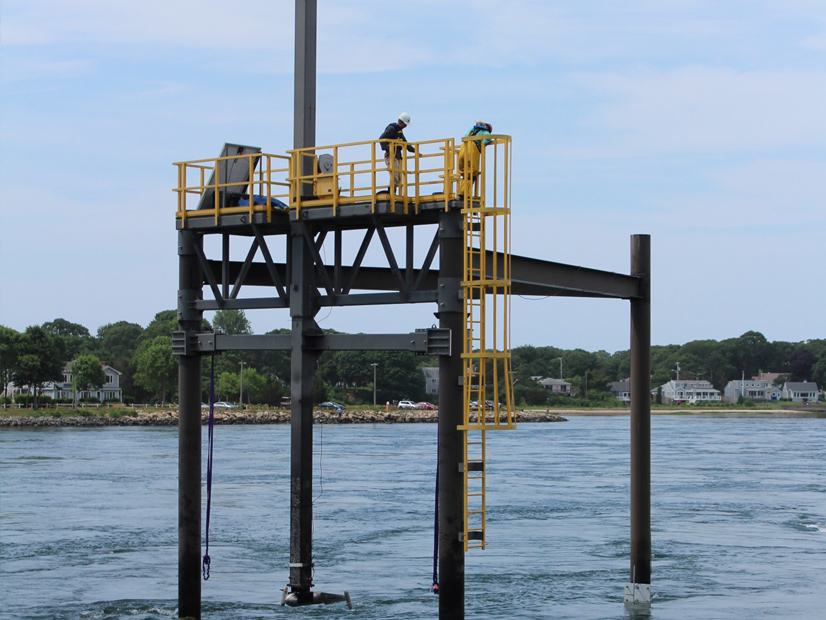
MRECo, which spun off as a nonprofit from the University of Massachusetts research center, established the Bourne Tidal Test Site in 2018 to avoid some of those costs.

Bourne-Tidal-Test-Site-(New-England-Marine-Renewable-Energy-Collaborative)-Alt-FI.jpg
The Bourne Tidal Test Site in the Cape Cod Canal | New England Marine Renewable Energy Collaborative

The demonstration last week was funded by the Massachusetts Seaport Economic Council at a total cost of $400,000. With a designated testing site already at their disposal, the energy collaborative has a much lower testing cost than other researchers. Developing a testing site alone can cost up to $1 million, Miller said.

Previous tidal turbine testing in both the Northeast and Europe went from a university tank to a real-world test of turbine systems 30 to 40 feet in diameter, Miller said. Those large sites typically have a water velocity of 6 knots, equivalent to a 400-mph wind, he added.

“That’s like testing a wind turbine in a hurricane,” he said.

Tidal turbine blades have flown off some tests because the system was not tested at an interim level. The Cape Cod Canal, which runs at about 4 knots, allows researchers to develop the technology at lower speed, increasing the number of places the technology could be deployed, Miller said.

Some of the first large-scale tidal turbines in countries like Canada and Scotland have a diameter of 40 feet and a generating capacity of 1 MW.

But the Ocean Renewable Power Co. is planning to install a utility-scale tidal energy project in the Cook Inlet in Alaska that with a generating capacity of 5 MW. And in Scotland, Simec Atlantic Energy is now planning a tidal power project with a proposed generating capacity of 398 MW.

“We are just getting our toes wet in the U.S.,” Duquette said.

The site in Cape Cod also serves as a place for other companies to test underwater sensors. OpenCape, which provides fiber optics for Cape Cod and southeast Massachusetts, is working with the energy collaborative to install broadband on the test site platform.

Now, the nonprofit is focusing on adding power to the platform, which would also allow the tidal turbines to supply energy to the grid eventually.

Stakeholders Back PJM MOPR-Ex Replacement

PJM stakeholders voted overwhelmingly Wednesday in support of the RTO’s proposed replacement for the extended minimum offer price rule (MOPR-Ex), handing the recommendation to the Board of Managers.

The RTO’s proposal, which would apply the MOPR only to resources connected to the exercise of buyer-side market power or those receiving state subsidies conditioned on clearing the capacity auction, bested eight other plans in a special Members Committee meeting. It received an 87-18 vote for a sector-weighted score of 4.18/5 (83.6%).

Two other proposals also won majority support but fell short of the two-thirds sector-weighted threshold for a positive recommendation. American Municipal Power’s (AMP) proposal won a 68-30 majority (3.25/5), while the Delaware Division of the Public Advocate’s received a 54-37 vote (2.98/5). Most of the others received less than 20% support.

Dave Anders, PJM’s director of stakeholder affairs, emphasized, however, that the votes were advisory and that the board was not bound by them in proposing tariff changes to FERC under Section 205 of the Federal Power Act. “It does not require a positive, weighted vote,” he said.

“We expect the board will consider all of this in their decision-making,” he said after the vote.

The vote was conducted at a public MC meeting following a closed session with board members in which stakeholders debated the proposals. Proponents were permitted up to three minutes to lobby for their plan in the public session, and several of them used their time to rebut criticism they had heard at the earlier session.

The vote was conducted under the RTO’s critical issue fast path (CIFP) accelerated stakeholder process mechanism, initiated by the board in April. It was the latest development in an 18-month saga that has whipsawed PJM and caused the cancellation of the 2020 Base Residual Auction (BRA).

PJM adopted the extended MOPR in response to FERC’s 2-1 ruling in December 2019 saying MOPR should apply to all new state-subsidized resources to combat price suppression in the capacity market (EL16-49, EL18-178). Then-Chair Neil Chatterjee and fellow Republican Bernard McNamee formed the majority, with Democrat Richard Glick angrily dissenting, calling it an attack on state decarbonization efforts.

Glick asked PJM to undo the rule after he was named chairman by President Biden in January. (See PJM MOPR in the Crosshairs at FERC Tech Conference.)

Before Wednesday’s vote, board Chair Mark Takahashi thanked stakeholders for their efforts. While noting that members disagreed in their approaches and legal opinions, he said “everything was extremely professional and very helpful to the board.”

‘Maximize Transparency and Market Confidence’

PJM said its approach “will maximize transparency and market confidence while ensuring PJM and the Independent Market Monitor are able to mitigate the exercise of BSMP [buyer-side market power] when it is identified, while also better accommodating state public policies and self-supply business models.”

“Exercises of BSMP require both the ability and incentive to do so. It is the exercise of BSMP that shall be prohibited,” PJM said in a presentation.

Market participants will be asked to sign attestations declaring that they are not exercising market power or receiving state funds tied to clearing in the auction.

The RTO said it and the Monitor will conduct “fact-specific,  case-by-case reviews” if it suspects market power. “Upon that review, should PJM or the IMM have concern that the market seller provided a misrepresentation or otherwise acted fraudulently, PJM or the IMM may make a referral to FERC for investigation,” it said.

With the new rules in place, PJM would eliminate both the expanded MOPR and the prior MOPR, which was limited to new natural gas resources. The board has pledged to have new rules in place for the December BRA for delivery year 2023/24, with a FERC filing expected by the end of July.

Different Approaches

The second-most popular proposal, from AMP, would have determined whether a load-serving entity can exercise market power by determining its ability to influence capacity prices based on its size relative to the rest of its  constrained locational deliverability area. “PJM should not be put in a position of having to determine appropriate versus inappropriate intent,” AMP said.

PJM’s proposed procedure for determining whether a resource is receiving state subsidies conditioned on clearing the capacity auction | PJM

The Delaware Division of the Public Advocate said it combined parts of PJM’s plan and one from Exelon. It would provide an exemption for “emerging technologies,” citing the Bloom Energy fuel cell in Delaware and offshore wind.

The Monitor’s proposal also would exempt emerging technologies such as offshore wind and carbon capture and sequestration that would not otherwise be competitive. “It is not undue discrimination to distinguish between subsidies for uneconomic, emerging technologies and subsidies for mature technologies,” it said.

The IMM also would have PJM exempt self‐supply entities whose net long position did not exceed 15%. All resource types would be subject to review. “Intent is not relevant. Profitability is not relevant,” says the proposal says, rejected by stakeholders 20-81.

Monitor Joe Bowring said it would keep the MOPR in place with “de minimis” impact on auction results. “Contrary to the assertions of some this morning, our proposal is not anti-ZEC,” he said, referring to state zero-emission credits for nuclear plants.

Kicking the Can

Calpine won only 10 votes for its “Sunrise” proposal, which would suspend the MOPR rules through the BRAs in December and June 2022 (delivery year 2024/25) to allow stakeholders to conduct a broader review of capacity market rules.

“Calpine is against just changes in the MOPR,” David “Scarp” Scarpignato said in remarks before the vote. “We think PJM has to take a more holistic approach.”

Among other changes, Calpine wants to increase Capacity Performance penalties and require dispatchable resources to have 16 hours of guaranteed run time for three days through on-site fuel, backup fuel or contracted LNG.

If no agreement could be reached, the existing MOPR rules would become active again — the “sunrise” — for delivery year 2025/26.

Exelon (NASDAQ:EXC) said Calpine’s proposal would “‘kick the can down the road,’ holding MOPR reform hostage to other capacity modifications that will be controversial and are likely to be delayed.”

Instead, Exelon proposed use of an “objective” buyer-side market power test that was effective through 2018. It would use two “bright line” screens: one to address state policies targeted at modifying auction prices, and one to address buyer-side market power.

“Mitigation should only be applied to capacity market offers of new gas-fired units. New gas units are widely acknowledged to be the least expensive incremental capacity resource and therefore the most effective means of successfully exercising buyer-side market power,” Exelon said in its presentation. “Simply put, it makes little economic sense for a buyer to invest in any resource other than a new gas-fired unit if it were attempting to exercise buyer market power.”

Exelon said its proposal is targeted at the Supreme Court’s holding in Hughes v. Talen Energy Marketing, which  outlawed state policies “tethered” to PJM’s federally regulated market.

“State policies that provide value for clean energy attributes that are not conditioned upon clearing in the PJM capacity market are legitimate exercises of state authority; not exercises of market power,” Exelon said. “PJM has every reason to accommodate and respect the state policy. Both the Supreme Court and lower federal courts have acknowledged that nearly every state policy can ‘affect’ PJM capacity market outcomes, without such policies constituting an impermissible intrusion into” federal jurisdiction.

Exelon said the current MOPR rules, which cover ZEC payments, resulted in the transfer of more than $35 million in capacity market revenue from its Illinois nuclear plants to emitting fossil resources in the 2022/23 auction in May. Exelon’s proposal failed 27-66.

Another nuclear operator, Public Service Enterprise Group (NYSE:PEG), also attempted to protect its New Jersey units receiving ZECs with what it called the “Carbon Adjusted Minimum Offer Price Rule.”

It said FERC’s December 2019 ruling on a complaint by Calpine and others “did not take account of the price-distorting impacts of a lack of a price for carbon in the PJM markets.”

PSEG’s proposal would exempt all zero-carbon support programs created by states from the MOPR. PSEG says most zero-carbon programs within the PJM footprint have implied costs of carbon below the federal social cost of carbon and that the two programs with costs above that level — the New Jersey and D.C. solar renewable energy credit programs — are too small to have a material impact on capacity market prices.

It said it would improve the economic efficiency of the market, remove obstacles to states’ carbon-reduction efforts and “establish PJM’s leadership as a change agent in moving towards the establishment of a carbon-free energy economy.”

“Programs designed by states to promote other policies — for example, a state program to help keep coal plants in operation — would not pass this test” and would be subject to the MOPR, PSEG said. Its proposal failed 11-87.

E-Cubed Policy Associates, representing Elwood Energy, proposed testing all new-entry resources and certain existing resources receiving out-of-market revenues through non-bypassable charges. It said it would avoid “the messy and likely costly legal battles of what state policies should or should not be subject to MOPR.” It failed 16-73.

The least popular proposal was LS Power’s “repricing” plan, in which PJM would clear the auction with the MOPR to establish the total cost to load. Then it would have a second run including resources subject to the rule that did not clear and divide the total cost to load by the total megawatts. Resources could withdraw from consideration if prices were lower than it needed as expressed in its bid.

LS Power’s Tom Hoatson used his time to dispute “this notion that all we’re interested in is high capacity prices.

“What we’re interested in is a competitive outcome,” he said. The proposal failed 7-82.

NJ Awards Two Offshore Wind Projects

New Jersey awarded its second offshore wind solicitation to two projects with a combined capacity of 2,658 MW Wednesday, giving developer Ørsted its second project in the state, and the other to a joint venture between EDF Renewables North America and Shell New Energies US.

The New Jersey Board of Public Utilities (BPU) said it concluded that it could create a more competitive wind sector and accelerate efforts to create an industry hub by assigning two projects.

The two projects will generate electricity equivalent to the amount needed to power 1.15 million homes. Ørsted’s Ocean Wind II, located about 14 miles from the New Jersey shoreline, will generate 1,148 MW and is expected to be completed in three phases in 2028 and 2029. Ørsted is also developing Ocean Wind, an 1,100-MW project off the state’s coastline. Atlantic Shores, by the EDF/Shell partnership, will generate 1,510 MW of electricity in a wind field between 10 and 20 miles off the Jersey Shore near Atlantic City, with completion expected in two phases, in 2027 and 2028.

New Jersey plans another four solicitations, scheduled every two years, to reach its goal of deploying 7,500 MW of capacity by 2035. The first and second awards, if completed, would account for about half the targeted capacity.  

State officials said the award was the largest offshore wind project award in the nation and described it as a major step forward in the state’s effort to reach the target of generating 50% of its electricity through renewables by 2030, and 100% clean energy by 2050. They also sought to cast it as a sign of the state’s strength in the East Coast’s rapidly growing offshore wind sector.

“Today’s award further solidifies New Jersey as an offshore wind supply chain hub,” Gov. Phil Murphy said in a release. “This award ensures that our investment in clean energy is also an investment in our communities and will generate good-paying, union jobs and bring valuable investments to New Jersey.”

Rapidly Growing Sector

The first commercial scale offshore wind energy project in the U.S., Vineyard Wind off the coast of Massachusetts, gained final permit approval from the Bureau of Ocean Energy Management (BOEM) on May 11.

The Biden administration has pledged to build 30 GW of offshore wind in the U.S. by 2030, and in March announced that it would open a new area, New York Bight, to offshore wind development between Long Island and New Jersey. New York has set a goal of generating 9 GW of offshore wind capacity by 2035 and has five projects in the works totaling 4.4 GW.

Before the board’s 5-0 vote on the two projects, BPU Commissioner Bob Gordon said the decision not only showed the state is serious about combating climate change, but also is “making a long-term commitment to offshore wind.”

“We want to build the regional supply chain here in New Jersey,” he said. ”We want to foster innovation and competition. We want to build a whole new industry and the jobs and the economic opportunity that come with it.”

In outlining their recommendation that the board back the two projects, BPU staffers said both will use the New Jersey Wind Port, a manufacturing and logistics hub for the offshore wind sector in Lower Alloways Creek in Salem County, and a monopile manufacturing plant under construction in the Port of Paulsboro.

Ørsted said it would build a nacelle manufacturing plant at the wind port with GE. David Hardy, CEO of Ørsted Offshore North America said the award of the latest project would strengthen the company’s ties to the state.

“We’re thrilled to grow this global industry alongside the state of New Jersey, as well as help all communities in the state benefit from the offshore wind industry,” he said.

Ørsted has financed and has equity interests in 24 offshore wind partnership worldwide, including the Block Island Wind Farm, the first commercial offshore wind project in the U.S.

The Atlantic Shores project, which has agreed to use union labor, will create a nacelle assembly facility at the state’s wind port. The developer will also collaborate on a project to research, monitor and analyze the deployment of hydrogen technology and natural gas blending.

“As offshore wind prepares to take off in the United States, this is a critical moment to lay the groundwork for workforce training and supply chain development,” said Joris Veldhoven, commercial and finance director at Atlantic Shores. “Our robust project includes a number of essential initiatives to train local workers and bring manufacturing jobs to the state.”

Both project developers will also contribute $10,000 per MW to a fund that is expected to accumulate $26 million for use on research initiatives and wildlife and fishery monitoring in the region, the BPU said.

Mixed Reception

In June 2019, New Jersey awarded its first offshore wind contract to Ørsted’s Ocean Wind project, which will be built 15 miles from Atlantic City. It is expected to begin operations in 2024, and is now quarter-owned by Public Service Enterprise Group (NYSE:PEG). (See Orsted Wins Record Offshore Wind Bid in NJ.)

The project has faced opposition from the tourism and fishing industries, as well as some residents, who are concerned about the impact. Yet state legislators showed their commitment to ensuring that offshore wind projects move ahead by passing legislation last week that would allow offshore wind developers to override local and state government to site transmission lines and related infrastructure for their projects on public land. The bill now sits on Murphy’s desk. (See NJ’s Offshore Wind Project Faces Criticism, Support and NJ Lawmakers Back Offshore Wind Bills)

The BPU opened the second solicitation last September, releasing a 142-page guidance document that outlined the requirements for companies looking to fulfill the offshore wind renewable energy certificate (OREC). BPU staffers said the two solicitations were evaluated through a variety of criteria laid out in state laws, including the projects’ impact on ratepayers, the economic benefits to the state, the environmental impact and the likelihood that the project would be brought to fruition.

The staff also looked at issues such as how the selection of a particular project would diversify the state’s risk in pursuing offshore wind projects, how they would spread the economic benefits around the state and how they would expand the supply chain for wind energy goods.

The projects will reduce greenhouse gas emissions by 5 million tons a year, equal to about 26% of the current green house gas emissions from electricity generation, the BPU said.

“These projects will go a long way toward helping New Jersey meet its long-term clean energy goals,” said Raymond Cantor, a lobbyist for New Jersey Business & Industry Association (NJBIA), one of the largest trade groups in the state. “We look forward to the creation of this new and dynamic industry.” Still, he added, “as we applaud the award of these projects, we are also mindful that we must still be vigilant to ensure that our electric grid remains reliable and that the energy we produce remains affordable.”  

Environment New Jersey and Sierra Club New Jersey also welcomed the BPU’s move, in part for the economic benefits and job creation it would bring to the state.

“With this procurement, New Jersey has continued to establish itself as a national leader in offshore wind,” said Taylor McFarland, acting director of Sierra Club New Jersey. “The clean energy boom is inevitable, and it is critical that New Jersey regulators are taking proactive measures to expand our offshore wind industry. This is the future, and we can either fall behind or stay ahead. I’m happy we’ve chosen the latter.”  

NERC Joins EPRI for RA Modeling Effort

Citing “emerging resource adequacy risks” making it ever more urgent for electric utilities to accurately assess resource adequacy, the Electric Power Research Institute (EPRI) announced an initiative on Tuesday aimed at building better RA research, assessment and modeling tools for all industry stakeholders.

EPRI’s effort is being undertaken in partnership with “grid operators, utilities, researchers and other key stakeholders” from the electric industry. The project has 12 initial participants including NERC; additional contributors are expected to join during the life of the project, which began in the first quarter of 2021 and will conclude in 2023.

EPRI sees the need for new RA tools as increasingly urgent in light of ongoing efforts to lower carbon emissions across the North American economy, causing energy use to shift from fossil fuels to electricity in fields like transportation, cooking and heating. At the same time, electric utilities themselves are trying to cut down on their carbon emissions by tapping renewable resources such as wind and solar.

However, these resources and their behavior are not always fully captured by existing adequacy metrics and models, as NERC and WECC warned in a joint report last year. (See NERC, WECC Warn of Inverter Modeling Gaps.) At the same time, EPRI warns, current methods may also not be adequate to account for “more frequent and severe storms and other weather impacts” resulting from climate change.

“Reliably meeting electricity needs 24/7 is increasingly important as electrification expands, becoming even more vital to the nearly 400 million people we serve in North America,” NERC Senior Vice President and Chief Engineer Mark Lauby said in a press release. “Through our collaboration with EPRI and other industry leaders, we are preparing for the transformation of the grid to ensure that resilience is sustained and improved, as the grid becomes more decarbonized, decentralized and digitized.”

Initiative Covers Metrics, Models, Tools

The initiative comprises four main tasks: developing RA assessment metrics, updating models and data, improving current commercially available RA assessment tools, and producing case studies using the new methods.

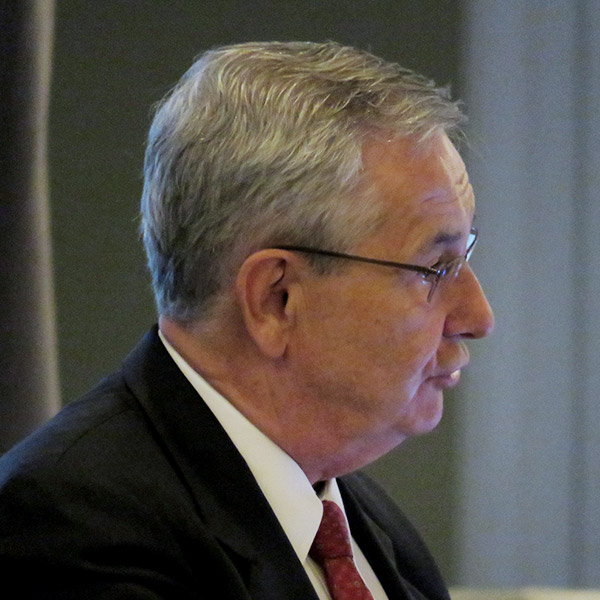
Lauby-Mark-2019-05-08-RTO-Insider-FI.jpg
Mark Lauby, NERC | © RTO Insider LLC

For the first task, EPRI and its partners will create guidelines for metrics that better reflect the nature of outages and the consequences of deficient supply, along with guidelines for setting adequacy criteria that take into account the specific needs of a system, the regulatory and market context, and available mitigating options. Participants will also deliver a “framework … for developing planning scenarios that account for evolving technology, policy and climate dimensions.”

In the models and data task, the group will target vendor-neutral reference models and algorithms that reflect the wider spectrum of technologies and the demand and system characteristics of the changing grid. Team members will also develop guidelines for streamlining the process of data collation in RA studies for new and existing models.

Under the third task, participants will document the capabilities of existing assessment tools — and those currently under development — regarding different resource mixes and regulatory/market constructs, while specifying new metric, model and algorithm improvements that could accelerate tool performance.

The final task involves performing case studies that will “demonstrate the analytic capabilities required for RA … illuminate the deficiencies of existing commercial … [research and development] processes and tools, and demonstrate and evaluate the methods being developed through this project.” Four to six case studies, covering differing regions, issues and tools, are expected to be produced through the initiative.

Participation is open to utilities and RTOs, research groups, tool vendors, regulatory groups and other stakeholders; nonproprietary products of the initiative will be made available to the public, either for purchase or otherwise.

“Utilities are transforming with their foot on the accelerator,” EPRI President and CEO Arshad Mansoor said. “Serving tomorrow’s energy customer means anticipating and preparing for high-impact events when, where and how they may occur. Through this initiative, EPRI is leading industry-level collaboration to understand and overcome power supply challenges before they happen.”

Former Wisconsin Commissioner’s Texts Imperil Cardinal-Hickory Creek Line

The embattled Cardinal-Hickory Creek transmission line’s reputation took another hit this week after owners American Transmission Co. and ITC Midwest discovered inappropriate communications between a former state commissioner and the companies’ employees.

ATC and ITC said they discovered former Wisconsin Public Service Commissioner Mike Huebsch was in regular contact with “an ATC employee and a former independent contractor for ITC” and other individuals for several years while Cardinal-Hickory Creek’s certificate of public convenience and necessity was pending before the commission.

According to the companies, Huebsch used the encrypted Signal software app to send messages, and it’s “presently uncertain whether these messages can be fully recovered.”

The companies filed a request Monday to rescind and reopen the certificate proceeding for the $492 million, 102-mile 345-kV line from Dubuque County, Iowa, to Dane County, Wis. (5-CE-146). Third minority owner Dairyland Power Cooperative also filed its support for the request.

In a joint press release the same day, the companies said they “have a shared interest in preserving transparency, fairness and integrity of all regulatory and judicial proceedings.” The two said they unearthed evidence of the encrypted messages during legal discovery for local conservation groups’ ongoing court case against the line in Dane County Circuit Court. ATC and ITC said they don’t know if the messages pertain to Cardinal-Hickory Creek.

“The individuals involved in this situation have maintained longstanding personal relationships with each other; however, we are aware this information raises concerns about one of the commissioners who granted approval of the Cardinal-Hickory Creek project,” ATC CEO Mike Rowe said. “We understand the speculation this presents, which is also why we have made this unique request to the PSC and are sharing this information with our employees, our stakeholders and Dane County Circuit Court.”

“The co-owners are committed to maintaining the highest ethical standards in all of our work, including proceedings before the PSC,” ITC Midwest President Dusky Terry said. “We are asking the PSC to rescind and reopen the Cardinal-Hickory Creek docket because we are committed to integrity and transparency in the regulatory process.”

ITC spokesperson Rod Pritchard said the company will not address “any further media questions at this time” regarding next steps for the line. ATC spokesperson Alissa Braatz said her company will send notifications only as new developments occur.

Conservation groups Wisconsin Wildlife Federation (WWF) and Driftless Area Land Conservancy (DALC) are fighting Cardinal-Hickory Creek’s construction in Dane County Circuit Court, alleging that Huebsch and PSC Chair Rebecca Valcq had perceived conflicts of interest when they voted to permit the line.

The conservancy has argued that the commissioners should have recused themselves on the grounds that Valcq  previously worked for WEC Energy Group, the parent company of line developer ATC, and that Huebsch, as a member of the Organization of MISO States, had communications with MISO. They also take note that Huebsch unsuccessfully applied to be CEO of Dairyland in February 2020, five months after he voted to approve the line. Huebsch now runs a government and regulatory consulting firm.

Huebsch Responds

Huebsch told RTO Insider that he had no improper discussions regarding the transmission project.  

“Like most people, I have used several different messaging apps over the years. Signal is one of them. I have described it as the ‘21st century coffee shop,’ where friends can get together, chat, and move on,” he said in a text message via LinkedIn. “The messages disappear, as they would if spoken at a lunch or on a conference call, and conveniently they do not jam up the phone’s storage capacity (like normal texts do).

“One of the groups of friends that I have discussions with over Signal I have known for over 25 years, some of them more than 30 years. Although some of them are connected to the utility industry, at no point have I discussed with them over Signal anything related to my work as a commissioner. That’s primarily because we are all aware of the law, and we know ex parte communication is not allowed. And frankly, the commission’s business is just not that interesting.

“We have discussed things like sports (the Packers and Bucks are very hot topics), health and family. We have bragged about our children and asked for advice and even prayer when things were tough, as longtime friends sometimes do. Some will try to make this appear to be more than it is for their own purposes, but as anyone who has friends knows, it’s not.”

The Cardinal-Hickory Creek line is the last unconstructed project of MISO’s 2011 Multi-Value Project (MVP) portfolio. With a decade behind the portfolio’s approval, MISO has already begun another long-term planning effort. The RTO last year predicted the line would be in service in 2023.

In late May, Dane County Circuit Court Judge Jacob Frost ruled that DALC and WWF could conduct discovery on whether Huebsch was biased “or had the appearance of bias” when he steered the Wisconsin PSC’s decision to approve the line.

“The right to an impartial decision-maker is fundamental to due process. Violation of that right would taint the entire proceeding and require I vacate the PSC decision and remand for further proceedings conducted in accordance with due process,” Frost wrote at the time when allowing discovery. A trial was initially set for September; that may be put on hold now.

DALC and WWF maintain that the line is unnecessary and “would cut a wide swath through the scenic Wisconsin Driftless Area communities, family farms and vital natural resources.” Public interest attorneys from the Environmental Law and Policy Center are representing the conservation groups.

ATC and ITC have argued that about 10 GW worth of renewable projects in the Upper Midwest are dependent on Cardinal-Hickory Creek’s construction and that the line is a “vital link to the future of our region’s renewable energy developments.”

Where There’s Smoke

Environmental Law and Policy Center attorney Howard Learner, representing DALC and WWF, said there’s no doubt that a biased process took place at the Wisconsin PSC.

“ATC and ITC’s revelations this week that their senior officials and representatives were engaged in secret texts reinforces that there were improper, ex parte communications with a commissioner, and it should invalidate the commission’s decision to grant a certificate of public convenience and necessity,” Learner said in a telephone interview with RTO Insider.

Learner said DALC and WWF already knew that Huebsch communicated extensively with ATC Manager of State Government Relations John Garvin, Dairyland Vice President of External and Member Relations Brian Rude and WEC Energy Group’s Executive Vice President of External Affairs Robert “Bert” Garvin. (WEC Energy Group is the majority owner of ATC.) Learner doesn’t know what the freshly discovered encrypted messages contain.

“We need to get of the bottom of the facts here and find out who was talking to whom and what they knew and when they knew it,” he said.

Learner said commissioners with pending cases on projects, especially controversial ones, “know better” than to communicate privately with project developers.

“As everyone knows, this is a hugely controversial line… In addition to smoke, there’s clearly some fire here,” Learner said. “The fact that ATC and acted this week to rescind and withdraw the certificate of public convenience and necessity basically speaks for itself. Why would they withdraw it unless they knew the state court would rule in our favor? One biased commissioner taints the others.”

Leaner said ATC, ITC and Dairyland now have the chance to reassess the line’s design and build a better project that more parties can agree on.

“We hope that this is an opportunity for state officials and ATC, ITC and Dairyland to not try to do the same flawed business-as-usual but look to better, less expensive, more environmentally friendly alternatives. ATC and ITC and other officials should seize this opportunity to do better… and reach common ground on better alternatives.”

Learner also said MISO itself probably needs to “step back and reassess the situation,” and pay more attention to the role that battery storage can play in easing major transmission needs.

“MISO’s decision to support the line was made a decade ago. The electric system world has changed as much in the last decade as the telecommunications world did when cell phones were replacing landlines. The world has changed enormously since MISO conceived of this project more than a decade ago. There should be a fresh start with a fresh look at the facts with a fresh set of eyes,” he said.

Learner said for example, ATC’s resource modeling for the line only contemplates 30 MW of solar development by 2019.

“There are thousands of megawatts of solar development in Wisconsin now,” he pointed out.

FERC OKs CAISO Wheel-through Restrictions

FERC approved the most controversial of CAISO’s summer readiness measures Friday, saying the ISO’s new limits on wheel-throughs to promote in-state reliability are reasonable and do not violate the commission’s open access transmission principles (ER21-1790).

In doing so, the commission rejected opposing arguments by a coalition of Arizona’s major utilities, along with NV Energy, the Bonneville Power Administration, Powerex, Idaho Power, Portland General Electric and others. Opponents argued the CAISO rule changes are discriminatory and overly burdensome, among other objections.

The CAISO plan reprioritizes wheel-throughs so that transfers between the Northwest and Southwest would no longer take precedence over capacity needed to serve CAISO native load. Non-CAISO entities would have to apply at least 45 days in advance to designate high-priority wheel-throughs needed for reliability, giving the wheels equal standing with native CAISO load.

They would also have to demonstrate that they have firm generation behind the transfers and firm transmission to reach CAISO’s borders. (See CAISO Approves Controversial Wheeling Limits.)

CAISO has insisted that the plan is a short-term fix, for this summer only, to avoid transmission congestion and capacity shortfalls like those that led to rolling blackouts last August. It has started a stakeholder initiative to find longer-term solutions.

FERC said it preferred that the changes be temporary but found nothing wrong with the new rules.

“CAISO’s proposal adjusts its prioritization such that wheeling through transactions that meet [its requirements] … receive curtailment priority on par with CAISO’s imported resource adequacy resources,” FERC said. “We find that this prioritization will result in a just and reasonable interim solution that will reconcile the needs of both CAISO load and external load.”

Transmission congestion was a factor in the Aug. 14-15 rolling blackouts, but wheel-throughs were not, CAISO said. The ISO said it made the wheel-through rules part of its summer readiness measures because entities in the Southwest were contracting for larger amounts of energy from the Northwest in anticipation of summer resource scarcity.

Much of that capacity travels on transmission paths through California, potentially causing transmission congestion in CAISO. (See Wheeling Debate Tests West, CAISO CEO Says.)

The plan was so disputed that, in a rare move, the Governing Body of the CAISO’s Western Energy Imbalance Market declined to “opine” on the plan, though stopped short of rejecting it. (See EIM Governing Body Rejects Part of CAISO Summer Plan.)

Webinar Explores EV Charging for Multi-unit Housing

When it comes to increasing the availability of electric vehicle charging at apartment complexes, Level 1 charging is a big part of the solution, according to speakers at a webinar on EV charging equity in California.

With a 10-hour overnight charge, a Level 1 charger provides 40 to 50 miles of range — enough for most residents’ daily needs, said Peter Ambiel, energy programs specialist with Peninsula Clean Energy. PCE is a community choice aggregation program serving San Mateo County.

But the tendency is to overbuild charging stations at multi-unit housing complexes, Ambiel said Friday during a webinar hosted by the California Community Choice Association (CalCCA). The group represents the state’s community choice electricity providers.

“They’re putting too much capacity per port, which incurs extra costs,” Ambiel said. “You don’t need to put as much power into these stations because you meet drivers’ daily needs with a much lower threshold.”

Cost Differences

As an example, Ambiel presented a case study of installing 17 EV charging ports at a San Mateo County apartment complex. The cost for equipment and installation of 15 Level 1 stations plus two Level 2 stations would be $90,600. The cost if all 17 stations were Level 2 would be $251,500, or possibly higher if a new transformer were needed.

Because most apartment complexes assign parking spaces to their residents, a complex would ideally provide a Level 1 charger at every assigned space, Ambiel said. In addition, an apartment complex might want to provide Level 2 charging in shared spaces for occasions when a resident wants to charge up for a longer trip.

Level 1 charging is especially important for older or smaller multi-unit complexes, Ambiel said, because it may allow them to avoid significant panel or transformer costs.

PCE is running a $28 million electric vehicle charging infrastructure program called EV Ready, which aims to install 3,500 charging ports in San Mateo County over four years. The program includes a target of 1,075 Level 1 and 335 Level 2 charging stations at multi-unit housing complexes.

EV Charging Disparities

Electric vehicle charging is frequently not available at multi-unit housing complexes, which are often home to lower-income residents. About 30% of Californians, or more than 10 million people, live in multi-unit housing, according to the webinar presentation.

In the San Francisco Bay Area, about 60% of residents live in multi-unit housing, but only 10% of electric vehicles are owned by people living in multi-unit housing, according to webinar speaker Sherry Bryan, a program manager with Ecology Action.

“That’s a huge disparity,” Bryan said.

Providing EV charging for residents has no return on investment for apartment owners, Bryan said. And EV service providers aren’t that interested in multi-unit complexes, where the amount of charging may be less than at workplaces or charging destinations, she said.

“If you want to increase equity, especially [in] affordable housing, coming at the property owner with a no-cost, free installation is probably your best way to go,” Bryan said. “Any kind of cost-share is going to pause the conversation.”

Ecology Action is a nonprofit that offers community programs aimed at reducing greenhouse gas emissions. One of its programs provides free installation of EV charging stations at apartment complexes.

Bryan said EV charging assistance programs shouldn’t require a certain amount of electricity use. It could take as long as a year before residents start using the charging stations, she said, noting that residents may need to save money to buy an EV.

And requiring a minimum number of ports may exclude smaller complexes, Bryan said.

Ecology Action has used EV charging equipment from Plugzio, which allows the property owner to collect payment for electricity used during charging.

Resident Education

Bryan said resident education is an important component of the EV charging programs. Information about EVs can be shared with residents by going door to door or by posting fliers in community spaces such as laundry rooms.

Another strategy is to roll out an electric vehicle during a community event such as a movie night. Many residents may not have seen an EV before, Bryan said. Tenants interested in an EV can be directed to purchase guidance and incentive programs.

Bryan said a question she often hears is why should someone buy an EV in an era of rolling blackouts and power outages. She said a plug-in hybrid may be a good initial choice for some apartment residents, who may rely on a single car.

“That gives the person the flexibility to have gas if they need it, but also to do most of their day-to-day commuting and errands on a battery,” she said.