Texas PUC Briefs: June 24, 2021

Commission Shortens Release of Generator Outage Data to 3 Days

Texas regulators last week directed ERCOT to waive its protocols and disclose generator outage information in three business days after an outage, rather than the standard 60 days.

The action comes after an unusual large number of forced outages led ERCOT to ask for weeklong customer conservation on June 14 to avoid another disaster similar to February’s. (See Generation Outages Force ERCOT Conservation Alert.)

In a memo filed before Thursday’s open meeting, Public Utility Commission Chair Peter Lake said the commission needs more transparency and information on forced outages and that the data should quickly be made available to the general public (51617).

“Recent events have made it clear that, when it comes to forced outages, the public deserves to know what generation units are unavailable, the amount of unavailable capacity, the cause of the outage and when the units are expected to return to service,” Lake wrote.

The commission, with newly sworn-in Lori Cobos joining Lake and Will McAdams, was unanimous in its decision as it tries to determine why the outages occurred. Was it the weather? Was it damage from February’s winter storm? Was it something else?

“Transparency is a means to send market signals to stakeholders, both private companies and the [municipalities] who have significant generating capabilities and are more than likely involved in the outages,” McAdams said. “It’s important to invest in your maintenance, to adequately perform maintenance, to rehab your facility to meet basic reliability parameters which are commonplace in the industry.”

The commission made the waiver effective June 1 to Sept. 30 to ensure that the forced outages earlier in the month are made available, along with additional outages through the summer. It gave ERCOT seven days from the PUC’s order to make the information available on its website.

Lake said he is asking for the generation units that are unavailable, the amount of unavailable capacity, the outage’s cause and when the units are expected to return to service. He said the PUC could work with staff on potentially adding company names.

Michele Richmond  executive director of Texas Competitive Power Advocates, a trade association that represents 70% of the state’s competitive generation — urged caution in what information ERCOT eventually releases.

“We need to accept that machines require maintenance. That is just a fact. We want generators to do that to gain maximum performance and extend the useful life of the plant,” she said. “Providing the info … in a shorter time frame doesn’t bring additional capacity online; it doesn’t enhance reliability. … We’re trying to understand the goal of doing so.”

Richmond said her trade group would work with the PUC and ERCOT in working to place the outage data in proper context.

“Without that, there’s the potential that information could be misleading to the public and lead to misinformed political discourse,” she said.

ERCOT said it was “fully onboard” with the PUC’s efforts to increase transparency and accountability.

“Our team is working on the best way to present the outage information as directed in a timely fashion and with the requested degree of detail,” spokesperson Leslie Sopko said in an email.

Sopko said that as of 2 p.m. Friday, ERCOT still had 10.98 GW of generation offline, much of it for mechanical failure or other issues. The grid operator had 12.2 GW of forced outages when it called for conservation measures on June 14.

ERCOT had more than 9 GW of operating reserves on hand Friday, she said, a result of a “more aggressive” approach to maintaining a larger minimum amount of reserves and ensuring it can meet demand during unexpected tight conditions.

Woody Rickerson, ERCOT vice president of grid planning and operations, said the grid operator classifies three different levels of outages: planned, 45 days in advance; forced, when something breaks or leaks; and maintenance-level, for pending outages to prevent a forced outage.

He told the commission that ERCOT has noticed a “bubble” of forced outages that stubbornly fails to dissipate.

“We’re seeing that at the end of the day, forced outages that were supposed to end are being extended another day. [The bubble] keeps moving one day to the next and the next,” Rickerson said.

Commission Nixes Gas Index Link

The PUC approved a rulemaking that revises ERCOT’s pricing mechanism by eliminating a provision that ties the low systemwide offer cap’s (LCAP) value to the natural gas price index and replaces it with a make-whole provision (51871).

Previously, the LCAP had been set daily to the higher of $2,000/MWh or 50 times the natural gas price index, as calculated by ERCOT. The revision eliminates the gas price index component and sets the LCAP at $2,000/MWh without an alternate calculation.

ERCOT will now be required to use existing settlement processes to reimburse generators for marginal costs above real-time revenues “during an event when the system-wide offer cap is set to the LCAP.”

Commission staff disagreed with stakeholders who said that a fuel index price multiplier supports reliability and market stability because it incentivizes a generation provider to lock in and control its fuel costs. Staff countered by pointing to three-figure gas prices during the February storm that contributed to the $9,000/MWh prices.

“Natural gas prices can vary significantly such that applying any multiplier could result in large swings in energy prices, as the events of February 2021 demonstrated,” staff said.

McAdams said tying the LCAP to the fuel index price “distorted” the scarcity pricing mechanism. “Addressing it now provides certainty. It keeps resources affordable, so we don’t have this perverse phenomenon in the future,” he said.

Commission Defers Action on Entergy DG

The commission declined to rule on an Entergy request to install distributed natural gas generation to provide backup power at customer facilities, saying they preferred to address these issues in a broader policymaking rulemaking rather than piecemeal analysis (51575).

McAdams filed a memo before the meeting saying existing PUC rules do not provide enough guidance to properly evaluate Entergy’s proposal.

“Ultimately, the questions surrounding distributed generation will have an industrywide impact,” he wrote. “A rulemaking would be a better forum to allow manufacturers and installers of backup power generators, batteries and other participants in the distributed generation space to be involved.”

Lake directed staff to add the issue to the PUC’s rulemaking calendar. Entergy withdrew its application on Friday.

The commission in 2018 rejected AEP Texas’ request to connect two West Texas battery storage facilities to the ERCOT grid. It opened a rulemaking on energy storage ownership (48023) before requesting state lawmakers clarify who will own the devices in the market. (See “Commission Welcomes Legislative Input on Energy Storage,” Texas PUC Briefs: Jan. 17, 2019.)

In other action, the commission approved Sam Houston Electric Cooperative’s application for a certificate of convenience and necessity for a 138-kV transmission line in East Texas. The 16.6-mile line will connect a new substation with an existing Entergy Texas transmission line (50485).

PUC to Open its Meetings

The PUC is ending COVID-19 restrictions and will open its open meetings to all stakeholders, effective July 15. The meetings were originally limited to staff only as the pandemic raged last year; witnesses were allowed into the hearing room only recently. Attendance will be limited to two representatives per company or institution.

“We’ve been out for 18 months or so. I believe it’s time to open these meetings back up,” Executive Director Thomas Gleeson said.
Non-violent Protesters Occupy Enbridge Regional Office in Massachusetts

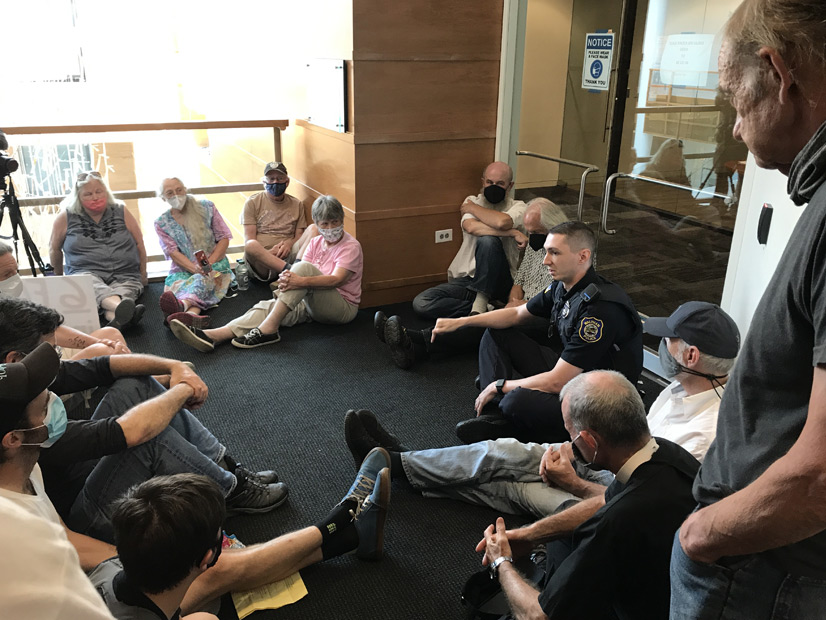
Dozens of climate justice advocates in Massachusetts occupied international pipeline company Enbridge’s office in the city of Waltham on Tuesday in solidarity with Indigenous water protectors protesting the company’s Line 3 tar sands pipeline in Minnesota.

Activists also demanded Enbridge shut down the natural gas compressor station in Weymouth, Mass., which has had six system failures over the last year, shutting down and triggering releases of natural gas into the air without warning.

Another Enbridge project in Massachusetts, the West Roxbury Lateral natural gas pipeline in Boston, does not have a safety plan that addresses its close proximity to an active blasting quarry.

The protest ended Wednesday afternoon when the remaining three protesters were arrested by Waltham police officers. Thirteen of the protesters stayed overnight Tuesday, waiting just under 24 hours for Enbridge officials to speak with them before they left Wednesday morning.

“Many of the people affected by these Enbridge projects have taken all steps available to them via their state’s permitting process and have found that there is no urgency to protect public safety and enforce existing environmental laws,” Andrea Honoré, a climate justice advocate in Massachusetts, said in a Twitter message to NetZero Insider. “So that’s how you end up on the floor of an Enbridge office.”

The protest started with a brass band circling the floor of the lobby alongside the climate justice activists. Others traveled to the third floor of the atrium and hung banners down the banisters that said, “Stop Enbridge Line 3” and “Keep it in the ground!”

Enbridge-office-Protest-2-(No-Line-3-Boston)-Alt-FI.jpg
At least 15 protesters occupied the Enbridge office in Waltham, Mass., through late Tuesday evening, refusing to leave until the company called off natural gas projects in Massachusetts and Minnesota. | No Line 3 Boston

Response from Enbridge

“Our first priority is the safety of all involved – our workers, law enforcement and the protesters themselves,” said Max Bergeron, spokesman for Enbridge, in an email statement to NetZero Insider. “Our preference is always to seek to resolve differences of opinion through dialogue – peacefully and respectfully.”

But Enbridge does not tolerate “illegal activities of any kind, including trespassing,” Bergeron wrote.

Police guarded employees as they exited the building Tuesday, but protesters say they only want to have a dialogue with Enbridge employees in Massachusetts about the company’s natural gas projects and their impact on human health, such as higher rates of respiratory illnesses.

Bergeron said that Enbridge organizes public meetings, listens to comments from diverse groups and seeks opportunities to “give back and have a positive presence in the community.”

Pipeline projects go through “extensive public permitting processes which provide additional opportunities for those interested to be heard,” Bergeron said.

What Protesters Are Saying

Protesters said they would not leave the office until the Hubbard County Sheriff’s Department ceases its blockade and imprisonment of water protectors on privately owned land in Minnesota and Enbridge cancels its projects in both states, according to Fore River Residents Against the Compressor Station (FRRACS).

“We were there at Enbridge to make connections around the Environmental Justice issues that are taking place in Minnesota,” said Rev. Betsy Sowers, the environmental justice coordinator at FRRACS.

Enbridge was not immediately available for comment on Tuesday.

The sheriff department’s blockade is preventing the delivery of food and water to peaceful protestors. And Enbridge is drilling under the Mississippi River and through rice fields that are protected by treaties.

Court cases against Enbridge’s projects are being fought at the federal level, but the company continues to build and operate its pipelines while the cases are ongoing.

“They are unresponsive and opaque” to communications from concerned residents near their project sites, Honoré said.

Sowers left the office after police arrived, but at least 15 protesters remained through Tuesday evening.

“If we can’t breathe the air or drink the water, all the money in the world won’t make a difference,” she told NetZero Insider.

This article was updated on June 30, 2021, at 10:45 a.m., EDT, to include a statement from Enbridge. A second update on June 30, 2021, at 2:15 p.m. EDT, provided the status of the protest on Wednesday afternoon.

Clean Energy Groups Pan Southeast Utilities’ SEEM Proposal

Clean energy advocates mounted new attacks on the Southeast Energy Exchange Market (SEEM) this week, saying the proposal to automate bilateral trading in 11 Southeastern states would offer a fraction of the benefits of an organized market and undermine decarbonization efforts.

In a report released Tuesday, the American Council on Renewable Energy said SEEM “offers negligible benefits over traditional utility operations and few of the benefits associated with real-time energy markets.”

The report, done in coordination with the American Clean Power Association and the Solar Energy Industries Association, provides little new empirical data, but it contrasts SEEM’s projected cost savings with the estimates of benefits provided by PJM, CAISO and other RTO/ISO markets. Those estimates “have found consumer benefits in the billions of dollars per year, dozens of times larger than the estimated benefits of SEEM,” ACORE said.

A study conducted for SEEM by Guidehouse and Charles River Associates projected a minimum of $40 million in benefits per year (2020$) in a scenario based on current plans, rising to $100 million annually under a “carbon constrained” scenario. In contrast, a study last year by Energy Innovation Policy and Technology concluded that a competitive Southeastern RTO would save $384 billion by 2040 compared to the business-as-usual case — a 29% reduction in retail costs.

In February, SEEM’s sponsors, led by the Tennessee Valley Authority, Southern Co. (NYSE:SO) and Duke Energy (NYSE:DUK), asked FERC to approve their proposal, which they said would eliminate transmission rate pancaking and allow 15-minute energy transactions. On June 7, the proponents responded to a FERC deficiency letter with promises to provide FERC confidential market data and increased transparency and allay market power concerns (ER21-1111, et al.). (See SEEM Members Offer Rule Changes.)

But in filings this week, several intervenors said SEEM’s response to the deficiency letter failed to address their market power concerns and reiterated calls for a FERC technical conference on the future of the Southeast. The critics say FERC should insist on an independent market monitor and that governance of SEEM be opened to all market participants rather than just load-serving entities.

A group including the Sierra Club, Southern Alliance for Clean Energy, Vote Solar, the Sustainable FERC Project and the Natural Resources Defense Council, filing as “Public Interest Organizations (PIOs),” said SEEM “dodged” the commission’s questions, “doubling down on a flawed, self-serving proposal.”

“SEEM will not only fail to deliver the promised benefits but is primarily an effort to distract from or derail state- and community-led efforts in the Southeast to push for more meaningful and much-needed market reform,” the PIOs said. “As PIOs and others have pointed out, efforts to consider wholesale market reforms underway in North Carolina, South Carolina, Kentucky, Mississippi, Georgia and areas served by TVA are building pressure in the Southeast for significant market reform, and SEEM offers applicants the opportunity to try and stay ahead of and control that reform.”

SEEM, which asked for a FERC ruling on its proposal by Aug. 6, contends the commission can only opine on whether the rates proposed in the group’s Federal Power Act Section 205 filing are just and reasonable, limiting any changes to “minor deviations.”

But the ACORE report suggests the FPA gives FERC to reject freely negotiated wholesale transactions if they “seriously harm the public interest.”

In ACORE’s view, SEEM would be harmful because it would undermine utilities’ efforts to decarbonize by insulating fossil fuel plants from competition from renewables and making renewables more prone to curtailments than in an RTO.

Conceding “other factors may also contribute,” ACORE cites data from the Energy Information Administration that show CO2 emissions have fallen 5 percentage points more in organized market regions since 2013 than in non-market regions.

“While broader organized markets and certain parts of the SEEM footprint have historically succeeded in integrating renewable energy, SEEM’s unusual 15-minute transaction interval and the lack of an independent entity overseeing open access to transmission service by independent power producers whose new development is predominantly renewable energy may stymie similar growth in the full SEEM footprint,” ACORE said. “Furthermore, to the extent the SEEM footprint extends the load-serving capability of otherwise uneconomic existing generation located within a single utility’s generation fleet and helps insulate the inflexibility of those resources, those resources may see a longer service life than would otherwise be economic relative to available lower-cost alternatives. The competition provided by a full wholesale market is the most effective way to provide all resources with the level playing field that ensures large consumer and environmental benefits.”

Southern, Duke, TVA and SEEM sponsors Dominion Energy (NYSE:D), Louisville Gas & Electric and Kentucky Utilities, and the North Carolina Electric Membership Corp. all have emission-reduction goals, ACORE noted.

It also noted that proposed natural gas generating capacity has declined across most of the country while proposed renewable capacity has rapidly increased. “The Southeast, one of only two non-real-time market regions in the continental U.S., has bucked this trend with a record of nearly 40 GW of natural gas capacity waiting in grid interconnection queues as of 2020,” ACORE said. It cited an April 2021 survey of leading renewable energy project developers who found the Southeast the least attractive region in the continental U.S. for project development, with PJM, CAISO and NYISO ranked as the most attractive. (See Study Finds Robust Appetite for Green Investing.)

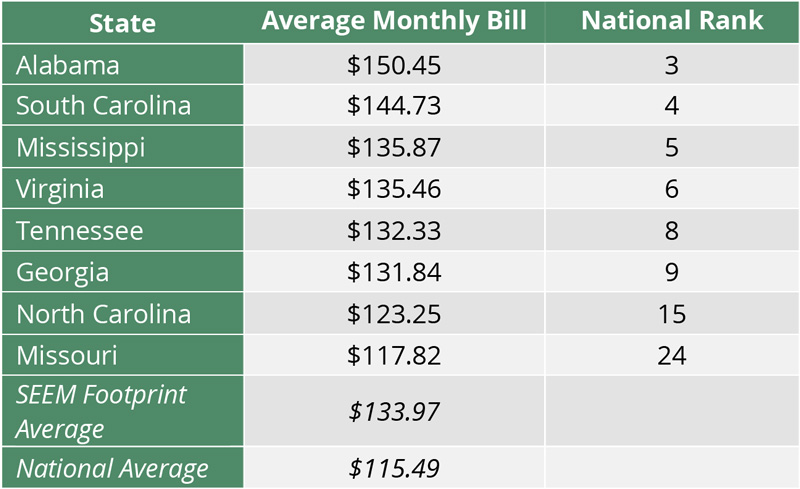
ACORE said Southeast ratepayers would continue to pay above-average electric bills under SEEM, citing EIA data that ranks Alabama, South Carolina, Mississippi, Virginia, Tennessee and Georgia among the top 10 states for average monthly electric bills. “Electricity rates themselves are low in the Southeast, but high consumer energy demand generates high retail electric bills,” ACORE said.

Retail-Electric-Bills-by-SEEM-State-(US-EIA)-Content.jpg
Despite low rates, Southeastern ratepayers have among the largest monthly electric bills in the country because of high consumer energy demand. | U.S. EIA

“SEEM offers little in the way of the benefits provided by centralized wholesale energy markets relative to traditional utility operations,” ACORE said. “The lack of centralized clearing prices, a transparent stakeholder process and an independent market monitor are all readily apparent when contrasted with an [energy imbalance market], which itself is only a light form of a real-time market. SEEM also lacks effective means for planning and paying for transmission on a regional basis, which helps ensure competitive electricity markets.”

Response

Duke spokesperson Erin Culbert said the ACORE report “expressly acknowledges that RTOs do not adhere to or protect state clean energy policies, but SEEM will.”

“RTOs don’t necessarily place a high value on the carbon-free benefits nuclear provides, and that conflicts with many of the clean energy goals that we and our states want to reach by 2050,” she continued. “This is one of many reasons why RTO membership decisions should not be made in Washington. For the Southeast, our nuclear units are absolutely critical to our ability to achieve a clean energy future with carbon-free resources that meet customers’ needs reliably and affordably. We can’t do it without them.”

Culbert also rejected ACORE’s allegation that solar power would suffer under SEEM, saying North Carolina, Florida and South Carolina are among the nation’s leaders in installed solar generation.

“The SEEM proposal reduces solar curtailments and better integrates renewables across 11 states at a much lower cost than an RTO,” she added. “In fact, the SEEM region is already on pace or outperforming RTO markets on critical metrics like reliability, affordability and clean energy.”

TVA, Dominion and Southern did not respond to requests for comment.

FERC Filings

In their filings with FERC this week, Advanced Energy Economy, the Advanced Energy Buyers Group and SEIA, filing as the “Clean Energy Coalition,” said SEEM’s governance structure would concentrate decision-making authority in TVA, Southern and Duke.

The coalition said it seeks competitive wholesale markets because they “allow customers to access a suite of products and services that incumbent utilities have refused to provide under a vertical integration model.”

“The SEEM proposal … does no more than add a computerized platform to add efficiency to the existing bilateral market,” the coalition added.

The coalition said FERC should convene a technical conference as well as a joint federal-state hearing under FPA Section 209  to “develop additional record evidence regarding the SEEM proposal [and] provide a forum to resolve the deficiencies in the SEEM proposal.”

The PIOs challenged SEEM’s legal argument, saying the public utilities in SEEM should file a pool-wide or systemwide tariff and that its actions should be held to the higher “just and reasonable” standard rather than the lower public interest standard that applies to bilateral transactions.

“In a bilateral market that is as closed to competition as the Southeast, the new transmission service that encompasses service across the entire SEEM territory and eliminates rate pancaking has significant value to owners of generation resources in the territory. By controlling access to the transmission service by exclusionary practices related to enabling agreements, the applicants have the ability to exercise market power over transmission service,” the PIOs said. “This exercise of market power may be as simple as exclusion of access to the non-firm energy exchange transmission service. It could also take the form of extraction of concessions from resource owners unrelated to participation in the SEEM that may help solidify the existing market power of SEEM’s member utilities.”

Their filing included an affidavit from former PJM economist Paul Sotkiewicz alleging that independent power producers wheeling out of SEEM to sell energy into PJM, MISO and SPP will be forced to pay higher firm point-to-point transmission rates and will not get any benefits because they do not serve load in SEEM territory.

Hawaii PUC Weighs Oahu Coal Plant Closure Options

Last week’s Hawaii Public Utilities Commission status conference on the impending shutdown of the AES Hawaii Power Plant provided hope that Hawaiian Electric Company (HECO) can find a timely way to fill the void left by the closure of Oahu’s largest electricity source.

The 180-MW plant, which accounts for about 20% of Oahu’s energy needs, is slated to be decommissioned in September 2022. To make up the energy shortfall, the PUC has been aggressively pushing for renewable energy projects.

PUC members have criticized HECO for the slow pace of project development and for its plan to run an oil-fired plant — in part to charge a large battery storage system — until sufficient renewable resources come online. (See Discontent Mounts over HECO Coal Plant Closure Plans.)

During the June 21 conference, one of a series to explore accelerating deployment of renewable energy projects, developers and other stakeholders offered multiple proposals.

Scott Glenn, chief energy officer of the Powering Past Coal Task Force, said he reached out to AES before the conference to suggest retrofitting the plant to burn biomass until renewable energy projects can recover the energy shortfall.

The utility then drafted a plan that, according to AES Managing Director of Fuels John Bigalbal, could be implemented “as early as Q1 2023.” Bigalbal said AES can provide a “flexible term” of operation to cover the energy shortfall from “as short as two years to aid in the transition of the stage 1 and 2 [renewable] projects, or 10 years until the standalone battery can be substantially filled with renewable energy, or 20 years, to help with the transition to renewable energy, depending on the needs and desires of the state.”

If retrofitted, the plant would be fueled by wooden pallets from western Canada.

AES Hawaii Market Business Leader Sandra Larsen said that. “We emphasize that time is short, and we respectfully do request that any decision on whether to proceed with an evaluation be made within 30 days, if possible.”

‘Turning a Corner’

Longroad Energy said its Mahi Solar project can be brought online two to three months earlier than expected, while Clearway said it could accelerate the Mililani 1 and Waiawa projects by three months and two months, respectively.

“I didn’t think that the Mahi solar project could be accelerated because of the needs of financing, but we were able to find a way,” Longroad Energy Director of Development Wren Wescoatt said.

But acceleration comes at a cost. Longroad Energy CEO Paul Gaynor said faster timelines would force the company to spend more than two times its $21 million estimate for long-lead equipment for Mahi. “So, it can be done, it just takes money.”

But an earlier purchase of the equipment would mean the company could advance construction and have the project online by the end of July 2023, or “potentially sooner.”

Jason Smith, General Manager for Bright Canyon Energy, spoke about Kupono Solar, a proposed 42 MW solar array paired with a 168 MWh storage battery that has not yet been approved.  Smith said the project would help power infrastructure for the Navy at Pearl Harbor and could be online in June 2023 if negotiations accelerate between Bright Canyon and the Navy’s selected developer, who has not yet been publicly named.

All the projects have been subject to delays, leaving PUC chair James Griffin to reiterate a persistent frustration. “The idea that the commission is supposed to make a call on this in the next 30 days, on top of all the other proposals that need a quick turnaround from the commission — I’ll just be blunt: it’s very frustrating. This situation is created by delays, and we still don’t have a clear picture on what will get through next year.”

“It seems to me that we need a call from you,” Griffin told HECO CEO Scott Seu. “… Your company needs to be very clear and say whether [extending the life of the coal plant] is necessary or not.”

“If you were to ask me if we need to extend the coal plant past September 2022, I’d say no,” Seu said.

“What I take from this is that we need to follow up after these deliberations with the developers and make sure that the timelines sync up,” Griffin said. “I haven’t heard anyone say that everything’s OK yet.”

But Griffin finished the meeting on a positive note: “I do see us turning a corner here.”

Hawaii Governor Signs EV Adoption Bills

Hawaii Gov. David Ige last week signed three bills into law to encourage electric vehicle adoption in both the public and private sectors.

Ige signed HB 552, HB 424, and HB 1142, all of which are designed to help the state achieve carbon neutrality by 2045 through transportation measures. HB 552 notes that “the transportation sector accounts for the use of over two-thirds of the oil imported into the State.”

HB 552 requires all state agencies to transition their passenger and light-duty vehicles to a zero-emission fleet by 2035, a process that will be coordinated by the state’s Department of Transportation (DOT) and Hawaii State Energy Office. The bill requires the DOT to purchase only zero-emission passenger vehicles starting Jan. 1, 2022, and only zero-emission light-duty vehicles “as soon as practicable but no later than” Jan. 1, 2030. The state comptroller can make exceptions if “zero-emission vehicles are demonstrated to be cost-prohibitive on a lifecycle basis or unsuitable for the vehicles’ planned purpose, or if funds are unavailable.”

HB 424 requires any state official renting a car on official business to rent an electric or hybrid vehicle if available and requires them to use the minimum cost fuel to save funds. The bill does say, however, that state agencies can forego this requirement if the rate of renting an electric or hybrid vehicle versus a fossil fuel vehicle is not “comparable,” and if a higher rate interferes with budget constraints.

HB 1142 allocates 3 cents from the state’s barrel tax to fund the installation of EV charging stations. The funds will be directed to the state’s rebate program for installing EV charging stations, which was established in 2019 but has since become depleted of funds. The bill notes that the program “has proven to be very successful, with more than 70 new charging systems installed or in the pipeline,” and that use of the barrel tax will provide the program with a “sustainable source” of funds.

HB 1142 also notes that some promised EV charging stations were never installed, while others have fallen into disrepair. In response, the bill grants counties the ability to adopt ordinances and penalties to enforce proper installation and repair. It also requires all newly installed EV charging stations to be “level 2 and network-capable.”

The bills were signed into law during a ceremony at Central Middle School on Oahu.

“Even with all the progress that has been made in the last decade, Hawaii is still heavily reliant on imported oil, a majority of which is used in the transportation sector,” Rep. Nicole Lowen, chair of the House Committee on Energy and Environmental Protection and co-author of HB 552 and HB 1142, said during the event.

Expert Tells Vermont Climate Council to Spend More Time on Equity

As the Vermont Climate Council (VCC) works under an aggressive legislative timeline to deliver a state climate action plan in December, one equity expert says the council needs to “slow down.”

The urgency with which the council is working, “even in the context of the climate crisis, and even when we know we need to get somewhere fast, can be very detrimental in the long run,” Amy Laura Cahn, acting director of Vermont Law School’s Environmental Justice Clinic, said at the VCC’s meeting Monday.

If the council can find a compromise solution around slowing down, even if just for six months, she said “the willingness to do that demonstrates the commitment to partnership and relationship.”

The council has been struggling to balance the urgent call for climate action with the need for a much slower process of building relationships with vulnerable communities. (See VT Climate Council Might Delay Release of Action Plan.)

Vermont’s 2020 Global Warming Solutions Act directs the council to adopt a climate plan that benefits residents equitably and ensures mitigation strategies consider disproportionate impacts of climate change on marginalized communities. The council’s Just Transitions Subcommittee is charged with identifying how the plan will meet that mandate, and it recently released a draft set of equity and justice definitions and guiding principles.

Cahn spoke to the council about taking lessons from contemporary climate and energy policies that demonstrate both beneficial and harmful approaches to policymaking.

Among the positive examples of climate policies today, she said, there are few that have made the most affected communities equal partners in decision-making.

“I think there are some lessons learned from the climate space of what’s happened to date and how we have fallen short,” she said. “And we’ve fallen short, both internal to policymaking within government … and as environmental movements.”

Cahn cited the Regional Greenhouse Gas Initiative (RGGI) and the Transportation and Climate Initiative Program (TCI-P) as examples of climate policy design that addresses climate “in the aggregate” and assumes the benefits will trickle down.

Policies that raise resources must specify that the resources go to the people of color communities that are harmed disproportionately by siting of emitting facilities and transportation corridors, according to Cahn.

“We know that RGGI has worked in terms of ratcheting down the emissions; we know that it has generated resources; and we also know that those resources have not gone to the communities most in need of support,” she said.

In Massachusetts, she added, RGGI resources that fund the state’s energy efficiency programs more often go to wealthy, white communities.

RGGI’s most recent report covering program investments for 2019 shows 16% of overall investments target low-income communities. The report, however, does not demonstrate whether any investments are dedicated to historically marginalized communities.

The early phase of TCI-P development, according to Cahn, did not engage environmental justice groups, but as the program continues to move toward implementation, that’s beginning to change.

“Very late in the game, the communities most impacted by transportation emissions were suddenly finding themselves … raising a whole set of concerns that were ignored for years,” she said. Those concerns included how the program will ensure that benefits go to communities overburdened by GHG co-pollutants and how it will mitigate negative effects of increased electrification on environmental justice communities.

The TCI-P memorandum of understanding signed by three states and D.C., however, shows movement toward equity language that was not in the original program documents.

“There’s definitely a shift in the engagement,” Cahn said. “There is starting to be some traction from the environmental movement saying, ‘We need to take a beat; we need to listen; and we need to understand what the concerns are, so that we can create something that’s actually responsive to the communities that need it most.’”

Vermont can learn from RGGI and TCI-P as it prepares recommendations for reducing emissions and mitigating climate change in the state.

“You’re at the beginning of your process, and you have the opportunity to … create something that is potentially transformative,” Cahn said.

Guiding Principles

The design of the council’s draft Guiding Principles for a Just Transition is intended create an equity lens for developing the climate plan’s strategies.

It places equity in distributive, procedural, contextual and corrective pillars, and it aligns justice across environmental, climate and energy segments. The environmental justice segment includes redressing systems of oppression and harm done to people of color communities.

Council members, through four subcommittees, are currently building their recommendations for the draft climate plan; equity and justice concepts, together with a set of guiding principles, must inform that work now.

The principles call for the council, in building out investment and implementation plans, to acknowledge inequity and racism and remedy historical environmental injustices. A set of self-assessment questions and a grading system accompany the principles to help subcommittees determine whether their recommendations are just and equitable in the lead up to the initial plan compilation this summer.

While council members begin to the apply the draft guiding principles to their work in the coming months, they will provide feedback on the document to the Just Transitions Subcommittee. The council also plans to contract a specialist to support committee members in grading their recommendations before finalizing the climate plan in the fall.

Activists Unhappy with NY Climate Justice Policy

Social and environmental justice activists told state officials Monday that New York needs to hurry up and get serious with its climate justice policies.

The Transportation and Climate Initiative (TCI) and its approach of throwing money at the problems of social injustice “is really the most offensive way of thinking about communities of color, particularly frontline people… TCI literally speaks against the spirit of [the Climate Leadership and Community Protection Act], which is about frontline solutions where we’re talking about investments, infrastructure and food sovereignty,” said attorney Elizabeth Yeampierre, executive director of UPROSE, Brooklyn’s oldest Latino community-based organization.

Yeampierre was one of several members of the Climate Justice Working Group, working under the aegis of the New York State Climate Action Council (CAC), who gave feedback to the council June 28 on policy recommendations from two of its advisory panels, one on transportation and one on energy efficiency and housing.

The panels are two of several informing the 22-member CAC as it works to complete a scoping plan by fall to help achieve the state’s goals under the CLCPA.

Cap and Trade?

The transportation panel in May told the council that joining the TCI, a regional collaboration, will help New York by capping and reducing transportation emissions across the Northeast and Mid-Atlantic regions by close to 25% by 2030, while raising revenues for investment in electrification and public transportation and prioritizing investment in disadvantaged communities. (See New York Should Join TCI-P, Transportation Panel Says.)

Eddie-Bautista-(NYDPS)-Content.jpg
Eddie Bautista, NYC Environmental Justice Alliance | NYDPS

Not everyone agrees with the panel’s assessment.

“Let’s lead with the overall antipathy that climate justice and environmental justice communities and leaders across the country have when it comes to market-based solutions,” said Eddie Bautista, executive director of NYC Environmental Justice Alliance. “The best available evidence shows that cap and trade systems do not eliminate air pollution hotspots, and often exacerbate them.”

Neither panel’s recommendation got the state close to achieving the 2030 target of reducing greenhouse gas emissions by 40% from 1990 levels, a reality that concerned CAC member Bob Howarth, professor of ecology and environmental biology at Cornell University.

“At least some of the leadership in the Assembly put off taking a stand on the TCI, saying they wanted input from the Climate Action Council,” Howarth said, asking Bautista “specifically what you would recommend to us.”

Bob-Howarth-(NYDPS)-Content.jpg
Bob Howarth, Cornell University | NYDPS

“What’s attractive about TCI is that by establishing a polluter penalty fee of $50/ton … we’d be addressing emissions reduction not just with climate change, but also the more troubling public health [problems] that so burden environmental justice communities,” Bautista said.

The program would generate around $15 billion a year, which would be “a nice step” to meeting estimated costs for New York state of $30 billion a year to meet CLCPA goals, he said.

“Not to bash our friends in the Assembly, but in order to improve a piece of legislation you have to have a dialogue, have a hearing,” Bautista said. “There was absolutely no engagement, and to put off to the CAC just didn’t register with us. We didn’t see the need to delay another year for the CAC to arrive at a series of systems, projects and initiatives to get us there without coming up with the money.”

More Clarity, Less Jargon

The clean energy transition must be community driven, because different regions have different needs, and that can only be accomplished with local data, Yeampierre said.

“What happens if the benefit target is not achieved over a given timeframe?” she asked. “Should it be assessed annually? For example, should state agencies be required to retroactively meet the 35% to 40% goal for investments [in disadvantaged communities] made since the CLCPA passed?”

Ideally, she said, it should, but wondered what would happen if an investment doesn’t produce the anticipated benefit.

“How are the panels accounting for the social cost of carbon and co-pollutants?” she asked.

Abigail-McHugh-Grifa-(NYDPS)-Content.jpg
Abigail McHugh-Grifa, Climate Solutions Accelerator | NYDPS

A primary concern of Climate Solutions Accelerator, an advocacy group in the Genesee-Finger Lakes Region, is a general lack of clarity and detail in the transportation panel recommendations, according to Executive Director Abigail McHugh-Grifa.

“Whereas the EE and Housing Panel provided definitions of terms and acronyms, the Transportation Panel’s recommendations are full of jargon and vague or squishy language,” McHugh-Grifa said. “This kind of language prohibits the public from meaningfully engaging in this important process, which in itself is problematic from an environmental justice perspective.”

For example, the panel recommended to “enhance service availability, accessibility and affordability, but it provides zero detail about how that should be accomplished,” she said.

Another recommendation was to “make ready costs for service facilities,” McHugh-Grifa said. “I’ve been doing this work for a while and just simply don’t understand what that means.”

Rahwa-Girmatzion-(NYDPS)-Content.jpg
Rahwa Ghirmatzion, PUSH Buffalo | NYDPS

State agencies should better coordinate their work on climate justice, according to Rahwa Ghirmatzion, executive director of neighborhood organization PUSH Buffalo.

“NYSERDA has been providing some really amazing programs that could benefit disadvantaged communities, but then we run up against some of the policies with the Public Service Commission,” Ghirmatzion said. “I think it’s fair to say [the commission has] been much cozier with utilities, and it has not been an open and transparent process.”

Even when environmental activists were able to win renewable energy credits for community solar to make it easier for communities like hers in Buffalo to build the infrastructure to reduce the energy burdens, “they came up with a very complicated feeder proposal, which absolutely makes no sense and adds to the enormous amount of unnecessary complexity,” Ghirmatzion said.

“Of course, we’re not dumb enough not to recognize that it is really not going to benefit communities like ours, that we will never be able to own the energy, to maintain and distribute the power in our own communities, which could actually generate community wealth,” she said.

The CAC, according to Ghirmatzion, should look at which opportunities the state agencies have for greater collaboration that also remove barriers, provide additional support for communities and, more importantly, streamlines the process. “Right now a lot of our time is being used and we’re happy to commit this time… but the reality is, even how we’re receiving these recommendations is really confusing and difficult to understand,” Ghirmatzion said. “That is showing us that the infrastructure itself on the state agency side really needs to be fixed.”

MISO, SPP Name Projects to Help Queue Troubles

MISO and SPP on Monday said two expensive amalgamations of smaller transmission projects have emerged as options to help generation projects interconnect near their seams.

The results are the latest in the RTOs’ joint targeted interconnection queue study, which is searching for interregional transmission projects to alleviate their jampacked generator interconnection queues. (See MISO-SPP Targeted Interconnection Study Moves Forward.)

The first cluster, a $424 million project, incorporates a long distance 345-kV line from Big Stone, S.D., to Alexandria, Minn.; a 345-kV line on the northeast side of Kansas City; and a transmission facility on the west side of Minneapolis.

A second, more expensive alternative to the multipoint project includes an additional segment from Alexandria to Monticello, Minn., bringing the project’s costs to $728 million.

SPP Vice President of Engineering Antoine Lucas cautioned the projects’ reveal is “very preliminary.”

“I just want everyone to keep in mind that these are initial results,” he told stakeholders during a joint SPP-MISO workshop.

While the study shows both projects mitigating nearly 20 constraints, three major flowgate constraints remain untouched on 345-kV lines on the Kansas-Missouri border near Kansas City.

“By using these two projects, we were able to mitigate most of the constraints, except for the top three,” MISO Senior Transmission Planning Engineer Sumit Brar said. MISO and SPP will soon open another window for stakeholder suggestions addressing the three most congested flowgates, Brar said.

The two clusters currently have negative benefit-to-cost ratios because their increased capacity has downstream effects on nearby areas that raise shadow prices.

The RTOs have also come up with nine other project ideas that crisscross the seams in Minnesota and South Dakota and range from $32 million to $1.6 billion. The two also received 18 alternative proposals from stakeholders, costing between $64 million and $871 million and spread from Kansas City to Minneapolis and Sioux City, Iowa.

The grid operators said they evaluated 29 projects submitted by staff and stakeholders, including the two optimized project groupings. Eight projects failed to provide relief on seams constraints when tested.

The RTOs said they then tested six different combinations of the most effective projects, finding two of them solved most of the RTOs’ flowgate constraints.

SPP’s Juliano Freitas said the projects will undergo more testing. Staff are using their respective reliability models and those from the MISO Transmission Expansion Plan and SPP’s Integrated Transmission Planning process to test projects for economic benefits.

Lucas said the RTOs won’t test project candidates for how well they might facilitate the interconnection of individual generation requests. However, he said, projects will be tested for how many hypothetical new projects they could allow on their systems.

“It’s important that we get a sense of how much these projects will advance interconnections, how much and in what areas,” Advanced Power Alliance’s Steve Gaw said.

Stakeholders asked MISO and SPP to create a map showing seams projects under consideration. They also asked why some voltage stability issues that consistently show up in queue studies didn’t show up in the RTOs’ reliability study. Staff planners said their study incorporated interconnecting generation, which might have resolved voltage problems.

SPP CEO Barbara Sugg said the RTOs’ relations over the past 18 months are the best they’ve ever been for study collaboration and coordination during storms.

“The work we’ve been able to do over the past several months has really been astounding,” she said.

Sugg said renewable expansion along the seams will continue to be limited unless the grid operators can find high-value network upgrades that will let more requests reliably interconnect.

SPP currently has approximately 82 GW awaiting interconnection in its queue. MISO’s queue stands at 83 GW with a new round of applications coming in July. MISO planners have said they expect the newcomers to push the queue to the 100-GW-plus highs seen in 2020.

“We’ve not resolved the cost allocation at this point because we wanted to focus on the engineering study,” Sugg said.

The RTOs have scheduled a cost-allocation discussion with stakeholders on July 7 to begin exploring how costs might be divided for seams transmission projects.

Western RA Planners Turn to Organization Details

The Northwest Power Pool’s regional resource adequacy program is nearing initial deployment this August despite the challenges of devising a completely new kind of governance structure, program organizers said in a webinar Friday.

“We’re trying to create a governance model for something that’s a little bit unique,” said Sarah Edmonds, director of transmission services at Portland General Electric. “It’s never been done before, the standalone regional RA program outside of an RTO … and so there’s not any precedents or examples that are an exact fit for us.”

Deployment Still on Track

NWPP began the RA effort in April 2020, reacting to growing concerns that capacity deficits in the West could cause load-serving entities to inadvertently draw on the same resources for RA amid the retirement of fossil fuel generators and the spread of intermittent renewables. (See NWPP Planning Western Resource Adequacy Program.) Earlier this year, NWPP said it was “closing in on the tail end of the detailed design,” with a “nonbinding” version of the program targeting deployment in the third quarter of the year. (See NWPP RA Program Taking Shape for Q3 Launch.)

Project-timeline-(NWPP)-Content.jpg
Timeline for implementation of the program | NWPP

In Friday’s webinar Edmonds confirmed that the program is still on track, providing further details about the deployment schedule. First comes implementation, on a nonbinding basis, of the “forward showing” program, which will require participants to outline resource adequacy and availability seven months in advance of the summer and winter capacity periods. However, they would not be penalized for failing to meet their showing requirements until 2023, when the binding forward-showing program takes effect.

“In the nonbinding forward showing, it’s just information; it’s not associated with mandatory compliance and penalties,” Edmonds said. “The reason that’s important is because this may be new or different information for some load-serving interests — that is different than the way they’ve been doing things. And if that’s the case, then there are going to be a lot more conversations and actions they have to take … to adjust into that position.”

When the full program takes effect in 2024, the forward-showing projections will be joined by an “operational” component involving a rolling look-ahead six days in advance. When an extreme event is forecasted that could require resource sharing, participants will be required to make their resources available to neighbors; in the event sharing is required, settlements will be handled after the fact.

Rebecca-Sexton-(NWPP)-Content.jpg
Rebecca Sexton-Kelly, Sapere Consulting | NWPP

The full program framework also incorporates loss of load estimates (LOLE) on a five- and two-year look-ahead basis to encourage longer-term planning among utilities, explained Rebecca Sexton-Kelly of Sapere Consulting, hired by NWPP for project management services and legal expertise. Entities’ reports will be reviewed by program operators at the start of the forward showing season to identify any discrepancies that may have arisen since the reports were finished, and entities will be given two months to reconcile the reports with their actual resources.

“Unlike the CAISO, we don’t have some way … to solve their problems before that. We would not go off and contract that capacity,” Sexton-Kelly said. “That’s part of the whole package: In order to maintain a relatively light touch, we want to encourage folks to do their own problem solving.”

Organizational Debates Continue

Sarah-Edmonds-(NWPP)-Content.jpg
Sarah Edmonds, Portland General Electric | NWPP

The program operators will fall under the authority of an RA Participants Committee (RAPC), according to an organizational chart shared on Friday; this in turn will be governed by an independent board of directors. Edmonds explained that this organizational structure “recognizes the fact that these are the entities that are voluntarily committing themselves to be on the hook for compliance, and so they are proposed to have a strong role.”

“Ultimately, though, the important aspect is that all decisions roll up to the board. The board is the ultimate backstop,” she continued.

Designers are proposing that the NWPP board of directors take responsibility for the RA program, though Edmonds acknowledged that NWPP’s board is currently “semi-independent” and that “changes will need to be made” to satisfy the RA program’s independence requirements.

When it comes to selection of the independent board members, “we’re not going to reinvent all the wheels here,” Edmonds said. She suggested that “a really good precedent out of the Energy Imbalance Market” could be the use of a nominating committee made up of representatives from multiple industry sectors. Planners will debut their ideas “in the next version of our ever-evolving governance proposal.”

New Eversource Rate Corrects Course on Conn.’s Dwindling Solar Program

A new electricity rate option for small, non-residential Eversource Energy customers in Connecticut could correct what solar advocates say has been a five-year death spiral for the state’s solar program.

Connecticut’s Public Utilities Regulatory Authority directed Eversource last week to offer optional interim rate riders to small businesses.

The move responds to concerns from Solar Connecticut that Eversource rates have damaged the state’s solar industry. State legislators also urged PURA to consider new rates to provide relief to small businesses that saw unusually high electricity bills during the pandemic.

SolarConn, in a filing to PURA, said a shift in 2015 from consumption rates (per kWh) to fixed charges (per kW) in rates for Eversource’s commercial customers decreased demand for solar. That shift, SolarConn said, changed the profitability profile for projects in the state’s Zero Emissions Renewable Energy Credit (ZREC) program.

By eliminating the ability of a solar project to net meter production against per kWh charges for consumption, “the entire economic model for distributed renewable energy was predictably upended,” the business group said.

The results of the 2015 rate change have been evident in the small ZREC program, SolarConn said, adding that “for over two years, almost no small ZRECs have been utilized for projects.”

PURA’s decision directs Eversource to establish an optional rider with “a volumetric component” (per kWh) for two of its existing rates.

Relief from the new interim rate should help in the latest round of solicitations for low-emissions REC and ZREC projects. Under the program, projects are supposed to realize a 15-year revenue stream from REC sales. That revenue, SolarConn said, has not materialized for many projects.

PURA said the creation of optional rate riders with both a volumetric rate and a demand charge component “is consistent with Connecticut law and public policy as it encourages economic development … by giving small businesses more control over their energy expenses.”

“Small businesses will have the potential to reduce their electric bills by decreasing their kWh electricity consumption through reduced usage, employing conservation and energy efficiency measures, or by participating in the LREC/ZREC program or its successor,” PURA wrote in its unanimous decision.

Eversource must update its website by July 1 to indicate the availability of the new optional riders — beginning Nov. 1 — and allow customers to sign up for them ahead of the effective date.

In addition, Eversource needs to show “how it plans to proactively work with new and existing customers” to ensure customers select the best rate option, according to PURA. The riders will be available until PURA approves Eversource’s new rate schedules in the utility’s subsequent rate-case proceeding.

Two Letters

PURA Chair Marissa Gillett said the leadership of the General Assembly’s Energy and Technology Committee sent a letter in December 2020 that called attention to “the importance of considering targeted relief” for Connecticut’s small businesses amid “the devastating impacts” of the COVID-19 pandemic. The committee’s leadership specifically requested PURA consider implementing interim rate riders to help small businesses curb “wildly high bills despite being closed or operating at reduced hours” because of “high fixed charges (per kW).” PURA concluded that the development of optional rate riders was “in the public interest, and is consistent with current practices and tariff offerings, the Take Back Our Grid Act, and PURA’s statutory authority. “The Take Back Our Grid Act, which passed into law in the wake of Tropical Storm Isaias in 2020, gives PURA legal latitude to consider an “interim rate decrease, low-income rates and economic development rates” for Eversource and United Illuminating customers.

In an additional supporting letter submitted in April, the Department of the Energy and Environmental Protection said the state’s Conservation and Load Management Plan demonstrates that “a reduction in both kW and kWh usage provides broad societal and energy benefits to Connecticut’s ratepayers.” According to DEEP, rate designs that encourage reductions in both demand and overall kWh consumption further realize those benefits.

DEEP stated that generally, “volumetric charges are shown to incent energy efficiency, and the greater the fixed cost within a rate structure, the less motivated a customer will be to lower their energy usage.”

Additionally, DEEP said commercial and industrial energy efficiency programs drive down demand and bring Connecticut “closer to its decarbonization goals.” In 2020, they provided 82,133 tons of annual carbon dioxide emissions reductions and 952,749 tons of lifetime emissions reductions. Cleaner air resulting from the state’s energy efficiency and clean energy programs deferred over $5 million in public health costs last year.