ERCOT Technical Advisory Committee Briefs: June 23, 2021

Stakeholders Approve 1st Storm-related Protocol Changes

ERCOT stakeholders last week endorsed the first of several Nodal Protocol revision requests (NPRRs) addressing system changes stemming from February’s severe winter weather that almost shut down the Texas grid.

One revision (NPRR1080) limits the ancillary service market’s clearing prices to the systemwide offer cap of $9,000/MWh. A second (NPRR1081) requires that ERCOT’s real-time online reliability deployment price adder (RTORDPA) be adjusted to take firm load shed into account.

Both measures, sponsored by ERCOT and its Independent Market Monitor, unanimously cleared the Technical Advisory Committee during its meeting Wednesday in separate votes. A handful of members abstained from each vote.

The Board of Directors approved both NPRRs and an accompanying other binding document request (OBDRR030) during a brief teleconference Monday morning.

Texas Public Utility Commission Chairman Peter Lake, presiding over the board meeting, recognized the “accelerated” approval process as being outside the normal stakeholder process.

“This will ensure that as we go through the summer, we have the best functioning market we can have,” Lake said. “This is by no means the end. This is a part of the beginning in making our system better.”

In approving NPRR1081, the TAC first rejected a proposed amendment by Lower Colorado River Authority (LCRA) to remove the RTORDPA from ancillary service (AS) imbalance settlement calculations.

Referring to the adder as a “plug,” Randa Stephenson, LCRA’s senior vice president of wholesale markets and supply, said the public utility lost “tens of millions of dollars” when its services were deployed during the February winter storm, only to have the adder clawed back. She said the RTORDPA will increase real-time energy prices during periods of firm load shed before being clawed back from providers as part of the AS imbalance settlement.

“Our load paid $15 million for this uplift charge after they had done all the right things. This costs load money after they’ve hedged themselves,” Stephenson said. “There really needs to be an understanding of what this does to generators when they’re making decisions.”

LCRA found general support for its proposal. Attorney Katie Coleman, who represents ERCOT industrial consumers. said the measure will create risk for responsive service providers and deter their participation in the day-ahead market and bilateral transactions.

“This will ultimately raise costs to customers, beyond the little benefit they get when a resource makes this imbalance payment,” Coleman said. “Instead of adjusting for the actual megawatts of firm load shed, the [RTORDPA] adjustment is being used to backfill up to the cap. It’s making that imbalance exposure exponentially larger than it otherwise should be. We have concerns about this approach of not adjusting for the actual megawatts of load shed, but backfilling up to the cap.”

Kenan Ögelman, ERCOT vice president for commercial operations, said Stephenson and Coleman were not “necessarily incorrect” and agreed there is a need to look at the going-forward incentives NPRR1081 creates. However, he pointed out, staff worked with the Monitor in filing the revision request to address “urgent recommendations” in its recent market report. (See ERCOT Moves Quickly to Address Monitor’s Recommendations.)

“We don’t want to preclude the discussion or efforts to solve [LCRA’s issue],” he said. “We understand it might not be inherently clear around the new incentives being created here.”

LCRA’s amendment failed to pass, falling two votes shy of the 67% approval threshold, 14-9. Seven members abstained. The TAC then approved NPRR1081 26-0, with four abstentions.

NPRR1080 cleared the committee by a similar margin, 27-0, with three abstentions, despite some concerns that the change doesn’t appropriately value AS.

The measure is a direct response to the winter storm, when AS prices exceeded $25,000/MWh. They will now be capped at the systemwide offer cap of $9,000/MWh. That cap has been reduced by rule to $2,000/MWh for the rest of the calendar year because the peaker net margin topped a threshold of three times the cost of entry for new generation plants on Feb. 16.

Ögelman said the NPRR’s proposed changes “are consistent with economic market design principles.” Because AS is procured to reduce the probability of losing load, those principles dictate that reserves’ value should not exceed the value of lost load, which is equal to the offer cap.

The TAC also separately approved NPRR1078, which ensures only amounts owed to ERCOT by counterparties through the default uplift process can be collateralized. CPS Energy, with is involved in litigation with ERCOT and numerous natural gas suppliers, abstained from the vote.

More Reserves to be Procured

The committee will hold a special virtual meeting this Wednesday to consider ERCOT’s proposal to modify procedures for deploying non-spinning reserves sooner, an acknowledgement of the likely tight conditions for the rest of the summer months.

“Going forward, ERCOT is going to be bringing more reserves online and deploying earlier than we have previously,” said Jeff Billo, director of forecasting and ancillary services.

Billo said staff will be relying on their meteorologist’s weather forecasts to determine the load, wind and solar forecasts before making decisions on procuring additional reserves. The forecasts will likely be classified as low-, medium- or high-potential certainty.

“There are likely to be those days when the weather forecast is not as certain, and that affects the load and the wind and the solar,” he said. “On those days when we’re just not as confident in the weather forecast’s information, we may be procuring additional reserves.”

Members asked for data on how accurate ERCOT’s forecasts have been, noting deploying more reserves will affect prices.

“We’re going to be very much open to stakeholders’ comments and concerns,” Billo said.

Securitization Issues

Staff promised the TAC as many as two opportunities to discuss the grid operator’s plans for handling securitization legislation designed to address the market’s and market participants’ losses during the winter storm.

Members expressed a desire for a “full soup-to-nuts” workshop, but Ögelman cautioned that staff will be limited in what it can detail.

“We’re happy to share what our thinking is and an outline of what we’re working on,” he said. “What we would share would be our interpretations, which is not necessarily the final version of the application of those laws … potentially laying out options and talking about what we can do within our systems.

“I think everyone is going to have to weigh in on their preferences at the” PUC, Ögelman said.

“It sounds like the filing may be more high level, and we’ll be doing the designing of the process at the commission,” Reliant Energy Retail Services’ Bill Barnes said.

ERCOT is working on a tight timeline, as it must file its proposals with the PUC within 30 days.

Lawmakers passed several securitization measures that use customer-financed bonds to help market participants pay back the massive bills many incurred during the February storm. ERCOT’s market was short $2.991 billion as of June 4, while several participants have filed for bankruptcy. (See Texas Legislators Finish Work on Electricity Market — for Now.)

Combo Ballot Includes 7 Changes

The TAC unanimously approved a combination ballot that included three additional NPRRs, two revisions to the resource registration glossary (RRGRR), and single changes to the nodal operating (NOGRR) and planning guides (PGRR):

    • NPRR995: sets the term “settlement-only energy storage system” (SOESS) and further defines it as transmission-connected or distribution-connected; relocates the settlement-only generator (SOG) term from under resource to stand alone as its own unrelated term; and incorporates the relevant SOESS terms into the market information system (MIS) reporting created for SOGs.
    • NPRR1005: redefines point of interconnection (POI) to refer to any physical location where a generation entity’s facilities connect to a transmission service provider’s facilities, and removes references to load interconnections; introduces the term “point of interconnection bus” (POIB) for the bus in the substation closest to the resource’s POI or any electrically equivalent bus in the substation; and changes POI to POIB throughout the protocols, among other revisions.
    • NPRR1063: requires ERCOT to post dynamic rating approval information to the MIS secure area.
    • NOGRR210: clarifies language in the revised POI term and NPRR1005’s POIB.
    • PGRR089: revises the list of data sets posted to the MIS by removing the planning horizon transmission capability methodology and adding long-term system assessment postings, geomagnetic disturbance vulnerability assessments and the monthly generator interconnection status.
    • RRGRR025: clarifies language for NPRR1005’s defined POIB term by modifying the existing POI term to conform to the generation agreement’s conception of the POI as the point of ownership change. The revision also removes the generation agreement’s reference in that definition.
    • RRGRR028: adds transformer manufacturer test reports to the data collection requirements and clarifies the required transformer information.
Transource Challenges Pa. PUC Decision in Court

Transource Energy has appealed the Pennsylvania Public Utility Commission’s decision to reject the controversial Independence Energy Connection (IEC) transmission project between the commonwealth and Maryland.

The Columbus, Ohio-based company, made up of a partnership between American Electric Power and Evergy, filed two different challenges last week — one in the U.S. District Court for the Middle District of Pennsylvania and another in the Commonwealth Court of Pennsylvania — against the PUC and its four commissioners (1:2021cv01101).

The PUC voted 4-0 during its public meeting last month to reject a series of related applications and petitions filed by Transource for the siting and construction of high-voltage electric transmission lines in Franklin and York counties. The PUC denied the project based upon concerns about whether the need established in the PJM planning process met the requirement for needs specific to Pennsylvania. (See Transource Tx Project Rejected by Pa. PUC.)

PJM selected Transource’s market efficiency proposal in August 2016 to reduce congestion along the RTO’s AP South interface. The congested interface was included in PJM’s inaugural window for proposing market efficiency projects as part of the RTO’s implementation of FERC Order 1000.

“New transmission infrastructure is necessary to incorporate new energy sources into the market while maintaining system reliability, and the evidence clearly demonstrates that multistate regional planning is the most effective way to meet these needs,” said Brian Weber, Transource senior vice president.

Court Filings

In its filings, Transource said PJM’s determination of need for a project is the requirement that should be followed to operate a multistate regional transmission system efficiently and reliably. The company said the PUC determined the lines were not needed because eliminating the bottleneck would primarily help out-of-state customers and raise wholesale energy prices paid by Pennsylvania customers.

Transouce said the PUC’s decision to reject the siting applications violated two separate constitutional constraints on state action. In the first case, the company said Pennsylvania’s decision to deny the applications was pre-empted by federal law because the state’s “broad authority over siting determinations” does not allow the overruling of a determination made under federal law that the interstate transmission system needs a new line.

“The authority claimed by the PUC — to deny that a line is needed when the federally authorized transmission planning process has reached a contrary conclusion — improperly second-guesses the result of a federally approved process and is an obstacle to achievement of national policy and FERC’s regulatory authority over the interstate transmission system,” Transource said in its filing. “If a state can determine that local, parochial interests allow it to reject a regional determination of need, regional transmission planning will be effectively impossible.”

Transource also argued that the PUC’s decision violates the dormant Commerce Clause, the legal doctrine that the Constitution prohibits states from regulating interstate commerce, a power prescribed to Congress. The company said the PUC’s ruling blocked the construction of an “interstate channel of commerce” that would allow less expensive energy produced in Pennsylvania to flow out of the state and reach the broader market.

Transource said the commerce clause also bars states from “imposing burdens” on interstate commerce that outweigh local benefits.

“The court cannot allow a state to point to the local economic benefits that result from interstate transmission congestion as the justification for blocking a project needed to alleviate congestion and benefit the entire region by improving the efficiency of the electric grid,” Transource said in its filing.

Project’s Status

Transource’s transmission line proposals, known as the IEC East and West projects, have gone through several rounds of litigation and investigation since they were first brought to the PUC and other state and federal agencies in 2017. The project got the go-ahead with a certificate of public convenience and necessity from the Maryland Public Service Commission last June. (See Md. PSC OKs Independence Energy Connection Deal.)

Eastern-IEC-segment-Transource-Content
Transource’s proposed alternative plan for the eastern segment of its Independence Energy Connection project | Transource Energy

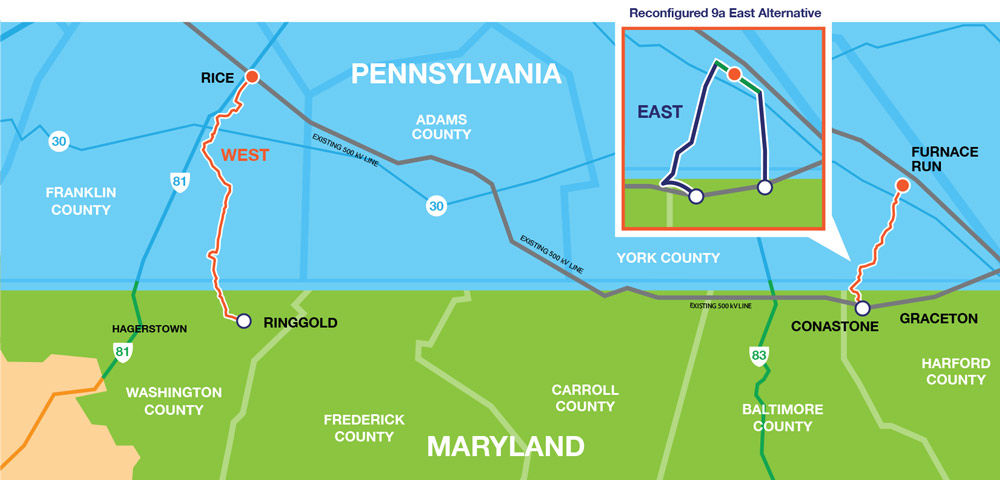
Transource’s plan for the eastern section of the project originally called for extending 15.8 miles of transmission lines from a new Furnace Run substation in York County, Pa., to the Conastone substation in Harford County, Md. By October 2019, an updated configuration designed in consultation with PJM increased the size of the new substation in Pennsylvania and added 4 miles of lines connecting to an existing right of way that would feed into two upgraded Baltimore Gas and Electric substations. (See Transource Files Reconfigured Tx Project.)

The western segment of the IEC project includes a 230-kV double-circuit transmission line running 28.8 miles from Franklin County, Pa., into Washington County, Md.

Transource said the project is expected to create 130 full-time jobs and support $40 million in local economic activity.

But from early in the project, local landowners challenged Transource and PJM on the necessity of the transmission lines, creating community groups to protest and challenge the project in court. (See Protesters Doubt PJM Analysis of Transource Alternative.)

In December, PUC Administrative Law Judge Elizabeth Barnes issued her recommended decision on the project, citing 233 findings of fact and 16 conclusions of law. In her decision, which was ultimately adopted by the PUC, Barnes said she was “not persuaded” that Transource had carried the burden by a “preponderance of the evidence” to establish need after viewing the evidence of the case and finding the opposing arguments made by local landowners to be “more persuasive.”

Barnes ultimately concluded that data used by PJM regarding congestion on the AP South interface were “not reliable enough to form the basis of need” for the project. (See PJM Analysis of Transource Alternative Challenged.)

New York Regulators Investigating Alleged Bribery Scheme at National Grid

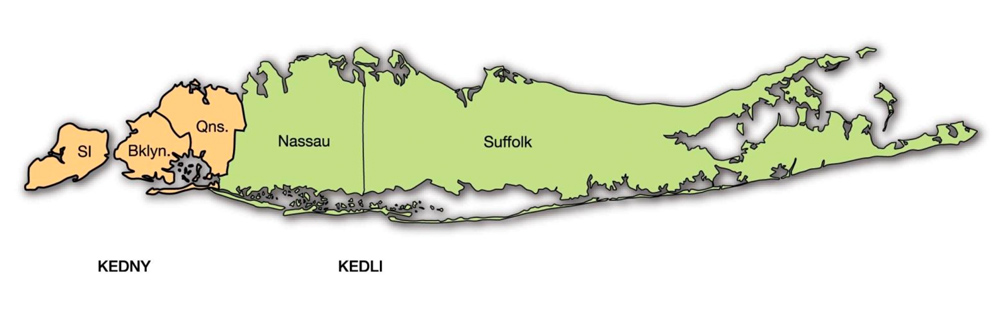
New York regulators on Wednesday opened an investigation into an alleged bribery scheme involving National Grid’s natural gas distribution company facilities in New York City and Long Island that federal prosecutors say has been running for seven years and affected tens of millions of dollars in maintenance deals.

Acting in his capacity as CEO of the Department of Public Service, interim Public Service Commission Chair John Howard issued the order launching the investigation, citing the June 17 indictment of five former National Grid employees by the U.S. Attorney for the Eastern District of New York (21-M-0351).

“The allegations presented in the complaint raise significant concerns related to the internal controls established and implemented by National Grid … to ensure the integrity of the companies’ contracting process,” the order said.

National Grid said it is fully cooperating with the FBI investigation and that it was not aware of the scheme, which prosecutors say involved maintenance contracts for Brooklyn Union Gas and KeySpan Gas East. The company stated that the contracts did not involve critical gas infrastructure, so public safety is not at risk.

“In this proceeding, we will examine potential imprudence, the adequacy of National Grid’s internal controls and National Grid’s compliance with its own internal procedures as well as provisions of the public service law, the commission’s regulations and commission orders,” Howard said in a statement.

The legal troubles come at an awkward time, as National Grid last month made a joint proposal to the PSC in May 2021 for a three-year, $193 million increase in revenues for its gas infrastructure maintenance.

NG-Service-Territory-Map-(National-Grid)-Content.jpg
Service territory map of National Grid subsidiaries KeySpan Energy Delivery New York (KEDNY) and KeySpan Energy Delivery Long Island (KEDLI). | National Grid

Newsday last week reported that the Long Island Power Authority, PSEG Long Island and the state DPS plan to review whether payments made to any contractors and subcontractors were billed to the utilities’ ratepayers, as PSEG leases space at facilities owned and operated by National Grid.

National Grid’s downstate gas distribution utilities serve 1.9 million customers, employ 4,600 workers and have 12,400 miles of gas distribution and transmission pipe.

Lacking a Quorum

With three newly confirmed commissioners not yet seated and one absent, the PSC lacked a quorum for its regularly scheduled session June 17, so it scrapped its consent agenda and only reviewed the investor-owned utility performance for 2020 in electric reliability service, gas safety, electric safety and customer service.

The reviews led the commission to cut the revenue of Consolidated Edison Company of New York by $5 million and that of New York State Electric and Gas (NYSEG) by $7 million for failing to meet reliability targets. The PSC cut NYSEG revenue by an additional $1.4 million and that of Rochester Gas and Electric by $1.8 million for poor performance on measures of customer service established within their respective rate case proceedings. Because of the impacts of COVID-19, NYSEG and RG&E have filed a petition to waive meter reading requirements, which is pending before the commission.

By its next scheduled regular session July 15, the PSC should have its full complement of seven commissioners.

The New York State Senate voted June 10 to confirm three new commissioners to serve six-year terms: former state Sen. David Valesky; longtime Cuomo aide John Maggiore; and Rory Christian of Concentric Consultants. It also confirmed Commissioner James Alesi to a second term.

PSC spokesman James Denn told RTO Insider that, “since the three recently appointed commissioners are still being onboarded, including necessary steps such as signing the oath of office, and given the practical reality that there was insufficient time for them to be fully briefed for the June session, they were not in a position to vote.”

Meanwhile, Howard issued several one-commissioner orders, in addition to the one launching the investigation into National Grid.

A June 23 order granted Con Ed rate recovery for expenses up to $5.9 million between now and 2023 on two “non-pipeline alternative” (NPA) natural gas load relief programs: the Behavioral Demand Response Program and the Heat as a Service Financing Program. “These programs will help the company reduce gas demand in a constrained portion of its service territory and simultaneously advance the state’s energy policy goals” (19-G-0066). The commission denied $1.1 million in funding for a Solar Photo Voltaic Heat Recovery program.

The commission also authorized Con Ed to spend $5 million to continue implementing its Gas Demand Response Pilot Program through March 31, 2022 (17-G-0606).

The term of Con Ed’s existing gas rate plan ends on Dec. 31, 2022, so if the company were to file for new rates in 2022 and include the terms of a gas DR proposal within such filing, tariffs reflective of the commission’s decision regarding that filing would not be effective until Jan. 1, 2023, at the earliest, which is midway through the 2022/2023 Winter Capability Period, the order said.

Howard also signed an order granting a certificate of public convenience and necessity and providing for lightened regulation for Con Ed’s 100-MW East River energy storage facility in Astoria, Queens (21-E-0122). (See “New York Supports Con Ed Project,” NYPSC Considers Two Utility Storage Petitions.)

TOs, Consumer Groups Clash over RTO Adder

Transmission owners told FERC on Friday that limiting the incentive for RTO participation would reduce grid investments and undermine efforts to address climate change, while consumer groups and state officials said the commission’s proposal was long overdue (RM20-10).

FERC proposed limiting the current 50-basis-point rate for participating in RTOs to the first three years in April (RM20-10). The commission’s 3-2 vote approving a supplementary Notice of Proposed Rulemaking was a sharp turnabout from March 2020, when FERC, under then-Chair Neil Chatterjee, advanced a proposal to double the adder to 100 basis points.

The reversal prompted utilities to threaten litigation and petition members of Congress to intervene. (See TOs Won’t Give up RTO Adder Without a Fight.)

Friday was the deadline for filing initial comments on the NOPR, and dozens of utilities, RTOs, regulators and ratepayer groups weighed in, clashing over the legality and impact of the proposed change.

What Does the Law Require?

Supporters of the NOPR generally agreed the three-year limit is, as the American Public Power Association (APPA) put it, a “reasonable balance” for promoting RTO participation and protecting consumers against excessive rates.

But TOs said the NOPR would be contrary to Congress’ intent in 2005, when it amended the Federal Power Act to direct FERC to “provide for incentives to each transmitting utility or electric utility that joins a transmission organization.”

“That is the only specific conduct in all of Section 219 for which Congress mandated an incentive,” ITC Holdings said. “The supplemental NOPR thus improperly attempts to rewrite the statute by replacing ‘that joins’ with ‘to join.’”

The Edison Electric Institute’s comments opposing the NOPR included an affidavit from former U.S. Rep. Joe Barton, who chaired the House-Senate conference committee that approved the 2005 legislation.

“Contrary to the interpretation proffered in the Federal Energy Regulatory Commission’s April 21, 2021, Notice of Proposed Rulemaking, Section 219c does not contain a ‘sunset’ clause, and at no point does it implicitly, or expressly, state that the incentive to a utility that joins a transmission organization should be limited in duration,” the Texas Republican said. “If the committee had intended that the incentive to a utility that joins a transmission organization was meant to be a one-time payment or one-time deal, I would have instructed conference committee staff to make that clear in the language of the statute.”

SPP and MISO filed joint comments criticizing the NOPR as an “abrupt and unsupported change of course” by FERC, adding that “the benefits of RTO membership largely flow to the end-use customers and not to a regulated utility that owns the assets.”

“The resilience of the RTO model is not infinite,” they continued. “As voluntary constructs created by the commission, the RTOs are highly sensitive to the ever-changing calculus of costs and incentives. … Growing and disparate regulatory costs and burdens imposed by the commission solely on RTOs present a serious challenge to the voluntary membership model. In such an environment, it is not surprising that not only have no new RTOs formed after the initial period of RTO development, but large parts of the country continue to have no access to the significant and quantifiable benefits provided by RTO markets,” the RTOs said.

PJM also filed comments opposing the change. As of Monday evening, no comments had been filed in the docket by ISO-NE, NYISO or CAISO.

Potomac Economics, which performs market monitoring for MISO, NYISO and ISO-NE, said the commission’s proposal “seems to be predicated entirely on a false distinction between the decision to ‘join’ an RTO and the decision to ‘remain’ in an RTO; unsupported assertions that all utilities benefit from being members of an RTO; and a disregard of the additional obligations and costs borne by members of an RTO.”


Case-by-case Review Required?

SPP transmission owners American Electric Power (NASDAQ:AEP), Evergy (NYSE:EVRG), Oklahoma Gas and Electric (NYSE:OGE) and Algonquin Power’s Empire District Electric (NYSE:AQN) said FERC would have to make individual findings on whether existing transmission rates including the adder are just and reasonable.

“How, for instance, would FERC support finding that one utility’s total ROE [return on equity] of 10% is unjust and unreasonable and needs to be reduced by 50 basis points, if another utility with comparable credit ratings has a just and reasonable base ROE of 10.25% even without the 50-basis-point adder?” they asked.

The New England States Committee on Electricity (NESCOE) said it supported most of the proposed NOPR but also called for individual determinations on any future RTO adders.

“The proposal to codify a 50-basis-point adder incentive would make it impossible for the commission to fulfill its statutory obligation to ensure that rates are just and reasonable,” NESCOE said. It asked FERC “to reaffirm the burden it placed on utilities in Order No. 679 to demonstrate, on a case-by case-basis, that the level of the transmission organization ROE adder incentive is appropriate.”

NESCOE quoted from the order, in which FERC declined to “make a generic finding on the duration of incentives that will be permitted for public utilities that join transmission organizations.”

The Electricity Consumers Resource Council (ELCON), which represents industrial consumers, said it supports limiting the incentive but said the commission should provide an empirical analysis to justify the size and duration of the adder. “The commission has not provided an analytical framework for judging whether (or why) that specific duration — and the associated ratepayer burden — is ‘just and reasonable and not unduly discriminatory or preferential,’ as required by Section 219d. The same critique applies to the level (or size) of the incentive.”

It also said FERC should calculate the cost of the adder, which the Transmission Access Policy Study Group (TAPS), an association of transmission-dependent utilities, has estimated at $400 million per year. “We happen to agree with TAPS’ estimate, but we are troubled that the commission does not provide its own estimate of the cost of its policy in rates under its jurisdiction,” ELCON said.

The Virginia Office of Consumer Counsel noted that its investor-owned electric utilities are required by a 2003 state law to participate in an RTO. “An incentive … is something ‘serving to encourage, rouse or move to action.’ The dangling carrot must actually bring the donkey to a trot.”

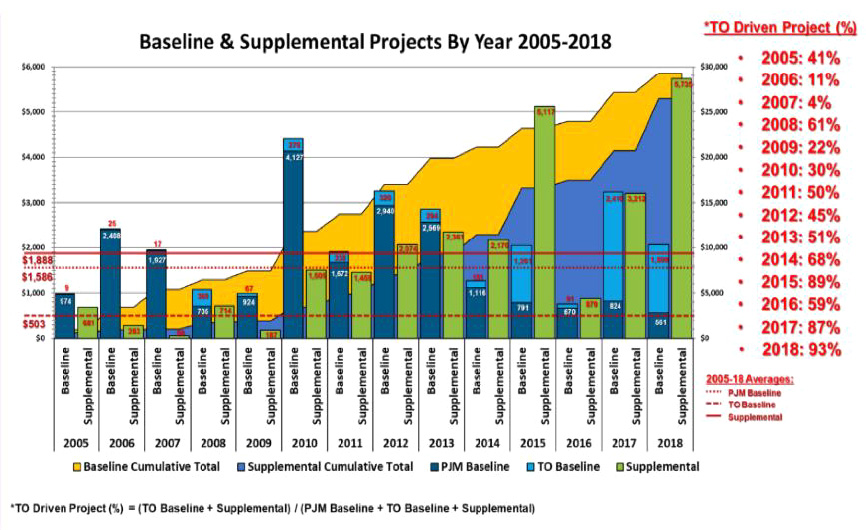
The Organization of PJM States Inc. (OPSI) said keeping “the incentive in perpetuity goes beyond the requirements of Section 219 and thereby imposes unnecessary and unjustified costs upon ratepayers.” OPSI also said the adder should not apply to supplementary transmission projects which do not result from the RTO transmission planning process.

Baseline-and-supplemental-projects-by-year-(American-Municipal-Power)-Content.jpg
The Organization of PJM States Inc. said the RTO adder should not apply to supplementary transmission projects, which do not result from the RTO transmission planning process. | American Municipal Power


MISO generation and transmission cooperatives Great River Energy, Hoosier Energy Rural Electric Cooperative, Southern Illinois Power Cooperative and Wabash Valley Power Alliance said there is no evidence that the adder has been an incentive for joining RTOs. “While the transmission organization incentive was created through Order 679 in 2006, many of the largest (in terms of rate base) transmission owners in MISO did not receive the transmission organization incentive until Jan. 5, 2015. Many, if not all, of these transmission owners were MISO members prior to receiving the transmission organization incentive, so clearly it was not needed to incentivize them to join MISO or remain members.”

Burdens, Benefits of RTO Participation

The two sides also clashed over the burdens and benefits of RTO participation.

PJM transmission owners, including Dominion (NYSE:D), Duke Energy (NYSE:DUK), East Kentucky Power Cooperative, Exelon (NASDAQ:EXC), FirstEnergy (NYSE:FE) and Public Service Enterprise Group (NYSE:PEG) complained that FERC’s existing ROE methodology does not capture the risks TOs face in joining RTOs.

“RTOs are governed by increasingly divergent and combative stakeholders and are deferring more to stakeholders who can be hostile to transmission owner interests and who can make changes to the RTO’s tariff and other governing documents difficult, if not impossible, for transmission owners,” the TOs said. “Thus, the RTO incentive is necessary to maintain a proper balance by compensating the transmission owner for the risks of RTO membership. Removing the RTO incentive … would destroy that balance.”

ITC said customer benefits from RTOs “far exceeds the costs of the incentive,” citing estimates of $3.1 billion to $3.9 billion in annual net benefits in MISO alone. The incentive “appropriately (although not equally) enables ITC to share in the benefits it creates for others through its ongoing participation in MISO, Southwest Power Pool and PJM Interconnection,” it said.

Will Eliminating Adder Affect Behavior?

Opponents of the NOPR painted a dark picture of the transmission system without the adder.

“The legal threshold for transmission owner withdrawal is not high and, given the ever-increasing costs and regulatory burdens imposed on the RTOs, limiting the existing incentive could make both joining and staying in an RTO less attractive,” MISO and SPP said. “The value of RTO membership is built, in part, on the value that each member, and each member’s facilities, brings into the footprint. One member leaving could have a disproportional impact on the value of continued RTO membership for the other members. Any subsequent withdrawals further diminish the overall value for the remaining members to stay in the RTO.”

ITC said eliminating the RTO adder “will only stunt transmission organization growth, potentially leaving these regions with only energy imbalance markets (EIMs). Worse yet, the policy could lead fully formed transmission organizations to devolve into EIMs.”

“If even a few utilities exit transmission organizations, the disruption to organized markets would be significant and would substantially erode the benefits currently enjoyed by market participants and customers,” ITC added.

The SPP TOs cited estimates that up to $600 billion in transmission investments will be needed by 2050 to integrate renewables and reduce carbon emissions. FERC’s proposal “is in direct conflict with the policy initiatives that are being pursued by the [Biden] administration and debated in the Congress,” they said.

PJM said the commission “should neither assume that elimination of the incentive would have zero effect on the potential for transmission owners to exit an RTO, nor assume that the consumer benefits would remain at their same level should the size of the RTO be reduced.”

If FERC does change the adder, PJM said, it “should avoid making a sweeping nationwide ruling that ignores region-specific issues such as the degree of vertical integration in a particular RTO; whether the RTO already has formal exit fees applicable to transmission owners; how particular transmission owners came to join the RTO; whether the region is dominated by restructured or traditional regulation states; and other aspects of transmission owners’ profiles that differ across the nation.”

“If it fails to do so, the commission may be making assumptions about affiliate relationships, the history of how particular transmission owners came to join RTOs as it relates to the ‘voluntariness’ issue, and other matters that do not necessarily fit for a large and mature multistate RTO such as PJM,” it said.

Others said TOs are bluffing in threatening to leave RTOs over the loss of the adder.

“A utility that would contemplate leaving an RTO/ISO arrangement or refusing to participate in one absent an adder could be called upon to justify why that decision is reasonable for either the company or its customers,” the Connecticut Public Utilities Regulatory Authority (PURA) said.

“As a practical matter, utilities that join transmission organizations are unlikely to leave because of the significant cost savings in the form of congestion cost relief or less expensive power due to access to economic dispatch of supply gained in joining a transmission organization, and they do not need an ROE adder incentive to remain,” NESCOE said.

NESCOE noted RTO members are generally exempt from having to purchase energy and capacity from qualifying facilities under the Public Utility Regulatory Policies Act (PURPA) and can charge market-based rates because the region over which their market power is measured is much larger.

The MISO G&T co-ops said the RTO’s exit fees will prevent TOs from leaving.

“The exit fees provide a significant barrier to exit for longstanding members, particularly those in MISO whose membership predates the 2011 approval of roughly $5.6 billion of Multi-Value Projects. For a utility that is considering exiting the transmission organization, the financial impact of the loss of the incentive is likely far outweighed by the financial impact of the exit fees,” they said. “Thus, from a practical standpoint, the incentive does not prevent any utility that is a member of a transmission organization from exiting the transmission organization.”

TAPS said limiting the incentive could increase RTO participation. “A state regulator that has authority to approve a utility’s application to join an RTO might be more willing to do so if the ratepayer impact of joining is lower due to the limited duration of the transmission organization incentive,” it said.

APPA said the decision to join or remain in an RTO “is not solely a decision of transmission owners; the decision is also influenced by other stakeholders — including state regulators.”

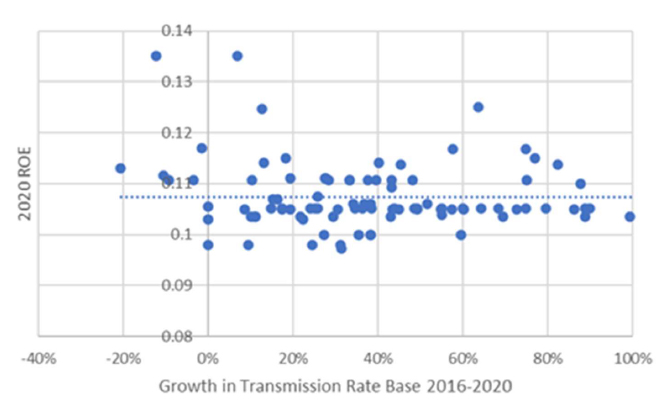
It provided an affidavit from consultant Marc Montalvo, who said limiting the adder is unlikely to discourage transmission development in RTO regions. “The base ROE is explicitly designed to allow utilities to attract capital for their projects, without the necessity of any adder,” Montalvo said. He included a scatterplot comparing RTO utilities’ 2020 ROE rates with their rate base growth between 2016 and 2020. He said the analysis “reveals no discernible relationship between ROE and rate base, presumably because many other factors come into play in investment decisions.”

Growth-in-Tx-Rate-Base-(Mark-Montalvo-Daymark-Energy-Advisors)-Content.jpg
Marc Montalvo, a consultant for the American Public Power Association, said an analysis of the growth in transmission rate base and average returns on equity among utilities shows no relationship between ROE and rate base. | Daymark Energy Advisors


Montalvo also presented data showing TOs’ rate bases grew from $106 billion in 2016 to almost $150 billion in 2020, an increase of 41.5%.

“Applying an additional ROE adder to this incremental rate base produces an additional, steadily increasing revenue stream that is essentially a windfall to the utility,” he said. “These additional revenues would plainly overcompensate utilities for any frictions management and shareholders may perceive to be associated with remaining in an RTO.”

ITC included a fallback position in its comments. If the commission does eliminate the RTO adder, it said, it should also require RTOs to eliminate their exit fees. “The commission cannot adopt a ‘Hotel California’: ‘You can check out any time you like, but you can never leave,’” ITC said.


MISO Analyses Show Reliability Woes Without Transmission Builds

MISO last week said that without major, long-range transmission projects, reliability issues will explode in the Midwestern portion of its footprint.

The grid operator used the most conservative scenario of its three planning futures — Future I — to look 10 years into the future. It said days containing high renewable generation and shoulder seasons could yield thousands of thermal and voltage stability issues. MISO has yet to perform future reliability analyses using Futures II and III, which predict more renewable penetration and electrification growth.

The reliability analysis is the latest in MISO’s attempt to bolster its case for long-range transmission projects. (See MISO Leadership Says Tx Expansion, Market Redefinition ‘not Optional’.)

Future low-voltage and thermal issues are most ubiquitous in the West planning region, which includes Minnesota, Iowa, parts of the Dakotas and western Wisconsin. On winter days, MISO said reliability violations could number more than 4,400 in the West.

MISO also said high renewable generation paired with light-load days is the biggest cause of concern into the 2030s for its Midwest region. The grid operator said more frequent thermal problems are caused by localized transmission issues and shifting regional flow patterns. The voltage violations are a product of high renewable output and load-serving needs.

Speaking during a special workshop Friday, MISO Senior Economic Planning Engineer Ranjit Amgai said Local Resource Zone 3 in Iowa sees the most reliability violations during shoulder months, nights with light load and winter days. He said the region sees strong southern flows from Minnesota, Wisconsin and the Dakotas (Zone 1), and west-to-east flows across eastern Iowa will probably overload the zone’s 161- and 345-kV lines.

Stakeholders asked MISO to also study how its indicative map of projects could assist with the identified reliability issues. (See MISO Reveals Contentious Long-range Tx Project Map.) MISO planners said they have not yet looked at how the draft line routes could solve the looming reliability troubles, but they noted the RTO’s first round of reliability results are only the beginning.

“Identifying violations are the main focus right now before we can propose any projects,” Amgai said. “We’re on step 1-A of about 10 steps.”

“Analysis is going to get more intense as we go along and have more models. This is going to be a multiyear effort,” MISO Senior Manager of Transmission Planning Coordination Jarred Miland told stakeholders. He said MISO will complete some 20-year reliability models next month, and he added that a transfer analysis is forthcoming.

Other stakeholders asked why MISO South was so far absent from the reliability analysis.

“Our focus right now is really on the East, West and Central,” Executive Director of System Planning Aubrey Johnson said. He said a MISO South focus in reliability analyses — including the exploration of projects that could open the RTO’s Midwest-to-South transfer capability — won’t arrive until late 2021 or early 2022.

MISO also has yet to investigate future thermal and low-voltage issues on its seams with PJM and SPP. WEC Energy Group’s Chris Plante said it’s imperative MISO provide reliability results into tie lines on neighboring systems.

“We have to respect those constraints on our neighbors’ system,” Plante said.

Miland said MISO still may put forward a “limited number” of initial long-term projects for board approval by year-end with the 2021 Transmission Expansion Plan (MTEP 21). Without long-term projects, MTEP 21 is shaping up to bring the lowest investment to the footprint in three years. (See MISO Annual Tx Investment Falls in 2021.)

‘Generation Pays’ Deliberations

Meanwhile, MISO’s stakeholder-led Regional Expansion Criteria and Benefits Working Group (RECBWG) on Thursday debated whether generators should bear some cost-sharing for long-range projects.

Some stakeholders at the teleconference said that if an interconnecting generation project is found to be dependent on a long-range project, it should be assigned a portion of the costs, similar to MISO’s current shared network upgrade process in its interconnection queue procedures.

“Generators aren’t the only ‘free-riders’ in cost allocation. New load can be free riders. Cost allocation is based on a snapshot, and that changes the next day. There are going to be free riders all over this,” Sustainable FERC Project counsel Lauren Azar said.

MidAmerican Energy’s Neil Hammer said the discussion was too focused on the benefits that generators stand to obtain when the larger picture is the long-range plan is necessary for MISO’s future system overall. He said the transmission projects will enable multidirectional flows, reliable resource retirements and members’ renewable goals.

“Really, this is benefiting the pool and load,” Hammer said.

Mass. Efficiency Plan Budget Misses Mark on Electrification

Members of the Massachusetts Energy Efficiency Advisory Council urged state officials last week to maintain current program funding for commercial and industrial (C&I) energy efficiency projects, despite not having a clear plan on how to use the budget.

The current draft three-year energy efficiency plan for the state would cut the budget for projects in the C&I sector by over $200 million, though the overall plan budget remains the same. State energy providers, in conjunction with EEAC, develop the state’s three-year plans, and the Department of Energy Resources approves them. The DOER Commissioner chairs EEAC, which comprises members from organizations and interests in the state.

In previous years, a majority of the C&I budget went to energy efficient lighting in facilities. As LED lights become the market norm, DOER has not identified a new focus area that can achieve more ambitious energy cost-saving goals or emissions-reduction goals.

But council members say that the sector can reduce emissions through electrification.

“I am concerned there seems to be a disconnect between policy makers and science and engineering,” said Dennis Villanueva, an EEAC member and senior manager of energy and sustainability at Mass General Brigham hospital.

Villanueva would like the council to develop a working group specifically on the C&I sector, he said during a council meeting on June 23. EEAC members would work with program administrators to develop a plan for using new technologies in the sector and cut emissions before the state submits a final plan resolution next month.

“The climate crisis is here; it’s happening,” said Amy Boyd, council member and director of policy at the Acadia Center. “We can’t ask it to hold on a minute while we figure out how to run a program without lighting.”

Energy-focused organizations in Massachusetts, such as the Home Energy Efficiency Team, have worked to educate lawmakers over the past several years about the potential to cut emissions and lower energy bills by installing ground-source heat pumps.

A study published by the Buro Happold engineering firm found that ground-source heat pump systems shared by buildings along a single street segment, or GeoMicroGrid, could be used to replace natural gas in Massachusetts.

“As gas pipes are replaced, individual GeoMicroDistricts could interconnect to form increasingly larger and more efficient systems that could be managed by a thermal distribution utility” in neighborhoods across the state, according to the study.

Instead of investing over $9 billion to replace leak-prone gas pipes that contradict new state climate laws, DOER can investigate geothermal microgrid systems that are already powering universities and commercial facilities out West.

However, the current 200-page, three-year draft plan makes no mention of ground-source heat pumps.

Growth projections, the plan said, show a significant need for new HVAC and weatherization workers — “a direct effect of the program administrators’ ambitious goals to increase air-source heat pump installations during the 2022-2024 term.”

A load study conducted by Achieve Renewable Energy found that ground-source systems reduce peak demand by 45%, while air-source systems did not reduce peak demand at all, the company’s director, Lawrence Lessard, said during the public comment session.

Ground-source systems also offer two times the annual efficiency of air-source heat pumps, according to Martin Orio, principal of Massachusetts Geothermal, a company that does retrofits in the state.

DOER needs to “take a longer and stronger look at what heat pumps, particularly ground-source heat pumps, can do to meet and exceed 2050 net-zero goals,” Orio said.

The EEAC plans to continue discussion of the draft plan during its meeting July 14, with the opportunity for public comment at the beginning of the session.

Sparks Fly at Virginia SCC Hearing on Appalachian Power’s Coal Plants

The Sierra Club urged the Virginia State Corporation Commission Thursday to reject Appalachian Power’s (APCo) petition to recover $31.6 million in environmental compliance costs for its 2,900-MW John E. Amos and 1,299-MW Mountaineer coal-fired plants, saying the company should shutter them by 2028.

“The question for the commission today is whether it is reasonable and prudent to continue to invest millions of dollars into uneconomic, less competitive coal plants when all the signs, the market and the industry trends, are pointing towards retirement,” Sierra Club attorney Dori Jaffe said in her closing argument at the end of a two-day hearing Thursday (PUR-2020-00258).

“A carbon price is coming, and the company’s customers shouldn’t be left holding the bag when it does,” she added.

James Martin, regulatory case manager for APCo parent American Electric Power (NASDAQ:AEP), acknowledged, “our basic position is that carbon costs are coming. It’s just a question of when and how much.”

It was the “when and how much” that were at issue.

In his closing argument for APCo, attorney Daniel Summerlin III, of Woods Rogers, said that allowing the two coal-fired plants to stay open until 2040 would offer “maximum flexibility” for customers. Mandating their replacement by 2028 would impose a “tremendous risk” and costs on customers, he said.

Testifying on behalf of the Sierra Club, Rachel Wilson, an energy policy and economics analyst with Synapse Energy Economics, said it would be uneconomic to invest in both coal combustion residuals (CCR) standards and effluent limitations guidelines (ELGs) and continue to run Amos through 2040, even assuming no price on carbon emissions by then. Investing in only CCR costs at the Amos plant and retiring it in 2028 would save ratepayers $200 million, she said. Assuming a carbon price increases ratepayer savings to $1.1 billion if the plant is replaced with a combination of renewable and battery storage resources, she said.

APCo said that denial of the CCR investments would result in the immediate shutdown of Amos and Mountaineer.

Agreeing with neither side wholly were representatives of the Attorney General’s Consumer Counsel. In closing arguments, Assistant Attorney General C. Mitch Burton, Jr. said the Consumer Counsel opposes Appalachian Power’s recovering the ELG costs.

The proceedings were largely cordial in tone, though occasional dramatic statements lit up the highly technical back-and-forth, in which attorneys for both sides quizzed witnesses on their prior testimony.

D. Scott Norwood of the Attorney General’s Office accused APCo of “flagrant inconsistency” in its cost estimates in this case as compared to those in a prior docket, and said the company’s petition should not be approved. An attorney for the company tried to coax Norwood into saying it would not be “reasonable nor prudent” to close both coal-fired plants by 2028, but he demurred, saying that a detailed analysis would have to be done.

In his closing argument, Summerlin took issue with Wilson’s report for the Sierra Club. To replace Amos and Mountaineer by 2028, he said, Wilson assumes that APCo could bring online 6,300 MW of solar generation and storage. But that would require 66 square miles of acreage, Summerlin argued, or approximately the size of the Richmond metropolitan area. “Even if it were economically possible  which it’s not … it’s too much, too fast,” Summerlin said.

In response to Martin’s criticism for not carrying her analysis further forward, Wilson testified Wednesday that “the savings associated with early retirement of coal plants becomes greater the longer a period is modeled.” She said the company’s own analysis shows a very slim margin between retiring the coal plants in 2028 or 2040, such that just adjusting one variable “makes the 2028 retirement the least-cost option.”

No recommendations were issued at the conclusion of proceedings. In several weeks’ time, Ann Berkebile, the senior hearing examiner for the commission, will issue a report that will serve as a recommendation to the full commission on whether to accept APCo’s petition.

California PUC Orders Additional 11.5 GW but No Gas

The California Public Utilities Commission reversed course Thursday on a proposal to include up to 1,500 MW of gas generation in its plan to add 11.5 GW of new resources by 2026 to ensure reliability — the largest single procurement order in state history.

Commissioners unanimously approved a revised proposal that requires all 11.5 GW of new resources to be free of greenhouse gas emissions.

“This is a landmark decision,” Commissioner Clifford Rechtschaffen said. “I don’t think it’s hyperbole to describe it as such. We are directing the various load-serving entities to procure what is an unprecedented amount of new clean energy resources … [that] will come online in the middle of the decade.

“Just to give you a sense of the scale, this is enough to power about 2.5 million households in the state, and all of it will be coming from renewable or zero-emitting resources,” Rechtschaffen said. “We need these resources … to respond to the changing climate and to more extreme weather events, such as the ones we saw last summer and which we’re going to continue to see. We need it to respond to the changing grid.”

Clifford-Rechtschaffen-(CPUC)-Content.jpg
Commissioner Clifford Rechtschaffen | CPUC

Multiple gas plants, including a group of aging once-through-cooling plants, are scheduled to retire within the next few years. So is Diablo Canyon, the state’s last operating nuclear generator.

In a proposed decision in May, CPUC Administrative Law Judge Julie Fitch said the CPUC should include from 1,000 MW to 1,500 MW of additional gas generation in the procurement order to make sure the state can meet its evening peaks, after solar goes offline. Last summer’s rolling blackouts happened in the early evening.

Continued outages could jeopardize the state’s plan to supply retail customers with 100% clean energy by 2045, Fitch said. (See CPUC Proposes Adding 11.5 GW of New Resources.)

“The middle of this decade represents an inflection point and a transition; we need to make it through successfully in order to realize our goals,” she wrote. “The potential for a destabilized electric grid and unreliable service if we fail to plan appropriately for the transition is a very serious threat to our ability to realize our long-term goals.”

Rechtschaffen offered an alternative plan that limited the amount of added gas to 500 MW with a five-year time limit. Both plans said the gas should come from increased production at existing plants, not from new generation.

The proposal caused an uproar among stakeholders and residents, who saw it as a step backward and a move away from nearly all state policy in recent years.

“There’s been a tremendous amount of party interest in this case,” Rechtschaffen said. “We had over 50 parties filing comments [and] we had over 40 parties participating in the all-party meeting we [held on the matter].” Numerous public commenters critiqued the plan on June 17, saying the CPUC had failed to show that more gas generation was needed.

On Tuesday, however, Fitch had issued her revised decision, and Rechtschaffen withdrew his alternative plan.

The revised order retains the requirement that LSEs, including community choice aggregators and the state’s three big investor-owned utilities, must procure resources in proportion to their share of load in CAISO in phases from 2023 to 2026. Batteries, long-duration storage, solar, wind and other renewables would make up the resource mix.

“The revised [proposed decision] that we’re voting on today removes the requirement to procure any fossil resources, and instead our staff will work with the Energy Commission staff to conduct additional analysis over the next few months about the need for fossil resources for reliability purposes,” Rechtschaffen said. “The results of this analysis from our staff and the Energy Commission will help inform our next procurement decision, which we will debate about later this year.”

SERC Board of Directors Briefs: June 24, 2021

[EDITOR’S NOTE: An earlier version of this story erroneously stated that SERC’s goal was to return employees to a normal five-day office work week by the end of July.]

Phased Reopening Underway at Charlotte Office

SERC Reliability’s return-to-office plan is well underway, management said on Thursday at the regional entity’s first partial in-person meeting since the beginning of the COVID-19 pandemic.

“It’s wonderful to be here [and] see humans with the full bodies, and not just heads,” CEO Jason Blake joked in his opening remarks at SERC’s office in Charlotte, N.C. Blake was joined in the office by officers and members of SERC’s Board of Directors from the Charlotte area, with all other attendees participating remotely.

“It’s been a very surreal experience, and it feels very nice to be on the other side where we’re starting to return to normalcy,” he continued. “It seems like we all got very comfortable with the ‘new normal,’ and now as we’re moving back into normalcy, it feels like now we’re trying again to get comfortable with the way things were. … It’s been a lot of work for us.”

SERC began to allow voluntary returns to the office in January; the goal at the time was to begin a phased “hard opening” by March 1 aimed at getting all employees back to the office.

However, because of a rise in COVID-19 cases in North Carolina, the full reopening was postponed to June. Instead, only executives were required to return to the office in March — “to be the canaries in the coal mine,” as Blake put it. The following month, managers were ordered to return.

This month the rest of the staff returned; however, rather than bring everyone in at once, management has been easing people in by requiring only one day of in-person attendance for the first few weeks and then adding a day every week or two. Currently employees are required to work in the office at least two days a week. Starting July 12 they will come in at least three days a week; this policy will remain in effect for the foreseeable future.

“The first point that has really driven us and guided us through all of this is the health and safety of our staff and a strong commitment to follow the science, although the science has been malleable over the course of this,” Blake said. “But we’ve stayed very true to that, and now we feel very confident to be in a position to start reintroducing folks.”

Members Review Financial Measures, Budget

The board voted to approve SERC’s final 2022 business plan and budget for submission to NERC, along with changes to the RE’s cash investment policy.

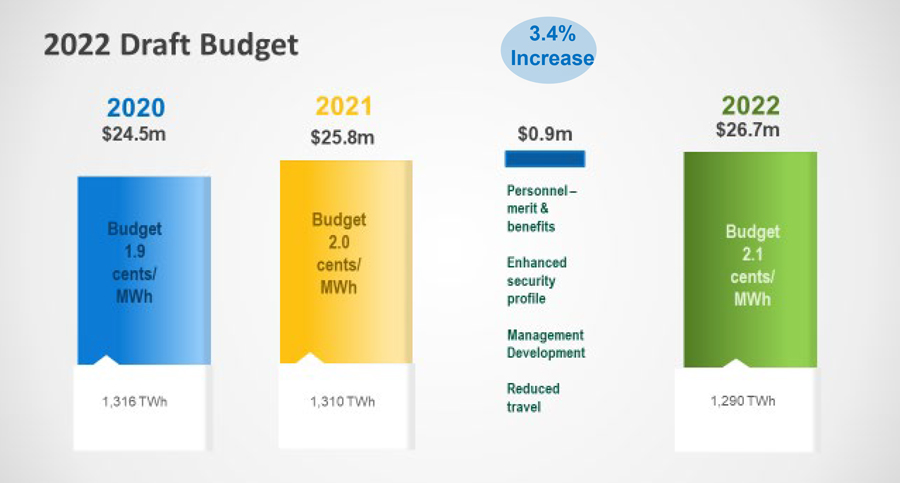
SERC is targeting a budget of $26.7 million next year, representing a 3.4% increase over the budget for 2021. Staff of the Finance and Audit Committee (FAC) participating in the meeting reminded members that this is the smallest planned budget increase among NERC and the other REs; the next smallest is WECC, with 4%, while the Texas Reliability Entity has the biggest increase at 20.8%.

SERC-2022-Draft-Budget-(SERC)-Content.jpg
SERC’s budgets for 2020 and 2021, along with the regional entity’s draft budget for 2022 | SERC


SERC’s proposed assessment for 2022 is $24.8 million, up 5.5% over 2021. The RE plans to make up the difference between the assessment and budget with unused penalty monies from the previous year, as well as by releasing $1.2 million from its Assessment Stabilization Reserve.

The largest reason for the rising budget is staffing, with a merit-based pay increase and an increase in employee benefit costs driving a $1.2 million increase in personnel expenses. SERC is also adding staff, with four full-time-equivalent positions to be added, helping to “drive a stronger and more robust internal IT team.” Three of the four FTEs are budget-neutral.

Offsetting the spending in personnel is an expected $102,000 decrease in meetings and travel because of “efficiencies realized in SERC’s compliance monitoring audit process”; this refers to some of the innovative approaches to audits that RE staff had to devise in response to restrictions on in-person meetings because of the pandemic. (See SERC Seeks to Streamline Audits Post-Pandemic.) In addition, SERC expects to reduce its spending on consultants and contracts by $386,000.

The changes to SERC’s cash investment policy are intended to “provide more specificity regarding investment restrictions” on the RE’s funds, specifically with regard to investments in the energy sector. Previously the policy prohibited all energy-related investments; the update clarifies this restriction to permit purchasing securities in the following subsectors, provided that the issuer is not a NERC registered entity or its affiliate:

  • gas distribution;
  • oil field equipment services;
  • oil refining and marketing; and
  • non-electric utilities.

“There’s an attempt here to be very specific about avoiding investments in NERC registered entities and the electric utility space, as that’s defined in the restrictions, but recognizing that there are other energy sectors that are open for investment and actually could make a positive difference in terms of managing cash reserves for SERC,” FAC Chair Lisa Johnson said.

Regional Standard Gains Board Approval

The board also voted to adopt regional reliability standard PRC-006-SERC-3 (Automatic underfrequency load shedding requirements), intended to “establish consistent and coordinated requirements for the design, implementation and analysis of automatic underfrequency load shedding (UFLS) programs among all SERC applicable entities.”

The new regional standard replaces PRC-006-SERC-2 and will serve as the equivalent of NERC’s PRC-006-3, adopted in 2017. SERC’s standard “has more stringent requirements compared to NERC’s continent-wide standard,” Gaurav Karandikar, SERC’s manager of reliability assessment and performance analysis and technical services, told the board.

SERC undertook the latest revisions to the standard after taking over the footprint of the Florida Reliability Coordinating Council in 2019, Karandikar explained. The new version incorporates three major changes:

  • elimination of a requirement to maintain a database of over- and under-frequency tripping data;
  • removal of a requirement for subregion island boundaries to be contiguous for the benefit of UFLS program planners; and
  • an update to frequency set points and load-shed percentages “to accommodate the unique bulk power system characteristics of the Florida peninsula.”

Following the board’s approval, the standard will be submitted to NERC and FERC for final approval.

PNNL Tool Weighs Trade-offs on Climate Measures

Dealing with climate change sometimes involves trade-offs.

What is good for the environment could have bad economic repercussions. Or a measure that could help fish might also harm wildlife along the shore.

Are there sweet spots in these balancing acts?

The Pacific Northwest National Laboratory in Richland, Wash., has come up with an approach to scientifically analyze these competing factors.

“It’s not hardware. It’s not software. It’s a concept,” Ann Miracle, group leader for PNNL’s Risk and Environmental Assessment Group, told NetZero Insider.

The PNNL concept is the Framework for Assessment of Complex Environmental Tradeoffs (FACET), which is designed to evaluate competing environmental, economic and social impacts.

A government agency would contract with PNNL to gather all the available historical environmental data and trends, then crunch that information with economic trends, plus costs of any mitigating measures. The process will likely include some original research, use existing or possibly new computer models, and potentially require writing new computer programs. Once the basic framework is set up, scientists can enter different environmental mitigation factors into the formulas and programs to predict the results of any scenario they can think of.

“The beauty of FACET is you can overlap climate change on top of it,” Miracle said.

A problem with this type of analysis is that “apples-and-oranges” comparisons are inevitable. The FACET approach tries to factor that wrinkle into its calculations, Miracle said.

The purpose of FACET’s approach is to look only at empirical and scientific data — leaving politics and decision making up to the government agencies that contract for such studies. “We’re not making the decisions. We’re providing the science,” she said.

Miracle said PNNL is in talks with several federal agencies to use a FACET approach. She did not have details available during the phone interview.

PNNL recently completed a pilot FACET project on the upper Colorado River basin, the region upstream of the Arizona-Utah border.

The pilot focused on scenarios involving cutthroat trout, looking at trade-offs related to river flows and withdrawal of water for cities, crop irrigation and power generation. The upper Colorado basin is facing one of the longest droughts in its history.

A typical scenario is if river flows are increased, river temperatures go down. That helps fish but translates to less water being stored for people.

“With climate change, river flows will likely decrease — there will be winners and losers,” PNNL earth scientist and hydrologist Rajiv Prasad, said in a press release. “Who gets the water and who’s willing to pay the most for it? … Our scenario’s projections showed that withdrawal could be restricted — sometimes as much as three to seven days per month in summer by the end of the century. Water would have to be obtained from elsewhere. This could have a disproportionate impact on those who can’t afford it.”