New York City officials are trying to work out how to account for distributed energy resources (DER) under a building emissions law the city passed two years ago.
Local Law 97, which is part of NYC’s 2019 Climate Mobilization Act, limits GHG emissions for buildings with more than 25,000 square feet and sets carbon coefficients for different energy resources to help calculate those emissions.
Coefficients are already set from 2024 to 2029 for certain resources, such as utility electricity and natural gas, but the city has yet to identify a coefficient for DERs, including energy storage. The coefficient for natural gas, for example, is 0.00005311 ton carbon dioxide equivalent/kilo Btus.
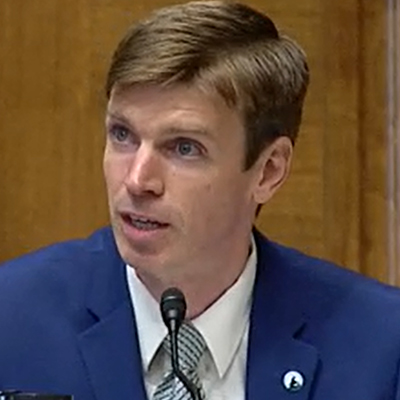
“If the New York State goal for 70% renewable electricity by 2030 is achieved, obviously this has a big impact on coefficients,” Gina Bocra, chief sustainability officer at the New York City Department of Buildings, said at the New York Battery and Energy Storage Technology Consortium’s Capture the Energy conference on Wednesday. “Likewise, if we’re moving towards 100% by 2040, that has a huge impact on compliance for Local Law 97.”
Building owners with properties covered by the law must start emissions reporting to NYC in 2025 based on 2024 performance.
“For most buildings, that means they’re going to have to make upgrades to become low-carbon operating buildings,” Bocra said.
The law’s success, she said, depends on how the grid changes in the coming decades, and the coefficients for different resources help reduce uncertainty in investment strategies for building owners.
“We have to make the law responsive to a changing energy infrastructure,” Bocra said. “We have to promote renewables and avoid stranded assets, and we also have to set guidance on how to account for distributed energy resources.”
Finalizing the DER coefficient is a “must” to make energy storage work in New York City at scale, Josh London, senior vice president at Glenwood Management, said during the conference.
Glenwood operates 1.5 MW/6 MWh of dispatchable behind-the-meter energy storage in the city.
“We use it for demand response, time-shifting and peak demand reduction,” he said, and the economics of that storage strategy have been positive for the company.
London sees the installation of behind-the-meter energy storage systems in buildings throughout the city as an important way to support the goals of Local Law 97. If, for example, 10,000 of the 50,000 buildings that the law covers install a 100-kW storage system, they would create a 1-GW virtual power plant, he said.
Some stakeholders in the city believe that a real-time carbon coefficient would be the best answer for valuing DERs under the law.
“[A real-time coefficient] helps the building understand how it can adjust its own behavior to maximize decarbonization based on how the grid is behaving,” Robyn Beavers, CEO of Blueprint Power, said during the conference.
A building that has solar, storage, and combined heat and power technologies, for example, can use real-time grid carbon performance to make optimal decisions about how it is consuming, storing and producing electricity behind the meter, she said.
For storage, focusing on using energy at the right time is important, according to Rebecca Craft, director of sustainability-electrification at Sidewalk Labs.
“When the carbon intensity of the grid is very high, it’s a good time not to use energy,” she said during the conference. “But when renewable supply exceeds demand and renewables are being curtailed, it’s a great time to use energy.”
The only way to have that level of insight is for the grid to be much more transparent about what types of resources are on it during any hour, she added.
“Knowing that allows you to plan a strategy that would create a more effective pathway to managing energy use,” she said.
President Biden said Saturday he will stand behind the $1.2 trillion infrastructure package the White House negotiated with a bipartisan group of senators and sign it into law, whether or not it comes to his desk “in tandem” with party-line reconciliation bills enacting more provisions of his climate and domestic agenda.
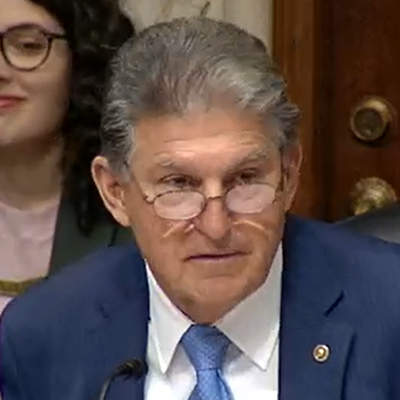
Sen. Joe Manchin (D-W.Va.) | Senate ENR Committee
In a statement released by the White House, Biden pulled back from his apparent veto threat during Thursday’s announcement of the deal when he said: “If [the bipartisan deal] is the only thing that comes to me, I am not signing it. It’s in tandem.”
Biden walked back his comments after Republicans complained they were blindsided by them.
The president said that he intends to pursue the passage of the deal “without reservation or hesitation.” But, he said, “our bipartisan agreement does not preclude Republicans from attempting to defeat my [American] Families Plan; likewise, they should have no objections to my devoted efforts to pass that Families Plan and other [clean energy] proposals in tandem. We will let the American people — and the Congress — decide.”
Sen. Mitt Romney (R-Utah) said on CNN’s “State of the Union” Sunday that he was satisfied by Biden’s clarification. “I think the waters have been calmed by what he said on Saturday,” Romney said.
The weekend saw both Biden and Sen. Joe Manchin (D-W.Va.) talking infrastructure, in the wake of the bipartisan deal and Manchin’s rollout, also on Thursday, of a 423-page “discussion draft” of infrastructure legislation encompassing energy, water, abandoned mine reclamation and wildfire management.
Introduced at a hearing of the Senate Energy and Natural Resources Committee, which Manchin chairs, the $95 billion Energy Infrastructure Act covers many energy and climate initiatives that the bipartisan framework will not. It would also be passed through the Senate’s “regular order” rather than the budget reconciliation process that Biden and some Democrats hope to use to pass climate and family legislation.
Perhaps trying to head off such a potentially divisive move, Manchin opened the hearing on Thursday by saying his bill “would deliver on the president’s American Jobs Plan in many big ways that can garner bipartisan support.”
“Although I don’t anticipate we will all agree on the size and scope of the investment … I think all my colleagues will agree that the areas within our jurisdiction are an important piece of the broader conversation about our infrastructure needs,” he said.
Sen. John Barrasso (R-Wyo.) | Senate ENR Committee
Sen. John Barrasso (R-Wyo.), the committee’s ranking member, was quick to criticize Manchin on drafting the bill without input from Republicans on the committee. He also criticized the bill’s funding — $45 million a year for 2022-2026 — to support upgrades for state building codes to promote energy efficiency, and $1 billion a year, for the same five years, for grants to help states undertake projects to improve grid resilience and reliability.
The funds for building codes could allow “the Department of Energy to coerce states to adopt building codes which may restrict the use of natural gas,” Barrasso said. He also labeled the grid improvement funds as a bailout for California. However, the bill makes no mention of building code restrictions on natural gas and stipulates that no more than 20% of the grid resilience funds could be used for projects in California.
Other provisions in the bill include:
the creation of regional hubs to promote direct air carbon capture and green hydrogen technologies. Funding for the direct air hubs would be $3.5 million and for green hydrogen, $8 million, both over the next five years.
improved permitting, both for the responsible mining of critical minerals, such as lithium, and for interregional transmission. On mining, the bill calls for collaboration by the Bureau of Land Management and the Forestry Service to establish “clear, quantifiable and temporal permitting performance goals and [track] progress against those goals.”
to speed up transmission planning and permitting, FERC would be directed to open a docket on “the effectiveness of existing planning processes for identifying interregional transmission projects” and synchronizing “planning processes in neighboring regions.”
Heat Waves and Drought
The testimony of the five witnesses commenting on the bill fell similarly along party lines. Officials from the Energy, Interior and Agriculture departments all praised specific provisions of the bill but said higher levels of funding would be needed.
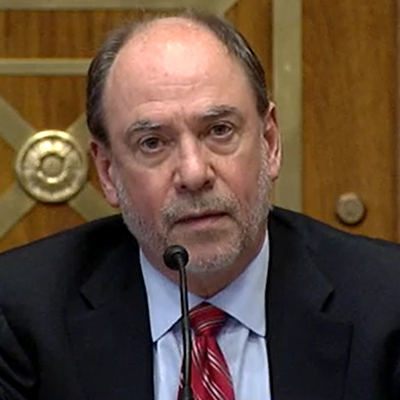
Douglas Holtz-Eakin, American Action Forum | ENR EIA
“We see this discussion draft as inspired by the American Jobs Plan,” said Kathleen Hogan, acting undersecretary for science and energy at DOE. Improvements to the bill could include “more flexible and larger state, tribal and local grants to advance clean energy throughout the country, greater supply chain investment beyond the battery and critical minerals sphere and more resources to help retool existing factories and [to] transition workers,” she said.
Douglas Holtz-Eakin, president of the nonprofit American Action Forum, a free-market research and policy group, said infrastructure funding should focus on “things that raise productivity. Focusing on those core infrastructure areas and avoiding spending money on things which will not raise productivity is probably a key design issue for this committee and Congress,” Holtz-Eakin said.
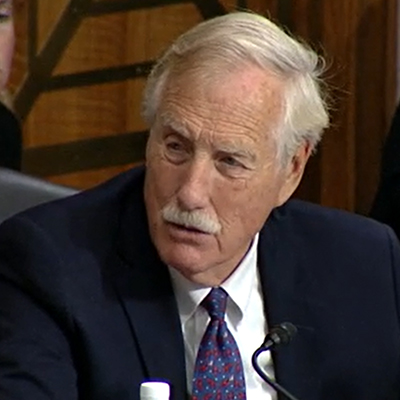
Sen. Angus King (I-Maine) | Senate ENR Committee
He pointed to spending on energy efficiency and school building upgrades as examples of nonproductive spending in the discussion draft and said infrastructure investments should come primarily from the private sector. Government investment gets “the incentives wrong … you also tend to run past the project selection criteria and invest poorly,” he said.
Sen. Angus King (I-Maine) answered Holtz-Eakin with a quote from President Abraham Lincoln, underlining the importance of public investment. “‘Time and experience have verified to a demonstration the public utility of internal improvements.’ In other words, infrastructure,” King said.
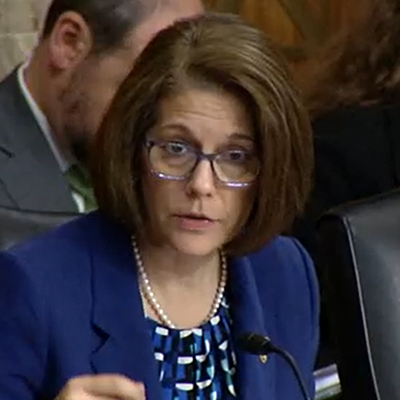
Sen. Catherine Cortez Masto (D-Nev.) | Senate ENR Committee
But senators on both sides of the aisle — and especially those from the Western states — were more preoccupied with the record-breaking heat waves and droughts now affecting their states, and how infrastructure investments might help mitigate the impacts. “The Colorado River basin is facing its worst hydrology on record, which could lead to its first ever shortage declaration this year,” Sen. Catherine Cortez Masto (D-Nev.) said. The drought is exacerbating wildfire risks, as well as cutting hydro power in the West.
Collin O’Mara, president and CEO of the National Wildlife Federation, said his organization estimates “we need almost $60 billion investment in our forests over the next five years. We also need a lot more resources for the Bureau of Land Management,” he said. “A lot of the fires that are starting right now are not starting in our forests. They are starting in our grasslands.”
A Tandem Deal
However, the discussion at the hearing and the prospects for the Energy Infrastructure Act were largely overshadowed by President Biden’s announcement of the bipartisan infrastructure deal.
Collin O’Mara, National Wildlife Federation | ENR EIA
While only about half of the $2 trillion package Biden had originally proposed, the president focused on the “good-paying jobs” the deal would create. The price tag on the agreement is $973 billion over the next five years, going up to $1.2 trillion over eight years, according to a fact sheet released by the White House.
“This still makes key investments to put people to work all across the country building transmission lines, upgrading the power grid to be more energy efficient and resilient in extreme weather — to be able to sustain extreme weather and the climate crisis,” Biden said in a Thursday afternoon briefing. “It also builds our natural infrastructure — our coastlines and our levees — to be more resilient as well.
“American workers will be installing electric vehicle charging stations and undertaking critical environmental cleanups. This bipartisan agreement represents the largest investment in public transit in American history,” he said.
Specific spending over the next five years includes:
$7.5 billion each for EV charging infrastructure and the electrification of buses and public transit;
$73 billion for power infrastructure, including the creation of a Grid Authority, to build “thousands of miles of new, resilient transmission lines to facilitate the expansion of renewable energy”; and
$43 billion for resilience to “prepare more of our infrastructure for the impacts of climate change, cyberattacks and extreme weather events.”
The response from energy industry organizations was mixed.
Paula Glover, president of the Alliance to Save Energy, praised the bipartisan efforts on infrastructure but noted the absence of energy efficiency in the deal. “[We] will continue to work with the administration and Congress to ensure energy efficiency policies are fully funded and seen as a top priority in future legislation,” she said in a statement released Thursday afternoon. Manchin’s bill got higher marks for its energy efficiency provisions.
While not directly commenting on the bipartisan framework, Jason Burwen, interim CEO of the Energy Storage Association, said, “An infrastructure bill that does not include clean energy and storage will fail to address the failings of our power infrastructure.” Manchin’s bill incorporates policy recommendations supported by ESA, Burwen said, such as funding to build out a battery supply chain.
“An infrastructure bill coupled with a storage investment tax credit will ensure that energy storage deployments accelerate to keep the lights on in the face of severe weather threats, cyberattacks and other catastrophic impacts to our country’s electric infrastructure,” he said.
An analysis from ClearView Energy Partners, an energy research firm, suggests that Manchin could be positioning his bill to be either incorporated into the bipartisan agreement as it is translated into legislation or as part of a party-line budget reconciliation bill.
Biden stated clearly that he sees the infrastructure agreement as the first part of a tandem deal. “If [the deal] is the only thing that comes to me, I’m not signing it,” he said. “It’s in tandem. … I proposed a significant piece of legislation in three parts, and all three parts are equally important.”
MISO is grappling with how many hybrid generation formats could be coming its way as it prepares a dedicated participation model.
The grid operator’s staff believe there could be a crush of hybrid resources — which MISO defines as storage paired with generation, often renewable — on the way. The RTO held a June 21 teleconference to discuss near-term market prospects for hybrid resources.
“It will be hugely helpful to MISO to know about the projects you have in your pipelines,” Wind and Solar Program Manager Laura Hannah told stakeholders.
MISO’s approximately 83-GW interconnection queue contains about 5 GW of hybrid projects set to come online in 2023, mostly in the form of solar and storage. But the grid operator is bracing for more than that.
“That could be only a fraction of the projects that become hybrid,” Hannah said, explaining that interconnection customers sometimes request two separate applications for the storage and generation components, with others requesting surplus interconnection capability for storage that’s added later.
“Just glancing at the queue, it’s difficult to tell how many projects that are hybrid are coming our way,” she said.
“Hybrids are definitely a requested method of interconnection,” MISO Director of Market Design Kevin Vannoy added. He said that MISO should facilitate the entry of new generation resources to allow for “more participation and increased competition in MISO markets.”
Vannoy said MISO currently has no generation operating as a hybrid resource. It does, however, have co-located resources: multiple generators operating independently at a single point of interconnection. Unlike the co-located category, hybrid resources operate as a single asset.
Last year, stakeholders prioritized a MISO hybrid resource participation model in MISO’s Market Roadmap list of improvements.
Market Design Adviser Bill Peters said hybrid resources might be able to pursue interconnections through one of three existing options until a definition is added to the MISO tariff: the traditional generation registration, which doesn’t use fuel forecasts; as a dispatchable intermittent resource; or as a stored energy resource type II.
“We’ll have to approach this on a case-by-case basis until those lines are drawn,” Peters said.
MISO counsel Mike Blackwell said the RTO in late July will file a proposal with FERC for a hybrid resource capacity accreditation. At first, the new resource accreditation will rely on default ratings, then morph into a performance-based accreditation once enough data rolls in on the asset’s output.
Some stakeholders said MISO should consider expanding its dispatchable intermittent resource type to be more versatile, allowing hybrid assets to follow MISO wind forecasts.
Clean Grid Alliance’s Natalie McIntire said if MISO also developed forecasts for hybrid resources, it would provide more certainty for those wanting to develop them.
“Nothing today offers the full capability for hybrids to participate,” Great Plains Institute’s Matt Prorok commented. He said MISO might consider making a more general participation model that allows the full participation of more flexible resources.
Clean Grid Alliance’s Rhonda Peters said so far there doesn’t seem to be any interest among developers in interconnecting under MISO’s stored energy resource type II definition.
Prorok agreed that it has failed to attract a string of projects.
NextEra Energy Vice President of Renewable Energy Policy Mark Ahlstrom has said that there is no need for MISO to create special market definitions for hybrid storage resources because they can emulate existing, conventional generation.
“It simplifies the approach for the RTO,” Ahlstrom said last year at a MISO Market Subcommittee meeting, adding that hybrid resource can perform with the “same quality, reliability and forced outage rate” as conventional generation. Currently, MISO models hybrid resources separately for each fuel source.
“It’s the most flexible resource you can likely imagine,” he said.
Ahlstrom said capacity values could be calculated by adding the effective load carrying capability of the renewable generation plus the nameplate capacity of the battery.
When Colonial Pipeline CEO Joseph Blount appeared before lawmakers earlier this month to defend his company’s response to the ransomware attack that paralyzed fuel supplies for the U.S. East Coast in May, he was forced to admit that his company and its peers need help meeting the threat posed by today’s increasingly aggressive cyber threats.
“Private industry alone can’t … solve the problem totally by [itself],” Blount told members of the Senate Homeland Security and Governmental Affairs Committee. (See Colonial CEO Welcomes Federal Cyber Assistance.) “The partnership between private and government is very important to fight this ongoing onslaught of cyberattacks around the world.”
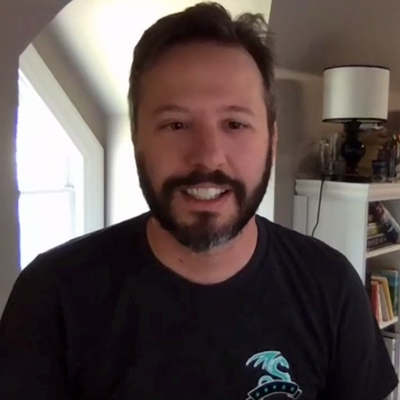
Ben Miller, Dragos | Dragos
Improving that partnership is the goal of Neighborhood Keeper, the recently announced product of an alliance between cybersecurity firm Dragos and NERC’s Electricity Information Sharing and Analysis Center (E-ISAC), with support from the Department of Energy in the form of a research grant. The initiative is aimed at helping utilities, regulators and other stakeholders improve security outcomes by pooling their knowledge and brainpower.
“It’s widely acknowledged that the U.S. government does not have a visibility into critical infrastructure, because it is owned by the industry,” Ben Miller, vice president of professional services and research and development at Dragos, told ERO Insider. “And so we’re focused on [giving] them visibility into the threats that may exist within critical infrastructure, but in a safe fashion. That’s really the focus: to give government some assurances of what is occurring in these environments and visibility into something that’s never really existed before.”
Dragos’ infographic demonstrating how Neighborhood Keeper collects information from multiple stakeholders to inform customers of threats, vulnerabilities and supply chain issues. | Dragos
Neighborhood Keeper acts as a threat intelligence system based on the Dragos Platform, a network of sensors analyzing multiple data sources across customers’ industrial control systems (ICS) and operational technology environments. Data are aggregated, anonymized and shared by Dragos with the E-ISAC, which analyzes the information for markers seen in recent attacks or general signs of compromise.
Manny Cancel, NERC | NERC
“There are so many different things that would be indicative of malicious activity,” Manny Cancel, senior vice president at NERC and CEO of the E-ISAC, told ERO Insider. He noted examples such as employees accessing networks for which they haven’t been approved, or remote access requests coming unexpectedly from overseas or other unusual locations.
But the growing sophistication of attackers has made detecting intrusions, let alone shutting them down, ever more difficult. In the case of the SolarWinds hack last year, intruders believed to be Russian gained access to the update server for the company’s Orion network management platform and inserted their own code into the platform’s software patches; when clients downloaded and executed the patches, the attackers gained access to their information technology networks. About 18,000 public- and private-sector organizations are known to have been impacted by the compromise. (See SolarWinds Recovery May Require Extreme Actions.)
Critical to the collaboration, and an essential condition of DOE support, is that the insights gained through the E-ISAC’s analysis be available for the entire industry, not just users of Dragos’ technology. Miller and Cancel both acknowledged that no single solution will spot all threats; the hope is that Neighborhood Keeper will help utilities filter out the important information from the background cyber noise.
Broader Collaboration Efforts Ahead
All of the parties to Neighborhood Keeper see the collaboration as just a first step. For Dragos, similar platforms could be easily developed for other critical infrastructure sectors, working alongside those sectors’ equivalents to the E-ISAC or any other partners who can provide useful insights.
“We are certainly looking at … expanding [the system] out to more parties, the E-ISAC being one of the first ones,” Miller said. “But we also have the ability to extend it out to industry as well. … We’ll be opening up to a larger pool, over time, of who can be involved from an analysis perspective.”
Cancel also sees the Dragos partnership as a potential model for future collaboration efforts. There are many cybersecurity researchers and consultancies with perspectives on the electric industry, and the E-ISAC sees expanding its partnerships with all players in the ecosystem as an essential element of fulfilling its mission.
“I would say this is part and parcel to the E-ISAC’s mission. We are a provider of information to the electricity sector … and certainly anything that would be potentially impacting an operational technology environment or an environment that’s used to distribute energy is important,” Cancel said. “And the analysis that the E-ISAC does now, and would continue to do on this platform, is right in our sweet spot and part of our strategic plan.”
Consumers Energy, Michigan’s largest utility, announced Wednesday that it will shutter its five remaining coal plants by 2025 — 15 years earlier than previously planned — while tripling its renewable capacity and increasing use of natural gas.
Consumers, a unit of CMS Energy (NYSE:CMS), said it will cut carbon emissions 60% by 2025 from a 2005 baseline.
Environmentalists praised the early coal retirements and renewable pledges but said they would challenge the proposed gas additions in proceedings before the Michigan Public Service Commission.
“Moving off coal by 2025 is an important move by Consumers Energy … but this is only a half-step if they are going to replace coal with other fossil fuels like natural gas,” said Derrell Slaughter, Michigan Clean Energy Advocate for the Natural Resources Defense Council.
The company said it will seek PSC approval to:
retire coal-fired Campbell units 1, 2 and 3 (1,440 MW) in 2025 — six to 15 years sooner than their scheduled design lives;
retire Karn units 3 and 4 (1,100 MW), which run on natural gas and fuel oil, in 2023, eight years sooner than their design lives. (Karn’s coal-fired units 1 and 2 (500 MW) are already scheduled for retirement in 2023.);
purchase four existing natural gas-fired plants in the state totaling more than 2 GW: the 1,176-MW Covert combined cycle plant in Van Buren County; Dearborn Industrial Generation, a 770-MW natural gas and waste cogeneration plant in Wayne County; and two peaker plants: Kalamazoo River Generating Station in Kalamazoo County and Livingston Generating Station in Otsego County.
In a filing with the Securities and Exchange Commission, the utility said it had signed a contract June 21 to purchase the Covert facility for $810 million, with closing expected by April 2025.
Consumers currently owns two natural gas-fired plants in Zeeland (527 MW) and Jackson (542 MW).
The utility pledged to construct 8 GW of solar power (up from 6 GW in its current plan) and generate 60% of its power from renewables by 2040.
“Combining that growth with advances in energy storage and customer efficiency will allow us to meet customers’ needs with 90% clean energy resources,” the company said in a statement.
Consumers spokesperson Katie Carey said the company will file its revised integrated resource plan (IRP) with the PSC next week, kicking off a nearly year-long proceeding in which it will seek approval. A presentation on the IRP lists 1.1 GW of energy efficiency, 750 MW of demand response, more than 100 MW of conservation voltage reduction and 475 MW of battery storage.
Consumers currently runs solar plants at Western Michigan University, Grand Valley State University and in Cadillac, and purchases solar power from other locations in the state.
The utility said the proposals would save ratepayers about $650 million through 2040 compared to its current plan, in part by depreciating the retired plants over their design life rather than using securitization. Reduced fuel costs also will contribute to the savings, Carey said.
Consumers retired seven coal-fired plants totaling 900 MW in 2016. Its remaining 1.8 GW burns 9 million tons of coal annually.
At a press conference, Consumers CEO Garrick Rochow said the plan would reduce carbon emissions by 63 million tons.
Company executives said purchasing the existing four gas plants was critical to the plan’s success, contending it needs the additional natural gas capacity for reliability. “A predominantly renewables scenario offers insufficient capacity to meet reliability standards in the winter when solar energy is less abundant — and in the summer,” the company said.
Purchasing existing plants with less remaining life at a lower cost “reduces long-term risks,” it added.
Reaction
“This historic and critical announcement from Consumers Energy to shutter coal plants ahead of schedule will improve the health of Michigan residents and protect our Great Lakes from pollution,” said Charlotte Jameson, program director of energy for the Michigan Environmental Council. “However, we are skeptical of the transition to using additional natural gas to fulfill our state’s energy needs. We will be intervening in the case to put forward ways for Consumers Energy to more rapidly transition to fully carbon-free, clean energy, like wind and solar, energy efficiency, and battery storage.”
John Delurey, Midwest senior regional director for Vote Solar, also criticized the company’s gas plans. “To meet Gov. Gretchen Whitmer’s goal of carbon neutrality, we need stronger investments in clean energy, including a hard look at the benefits of increased distributed generation,” he said.
“We appreciate Consumers’ commitment to move beyond coal and not to create new fracked gas infrastructure, unlike DTE, who have used every opportunity to double down on coal and fossil fuels,” said Mike Berkowitz, Michigan Beyond Coal Campaign representative for the Sierra Club.
Nick Occhipinti, government affairs director for the Michigan League of Conservation Voters, said that, in addition to investing in renewables, Consumers “should prioritize energy waste reduction and expanding rooftop and local community solar before investing in additional natural gas plants.”
‘Just Transition’ Promised
In addition to touting the environmental impact of the new plan, company officials also said it would be good for their shareholders, noting the gas plant purchases would add $1 billion to its rate base over five years. With the addition of the gas plants and CMS Energy’s recently announced sale of EnerBank, more than 95% of CMS’s earnings will be from its regulated utility and 5% from unregulated businesses, it said.
Brandon Hofmeister, CMS Energy | CMS Energy
At the press conference, Brandon Hofmeister, CMS Energy senior vice president of governmental, regulatory and public affairs, said the company will ensure a “just transition” for the 510 employees at the five coal plants as well as the communities hosting them.
“We have a great track record of success of taking care of both the coworkers at these facilities — ensuring that they have the opportunity to continue to find work at Consumers Energy — as well as working proactively with the communities to reimagine the economic development opportunities for those communities and for these sites,” he said.
FERC on Thursday announced it has finished work on establishing its new Office of Public Participation (OPP) and that it will hire a director by Oct. 1, the end of this fiscal year.
“I am pleased to announce that FERC has established an Office of Public Participation, a step that is long overdue,” Chairman Richard Glick said. “I am looking forward to finding a director to lead this office and continuing to engage with the public on these essential issues.”
FERC has been required to establish the office since 1978 under the Public Utility Regulatory Policies Act, but Congress had not allocated it funding until late last year. Its purpose is to not only assist members of the public impacted by the commission’s proceedings, but also gather more public input.
The announcement followed several months of public input, including several listening sessions led by Commissioner Allison Clements, a commissioner-led workshop in April and 115 written comments. (See Panelists Urge Inclusive Approach to FERC’s OPP.) Among the many complaints levied by commenters was that they were often completely unaware of an infrastructure project (usually a natural gas pipeline) being built until developers asserted eminent domain.
“Our process for establishing FERC’s new Office of Public Participation was driven by the desire to hear directly from the audience that the new office will serve: the public,” Clements said. “The form and function of OPP is based on a strong foundation of input, particularly from people and communities who traditionally have not had a voice in commission processes yet stand to benefit from participation. I look forward to seeing how OPP evolves to carry out Congress’ directives.”
In compliance with a congressional directive, FERC outlined the structure and functions of the new office in a 34-page report, released alongside the announcement. In it the commission said it would implement the office in four phases, beginning by detailing current staff for “the first few months” before beginning to hire new, dedicated staff over the course of the next fiscal year under its director.
The office will house an Outreach and Assistance unit, which will be divided into groups for energy infrastructure and energy markets. FERC expects the office to be fully staffed in FY24. Applications for the director position are due by July 15.
“We commend FERC for its action today of getting the Office of Public Participation off the ground,” said Aaron Stemplewicz, senior attorney at Earthjustice. “The office will help correct the existing power imbalances in FERC proceedings. It will provide historically underrepresented communities and individuals with the critical tools and assistance necessary to meaningfully engage in those proceedings.”
“Consumers finally have a seat at the table!” Illinois Rep. Jan Schakowsky tweeted. “The Office of Public Participation at FERC will give consumers a voice in how FERC regulates electricity rates or approves energy infrastructure.”
FERC on Wednesday accepted NYISO revisions to its operating reserve demand curves (ORDCs) but rejected the supplemental reserves procurement process component of the ISO’s proposal (ER21-1018-001).
NYISO proposed two sets of changes, with the first concerning the current ORDCs and designed to improve pricing efficiency; provide for better alignment with the cost of actions that may be taken to preserve sufficient availability of reserves and maintain system reliability; and reduce historical occurrences of reserve shortages.
The commission found that the proposed ORDC changes would improve pricing efficiency by introducing additional steps to the New York Control Area’s 30-minute reserve demand curve based on recent NYISO data demonstrating the value of various operator actions taken to maintain reserve availability and system reliability.
“These additional steps will make the ORDC more graduated and assign more accurate prices to these actions and avoid unnecessary price volatility by further graduation of the NYCA 30-minute reserve demand curve,” the commission said, adding that the proposed updated ORDC values better reflect the locational price signals necessary to incent resources to develop and/or maintain the capability to provide reserves when and where needed.
“Further, based on the evidence NYISO provided, we find that the proposed ORDCs would significantly address the reserve shortages that NYISO has experienced. Together, the ORDC changes will improve NYISO’s ability to manage operational uncertainty via market signals,” the commission said.
The compliance filing must provide at least two weeks’ notice of the actual effective date; NYISO requested a flexible effective date between June 1 and 30.
Supplemental Reserves
The second set of tariff revisions concerned the establishment of a process to facilitate procurement of operating reserves in excess of the quantities required by minimum reliability standards and rules to the extent such supplemental reserves are needed to assist with maintaining system reliability as intermittent renewable generation increases over time.
The commission, however, rejected this proposal and directed the ISO to submit a compliance filing removing all instances of supplemental reserves from its proposed language within 30 days.
The New York Department of State’s Utility Intervention Unit (UIU) had protested the supplemental reserves component, arguing that the filing lacked the information the commission needs to assess the proposed changes. The Independent Power Producers of New York supported the proposal, arguing it was made in collaboration with stakeholders to address reliability concerns as intermittent renewable resources increase in the near future.
“As a preliminary matter, we disagree with NYISO’s assertion that the procedures for implementing and adjusting supplemental reserve requirements are substantially similar to the existing procedures for adjusting regulation services requirements,” the commission said. “We agree with UIU’s assertion that the two requirements are not substantially similar because the criteria by which the regulation services requirements are established and adjusted rely on reliability rules established by external reliability organizations rather than at NYISO’s discretion.”
The commission said NYISO’s proposed tariff revisions “lack sufficient specificity” because they only describe how the ISO would review any supplemental reserve procurement with its market participants; obtain Operating Committee approval at least 30 days prior to any procurement; and then post the targeted procurement level.
“Additional specificity in the Services Tariff will provide a degree of predictability as to costs associated with any procurement of supplemental reserves,” the commission said.
To help Colorado meet its ambitious decarbonization goals, Gov. Jared Polis on Thursday signed Senate Bill 72, an infrastructure and transmission bill that requires utilities with transmission facilities to join an RTO.
MIT Energy Initiative’s Patrick Brown told the state’s Public Utilities Commission in April that the fastest and most cost-effective method to reaching deep decarbonization would be to interconnect the state’s grid to other regions. (See Colo. Regulators Consider the Advantages of Interstate Tx.) This allows for the transfer of more renewable energy and promotes grid resilience. By requiring local utilities to join an RTO, the state will be able to interconnect its transmission facilities and take advantage of other regions’ renewable resources.
The bill will exempt a utility from joining an RTO if the PUC determines that there is not a viable market or that it would not be in the public’s best interest. The commission will also be responsible for approving new transmission projects and ensuring that those projects “support future expansion as needed to enable the utility to participate in a regional transmission organization.”
Advanced Energy Economy Principal Emilie Olsen said in a press release that the bill “will put Colorado on a path toward achieving the state’s ambitious decarbonization goals, sustain economic growth, and prepare our electricity grid for the challenges ahead.”
A FERC technical conference on Western resource adequacy began Wednesday with Chairman Richard Glick joining the chorus of those calling for the West to form one or more RTOs soon.
He cited last year’s rolling blackouts in California, extreme heat waves in the West, and strained resources across the region. The West already had one serious heat wave in June and expects triple-digit temperatures this weekend from Tucson, Ariz., to Portland, Ore., he said.
“Portland’s supposed to get to like 110 degrees in June,” Glick said. “That’s amazing to me, and we saw extremely hot weather in California and parts of the Desert Southwest last week. And so we know that climate change is with us, and it’s going to present significantly increased challenges in terms of stress on the system.”
(The National Weather Service said Portland hit a record high temperature of 112 degrees Fahrenheit on Sunday and forecast Monday’s high at 114.)
“I believe a regional transmission organization, or maybe a couple of regional transmission organizations, in the region would be a big part of the solution,” Glick said.
“I’m well aware of the history associated with the Western energy crisis 20 years ago and how that soured a lot of people in the region on developing an RTO beyond California’s borders,” he said. “While there has been a lot of progress, the [CAISO Western Energy Imbalance Market] for instance, much more work remains. In my opinion, the time is right for the states, the region’s utilities and other key stakeholders to go ahead and finish the job.”
Commissioner Allison Clements agreed. Since the energy crisis of 2000/01, FERC has tried to leave Western entities alone to ensure their own resource adequacy and to design markets that promote reliability and cost savings, she said.
FERC Commissioner Allison Clements | FERC
“This commission has been wise to respect [the West’s] processes and not work to scare off progress from the East … [but] the urgency has changed,” Clements said. “The urgency of efforts toward broader regional integration has changed in the last year, even in the last six months. The shared goals of ensuring reliability against these extreme weather threats, the goals of meeting state policy mandates [regarding greenhouse gas emissions], and the goals of protecting consumers in the process require continuing progress toward full regional integration.
“And it’s no secret that I, like the chairman, believe that well designed regional markets — designed by westerners for westerners — are the best path forward to protect customers and ensure reliability while addressing resource adequacy concerns and the other serious challenges facing the West.”
Doing so successfully will require transparent and effective market design and inclusive, fair governance, she said.
The commissioners’ comments were the latest push toward a Western RTO.
The Public Utilities Commission of Nevada said last week that the West needs an organized market. Lawmakers in Nevada and Colorado passed bills that require transmission owners to join an RTO by 2030. And a state-led study funded by the U.S. Department of Energy found the West could save $2 billion annually by forming a single RTO. (See Nevada PUC Calls for Organized Market in West and Study Shows RTO Could Save West $2B Yearly by 2030.)
RTOs, Capacity Markets
In a subsequent panel Wednesday, FERC Commissioner Mark Christie asked panelists, who had been discussing challenges and trends in resource adequacy across the West, an open-ended question about whether Eastern-style RTOs or capacity markets would work in their region.
He got a series of nuanced answers that touched the relevant points on both sides of the argument.
Bryce Freeman, administrator for the Wyoming Office of the Consumer Advocate, said he did not understand how the development of a sound, resource adequacy construct that provides the lowest-cost assurance to customers gets done without a capacity market.
“I’ve thought about this a lot over the years,” Freeman said. “Energy-only markets, I don’t think work. That was part of the problem in Texas in February. The system needs reliability, costs money, and reliability in the form of capacity that can be dispersed when needed. Whether that’s battery storage or gas or coal, or something else [like] hydrogen, the markets, or the customers, need that reliability. I don’t see how you value that prudently without making a market for it.”
Mark Holman, managing director of Powerex, conversely added that whenever the topic of resource adequacy comes from the West, raising the concept of a centralized capacity market along with it, “there is generally strong resistance to that structure.” Holman favors a capacity market “in the form of bilateral transactions” that allow entities autonomy to decide what mix of resources — contracted or owned — work best for them.
Carrie Bentley, CEO of Gridwell Consulting, said there is a “robust” bilateral market in the West, and “capacity markets work best when you have a uniform product.”
“When you have resources where you can easily compare the reliability, they have a similar obligation to the market,” Bentley said. “I think the diversification of resources out here from year to year, and from hour to hour even, on what their contribution to reliability is, makes it really challenging to run a market, similar to the Eastern RTOs.”
Bentley said as much as she could see “benefits of capacity markets in general, I just don’t think they’re well-suited to the West’s resource mix or diverse set of buyers.”
Paul Lau, CEO of the Sacramento Municipal Utility District, said there must be a way to control “how we want to address reliability … and not be something that’s mandated through a capacity market.”
“I think it’s absolutely important right now that we don’t have a mandatory capacity market because I think there’s a lot of movement and a lot of good work that we’re doing in the Pacific Northwest, certainly in the Northwest Power Pool,” Lau said. (See NWPP RA Program Taking Shape for Q3 Launch.)
Governance Key
In the conference’s second day Thursday, Scott Bolton, PacifiCorp’s senior vice president of transmission development, said his company had been spending an “inordinate amount of time” working with CAISO to ensure that its integrated planning, procurement and market framework provides enough capacity to help California meet its clean energy goals.
“The stakes couldn’t be higher. We’re already in the midst of a very hot summer,” Bolton said. “It’s increasingly important, if not more important, to work across the interconnection. [FERC’s] effort to facilitate greater dialogue between the fellow regulators and the state is critical. I can’t overstate that, having worked both outside and inside California. I’m acutely aware that we need to keep progressing together and keeping our momentum.”
Agreeing with Bolton, Oregon Public Utility Commissioner Letha Tawney said, “We see that there is a substantial resource adequacy issue heading towards us. It’s abundantly clear that cooperating is to our benefit.
“I very much look forward to that opportunity to have a apples-to-apples conversation, recognizing that there will continue to be a challenge in bridging the California RA system and we’ll all need some sort of clever cheat sheet or translation table,” Tawney said. “I think that’s possible, and I look forward to it.”
So is an RTO the next logical step? Several panelists pushed the idea.
SPP has proposed starting an RTO West, contending it is the logical choice to lead an organized market that includes diverse Western interests.
Bruce Rew, the grid operator’s senior vice president of operations, noted SPP is a reliability coordinator in parts of the West and that it is helping the Northwest Power Pool develop a multistate resource adequacy program. SPP also manages a Western Energy Imbalance Service to compete with CAISO’s EIM. (See SPP CEO Pitches WECC on Western Benefits.)
SPP’s inclusive governance model would serve the West well, Rew said.
“From our perspective, governance is key for these regional organizations to be effective,” he said. “Governance needs to be broad. It needs to be very inclusive for the stakeholders and all parties. Regional markets are going to be very diverse, from the small entities and large entities top the public organizations and state organizations. All those participants are the foundation for an RTO to be successful.”
Western Grid Group Director Amanda Ormond pointed to the potential financial benefits.
“We know that the RTO will save $2 billion [annually] for customers,” Ormand said, referencing the DOE-funded study. “Every year there’s a delay, the customers are paying more than they need to.
“I totally understand that governance is an important issue,” she said. “We need independence of an organization. We need state regulators to have a key place at the table. To build the best, we can look at the governance models all over the countries and the world.”
In the meantime, “we’re getting less reliable because weather patterns are changing,” Ormand said. “Our systems are changing. At some point we need to make a decision to move forward.”
Sen. Jeanne Shaheen (D-N.H.) wants the Department of Energy to consider putting climate controls in all the rooms on Capitol Hill and explore the use of energy-saving performance contracts for federal buildings.
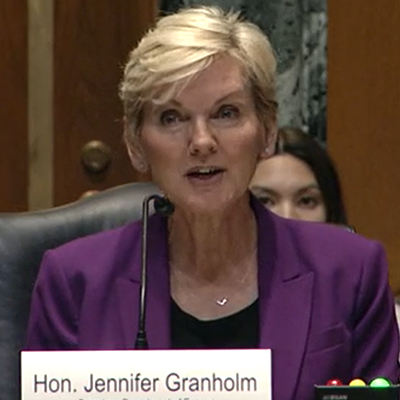
“It’s ridiculous that we can’t control the temperature in the rooms in this building,” Shaheen told Energy Secretary Jennifer Granholm during a Senate Appropriations Subcommittee on Energy and Water Development hearing Wednesday on DOE’s 2022 budget. “I would urge you to look at energy-savings performance contracts,” which Shaheen said cut heating bills and emissions for New Hampshire’s state buildings when she was governor.
Energy Secretary Jennifer Granholm | DOE
But according to Joanne Lowry, strategic director of the department’s Federal Energy Management Program, performance-based contracting is a standard practice for its efforts to make federal government buildings more energy efficient. Under such contracts, building upgrades are paid for by actual energy savings.
Speaking during a Wednesday webinar on the 2022 budget for DOE’s Office of Energy Efficiency and Renewable Energy (EERE), Lowry said it provides a “significant bump-up” for program funding that will “continue to leverage that [performance-based] mechanism and explore other pathways to get money out.”
That bump-up is, in fact, a 10-fold increase from $40 million in 2021 to $438 million in 2022, according to figures presented during the webinar.
The two sessions — less than an hour apart — underlined the stark contrast between the politics of energy funding in Congress, and the actual programs that the budget makes possible and their potential impact.
Wednesday’s Capitol Hill hearing was Granholm’s fourth on the $46.2 billion budget request for 2022, and Republicans on the subcommittee continued to hammer away at President Biden’s infrastructure plan as an attack on the fossil fuel industry and jobs. Even if the U.S. can zero out its emissions, any impact on climate change would be nullified by countries such as China and India that continue to build coal plants, said Sen. John Kennedy (R-La.), the subcommittee’s ranking member.
“The administration’s hostility toward fossil fuels [is] more an emotional reaction than a rational reaction,” he said. “A lot of members of the administration … don’t see climate as a discrete scientific problem; they see it as a religion. They see it as a vehicle through which they can remake American society.”
Granholm stood her ground, noting that the budget and Biden’s American Jobs Plan both include funding for research, development and deployment of a range of clean technologies, from nuclear and green hydrogen to carbon capture and sequestration — all of which Kennedy and other Republicans said they favor.
“I want you to understand that we are there with you on that,” she told Kennedy.
As at a recent budget hearing before the Senate Energy and Natural Resources Committee, these low- or no-carbon technologies seemed to provide some common ground for Democrats and Republicans. (See Granholm Pitches DOE Budget to Senate Energy Committee.)
But some Democrats on the subcommittee also argued that specific line items should be increased. Pointing to the ongoing impacts of climate change in California, subcommittee Chair Dianne Feinstein (D-Calif.) wanted to raise the budget for DOE’s Office of Science to promote research on advanced computing, artificial intelligence and machine learning. Shaheen also pushed for more money for efficiency programs at the department’s Building Technologies Office, where, she said, “we know there are substantial energy savings being left on the table.”
Granholm used such comments to pitch the American Jobs Plan. For example, on building efficiency, she said passage of the fully funded plan “would allow us to push this much further, providing incentives to states to really up their game on building codes and allowing us to up our game on advising and giving technical assistance that is necessary to all these local units of government to do the same.”
Manufacturing
The EERE webinar offered a more granular look at the budget and the increased funding Granholm and Biden are seeking for specific programs that could, perhaps, also draw bipartisan support. The total EERE budget request of $4.7 billion is a 65% jump from 2021, in order to “focus on investments to drastically reduce emissions in the near term, while investing in research to ensure American leadership and competitiveness in advanced clean energy technologies,” said Anna Garcia, deputy assistant secretary for energy efficiency.
Going for fast emission reductions, the requested energy-efficiency funding is almost double from 2021 — from $1.1 billion to almost $2.2 billion — and accounts for close to half of the EERE budget, according to figures presented during the webinar.
Garcia broke down those figures further in her review of the department’s Weatherization Assistance Program (WAP), which provides funds to improve energy efficiency for low- and moderate-income households. In addition to a 27% increase in the funding for the program, Garcia said, this year’s budget includes a new line item: $21 million for a Weatherization Readiness Fund.
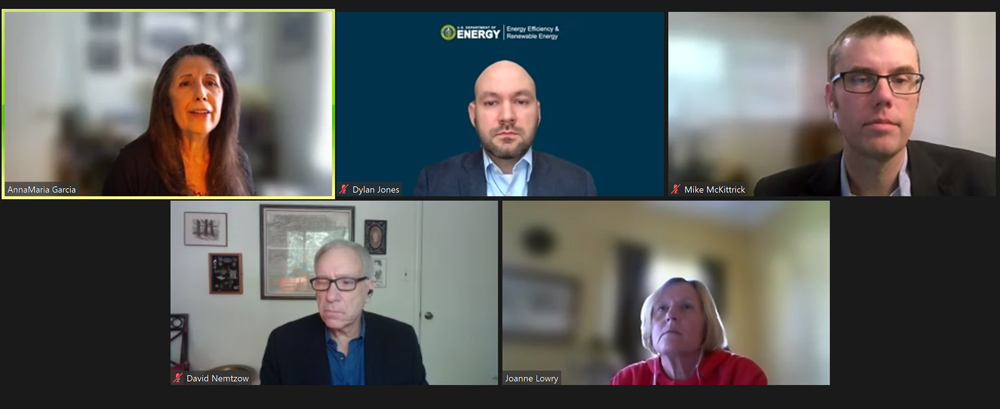
At Wednesday’s webinar on DOE’s budget for the EERE office (clockwise from upper left): Anna Garcia, deputy assistant secretary for energy efficiency; Dylan Jones, chief of staff for energy efficiency; Mike McKittrick, Advanced Manufacturing Office; Joanne Lowry, FEMP; and David Nemtzow, Building Technologies Office | DOE
“The purpose of this fund is to reduce deferrals of homes that can’t be weatherized due to structural, health and safety repairs that cannot be done under the current WAP rules,” she said. “We know that our WAP crews are generally some of the first people to enter these homes and notice these structural, health and safety repairs that may not be intrinsic to the installation of the conservation measures.”
The new fund would, she said, reduce the number of homes that are turned down for WAP improvements.
Mike McKittrick, acting director of the Advanced Manufacturing Office, said the requested 39% increase in his budget, from $396 million to $550 million, would focus on decarbonizing the industrial sector while at the same time “growing a strong, resilient U.S. manufacturing sector.”
Key strategies for industrial decarbonization include energy efficiency at the process level and across product life cycles, electrification and fuel switching — for example, from natural gas to hydrogen — and carbon capture, utilization and storage, he said. Demonstration projects to help decarbonize steel, chemicals and cement are also in the budget, along with building out domestic supply chains for sourcing and processing critical minerals needed for clean technologies, such as lithium for batteries.
A featured investment in the Advanced Manufacturing budget, he said, “is a new lab-industry consortium that will validate and de-risk technologies that are important for critical mineral supply chains and the industrial ecosystem.”
With continuing Republican opposition, how these line items will fare in Congress is uncertain. Kennedy was not overly concerned with the numbers in Biden’s budget. “Senators are like cats,” he said. “They do what they want. We’re in the process of putting together a budget, and I don’t think I’m going out on a limb by saying it will be different that the president’s submission.”