The Transportation and Climate Initiative (TCI) released a finished Model Rule last week that program participants will use to develop their own regulations to reduce emissions from transportation fuels through a cap-and-trade program.
TCI also released a draft framework for public engagement, draft model implementation plan and draft proposed strategies for regional collaboration.
The Model Rule incorporates changes to the program (TCI-P) draft model rule released in March based on suggestions from stakeholder groups and companies. An original allocation of 35% of state or jurisdiction funding for communities overburdened by pollution and underserved by public transportation becomes a minimum commitment in the Model Rule, and each participant must create an Equity Advisory Body Membership.
In addition, the Model Rule aims to create well-paying jobs for low-income and environmental justice communities. People who were formerly incarcerated will be eligible for employment opportunities.
The changes are “reflective of the values of the people who are participating,” said Vernice Miller-Travis, executive vice president of the Metropolitan Group, a social change agency.
People at risk from pollution and living near highways can “come to the table” and “decide what [transportation] will look like for the next generation,” Miller-Travis said during a webinar Thursday.
Connecticut raised its funding allocation for environmental justice communities to 50% from 35% after meeting almost weekly with community leaders and “some youth,” said Garrett Eucalitto, deputy commissioner of the Department of Transportation.
Lawmakers in Connecticut failed to pass legislation authorizing state participation in TCI-P before the end of the regular legislative session last week, but Eucalitto confirmed that Gov. Ned Lamont is still committed to participating in the program.
Eucalitto said Connecticut would use the program to electrify its public bus and school bus fleets and invest in air quality monitoring to better understand pollution quantities at the local level.
The draft strategies for regional collaboration also include air quality monitoring to “ensure transparency in effectiveness” of the program, said Terry Gray, deputy director of environmental protection in Rhode Island.
In Massachusetts, state officials worked with local nonprofit GreenRoots under TCI-P to establish community air quality monitoring in Chelsea and Boston to establish hot spots that need to be prioritized.
“As we plan for the summer and fall, it is the right time to come forward if you haven’t participated already,” said Katie Theoharides, secretary of energy and environmental in Massachusetts, during the webinar.
TCI is accepting feedback on the draft plans through Aug. 13.
The Pennsylvania State University Wind Energy Club won first place in the U.S. Department of Energy’s Collegiate Wind Competition on Friday.
Thirteen teams competed in contests for turbine design, wind farm development and community outreach, while working to adapt to the pandemic virtually and in-person after restrictions were lifted.
“This year has been particularly challenging and disruptive, but I do hope that in some way that that even added a little more depth and dimension to the experience that you got this year,” Alejandro Moreno, deputy assistant secretary for renewable power for the Office of Energy Efficiency and Renewable Energy, told teams during the award ceremony held virtually this year.
DOE launched the wind competition in 2014 to give students practical experience in wind energy disciplines and encourage entry into the industry’s workforce.
“We need you to bring everything that you have learned to the big wind competition, which is, of course, helping us to solve the climate crisis,” Energy Secretary Jennifer Granholm said in an opening message. “After you’ve celebrated … I want you to think about what your favorite part of this competition was because maybe it was building the turbines or maybe it was developing the plans or doing outreach to local communities; whatever it is, know that there is a career out there with your name on it.”
DOE also named winners in each of the three individual contests. Penn State won the wind farm project development contest; Kansas State University won the turbine prototype contest; and Virginia Tech won the community outreach contest, which was new this year.
Faculty members at the teams’ schools recognized outstanding students for their work during the competition with unofficial awards.
Alyssa Gorrell from Washington State University Everett, for example, received the Recruiter Award for organizing a trip to a wind farm and helping give talks on wind energy for ecology classes. And Trey Gloeckler from Texas Tech University received the Energy Bunny Award for bringing energy to his team when it needed a boost.
Impressing the Judges
All the teams presented their submissions virtually to a panel of judges over six days starting June 2.
The students impressed judge Toby Butterfield, director of development at Primergy Solar, with their understanding of the wind farm project development process. They showed how working as a team is key to a successful project.
“You can’t just have people who are narrowly focused on finance and separate people who are narrowly focused on site design and engineering, and other people who are narrowly focused on energy assessment,” he said. “You really need all of them working together in concert.”
In the community outreach contest, the students’ ability to engage despite social distancing guidelines inspired the judges, according to judge Lynn Abramson, president of the Clean Energy Business Network.
The outreach portion of the competition challenged students to build connections with industry members and local communities and media.
Several teams brought communications or marketing majors on board to help with their outreach, according to Abramson.
“By diversifying their team’s expertise, they were able to create very professional looking social media and websites,” she said. “We really appreciated the teams who presented metrics of their efforts, such as their social media engagement posts, event surveys or the number of students recruited or engaged.”
The students’ ability to create a working wind turbine in the prototype contest in a short time frame was laudable, according to judge Srinivas Guntur, engineering manager of aerodynamic technology at Siemens Gamesa.
And the turbine testing, which could not always be done in a proper wind tunnel, showed real innovation, he said.“You just decided to create your own rigs and started testing it by putting turbines on top of SUVs or cars, and one of the teams even put it on a VW bus,” he said, adding that he wished he could award extra style points for the students’ creativity.
2022 Competition
Penn State has won the competition four other times since 2014 and will have an opportunity to defend the title next year.
DOE named 10 teams for the 2022 Collegiate Wind Competition, which will take place next May.
The NERC Board of Trustees on Friday unanimously approved standards requiring generator operators (GOs) to protect their units against freezing and share their cold weather operating parameters with regulators.
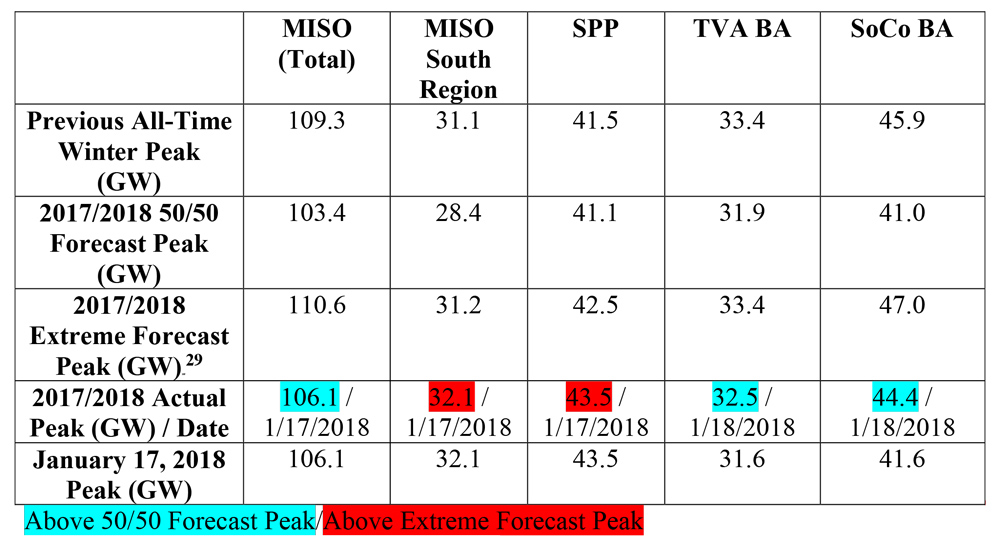
Project 2019-06 was initiated in response to the FERC/NERC staff report on the January 2018 cold weather event, when below-average temperatures resulted in 183 generating units in SPP, MISO, the Tennessee Valley Authority and SERC Reliability experiencing either an outage or a failure to start over a five-day period.
The board approved three updated standards — EOP-011-2 (Emergency preparedness and operations), IRO-010-4 (Reliability coordinator data specification and collection) and TOP-003-5 (Operational reliability data) — clearing the way for submission for FERC approval.
EOP-11-2, which cleared members’ final ballot with 66% support, adds two new requirements. R7 would require GOs to implement a plan to protect their units from freezing “based on geographical location and plant configuration.” It would also require them to identify operating parameters such as minimum design temperature and fuel switching capabilities. R8 would require GOs to provide maintenance and operating personnel with unit-specific training on the plan.
IRO-010-4, which received support from 71%, and TOP-003-5, which won 72.5% support, would require reliability coordinators, transmission operators (TOPs) and balancing authorities to include in their data specifications provisions for reporting the cold weather information identified by the GO in the cold weather plan.
GOs would be required to satisfy the specification using a mutually agreeable process, as outlined in existing IRO-010 and TOP-003 requirements. (See NERC Cold Weather Standards Headed to Final Ballot.)
Near-term Actions
Because the standards would not take effect for 18 months after FERC approval, Howard Gugel, NERC vice president of engineering and standards, said the ERO will take some short-term measures to ensure reliability in the next two winters.
Gugel said NERC is considering issuing a level 2 alert, which would “be a way of asking generator owners to report back whether or not they have … winter weather preparation plans, and whether or not they have implemented those, and then also whether or not they have attended a webinar that we would be doing.”
He said staff also will address the issues in the winter reliability assessments “to give us a good understanding for both winter and next winter, what we could possibly be exposed to.”
In addition, the FERC/ERO Enterprise report on the 2021 Texas deep freeze is expected by September or October, Gugel said. “We will look at further standard enhancements that are recommended by that inquiry team,” he said.
‘Market’ Question
Gugel told the board there were two “minority issues” raised during the standards development.
Two representatives from the Northern California Power Agency (NCPA) said the standards ran afoul of NERC’s “market principles,” which state that “a reliability standard shall not give any market participant an unfair competitive advantage.”
Marty Hostler, manager of reliability compliance, said requiring “GO/GOP market participants to perform activities that non-registered generator market participants do not have to perform, nor pay for,” violated the principles.
He also said it was unfair that “BAs and regional RC RTOs will be able to use requested information in bid stack analysis for award[ing] day ahead and real-time dispatch. Non-GO/GOPs will not have to submit the same information used in modeling evaluations of their competitive bids.”
He also complained that the drafting team “refuses to make reliability enhancement requirements for BA and RC winterization training, load forecasting improvements, and reserve increases which the FERC/NERC report also discusses.”
“SDT [standards drafting team] responses to the last round of stakeholder comments states a new SAR [standard authorization request] would be required to include these concerns. A couple months ago, during the [Standards Committee] meeting discussing SAR approval, NERC and the SDT chair advertised that the SAR … was written broadly to address stakeholder concerns. Now the SDT … refuses to address these concerns.”
Dennis Sismaet, manager of power management coordinated system operations for NCPA, said, “NERC should not create a reliability standard that applies to all regional entities. Since cold weather is geographic specific, NERC should let the regional entities decide how best to implement any cold weather regional standards specific to their geographic area. For example, in California, there are no cold weather issues that other parts of the country are facing.”
Gugel told the board the drafting team “addressed that appropriately by saying that these were reliability requirements, and that … market issues were not addressed in the standard.”
Some commenters also said the training in R8 of EOP-11 should have been put in the PER standards (Operating personnel credentials) with other training requirements.
Training Requirements
The drafting team noted that there were training requirements sprinkled throughout the standards in addition to the PER standards, Gugel said. “They also felt it was important to keep that training standard adjacent to the plan, so the folks know exactly what that was referring to. There may be a time in the future when we have an idea of consolidating within one standard, but at this point, it seems more appropriate to keep it close to the requirements that the … training requirements are referring to,” Gugel said.
Chairman Ken DeFontes called the new standards “a big first step.”
“Clearly this is going to have a very positive impact on improving our reliability in cold weather events,” he said, adding “I’m confident that once we get the results of the Texas investigation, we’ll have a fulsome conversation about what implications that has for any further work that needs to be done.”
Citing the Texas outages, Trustee Roy Thilly said it was essential that NERC “keep up the momentum on this issue.”
He also said it was important “that the implementation of the standards is as uniform as we can get it — not the temperature criteria — but how it’s audited.”
MISO said it’s poised for a slightly sunnier supply picture after tabulating this year’s resource adequacy survey in partnership with the Organization of MISO States.
In the next five years, OMS and MISO said the footprint could experience deficits as steep as 4 GW or surpluses nearing 14 GW.
The OMS-MISO survey showed that all local resource zones appear to be in good shape for 2022 on a committed capacity basis and that potential shortfall estimates across all five years are much shallower than in past years. The two said the grid operator should have anywhere from 3.4 to 13.9 GW of extra unforced capacity beyond its 2022 summer peak planning reserve margin requirement.
Other survey years showed anywhere from a 0.2-GW shortfall or 13.3 GW in excess of the planning requirement in 2023; a 1.9-GW shortfall or 11.8-GW surplus in 2024; and a 3.3-GW shortage or 10.2-GW surplus in 2025. MISO used an approximate 9% unforced capacity planning reserve margin requirement for reference in all years.
It’s not until 2026 where MISO could see an almost 4-GW systemwide shortfall, with four out of the 10 local resource zones potentially needing help from other zones. At that point, there might not be enough supply to go around.
“It puts more emphasis on putting more potential capacity online as well as retaining some uncertain capacity,” MISO Executive Director of Market Operations Shawn McFarlane told stakeholders at a special teleconference Friday to discuss the survey.
Last year’s survey indicated that MISO could face a 400-MW capacity shortfall as early as 2022, and the next five years could contain surpluses as high as 12.5 GW or shortfalls that could dip to 6.8 GW. (See OMS-MISO Survey Sees Uncertain Supply Future.) In 2018, the survey predicted anywhere from a 2.3-GW shortfall to a 7.5-GW surplus in 2022.
McFarlane said this year’s survey shows that there could be a “fairly healthy” 10 GW in resource additions annually over the next four years. In the past two years, MISO interconnected the most generation it ever has, with 10.8 GW in 2019 and 9.9 GW in 2020.
MISO said this year’s less risky supply picture can be attributed to lackluster load. McFarlane said forecasted load for 2022 dropped 3.6 GW between this year’s survey and the last, mostly owing to the COVID-19 pandemic.
In the survey’s ensuing years, MISO and OMS continued to include the load decrease and used a 0.3% demand growth rate on a year-to-year basis between 2022 and 2026.
“Once again, the survey shows an uncertain year has evolved into a more certain year,” North Dakota Public Service Commission Chair and OMS President Julie Fedorchak said of 2022.
“The outlook is modestly better,” McFarlane agreed. “In 2023 and beyond, the resource picture is a little less certain.”
McFarlane said more generation retirements and livelier demand growth could make reality more dire than the survey’s predictions. He said a robust pandemic recovery with more energy demand could wipe out the moderate capacity gains.
However, McFarlane said that states and load-serving entities and state regulators will use this year’s OMS-MISO survey results to guide new resource decisions.
Fedorchak said even though some local resource zones might come up short in future years, they could lean on supply from other flush zones. She also said it’s imperative that generation projects be able to complete MISO’s interconnection queue.
“We’re aware of those projects and need to ensure that the portions of those needed for resource adequacy are able to interconnect,” she said.
MISO singled out Wisconsin and the Upper Peninsula’s Zone 2, Southern Illinois’ Zone 4, and Indiana and Western Kentucky’s Zone 6 as being most at risk of needing to rely on imports over the next five years.
Survey results are based on responses from more than 97% of LSEs and other non-LSE market participants.
As with past surveys, MISO hasn’t assumed that all of the proposed generation in its interconnection queue reaches commercial operation and can help mitigate capacity needs.
MISO gave a 75% probability of completion to conventional generation projects in phase 2 of the three-phase interconnection queue and a 50% probability for intermittent generation projects at the same point. Projects that have scaled the three definitive planning phases and are executing generator interconnection agreements received a 90% certainty. For projects that have applied but not yet entered the queue, MISO assigned a 10% weight.
McFarlane also warned that next year’s survey result might slide again into pessimism, considering that MISO is preparing to introduce a stricter and seasonally based capacity resource accreditation. “We need to approach OMS about how we approach the survey in a seasonal capacity construct,” he said.
“We’re moving forward to comply with the one-year-from-now deadline. We’re looking at how we’re going to juggle that with other priorities,” MISO Executive Director of Market Operations Shawn McFarlane told stakeholders at a Market Subcommittee meeting Thursday.
Earlier in June, MISO General Counsel Timothy Caister said the RTO may seek rehearing on the order, but it is currently preparing its aging market platform to host storage offers.
Stakeholders asked MISO for more details about the cost of rolling out storage participation on the current market platform and how compliance may affect other market projects and the platform replacement itself.
Others asked for MISO to circulate a rehearing request before it files with FERC.
MISO corporate counsel Jacob Krouse said it’s not RTO procedure to share rehearing requests with stakeholders ahead of filing. He said it’s MISO’s prerogative to seek rehearing without consulting the stakeholder community.
For now, it remains to be seen how the inclusion of storage offers will affect MISO’s market platform replacement. The grid operator had argued that its June 6, 2022, Order 841 compliance deadline stood to postpone the launch of a new platform.
MISO is set to begin parallel operations on its new market user interface on July 6 and its new cloud-based, one-stop modeling manager in mid-September. Both efforts are tied into the larger platform replacement project.
MISO Calls 2nd Max Gen Emergency of 2021
Battling a heat wave and generation outages, MISO enacted a maximum generation event for its Central and North regions for a few hours on Thursday afternoon.
The grid operator said it contended with above-normal temperatures paired with high load and forced outages. The emergency was called for about 2 to 5 p.m. and never escalated beyond use of load-modifying resources.
Ahead of the heat, MISO instated a capacity advisory for its North and Central regions Wednesday that escalated into a maximum generation warning Thursday morning.
The event was MISO’s second emergency event of 2021. The first was called amid the February winter storm’s grip on much of the nation. (See MISO: Wintry Weather Vindicates RA Changes.)
MISO Begins Exploration of SATA for Market Services
MISO is beginning to contemplate how its storage serving as transmission can also participate in its energy markets.
Adviser Michael Robinson opened a presentation by explaining the difference between a permutation and a combination. In a permutation, the order of the items matter, he said.
He asked stakeholders for any ideas on how MISO might arrange the functions of storage resources to allow for dual usage.
“We do understand the value-stacking of these assets,” Robinson said.
When MISO staff drafted rules around storage-as-transmission-only assets (SATOA) in 2019, they repeatedly promised that they would soon chart a new process for storage to function simultaneously as transmission and participate in the markets. (See FERC Greenlights MISO Storage-as-Tx Proposal.)
Robinson asked if a storage asset’s transmission use needs could be predictable enough for MISO to confidently schedule storage assets for market services.
Compensation for market services also requires some thought, he told stakeholders.
“How do we compensate these assets for market services when they’re getting full recovery of cost today?” he asked stakeholders rhetorically.
Robinson said existing SATOA won’t be able to skip MISO’s generator interconnection queue to gain market entry, as they are able to currently.
MISO will take stakeholder suggestions on the issue through the end of June.
“We want to get as much out of our storage asset for the benefit of our customers,” American Transmission Co.’s Bob McKee offered.
MISO Investigating FTR Underfunding
MISO said it’s noticed a recent problem with underfunding of financial transmission rights.
“We’ve initiated a review of the FTR market,” McFarlane revealed. He said MISO staff are running diagnostics to see what’s driving the poorer financial performance.
However, McFarlane stressed that MISO’s FTRs are still “substantially funded” near 100%. “We’d like them to be 100% again,” he added.
The RTO is looking for improvements to implement in 2022, McFarlane said.
Earlier this year, MISO Director of Market Administration John Harmon said “new and variable congestion patterns” are to blame for the underfunding, particularly those brought on by more wind generation and warmer winters in general. He said the underfunding became more prominent in the fourth quarter of 2020.
Harmon said MISO has begun modeling more constraints on its the transmission system to address the problem. He said MISO wants to make sure it exactly matches what it auctions off with what is available.
McFarlane promised more discussion at upcoming subcommittee meetings.
Hurricane Laura has Domino Pricing Effect
MISO will resettle about $10 million in pricing on Aug. 27 related to Hurricane Laura, staff announced Thursday.
In the course of reviewing its practice of pricing dead buses at the value of lost load during the hurricane with its Independent Market Monitor in a nonpublic setting, MISO said it discovered a discrepancy in its hourly commercial pricing node between the day-ahead and real-time markets. (See MISO to Outline New Pricing Plan for Hurricanes.)
MISO said the difference arises when there are de-energized elemental pricing nodes within a commercial pricing node. The RTO’s hourly real-time commercial node pricing uses an aggregation of LMPs at both live and dead elemental pricing nodes, while hourly day-ahead and five-minute real-time commercial node pricing aggregates only the LMPs at live elemental pricing nodes.
MISO said its working with market platform vendor General Electric to install a patch so hourly real-time pricing lines up with both five-minute real-time and hourly day-ahead settlements. The patch will be ready June 22, MISO said.
Director of Settlements Laura Rauch said it will take about a month to reprice and resettle prices on Aug. 27, when Laura made landfall in the Gulf of Mexico. MISO will reprice real-time hourly commercial node prices; the change will not affect day-ahead pricing.
McFarlane said he expects “some disputes will fall away” from members over Laura pricing when MISO applies the fix.
“I know it won’t settle all of the disputes that were filed. But some of them,” he said.
McFarlane said the error can be traced back to the introduction of five-minute settlements in 2018.
“This is a continuing error, so we’re figuring out what to do for the rest of the days,” McFarlane said.
Rauch said the discrepancy became apparent during the “dramatic and abnormal price separation” caused by the storm.
She said it’s unlikely that the error will have much impact outside of abnormal weather days. “So we’re talking about impacts that are very, very small outside of events like this,” Rauch said, adding that MISO will investigate the mid-February cold snap as well.
MISO has prepared a filing outline for stakeholder evaluation on its plan to bring distributed energy resource aggregations into its markets.
The RTO plans to lean on its existing dispatchable intermittent resource and electric storage resource participation models for FERC compliance. It would limit full dispatch participation to DER aggregations of 1 MW or greater, forcing those smaller than 1 MW to self-commit in the markets in order to participate. The RTO in early spring said necessary software changes would be too overwhelming if it fully accommodates the 0.1-MW minimum aggregation size outlined in FERC’s Order 2222. (See MISO to Recycle Participation Models for Order 2222.)
The RTO has until April 18, 2022, to submit a compliance filing to FERC. It has DER Task Force meetings and workshops with distribution companies scheduled nearly every month until the filing date.
“Research studies show broad, multi-node aggregations can lead to reliability concerns and power/price oscillations that are worsened with inaccurate distribution factors,” MISO said.
As an added bonus, MISO won’t have to make market clearing changes to accommodate the single-node dispatch of a DER aggregation, DER Program Director Kristin Swenson said at a special workshop June 7.
The RTO said it would not impose a maximum size limit on individual resources within an aggregation. But Swenson said MISO might glean through experience a maximum size threshold.
“We know we need automated data,” Swenson said, adding that individual phone calls to supply data from distribution companies to the MISO control room is an unrealistic option.
Swenson also said MISO still must figure out when a DER interconnection will require an affected-system study. She said unlike the affected-system studies between RTO territories, MISO in this case will be considered the affected system by the distribution system.
The decision to limit aggregations to a single pricing node will give MISO an easier time modeling the aggregations, Manager of Planning Modeling Amanda Schiro said.
“These decisions build upon one another,” she told stakeholders.
MISO plans to model an aggregation as a representative aggregate generator with positive or negative capabilities. The generator designation will minimally disturb MISO’s existing reliability and planning modeling, Schiro said.
Staff acknowledged that MISO’s modeling isn’t a swift process that can easily include mobile DERs or additions and deletions in aggregations.
“We do have this question about how do you update what’s in an aggregation,” Director of Settlements Laura Rauch said.
Swenson added that electric vehicle technology is at least a few years away from being true mobile resources.
While it’s up to regulatory authorities whether to allow dual participation in the retail and wholesale markets, MISO will probably devise a matrix provided to aggregations upon registration and enrollment in the RTO that shows which options for wholesale participation are compatible alongside retail market participation and which aren’t.
Swenson said MISO can use its existing market participation agreement with some modifications for aggregations, but the agreement does not negate the need for further operational agreements between DERs and aggregators.
MISO is taking stakeholder comments and suggestions on its filing approach through June 28.
On a cold day in Seattle, natural gas accounts for about two-thirds of the city’s energy consumption, Puget Sound Energy CEO Mary Kipp told listeners dialing into the NW Energy Coalition’s virtual Clean & Affordable Energy Conference.
Kipp was highlighting the key role natural gas plays in heating homes and businesses in the Pacific Northwest — and the challenge of fully weaning Washington off the gas system as it moves to decarbonize its economy by 2050.
As a mixed utility with about 1.1 million electric and 900,000 gas customers in the Seattle suburbs, PSE has a financial interest in preserving both of its business lines as it prepares to meet the state’s greenhouse gas targets.
Citing the difficulty of building enough transmission to tap the state’s “big renewable resources” located on the other side of the Cascade Range, Kipp said PSE must “think about the infrastructure we have to decarbonize as quickly as possible.”
That includes the company’s extensive natural gas pipeline network.
“My goal is to do what we can to decarbonize our pipes, and the value is the pipe network — it’s not what flows through it,” Kipp said. “We are neutral to what flows through it. You know, it’s natural gas today, but hopefully it’s going to be more RNG [renewable natural gas] and then likely hydrogen in the future.”
“I’m tasked with doing a study, and I don’t want to prejudge what’s going to come out of that study, but my first observations are, boy, this decarbonization of the gas system is going to be very hard,” David Danner, chair of the Washington Utilities and Transportation Commission, said later during a panel discussion on the regulatory barriers to decarbonizing the gas system.
Danner called electrification a “proven technology” for decarbonization, but he acknowledged that the electrification process is fraught with its own challenges, such as stranded costs, job disruption, resource adequacy issues and — as Kipp noted — the hurdle of developing new transmission lines to tap zero-emissions resources.
“And then you’ve got equity issues, because … when you have a transition, if you’re going to electrify, it’s going to be the more well-off people who are going to be able to get heat pumps and electric ranges in their homes before lower-income people,” who will see their rates increase as they’re forced pay for the system “going forward,” Danner said.
But many questions still linger around the technologies that promise to decarbonize the gas system, such as green hydrogen, carbon capture and RNG, he said.
“When will they be available? And in what quantities? Are they really going to make a material difference in carbon reductions? And the jury, I think, is still out on that. We’re going to have to see,” Danner said.
Also speaking on the panel, Mary Moerlins, director of environmental policy and corporate responsibility with Portland, Ore.-based gas provider NW Natural, likened reliance on one type of energy source to historical “agricultural foibles” of societies depending on monocrops. Moerlins pointed to her own circumstance this past winter when she was one of more than 1 million Oregon residents who lost power for multiple days after a series of ice storms swept the state, downing thousands of distribution lines and taking out substations. (See PGE Execs Contrite over Feb. Outage Communications.)
“I know I spent seven days sans electricity and really appreciated having a gas stove and a gas fireplace. And that’s not to say that everyone’s going to have that other fuel, but it begs the question of should we ever rely on one resource to answer all our energy needs,” she said.
“Yes, field diversity [in agriculture] is important, and redundancy to a certain extent is too, but we need to keep in mind when we’re talking about redundancy in terms of infrastructure, we’re talking about having two very expensive systems at the same time,” said Alejandra Mejia Cunningham, building decarbonization advocate with the Natural Resources Defense Council.
While Mejia Cunningham advocated for industry stakeholders to have discussions about fuel diversity and “backup options,” she also called for a reduction in the volume of expensive infrastructure needed to serve energy customers because all that equipment will need to be hardened and made resilient in the face of weather events.
“Do we need to have everything? Or do we need, in some cases, a different way to think about what that backup fuel is and how it’s delivered?” she said.
New Look at Cost Recovery
NWEC Executive Director Nancy Hirsh, the panel’s moderator, asked how the utility regulatory model could be modernized to focus on performance-based measures that contribute to the affordability of decarbonization and to supporting community energy service goals while still addressing cost recovery and safety issues.
“I think one of the biggest things that can be done from a regulatory perspective is recognizing that we have to figure out ways of honoring the promises of the past with the existing infrastructure differently than new investments going forward,” said Michael Colvin, the Environmental Defense Fund’s director of regulatory and legislative affairs.
Colvin said regulators need to establish a “bright line” between cost recovery for present-day and future investments “because we’re still going to need a gas system, even in the 2045 time frame … that is going to look very different than what we have today.”
“Who are the customer segments that we are going to be serving with that gas system? What are their needs? And how do we invest for them?” he said.
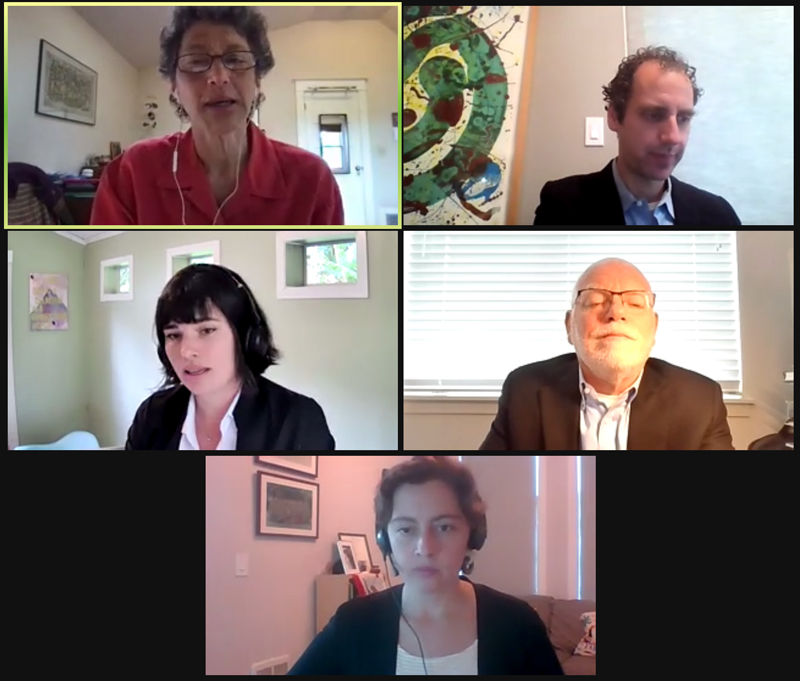
Clockwise from top left: Nancy Hirsh, NWEC; Michael Colvin, EDF; David Danner, WUTC; Alejandra Mejia Cunningham, NRDC; Mary Moerlins, NW Natural. | NWEC
Colvin said hydrogen might be needed for parts of the economy that will be difficult to electrify. And in California, he said, gas-fired generators are currently one of the largest end-users of gas. In the future, they will still need gas but won’t be running at a steady state, instead required to perform more ramping.
“The gas system in California was never designed to move gas around that quickly and that sporadically. It was always sort of designed to have that steady state, with maybe a little bit of pressure up and pressure down,” Colvin said.
A change in usage patterns will require new investments in the gas system to help supply those generators. “That’s going to require new recovery just from the gas generators,” he said.
“I just wanted to point that I don’t think that putting hydrogen through a generator is necessarily the highest and best use of that product. But I do also realize we need dispatchable energy. So where is the right use for that?” Moerlins said. “I would argue that there are a lot of really good near-term uses for carbon-free gases on the pipeline delivery system for a distribution company to deliver for direct use. … I think in furnaces, hydrogen and RNG makes sense today.”
Danner said future ratemaking will require “a lot of discussion and dialogue.” A recently passed Washington law (SB 5295) requires the state’s gas and electric utilities to file multiyear rate plans that incorporate performance-based ratemaking. The UTC shouldn’t “prescribe” what will be included in those plans, he said.
“What I envision is that this is going to be determined in our proceedings, that the utilities are going to file a plan with us,” he said. The commission will then hear from all intervenors, the public and stakeholders. “And I envision standards that are going to address energy efficiency, safety outages, consumer satisfaction, compliance with billing and customer service rules.
“And so it involves basically setting priorities and then setting baselines or targets for what is acceptable, and then providing incentives for going beyond or penalties for failures to meeting those targets. But I think it’s all going to be part of a large discussion. We’re doing this for the first time, really, in a big way. And I’m very excited to see what we get. I think that there can be a lot of innovation in the performance-based ratemaking world.”
Utility regulators from five Western states shared concerns and strategies for dealing with heat waves, cold snaps and wildfires during last week’s annual meeting of the Western Conference of Public Service Commissioners.
Extreme weather and its consequences are growing worse with climate change, and the West needs to cooperate to fight the threats to the electric grid and communities, they said.
Oregon PUC Commissioner Letha Tawney | WCPSC
“My word of caution to my colleagues is, ‘This is likely coming to a forest near you sooner than you want,’” Oregon Public Utility Commissioner Letha Tawney said.
Oregon has been paying close attention to the experience in California, which was the “canary in the coal mine” when it comes to rising temperatures and wildfires, Tawney said. With similar conditions affecting normally lush western Oregon, utilities there have began preparing for intentional blackouts to prevent fires this summer.
Portland General Electric called the state’s first public safety power shutoff (PSPS) on Sept. 7, 2020, during severe wind storms in the Pacific Northwest. (See High Fire Danger Prompts First Oregon PSPS Event.)
The storms “wreaked enormous havoc across both Washington and Oregon, driving really intensive fire activity unlike what we’re accustomed to and much more akin to what California’s been experiencing,” she said.
Taking lessons from the California Public Utilities Commission, the Oregon PUC has been weighing protocols for PSPS events this summer, with a focus on how and when utilities should notify customers and local authorities about planned shutoffs, Tawney said.
“I had hoped we had a little more time, but really the time’s run out, and so we spent the winter getting temporary rules for how public safety power shutoffs will unfold in Oregon,” she said.
In Arizona, summers are growing hotter and longer, said Lea Marquez Peterson, chair of the Arizona Corporation Commission. Last year Phoenix topped 100 degrees Fahrenheit on 145 days, breaking previous records.
August and September saw Western heat waves that drove temperatures beyond 100 F across much of the Southwest, with Phoenix soaring above 115 F at times. CAISO had to order rolling blackouts in mid-August because of resource deficiencies as imports from Arizona and Nevada dried up during a brutal heat storm.
If rolling blackouts occurred in Arizona, losing air conditioning could become a matter of life and death, Marquez Peterson said.
“Following the challenges that California had this past summer, we hosted emergency meetings to understand the implications for Arizona,” she said.
California PUC President Marybel Batjer discussed the state’s extensive experience with massive wildfires and PSPS, which the commission has been trying to bring under control after millions of customers lost power in recent years. The state’s investor-owned utilities now are spending billions of dollars annually on wildfire mitigation, including grid hardening and vegetation management, she said. (See Calif. Tries to Rein in PSPS for Fire Season.)
California also has been struggling with resource adequacy issues as it transitions from fossil fuels to clean power, another trend taking hold across the West. (See CAISO Issues Final Report on August Blackouts.)
She acknowledged other states’ efforts and invited them to continue learning from the California’s problems and solutions.
“All of you have gone to school [on California] very well it seems,” Batjer said. “If you’re not ahead of us, you’re certainly alongside us in these really tough situations.”
Idaho and Montana
Idaho and Montana are different from other Western states but are proactively dealing with fires and weather, commissioners said.
Montana Public Service Commissioner Brad Johnson | WCPSC
In Montana, summers are generally mild, but winters are frigid, said state Public Service Commissioner Brad Johnson, the panel’s moderator.
“Just as a loss of air conditioning in Arizona when it’s 120 degrees is a major concern, so is loss of an ability to run your furnace when it’s 40 below in Montana,” Johnson said.
Unusually prolonged, frigid weather in the winter of 2018-2019 led to a “dramatic shortfall in generation” and pushed energy prices from $27/MWh to $900/MWh, he said.
“While we didn’t face any kind of outages as a result of that, the financial impact was dramatic,” he said.
Montana, he said, needs to avoid shortfalls like those that led to days of blackouts in Texas last winter. Taking reasonable steps to bolster the grid is “not gold plating if it heads off that 100-year catastrophe we saw in Texas,” he said.
In Idaho, extreme weather and wildfires have not caused problems like those in California and Oregon, but the state intends to take reasonable precautions without unduly burdening ratepayers, Idaho Public Utilities Commissioner Kristine Raper said.
“We have benefited from the pain that California has endured,” she said.
Wildfires and capacity shortfalls “didn’t come to Idaho first, [and they] didn’t come to Montana first,” she said. “So we’ve had the ability to be a little more proactive, and our utilities have had the ability to be a little more proactive in how they’re going to react and respond to these things without having to be in catch-up mode.”
Jordan White, a former member of the Utah Public Service Commission and now vice president of strategic engagement at WECC, said states, the federal government and organizations such as WECC need to work together to mitigate wildfires and climate impacts.
“I think the name of the game nowadays is coordination and lessons learned,” White said. “There’s no reason to reinvent the wheel again and again. It’s all about sharing those best practices and getting everyone pulling in the same direction.”
MISO said it has a new cost-allocation method in mind for members that use the regional transfer limit linking its Midwest and South regions.
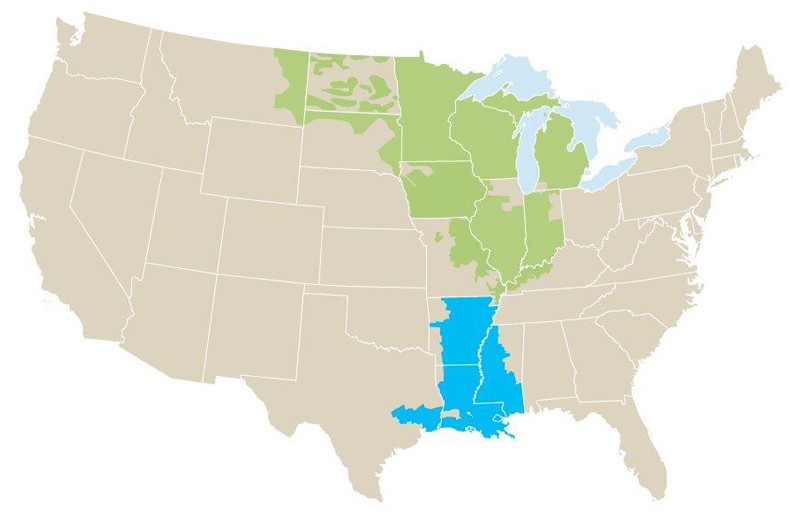
Senior adviser Jack Dannis said the grid operator will make a filing for a new rate structure with FERC in November. The grid operator hopes the proposal will serve as a permanent cost-allocation mechanism for settlement payments made by market participants that use the subregional transfer limit beyond the 1,000-MW contract path linking MISO Midwest and MISO South after Feb. 1, 2022.
MISO’s payments to SPP and six other parties for regional flows on the transfer limit are recovered from market participants using a special rate schedule called Schedule 49, which is considered separate from the 2016 settlement agreement that the eight parties signed for use of the transmission.
MISO Midwest and South | MISO
Based on stakeholder feedback, Dannis said MISO will abandon its current load ratio-based allocation method among members and adopt a market-based allocation that assigns costs based on the level of congestion accrued when the transfer limit binds on its 2,500- or 3,000-MW limits, depending on flow direction. Over the past five years, day-ahead and real-time congestion on the transfer limit makes up 74% of total costs needing to be allocated under the settlement agreement. He said the market-based approach more effectively assigns costs to beneficiaries.
MISO said Schedule 49, which also employs a diminishing flow-based calculation, is too complex, with the RTO using a planning model to estimate flow-based benefits. That allocation is currently pending in FERC settlement proceedings after MISO extended its use through January 2022. (See FERC Orders Hearing on MISO Pact for Midwest-South Tx.) Alliant Energy and MidAmerican Energy have complained that market participants in an Iowa local resource zone bore a disproportionate one-third of rate schedule costs in 2020.
Director of Market Design Kevin Vannoy said the new market-based approach is predicated on the theory that an importing region is benefiting — despite accruing congestion charges — from using the transfer to access lower-cost energy instead of calling up even more expensive generation. Now, when the transfer limit binds, congestion costs will be collected from the importing region through higher LMPs.
MISO said Schedule 49 charges will be collected monthly through multiple methods: the current month’s congestion fees, and a carryover of past excess congestion charges that went beyond its settlement agreement payment. If there’s a shortfall after those two, MISO will collect the remainder of costs through a pro rata charge to the majority importing region that month.
Stakeholders asked whether MISO Midwest or MISO South would more often be categorized as the importing region. Staff said regional use varies and doesn’t appear to follow a set pattern.
The new approach will “eliminate some of the modeling variables that could be disputed,” Dannis said.
“I think parties will see less volatility monthly and yearly in their Schedule 49 payments,” he added.
Texas regulators last week agreed to end a moratorium on customer disconnects for nonpayment that dated back to February as energy prices soared in the wake of a severe winter storm.
The Public Utility Commission said Friday that with a “proliferation” of available financial support and the need for utilities to resume normal business operations, it would end the moratorium on June 18. It went into effect Feb. 21 and applied to investor-owned utilities under the PUC’s jurisdiction.
Retail electric providers (REPs) must issue new disconnection warning notices to customers in danger of losing service, effective June 19. That will trigger a 10-day waiting period that allows customers to arrange deferred payment plans the REPs are required to offer (51812).
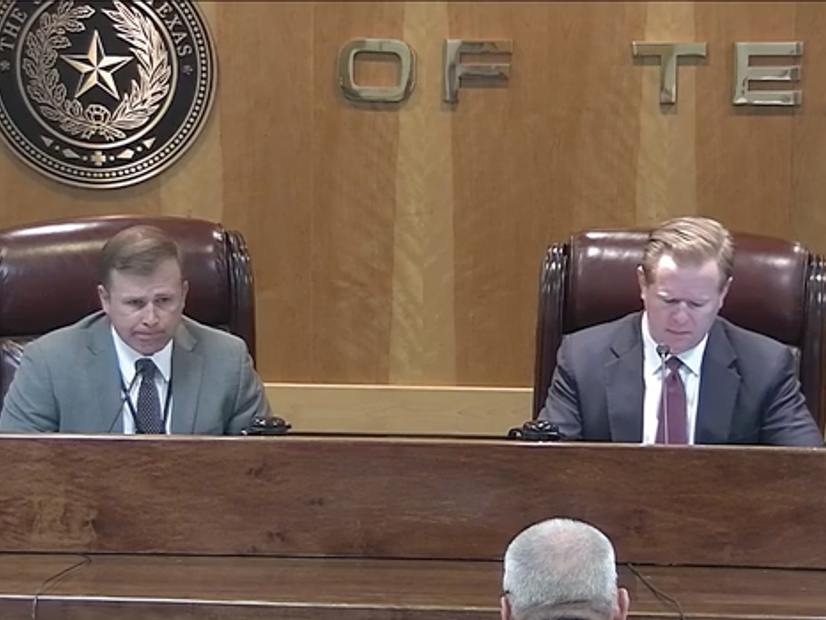
PUC Commissioner Will McAdams (left) and Peter Lake discuss an order. | Texas PUC
Commissioner Will McAdams signaled the PUC’s intention when he filed a memo earlier this month that said continuing the moratorium could lead to an “unsustainable impact” on “financially at-risk Texas consumers.” He pointed out that customers facing disconnection would soon fall under automatic moratoriums during heat advisory conditions, as defined by a National Weather Service heat advisory issued on a county-by-county basis.
“In some cases, these liabilities could amount to seven months of overdue bills before the commission may be able to readdress the issue in the fall,” McAdams wrote.
“My memo still stands,” he said during the PUC’s open meeting. “In my view, the emergency has passed. We need a catalyst in the market to break this logjam. The longer we stay in this kind of regulatory limbo, the more these consumers are going to just be rolling these large averages into the fall.”
McAdams encouraged customers to contact their REPs and ask for a deferred payment plan. Electric providers are required to offer plans that allow customers to pay back their debt over five billing cycles.
The PUC’s decision came after it opened the meeting with public comments. Two customers of REPs called for an extension of the moratorium, complaining they were being hit with pass-through ancillary service charges. A representative for a retailer urged that the moratorium be lifted to ensure the REP’s financial well-being.
“There’s a delicate balance between the financial impact on consumers and households and the economic health of competitive providers in our marketplace,” PUC Chair Peter Lake said. “It’s a tough challenge to find that balance … but we do need to move forward.”
The winter storm is thought to have inflicted more than $130 billion in damage throughout the state.
In other actions Friday, the commission approved Entergy Texas’ request to recover $31.6 million through an amended transmission cost recovery factor (51406) and Southwestern Public Service Co.’s implementation of a net surcharge of $71.5 million on its Texas retail customers as part of a previous rate case (51644).