Biden Pick for BLM Head Sidesteps Oil, Gas Leasing Questions

Four nominees for key energy and land management positions faced a group confirmation hearing before the Senate Energy and Natural Resources Committee on Tuesday, but the session was clearly focused on only one — Tracy Stone-Manning, President Biden’s pick to head up the Bureau of Land Management.

The agency oversees 247 million acres of public land — about 10% of the U.S. — which include 30% of U.S. minerals, as well as thousands of oil and gas leases and thousands of megawatts of solar and wind. The BLM was without a Senate-confirmed director throughout the Trump administration.
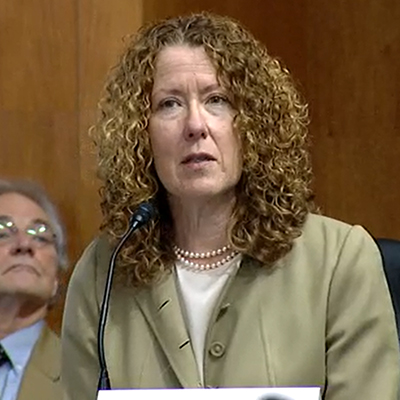
Tracy-Stone-Manning-(Senate-Committee-on-Energy-and-Natural-Resources)-Content.jpg
Tracy Stone-Manning, nominated as director of the BLM | Senate Committee on Energy and Natural Resources

Hailing from Montana, Stone-Manning said she is an avid outdoorswoman devoted to smart, multiple uses of public lands, with a resume of policy work based on bipartisan collaboration — as a senior aide to Sen. Jon Tester (D-Mont.), director of the state’s Department of Environmental Quality and chief of staff to former Democratic Gov. Steve Bullock. But she spent most of the hearing sidestepping hard questions from Republicans about Biden’s pause on oil and gas leasing on federal lands and her involvement with advocacy groups, such as Montana Conservation Voters (MCV).

Stone-Manning was board treasurer of the group, which is highly critical of Sen. Steve Daines (R-Mont.). Sen. John Barrasso (R-Wyo.), ranking member of the committee, pressed Stone-Manning hard on her role in what he called MCV’s 2020 smear campaign against Daines. According to information on the MCV website, the advertising campaign consisted of “a billboard in Belgrade, newspaper ads in Billings and Bozeman and aerial advertising in both Bozeman and Missoula.”
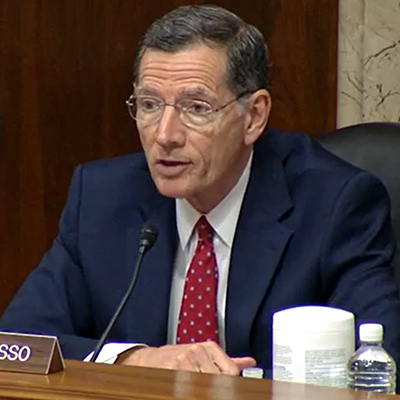
John-Barrasso-(Senate-Committee-on-Energy-and-Natural-Resources)-Content.jpg
Sen. John Barrasso (R-Wyo.) | Senate Committee on Energy and Natural Resources

“On behalf of all the Republican senators, we want to know how members of this committee can have any confidence that you’re going to work with us in any kind of bipartisan way?” Barrasso said.

“Senator, I have led nonprofit organizations, and I have been on the board of nonprofit organizations, and I take very seriously the difference in those two roles,” Stone-Manning replied. “I was a voluntary board member who had a core belief of never micromanaging staff. I hope that you would look to my record in my day job on that issue and my approach to it.”

The other nominees at the hearing were Shalanda H. Baker, nominated as director of the Office of Minority Economic Impact at the Department of Energy; Samuel T. Walsh, nominated as DOE general counsel; and Andrew Light, nominated as assistant secretary of energy for international affairs.

‘Plenty of Room’

Introducing Stone-Manning to the committee, Tester himself answered Barrasso’s criticisms. Stone-Manning “listens; she works; she does the right thing,” he said. “There are places we can mine; there are places we can drill; there are places that are appropriate for resource extraction; there are other places that are not. Tracy Stone-Manning brings that understanding to the table.”

Barrasso did not let up, questioning Stone-Manning about her most recent job as senior adviser for conservation policy at the National Wildlife Federation. “You urged the Forest Service to abandon plans to expand oil and gas development in our national forests,” he said. “You said at the time [that] that the use of the proposed rule would create ‘deadline loopholes for oil and gas companies so they can avoid compliance with environmental regulation.’”

He also pushed Stone-Manning on Biden’s current pause on oil and gas leasing on public lands, which, he said, could lead to Americans importing fossil fuels from countries that do not have the same rigorous environmental standards as the U.S.
Shalanda-Baker-(Senate-Committee-on-Energy-and-Natural-Resources)-Content.jpg
Shalanda H. Baker, nominated as director of the DOE Office of Minority Economic Impact | Senate Committee on Energy and Natural Resources

Stone-Manning repeatedly finessed this and similar questions. “I think the president and [Secretary of Interior Deb Haaland] have been clear that this leasing pause is giving the department time to take a hard look at the oil and gas program and make sure that it is right for the century we’re living in,” she said. “If I have the honor of being confirmed, I look forward to digging in and helping with those discussions.”

When Sen. John Hoeven (R-N.D.) pressed Stone-Manning on whether she would commit to resuming quarterly auctions for energy development on federal lands, she cited her work at the Montana DEQ.

“I had a goal of providing certainty for folks, certainty for business, certainty for local communities,” she said. “I was clear with people that I would take as transparent and open and timely [an] approach as possible, and that no one would be surprised by the decisions that we made because everybody would be part of the decision making along the way. I commit to you that we’re going to work as efficiently as possible, as government should.”

Sen. James Lankford (R-Okla.) got a more direct answer when he asked Stone-Manning about a past statement she had made “that there’s plenty of room in the West for oil and gas development.” Stone-Manning quickly agreed.

According to information on the BLM website, as of 2020, the agency had 23,878 producing oil and gas leases on federal land, 7,372 of which are in Wyoming. Existing leases are not affected by the president’s pause on new leasing.

Significantly, Stone-Manning got no questions about renewable energy development on federal lands. According to the BLM, as of May 2021, 36 wind projects on federal land had a total capacity of 2,900 MW, while 37 solar projects had 7,000 MW. The agency recently approved the 350-MW Crimson solar project in California.

Lankford also raised concerns about long permitting times. “It’s one thing to say, it is available; it’s another thing to say, it’s really not available because it’s going to take a really long time to get to it,” he said. “Capital won’t flow to places that it takes a really long time to actually use the lands, and the taxpayers lose out and the country loses out in the long term.”

A Better Deal than China’s

Light got on better with Republican senators like Lankford who quizzed him on his views on LNG exports — and the need for the U.S. to compete with China and Russia in international markets.

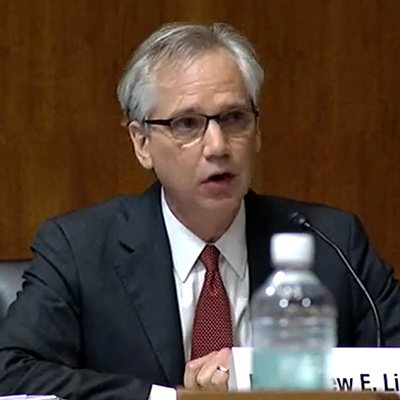
Andrew-Light-(Senate-Committee-on-Energy-and-Natural-Resources)-Content.jpg
Andrew Light, nominated as DOE assistant secretary for international affairs | Senate Committee on Energy and Natural Resources

Introducing himself to the committee as the grandson of West Virginia coal miners, Light noted that LNG exports are now at an all-time high and expected to increase, “My job is to make sure U.S. gas is competitive around the world. More and more countries are looking for cleaner sources of gas. Russia’s got the dirtiest source of gas right now. We’ve got to make sure that ours is cleaner, and there are still those markets around the world.”

Sen. Bill Cassidy (R-La.) also queried Light about China’s massive Belt and Road Initiative, through which the country is building coal plants and other infrastructure in developing nations around the world.

“What China is doing is a threat not only to the climate, it’s a threat to U.S. national security,” Light said. “We’ve got to create a whole-of-government approach. We’ve got to be able to go into these countries and offer them packages that include funding. The packages could certainly include natural gas. We’ve got to go in and assess what is the best option for these countries, given what their commitments are with respect to their energy transition. We’ve got to offer something which is a better deal than China can.”

Light also sees a big role for the U.S. in carbon-capture and other emissions-free technologies. “We have to provide decarbonization. Energy is good; it’s the emissions that are a problem. We can become the leaders in abated natural gas technology around the world; we can become the leaders in abated coal technology around the world. We’ve got to innovate towards that.”

FERC Approves Penalties Totaling $930K

FERC last week approved a number of settlements for violations of NERC reliability standards by multiple registered entities, carrying more than $900,000 in penalties in all (NP21-11, et al.). Regional entities involved in the settlements include WECC, NPCC and SERC Reliability.

NERC submitted the penalties to the commission in April, filing separate Notices of Penalty for the following settlements:

      • A $360,000 penalty assessed against Central Maine Power Company (CMP) by NPCC;
      • $420,000 against Entergy by SERC and NPCC;
      • $100,000 against Vermont Transco (VT) by NPCC; and
      • A spreadsheet NOP including a $50,000 penalty against Valley Electric Association (VEA) by WECC, and a settlement between SERC and the Tennessee Valley Authority carrying no monetary penalty.

NERC also submitted two NOPs relating to violations of the Critical Infrastructure Protection (CIP) standards. Details of those violations, including the REs and utilities involved, were not disclosed, in accordance with FERC and NERC policy on the treatment of such information announced last year. (See FERC, NERC to End CIP Violation Disclosures.) The commission indicated last Friday that it would not review the NOPs, leaving all of the settlements intact.

CMP Fails Assessment Test

NPCC’s settlement with CMP concerns two violations of TOP-001-4 (Transmission operations). Both violations involve requirement R13, which mandates that transmission operators ensure a real-time assessment is performed at least once every 30 minutes.

A real-time assessment requires both a real-time contingency analysis (RTCA) and a state estimation. CMP uses both of these data points, along with actual megawatt flows, generation output, voltage profiles and equipment status to complete the assessment.

In the first incident, which occurred on Sept. 5, 2019, CMP lost communication with 10 substations, nine of which are part of the bulk electric system, after a communication cable was severed at 8:56 a.m. Within minutes, the system operator noticed that the state estimation had not been completed successfully and notified CMP’s operations support group (OSG).

The OSG began to monitor the status of both the state estimation and RTCA but did not discuss the real-time assessment with the system operator. Likewise, the system operator did not bring up the assessment either, even when it notified the OSG about the loss of contact with the substations at 9:35 a.m.

At 10:08 a.m., the RTCA failed to complete. At this point a real-time assessment could not be done because neither a state estimation nor the RTCA was available. OSG staff managed to restore the RTCA long enough for it to complete once, but not until 10:57 a.m., 49 minutes after the initial failure of the RTCA; as a result, CMP missed the deadline to perform a real-time assessment by 19 minutes.

After performing the RTCA, OSG personnel finally notified the system operator that the RTCA had not been solved since 10:08 a.m. The system operator immediately informed its reliability coordinator, which was aware of the initial communication failure but not of the issues with the RTCA. The RC then began to perform real-time assessments on behalf of CMP and continued to do so until 3:34 p.m. despite CMP restoring its RTCA capability more than three hours before.

The second incident occurred on Feb. 12, 2020, after an evacuation drill that involved switching from CMP’s primary control center to the backup. Beginning at 7:16 a.m., during the attempted switch, the utility’s emergency management system (EMS) failed and restarted several times. The final failure occurred at 7:36 a.m., and the EMS was not fully restored until 8:53 a.m.

Because the system had been temporarily restored several times, the system operator and control room supervisor assumed that the RTCA, and hence the real-time assessment, had been performed until 7:36 a.m. As a result, they did not ask ISO-NE for help performing the real-time assessment until 8:04 a.m.

However, they were unaware that the EMS needed to be online for at least five minutes before the RTCA could be performed. Because the EMS had never been on long enough during the relevant time, no RTCA was done and the real-time assessment was not completed between 7:16 a.m. and 8:04 a.m., 18 minutes past the deadline.

No harm is known to have occurred as a result of either violation; system conditions during both incidents were normal and no emergencies occurred. However, NPCC observed that “the failure to ensure a real-time assessment [was] performed … [increased] the risk that system operators could be unaware of changing system conditions … that could result in instability, uncontrolled separation, or cascading outage.”

In assessing the penalty amount, NPCC pointed to the compliance history of CMP and its parent Avangrid. Not only does this case involve two separate incidents, but NPCC assessed a $450,000 penalty in 2019 against three Avangrid utilities, including CMP, for violations of the TOP standards (NP20-4). (See FERC OKs $450,000 Avangrid Penalty.)

Mitigation actions by CMP and Avangrid include taking “steps designed to improve [their] operation’s culture of compliance” by reorganizing the operations department to ensure better interaction with compliance staff. CMP also revised its internal procedures to include strategies for system operators to mitigate the loss of state estimation and RTCA functionality, and to require OSG personnel to “notify system operators immediately upon discovery of potential reliability issues with the [state estimation] and/or RTCA.”

SERC Alleges Entergy Voltage Violations

Entergy’s infringement involves violations of VAR-002-4 and its predecessor VAR-002-2b (Generator operation for maintaining network voltage schedules). Both were self-reported: the first by EntergyNUC, which manages nuclear plants in the SERC region, in November 2017; the second by EntergyFHG, which runs fossil and hydroelectric generation in SERC, in July 2019.

EntergyNUC disclosed 1,399 instances of noncompliance at eight generation units, spanning almost three years. The utility initially discovered compliance issues at the Arkansas Nuclear One station, with additional problems found during a subsequent extent-of-condition assessment at Grand Gulf Nuclear Station, Indian Point Energy Center, and three other facilities in both the SERC and NPCC footprints.

The issues discovered mainly involved operating outside of the voltage schedule; for example, Arkansas Nuclear One on 193 occasions “exceeded its voltage schedule, did not recover within the specified timeframe, and failed to notify its [transmission operator].” Other violations included Grand Gulf Nuclear Station not requiring operators to monitor voltage at all times, which is mandatory under the standard, and the Waterford 3 station failing to incorporate an update to its voltage schedule into its operations procedures and computer systems.

EntergyFHG’s violations included 378 noncompliance instances at 17 facilities, with a duration of five years. The issues were discovered during an extent-of-condition review ordered in response to EntergyNUC’s previously discovered compliance issues. Most of the issues occurred during 2018 and 2019, but two facilities in Louisiana were discovered to have instances of noncompliance dating back to 2014.

SERC found that EntergyNUC’s violations posed a “serious” risk to the bulk power system, while EntergyFHG’s posed a moderate risk. The regional entity identified the root cause of the former entity’s infringement as “organizational siloes and ineffective processes and procedures,” since each nuclear facility was responsible for its own compliance program with no coordination or sharing of best practices and lessons learned. In the latter entity, the root cause of the issues was found to be a lack of “sufficient internal controls to ensure proper execution of its compliance program.”

According to the settlement agreement, SERC will pay 17.4% of the monetary penalty to NPCC. Entergy’s mitigation measures include enhancing the compliance programs at both EntergyFHG and EntergyNUC through improved internal controls and communication. Entergy also implemented a common VAR-002 process for both entities.

Tree Runs Afoul of VT’s Lines

NPCC’s case against VT comprises two violations of FAC-003-4 (Transmission vegetation management). Requirement R2 of the standard mandates that transmission owners (TO) and generator owners (GO) prevent vegetation encroachments into the minimum vegetation clearance distance (MVCD) of their applicable lines, while R6 requires TOs and GOs to perform full vegetation inspections of transmission lines at least once per calendar year.

VT infringed on R2 when a tree grew into the MVCD of a 345 kV transmission line, eventually contacting the line and causing it to trip and lock out of service. That breach was later found to have resulted from the R6 violation, due to VT’s failure to include that line — and a parallel and redundant line located beside it — in the database used for its vegetation management program. That exclusion meant that VT did not perform the required annual inspection on the lines, allowing the tree to encroach on the MVCD.

NPCC found that the R2 violation posed a moderate risk to the BPS, as did the R6 violation. VT mitigated the infringements by removing the violation from the lines’ right-of-way and adding the lines to its vegetation management program. The utility also performed an extent of condition review and found no other lines were missing from the program’s database.

WECC Finds VEA Ratings Variations

NERC’s last filing, the spreadsheet NOP, covers WECC’s settlement with VEA for $50,000 over infringing on FAC-008-3 (Facility ratings), along with SERC’s settlement with TVA over a violation of PRC-001-1 (System protection coordination).

WECC discovered VEA’s potential violations during a compliance audit in January 2019. After sampling seven of VEA’s transmission facilities for a detailed review, WECC found a number of discrepancies. For instance, one of the 138 kV transmission lines had three different facility ratings in VEA’s records. WECC traced this inconsistency to a failure by VEA to communicate internally when a new rating was released for one element at a switching station.

VEA’s database also did not match its one-line diagrams in several places, with equipment represented in one missing from the other. The utility attempted to revise its database during the audit to eliminate the variations, but the RE still found differences between the new database and the diagrams.

The violations were found to have posed a moderate risk to the BPS, as the lack of accurate ratings “could have resulted in operating the transmission facilities above … system operating limits, potentially resulting in permanent or premature damage to the equipment.” Mitigation measures by VEA included updating its facility ratings spreadsheet and confirming equipment ratings, identifying and resolving inconsistencies with joint owners, scheduling annual reviews of the facility ratings manual and spreadsheet, and revising its training methods and manuals.

Not all of these measures were complete at the time of filing in April 2021, but WECC expected them to be finished by May 1.

TVA’s violation stems from an incident on Apr. 17, 2019, when the utility reported to SERC that a 500 kV relay at its Brownsville Combustion Turbine Plant had several failed components. TVA later expanded upon the report, informing the RE that one component had failed in 2012, while another failure dated back to 2017. Though personnel had flagged the relay for repair in both cases, TVA failed to repair or replace it until 2019.

The utility reported the deficiency as a violation of PRC-001-1, which requires generator operators to notify the transmission operator and balancing authority “if a protective relay or equipment failure reduces system reliability;” GOPs are also required to “take corrective action as soon as possible.”

SERC determined the root cause of the violation to be management oversight; TVA failed to implement a documented process and internal controls to ensure the relevant reports were reviewed and actions were taken. The RE noted that TVA has taken a range of mitigation actions, including updating its compliance procedures, evidence checklists, and site notification matrix to account for relay failures; providing training on revised procedures; and reviewing the system to ensure there are no other unresolved or unreported equipment issues.

TVA is not subject to monetary penalties due to a D.C. Circuit Court of Appeals ruling that FERC and NERC cannot impose such penalties against federal entities.

Kerry: Money Will Talk in US Staying Power on Climate

Mounting financial backing for climate change efforts is what Special Presidential Envoy on Climate John Kerry takes as the sign that U.S. leadership could never roll back climate policy again.

“My sense is that the amounts of money that are going to be invested in this transition will make it nearly impossible for anybody, ill advised enough or inclined, for whatever reason, to go against science and the efforts of every other country in the world,” Kerry said at the American Clean Power Association’s CLEANPOWER 2021 virtual summit on Tuesday.

The benefits of the transition, he added, will ensure that the U.S. will not “go backwards” on its commitments under the Paris Agreement in the future as it did under the Trump administration.

Trillions of dollars, he said, are going to be allocated to the climate challenge, and mandates for investment disclosures will have “a profound impact on people’s judgment about where capital ought to go.”

Net-zero financial alliances are happening at every level, he said.

In April, six U.S. banks committed to spending $4 trillion on climate-related efforts over the next decade and 14 asset managers handling $5 trillion in assets joined the Net Zero Asset Managers initiative. In addition, Kerry helped launch the Glasgow Financial Alliance for Net Zero, which will coordinate the climate efforts of financial institutions.

“The key now is going to be to harmonize globally a lot of the standards by which we’re measuring investments,” he said.

Global Stage

The 26th U.N. Climate Change Conference of the Parties (COP26) in Glasgow in November will be an opportunity for the U.S. to lead on climate, Kerry said. The U.S. wants to work with the other biggest GHG-emitting countries to develop a plan that goes beyond the 2015 Paris Agreement.

“The plan this time, unlike Paris, where everybody kind of did what they were willing to do, this is one where we now have to respond to the science and do what we need to do,” he said. The hope, he added, is to realize a significant reduction in emissions by 2030 and then move to a net-zero target for 2030 to 2050.

“Right now, we have 55% of global GDP … committed to keeping the Earth’s temperature at 1.5 degrees,” he said. “That’s an enormous step forward.”

The G7, he said, recently agreed to stop funding coal development internationally to meet the 1.5-degree target of the Paris Agreement. And the International Energy Agency just released a report that Kerry said calls for putting the deployment of existing renewable technologies and development of new solutions “on super steroids.”

All these efforts are “absolutely doable,” he said, but the test will be “whether we have the willpower to do it right.”

NJ Bill Would Require Warehouses to be Solar Ready

New Jersey legislators looking to ensure that solar projects are a key part of the state’s booming warehouse development sector have passed a bill that would require new warehouses more than 100,000 square feet to be ready to install rooftop solar projects in the future.

The bill, which now sits on Gov. Phil Murphy’s desk, would require warehouse developers to ensure that at least 40% of the area of a new warehouse roof is available and structurally ready to take solar photovoltaic or thermal systems. The area is calculated after the space taken up by skylights, occupied roof decks, vegetative roof areas and other uses is removed from the calculation.

The New Jersey Senate on Thursday approved the bill, A3352, 25-13, and the General Assembly backed it 46-24 the same day.

New Jersey, like other states, is seeing a surge in demand for warehouse space after the COVID-19 pandemic helped trigger a dramatic shift in consumer behavior from in-person shopping to online. The pressure from demand for space for fulfillment centers and smaller warehouses to serve as launch-pads for last-mile deliveries is enhanced in New Jersey by the presence of the Port of New York and New Jersey, the third largest port on the East Coast, which needs warehouse space for logistics companies. That’s all enhanced by the state’s location in the massive New York consumer market.

The amount of industrial space leased in New Jersey the first quarter of 2021, 13.7 million square feet, was the “highest level in history” for the quarter, according to the quarterly report by real estate broker JLL. The average rent for industrial space is higher than at any time in the last 14 years, and vacancies are at their lowest level over the same period, according to the report, which said that the market in 2021 is “primed for more gains.”

Murphy is pushing solar power as part of New Jersey’s effort to reach 100% clean energy by 2050. He wants the state to have 32 GW of solar by then, about nine times the capacity online today. The capacity of new non-residential solar projects grew each year from 2016 to 2019, with a 65.7% increase in 2019 over the previous year to 227,731 kW installed, according to data on the state’s Clean Energy Program website. The annual installation figure dropped dramatically in 2020 to 35,511 kW.

After the bill’s passage, its sponsors, Democratic Assemblymen James J. Kennedy, Sterley Stanley and Clinton Calabrese, released a statement saying that by promoting solar projects, the bill would help the buildings save energy and be cost effective because lighting and space heating account for approximately 76% of total energy used in a warehouse.

“We want to encourage building owners to begin a transition toward using solar energy for their warehouses,” the the legislators said. “New Jersey is rapidly moving toward solar energy, and we need to begin preparing our buildings for the future.”

Potential Boon for Solar Developers

Shaun Keegan, CEO of Asbury Park-based Solar Landscape, said the bill will be a big help for the solar development sector and has already prompted building developers to ask questions about and “give more consideration to solar.” It also gives comfort to solar developers to know that buildings will be strong enough to take the weight of a solar project if they can show the owners that putting solar on the roof is in their interest, he said.

“There are instances where [existing] buildings can’t handle the weight, and it takes some engineering to figure that out,” he said. “So, we spend time and money developing and contracting for a project only to find out the building is incompatible after undertaking engineering work to evaluate the building’s weight load capacity.”

Others were skeptical that the bill would do much except put new requirements on developers and warehouse owners.

Ray Cantor, a lobbyist for the New Jersey Business and Industry Association, one of the state’s largest trade groups, said his organization considered the bill “an unnecessary mandate on the construction industry,” which could add to the cost of building a warehouse.

“Most warehouses that are built on spec would meet the requirements of this bill,” he said. “There are other warehouses built at the specific direction of a company, and they may have no need or desire to spend extra money for it to be solar ready.” The property may also be in a location where it “does not make sense to build solar.”

Jim Coyle, president of the Gateway Regional Chamber of Commerce — whose affiliates include the Gateway Solar Alliance, which promotes the use of solar — said that putting solar projects on their roofs is not a high priority for warehouse developers and owners at present, in part because they are so busy meeting the demand for their regular services: designing, building and operating warehouses.

One reason is that New Jersey requires that rooftop solar projects generate electricity only for use in the building; it does not allow them to sell excess power to the grid, he said. That reduces the potential to make money from a solar project, and many warehouses, unless they are refrigerated, don’t use a lot of energy because they are built for efficiency, he said.

The exception to the selling prohibition is if the project participates in the state’s Community Solar Energy Pilot Program. But that tactic requires extensive administration to apply to the program, which is competitive and oversubscribed, so the outcome for applicants is unsure. New Jersey is expected in the coming weeks to announce the second set of project approvals, after approving the first 45 community solar projects in 2020, with the first one coming online in January of this year. (See Billing Key to NJ Community Solar Growth.)

“In my talks with developers/owners of warehouses, as opposed to tenants, the feeling is, ‘If it doesn’t make me a whole lot of money, why would I do it?’” Coyle said. In addition, the roof of a warehouse is to many owners and developers the most precious part of the building, and they are reluctant to potentially jeopardize it by putting solar panels on it, he said.

Blunting Competitive Edge

Assemblyman Gerard Scharfenberger, a Republican who voted against the bill, said at a hearing on the legislation held in February by the Assembly Environment and Solid Waste Committee that he feared it would drive up the cost of warehouse construction and make buildings less competitive than those in neighboring states.

“I have concerns about pricing, about pushing projects, maybe, to surrounding states,” he said. He also noted “the fact that it would add cost to an already expensive project.”

But Jeff Tittel, who was at the time director of the New Jersey Sierra Club, told the committee that New Jersey is so far away from its 32-GW goal that it will have to consider all options on where to put solar panels. Tittel noted that even as conservationists complain about putting solar panels on farmland, more and more farmland is being developed into warehouses.

“We’ve been kind of short sighted in how we’re doing our warehouses,” he said. “And so we think this legislation will not only help preserve farmland but will also help make some of these warehouse projects actually be greener” because they will have solar panels on the roof, he said.

“There’s a real opportunity here to move New Jersey forward with clean energy and clean energy jobs,” he said.

FERC Accepts, Rejects Parts of ISO-NE, NEPOOL ORTP Filing

FERC on Monday approved parts of the ISO-NE and NEPOOL “jump ball” filing on offer review trigger price (ORTP) values for Forward Capacity Market (FCM) parameters in the 2025/26 capacity commitment period (ER21-1637).

The commission accepted NEPOOL’s proposed ORTP value for battery storage and proposed federal tax credits adjustments to the ORTPs for solar resources for FCA 17 and FCA 18.

FERC also accepted the RTO’s proposed ORTP values, including offshore wind, and ISO-NE’s proposal to maintain the current tariff language regarding economic life determination and the establishment of ORTPs for hybrid and co-located resources in the FCM, rejecting NEPOOL’s proposed revisions in each case.

But FERC also rejected NEPOOL’s proposal to require that the RTO account for future federal tax credit changes through the tariff’s indexing process.  

The commission directed ISO-NE to submit a compliance filing on or before June 22 that combines the accepted alternative proposals.

Chair Richard Glick and Commissioner Allison Clements, the two Democratic members of the commission, dissented on the part of the order that included ISO-NE’s ORTP proposal for offshore wind.  Republican commissioners Neil Chatterjee, James Danly and Mark Christie, voted in favor of the RTO’s ORTP values. Glick said he “strongly” believes that ISO-NE’s proposed capital cost estimate for OSW “is not just and reasonable.”  

“The majority’s adoption of ISO-NE’s proposal will, by definition, shunt every [OSW] resource into an administrative pricing construct that is particularly ill-suited to an emerging technology,” Glick wrote. “The commission should have instead adopted [NEPOOL’s] estimates, which better reflect market activity as opposed to bureaucratic cost estimates that bear little relation to reality.”

Glick added that NEPOOL’s use of publicly available data from four recent power purchase agreements for large regional OSW projects gives its plan “a clear and strong connection to the actual resources being developed in New England.”  

“By contrast, ISO-NE’s proposal is based on a mythical project that produces an absurdly high ORTP of $17.947/kW-month, which ISO-NE calculated by assuming $4.3 billion in capital costs for its hypothetical offshore wind facility,” Glick said. “ISO-NE’s capital cost assumptions are so high that ISO-NE does not even bother to propose an ORTP for [OSW] resources because it is so far above the estimated starting price of $12.400/kW-month for the upcoming Forward Capacity Auction.”  

Glick said by accepting ISO-NE’s proposal, FERC forces OSW developers “to beg for permission just to bid into an upcoming capacity auction at a price that at least offers a chance to be selected for a capacity payment.” Also, by adopting a capital cost estimate “beyond the outer limits of anything even remotely reasonable,” Glick said that the commission assumes “any contract for offshore wind is commercially unreasonable.”  

“The majority’s decision to apply buyer-side market power mitigation rules to entities that are not buyers or that lack market power is nonsensical,” Glick wrote. “I urge ISO-NE to move expeditiously to replace its ORTP and [minimum offer price rule]-related rules or the commission will be left with little choice but to step in and establish new rules ourselves.”

Clements said costs for OSW keep declining as project development proliferates and as states in the Northeast contract for increasingly large projects.  

“These decreasing costs weigh in favor of an ORTP method that uses as up-to-date data as possible,” Clements wrote. “NEPOOL’s approach relies on recently signed PPAs for New England projects, which means it is both up-to-date and reflective of the region in question.”  

She said that given FERC’s “limited visibility” into the sources of the cost database used by ISO-NE consultant Mott MacDonald, the commission could not “ascertain whether that data reflects equally current sourcing.”

Clements said that NEPOOL’s proposal also offers a viable alternative to ISO-NE “having to estimate costs for a hypothetical resource, an exercise that is inherently fraught.”

“RTOs/ISOs are not project developers,” Clements wrote. “Even with the aid of consultants, experience demonstrates that processes requiring RTO/ISOs to make myriad project development assumptions and estimate the associated costs using proprietary data is a recipe for extensive litigation before the commission.”  

Clements said that the ORTP decision was “especially troubling” given New England states’ increasing interest in procuring OSW generation to support their policy goals.  

“I can only express my hope that the Internal Market Monitor will provide a fair and legitimate opportunity for offshore wind resources to demonstrate the appropriateness of offer prices below the ORTP,” Clements wrote.

Abbott Signs Texas Grid Legislation into Law

Texas Gov. Greg Abbott signed into law Tuesday a pair of bills that he said would fix the “flaws” that led to February’s power failure, when a severe winter storm froze out half of ERCOT’s available generation and led to power outages that lasted for more than four days.

“A top priority we had this legislative session was to fix the power grid to prevent any other power grid failures in the future,” Abbott said during a televised bill signing ceremony in Austin. “The bottom line is that everything that needed to be done was done to fix the power grid in Texas.”

The legislation, Senate Bill 2 and SB3, require weatherization of power plants and some natural gas facilities, create a statewide emergency alert system, overhaul ERCOT and the Public Utility Commission, and bail out some market participants facing massive bills from the storm. (See Texas Legislators Finish Work on Electricity Market — for Now.)

The extreme weather left almost 5 million customers without power for almost 100 hours, led to hundreds of deaths and billions of dollars in damages, and bankrupted several market participants when prices were stuck at their $9,000/MWh cap for days.

“There’s no one sitting or standing here who does not remember that week, none of us,” Sen. Kelly Hancock (R), who carried SB3 to the finish line, said. “We don’t want people to go through that again. That’s why we passed reforms, to fix that, to make sure it will never happen again. We’re not immune to the pain and hurt of the people of Texas.”

Hancock joined Abbott for the bill signing. Also on hand were fellow lawmakers Sen. Charles Schwertner (R) and Rep. Chris Paddie (R). ERCOT Interim CEO Brad Jones, PUC Chair Peter Lake and Williamson County Judge Bill Gravell stood behind the politicians but did not have any remarks.

ERCOT-Signing-Ceremony-(KXAN)-Content.jpg
Texas Gov. Greg Abbott (second from left) is joined by (l-r) Rep. Chris Paddie and Sens. Kelly Hancock and Charles Schwertner in explaining the bill. ERCOT Interim CEO Brad Jones, Williamson County Judge Bill Gravell and PUC Chair Peter Lake (l-r) joined the politicians for the bills’ signing. | KXAN

ERCOT issued a statement thanking Abbott and all state leaders for passing legislation “that will improve overall grid reliability for Texans.”

“We have already implemented a number of new operational and communications measures in preparation for summer and will continue coordinating with the [PUC] on implementing the grid enhancements that were signed into law today,” the grid operator said.

SB2 reduces the ERCOT Board of Directors from 16 members — comprised of directors unaffiliated with the ERCOT market and others selected by their market segments — to 11 members. Most of those will be picked by a political committee, with the selections approved by Abbott and other leaders.

Hancock called the measure a “total reform” of ERCOT. He said that while the board had been composed of industry experts, legislators found “conflicts of interest” during investigatory hearings.

“We blew it up,” Hancock said. “The board has a completely independent goal, whose entire focus is ensuring ERCOT remains strong and reliable. [ERCOT] is committed, we are committed to ensure … the lights stay on and there can be confidence now in the system we have in the great state of Texas.”

Energy experts have criticized the legislation for being too kind to the natural gas industry and have said that it leaves oversight to regulators cozy with the industry. The weatherization mandates do include fines for up to $1 million a day per violation but are not required until after next winter.

Paddie, who led the bills’ passage through the House, pushed back against comments that the legislation took it easy on the gas industry.

“I wish you would go tell them that because they’ve been whining in my office,” Paddie told reporters. “That is not what they’re saying.”

ERCOT Improving Summer Preparedness

Jones and Lake broke from ERCOT’s regularly scheduled virtual board meeting to attend the ceremony at the Capitol, where they shared the same summer preparedness presentation Jones had given to the directors.

ERCOT has added a number of new operational activities and initiatives based on lessons learned from February. They include performing on-site checks to verify weatherization plans, adding a short-term solar forecast with better data to address solar ramps with dispatched generation and reviewing load shed procedures and timing during emergency conditions.

Jones said the grid operator has created an advisory board comprised of officers from 15 regions of the Texas Municipal League. The group is expected to meet at least twice a year with ERCOT in an effort to improve communications and emergency preparedness.

“This allows us to meet with large- and small-town mayors and explain who ERCOT is,” Jones told the board. “It gives them the ability to communicate better with their residents.”

The advisory board will meet for the first time later this month. The Texas Municipal League has almost 1,200 member cities and involves more than 16,000 mayors, city managers and other city officials.

The grid operator and the PUC have already hosted a virtual pre-summer communications meeting with market participants and performed a biannual test of ERCOT’s emergency notification system. ERCOT is also strengthening its coordination and alignment with the PUC and Texas Division of Emergency Management. (See ERCOT, PUC Deal with ‘Trauma’ of February Storm.)

AEP Reports Receiving SEC Subpoena Connected to Ohio Bailout Bill

American Electric Power said Tuesday that it had received a subpoena from the U.S. Securities and Exchange Commission’s Enforcement Division seeking documents related to how it might have benefited from the passage of Ohio H.B. 6 in 2019.

Designed initially to create a statewide charge to subsidize two Ohio nuclear power plants then owned by FirstEnergy, H.B. 6 was broadened to include a separate customer charge to subsidize two aging coal-fired plants owned by a consortium of public utilities, including AEP. Lawmakers this year stripped out the nuclear subsidizes, valued at more than $150 million a year for seven years.

The coal subsidies remain in effect until 2030 and will cost Ohio customers an estimated $700 million. A bill pending in the state Senate, S.B. 117, would remove those subsidies as well. Introduced in March, the legislation had a well attended committee hearing in May. No hearings have occurred since.

Whether the bill makes it out of committee before the legislature’s summer recess at the end of the month is questionable because lawmakers’ priority is passage of the state’s two-year budget bill by June 30.

Rammed through the legislature by then-House Speaker Larry Householder (R), H.B. 6 became the center of what federal prosecutors called the worst scandal in Ohio’s history after FBI agents raided Householder’s home in June 2020 as well as the homes of four lobbyists associated either with Householder or the Ohio Republican Party.

Without mentioning FirstEnergy, but clearly referring to the company, federal prosecutors alleged that Householder and his associates used $60 million in corporate dark money to pass the bill. Householder at his associates have been indicted on racketeering charges. FirstEnergy has since fired its CEO and four other top executives.

In a brief note to investors Tuesday, AEP said the SEC subpoena sought “various documents, including documents relating to the benefits to the company from the passage of H.B. 6 and documents relating to our financial processes and controls.”

“AEP is cooperating fully with the SEC’s subpoena,” AEP said. “Although we cannot predict the outcome of the SEC’s inquiry, we do not believe the results of this inquiry will have a material impact on our financial condition, results of operations or cash flows.”

In an email, a spokesman said the company would not provide a copy of the subpoena. “The notice we issued today is an update on H.B. 6-related items that we committed to provide to investors,” said Scott Blake, media relations and policy communications manager.

AEP’s share price fell 3.15% over the day, closing at $82.97.

Granholm Announces R&D into Green Hydrogen as 1st ‘Energy Earthshot’

In a callback to President John F. Kennedy’s 1961 speech before a joint session of Congress setting the goal to land astronauts on the moon within the decade, the Biden administration Monday announced the Energy Earthshot Initiative, a campaign to accelerate research and development of clean energy technologies.

Its first task is the “Hydrogen Shot,” a challenge to the Department of Energy, its partner research universities and the energy industry to engineer breakthroughs in hydrogen production.

“The Energy Earthshots are an all-hands-on-deck call for innovation, collaboration and acceleration of our clean energy economy by tackling the toughest remaining barriers to quickly deploy emerging clean energy technologies at scale,” Energy Secretary Jennifer Granholm said in opening DOE’s weeklong virtual conference on technologies to produce, store and use hydrogen.

The bulk of the 10 million metric tons of hydrogen produced annually in the U.S. today is created by splitting the atoms from methane, a process that also creates carbon dioxide.

The administration wants to move away from this “blue hydrogen” to “green hydrogen,” produced by removing the hydrogen from water through electrolysis using renewably generated electricity or electricity generated by nuclear power plants.

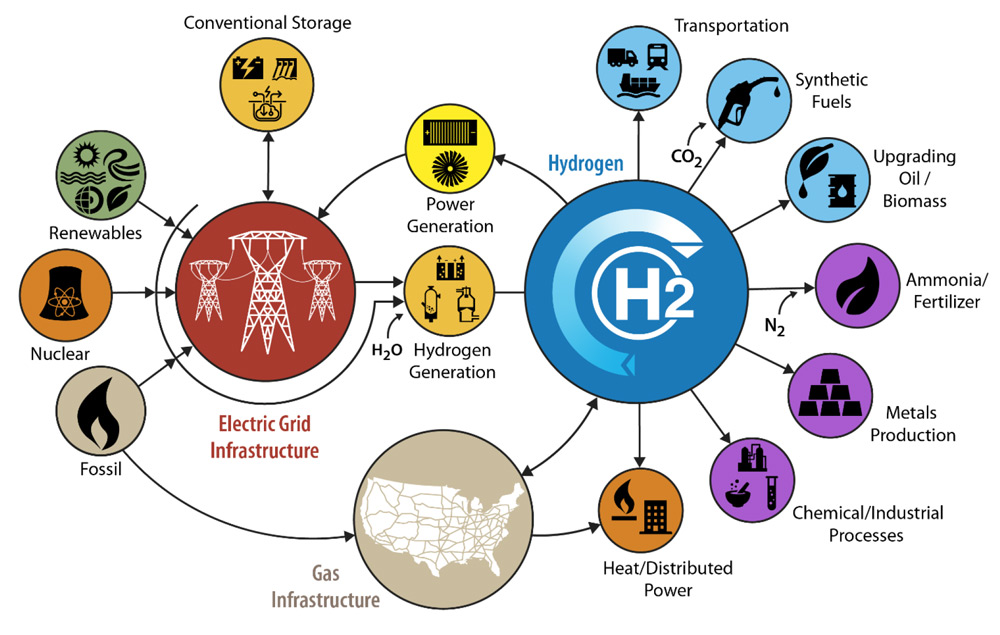
Hydrogens-coming-energy-roles-(DOE)-Content.jpg
DOE’s “Hydrogen Shot,” the first Biden “Energy Earthshot” will make the production of green hydrogen produced by renewable energy and nuclear power to drive down the price of green hydrogen for use as a transportation fuel and a feedstock for industrial process and manufacturing. | DOE

But green hydrogen is several times more expensive than the hydrogen stripped out of methane. Granholm described the “Hydrogen Shot” as an effort to reduce the cost of green hydrogen produced with renewable or nuclear energy by 80% to $1/kg by 2030. The current cost of hydrogen produced from natural gas is about $1.50/kg.

“Clean hydrogen is a game changer. It will help decarbonize high-polluting heavy-duty and industrial sectors, while delivering good-paying clean energy jobs and realizing a net-zero economy by 2050,” she said.

“We want to reduce carbon emissions by 50 to 52% by the end of this decade, produce 100% clean energy by 2035 and hit net-zero economy-wide carbon emissions by 2050,” she said.

“Those are not small goals; they are big, audacious goals, and meeting them is going to take all of us — the federal government, all 50 states, the private sector, our counterparts in other countries who have joined with us — all of us working together and scaling this capacity for science and innovation to an unprecedented level.

“Our scenario analyses suggests that we could produce five times more hydrogen than we are at current levels,” she said. “And as those numbers go up, [carbon] emissions will go down and jobs will skyrocket. Industry leaders estimate that mature hydrogen and the fuel cell industry could create $140 billion in revenue and 700,000 jobs in the United States alone.”

Granholm’s announcement also constituted an official request for information from researchers and industry by July 7 “on viable hydrogen demonstrations, including specific locations, that can help lower the cost of hydrogen, reduce carbon emissions and local air pollution, create good-paying jobs, and provide benefits to disadvantaged communities.”<!–

Can Nuclear Thread the Needle in a Polarized Congress?

Senate Republicans have rejected Democrats’ infrastructure spending proposals and climate policies. Could the two parties possibly find agreement on increased support for nuclear energy?

That question hung over the Nuclear Energy Institute’s virtual Nuclear Energy Assembly this week.

More than four decades after the Three Mile Island accident virtually ended the expansion of nuclear power in the U.S., NEI’s gathering came with the industry benefiting from some tail winds for a change.

While Republicans and Democrats in Congress are at loggerheads over everything from voting rights to gun control, members on both sides have expressed support for advanced nuclear generation designs that provide passive safety systems to eliminate the chance of a meltdown. (See Strong Bipartisan Support for Advanced Nuclear at Senate Hearing.) And some environmental groups that previously shunned nuclear power have concluded that it’s impossible to reach net-zero greenhouse gas emissions by midcentury without it.

“Let me say it loud and clear: Carbon-free nuclear power is an absolutely critical part of our decarbonization equation,” Energy Secretary Jennifer Granholm said in remarks before NEI on Tuesday. “And we’re not just talking the talk. The administration is ready to walk the walk, and nowhere is that more clear than in the president’s 2022 budget request for the Department of Energy. For example, it calls for a record $1.8 billion in funding for our nuclear energy program. That’s up 50% from just last year’s ask, which makes this our largest proposed investment ever. And we need every single cent of it to get nuclear energy where we need it to be.”

Granholm said the administration wants to first preserve the existing nuclear fleet, which generates 50% of the nation’s carbon-free electricity. The American Jobs Plan includes an allocated production credit for existing nuclear facilities, “which solves the nuclear plant retirement issue,” she said.

The administration is also seeking $245 million for the demonstration of two advanced reactors in the next six years and $305 million for further development of advanced designs by the mid-2030s.

Maria-Korsnick-(Nuclear-Energy-Institute)-Content.jpg
Nuclear Energy Institute CEO Maria Korsnick | Nuclear Energy Institute

“We need experts like yourselves standing up and speaking out if we’re going to get these proposals over the [goal] line,” Granholm said.

In her remarks opening the conference Monday, NEI CEO Maria Korsnick noted that nuclear power surpassed coal-fired electricity for the first time last year, making it the second-largest source of electricity in the U.S.

But she also mourned the loss of the Indian Point plant in New York, which shut down this year after 60 years of operation. “If the nuclear plants under threat this year are shut down, the lost carbon-free generation would be equivalent to all the renewables we deployed in 2019 across the entire country,” she said. “That isn’t decarbonizing. It’s throwing in the towel before the fight even begins.”

New Plants Coming

She also noted that Southern Co.’s Vogtle 3 reactor in Georgia is expected to go into commercial operation next year — albeit years behind schedule and billions over budget. “When completed, Vogtle 3 and 4 will be the first reactors of their kind in the United States. Together, they will produce more carbon-free electricity than all 7,200 wind turbines in the state of California,” she said.

NuScale Power, whose small modular reactor design won Nuclear Regulatory Commission approval in September, has announced deals to site its plants in Idaho and Washington state. (See Wash. PUD, NuScale Sign MOU to Explore Use of Small Reactors.)

Last week, officials announced that a shuttered Wyoming coal plant will be repurposed for a 345-MW advanced nuclear reactor that will also include molten-salt storage and provide jobs for the former coal plant’s workers. (See Wyoming Welcomes DOE-funded Advanced Nuclear Plant.)

“We’ve gone from concept to site selection. We’ve gone from design to demonstration. We’re not just talking about the next generation of nuclear technology; we’re actually beginning to build it,” Korsnick said. “With the continued progress and the right investments and policy choices, many of these designs can be online before this decade is out.”

Wendell Hibdon — director of energy and infrastructure for United Association, which represents plumbers and pipe fitters — said the idea of putting small modular reactors in former coal plants is an “absolutely great idea.”

“Using retired coal plants brings hope to the communities that are there. When they lose that plant, it’s not just the operators that lose jobs. It affects the whole community itself: the tax base of the community; suppliers for the powerhouse; people who haul coal. … It’s devastating for a community.”

New Allies

Nuclear has found some new and unexpected allies. Sen. Sheldon Whitehouse (D-R.I.), “who makes  a speech every night on the Senate floor about climate change, [has] recognized that there’s no way to deal with climate change — particularly in an era of electrification — if we don’t keep the existing plants we have and we don’t build more,” former Sen. Lamar Alexander (R-Tenn.) said.

Officials from the Audubon Society and the Nature Conservancy also appeared at the conference to explain why they are backing nuclear power as part of the climate solution.

“We’re the bird organization. A lot of people have asked, ‘Why are you engaged in climate policy at all?’” said Sarah Greenberger, Audubon’s senior vice president of conservation policy. “But our science team has shown that two-thirds of North American bird species are at risk of extinction by the end of the century because of a changing climate. So for us, addressing climate change — getting to net zero by the midcentury — is a critical part of our mission.”

Whats-Next-Panel-(Nuclear-Energy-Institute)-Content.jpg
Clockwise from top left, moderator Neal Cohen, Aperture Communications; Sarah Greenberger, Audubon Society; Wendell Hibdon, United Association, and Lynn Scarlett, The Nature Conservancy | Nuclear Energy Institute

Lynn Scarlett, chief external affairs officer at the Nature Conservancy, said being “science informed” is part of her group’s DNA.

“We have hundreds of scientists on staff. Our goals and our approach to things are data driven. So when we look at the challenge of where we are and where we need to go in terms of getting to a net-zero 2050 future, we realize that we’re going to need an all-of-the-above strategy.

“It’s true we’ve been very  supportive of renewables … but when we look at the big picture, to really get to that net-zero place, many, many different technologies need to be part of that picture simply from a data analysis standpoint. … We’ve done the math.”

Scarlett said that although her group supports carbon pricing and a clean energy standard, “we actually do not right now see a filibuster-proof pathway to big policy ambitions such as … carbon pricing of some sort, cap and trade, or even a clean energy standard.”

As a result, she said, her group is using a “try everything approach.”

“We’ve got to have R&D. We’ve got to have grid modernization. We’ve got to have the underpinnings and infrastructure that will allow these multiple tools to move forward. We do see a path forward — whether in the infrastructure bill or other venues for some of those building blocks to advance.”

DOE Can Crack the Funding Problem for E-bus Adoption

The range of benefits that electric buses can bring to a community has become a complicating factor in their adoption, according to Jigar Shah, director of the U.S. Department of Energy’s Loan Programs Office (LPO).

But the DOE is positioned to help.

Stacking up the values of e-buses makes it difficult to determine who should pay for the vehicles, Shah said during the Electric Power Research Institute’s Frontiers of E-Mobility forum on Monday.

In meeting a school’s transportation needs, an e-bus also ensures students are breathing cleaner air. That’s a public health benefit that carries over to healthcare costs by reducing asthma rates in children, for example, Shah said.

The same bus can be used as a generator in emergency situations.

“Many schools are emergency shelters, so you can power the school building off the school bus,” Shah said, adding that generator costs likely would be part of a municipality’s emergency services budget.

Multiple buses also can become a virtual power plant to replace a natural gas peaker plant.

“We pay handsomely to make sure that [those plants] are capable of operation, even if we don’t use them,” he said. “You can divert those payments to school buses.”

The e-buses can transport kids in the morning and afternoon, and otherwise be plugged in for peaker services, which delivers value to the local electric utility.

All the potential values of an e-bus make it unclear who should pay for the buses in the early stages of adoption, and therefore slows down the adoption process, Shah said.

“LPO can help to start solving the chicken-and-egg situation where folks on the ground might say that the school board has to go first or the utility has to go first or the governor’s office,” Shah said.

DOE has loan guarantee authority to support carbon-reducing energy projects, like a fleet of e-buses, where the department recognizes a clear value stream. Someone still needs to initiate an application to LPO, he said, but from there, the office can support a proposal that all beneficiaries of the value stream can “rally behind.”

Early discussions about who should own a battery that supports the power grid point to utilities, according to Shah.

“Utilities do have cheap money, but that cheap money is regulated,” he said.

While regulators may not have confidence in a battery’s ability to deliver system benefits or hold up through long-term use, the DOE has done that research already.

“We’ve tested it,” he said. “We have the ability to more confidently … give you a 30-year loan because we actually think that [the battery] will last 30 years.”

Even if there is a problem, he added, DOE believes the infrastructure is in place now to support upkeep on batteries.

Business Value

The predictable nature of electric vehicle maintenance could break open a new way to support EV value streams, according to Shah.

“I think you will see a huge movement around people [leasing] EVs on a cost-per-mile basis,” Shah said.

The EV market is already delivering vehicles at a price that is cheaper than internal combustion engines on a cost-per-mile basis over 200,000 miles. And as EV sticker prices continue to drop, their value to the system will go up, Shah said.

“Having a central owner that rents them out on a vehicle cost-per-mile basis, you now have a central group that can unlock all the other value streams of the vehicles,” he said. Individual owners likely are not going to go out of their way to tap into those streams.

The low maintenance costs of EVs, he said, will unlock business model innovations.