SEEM Members Offer Rule Changes

Sponsors of the Southeast Energy Exchange Market (SEEM) pledged Monday to provide FERC confidential market data and to apply the “just and reasonable” standard to increase transparency and allay market power concerns.

The sponsors made the pledges Monday in their response to a May 4 deficiency letter from FERC staff that asked 12 detailed questions about how the proposal to automate matching buyers and sellers in bilateral trading would operate (ER21-1111, et al.).

SEEM’s sponsors say their proposal would eliminate transmission rate pancaking and allow 15-minute energy transactions.

“The Southeast EEM members continue to believe that the Southeast EEM proposal will materially benefit customers throughout the southeastern United States by enhancing opportunities for competition in the bilateral market and increasing access to lower-cost energy from across the large footprint of the Southeast EEM,” said the group, comprising more than a dozen utilities and cooperatives including the Tennessee Valley Authority, Southern Co. (NYSE:SO) and Duke Energy (NYSE:DUK).

They said the changes to the proposed SEEM agreement would “increase transparency and provide the commission, participants and other stakeholders with the same confidence as the Southeast EEM members that the Southeast EEM will operate to the benefit of all concerned.”

They asked the commission to approve their proposal by Aug. 6.

“It is apparent from many of the deficiency letter’s questions that commission staff is interested in issues related to market power, market manipulation and market oversight,” the sponsors wrote. “The Southeast EEM provides no new opportunities to exercise market power.”

The members proposed the following changes:

  • confidential weekly submissions of market data to FERC and the Market Auditor, “comparable” to the data provided by RTOs under Order 760, including participants, bid/offer prices, quantities and locations.
  • disclosure of regulators’ questions and answers, as well as Market Auditor reports, to participants, subject to restrictions on access to confidential information by marketing function employees. The Market Auditor will be required to respond to the state regulatory commissions in Alabama, South Carolina, Mississippi, Virginia, Tennessee, Georgia, North Carolina, and portions of Kentucky, Oklahoma and Florida, as well as FERC, NERC and the TVA inspector general.
  • a clarification that available transfer capability calculated by participating transmission providers must be provided to the SEEM administrator and must be used in the algorithm for each leg of any contract path to ensure transmission will not exceed available capacity.
  • making the “just and reasonable standard” the default for most SEEM rules rather than the lower Mobile-Sierra public interest standard.

“While the Southeast EEM members do not believe these changes are needed here to ensure that the proposed market enhancements are just, reasonable and not unduly discriminatory or preferential, the changes are offered to respect and heed the message suggested by the staff questions and the intervenor concerns some of those questions echo,” the members said.

They reiterated that their proposal could only lower power costs for customers because SEEM transactions will only occur when a seller has lower-cost energy available to meet 15-minute non-firm increments than the buyer has available from its owned or controlled firm generation. “Therefore, there is no potential for the Southeast EEM to be used as a tool to increase prices through the exercise of market power,” they said.

SEEM said it was unable to answer FERC’s question about the supply of 15-minute residual energy expected to be offered.

“Before market launch, forward-looking estimates of the level of supply and demand in this voluntary residual market are difficult to make with any precision or certainty,” it said, adding that its consultant, Susan Pope of FTI Consulting, “expects that the market will attract robust participation by buyers and sellers in the Southeast.”

They also emphasized that SEEM will not function as an imbalance market and that balancing services will continue to be provided by the 10 balancing authorities in the SEEM footprint, unlike the Western Energy Imbalance Market (EIM) run by CAISO.

“The ‘EEM,’ unlike the ‘EIM’, will have no market clearing imbalance price that could be driven up through an exercise of market power to favor a related position; each Southeast EEM ‘exchange’ will be individually priced, just like the other bilateral transactions for which existing market power mitigation measures are already sufficient.”

Critics: SEEM Not a True Market

Clean energy groups have asked FERC to reject SEEM’s proposal, saying it doesn’t go far enough to encourage competition. In March, SEEM filed a response rejecting the critics’ objections as flawed or irrelevant. (See Southeast Utilities Defend SEEM Proposal.)

In a blog post Monday, Maggie Shober, director of utility reform for the Southern Alliance for Clean Energy, said FERC should require SEEM to be an imbalance market.

“SEEM as proposed is unlikely to deliver on its own promise: small incremental cost savings and marginally reduced renewable energy curtailments. Instead, ratepayers in the Southeast need actual competition, under a neutral administration, with broad participation, market transparency and accountable governance,” Shober wrote. “SEEM does not even attempt to promise these market essentials.”

She said SEEM should have an independent market monitor, eliminate the “split the difference” price settlement to one similar to locational marginal pricing and add a day-ahead hourly market with a resource-sharing construct.

“Right now there are countless utilities across the region that have proposed new gas plants in their queues, far more than regions of the country where markets are in place. One key reason for this is that each utility is doing resource planning largely as an island,” Shober wrote. “We’ve shown before that Southeast utilities do not tend to peak at the same time, and a platform for sharing resources across these utilities (i.e. a market) would reduce the need for all that new gas and would make it more economically efficient for complementary clean energy resources to flow across the region.”
100% Clean Power by 2035 Needs Energy Standard with a Twist

Reaching a 100% clean power target by 2035 will require the U.S. to adopt a federal clean energy standard (CES) that will call for a novel approach to get passed.

“We could pass a CES through budget reconciliation by changing the way a CES works,” Leah Stokes, assistant professor at the University of California, Santa Barbara, said at the American Clean Power Association’s CLEANPOWER 2021 virtual summit on Monday.

The federal standard would differ from state renewable portfolio standards. There would be no mandate for the percent of system power that needs to come from renewables or program of energy credits paid for through rate base. Instead, Stokes said, the federal government would pay states for hitting an annual clean power target to help offset the cost of the transition.

The funding could be used to pay for stranded power plant debt, customer bills, new clean power plant construction or energy efficiency programs.

“What we can do with the federal government is use the power of the purse,” Stokes said.

Legislators have been trying to pass versions of a federal energy standard for years, and current efforts do not show much promise. In addition, she said, the investment tax credit and production tax credit, on their own, are not enough to reach 100%, even if they were given a 10-year extension.

Analyses show that an extension of those credits would achieve, at the high end, 56% renewables by 2030.

“What this [CES] would do is get us to 80% clean power by 2030, which is directly on the pathway to 100% clean by 2035,” Stokes said, adding that the power industry should lobby for this policy now.

“Without it, we’re not going to expand the pie, and we’re not going to be building clean power at the pace and scale that’s necessary,” she said.

Steps to 100%

In a recent study, the International Energy Agency looked at net-zero ambitions from around the world and translated them for the electricity sector with actionable steps, according to Brent Wanner, head of power sector unit, World Energy Outlook. (See IEA Paints Daunting Path to Net Zero by 2035.)

“We need to reach net-zero emissions in advanced economies in electricity by 2035,” Wanner said at CLEANPOWER. “That’s in line with the Biden administration’s target.”

Reaching that target means completely revising the electricity generation mix in the U.S, he said, and the report provides a sense of scale for the revision.

The sector would need to phase out all fossil fuel generation while also achieving a 20-fold increase in wind and solar PV capacity over the next 30 years. It would take about 1,000 GW of wind and solar to directly replace the current 2,500 TWh per year that U.S. coal, oil and gas generate.

“That’s not including meeting additional electricity demand growth, as we electrify more sectors like vehicles and potentially heating,” Wanner said. “That 1,000 GW of wind and solar is five times more than we have in place today.”

Supporting high levels of solar and wind deployment will require tripling the current annual investments in transmission and distribution and rethinking grid security and flexibility.

“As we go forward, we see demand-side response and energy storage systems becoming the primary means of providing flexibility, as we move away from fossil fuels,” he said.

The report also shows hydrogen-based systems as having a high potential in the long term to help gas-fired power plants in the transition.

“In the end, we need to scale up the low-carbon sources: renewables, nuclear power, eventually low-carbon hydrogen and other sources,” he said. “And in 15 years, the task is great.”

Calif. Needs Tx and Gas to Decarbonize, Advocates Say

Speakers at a California Energy Commission (CEC) workshop Wednesday addressed some of the more difficult problems in the state’s transition to 100% clean energy, including the need for new transmission and efforts to keep and decarbonize natural gas.

The daylong workshop — part of a joint planning process by the CEC, the California Public Utilities Commission (CPUC) and the California Air Resources Board (CARB) — dealt with the huge influx of resources needed to comply with Senate Bill 100, the landmark 2018 law that requires utilities to serve retail customers with 100% clean energy by 2045.

Achieving that objective will require an infrastructure buildout of unprecedented proportions and greater cooperation by the CEC, CAISO and the CPUC, the three entities responsible for energy planning and procurement in California, speakers said.

SB-100-Requires-Significant-(California-Energy-Commission)-Content.jpg
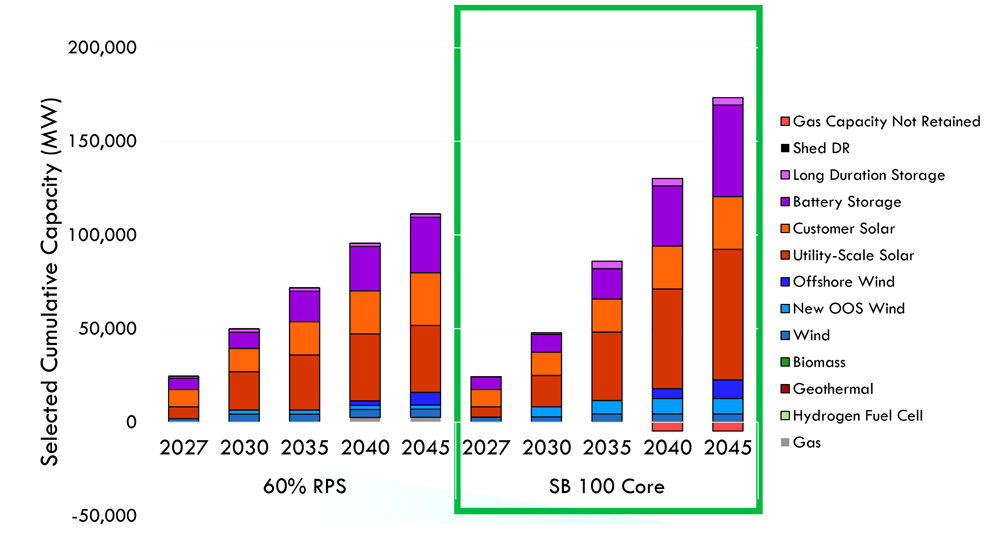
The state needs 172 GW of new resources to reach SB 100’s target, the CEC says. | California Energy Commission

CEC Adviser Liz Gill said her commission’s “high-electrification” planning scenario, which anticipates widespread adoption of electric vehicles and heating-and-cooling appliances, shows the state must add 172 GW of new resources to the approximately 80 GW it had as of 2019. (See Study: Calif. Must Build Renewables at Record Rate.)

“We’re really looking at tripling our electric grid capacity,” Gill said. The SB 100 Joint Agency Report released in March envisions massive increases in utility-scale solar, rooftop solar, battery storage, and onshore and offshore wind, she said.

New Transmission

More transmission is needed to deliver energy from the threefold increase in generating and storage resources to urban load centers, speakers said.

Neil Millar, CAISO vice president of transmission planning and infrastructure development, said the pace of development “needs to be considerably accelerated, and that applies not only to the resources but to the transmission development that will underpin those resources.”

Developing resources with longer lead times, such as offshore wind, and new transmission lines to serve those resources will require years of planning, “so it’s critical that we get going as soon as possible,” Millar said.

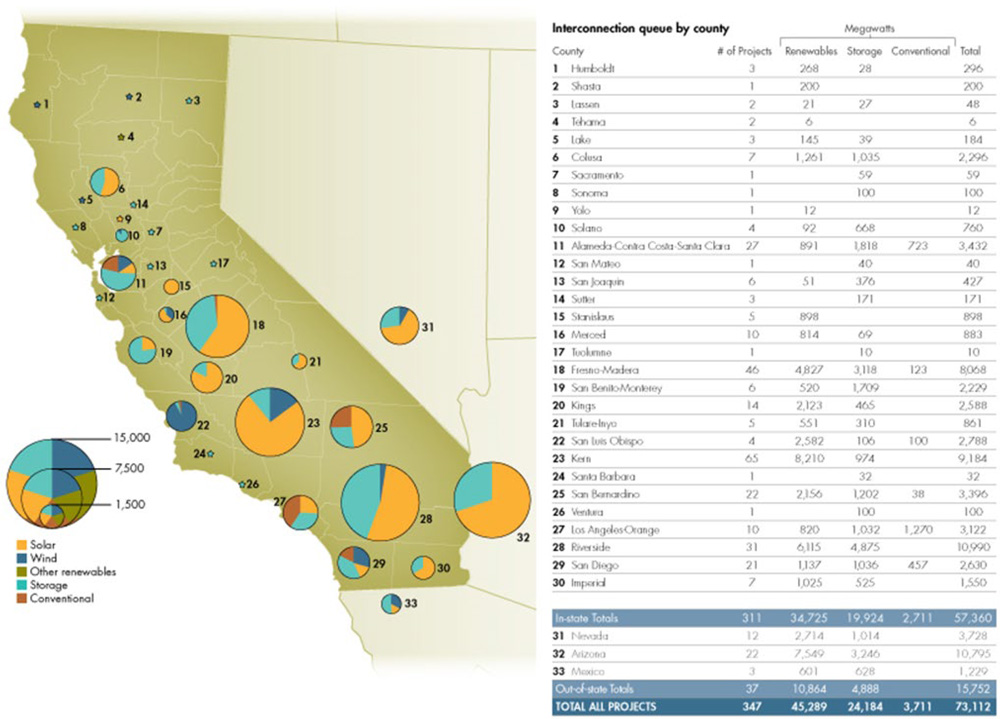
Jeff Billinton, CAISO’s director of transmission infrastructure planning, said the push to add generating and storage resources has led to interconnection queue requests that “exceed all previous levels and expectations.”

Over the past decade, CAISO received an average of 113 queue requests per year, he said. In April, the ISO received 363 interconnection requests totaling 106 GW, Billinton said.  

“This volume is creating staffing resource challenges for the ISO and, in particular, for the participating transmission owners,” he said.

Some speakers urged better coordination and planning to avoid future problems.

James Avery, an energy consultant who serves on the WECC Board of Directors, said the state needs to avoid the “planning paralysis that has plagued us for decades and … move as expeditiously as possible to evaluate all of the possible transmission projects that are before the ISO in the current [transmission planning process] cycle.”

Avery made his comments on behalf of Western Grid Group, which “seeks to accelerate the incorporation of a broad range of cost-effective, low-carbon technologies into the electric system,” according to its website.

“In order for California to meet our SB 100 goals, the state must develop a roadmap,” Avery said. “There’s been a lot of talk this morning about different initiatives, different objectives, but no one has put this all together into a roadmap that clearly lays out what we have to do to meet the 2045 time period.”

“Simply connecting renewable resources to the ISO grid will not enable us to reduce our dependence on the natural gas that’s used to serve our urban load centers,” he said. “If we do not build the transmission to deliver renewable resources to our coastal regions, we will never be able to meet our SB 100 goals.”

Interconnection-queue-by-county-(CAISO)-Content.jpg
Interconnection queue requests are centered in Central and Southern California, where solar power is abundant. | CAISO

Most utility-scale renewable resources — solar, geothermal, wind and hydropower — are far from the state’s coastal cities, requiring new transmission connections.

“We all know it takes 10 years to build any new transmission facility,” Avery said.  

“Without the roadmap, we will still be talking about what needs to be done when it’s too late to do anything,” he said.

Sticking with Gas

Another difficult issue is what to do with natural gas, a major fuel source for the state’s generators and consumers.

After last year’s rolling blackouts, there has been a growing call to retain aging natural gas plants until viable clean-energy substitutes can come online to provide reliability.  

In her presentation, the CEC’s Gill said, “retaining some natural gas power capacity may minimize costs while ensuring an uninterrupted power supply during the transition to 100% clean energy.”

On May 21, the CPUC proposed that utilities procure an additional 1,000 MW to 1,500 MW of fossil fuel generation to avoid capacity shortfalls, which broke with nearly all state policy in recent years. (See CPUC Proposes Adding 11.5 GW of New Resources.)

“A failure to provide insurance to keep grid reliability is a far greater threat to public confidence and public health than running state-of-the-art fossil-fueled generators a few extra hours a year,” the proposed decision said.

Utilities that rely on natural gas generation and sell gas directly to consumers said the fuel could be partly decarbonized using carbon-capture technologies or by mixing it with green hydrogen, produced with excess solar power.

Jan Berman, director of energy strategy and innovation with Pacific Gas and Electric, said gas remains essential for grid reliability because it powers plants that meet peak demand.  

“Like many here, we anticipate that decarbonized gas-fueled generation resources will be required in the long run to ensure peaking capability for California,” Berman said. “As California’s current fossil generation fleet begins to retire, these plants will be replaced by new generation that uses decarbonized gaseous fuels. This may be some combination of generation fueled by hydrogen, renewable natural gas … and possibly fossil [fuels] combined with carbon capture and storage.”

“We think it’s important to maintain flexibility for the pathways that will emerge as these technologies advance, and it’s really important for all of us to participate in ongoing research on the future of carbon-free gas generating resources,” she said.

Jeff DeTuri, policy and strategy manager at San Diego Gas & Electric, said the utility supports the goals of SB 100 but also remains concerned about resource adequacy.

“Natural gas is a critical partner to provide reliability to support renewable energy in California,” DeTuri said. “It needs to be supported by the joint agencies.”

The definition of a zero-carbon resource “should include combustion of renewable natural gas and green hydrogen and combustion of natural gas with carbon-capture sequestration,” he said. “SDG&E believes that these research types are essential to provide reliability.”

DOE Can Crack the Funding Problem for E-bus Adoption

The range of benefits that electric buses can bring to a community has become a complicating factor in their adoption, according to Jigar Shah, director of the U.S. Department of Energy’s Loan Programs Office (LPO).

But the DOE is positioned to help.

Stacking up the values of e-buses makes it difficult to determine who should pay for the vehicles, Shah said during the Electric Power Research Institute’s Frontiers of E-Mobility forum on Monday.

In meeting a school’s transportation needs, an e-bus also ensures students are breathing cleaner air. That’s a public health benefit that carries over to healthcare costs by reducing asthma rates in children, for example, Shah said.

The same bus can be used as a generator in emergency situations.

“Many schools are emergency shelters, so you can power the school building off the school bus,” Shah said, adding that generator costs likely would be part of a municipality’s emergency services budget.

Multiple buses also can become a virtual power plant to replace a natural gas peaker plant.

“We pay handsomely to make sure that [those plants] are capable of operation, even if we don’t use them,” he said. “You can divert those payments to school buses.”

The e-buses can transport kids in the morning and afternoon, and otherwise be plugged in for peaker services, which delivers value to the local electric utility.

All the potential values of an e-bus make it unclear who should pay for the buses in the early stages of adoption, and therefore slows down the adoption process, Shah said.

“LPO can help to start solving the chicken-and-egg situation where folks on the ground might say that the school board has to go first or the utility has to go first or the governor’s office,” Shah said.

DOE has loan guarantee authority to support carbon-reducing energy projects, like a fleet of e-buses, where the department recognizes a clear value stream. Someone still needs to initiate an application to LPO, he said, but from there, the office can support a proposal that all beneficiaries of the value stream can “rally behind.”

Early discussions about who should own a battery that supports the power grid point to utilities, according to Shah.

“Utilities do have cheap money, but that cheap money is regulated,” he said.

While regulators may not have confidence in a battery’s ability to deliver system benefits or hold up through long-term use, the DOE has done that research already.

“We’ve tested it,” he said. “We have the ability to more confidently … give you a 30-year loan because we actually think that [the battery] will last 30 years.”

Even if there is a problem, he added, DOE believes the infrastructure is in place now to support upkeep on batteries.

Business Value

The predictable nature of electric vehicle maintenance could break open a new way to support EV value streams, according to Shah.

“I think you will see a huge movement around people [leasing] EVs on a cost-per-mile basis,” Shah said.

The EV market is already delivering vehicles at a price that is cheaper than internal combustion engines on a cost-per-mile basis over 200,000 miles. And as EV sticker prices continue to drop, their value to the system will go up, Shah said.

“Having a central owner that rents them out on a vehicle cost-per-mile basis, you now have a central group that can unlock all the other value streams of the vehicles,” he said. Individual owners likely are not going to go out of their way to tap into those streams.

The low maintenance costs of EVs, he said, will unlock business model innovations.

Nevada Legislature Wraps up with Host of Energy, Climate Bills

A bill that would allow the sale of gasoline containing up to 15% ethanol in Nevada is one of several energy-related bills that are awaiting Gov. Steve Sisolak’s signature after being passed by state lawmakers.

Assembly Bill 411 would require the Nevada Board of Agriculture to adopt regulations allowing the sale of motor vehicle fuel containing up to 15% ethanol by volume, a formulation known as E15. The state’s current maximum for ethanol content is 10%.

The bill was sponsored by the Assembly Committee on Growth and Infrastructure.

The U.S. Environmental Protection Agency has approved E15 for use in light-duty vehicles of model year 2001 or newer, and the fuel is sold at more than 2,300 gas stations in 30 states, according to the Biotechnology Innovation Organization (BIO), a trade group that supported the bill.

“E15 is seen as one of the most important near-term pathways to decarbonizing the transportation sector,” Gene Harrington, BIO’s director of state advocacy and state government affairs, food and agriculture, said in a letter to lawmakers.

The Assembly passed the bill on a 32-10 vote; the Senate vote was 21-0.

Appliance Standards

AB411 was one of several energy-related bills to pass both houses by the end of Nevada’s 120-day legislative session, which concluded on May 31. The state legislature meets every other year.

AB383, by Assemblymember Howard Watts (D), would set energy efficiency standards for a long list of appliances, including computers, electric vehicle supply equipment, gas fireplaces and commercial dishwashers and ovens. (See Bill Would Make NV Energy Aim Higher on EE.)

The bill would instruct the director of the Office of Energy to adopt regulations setting minimum energy efficiency standards for the appliances by Oct. 1, 2022. The standards would apply to appliances sold on or after July 1, 2023.

The bill was sent to the governor last week after a 26-13 vote in the Assembly and a 12-9 vote in the Senate.

Watts sponsored another bill awaiting the governor’s signature: AB349, which would close the state’s so-called classic car loophole. Cars that are 20 years or older may be registered in Nevada as classic vehicles and receive an exemption from smog checks. But under AB349, the classic car designation couldn’t be applied to cars that are used for general transportation, defined as being driven more than 5,000 miles a year.

The votes on the bill were 25-17 in the Assembly and 12-9 in the Senate.

Those bills are in addition to Senate Bill 448, the main energy bill of the session. The bill, by Sen. Chris Brooks (D), would boost electric transmission and EV infrastructure in the state, among other provisions. (See Far-reaching Energy Bill Sweeps Through Nev. Legislature.) Sisolak is expected to sign it.

Land, Water Conservation

Nevada lawmakers this session also passed Assembly Joint Resolution 3 (AJR3), which aims to conserve 30% of the state’s lands and waters by 2030, a goal often called 30-by-30. The resolution was enrolled and delivered to the Secretary of State on May 25.

The resolution’s primary sponsors were Assemblymembers Watts, Cecelia González, Steve Yeager and Lesley Cohen, all Democrats.

AJR3 urges federal, state and local agencies to work together on reaching the 30-by-30 conservation goal.

Conservation may be achieved through actions such as designating or establishing wilderness areas, national parks, state parks and wildlife management areas, AJR3 states. The resolution includes some examples such as establishing as a national monument Avi Kwa Ame, a 380,000-acre area east of the Mojave Desert that is considered sacred to 10 Yuman-speaking tribes.

In addition to government action, private landowners may be encouraged to participate in voluntary conservation programs, the resolution says.

“Land conservation and restoration increases natural carbon sequestration and is one of the most cost-effective solutions to combating climate change,” the resolution states.

According to the Nevada Conservation League, which supported AJR3, Nevada is the first state in the country to pass legislation committing to the 30-by-30 goal.

But lawmakers had mixed views of the resolution. Some questioned whether conservation efforts would conflict with water rights.

Sen. Ira Hansen (R) said the resolution was vague as to what it seeks to conserve and protect. Hansen also expressed concerns about expanding federal oversight of lands.

“Giving more control to the federal government has proven to worsen the situation,” Hansen said during a hearing of the Senate Committee on Natural Resources.

The Assembly voted 26-16 to pass the resolution and the Senate vote was 12-9.

Transportation Working Group

Some bills have already been signed into law by the governor.

AB413 will establish a transportation working group to look at issues including greenhouse gas emissions associated with transportation. The group will consider the needs of all types of transportation users, including car drivers, transit users, bicyclists and pedestrians, along with social equity issues.

The group will also discuss the sustainability of the state Highway Fund, which uses gas tax revenue to pay for road repairs. The fund has been dwindling as drivers use less gas.

The state Department of Transportation will choose the 20 to 30 members of the working group. A written report to the legislature is due by Dec. 31, 2022.

AB413 was sponsored by the Assembly Committee on Growth and Infrastructure. The Assembly and Senate passed it unanimously, and Sisolak signed it on May 21.

Repealing Tax Breaks

SB442 will repeal a program that gives property tax breaks to energy efficient buildings.

The Green Building Tax Abatement program was launched in 2005, and the program uses a point system for determining energy efficiency tax breaks that hasn’t kept up with the energy efficiency requirements of building codes, proponents of the bill said.

“Today we have a program rewarding multimillion-dollar national companies for essentially building their properties to the current required code, or in some cases actually less efficient than current code requirements,” Angie Dykema, Nevada representative of the Southwest Energy Efficiency Project (SWEEP), said in a letter to lawmakers.

The Assembly voted 42-0 in favor of SB442 and the Senate vote was 15-4. Sisolak signed the bill into law on June 3. It takes effect on July 1.

NEPOOL Participants Committee Briefs: June 3, 2021

NEPGA Formally Approved for Membership

For more than 15 years, the New England Power Generators Association (NEPGA) participated in the NEPOOL stakeholder process through a standing invitation to attend meetings as a guest. Moving forward, NEPGA has a paid seat at the table.

The NEPOOL Participants Committee approved NEPGA’s membership application as a non-voting Fuels Industry Participant at its monthly meeting Thursday. According to a memo from NEPOOL counsel Pat Gerity, of Day Pitney, distributed before the vote, NEPGA wanted to “formalize its participation in the NEPOOL stakeholder process.”

NEPGA President Dan Dolan told RTO Insider on Friday that there were “two fundamental reasons” NEPGA applied for membership.

“First is comparable treatment,” Dolan said. “Historically, trade associations and other advocacy groups have not been equal members, but that door opened a couple of years ago, when we saw the American Petroleum Institute and Advanced Energy Economy both seek and receive NEPOOL membership in large part because they didn’t have the same guest status that NEPGA has been able to enjoy.”

Dolan added that API and AEE have been able to formally propose amendments on their behalf, participate in executive session discussions, such as the consideration of nominees to the ISO-NE Board of Directors. However, as guests in the NEPOOL process, NEPGA could not do either of those things.

“The second element is that formal process of participation. Every time NEPGA proposed an amendment or a concept in the NEPOOL process, it had to be sponsored by an entity that is a NEPOOL member. All [NEPGA] members are NEPOOL members, and so we were always able to do that. As you can imagine, one of the benefits of participating in a trade association is not having to have an individual company lead on a particular issue,” Dolan said. “Even the process of getting sponsorship was … 99% of the time, no issues whatsoever. There are a small handful of times in which no individual company wants to ‘own or be behind’ [an amendment], and it should be something that comes from the full NEPGA as an organization.”

Dolan said he heard that NEPGA was not a Fuels Industry Participant throughout the membership process but decided to apply under that non-voting banner for a specific reason.

“We’re not a direct participant in the market; as such we didn’t seek a voting right,” Dolan said. “I think that’s better done by our individual companies and members rather than us as a trade group, but we still want to be able to participate and have the same governance rights as some of the other entities. So, it’s simply a codification of the participation that we’ve largely had for almost 20 years now.”

No voting member of the PC opposed NEPGA’s membership, though there was an abstention. Dolan said NEPGA “patted ourselves on the back slightly” after the vote.

“While we absolutely butt heads with a lot of folks on substantive issues, I hope my interpretation is that we participate in good faith and are an important part of the overall conversation,” Dolan said.

Energy Market Value Drops

ISO-NE’s energy market value for May was $194 million (through May 25), down $53 million from the updated April valuation and $48 million higher than the same month in 2020, according to COO Vamsi Chadalavada’s monthly report to the PC.

May natural gas prices were 0.6% lower than in April. Average real-time hub LMPs were 10% lower than in April, at $23.32/MWh. Average natural gas prices and real-time hub LMPs were up 69% and 30%, respectively, from the same period last year.

Daily uplift or net commitment period compensation (NCPC) payments totaled $1 million over the period, down $1.7 million from the adjusted April value and $1.4 million less than May 2020. NCPC payments were 0.5% of the energy market value.

Chadalavada said that four new projects totaling 209 MW applied for an interconnection study — one co-located battery and solar project, two solar projects and one natural gas project — with in-service dates ranging from 2022 to 2025. ISO-NE is currently tracking 290 generation projects, which total approximately 31,047 MW.

Regulators Press on SPP-MISO Rate Pancaking

MISO and SPP state regulators, eager for the RTOs to address rate pancaking, are trying to find ways to inventory the instances and costs of duplicate transmission charges along their seams.

The MISO-SPP Seams Liaison Committee (SLC), comprised of regulators from the Organization of MISO States (OMS) and SPP’s Regional State Committee (RSC), met virtually last week with their newly formed rate pancaking working group.

American Clean Power Association’s Daniel Hall urged regulators to study pancaked rates’ adverse cost impacts on long-term supply contracts.

“This has real impacts on consumers, on the rates they pay,” he said during the June 4 call.

American Electric Power and other utilities have complained about the transmission service fees involved with serving load on both sides of the RTOs’ borders. Some, like Missouri River Energy Services, a member of both MISO and SPP, have split their power supply in order to avoid paying for SPP transmission service.

Some in the working group suggested that regulators ask MISO and SPP members to quantify their annual pancaking costs through a survey.

Others said researching MISO and PJM’s elimination of rate pancaking years ago could help guide regulators’ recommendations for MISO and SPP.

“I’ll say it was a long process to go through that,” said Missouri Public Service Commission economist Adam McKinnie.  

Xcel Energy’s Carolyn Wetterlin pointed out that new flows created from any MISO and SPP interregional projects might also be subjected to pancaking charges. MISO and SPP are pursuing an interregional study that could result in transmission projects to help ease their respective logjams in their generation interconnection queues. (See MISO Axes Remaining SPP Interregional Project.)

The OMS and RSC’s working group is working through how it might collect data on the fees. Regulators promised more information for the SLC’s next meeting July 15.

Colonial CEO Welcomes Federal Cyber Assistance

Last month’s cyberattack against Colonial Pipeline is a warning sign that “private industry alone can’t … solve the [cybersecurity] problem totally” by itself, company CEO Joseph Blount told lawmakers at a hearing of the U.S. Senate’s Homeland Security and Governmental Affairs Committee on Tuesday.

Blount was on the defensive for most of the hearing, as he parried members’ questions about the hack that led the company to shut down its entire network that carries almost half the supply of gasoline, diesel, and other fuel products to the U.S. East Coast. The FBI has linked the ransomware attack with DarkSide, a cybercrime group believed to be based in Eastern Europe that develops ransomware tools and provides them to affiliates to perform the actual hacking and deployment. (See Glick Calls for Pipeline Cyber Standards After Colonial Attack.)

Several members, including committee Chair Gary Peters (D-Mich.) and ranking member Rob Portman (R-Ohio), asked Blount about his decision to pay the 75 bitcoin (then about $4.4 million) ransom that the attackers demanded for the release of the data they had encrypted, which he confirmed in an interview with the Wall Street Journal last month. (See Colonial Hack Sparks Competing Recommendations at FERC.)

At least part of the ransom has since been recovered. The Justice Department confirmed Monday that the FBI had raided an online wallet belonging to DarkSide and seized more than 63 bitcoins with a current market value around $2.3 million.

Ransom Decision Tough but Necessary

In his written testimony Tuesday, Blount acknowledged the recovery of the funds and said that authorizing the payment was “one of the toughest decisions I have had to make in my life,” but said it was “the right thing to do for the country” in order to avert a prolonged shutdown.

Whether it was the right decision or not, paying off the attackers is contrary to the official recommendation of the FBI, as multiple lawmakers pointed out in their questioning. Portman noted that according to the timeline of the attack that Blount presented, Colonial had notified the FBI within hours of discovering the breach on May 7. Portman asked whether the FBI had made that recommendation clear to the company before it paid the ransom on May 8.

“I was not in that conversation; I can’t confirm or deny that,” Blount replied. “But I do agree that their position is they don’t encourage the payment of ransom. It is a company’s decision to make.” He confirmed that the company had verified with the Treasury Department’s Office of Foreign Assets Control that DarkSide was not on the list of sanctioned individuals or entities with which U.S. companies are forbidden from doing business.

Portman went on to ask about the effectiveness of the decryption tool that Colonial received in return for the ransom payment, observing that media reports claimed that the tool was so slow as to be unusable and that Colonial relied on its backups to restore the affected systems.

“So you paid the ransom, they gave you the decryption tool to be able to undo the harm that they did — that’s how it normally works — and yet the decryption tool was not effective. Is that correct?” Portman asked.

“The decryption tool is an option that’s made available to you. When you’re looking at bringing critical infrastructure back up as quickly as you possibly can, you want to make every option available to you that you can,” Blount said, adding that the tool “has worked.” However, when asked by Portman whether the reports were inaccurate, he qualified his statement by saying the tool worked “to some degree.” Later in the hearing he referred to the story obliquely with a mention of Colonial’s “really good backups.”

Colonial’s Federal Cooperation Questioned

The federal government’s response to the hack was another major topic of interest at Tuesday’s hearing, with Blount praising the Department of Energy for providing a “single point of contact” for the company so it would not have to juggle responses to multiple federal agencies during the crisis.

However, Blount returned to the defense when Peters asked about Colonial’s relationship with the Department of Homeland Security’s Cybersecurity and Infrastructure Security Agency (CISA). Testifying before the committee last month, CISA’s acting director Brandon Wales said that the company had not contacted his agency directly to inform it of the attack; instead, it called the FBI, which brought in CISA separately.

Questioned by Peters on this apparent oversight, Blount said he sees CISA as a “good organization” and that Colonial regularly communicates with the agency and participates in its events and exercises. He stressed that the company had not meant to leave CISA in the dark, but felt it unnecessary to reach out directly because the FBI — which, he noted, they had contacted “almost immediately” after discovering the attack — had already indicated it planned to bring in the agency in a later call.

Portman observed that at the time of the attack, informing CISA was voluntary; since then, he noted, the Transportation Security Administration (TSA) — which regulates pipelines — has issued a new security directive mandating that pipeline operators and owners report any potential cybersecurity incidents to CISA. Blount responded that the company is now “fully compliant” with the new regulation.

Senator Josh Hawley (R-Mo.) pressed Blount further on Colonial’s cooperation with the federal government, asking why the company had failed to take up the TSA’s offer of a comprehensive cybersecurity review of the pipeline three times before the attack, as reported in the Washington Post. Blount said that the company had tried to schedule the review but it had to be delayed due to the COVID-19 pandemic and Colonial’s recent office move.

“We have a good working relationship with TSA,” Blount said, adding that he was “a little surprised” by the report and that neither Colonial’s chief information officer nor “their contacts on TSA’s side” knew why their scheduling difficulty had been described as a refusal. He also suggested that the specific review TSA planned probably wouldn’t have detected the vulnerability that the hackers used anyway.

EPRI Panelists Stress the Need for Speed in Vehicle Electrification

For the U.S. to zero out its carbon emissions by 2050, one in four cars on the road will have to be electric by 2030.

“The only question we have to really ask and answer is how easy or hard do we want to make this on ourselves,” said Britta Gross, managing director of the transportation practice at Rocky Mountain Institute.

Gross was speaking at one of Monday’s opening sessions at the Electric Power Research Institute’s (EPRI) four-day Frontiers of e-Mobility virtual forum, and she said, right now, the country is definitely doing that transition the hard way.

“It’s inefficient today. Infrastructure is not where it needs to be; costs aren’t down; interconnection times that utilities [take are] too long,” she said. “We’re drawing it out; we’re doing pilots and demonstrations — five vehicles here, 10 buses there — and everything leads to costs.”

Michael-Berube-(EPRI)-Content.jpg
Michael Berube, DOE | EPRI

The need for speed, affordability, equity and market-based solutions to rapidly scale the electrification of transportation was the session’s core message, all of which calls for “a holistic approach,” said Michael Berube, deputy assistant secretary for sustainable transportation at the U.S. Department of Energy.

“We have to very much focus on, first and foremost, developing a transportation system that works for all Americans,” Berube said. “The transportation system, whether it be for individuals or businesses, has to get people where they need to go; has to be affordable; has to get the goods there on time.”

Both he and Gross said setting ambitious goals, with clear milestones, is what the U.S. market needs. At present, U.S. auto sales — light-, medium- and heavy-duty — total about 17 million a year, Gross said. New vehicles are now more durable, staying on the road for eight to 12 years, Gross said, citing figures from IHS Markit, and one-quarter of all vehicles now on U.S. roads are 16 years or older.

With that kind of sluggish turnover, “the pace that we’re on, the business-as-usual path, is not going to get us to 2030 [with] any kind of numbers,” she said. “There are sectors that can move today. Urban delivery vehicles [and] short-range vehicles are well within the capabilities of electric vehicle technology today. Both Uber and Lyft have announced electrification goals and commitments by 2030. How do we pull that schedule up sooner?”

Federal, state and municipal fleets should also be early movers to demonstrate scale and “clean up all the systemic challenges that are preventing scale today,” she said. “We can build a blueprint that everyone can use: states can use, utilities can use, cities can use and, of course, fleets across the country can use so that the rest of the market can react and accelerate their own timelines for 2030.

Preparing for Scale

Another reason for setting big goals is to provide certainty for the auto industry and, in turn, help build a domestic supply chain, the two panelists said.

“China and Europe have obviously moved out earlier and a little quicker and more aggressive than the United States” on transportation electrification, Berube said. “And that’s taking up some of the capital and some of the initial investment. There is a lot of opportunity for investments in the U.S. for the supply chain. The most efficient way to get that to happen is if people have a certainty that there is going to be that market there.”

Creating market certainty also means an equally rapid scale-up of charging infrastructure and, in particular, DC fast chargers, Gross said. RMI research suggests that “to support just 50 million EVs in 2030 is going to require at least 300,000 DC fast chargers. Until we really jump on a holistic, national confidence level in public charging, until there’s that confidence that that one big barrier is addressed, the automakers are going to struggle,” she said.

Britta-Gross-(EPRI)-Content.jpg
Britta Gross, RMI | EPRI

Getting enough chargers installed fast enough will also mean streamlining permitting to attack soft costs, as the solar industry has been doing for years, Gross said. She pointed to the recently released SolarApp, developed by the National Renewable Energy Laboratory, to allow fast, online permitting for residential solar installations. (See NREL Apps Accelerate Rooftop Approvals.)

“We’ve got to start preparing for scale. It can’t take 18 months to get a DC fast charging hub set up,” Gross said. “We need to come up with some policies, broadly across the U.S. regulatory landscape, that allow for utilities to come in and they’re just responsible for the make-ready [charger installation], and it gets done. There is no special approval you have to get.”

Future-proofing the Transition

Responding to a question about equity, Berube said, DOE is focusing on leveraging vehicle electrification to cut air pollution in low-income and disadvantaged communities. But cutting hard costs also remains a top priority, both he and Gross said, with a goal of getting to battery packs down to $70/kWh and eventually to new EVs with a 300-mile range in the $20,000 range that can then be channeled into the secondary-sales market.

“I firmly believe that people are going to realize how good a value the used EV is because of the lower maintenance and operating cost of it, and the used car market will take off, even quicker than the new car market,” Berube said “It’s just going to take the time of getting new cars to become used cars.”

“When there are products out there like used EVs for $10,000, $6,000, $14,000, I think that changes the game,” Gross agreed. Another high priority is updating the federal investment tax credit to remove the 200,000-vehicle limit on the number of ITC-eligible EVs any one automaker can sell, she said.

Berube also circled back on the importance of building a domestic supply chain for lowering EV costs and keeping them low. “If we don’t have a domestic supply chain, we’re subject to price swings that can be pretty dramatic and hurt the acceleration,” Berube said.

Maintaining momentum on vehicle electrification in a political landscape that can change every four years is still another reason for setting ambitious targets and establishing a firm foundation “to make the agreement on where we’re going clear,” he said. “That will give us the most durability.”

Corporate commitments on fleet electrification by large companies and automakers can also future-proof the transition to electric transportation, Gross said.

“It’s impossible for GM, FedEx, Uber and Lyft to walk back their commitments,” she said. “If we can use these next four years to pile on, then I think there is no walking back. I would just like to see what these commitments all add up to, what they should add up to, where should we all be in 2030 and actually 2025. Where do we need to be in four years?”

NERC Releases CIP Audit Guide for Network Monitors

Seeking to “provide additional clarity and ensure a common approach to auditing compliance with the Critical Infrastructure Protection (CIP) reliability standards,” NERC on Friday introduced a guide to help integrate network monitoring solutions into the industrial control systems (ICS) and operational technology (OT) networks of electric utilities.

NERC developed the ERO Enterprise CMEP Practice Guide: Network Monitoring Sensors, Centralized Collectors, and Information Sharing in response to the Department of Energy’s initiative, announced in April, to improve the cybersecurity of ICS at electric utilities and secure the energy sector’s supply chain within 100 days. (See Biden Reinstates Trump Supply Chain Order.)

Part of DOE’s initiative includes a “voluntary industry effort to deploy technologies to increase visibility of threats in ICS and OT systems,” along with milestones for their introduction over the specified time frame. The new practice guide — unlike implementation guidance, which provides registered entities with ERO Enterprise-endorsed examples of how to comply with reliability standards — is intended to assist compliance monitoring and enforcement program (CMEP) staff of the ERO Enterprise with executing CMEP activities related to the deployment of this new technology.

Asset Protection Assessed by Function, Environment

The guide identifies two primary issues for CMEP staff to consider when assessing entities’ technology solutions in relation to the CIP standards:

  • Protection of the cyber asset — whether the deployment of a network monitoring sensor in an entity’s environment triggers the application of certain CIP requirements and, if so, whether the entity identified which requirements apply and how its device protection plan complies with them;
  • Protection of data being transmitted to a third party — whether the type of data being transmitted triggers the need to protect that data and associate cyber assets under the CIP standards and, if so, how the entity plans to protect and securely handle the data consistent with the standards.

For the first topic, protection of the asset, the CIP standards require entities to protect bulk electric system cyber systems and “certain associated cyber assets;” CMEP staff are advised to determine first whether the sensor in question qualifies as a BES cyber asset based on CIP-002-5.1a (BES cyber system categorization). 

“Typically, based on the function it is performing, the sensor is unlikely to meet the definition of a BES cyber system,” the guide says. “However, CMEP staff should assess the registered entity’s CIP-002 categorization process to ensure that the sensor would not meet the definition of BES Cyber System.”

If the sensor does not qualify as a BES cyber system, it may still be subject to CIP requirements based on the environment in which it is deployed, the way it is used, and its functions. Devices that are used in high- or medium-impact environments may be categorized as protected cyber assets if they are connected using routable protocols within or on an electronic security perimeter, or as electronic access control or monitoring systems (EACMS) if they perform “certain electronic access and/or access monitoring activity.”

Entities may not be required to secure sensors that are deployed in an environment with only low-impact BES cyber systems even if they are “performing the functions of an EACMS or other … device subject to the CIP standards.” However, auditors must still assess whether those devices are subject to the requirements of CIP-003-8 (Cyber security — security management controls) concerning electronic access control.

Data Protection Includes Third Parties

Regarding the protection of data, the CIP standards require that entities control access to BES cyber system information (BCSI), defined as “information about the BES Cyber System that could be used to gain unauthorized access or pose a security threat to [it].” Examples of such data include security procedures, collections of network addresses, network topology of the system, or any information that is not publicly available and could be used to allow unauthorized access or distribution of sensitive data.

CMEP staff are advised to examine how the entity determines whether the data collected by its sensors contains BCSI and whether the information is transmitted to third parties. If BCSI is included in the data, auditors must assess whether the utility has a process in place to authorize access to the designated storage locations for BCSI; this must also be assessed for any third party that might come in contact with the information. 

The guide also reminds CMEP auditors to “consider the specific facts and circumstances for each aspect” of a utility’s network monitoring technology deployment, conducting a thorough review of every system to ensure that no possible vulnerabilities are missed. 

“The NERC reliability standards covered in this practice guide establish a set of controls for protecting network monitoring deployments and BCSI information,” the guide says. “CMEP staff must understand how each of the registered entity’s various CIP programs are applied such as policies, procedures, access controls, training and periodic reviews with the ultimate goal of preventing unauthorized access to these cyber assets as well as any associated BCSI.”