Texas Legislators Finish Work on Electricity Market — for Now

The biennial gathering of Texas lawmakers in Austin concluded on Memorial Day with a few last-minute administrative duties, but not before the 87th Texas Legislature passed an omnibus bill and several other pieces of legislation addressing ERCOT’s disastrous performance during February’s winter storm.

Senate Bill 3 captured most of the changes. Legislators approved, with little debate, a 56-page document designed to help the state prepare for, prevent and respond to weather emergencies and power outages and to increase administrative and civil penalties. The bill would require generators and transmission lines to be weatherized. However, only gas facilities that regulators consider “critical” by regulators would need to be weatherized, with penalties capped at $1 million per day per violation.

SB3 would also mandate that the critical gas facilities be mapped and registered with utility providers to prevent a repeat of the dayslong outages; create a new statewide emergency alert system; and bring together electric and natural gas regulators and market participants in a new energy subcommittee.

A separate bill, SB2, would shrink ERCOT’s Board of Directors from 16 seats to 11 and direct that most of the members be appointed by politicians. Previously, a search committee picked five independent directors (those seats have been eliminated) with market segment members electing their representatives. (See Texas Legislative Response to Winter Storm Leaves Some Doubting.)

Katie Coleman, TIEC
Katie Coleman, TIEC | © RTO Insider

Attorney Katie Coleman emerged shortly after the legislature adjourned sine die, having spent four months lobbying lawmakers on behalf of industrial customers. While reacquainting herself with family and friends, she said legislators focused on the right issues in addressing reliability.

“They got done everything that needed to get done. The question is whether we have an eventful summer or not, and there’s no real reason to think we will,” Coleman told RTO Insider, referring to ERCOT’s healthy 15.7% reserve margin and the market’s greater attention to resource adequacy.

“Our message was it’s harder to do the work to understand the root causes and address those,” she said. “There wasn’t some big silver bullet to all of this, which is often what people want in a legislative process. This was not a situation that lent itself to that. SB3 really targeted the right issues and will go a long way in making sure something like February doesn’t happen again.”

The bill would not fund weatherization or add energy efficiency standards for homes and other infrastructure, but it would remove requirements that renewable resources pay ERCOT for backup power when their units are offline.

“I’m hoping we can start moving to the implementation phase of this. It’s going to take some time, the ERCOT piece in particular,” Coleman said.

ERCOT would have until Sept. 1, when the legislation would become effective, to make any changes to its bylaws. Coleman’s attention is drawn more to SB3’s Section 18, which is directed at non-dispatchable generation and would mandate ERCOT establish requirements for ancillary or reliability services “appropriate” during extreme weather and low-supply conditions. It would also direct the Public Utility Commission to establish an emergency pricing program that takes effect when the high systemwide offer cap has been in effect for 12 hours in a 24-hour period.

Pat Wood, former FERC and PUC chair, praised Section 18’s language, which he called “very smart, very intelligent, very nuanced.”

“Section 18 tells the commission to go figure out how that’s going to work long term,” Wood said Friday as he drove home. “We have got to figure out how we keep dependable resources. Let’s not call them dispatchable resources, but dependable resources.”

Legislators also considered proposals by Berkshire Hathaway Energy and Starwood Energy Group Global to build natural gas-fired power plants that would sit on the sidelines of ERCOT’s energy-only market until needed. The proposals didn’t advance far; capacity market discussions never made the table. (See Berkshire Hathaway Offers Texas Emergency Power Supply.)

“What you really want here are capabilities that we know the regulators or the market model would support, because we just don’t have weather like [February] often enough and predictable enough to invest around,” Coleman said.

She also has her eyes on SB1281, which would reinstate a consumer-impact test of congestion costs and future load growth when ERCOT studies proposed transmission projects. The requirement disappeared from the criteria last decade when generators pushed back against a proposed economic project that would have brought low-cost generation into the Houston region, Coleman said.

“It gives ERCOT more flexibility to include the utilities’ load forecasts,” she said, noting staff currently use a banded approach.

The bill would also require ERCOT to assess the system’s reliability in extreme weather scenarios every two years.

Redefining ERCOT, PUC

During the session, lawmakers frequently said they were acting to “ensure this never happens again.” If so, SB2 left a few observers confused.
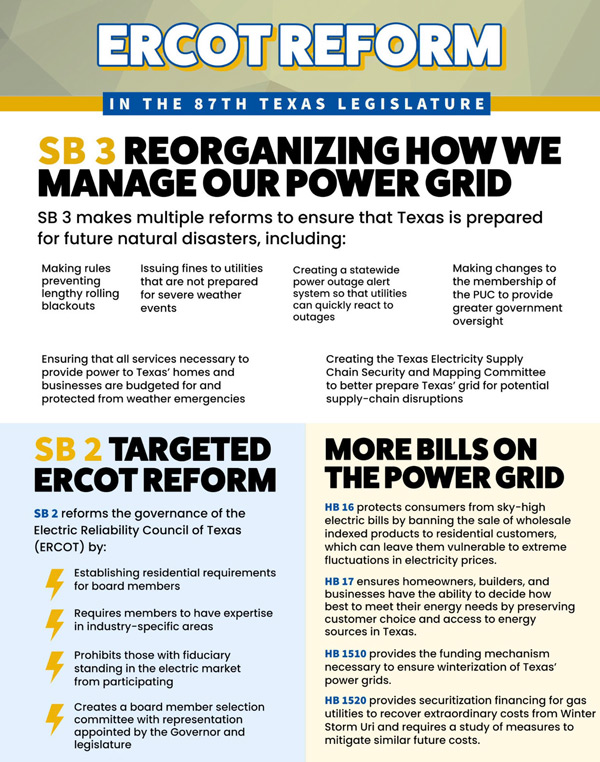
Gov. Greg Abbott's list of bills changing ERCOT and the PUC
Gov. Greg Abbott’s list of bills changing ERCOT and the PUC | Gov. Greg Abbott via Twitter

“One way to ensure ‘this never happens again’ is to redefine the organizations involved,” the R Street Institute’s Beth Garza said in an emailed statement. “After ERCOT and the PUC were ‘decapitated’ in the aftermath of the storm, they certainly have redefined both organizations.”

Garza, who directed the grid operator’s Independent Market Monitor until 2020, was referring to the mass resignations at both ERCOT and the PUC. Politicians criticized both organizations’ leadership in the aftermath of the storm, with many pointing fingers at the grid operator’s five out-of-state independent directors.

“I don’t think it matters whether anyone thinks the changes are good or bad. The important thing is the change, and that everyone in a leadership role be a Texas resident,” Garza said.

Consultant Alison Silverstein, a former adviser to Wood at both FERC and the PUC, disagreed. She said it’s a “disservice” to “disqualify” out-of-staters from serving on the board.

“Although it is superficially attractive to have only Texas residents on the ERCOT board, the power industry here is a small community, and it’s unlikely that the pool of candidates can be dispassionate, expert and unbiased on all the issues involved in running the ERCOT grid,” Silverstein told RTO Insider.

She said using a “politically slanted” selection committee  to pick the eight independent directors and the chair and vice chair— with the governor, lieutenant governor and the speaker of the House of Representatives each choosing a member — implies that new board members might have good connections and passed a political screen.

“We need board members with the best expertise, not board members with the best political answers,” Silverstein said. “A better board selection committee that seeks to raise all aspects of ERCOT’s performance should come from the full board itself, not from politicians.”

One of SB2’s requirements is that no more than two board members can be university professors. That has drawn snickers from some capitol insiders, who jokingly referred to the criteria as the Cramton Amendment in a dig at former Director Peter Cramton, professor emeritus of economics at the University of Maryland College Park. The academic was fluent in market design and frequently suggested taking ideas from other markets.

“An independent board that only has the interest of the grid and ERCOT as a whole is the right way to go,” Coleman said. “Compared to some other proposals, this was a much better approach.”

Legislators also sent several securitization measures to Gov. Greg Abbott for his signature. HB4492 would use $800 million from the state’s “rainy day” account to create a financing mechanism that funds unpaid balances in the ERCOT market. The market was still short almost $3 billion at the end of last week.

Two other bills, HB1520 and SB1580, would securitize natural gas utilities and cooperatives, respectively, for costs incurred during the winter storm. It remains to be seen whether that keeps Brazos Electric Power Cooperative, which owes the market almost $1.88 billion, out of bankruptcy.

Senate language to give ERCOT customers a one-time $350 credit on their bills failed to make any of the final bills.

Other industry legislation on its way to Abbott’s desk include:

  • SB2154, which would expand the PUC from three members to five and only require two commissioners to be “well informed and qualified in the field of public utilities and utility regulation.” The other three would need only five years of experience in business or government administration or as a practicing attorney, certified public accountant or professional engineer. Abbott is expected to move quickly to fill the bench so it can handle the work in front of it.
  • SB713, which was revised to include the PUC into the Sunset Advisory Commission’s current review cycle that determines which governmental agencies are still needed.
  • HB16, which would ban electric retailers from offering wholesale-indexed products, such as those that led to five-figure bills during the storm.


Vermont Energy Plan Update Will Shift to Strategic Narrative

Vermont energy officials will be taking the state’s comprehensive energy plan (CEP) update in a new direction this year by giving it a strategic focus.

“We’re going to look at the tradeoffs among different policies, milestones for identifying success and the need for modification,” said Ed McNamara, director of the Regulated Utility Planning Division at the Vermont Department of Public Service (DPS).

As part of the update, the department will identify uncertainties that could affect state policy success, McNamara said during the first of four CEP regional outreach sessions on June 1.

The state’s current plan, which was completed in 2016, is based on meeting a 90% renewable energy target by 2050 through 300 recommendations across the heating, transportation and electric sectors. The update will keep the 90% target while looking instead at potential market fluctuations in those sectors and how the state might need to accommodate them in the future, McNamara said.

In addition, the update will make recommendations for enhanced energy planning and climate and renewable energy pathways and recognize standards for regional energy planning that were developed after the state completed the 2016 plan.

DPS also must ensure that the update aligns with work currently underway by the Vermont Climate Council to develop the state’s first climate action plan. The 2020 Global Warming Solutions Act directs the council to complete that action plan by the end of this year. It also sets greenhouse gas reduction targets to 26% below 2005 levels by 2025 and 40% and 80% below 1990 levels by 2030 and 2050, respectively.

There is “significant overlap” between the energy and climate plans, McNamara said.

The primary responsibility of the climate plan is to identify cost-effective GHG reduction measures, going beyond energy to address other issues such as sequestration and non-energy sector emissions. The energy plan, however, will meet the state’s GHG reduction requirements “in an affordable manner while maintaining electric system reliability,” he said.

DPS expects to release a draft plan in September and publish the final plan in January. It will hold three more regional stakeholder meetings to help inform the plan.

Regional Planning

During its first outreach session, DPS heard from three regional planning commissions in southeastern Vermont about their energy plans and challenges.

All three regions have prioritized weatherization in their plans, but representatives say on-the-ground progress is not moving quickly enough.

For the Mount Ascutney Regional Commission (MARC), measuring the success of weatherization efforts is difficult.

“It’s really hard, it turns out, to quantify or to categorize what weatherization means,” Otis Munroe, MARC’s assistant planner, said. “There are a lot of DIY and incremental projects … that make it much more difficult to track where we are and what’s working and what isn’t.”

A high proportion of the region’s housing stock is old, making many homes more expensive to weatherize and heat, he said.

The Two Rivers-Ottauquechee Regional Commission (TRORC) says its data show low weatherization rates for the area.

“Our region has over 29,000 residential units, and of those, only 144 were weatherized as of 2019,” Victoria Littlefield, regional planner at TRORC, said. The progress, she added, may be underestimated because weatherization data is so hard to track, but the region is “definitely behind.”

Mount Ascutney and Two-Rivers also are struggling with residential building energy code enforcement.

“While there are residential building energy standards in practice, they are not being followed in most situations,” Geoff Martin, intermunicipal regional energy coordinator at TRORC, said. “Our towns don’t have a way of enforcing the standards.”

Building a strategy for enforcement at the state level, he said, would help increase compliance.

Local Planning

Regional planning commissions in the state also work directly with municipal energy committees to guide local planning efforts. They see a need for better state-level support at the local level.

In its outreach to the region’s towns, the Two-Rivers commission has received feedback from local officials that state data for solar and wind potential is not accurate.

“Those maps are created based on a formula that DPS came up with, but … the formula uses state data layers that aren’t updated as often, so it’s not quite reflective of what’s happening on the ground,” Littlefield said. She recommended that the state consider updating those layers so towns can have a “better picture” for siting renewable generation.

And the Windham Regional Commission has found that local energy committees could use some funding.

“Our rural communities are often reliant on volunteers for energy committees, and they have little time [or expertise] to … achieve their energy reduction goals,” Margo Ghia, regional planner of the commission, said.

Funding for local-level energy planners, educational opportunities and access to better data would go a long way in helping committees in their work, she said.

Drivers, Stakeholders Question NJ’s Proposed EV Incentive Rules

Proposed rule changes in a New Jersey Board of Public Utilities (BPU) program that awards incentives of up to $5,000 for an electric vehicle purchase triggered stakeholder questions at a public hearing May 27 about the goals of the program, who will benefit and whether it is big enough to meet the state’s ambitious fleet goals.

The board’s suggestion that the full $5,000 incentive be awarded to vehicles only with a manufacturer’s suggested retail price (MSRP) of below $45,000 prompted speakers at the hearing, which focused on proposed rule changes for the program, to question what the BPU is trying to achieve. The proposal would cap the incentive for EVs priced $45,000 or more at $2,000.

The straw proposal, released on May 18, outlines the rules for the award of grants totaling $30 million in the second year of the Charge Up New Jersey Program as the state tries to reach the legislature’s goal of putting 330,000 EVs on the road by 2025. The program aims to close the gap between the cost of a gas vehicle and the higher priced EV by offering an incentive to the vehicle purchaser equal to $25 for each mile the EV can travel powered solely by electricity.

The first year of the program, which ended in December, provided incentives for the purchase of about 7,000 vehicles, about 83% of which were Teslas. About 93% of the awards were for the maximum $5,000 grant.

But in an effort to award incentives to “incentive essential” customers — those who will buy only if there is an incentive, rather than those who would buy anyway — the BPU has suggested that the second year include the $2,000 “soft cap.” The change, the proposal said, would “keep the funding available longer and prevent vehicles with a higher MSRP from garnering a larger-than-necessary incentive.”

Several speakers said there were hardly any vehicles in that lower price band, and the number is declining as vehicle prices have risen in recent months, in part because of the shortage of computer chips. Only one of Tesla’s four models, the Model 3, is priced below $45,000.

“We have to ask ourselves about this program: What does New Jersey want?” said one speaker, whose lease on his EV just expired and who said he is looking to the incentive program to help buy another. He suggested the BPU raise the soft-cap threshold to $60,000.

“Does New Jersey want low-income families to have access? Or have everyone have access to these funds?” he said in the hearing. “Are we deciding that we want to give the ability for people to get into a Nissan Leaf that’s been out forever and hasn’t had many technological advances? Or are we wanting people to just get into an electric vehicle of some sort, because that is what’s better for the environment?”

Incentive Distribution in NJ

Outlining the rule proposals, Cathleen Lewis, the BPU’s e-Mobility program manager, said that the three counties in the state in which consumers received the most incentives — Bergen, Middlesex and Monmouth — were not only the largest but had “higher income levels.”

“By creating a soft cap, we are continuing to incentivize the same suite of EV vehicles but are focusing funding on vehicles more accessible to middle-income families,” she said.

A graphic displayed by Lewis showed that Tesla’s Model Y, which starts at $60,990, accounted for 44% of the incentives awarded, and the Tesla Model 3, which starts at $39,990, accounted for 39%. Third placed was the Chevrolet Bolt, with 6% of the incentives and a starting price of $36,500.

One reason for the shortfall in non-Tesla vehicles was the limited number of models on offer in the state, the BPU’s proposal says. The program rules don’t allow New Jersey residents to receive the incentive if they buy the vehicle outside the state.

Kathy Harris, clean vehicles and fuels advocate for the Natural Resources Defense Council, told the BPU that it should consider allowing consumers to buy EVs outside the state with the incentive.

“The goal of the rebate program is to reduce greenhouse gas emissions from New Jersey’s air,” she said. “Electric vehicles on the road will improve air quality and mitigate the effects of climate change. Therefore, so long as the electric vehicle is registered and driven in New Jersey, it shouldn’t matter where or how the vehicle was purchased.”

She added that the organization would like to see the BPU adjust the program to enable more members of the low- and moderate-income sectors to participate. That could include allowing buyers of used vehicles to get the rebate and providing an additional rebate for low- and moderate-income buyers.

Proposed Changes

The BPU’s suggested rule changes for the program’s second year also include switching the incentive structure for plug-in hybrid electric vehicles (PHEVs) from $25/mile to a flat incentive. PHEVs, which are seen by the BPU as bridge vehicles to help consumers move from gas-powered vehicles to EVs, made up only 4% of the incentive awards in year 1. The average incentive was just $625 in the first year, according to the proposal, which did not suggest a figure for the flat incentive.

In addition, the approval process for incentives would be streamlined to provide rebates at the point of sale instead of the EV buyer applying for the incentive as a rebate after the purchase of the car, as is currently the case.

A third phase of the program, to run concurrently with the second, would add an incentive for EV owners to install a “smart charger” that can collect and transmit operating data to be used to analyze consumer behavior. The incentive would pay half the cost of the charger, to a maximum of $250.

The first phase of the program ran from January to December 2020, and the second year will begin over the summer, although the BPU has yet to announce the exact date.

The Best Way to Incentivize

The reduced incentives drew the most attention in the public hearing. One speaker said he could find only nine EVs priced below $45,000, and they are all basic entry-level models. In addition, he said, dealers would likely stock cars with options, rather than the basic models, and the extras would likely push the cost of the EV above the threshold to receive the full incentive, he said.

“My point is that the rebate levels I think are going to drive people to potentially be in cars that they don’t necessarily want to get, but [they] want to capitalize on the rebate,” he said. “I think the incentive cap should be raised,” suggesting $60,000.

Stanislav Jaracz, president of the Central Jersey Electric Auto Association, said that EV sales in 2020, which likely were affected by the COVID-19 pandemic, were only a little above those of 2018. He noted that the state has a long way to go from the estimated 41,096 EVs in 2020 to the goal of 330,000 in 2025.

“So my suggestion is to scatter the rebate in a different way,” he said, advocating a cut in the incentive to $4,000 for vehicles priced up to $40,000 and $2,000 for those $40,000 to $50,000. That way, he said, “we can purchase as many vehicles as possible, without running out of the budget.”

Zachary Kahn, senior policy adviser for Tesla in the Northeast, said the company has “concerns” about the addition of the soft cap, in part because it complicates the incentive program. He said that research has shown that range — how far a vehicle can go on a single charge — is the most important factor to buyers, with at least 300 miles being generally desired.

“There are currently no 300-mile range cars on the market under the $45,000 MSRP cap,” he said. “So none of the cars that most people are interested in, in giving them the confidence that they can move to EVs, would actually be available.”

The Nissan Leaf, priced at $31,670, has a range of 226 miles. The Tesla Model 3, with a $39,990 price tag, does 263 miles.

Jim Appleton, president of the New Jersey Coalition of Automotive Retailers, a trade association that represents about 500 car and truck dealers, said the BPU has not released enough data for it to assess the merits of the soft cap.

“[We] certainly support the goal there, which is to ensure that more money goes to people who really are going to use that money and need that money to make the decision,” he said.

He added that the incentives would have more impact if they were frontloaded, with most of them awarded in the first five years of the program, rather than spreading them evenly over 10 years.

Clean Energy Wins, Fossil Fuels Lose in Biden Budget

The U.S. could save $35 billion by 2031 by immediately eliminating fossil fuel tax preferences, according to a line item in President Biden’s 2022 budget. If Biden can get it through Congress — a very big “if” — the budget would also extend through 2031 the federal production tax credit, a major incentive for wind development, at a projected cost of $38.6 billion.

Released on May 28, the $6 trillion budget puts solid numbers on the programs Biden has been promoting as part of his climate agenda and infrastructure package, with estimates of future spending through 2031. For example, the $2 trillion American Jobs Plan calls for the creation of “a targeted investment tax credit” (ITC) to spur the buildout of high-voltage transmission lines with a capacity of up to 20 GW. In the budget, that credit gets a modest $187 million in 2022, growing, with the expansion of the grid, to $3.4 billion in 2031.

Critical hits for the oil and gas industry include repeals of intangible drilling costs (a loss of $2.2 billion in 2022), capital gains treatment for royalties ($46 million), and expensing for exploration and development costs ($190 million).

Wins for renewables include a modified ITC that would be extended through 2031, starting with an estimated cost of $1.4 billion in 2022 and rising to $35.5 billion by 2027, reflecting an accelerated ramp-up in the industry to meet Biden’s goal for decarbonizing the grid by 2035. Other line items include $1 billion in support for community solar and storage through 2026, and $10 billion each through 2026 to support electric cooperatives’ adoption of clean energy and employment of electrical workers for upgrading the grid.

The Department of Energy issued its own breakdown of its $46.2 billion budget for 2022, including $4.7 billion for the Office of Energy Efficiency and Renewable Energy, a 65% increase over 2021. A new Office of Clean Energy Demonstrations is funded at $400 million “to keep bringing innovative technologies to market.”

Party-line Split

At the same time, the budget shows Biden trying to perhaps offset the repeal of fossil fuel subsidies with funding for the low- and no-carbon technologies now gaining support in the coal, oil and gas industries. Existing nuclear plants are slated for $750 million in credits in 2022 to help them stay in operation, with that figure rising to $1 billion per year through 2031. Federal procurement of advanced nuclear energy will get $5 billion over the next decade. Investment in hydrogen and carbon capture and sequestration will total $7.9 billion through 2026.

Brad Crabtree, director of the Carbon Capture Coalition, praised Biden’s “commitment to carbon management as a key component of a national strategy to reach net-zero emissions.” The budget underlines the “bipartisan common ground and growing support for a broader and more complete portfolio of federal carbon-capture policies that are essential to meeting midcentury climate goals, while preserving and growing America’s high-wage jobs base in energy, industry and manufacturing,” he said in a statement.

Judi Greenwald, executive director of the Nuclear Innovation Alliance, said the budget was “a good first step” toward adequate funding to support the development and commercialization of advanced nuclear technologies.

Still, congressional response to the energy spending in the budget split predictably along party lines.

Rep. Frank Pallone (D-N.J.), chair of the House Energy and Commerce Committee, said he was “delighted [with] President Biden’s plan … for transformative funding and a national clean electricity standard that will help us move toward a clean economy. This budget recognizes the climate crisis for what it is: not just a challenge, but also an opportunity to rebuild our country from the devastation of the COVID-19 pandemic.”

Rep. Cathy McMorris Rodgers (R-Wash.), the committee’s ranking member, took to Twitter, calling the budget “a radical agenda for the government to take over our lives. … Green New Deal-style policies will crush American jobs, energy reliability and our security.”

A Carbon Tax Alternative

Transportation electrification is another budget winner. With the auto industry now actively engaged in the transition to electric vehicles, Biden wants to spend $137.4 billion over the next decade to support widespread adoption, along with a $20 billion investment in electric buses. Another $3 billion through 2026 is budgeted to electrify the federal vehicle fleet and support the necessary charging infrastructure.

Other funding through 2026 includes:

  • $704 million to increase the use of net-zero technologies in agriculture;
  • $566 million in support for economic development in Appalachian communities;
  • $1.3 billion to increase a tax credit for new energy-efficient homes; and
  • the creation of new tax incentives and credits for heavy- and medium-duty zero-emission vehicles ($5.3 billion), sustainable aviation fuels ($3.5 billion) and low-carbon hydrogen ($1.1 billion).

“Today’s budget request from the Biden administration provides a detailed roadmap of the programs and federal investments necessary to support the renewable energy industry’s drive to decarbonize the power sector by 2035,” American Council on Renewable Energy CEO Gregory Wetstone said in a statement. “The budget’s forward-looking investment in electric grid expansion and modernization will unlock renewable resources, enhance our national security, and increase reliability for consumers and businesses.”

Heather Zichal, CEO of the American Clean Power Association, said the budget’s “funding levels for wind, solar and energy storage research and development will be crucial in keeping our country on the cutting edge of clean energy technology. … Alongside clean energy itself, this budget rightly acknowledges the importance of transmission infrastructure investments in facilitating the transition to a cleaner, more affordable American electric system.”

Given the current, stalled state of negotiations over Biden’s infrastructure package — with Republicans pushing a $928 billion alternative focused primarily on “hard” infrastructure like roads, bridges and water systems — the budget will likely face a similar, significantly slimmed-down GOP counter proposal. And the oil and gas industry will line up against any repeal of its subsidies.

Some Republicans could be exploring a carbon tax as an alternative to a repeal of oil and gas subsidies. McMorris and Sen. John Barrasso (R-Wyo.), ranking member on the Senate Energy and Natural Resources Committee, released a joint letter to the Energy Information Administration on June 1 requesting an analysis of Biden’s commitment to cutting U.S. emissions by 50 to 52% by 2030 and to net-zero by 2050.

The letter specifically asks EIA to include “future forecasts and run side cases using increasing carbon fees sufficient to meet these emissions targets. … Such an analysis could serve as an important starting point and baseline for further analyses as the Biden administration and Congress consider various proposals.”

Puget Sound Energy Contracts for 350 MW of MT Wind

Puget Sound Energy signed an agreement with a proposed Montana wind power project to obtain 350 MW of wind energy, the Seattle-area utility announced Wednesday.

Bellevue, Wash.-based PSE provides electricity to roughly 1.1 million people in eight counties surrounding Puget Sound. The 350 MW would supply power for about 140,000 households.

PSE signed the 20-year agreement with NextEra Energy Resources’ Clearwater Wind Project about 60 miles north of Colstrip, Mont. The 750-MW project will be the state’s largest, covering southeastern Montana’s Rosebud, Garfield and Custer counties and is expected to go online in late 2022.

“We are excited to partner with NextEra Energy Resources, which will move us toward achieving our goal of reducing our own carbon emissions to net zero by 2045,” Ron Roberts, PSE vice president of energy supply, said in a statement. “… We’ve been saying Montana has great wind resources and this agreement demonstrates PSE’s continued investment in Montana’s energy economy.”

“This is an important step forward in diversifying our regional economy, creating new jobs and bolstering local tax revenues for our schools, roads and county services,” said Bob Lee, Rosebud County commissioner. The project is expected to create 350 construction jobs and up to 20 permanent jobs.

Located in Rosebud County, Colstrip is home to a 1,480-MW coal-fired power plant co-owned by PSE, Portland General Electric, PacifiCorp, NorthWestern Energy and Talen Energy. Washington was Colstrip’s biggest power customer, but a 2019 law requires the state to stop using coal-fired power by 2025. Consequently, PSE caused two of the four Colstrip power units to close in 2020 while the other two units are slated for closure in 2025. The Clearwater Project will use the same transmission lines that stretch from Colstrip to Washington.

Montana has two other wind turbine sites in play.

Portland-based PacifiCorp’s Pryor Mountain Wind Farm recently went online in southeastern Montana with a 240-MW capacity to serve 76,000 homes.

In late 2020, Houston-based Broad Reach Power bought two local wind and solar power projects based in Billings, Mont. One is a 250-MW project expected to be completed in 2022. The 250-MW solar farm is expected to go online in 2023.

Students ‘Double Down’ on Efficiency with Wind Turbine Prototype

Judging began in the U.S. Department of Energy’s Collegiate Wind Competition on Wednesday with virtual team presentations.

Students from Johns Hopkins University (JHU) launched the competition with a look at their search for wind turbine efficiency via a counter-rotating dual-rotor design. They entered the design in the Turbine Prototype contest, which includes an optional testing phase that is not part of judging.

“This turbine design combines two separate turbine rotors to harvest energy from the weight of the rotors,” JHU team member Annika Torp said. Theoretically, the dual rotors can be 25% more efficient than a comparable single-axis wind turbine, and the team set out to see if they could achieve that result.

Doing so meant bringing the team together virtually in the early part of the pandemic for the design phase, and building a prototype when students were allowed to work in person again.

“All of our validation testing was performed in our one-meter wind tunnel on campus and in a benchtop setting for electronics,” Torp said. “Basically, what we found in testing was similar to what we had predicted [for efficiency].”

Last year, students were asked to “research, design and build a turbine for deployment in highly uncertain times, with a great degree of unknown risk and delays.”

“The 2021 competition embodied this challenge, as the teams adapted to the uncertainties and the hurdles of attending school and preparing for competition during the pandemic,” DOE Acting Assistant Secretary Kelly Speakes-Backman said at the start of judging.

Thirteen teams are competing in three contests and vying for first, second and third place overall. In addition to the Turbine Prototype contest, the competition includes Project Development for a 100-MW wind farm and Connection Creation, which is new this year.

Connection Creation called for teams to conduct outreach and build connections with wind industry members as well as local communities and media.

Judging continues through next week and culminates in an awards ceremony on June 11.

Team NAU

Students from Northern Arizona University (NAU) kicked off presentations on Wednesday in the Project Development and Connection Creation contests.Northern Arizona University Collegiate Wind Competition team member Aaron Zeek participated in a KidWind challenge as part of the competition’s Connection Creation contest. | U.S. Department of Energy Collegiate Wind Competition

The team developed a wind farm site plan in South Dakota with 70 wind turbines on property that contains an existing 230-kV transmission. They chose the Siemens-Gamesa 5.8-155 (6.6 MW) wind turbine from a manufacturing facility in a neighboring state.

“We chose this turbine because its high hub heights will capture higher wind speeds, and the higher capacity size of the turbine was chosen to produce high amounts of power, while needing less turbine sites and reducing overall project costs,” NAU team member Natalie McDonald said.

They were able to model the project with an installed capacity of 98.6 MW and capacity factor of 42% generating 368 GWh of energy annually. In addition, the team determined that the project would be economically viable based on a levelized cost of energy of $0.057/kWh and a levelized power purchase agreement price of $0.06/kWh.

As part of the NAU team’s submission for the Connection Creation contest, they developed an outreach plan that included supporting the Arizona KidWind Challenge and working with Willow Bend, a local environmental education center.

“The Arizona KidWind Challenge is a micro-scale wind turbine competition for kids … that is very similar to the [Collegiate Wind Competition] but is less competition-based and more for the sake of learning hands-on how the turbines work and how you can make them more efficient,” NAU team member Aaron Zeek said.

To accommodate social distancing guidelines, the team created instructional videos for the KidWind Challenge, with the help of Willow Bend, instead of providing in-classroom instruction. One of the videos showed kids how to maximize the power of a wind turbine through blade design.

At the end of the challenge, the team contributed to judging.

“It was amazing to see what the students created,” McDonald said. “The winning teams will be moving forward to compete in the National KidWind Challenge.”

Competition Teams

Collegiate team presentations will continue June 7, 8 and 10.

The 13 participating teams are:

  • Brigham Young University
  • California State University Maritime Academy
  • California Polytechnic State University
  • Johns Hopkins University
  • James Madison University
  • Kansas State University
  • Northern Arizona University
  • Pennsylvania State University
  • Texas Tech University
  • University of Maryland
  • University of Wisconsin-Madison
  • Virginia Tech University
  • Washington State University-Everett

Learn-along teams are a new feature of the competition this year. They submit projects and receive feedback but are not eligible for awards. The two learn-along teams are University of Colorado Boulder and University of Wyoming.

ERCOT Moves Quickly to Address Monitor’s Recommendations

ERCOT’s Independent Market Monitor last week released its annual State of the Market report for 2020, finding that the wholesale market performed competitively in 2020 but that February’s arctic weather event necessitated raising “initial issues” that need to be addressed.

ERCOT’s IMM has released its 2020 State of the Market report. | Potomac Economics

The Monitor offered two recommendations to address design flaws that “resulted in costly and inefficient pricing” during and after the winter storm. It promised a full analysis of the storm’s effects for next year but suggested that regulators and market participants “consider corrective actions soon.”

It also advocated that “urgent attention” be paid to including firm load shed in the reliability adder’s calculation and capping ancillary services prices in the day-ahead market.

ERCOT staff wasted no time in responding to the Monitor’s call. Kenan Ögelman, the grid operator’s vice president of commercial operations, told the Public Utility Commission on Thursday that it is ready to file and co-sponsor with the Monitor two protocol changes incorporating the recommendations.

Ögelman said both changes could be implemented before the Texas summer heats up in July and into August. He assured the commission that both software changes would be stress tested.

The Monitor said real-time energy prices should reflect that firm load shed is an out-of-market action with a cost equal to the value of lost load (VOLL). Usually, that’s equal to the systemwide high offer cap of $9,000/MWh. It noted that because one additional megawatt of energy during those conditions allows ERCOT to serve an additional megawatt of load, energy’s value must equal the VOLL.

“Efficient pricing during these extreme shortages is essential in an energy-only market because it provides necessary economic signals to increase the electric generation needed to restore the load in the short term and service it reliably over the long term,” the Monitor said in the report.

During the February storm, firm load shed was initially excluded from the reliability adder, the Monitor said, causing prices to settle well below the cap. The PUC issued an emergency order to address the problem, but the Monitor said ERCOT later in the week included other load not yet restored to the reliability adder’s calculation, even though it was not subject to a load-shed instruction.

The result was 32 hours of prices clearing at $9,000/MWh in what the Monitor called “billing errors.” The PUC declined to reprice the $16 billion in market transactions, despite political pushback. (See Texas PUC Won’t Reprice $16B Error.)

The Monitor is also recommending ERCOT use a penalty price for ancillary services (AS) that is equal to or less than the VOLL and by capping AS clearing prices for capacity at the VOLL. Day-ahead prices for the services were as high as $26,000/MWh during the week of the storm and were regularly priced between $16,000 and $17,000, Ögelman told the PUC.

“Ancillary service prices more than VOLL violate fundamental economic principles and generate inefficient market outcomes,” the Monitor said. “Since reserves are procured to reduce the probability of losing load, the value of reserves should not exceed the cost of actually losing load (the VOLL).”

The Monitor said this would prevent future “irrational ancillary services” until 2025, when real-time co-optimization (RTC) is scheduled to be added to the market. ERCOT has projected it will cost as much as $55 million to add the RTC tool, which procures both energy and ancillary services every five minutes.

RTC’s implementation has been delayed by staffing constraints as ERCOT continues to address the storm’s effects on the system. The Monitor said the tool “promises to significantly lower costs and improve pricing during supply shortages.” (See “Passport Pushed Back 18 Months,” ERCOT Technical Advisory Committee Briefs: April 28, 2021.)

Average energy prices dropped 45% to $25.73/MWh in 2020, mostly because of a nearly 20% decrease in natural gas prices, the Monitor said. Real-time congestion costs were up 11% to $1.4 billion, mostly because of additional renewable resources causing stability issues. It said offer-price caps in smaller areas of the system with transmission limitations helped prevent market power abuses in the wholesale market.

The ERCOT region added more than 7 GW of new wind and solar resources and about 400 MW of natural gas supply in 2020. At the same time, the Monitor said about 1 GW of fossil resources retired in 2020.

The report makes three other recommendations to improve market performance:

  • re-evaluate and redetermine the four competitive load zones every four years based on prevailing congestion patterns;
  • apply a small bid fee to point-to-point (PTP) obligations that would be consistent with cost-causation principles and would incent participants to submit smaller bid quantities that are move valuable and likely to clear than no-charge PTP bids; and
  • remove fixed-cost multipliers to ensure only marginal costs are included in mitigated offer caps.

It also keeps two recommendations from prior years:

  • modify the allocation of transmission costs by transitioning away from the four-coincident-peak method so that the resulting incentive better reflects the true drivers for new transmission; and
  • price ancillary services based on the shadow price of procuring each service.

The report, the first conducted entirely under new Director Carrie Bivens, retired six recommendations dating back to her predecessor’s tenure.

CIP Panelists Share Communication Security Fears

At the Texas Reliability Entity’s CIP Workshop on Thursday, participants from across the ERO Enterprise shared the challenges they’ve encountered with keeping their physical and electronic systems secure in the face of a rapidly growing threat landscape.

The day’s presentations focused on the requirements of NERC’s Critical Infrastructure Protection (CIP) standards, but presenters emphasized that safety depends on more than cleaving to the letter of the regulations.

“Something we all need to remember is that compliance doesn’t equal security, but compliance plus security helps mitigate those threats, those vulnerabilities, those risks that are out there,” Kenath Carver, Texas RE’s manager of CIP compliance monitoring, said in the day’s first panel on supply chain risk management.

Software Supply Chain Hacks to Continue

Many panelists touched on the compromise of the SolarWinds Orion network management platform that was discovered last year. More than 18,000 public- and private-sector organizations, including the Department of Energy and FERC, are known to have been impacted by the breach, which security officials have attributed to Russian hackers. Joseph McClelland, director of FERC’s Office of Energy Infrastructure Security, said earlier this year that large-scale replacement of affected systems “may be the only option” for some users. (See SolarWinds Recovery May Require Extreme Actions.)

Software supply chain vulnerabilities don’t only manifest through business management technology: Collaboration software like Slack and Microsoft Teams are another potential avenue for hackers to gain entry to corporate networks, particularly given the rise in working from home because of the COVID-19 pandemic. Even for a platform that has not been compromised, the surge in users gives hackers myriad new vectors to gain entry.

“In the world that we live in right now, which is way more remote than ever before, these technologies are becoming more and more sophisticated, and are also being developed in a more and more rapid fashion,” Brian Allen, a senior cybersecurity specialist at Georgia System Operations, told the first panel. “So you want to ensure that you fully understand the capabilities of these technologies and not simply go based off what you can see, but what could also be done behind the scenes.”

Bill Peterson, manager of training and outreach at SERC Reliability, acknowledged that web conferencing platforms have been a boon for remote workers but advised organizations to limit their impact on vital systems as much as possible. This means restricting interactivity so that users can view others’ systems but not change them, and even thinking proactively about how much vital information is visible to other users. After all, he said, if one coworker could take a screenshot of another’s screen, potentially any hacker who is surreptitiously watching their interaction could do the same.

Analog Communications also Vulnerable

Participants also reminded listeners that communication does not always mean digital interaction. In a panel focused on CIP-012-1 (Communications between control centers), NERC Senior CIP Assurance Adviser Jeremy Withers observed that old-fashioned phone calls between different entities or even within one entity’s business domain are vulnerable to interception too. Even voice communications within control centers can’t always be considered secure.

“Think about some scenarios where control centers are located in buildings that they don’t necessarily own … and they have other occupants. There may be some high-traffic areas in those buildings near the control centers,” Withers said. “And the entities may want to do … a walk close to the perimeters, to make sure that all communications aren’t heard outside of [them]. If they do find issues, maybe look at [mitigations] such as white noise machines … or other soundproof technologies.”

Jess Syring, CIP compliance monitoring manager for the Midwest Reliability Organization, added that entities should not expect to be able to use a one-size-fits-all playbook to satisfy CIP auditors.

“Some examples of the questions that we’re going to ask are: What part of the transmission between the applicable control centers is the encryption applied to? What is the demarcation point where the encryption is controlled? What is the method and level of encryption — is it an outdated encryption standard?” Syring said. “All of these are questions that I would say [are] going to be the first line to start additional conversations … to ensuring that there [are] appropriate protections around those communications.”

ERCOT, PUC Deal with ‘Trauma’ of February Storm

Communications staff from ERCOT and the Public Utility Commission told commissioners Thursday that they are working together to improve their practices and messages after February’s near collapse of the grid led to long-term outages, hundreds of deaths and billions of dollars in damages.

“We realized we are dealing with a statewide populace that has been badly traumatized by the events of February,” Andrew Barlow, the PUC’s director of external affairs, said during the commission’s open meeting Thursday.

He told commissioners that while social media are positive channels, the legacy print and broadcast media are “the best [way] to deliver information to the people of Texas.” Barlow said communications staffers will engage directly with the “critical reporters” in the state’s key markets to ensure they’re up to speed with the language and protocols during any severe events this summer and into the future.

“We’re making sure … they’re fully informed and fully connected so they can communicate with their audiences,” Barlow said.

ERCOT was pilloried for its use of social media in the runup to the February winter storm. Informal Twitter messages and the use of industry jargon did not adequately prepare Texans for the possibility of power outages, critics said.

The grid operator has since brought on Chris Schein, a 20-year veteran of Texas’ electric industry, as its interim communications leader.

“It’s been my job to communicate clearly and concisely,” said Schein, who will mark his 30th day on the job Monday. “One of the things that we heard from February is that ERCOT needs to communicate more clearly, and so we’re implementing the practices and policies to do that.”

“After talking with the policymakers, it appears you guys are on the right track,” Commissioner Will McAdams said. “People are now familiar with ERCOT and the Public Utility Commission. We need to promulgate as many educational products as we can.”

Before the meeting, McAdams filed a memo saying he would recommend ending a storm-based disconnection moratorium during the PUC’s June 11 open meeting. His memo was supported by retail providers and several other companies (51812).

Thursday’s meeting was designed as a work session to discuss addressing the various energy-related bills that have come out of the Texas Legislature.

“At the very least, these interim workshop open meetings will provide a way to work through the actual details before the decision points come up,” McAdams said.

Capacity Prices Drop Sharply in PJM Auction

Capacity prices in PJM fell sharply for delivery year 2022/23, the RTO announced Wednesday, with rest-of-RTO prices dropping by nearly two-thirds to $50/MW-day and prices in the Eastern and Southwest Mid-Atlantic Area Council (MAAC) regions falling to their lowest on record.

Nuclear generators, natural gas, renewables and energy efficiency increased their market share, while coal saw its contribution shrink.

Overall, the Base Residual Auction, held May 19 to 25, cleared 144,477 MW of resources for the June 1, 2022, through May 31, 2023, delivery year, at a cost of $3.9 billion. That is $4.4 billion less than the 2018 auction for 2021/22, after adjustments for an increase in those choosing to skip the auction by using the fixed resource requirement (FRR). The auction gives PJM a 19.9% reserve margin, above the 14.5% requirement, including load and resource commitments under FRR.

Prices in five areas — ComEd ($68.96), Duke Energy Ohio and Duke Energy Kentucky ($71.69), MAAC ($95.79), Eastern MAAC ($97.86) and Baltimore Gas and Electric (BGE) ($126.50) — cleared above the overall PJM price.

The MAAC region comprises Atlantic City Electric, BGE, Delmarva Power, Jersey Central Power & Light, Met-Ed, PECO Energy, Penelec, Pepco, PPL, Public Service Electric and Gas, PPL and Rockland Electric. The Eastern MAAC region is Atlantic City Electric, Delmarva, JCP&L, PECO, PSE&G and Rockland Electric.

The 2021 results continued the historical year-to-year price volatility. Prices in most of the RTO had cleared at $140/MW-day in 2018, an 83% increase from the year before. (See Capacity Prices Jump in Most of PJM.)

Load Forecast, CONE, Tx Capacity Cited

Stu Bresler, PJM’s senior vice president of market services, said the drop resulted from a lower load forecast, a reduction in the net cost of new entry (CONE), increased transmission capacity into constrained locational deliverability areas (LDAs) and lower offer prices.

PJM said net CONE was down 19% for the RTO and 28% in the ComEd LDA. Net CONE “anchors the demand curve,” he said. The lower load forecast and the increased transmission capacity in LDAs shifted the demand curve to the left.

BRA clearing prices ($/MW-day)
BRA clearing prices ($/MW-day) | © RTO Insider LLC using PJM data

“If you combine a shift down and to the left of the demand curve and a downward shift in the supply curve, those two conditions together will result in lower prices,” he said.

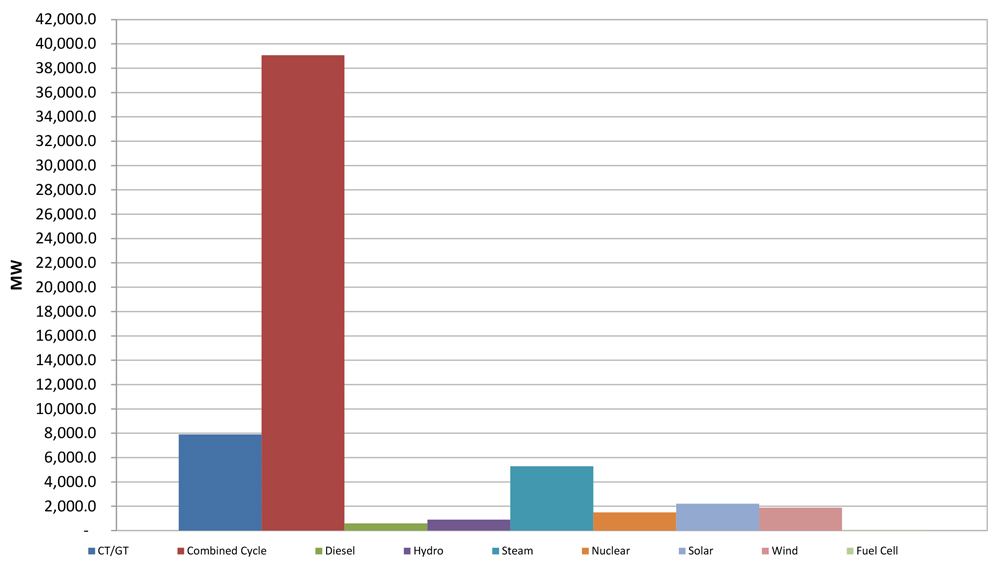
Wind resources cleared 1,728 MW (an increase of 312 MW over 2018) while solar cleared 1,512 MW (+942 MW), increasing the RTO’s total nameplate capacity for those resources to 11,761 MW.

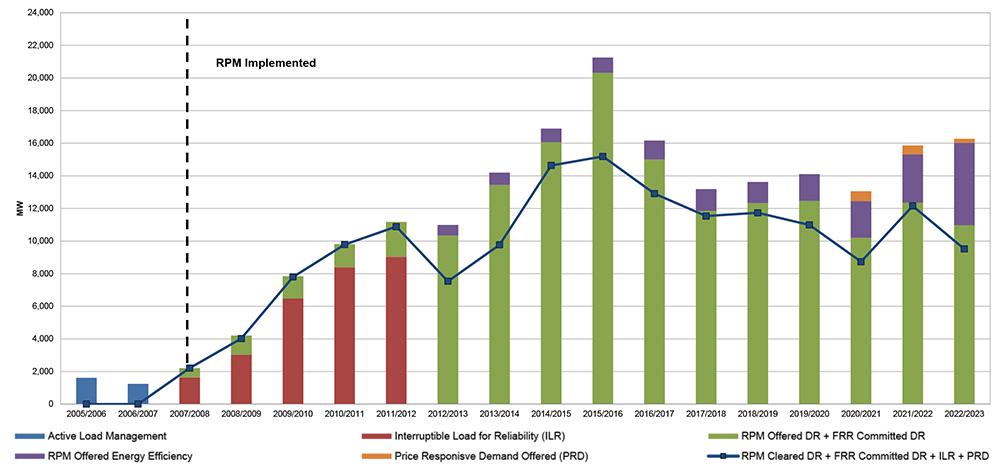
Energy efficiency rose by 1,979 MW (70%), while demand response declined 2,314 MW (-21%) to 8,812 MW.

Bresler said the drop in DR may have been caused in part by the one-year gap between the BRA and the delivery year, rather than the normal three-year forward period. “It seems to have been a trend in the past for demand response providers to … offer demand response on the basis of an ability to sign customers up between when the auction clears and the delivery year starts. So part of the effect here could be due to the fact that we are so much closer to the start of the actual delivery year, which limited the opportunity to adjust the portfolio through the incremental auctions.”

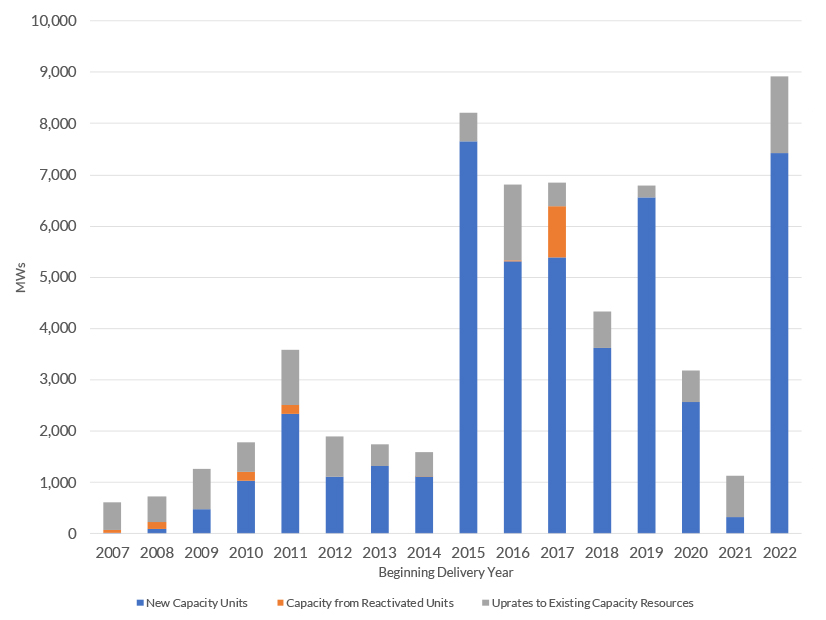
New capacity offered by year
New capacity offered by year | © RTO Insider LLC using PJM data

Combined-cycle gas plants added 3,414 MW and nuclear increased by 4,460 MW, adjusted for FRR elections. Cleared coal generation dropped by 8,175 MW, adjusted for coal units committed to FRR plans.

Dominion Energy Virginia chose the FRR option beginning with this year’s BRA over concerns an expanded minimum offer price rule (MOPR) would undermine its ability to meet Virginia’s renewable energy targets. The utility’s FRR election covered more than 60 generating units totaling more than 18.1 GW, including its 1.7-GW Surry nuclear power plant. All told, 175 generating units chose the FRR for this BRA, the second highest on record and more than double the 85 units that chose the FRR option for 2021/22. (See Dominion Opts out of PJM Capacity Auction.)

MOPR Impact

The 2022/23 auction, originally scheduled for 2019, was canceled by FERC after the commission ordered the RTO to expand its MOPR to state-subsidized resources. (See FERC Halts PJM Capacity Auction.) PJM will hold its next BRA, for 2023/24, in December.

Bresler said the impact of the expanded MOPR appeared to be modest.

“I can tell you there were some resources that were subject to the MOPR that did not clear in the auction. It’s very difficult to say whether or not they would have cleared but for the MOPR because we don’t know what they would have offered in the auction,” he said. “It’s hard for us to know some of these causes because we don’t have a whole lot of insight into the market sellers’ offer behavior.”

Demand side participation in capacity market
Demand side participation in capacity market | PJM

“However, when you look at the pricing results from this auction, together with the fact that there were significant increases in wind and solar and committed nuclear resources, it’s hard to see how the MOPR had any significant or large impact on this auction. That’s really what we expected.”

The expanded MOPR was ordered by FERC in December 2019 under then-Chair Neil Chatterjee, a Republican. But at a FERC technical conference in March, new FERC Chair Richard Glick, a Democrat, and PJM CEO Manu Asthana both said the MOPR is not “sustainable” because it is frustrating state decarbonization efforts.

In April, PJM proposed FERC take responsibility for determining what resources are subject to MOPR, rather than having the RTO and the Independent Market Monitor make such decisions. (See PJM Proposes Shifting MOPR Determinations to FERC.)

P3 Protests PJM MOPR Plan

On June 1, the PJM Power Providers Group (P3), which represents owners of 67 GW of capacity, wrote a letter to the RTO’s Board of Managers lambasting PJM’s position.

“While P3 generally would not offer a letter to the PJM board about a stakeholder matter that is still being actively discussed in the stakeholder meetings, the PJM-proposed revisions to the minimum offer price rule (MOPR) are so ill-conceived and completely incompatible with FERC’s authority and PJM’s mission that our organization feels compelled to bring certain matters to the board’s attention at this time,” P3 wrote.

Cumulative generator capacity additions
Cumulative generator capacity additions | PJM

It called PJM’s proposal “legally flawed” and “a dramatic departure from many of its foundational principles.

“PJM’s proposal starts with the unsupported premise that PJM can take no action to preserve a competitive market outcome if that action could be viewed as interfering with a state policy. From there, PJM’s current proposal puts forth a complete retreat from the notion of a competitive capacity market and instead sets up a market design that will allow subsidies rather than market signals to dictate market exit and entry.

“P3 is increasingly questioning whether PJM continues to believe in the promise of markets or if other priorities have supplanted this historical priority of the organization,” it added, urging the board to “communicate clearly to PJM management that the organization remains committed to markets and expects to review a MOPR-related proposal that is consistent with PJM’s historical commitment to competitive capacity markets.”