ERCOT Moves Quickly to Address Monitor’s Recommendations

ERCOT’s Independent Market Monitor last week released its annual State of the Market report for 2020, finding that the wholesale market performed competitively in 2020 but that February’s arctic weather event necessitated raising “initial issues” that need to be addressed.
ERCOT’s IMM has released its 2020 State of the Market report. | Potomac Economics

The Monitor offered two recommendations to address design flaws that “resulted in costly and inefficient pricing” during and after the winter storm. It promised a full analysis of the storm’s effects for next year but suggested that regulators and market participants “consider corrective actions soon.”

It also advocated that “urgent attention” be paid to including firm load shed in the reliability adder’s calculation and capping ancillary services prices in the day-ahead market.

ERCOT staff wasted no time in responding to the Monitor’s call. Kenan Ögelman, the grid operator’s vice president of commercial operations, told the Public Utility Commission on Thursday that it is ready to file and co-sponsor with the Monitor two protocol changes incorporating the recommendations.

Ögelman said both changes could be implemented before the Texas summer heats up in July and into August. He assured the commission that both software changes would be stress tested.

The Monitor said real-time energy prices should reflect that firm load shed is an out-of-market action with a cost equal to the value of lost load (VOLL). Usually, that’s equal to the systemwide high offer cap of $9,000/MWh. It noted that because one additional megawatt of energy during those conditions allows ERCOT to serve an additional megawatt of load, energy’s value must equal the VOLL.

“Efficient pricing during these extreme shortages is essential in an energy-only market because it provides necessary economic signals to increase the electric generation needed to restore the load in the short term and service it reliably over the long term,” the Monitor said in the report.

During the February storm, firm load shed was initially excluded from the reliability adder, the Monitor said, causing prices to settle well below the cap. The PUC issued an emergency order to address the problem, but the Monitor said ERCOT later in the week included other load not yet restored to the reliability adder’s calculation, even though it was not subject to a load-shed instruction.

The result was 32 hours of prices clearing at $9,000/MWh in what the Monitor called “billing errors.” The PUC declined to reprice the $16 billion in market transactions, despite political pushback. (See Texas PUC Won’t Reprice $16B Error.)

The Monitor is also recommending ERCOT use a penalty price for ancillary services (AS) that is equal to or less than the VOLL and by capping AS clearing prices for capacity at the VOLL. Day-ahead prices for the services were as high as $26,000/MWh during the week of the storm and were regularly priced between $16,000 and $17,000, Ögelman told the PUC.

“Ancillary service prices more than VOLL violate fundamental economic principles and generate inefficient market outcomes,” the Monitor said. “Since reserves are procured to reduce the probability of losing load, the value of reserves should not exceed the cost of actually losing load (the VOLL).”

The Monitor said this would prevent future “irrational ancillary services” until 2025, when real-time co-optimization (RTC) is scheduled to be added to the market. ERCOT has projected it will cost as much as $55 million to add the RTC tool, which procures both energy and ancillary services every five minutes.

RTC’s implementation has been delayed by staffing constraints as ERCOT continues to address the storm’s effects on the system. The Monitor said the tool “promises to significantly lower costs and improve pricing during supply shortages.” (See “Passport Pushed Back 18 Months,” ERCOT Technical Advisory Committee Briefs: April 28, 2021.)

Average energy prices dropped 45% to $25.73/MWh in 2020, mostly because of a nearly 20% decrease in natural gas prices, the Monitor said. Real-time congestion costs were up 11% to $1.4 billion, mostly because of additional renewable resources causing stability issues. It said offer-price caps in smaller areas of the system with transmission limitations helped prevent market power abuses in the wholesale market.

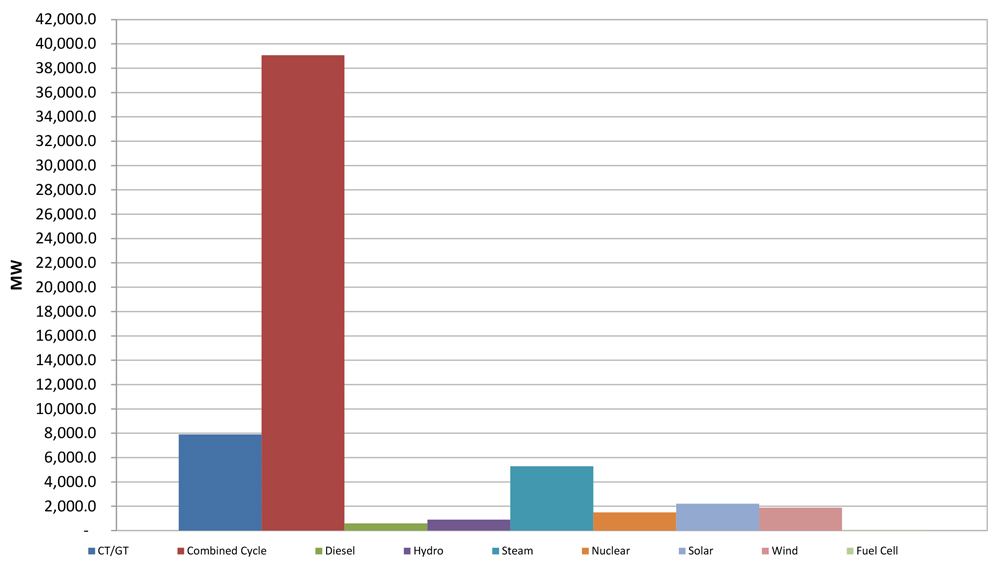
The ERCOT region added more than 7 GW of new wind and solar resources and about 400 MW of natural gas supply in 2020. At the same time, the Monitor said about 1 GW of fossil resources retired in 2020.

The report makes three other recommendations to improve market performance:

  • re-evaluate and redetermine the four competitive load zones every four years based on prevailing congestion patterns;
  • apply a small bid fee to point-to-point (PTP) obligations that would be consistent with cost-causation principles and would incent participants to submit smaller bid quantities that are move valuable and likely to clear than no-charge PTP bids; and
  • remove fixed-cost multipliers to ensure only marginal costs are included in mitigated offer caps.

It also keeps two recommendations from prior years:

  • modify the allocation of transmission costs by transitioning away from the four-coincident-peak method so that the resulting incentive better reflects the true drivers for new transmission; and
  • price ancillary services based on the shadow price of procuring each service.

The report, the first conducted entirely under new Director Carrie Bivens, retired six recommendations dating back to her predecessor’s tenure.
Stakeholders Discuss PJM Capacity Auction Impacts

The early impacts of PJM’s first capacity auction in three years began to emerge Thursday as Exelon reiterated plans to  retire two of its nuclear plants, even as cleared nuclear capacity increased by more than 4,000 MW across the RTO.

The long-delayed auction was the third in which PJM procured only Capacity Performance resources and the first applying the expanded minimum offer price rule (MOPR) to state-subsidized resources. At $50/MW-day, the RTO resource clearing price for 2022/23 was the lowest since 2013/14, and well below the $90 to $110 range Morgan Stanley had predicted in May. (See Capacity Prices Drop Sharply in PJM Auction.)

With the departure of Dominion Energy Virginia from the auction, fixed resource requirement (FRR) elections were the second-highest ever at 33.3 GW. FRR commitments increased by 19.6 GW, nearly equal to the 20.2 GW reduction in capacity offered. (See Dominion Opts out of PJM Capacity Auction.)

“PJM’s capacity bill will drop from $9.3 [billion] in 2021 to $3.9 [billion] in 2022. $1.1 [billion] of that drop is from Dominion FRRing out,” tweeted Tom Rutigliano of the Natural Resources Defense Council. “Still, saving $4.2 billion in unnecessary payments to fossil plants isn’t bad.”

Changing Fuel Mix

Cleared coal generation dropped by 8,175 MW, adjusted for FRR plans.

Nuclear generators cleared an additional 4,460 MW compared to the last auction, adjusting for FRR elections. But Exelon (NASDAQ:EXC) reported in a Thursday filing with the Securities and Exchange Commission that its three units in the ComEd region — Byron (2,347 MW), Dresden (1,845 MW) and Quad Cities (1,403 MW) — failed to clear the auction.

Exelon already announced in August that it intended to prematurely close the Byron and Dresden plants this fall. (See Exelon to Close Ill. Nukes as Gov. Touts Clean Energy Plan.) Exelon said it will continue operating Quad Cities because of state subsidies provided under the Illinois Future Energy Jobs Act. The company said those same subsidies that subjected it to the MOPR prevented the plant from clearing.

“The result is that customers in Northern Illinois and throughout PJM will pay for more capacity from polluting generation instead of securing carbon-free megawatts from Quad Cities, at what would have been a lower cost absent the MOPR,” Exelon said.

Exelon’s Braidwood and LaSalle nuclear plants were able to clear the capacity auction, the company said, but also face premature retirement “due to unfavorable market rules that favor emitting generation.” The company said a commitment to operate the two plants through May 2023 will provide a window for the logistical and technical planning necessary “to ensure a safe and orderly retirement in the event policy changes are not enacted.”

Exelon has been lobbying the Illinois legislature for years to provide support to its nuclear plants in the state. Media reports indicate Gov. J.B. Pritzker struck a deal late last month to charge ComEd customers more to support the Dresden, Byron and Braidwood nuclear plants, but details of the deal have yet to be officially made public.

Vistra (NYSE:VST) said in a press release it had cleared 7,218 MW at a weighted average price of $66.89/MW-day for a total of $176 million. “Including Vistra’s incremental revenue of $55-$60 million from existing retail bilateral sales above the capacity auction clearing price, Vistra’s total revenues for the period as of June 2, 2021 are approximately $231-$236 million,” it said.

Renewables had their biggest incremental increases ever in 2022/23, with wind adding 355 MW of new capacity and uprates and solar adding 1,491 MW. But they were still dwarfed by natural gas, which represents about three-quarters of all additions. Combined cycle plants added 5,943 MW and combustion turbines added 688 MW.

Generation’s success in clearing the capacity auctions has dropped from near 100% to below 90% as demand response and energy efficiency have played larger roles. But generation still represents 91% of capacity resources.

The auction showed a continuation of energy efficiency’s steady growth since 2014/15. Demand response was down, continuing its ping ponging between increases and decreases year-to-year.

Market Power

Another constant in the auction was the presence of market power. PJM said the RTO as a whole failed the three-pivotal supplier test, triggering market power mitigation for all existing generation resources. That limited offers by existing generation resources to their approved market seller offer cap (MSOC).

In March, FERC ordered PJM to revise the MSOC, siding with the arguments made in separate complaints filed in 2019 by the Independent Market Monitor and several consumer advocate groups (EL19-47). The Monitor said the MSOC has been inflated by the “unreasonable and unsupported” expectation of 30 performance assessment hours (PAHs) annually. (See FERC Backs PJM IMM on Market Power Claim.)

Market Monitor Joe Bowring said in an interview that he believes the MSOC issue allowed market power to be exercised in the latest auction, and plans on referring “a number of participants” to FERC as the commission requested in the March order.

Bowring said many dynamics influenced the clearing price, including a reduction in demand because of PJM’s reduced load forecast and an increase in transmission into key areas like ComEd and PSEG. He said Dominion Energy Virginia’s choice of the FRR option also had a “downward effect on prices” for the rest of PJM.

Bowring said he expects to release a report on the auction results within a month.

‘No Urgency’ on MOPR Changes

Other PJM stakeholders urged the RTO and FERC to reconsider any hasty action on MOPR reforms, saying the auction results showed the competitiveness of renewable resources in the market.

Todd Snitchler, CEO of the Electric Power Supply Association (EPSA), said the results of the capacity auction provided several key takeaways, including “no urgency to rush additional reform” of the MOPR. Snitchler said EPSA has advocated that PJM run auctions under the current MOPR rules to see the results before making dramatic changes.

Snitchler said the results of the latest capacity auction demonstrate PJM’s current path to eliminate the MOPR doesn’t have to be rushed and that stakeholders have time to “holistically address market reforms.” He said a well-designed approach to reforms can ensure that reliability is maintained while costs are affordable and carbon emissions goals are accomplished.

“The application of the MOPR did not raise prices for PJM consumers,” Snitchler said. “Nor did the application of the MOPR provide a financial windfall to fossil generators. Today’s results can, at long last, put an end to speculation — from all sides — about market outcomes.”

Study to Examine Best Energy Use of Seattle-area Landfill

The King County government and the Port of Seattle have allocated $500,000 to study whether to develop a Seattle-area landfill into a source for electric power or biofuel.

However, the scale and scope of the study must still be mapped out, a process that could last through the summer. The study is not expected to be finished until 2023, officials said. 

The port and county are teaming up on the study for separate reasons. The port wants to explore the production of biofuels to provide to jet airliners using Sea-Tac International Airport, which the port owns and operates. It does not have a timetable on how fast it expects to ramp up the use of biofuels to blend with regular petroleum-based fuel, concentrating instead on getting such an effort started.

Meanwhile, the county government is looking at expanding its one landfill, which is expected to be full by 2028. One avenue to justify that expansion while trimming the amount of trash — officially called “municipal solid wastes” — is to build a plant to burn much of the garbage to create raw materials for biofuel refineries or to create electric power, port commission President Fred Felleman and King County Councilmember Kathy Lambert said in separate interviews.

The study must address whether a raw-materials-for-biofuels or electric-power facility should be built, both said. 

They said numerous other questions need to be addressed, such as costs, materials found in the landfill, how raw landfill material has changed over the years, future demands for electricity and what technologies to consider.

The U.S. has at least 70 waste-to-energy plants, mostly in the Atlantic states, according to a recent briefing Lambert gave the King County Council. Only four are on the West Coast, with one in Spokane, Wash. Lambert said this type of venture has been successful in Europe, citing long-functioning waste-to-energy plants in Copenhagen and Hamburg. 

Landfills contribute to climate change with their methane emissions — a more potent greenhouse gas than carbon that does not last as long in the atmosphere.

Methane accounted for 10% of the nation’s GHG emissions in 2019, according to U.S. Environmental Protection Agency figures. Landfills account for 17% of the nation’s emitted methane, behind fuel production at 30% and livestock manure, burps and flatulence at 27%, according to EPA figures.

A facility to produce electricity or to create raw materials for biofuel refineries would trim the amount of methane emissions from the landfill at the King County town of Maple Valley, Lambert said. “The people living there would be oh-so-happy to have that [methane] gone,” she said.

King County also has seven closed landfills. Lambert speculated that trash could be dug out of these to burn in a power plant or biofuels raw-material facility. “We should be able to go in and mine them,” she said.

She pointed to a landfill-mining-and-power venture by the University of Texas. Teaming with the town of Denton, Texas, the university looked at mining landfill material to feed an electric plant in 2016. But by 2017, local officials concluded that the costs of operating such a facility would be greater than the revenue that it produced and dropped the project.

Another wrinkle to consider is that the Pacific Northwest does not have a biofuels refinery on the drawing board to use raw material created from a landfill. The Northwest has two biofuel refineries being developed — both being designed to use wood chips and forest slash as their raw materials. One is a $1.5 billion project in Grays Harbor County near Washington’s Pacific Coast. The other is a $320 million project in Lakeview, Ore.

CIP Panelists Share Communication Security Fears

At the Texas Reliability Entity’s CIP Workshop on Thursday, participants from across the ERO Enterprise shared the challenges they’ve encountered with keeping their physical and electronic systems secure in the face of a rapidly growing threat landscape.

The day’s presentations focused on the requirements of NERC’s Critical Infrastructure Protection (CIP) standards, but presenters emphasized that safety depends on more than cleaving to the letter of the regulations.

“Something we all need to remember is that compliance doesn’t equal security, but compliance plus security helps mitigate those threats, those vulnerabilities, those risks that are out there,” Kenath Carver, Texas RE’s manager of CIP compliance monitoring, said in the day’s first panel on supply chain risk management.

Software Supply Chain Hacks to Continue

Many panelists touched on the compromise of the SolarWinds Orion network management platform that was discovered last year. More than 18,000 public- and private-sector organizations, including the Department of Energy and FERC, are known to have been impacted by the breach, which security officials have attributed to Russian hackers. Joseph McClelland, director of FERC’s Office of Energy Infrastructure Security, said earlier this year that large-scale replacement of affected systems “may be the only option” for some users. (See SolarWinds Recovery May Require Extreme Actions.)

Software supply chain vulnerabilities don’t only manifest through business management technology: Collaboration software like Slack and Microsoft Teams are another potential avenue for hackers to gain entry to corporate networks, particularly given the rise in working from home because of the COVID-19 pandemic. Even for a platform that has not been compromised, the surge in users gives hackers myriad new vectors to gain entry.

“In the world that we live in right now, which is way more remote than ever before, these technologies are becoming more and more sophisticated, and are also being developed in a more and more rapid fashion,” Brian Allen, a senior cybersecurity specialist at Georgia System Operations, told the first panel. “So you want to ensure that you fully understand the capabilities of these technologies and not simply go based off what you can see, but what could also be done behind the scenes.”

Bill Peterson, manager of training and outreach at SERC Reliability, acknowledged that web conferencing platforms have been a boon for remote workers but advised organizations to limit their impact on vital systems as much as possible. This means restricting interactivity so that users can view others’ systems but not change them, and even thinking proactively about how much vital information is visible to other users. After all, he said, if one coworker could take a screenshot of another’s screen, potentially any hacker who is surreptitiously watching their interaction could do the same.

Analog Communications also Vulnerable

Participants also reminded listeners that communication does not always mean digital interaction. In a panel focused on CIP-012-1 (Communications between control centers), NERC Senior CIP Assurance Adviser Jeremy Withers observed that old-fashioned phone calls between different entities or even within one entity’s business domain are vulnerable to interception too. Even voice communications within control centers can’t always be considered secure.

“Think about some scenarios where control centers are located in buildings that they don’t necessarily own … and they have other occupants. There may be some high-traffic areas in those buildings near the control centers,” Withers said. “And the entities may want to do … a walk close to the perimeters, to make sure that all communications aren’t heard outside of [them]. If they do find issues, maybe look at [mitigations] such as white noise machines … or other soundproof technologies.”

Jess Syring, CIP compliance monitoring manager for the Midwest Reliability Organization, added that entities should not expect to be able to use a one-size-fits-all playbook to satisfy CIP auditors.

“Some examples of the questions that we’re going to ask are: What part of the transmission between the applicable control centers is the encryption applied to? What is the demarcation point where the encryption is controlled? What is the method and level of encryption — is it an outdated encryption standard?” Syring said. “All of these are questions that I would say [are] going to be the first line to start additional conversations … to ensuring that there [are] appropriate protections around those communications.”

ERCOT, PUC Deal with ‘Trauma’ of February Storm

Communications staff from ERCOT and the Public Utility Commission told commissioners Thursday that they are working together to improve their practices and messages after February’s near collapse of the grid led to long-term outages, hundreds of deaths and billions of dollars in damages.

“We realized we are dealing with a statewide populace that has been badly traumatized by the events of February,” Andrew Barlow, the PUC’s director of external affairs, said during the commission’s open meeting Thursday.

He told commissioners that while social media are positive channels, the legacy print and broadcast media are “the best [way] to deliver information to the people of Texas.” Barlow said communications staffers will engage directly with the “critical reporters” in the state’s key markets to ensure they’re up to speed with the language and protocols during any severe events this summer and into the future.

“We’re making sure … they’re fully informed and fully connected so they can communicate with their audiences,” Barlow said.

ERCOT was pilloried for its use of social media in the runup to the February winter storm. Informal Twitter messages and the use of industry jargon did not adequately prepare Texans for the possibility of power outages, critics said.

The grid operator has since brought on Chris Schein, a 20-year veteran of Texas’ electric industry, as its interim communications leader.

“It’s been my job to communicate clearly and concisely,” said Schein, who will mark his 30th day on the job Monday. “One of the things that we heard from February is that ERCOT needs to communicate more clearly, and so we’re implementing the practices and policies to do that.”

“After talking with the policymakers, it appears you guys are on the right track,” Commissioner Will McAdams said. “People are now familiar with ERCOT and the Public Utility Commission. We need to promulgate as many educational products as we can.”

Before the meeting, McAdams filed a memo saying he would recommend ending a storm-based disconnection moratorium during the PUC’s June 11 open meeting. His memo was supported by retail providers and several other companies (51812).

Thursday’s meeting was designed as a work session to discuss addressing the various energy-related bills that have come out of the Texas Legislature.

“At the very least, these interim workshop open meetings will provide a way to work through the actual details before the decision points come up,” McAdams said.

Capacity Prices Drop Sharply in PJM Auction

Capacity prices in PJM fell sharply for delivery year 2022/23, the RTO announced Wednesday, with rest-of-RTO prices dropping by nearly two-thirds to $50/MW-day and prices in the Eastern and Southwest Mid-Atlantic Area Council (MAAC) regions falling to their lowest on record.

Nuclear generators, natural gas, renewables and energy efficiency increased their market share, while coal saw its contribution shrink.

Overall, the Base Residual Auction, held May 19 to 25, cleared 144,477 MW of resources for the June 1, 2022, through May 31, 2023, delivery year, at a cost of $3.9 billion. That is $4.4 billion less than the 2018 auction for 2021/22, after adjustments for an increase in those choosing to skip the auction by using the fixed resource requirement (FRR). The auction gives PJM a 19.9% reserve margin, above the 14.5% requirement, including load and resource commitments under FRR.

Prices in five areas — ComEd ($68.96), Duke Energy Ohio and Duke Energy Kentucky ($71.69), MAAC ($95.79), Eastern MAAC ($97.86) and Baltimore Gas and Electric (BGE) ($126.50) — cleared above the overall PJM price.

The MAAC region comprises Atlantic City Electric, BGE, Delmarva Power, Jersey Central Power & Light, Met-Ed, PECO Energy, Penelec, Pepco, PPL, Public Service Electric and Gas, PPL and Rockland Electric. The Eastern MAAC region is Atlantic City Electric, Delmarva, JCP&L, PECO, PSE&G and Rockland Electric.

The 2021 results continued the historical year-to-year price volatility. Prices in most of the RTO had cleared at $140/MW-day in 2018, an 83% increase from the year before. (See Capacity Prices Jump in Most of PJM.)

Load Forecast, CONE, Tx Capacity Cited

Stu Bresler, PJM’s senior vice president of market services, said the drop resulted from a lower load forecast, a reduction in the net cost of new entry (CONE), increased transmission capacity into constrained locational deliverability areas (LDAs) and lower offer prices.

PJM said net CONE was down 19% for the RTO and 28% in the ComEd LDA. Net CONE “anchors the demand curve,” he said. The lower load forecast and the increased transmission capacity in LDAs shifted the demand curve to the left.

BRA clearing prices ($/MW-day)
BRA clearing prices ($/MW-day) | © RTO Insider LLC using PJM data

“If you combine a shift down and to the left of the demand curve and a downward shift in the supply curve, those two conditions together will result in lower prices,” he said.

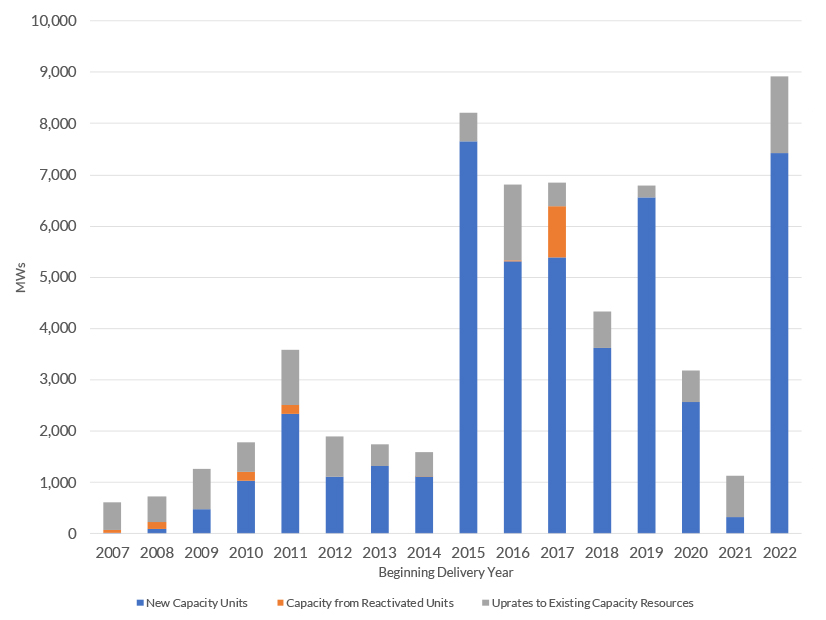
Wind resources cleared 1,728 MW (an increase of 312 MW over 2018) while solar cleared 1,512 MW (+942 MW), increasing the RTO’s total nameplate capacity for those resources to 11,761 MW.

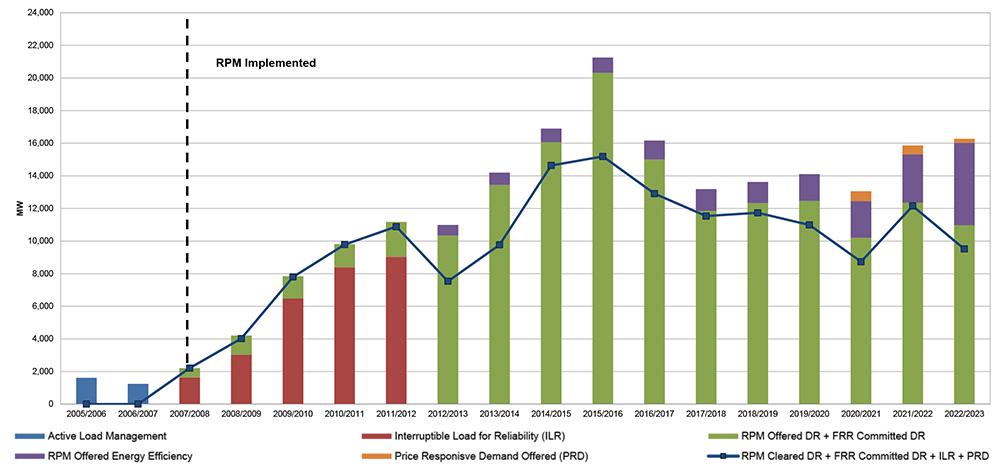
Energy efficiency rose by 1,979 MW (70%), while demand response declined 2,314 MW (-21%) to 8,812 MW.

Bresler said the drop in DR may have been caused in part by the one-year gap between the BRA and the delivery year, rather than the normal three-year forward period. “It seems to have been a trend in the past for demand response providers to … offer demand response on the basis of an ability to sign customers up between when the auction clears and the delivery year starts. So part of the effect here could be due to the fact that we are so much closer to the start of the actual delivery year, which limited the opportunity to adjust the portfolio through the incremental auctions.”

New capacity offered by year
New capacity offered by year | © RTO Insider LLC using PJM data

Combined-cycle gas plants added 3,414 MW and nuclear increased by 4,460 MW, adjusted for FRR elections. Cleared coal generation dropped by 8,175 MW, adjusted for coal units committed to FRR plans.

Dominion Energy Virginia chose the FRR option beginning with this year’s BRA over concerns an expanded minimum offer price rule (MOPR) would undermine its ability to meet Virginia’s renewable energy targets. The utility’s FRR election covered more than 60 generating units totaling more than 18.1 GW, including its 1.7-GW Surry nuclear power plant. All told, 175 generating units chose the FRR for this BRA, the second highest on record and more than double the 85 units that chose the FRR option for 2021/22. (See Dominion Opts out of PJM Capacity Auction.)

MOPR Impact

The 2022/23 auction, originally scheduled for 2019, was canceled by FERC after the commission ordered the RTO to expand its MOPR to state-subsidized resources. (See FERC Halts PJM Capacity Auction.) PJM will hold its next BRA, for 2023/24, in December.

Bresler said the impact of the expanded MOPR appeared to be modest.

“I can tell you there were some resources that were subject to the MOPR that did not clear in the auction. It’s very difficult to say whether or not they would have cleared but for the MOPR because we don’t know what they would have offered in the auction,” he said. “It’s hard for us to know some of these causes because we don’t have a whole lot of insight into the market sellers’ offer behavior.”

Demand side participation in capacity market
Demand side participation in capacity market | PJM

“However, when you look at the pricing results from this auction, together with the fact that there were significant increases in wind and solar and committed nuclear resources, it’s hard to see how the MOPR had any significant or large impact on this auction. That’s really what we expected.”

The expanded MOPR was ordered by FERC in December 2019 under then-Chair Neil Chatterjee, a Republican. But at a FERC technical conference in March, new FERC Chair Richard Glick, a Democrat, and PJM CEO Manu Asthana both said the MOPR is not “sustainable” because it is frustrating state decarbonization efforts.

In April, PJM proposed FERC take responsibility for determining what resources are subject to MOPR, rather than having the RTO and the Independent Market Monitor make such decisions. (See PJM Proposes Shifting MOPR Determinations to FERC.)

P3 Protests PJM MOPR Plan

On June 1, the PJM Power Providers Group (P3), which represents owners of 67 GW of capacity, wrote a letter to the RTO’s Board of Managers lambasting PJM’s position.

“While P3 generally would not offer a letter to the PJM board about a stakeholder matter that is still being actively discussed in the stakeholder meetings, the PJM-proposed revisions to the minimum offer price rule (MOPR) are so ill-conceived and completely incompatible with FERC’s authority and PJM’s mission that our organization feels compelled to bring certain matters to the board’s attention at this time,” P3 wrote.

Cumulative generator capacity additions
Cumulative generator capacity additions | PJM

It called PJM’s proposal “legally flawed” and “a dramatic departure from many of its foundational principles.

“PJM’s proposal starts with the unsupported premise that PJM can take no action to preserve a competitive market outcome if that action could be viewed as interfering with a state policy. From there, PJM’s current proposal puts forth a complete retreat from the notion of a competitive capacity market and instead sets up a market design that will allow subsidies rather than market signals to dictate market exit and entry.

“P3 is increasingly questioning whether PJM continues to believe in the promise of markets or if other priorities have supplanted this historical priority of the organization,” it added, urging the board to “communicate clearly to PJM management that the organization remains committed to markets and expects to review a MOPR-related proposal that is consistent with PJM’s historical commitment to competitive capacity markets.”

Energy Regs Need to Support Green Tech, Eversource Says

States with ambitious climate goals need to revamp their regulations to support geothermal and low-carbon hydrogen projects to meet their targets, said Nikki Bruno, director of clean technologies at Eversource Energy.

In Massachusetts, for example, “the Future of Gas proceeding will net out some good frameworks that we can provide to our regulators to say, ‘here’s how we want to pivot with the targets that are set out,’” Bruno said at the New England Energy Conference and Exposition last month.

The Department of Public Utilities opened the gas proceeding last fall and directed the state’s local gas distribution companies to determine which pathways to a net-zero industry are feasible, such as low- to no-carbon hydrogen or geothermal energy.

Reports from the distribution companies are due in March 2022.

“Policy does go hand in hand with the technology,” Bruno said. In Massachusetts, there is no regulatory framework for geothermal energy. The state’s comprehensive climate bill signed into law in March was the first piece of legislation that paved the way for gas companies to take on renewable energy projects, such as solar, and investigate options such as geothermal, she said.

Geothermal energy and hydrogen fuel technologies are not new, but widespread use of them is uncharted territory for utilities in the highly developed regions of the Northeast. State energy regulators can support decarbonization by overseeing the creation of a shared pipeline network between service areas, Bruno said.

“Everything underground is just as tight as the real estate above ground,” she said. “Patience and collaboration going forward is needed; these are complex problems that are not going to be solved overnight.”  

Eversource is planning a geothermal energy pilot that would include the installation of more than 100 ground source heat pumps in a mixture of low- and middle-income communities, homes and businesses, depending on the final location of the project.

Policy makers who pursue the “singular pathway of electrification to achieve emissions reduction objectives and energy system resilience actually hinder their ability to succeed,” Rick Murphy, managing director of energy markets at the American Gas Association, said.

“The question, or the opportunity as we see it, is how can we leverage the nation’s vast gas pipeline network — 2.6 million miles to be exact — to deliver lower-carbon energy sources like renewable natural gas and hydrogen,” Murphy said.

More Pipelines 

Technologies like hydrogen and geothermal, however, are realistically “a little ways out,” said Caitlin Tessin, director of market innovation with gas transmission company Enbridge.

Renewable natural gas is in the “earliest phase of opportunity,” Tessin said during the conference. Created by capturing methane emissions from organic waste, landfills or wastewater treatment plants, renewable natural gas can use existing gas infrastructure to heat homes and reduce emissions in the process.

Enbridge broke ground last year on a $42 million renewable natural gas plant in Ontario, Canada, that is expected to generate enough energy to heat 8,750 homes and reduce GHG by 48,000 tons every year, according to the company. It also recently received approval to blend hydrogen into a test portion of its gas network in Ontario.

There are opportunities for expansion along existing pipeline rights-of-way to optimize existing infrastructure in the Northeast to meet demand, Tessin said.

But new pipeline expansion does not look promising.

There is little chance that there will be any new pipeline installations in New England anytime soon, John Rudiak, senior director of gas supply for gas utility subsidiaries at Avangrid, said during the conference.

“In terms of possible small-scale expansions of existing systems, if they’re needed to meet customer demand, I can see them going into effect,” he said.

New Jersey Lawmakers Back Low-carbon Concrete

New Jersey legislators on Thursday passed a bill requiring builders to offer low-carbon concrete as an option and creating tax incentives for companies that purchase it.

The legislation (S3091), which now sits on the desk of Gov. Phil Murphy (D), encourages the use of concrete that is created under controlled conditions — known as unit concrete — and is certified as “generating at least 50% less carbon dioxide emissions” in its production. Unlike regular concrete, which is delivered wet to the construction site and dries on the job, unit concrete is pre-fabricated and is delivered in ready-to-use form to the construction site, often in the form of pavers or concrete blocks.

The state’s Democratic-controlled Assembly passed the bill 57-13, with no debate, following a 24-11 vote by the state Senate, also controlled by Democrats, in March.

Murphy has pledged to reduce the effects of climate change and put the state on track to use 100% clean energy by 2050. The bill addresses what some analysts see as a key generator of greenhouse gases, and one that is important to any effort to cut greenhouse gases, due to its prevalence in daily life.

A May 2020 report by consultant McKinsey and Co. concluded that the cement industry is responsible for about a quarter of all carbon dioxide emissions by industry worldwide, and 7% of all emissions globally.  In a sign of the industry’s shift, the Global Cement and Concrete Association (GCCA) in September released a statement pledging to reduce the carbon-dioxide footprint of what it called “the world’s most used man-made product” and create carbon-neutral concrete by 2050.

Sen. Dawn Marie Addiego (D), who sponsored the bill, told the Senate Government, Wagering, Tourism & Historic Preservation Committee in December that carbon emissions from concrete emissions are so large that if the concrete manufacturing industry were a country, it would be “the third largest global producer of carbon dioxide, trailing only the United States and China.”

Still, she said, “we are incentivizing and encouraging, not mandating” the use of low-carbon concrete through the bill.

Promoting A Low Carbon Product

The bill would:

      • Require any builder of a new project using unit concrete to provide the option for low-carbon concrete, if it is “technically feasible.” The requirement would apply to any residential or commercial building, except for the construction of certain condominiums, attached single-family townhouses and row houses
      • Requires the builder to state the cost and environmental benefits of the low-carbon concrete products
      • Make the purchase of carbon-reduced concrete exempt from state sales tax.
      • Make developers or property owners that purchase and install carbon-reduced concrete products eligible for a tax credit equal to $2 per square foot of qualified unit concrete products purchased and installed, up to $3,000 for a residential property and $30,000 for a commercial property.
      • Require that if a state or local government agency is executing a project that involves the use of unit concrete then it should use low-carbon concrete wherever “technically feasible”
      • Require the state Commissioner of Environmental Protection to establish a process for certifying whether the production of unit concrete product generates least 50% less carbon dioxide emissions  than unit concrete product made with ordinary Portland cement.

Assemblyman Andrew Zwicker (D), who backed the bill Thursday, said providing an incentive is key in the early stages of a technological advance, to get beyond the “early adopters” and attract the interest of more mainstream users. A separate bill sponsored by Zwicker would provide incentives for companies doing state contracts with low-carbon concrete of any kind, to close the gap between the higher cost environmentally friendly concrete and lower cost regular concrete.

New, Unfamiliar Concrete

The bill drew a mixed reaction from stakeholders. The New Jersey Builders Association, which represents residential and commercial builders and developers, said it generally supports the use of carbon-reducing strategies, but believes the bill still needed refinement.

“Although well intentioned, the bill lacks the proper mechanics that would streamline the use of carbon reducing products,” Kyle Holder, director of legislative affairs, said in an interview. “It requires builders to utilize new products that they are unfamiliar with and have no experience with.”

“For instance, builders would be compelled to offer carbon reducing concrete products in structural components of a home, which may create safety concerns and potential issues with new home warranties,’ Holder said. He added that the association believes the bill should cover only “horizontal projects such as driveways, and not building construction, and should include some “lead time so builders can confidentially determine how the products in question react and work with other components of the home.”

The Illinois-based Portland Cement Association, however, backed the bill, saying that “we feel that procurement is a key driver in providing the demand for our products that will allow us to continue to drive down our already low-carbon footprint.”

Spokesman Nick Ferrari said the use of low-carbon concrete is at a “tipping point,” and the “biggest obstacle to their adoption isn’t supply, it’s awareness.”

Cutting Production Temperature

Carbon dioxide is produced in the process of creating concrete, which involves burning limestone in kilns at 2,300 to 3,000 degrees Fahrenheit, usually with coal or natural gas, according to the Zero Energy Project, a non-profit organization that aims to educate people about building materials. The chemical reaction involved in making cement also releases CO2 as a byproduct; the production of one ton of Portland cement creates a ton of carbon emissions, the organization’s website said.

Cutting carbon is difficult, however. A report issued by the California Nevada Cement Association in March concluded that because the release of carbon dioxide is “immutable” during the chemical reaction in the cement manufacturing process, the industry would require carbon capture and storage, and expensive technology, to reach carbon neutrality. (See: Challenges Loom for Decarbonizing Concrete).

Solidia Technologies, a Piscataway, N.J.-based producer of low-carbon concrete, welcomed the legislation. Devin Patten, director of technology deployment for the company, urged the Senate Budget and Appropriations Committee to approve the bill in January, saying  it “incentivizes demonstrable and substantial reduction in materials carbon footprint.”

Patten told the committee that his company’s products cut carbon emissions both in the production of the concrete, and “the consumption of CO2 to cure the concrete, permanently sequestering it inside the product.”

“Through this, the net effect is up to 70% reduction in the carbon footprint compared to regular Portland cement,” he said.

Solidia Technologies, which announced a $78 million funding round in April, says it has developed a technique with Rutgers University and others that enables manufacturers to produce cement in their existing kilns at lower temperatures than normal. The process also uses less limestone, and as a result the process saves energy and reduces greenhouse gas emissions by up to 30%, the company says.

The company’s “concrete curing technology permanently and safely consumes up to 240 kg of CO2, leaving 3-5% of the finished precast product weight as solid CO2,” the company says.

The New Jersey Chapter of the Sierra Club did not back the bill. Megan Steele, the organization’s communications coordinator, said in an interview that the legislation could “end up incentivizing the movement of the cement industry into managing waste for other high-carbon coal-dependent industries,” and enabling the use of high-polluting fuels such as incinerating municipal waste. By promoting low-carbon concrete, the bill could also end up boosting the transportation and extraction of cement, which also are high polluting sectors, Steele said.

Bill to Dismantle Maine’s IOUs Moves Ahead

A bill that would ask Maine voters to decide whether a new consumer-owned nonprofit should replace the state’s investor-owned utilities won approval from the Legislature’s energy committee Tuesday.

The bill (LD 1708) would direct the Public Utilities Commission to oversee an asset sale of Central Maine Power and Versant Power if it determines the utilities are unfit to serve. A new consumer-owned utility called Pine Tree Power would then purchase the IOUs’ assets. (See Legislators Considering Bill to Replace Maine’s IOUs.)

The Energy, Utilities and Technology Committee voted 9-2 in favor of recommending that the Legislature pass the bill with a package of minor amendments to clarify its existing language. Voters would take up the question of whether to move forward with the proposal in November, if the bill passes.

In voting against recommending the bill’s passage, Rep. Steven Foster (R) said he is concerned that the board that would run Pine Tree would be “politically motivated.” He also said that the bill does not properly consider what the status of current IOU employees would be after Pine Tree is established.

Maine's investor-owned utilities
The Maine Legislature’s Energy, Utilities and Technology Committee voted 9-2 in favor of recommending a bill to replace the state’s investor-owned utilities with a consumer-owned nonprofit. | Maine Legislature

Rep. Nathan Wadsworth (R), who also voted in opposition, said he cannot support a government takeover.

“These companies are privately owned; they’re not up for sale. And [in this bill], we are forcing them to sell,” he said. “To me that’s a government takeover of power, and I’m just not there yet or probably ever.”

While Committee Chair Mark Lawrence (D) said he had been on the fence, he voted in favor, adding that he could not find a reason why the proposal should not go to voters. His primary concern, he said, is how the transition will affect the state’s objectives on climate change.

“There is risk in this, no matter what anybody wants to say, but there is also potential reward,” Lawrence said.

A poll conducted in mid-May for the nonprofit coalition Our Power found that 75% of Maine voters strongly or somewhat support replacing the IOUs with Pine Tree. Our Power expects the bill to go to the House of Representatives for an initial floor vote next week.

Far-reaching Energy Bill Sweeps Through Nevada Legislature

On the final day of Nevada’s legislative session on Monday, lawmakers passed a bill that would require transmission providers in the state to join a regional transmission organization by January 2030, among a host of other provisions.

The Assembly on Monday voted 32-10 to pass Senate Bill 448 by Sen. Chris Brooks (D), followed by a concurrence in the Senate on the bill’s final amendment. The Senate previously voted 21-0 in favor of the bill. (See Sweeping Nev. Energy Bill Passes Senate Unopposed.)

SB448 now heads to Gov. Steve Sisolak, who is expected to sign it.

Wide-ranging Legislation

SB448 would require transmission providers to join an RTO by January 2030 unless providers can show that they haven’t been able to find a viable RTO, or that joining an RTO wouldn’t be in the best interest of the providers or their customers.

The bill would also create a Regional Transmission Coordination Task Force to advise the governor and legislature. The panel would look at potential costs and benefits of joining an RTO, where to build transmission facilities to achieve the state’s clean energy and economic development goals, and businesses that could move to the state as a result of the state’s position in a regional wholesale electricity market.

But the wide-ranging bill goes beyond transmission.

Among its many provisions, SB448 would require NV Energy, the state’s monopoly electric utility, to develop a plan for $100 million in investments from 2022 to 2024 for a variety of electric vehicle charging programs.

The bill would address energy storage by adding storage facilities and hybrid generation-and-storage facilities to the Renewable Energy Tax Abatement Program.

SB448 would require electric utilities to align their planning process with state climate goals by showing how they could reduce their CO2 emissions by 80% compared to 2005 levels by 2030 and get to net zero by 2050.

The bill would require that at least 10% of an electric utility’s spending on energy efficiency programs go toward programs for low-income customers and historically underserved communities.

Rudy Zamora, program director of Chispa Nevada, said SB448 would help address disparities in low-income communities where there is often more air pollution. Chispa is a Latino organizing program for climate action.

“By doubling energy efficiency investments in low-income homes and ensuring at least 40% of new electric vehicle charging infrastructure is deployed in historically underserved communities, we can begin to address energy equity and climate justice,” Zamora said in a news release after the Assembly passed the bill.

Ellen Zuckerman, utility program co-director for the Southwest Energy Efficiency Project, also commended the legislature for passing SB448.

“Senate Bill 448’s passage will reduce emissions, eliminate wasteful energy use and make electric vehicles more accessible to low- and middle-income Nevadans,” Zuckerman said in a news release on Monday.

Energy Bill Support

The governor appears to support SB448. On May 13, the day it was introduced, Sisolak hosted a “virtual roundtable on energy in Nevada” during which Brooks discussed his bill.

Representatives of the Governor’s Office of Energy and Office of Economic Development expressed support for the bill during committee hearings.

The bill’s final amendment added co-sponsors to the legislation. It expanded the membership of the Regional Transmission Coordination Task Force that the bill would create to include a representative of the Nevada Indian Commission.

The amendment would also remove a portion of existing law that requires at least three-quarters of money in the state’s Renewable Energy Account be used to reduce electricity costs to certain retail customers of electric utilities. Instead, the amendment says money in the fund must be used for purposes that the director of the Office of Energy establishes by regulation.