Communities in Massachusetts Fight for Right to Be Green

Legislators in Massachusetts are trying to help some local governments qualify as green communities in the state.

The Green Communities Designation and Grant Program provides funding for towns in Massachusetts to implement energy efficiency and renewable energy incentives. Towns that are served by a municipal electric utility (light plant) are not automatically eligible for those grants, but a new bill before the Massachusetts legislature could change that.

Introduced earlier this year, H.3369 would open up technology assistance and emissions data tracking tools for the regions served by 50 municipal light plants. Grants could be used for air source heat pumps, ventilation upgrades, EV charging stations and other clean energy innovations.

The bill would make it easier for any town, no matter what its relationship is to a light plant or investor-owned utility, to opt into participation in the Green Communities program.

Without the 50 light plant service areas, the statewide program will be an “inconsistent patchwork of incentive programs,” said Barbara Salzman, a resident of Boxborough, Mass., which is served by a municipal light plant.

Of the 351 cities and towns in Massachusetts, 280 are involved in the program or have received grant funding for clean energy incentives.

Support from the state will help places like Boxborough carry out new state climate goals and their impending emission reduction targets, Salzman testified at a legislative hearing on the bill on Tuesday.

Many communities served by municipal light plants have “done the prerequisite steps,” but they are in “very stringent financial situations,” said Karen Herrick, a town selectman for Reading, Mass. The legislature should encourage laws that incentivize 100% adoption of new climate laws across the state and reduces emissions.

To qualify as a green community, towns must pass zoning in designated locations for renewable energy generating facilities; adopt an expedited application and permitting process for renewable energy facilities; reduce energy use by 20%; purchase fuel-efficient municipal vehicles; and adopt the state stretch code for buildings.

Funding for the state program comes from proceeds from carbon allowance auctions under the Regional Greenhouse Gas Initiative (RGGI).

Municipal light plants pay into RGGI, but state Sen. Michael Barrett (D) questioned why they should be eligible for Green Communities program funding at the hearing. They operate their own energy efficiency and rebate programs, and their customers are only eligible for those programs.

Communities not served by a local light plant have less control over where their energy is coming from and should be prioritized by state grant funding programs, Barrett said.

But municipal light plants own less infrastructure and have fewer resources than investor-owned utilities, state Rep. Joan Meschino (D) said at the legislative hearing.

“It’s not a free ride” for them to join the Green Communities program, she said. “Nothing could be further from the truth.”

For a community to participate, the municipal light plant would collect a per-kWh charge on behalf of the community for submission to the state’s Renewable Energy Trust Fund.

Senate Ag Subcommittee Hears Talk of Transmission

A 90-minute hearing Tuesday on renewable energy by the Senate Agriculture, Nutrition and Forestry Subcommittee on Rural Development and Energy focused mainly on ethanol blending, but senators also heard about the need for more electric transmission infrastructure in the Midwest.

Subcommittee leaders argued that future federal budgets ought to include dollars for new liquid fuels technologies and a possible mandate that future gasoline blends are 15% ethanol rather than the current 10%. But they also mentioned new incentives to pay for a massive buildout of wind and solar resources deep in America’s Farm Belt.

Katie-Sieben-(United-States-Senate-Committee-on-Agriculture,-Nutrition-and-Forestry)-Content.jpg
Minnesota PUC Chair Katie Sieben | U.S. Committee on Agriculture, Nutrition and Forestry

In a response to a question from Sen. Amy Klobuchar (D-Minn.) about the value of expanding renewable generation to rural communities as well as small farms, Katie Sieben, chair of the Minnesota Public Utilities Commission, said wind farms in their state have created rural wealth that farming alone had not.

“Renewable energy, especially wind projects, have created tremendous economic development opportunities for small communities. We are seeing the impacts of increased hiring of local workers, which leads to more careers in the renewable energy sector. We’re also seeing increased manufacturing domestically of wind turbines and solar panel components. Combined with the tax benefits that come from renewable energy projects, it really is a holistic, helpful way to improve rural economies across Minnesota,” she said.

“Though what we really need in Minnesota, especially, is more transmission,” she added. “As of January, there are 533 projects, renewable energy projects primarily, waiting to connect in the MISO queue [that] total over 15 GW.

“New transmission can maximize the value of low-cost renewable energy and create living-wage jobs that are essential to ensuring Americans have reliable power. Please include transmission investments in the American Jobs Plan or other relevant legislation.”

Bill-Cherrier-(United-States-Senate-Committee-on-Agriculture,-Nutrition-and-Forestry)-Content.jpg
Bill Cherrier, Central Iowa Power Cooperative | U.S. Committee on Agriculture, Nutrition and Forestry

Bill Cherrier, executive vice president and CEO of Central Iowa Power Cooperative, a nonprofit generation and transmission cooperative based in Des Moines, explained that federal tax credits are currently not available for electric cooperatives.

“It’s important for policymakers to note that the current federal tax credit structure prevents electric cooperatives from taking advantage of tax benefits to directly build and own wind and solar assets. The current program requires cooperatives to work with third-party providers on long-term contracts to bring this energy into the market. The current incentive structure impedes our ability to adopt renewables and new technologies in a more cost-effective way,” he told the lawmakers.

Still, biofuel remains a popular point of bipartisan agreement among rural lawmakers.

Emily-Skor-(United-States-Senate-Committee-on-Agriculture,-Nutrition-and-Forestry)-Content.jpg
Emily Skor, Growth Energy | U.S. Committee on Agriculture, Nutrition and Forestry

Included on the panel was Emily Skor, CEO of D.C.-based biofuels advocate Growth Energy, who used her testimony to unveil an economic analysis issued earlier this month demonstrating that boosting the E10 blending mandate to 15 would be a shot in the arm for the U.S. economy. Gasoline blenders have long resisted the switch to E15.

The study by Pennsylvania-based ABF Economics, Skor said, determined that a move to a national E15 standard would add $17.8 billion to U.S. GDP, support an additional 182,700 jobs, generate $10.5 billion in new household income and save consumers $12.2 billion annually in fuel costs.

“In fact, studies show there is no path to net-zero emissions by 2050 without biofuels,” she said. The Energy Information Administration “projects that gasoline- or flex fuel-powered vehicles will make up about 80% of new vehicle sales in 2050, meaning the vast majority of the cars on the road will continue to be powered by liquid fuels for decades to come.”

Massachusetts Cities Begin Acting on New State Climate Laws

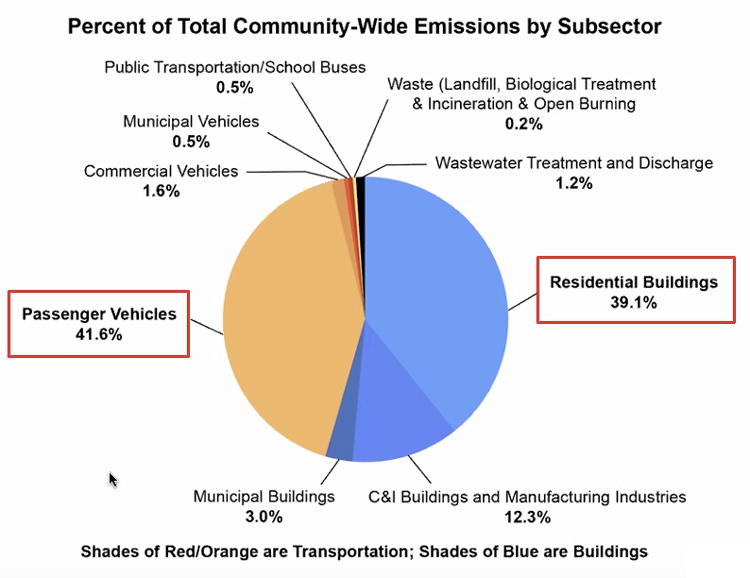
The city of Medfield, Mass., released plans last week to target emissions from residential buildings and passenger vehicles with the goal of eliminating or offsetting all greenhouse gases originating in the town by 2050.

Still in the initial stages, the city’s Net Zero Climate Goal was created to apply new state climate laws, including the Next-Generation Roadmap for Massachusetts Climate Policy and Gov. Charlie Baker’s state net-zero goal for 2050, to municipal laws and regulations.

“We are taking what the state is doing to our own level,” said Hildrun Passas, a member of the Medfield Energy Committee, at a webinar presenting the plan last week.

The state’s Clean Energy and Climate Plan for 2030 proposes a statewide high-efficiency energy code for buildings by 2028 and calls for an end to all fossil-fuel heating system incentives by the end of 2024. New climate laws passed by the legislature also implement caps on emissions from different sectors over the next few decades.

Town-of-Medfield-emissions-by-sector-(Medfield-Energy-Committee)-Content.jpg
Town of Medfield emissions by sector | Medfield Energy Committee

To meets those emissions reduction targets, Medfield plans to use a GHG measuring tool from the Massachusetts Metropolitan Area Planning Council. Based on international metrics, the Community Greenhouse Gas Inventory Tool will help Medfield assess where it is now, track whether emission levels drop and by how much.

The measurement tool will also “demonstrate the important role that cities and towns play in tackling climate change,” Passas said.

But with transportation and home heating and cooling as the city’s highest emitting sectors, residents will have to retrofit their homes and purchase electric vehicles in the future. Setting its own action plan will allow the city to take advantage of state and federal funding to help residents “make the transition as seamlessly as possible,” Passas said.

However, a lack of widespread EV charging infrastructure makes the decision to purchase one difficult. In towns like Medfield, public transportation is not available, so the energy committee decided to focus its efforts on converting passenger vehicles to EVs.

“EVs are the future, but consumer choice is not where it needs to be,” said Ken Pruitt, energy manager for Arlington, Mass., at the webinar.

Pruitt helped Arlington develop its own plan to reach net-zero emissions over the past few years. The town’s plan includes making buildings more efficient, electrification and adding renewable energy resources to the grid.

The Medfield Energy Committee is using Arlington’s plan as a model for a community-wide deep energy retrofit campaign and to advocate for improved utility rate designs to increase EV charging infrastructure.

In addition to EV infrastructure, another challenge Arlington faced in enacting its 31 new GHG emission reduction measures was the expensive and time-consuming conversion of natural gas or oil-fired water heating systems. Homeowners need to install costly air ducts in their home, which could force them out for a period of time during construction.

“Massachusetts has thousands and thousands of old homes,” Pruitt said. But the plan still received “overwhelming support for its actions to eliminate GHGs.”

The Medfield committee will be seeking input from residents as it develops the plan over the next few months, followed by a formal public comment period in October, Passas said.

A draft of Medfield’s plan will be released by the end of the year, with a final public comment period in January before the committee submits the plan to the Board of Selectmen for a vote.

New Jersey Solar Push Squeezes Farms

Aggressive demand for undeveloped land to meet New Jersey’s ambitious solar energy goals has triggered a vigorous debate — and proposed legislation — over whether agricultural land should be used, how much might be needed for solar electricity generation and what impacts these projects will have on the state’s farming industry.

With solar developers regularly approaching farmers with high-dollar offers to buy or lease their land, state legislators and the New Jersey Board of Public Utilities (NJBPU) are each wrestling with the issue of how much farmland should be used for solar projects. New Jersey Gov. Phil Murphy and the legislature want to deploy 32 GW of solar by 2025, about nine times current capacity, as part of the state’s plan to reach 100% clean energy by 2050. Lawmakers say that will require a dramatic increase in grid-scale solar capacity, raising questions about where to locate the projects.

One bill before the state legislature, S2605, addresses the issue by limiting the use of farmland and encouraging solar development on developed land or existing buildings, as part of an effort to stimulate the development of 3,750 MW of new solar power by 2026 through renewable energy certificates and competitive solicitations.

A second bill, S3484, which secured the approval of the Senate Environment and Energy Committee last week, would establish a pilot program to develop “dual-use” projects of 10 MW or less that enable solar projects to co-exist with land that “continues to be actively devoted to agricultural or horticultural use.” The bill prohibits the use of prime farmland unless approved by the BPU “in consultation” with the state secretary of agriculture.

The dual-use concept — now being piloted in several states — promotes cultivating crops that can grow in the shade or grazing animals around the panels. The NJBPU has also proposed a dual-use pilot program, with details to be developed with state agriculture officials, as part of its proposal to restructure the state’s incentive programs and cut costs while stimulating the creation of more solar generating capacity.

Caught in the middle are farmers, who are torn between embracing solar opportunities as a way of generating additional income and rejecting solar development for fear that it will gobble up precious farmland and diminish an industry already under attack from residential and warehouse developers.

“We have farmers on either side of the question,” said Peter Furey, executive director of the New Jersey Farm Bureau, which represents farmers. “Everybody’s very interested because surely there is opportunity in rural areas of economic development that, if (solar) in some way can be compatible with farmland, can make a win-win situation.”

Solar Project Payments

New Jersey has 230,000 acres of prime, “preserved“ farmland that is part of a program under which the state pays a farmer for a deed that requires the land to remain as farmland in perpetuity, Furey said. But the state has plenty of other prime farmland that is not protected and has become a target for developers looking for large, contiguous land spaces, he said.

Land is also available that is categorized as having “marginal value” for farming because it has a stream or forest on it, or the soil is low grade, Furey said.

Jason Menegus, who works a 100-acre farm in Belvidere, N.J., opposes the use of farmland for solar projects, because he fears the money offered by solar developers could result in the state losing tens of thousands of acres of farmland. Menegus, whose family has worked his farm for more than 100 years, said he has heard of developers offering to lease farmland for $3,000 or $4,000 per acre per year for a solar project, a figure that was confirmed by a solar developer. That is far more than the $40 to $400 per acre per year that farmer’s pay to rent land, Menegus said.

“It’s going to make farming unaffordable,” he said. “What you’re doing is basically destroying one economy to help another, with this green energy.”

But developers say that if the state wants to dramatically upgrade its solar capacity, then some farmland will have to be used, including the kind of prime farmland that some farmers and conservationists believe should be off limits.

“I don’t think, if we’re more or less limiting solar to not being on any prime farmland, that you’re going to see any large projects” developed, said Tim Daniels, principal of Dakota Power Partners, a solar project developer with a Millville, N.J. office. “I would be surprised if there are more than two or three sites in the state that are a larger scale, let’s say 50 MW or larger, that don’t include some percentage of prime farmland,” Daniels told the Senate Environment and Energy Committee during a hearing on S2605 on May 11.

Some environmentalists have also opposed tight restrictions on farmland use, arguing that the need to respond to climate change is of paramount importance.

“There are those who say we have to limit solar on farmland, and especially prime soils,” Jeff Tittel, former director of the New Jersey Sierra Club, told the same hearing. “But not all prime soils are being used, and not all prime soils are going to be farmed.”

Millions of square feet of warehouses are being developed on farmland, he said, adding that “if I had a choice, I’d rather see” farmland developed for solar panels than warehouses.

Warehouse Growth

Indeed, the solar-farmland debate comes as the farming sector is also under pressure from developers looking to satiate the escalating demand for warehouse space, which has been fueled by the shift in consumer buying habits from in-person shopping to e-commerce that accelerated during the COVID 19 pandemic.

Space for fulfillment centers and warehouses is at a premium, and the pressure is intensified by the proximity of the massive New York market and the logistics space needed by the Port of New York and New Jersey. In a sign of the space shortage, rents for new, high-quality industrial space in New Jersey increased by 17% percent in 2020, according to JLL Research, the real estate broker’s analysis arm. In its first quarter 2021 report, the company said the 13.7 million square feet leased in the first three months of the year represented the “highest level in history.”

Still, some environmentalists say that even with high demand for space, the state’s solar capacity can be expanded without turning to prime farmland.

“Our position is that we can meet our solar energy goals by continuing to focus on already disturbed sites, brownfield landfills, parking lots, rooftops and also on marginal [farm] land,” said Tom Gilbert, campaign director for energy, climate and natural resources for the New Jersey Conservation Foundation. “We’re not opposed to greenfield solar development, but it should be far away from our best farmland soils.”

Prime or Marginal Farmland

The current version of S2605 states that “in no case shall a grid supply [project] be located on preserved farmland.” The bill adds that a facility cannot be sited on “prime agricultural soils and soils of statewide importance” unless the BPU grants a waiver to allow it. The bill also limits the amount of farmland that can be used for solar projects to 5% of the state’s nonpreserved farmland.

But Gilbert said his organization believes the maximum amount of farmland available for solar development should be only 1%, about 1,600 acres.  Another “100,000 acres of farmland totally outside of those most sensitive farmlands” could be used for solar projects, he said.

The tension over the use of farmland for solar has played out in the halls of local government, before zoning and planning boards, and in court.

Farmer Menegus, who sits on the Warren County Agriculture Development Board, said he believes that the high prices offered by solar developers for farmland are one reason why the board has not seen an application for the state farmland preservation program for more than a year. He said the $3,000 to $4,000 per acre per year on a 20-year lease offered by solar developers is far more attractive to some farmers than the $10,000 one-time payment the state might offer to preserve the land with a deed.

Developer Daniels said the figure of about $3,000 to $4,000 per leased acre is about right for projects of below 60 acres, which can receive government incentives. But for larger projects, such as those that he develops, the figure would likely be around $1,000 to $1,500, he said.

Dakota Power Partners prefers not to lease or buy prime farmland because it is generally the most expensive, Daniels said.  But often there is little choice, he said, adding that the suggestion that the state can meet its goals by using nonprime land such as landfills is erroneous.

These arguments are generally not rooted in engineering and the realities of commerce in the market, he said.

In May, the Pilesgrove Township Planning Board in South Jersey rejected a plan by Dakota Power Partners to build a 150 MW project on 800 acres of farmland, an installation that had been opposed by environmentalists. The project would have provided enough electricity for the equivalent of 24,000 homes and generated taxes of $900,000, the developer said. The project would also have enabled the site to “remain in agricultural use” by allowing 1,000 or more sheep to graze below the panels, which would provide shade and “enhance moisture retention,” the company said.

But, for the New Jersey Conservation Foundation, “it was just kind of the poster child of bad siting, where not to do this,” Gilbert said. The organization opposed the project because 90% of it would have been on prime or high-quality soil. If approved, the project would have been the largest solar project in the state, he said.

Dakota Power Partners had better luck with a second project on 600 acres of farmland approved in January by Harmony Township, located on the Pennsylvania border in Northern Jersey. The 70 MW project would generate taxes of $330,00 a year and enough power for 11,000 homes, according to the company website. The township had bought some of the farmland to be used for the project years ago to avoid it being developed as  a “massive residential project,” according to Warren County Commissioner Lori Ciesla, who was quoted in a Dakota Powers Partner press release announcing the approval.

Harmony Township Mayor Brian Tipton, also quoted in the release, called the solar project “the epitome of smart development” that would raise revenue and help the township meet its “environmental sustainability” goals.

The township’s approval, however, prompted a lawsuit by the New Jersey Highlands Coalition, which believes the project is too big and should not be built on farmland. The owners of two adjacent properties are also part of the suit to stop the project.

Dual-use Projects

Dakota Power Partners, and other developers, say dual use projects — also called “agrivoltaics” — can benefit both farmers and solar developers. But the concept is new enough that its effect on farm production is still being studied.

The U.S Department of Agriculture last year awarded $7 million to four projects to study the impact, including one that “will assess crop productivity, soil health and microclimatic conditions for a range of crops under various solar array designs” at eight farms in Massachusetts. In New Jersey, Sen. Bob Smith, who sponsored the dual-use farm bill, said on June 15 that Rutgers University will conduct a three-year study of dual-use farming.

Kaitlin Hollinger, a policy associate for BlueWave Solar, a Boston, Massachusetts-based developer of community solar projects, said the company has developed two dual-use projects that will grow pumpkins, blueberries, strawberries and leafy greens around solar panels. One of those projects, in Maine, is located on a blueberry farm and will include a research plot to be monitored by specialists from the University of Maine Cooperative Extension.

Solar sites can also maintain or seed wildflowers, pollinator-friendly plants and native species that create pollinator habitats that bees can thrive in, Hollinger said.

“When we talk about dual use, we mean co-locating solar panels and ground crops in order to allow both uses on the same parcel of land,” she said. “And dual-use projects can be, and often are, community solar projects providing benefits such as stable revenue for struggling farmers, increased food security in the face of climate change, and electric savings to local residents, nonprofits, municipalities and small businesses.”


In Maine’s GridMod Movement, Innovating on Flexibility Gains Traction

Maine’s efforts to decarbonize are highlighting the role flexibility will play on the grid of the future.

“We need to start figuring out how to create demand flexibility today,” Ian Burnes, director of strategic initiatives at Efficiency Maine Trust, said Tuesday at E2Tech’s Planning the Grid of the Future webinar.

The call for flexibility seeks innovation beyond just demand-side management to accommodate and balance growing distributed generation and loads from electric vehicles and heat pumps. At Efficiency Maine, Burnes says, it will be necessary in the coming years to “demonstrate and put real numbers behind what full-scale demand flexibility is going to provide.”

To do that, he said, utilities must invest in transparent, real-time load data at the distribution level. From there, “we’re going to need the capability to take the data on what’s happening all the way down to the distribution level and model that [transmission and distribution] system to identify the load constraints and generate solutions,” he said.

A foundation of systems and policies that allows utility-level data to be shared with others will enable the private sector to develop “an ecosystem of devices that live on the system and provide benefits to ratepayers,” he added.

Real-time price signals at a granular level will likely become a part of a flexible grid solution for maximum integration of renewables and customer benefit, while reducing infrastructure investment.

“The hard part is to be able to say when we need [real-time pricing] and what we need to do to get there because that’s a long way off,” Burnes said. “We could have a great deal of customer benefit if we had even well-designed static pricing for a while.”

Efficiency Maine wants to move toward a flexible grid with its proposal for a demand management program that features a traditional demand response program and a load shifting initiative. The proposal is part of the trust’s Triennial Plan for 2023-2025, which is open for public comment through July 28.

The demand response program would compensate participants for reducing electricity usage when they are given a signal to do so. Under the load-shifting program, however, residential, low-income and commercial customer devices would offer programmable and potentially networked operations that respond to internal or remote signals.

During a previous pilot program, Efficiency Maine identified EV chargers and battery storage systems as having the highest potential for load shifting, while heat pumps were less viable because of their inherent high efficiency.

For EV smart chargers, the program will incentivize charging to take place during ISO-NE off-peak hours, according to the plan. And for energy storage measures, the program will require verification of connectivity, curtailment performance and algorithm effectiveness.

Transactive Energy

An upcoming microgrid pilot in Maine is set to demonstrate how the use of transactive energy principles can enable load flexibility.

The pilot, which Kay Aikin, founder and chief product officer at Dynamic Grid, says is set to begin this summer, will address aging electric system challenges on Isle au Haut in Maine’s Penobscot Bay. The community has turned to a microgrid option that includes solar, battery, heat pump and diesel technologies for its power.

Dynamic Grid’s technology will allow the heat pumps on the microgrid to transact with the system based on energy prices they receive. The heat pumps essentially look at a price signal and decide if it is cost-effective to run or defer to another generation resource.

The company is also leading another pilot on Mount Desert Island off the coast of Maine that it has submitted to the U.S. Department of Energy’s Connected Communities funding opportunity for grid-interactive efficient building communities.

As proposed, the pilot would move the island toward “a networked group of microgrids, all driven by price, or dynamic pricing scheme, to coordinate the loads as well as the supply from storage and solar on the grid,” Aikin said.

The pilot will manage 2 MW of loads, which is about 10% of the peak loads on the system, as well as 3 MWh of energy storage, according to Aikin.

“This is an example of how we can make loads and distributed generation benefit and optimize for the greater grid,” she said. “Eventually, this is the direction where we will have to go.”

Maine Grid Policy

This year, the Maine legislature moved six bills related to grid modernization to Gov. Janet Mills for her signature.

Mills has signed three of the bills.

LD 1682 incorporates climate change into the Public Utility Commission’s powers and duties, Rob Wood, director of government relations and climate policy at The Nature Conservancy Maine, said during the webinar. The law also directs the Governor’s Office of Policy Innovation and the Future to examine equity and environmental justice and how those concepts should be defined and incorporated into state agencies’ decision making, he said.

LD 1100 and LD 1053 are related to interconnection rulemaking and establishing a microgrid framework for the state, respectively.

The remaining bills are waiting for the governor’s signature.


LD 936 addresses net energy billing and would form a stakeholder group to make recommendations on a holistic long-term grid planning process, Wood said. LD 528 would implement recommendations from the state’s Energy Storage Commission and direct regulators to examine time-differentiated rates, he said. And LD 1710 would require the PUC to expedite transmission development in northern Maine to support renewables development.

SPP CEO Pitches WECC on Western Benefits

SPP CEO Barbara Sugg briefed WECC’s Board of Directors last week on the RTO’s efforts in the Western Interconnection and potential benefits for stakeholders there, including full membership in SPP’s proposed RTO West.

SPP operates as a reliability coordinator in parts of the West and is helping the Northwest Power Pool develop a multistate resource adequacy program that it hopes to administer, Sugg said.

Earlier this year, SPP started its Western Energy Imbalance Service (WEIS) to compete with CAISO’s Western Energy Imbalance Market (EIM), and WEIS members have expressed interest in joining a Western RTO led by SPP, she said.

Sugg-Barbara-2020-02-07-RTO-Insider-FI.jpg
SPP CEO Barbara Sugg | © RTO Insider

“Those entities that join the WEIS are very interested in full RTO membership,” she said, naming Basin Electric Power Cooperative, Deseret Power Electric Cooperative, the Municipal Energy Agency of Nebraska, Tri-State Generation and Transmission Association, the Western Area Power Administration’s Upper Great Plains West and Rocky Mountain regions, and the Colorado River Storage Project. (See 6th Western Utility Interested in SPP Membership.)

More recently, Colorado Springs Utilities (CSU) decided to drop its plans to join CAISO’s EIM and instead join the WEIS. CSU’s decision prompted much-larger Xcel Energy to reconsider its plan to join the EIM. Both moves followed the Colorado legislature’s passage of Senate Bill 72, which requires the state’s transmission owners to join an RTO by 2030. (See Xcel Delays Joining EIM to Examine Options.)

WEIS participants have all signed letters of investigation aimed at joining an SPP-led Western RTO, she said.

SPP is “looking at consolidating those balancing authorities in the West … into a separate balancing authority, so SPP would then operate two BAs,” one in the Eastern Interconnection and another in the Western Interconnection, Sugg said. The proposed RTO West would provide a day-ahead market and regional transmission planning and consolidate multiple transmission tariffs into a single tariff, she said.

SPP’s Appeal

Past attempts to form a Western RTO have failed, but Colorado’s measure and a similar law in Nevada could spur new efforts. (See related story, Many Next Steps to Follow Passage of Nevada Energy Bill.)

Stakeholders often mention CAISO and SPP as candidates to lead one or more new RTOs, but CAISO attracts criticism for being California-centric. The state’s governor appoints its Board of Governors, and the State Legislature dictates its policies. Entities in other Western states have been loath to join a CAISO-led RTO under those conditions, and California lawmakers have been unwilling to lose control of the ISO by opening its governance structure.

SPP’s more inclusive governance model could prove appealing to Western entities “largely because of the stakeholder process, because of the opportunity to engage and have a voice and be able to influence [decisions],” Sugg said.

The process is “very appealing to our stakeholders, and they will fight feverishly to maintain it,” she said. “It’s a very robust, inclusive stakeholder process that ensures everyone has a meaningful say. Our stakeholders are able to engage in committees and working group task forces and advisory groups … and those groups have a tremendous influence on board decisions.

“We feel like that’s what makes people want to do business with SPP,” instead of CAISO, she said.

US Must Watch Europe’s OSW Supply Constraints, Analyst Says

While the U.S. offshore wind market awaits its first Jones Act-compliant turbine installation vessel, it needs to be watching Europe, where the development pipeline may also face vessel constraints.

As the U.S. heads into a busy decade for OSW, the volume of European projects set for construction during that time “cannot be underestimated for its knock-on effect around the world,” Maxwell Clarke, senior associate at The Renewables Consulting Group (RCG), told NetZero Insider.

And although near-term manufacturing growth in the U.S. for some wind turbine components may look positive, U.S. developers will also have to rely on European component suppliers that are already in high demand.

OSW developers in the U.S. market must turn to European-flagged jack-up vessels if any steel is going to go in the water before Dominion Energy’s (NYSE:D) Jones Act-compliant vessel is completed sometime in 2023.

“There are nine jack-up vessels available at the moment globally capable of installing turbines greater than 10 MW,” said Clarke, who is co-author of the group’s new 2020 Global Offshore Wind Annual Market Report. “And there are only two jack-up vessels currently in the water” capable of installing turbines in the 12-MW-plus category.

But in Europe, RCG forecasts that over 86 GW of projects will enter construction over the next 10 years, and project developers there will want to install turbines with the largest capacities, Clarke added. The needs of European developers will constrain availability for the jack-up vessels that can handle those systems, he said. While more vessels are under construction and planned, demand will continue to be considerable.

For the foreseeable future, U.S. OSW developers must rely on barges that feed components to European vessels. It is not clear how that system will work with mega-projects like the 800-MW Vineyard Wind I.

Where Vineyard Wind has provided benchmarks for permitting and development in the U.S., it will do the same for construction in the early pipeline of large projects, Clarke said.

Dominion’s jack-up vessel will help move the needle in U.S. construction when it’s completed, but Clarke said it is still just one vessel.

“With multiple projects under construction over the space of one year, you’re still going to need two or three other vessels from Europe to help support that,” he said. “I don’t think we can expect all projects to be installed without a feeder barge system or other installation strategy for non-Jones Act vessels before the end of the decade.”

The near-term situation for components does not look much better.

Domestic components manufacturing is not going to come online in the U.S. at scale before projects enter construction in the coming years.

The current U.S. project pipeline, according to the RCG report, shows commissioning starting slowly in 2024 and 2025 and then ramping up significantly in the years following.

There has been some movement for foundations with the news that Germany-based EEW Group will construct a facility in New Jersey. Other suppliers will come forward in that space, Maxwell said, but there are still going to be monopiles that need to be built in Europe for the U.S. Northeast market in this decade.

“European suppliers will need to think about their orders on the books in Europe, where they’re already going to be massively stretched,” he said.

However, use of European supply chains for near-term projects could be positive for the U.S. market. For example, in Taiwan, the waiving of local content requirements for early OSW projects has allowed approximately 560 MW to enter construction since 2017, from a standing start. That approach has allowed the local supply chain to mature in time to support larger-scale projects entering construction from 2022. A similar approach could accelerate the U.S. market.

U.S. Ranking

New announcements for U.S. projects in the first quarter helped advance the market in the global portfolio ranking over the previous quarter from fifth to fourth place, according to the report, which is based on RCG’s GRIP 2.0 online database. With a total portfolio of 42 GW — counting installed, secured and in-development projects, the U.S. ranks behind the United Kingdom (49 GW), China (63.5 GW) and Vietnam (65.8 GW).

Globally, developers have announced projects totaling about 200 GW of new capacity since the beginning of 2020, according to the report, which said the active project portfolio for OSW now stands at 500 GW.

The U.S. West Coast is set to contribute to a burgeoning floating OSW market with the news the Bureau of Ocean Energy Management (BOEM) is planning a lease auction off the coast of California next year.

California’s OSW market will benefit from growth in the global floating wind market, which the report said is embracing more innovative technology concepts at a large scale.

“Ongoing development and formalized leasing of projects, as well as the construction of the 88-MW Hywind Tampen site in 2021 [in the North Sea], will support the global floating supply chain to enable rapid cost reductions as seen in fixed foundation OSW throughout the 2010s,” the report said.

Federal Actions

Successful commissioning of the pipeline of U.S. projects in the second half of this decade is predicated on the Biden administration’s plan to accelerate project permitting.

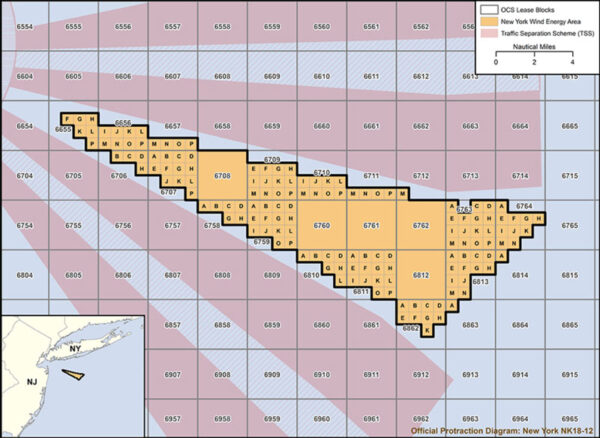
The administration made good on that promise last week with the news that it will begin the environmental review of Empire Wind’s projects off the coasts of New York and New Jersey.

Empire-Wind-Lease-Area-BOEM-Content.jpg
The Biden administration is moving forward with the environmental review of the Empire Wind projects off the coasts of New York and New Jersey, shown here. | BOEM

BOEM issued a notice of intent to prepare an environmental impact statement for the 816-MW Empire Wind 1 and the 1,260-MW Empire Wind 2 projects. The New York State Energy Research and Development Authority awarded the projects under 2019 and 2021 solicitations, respectively. Together, the projects would have up to 174 wind turbines, two offshore substations, three submarine export cables and landfalls, and two onshore substations to connect to the New York power grid.

The Empire Wind lease area is 12 nautical miles south of Long Island, N.Y., and 17 nautical miles east of Long Branch, N.J.

BOEM will hold virtual public meetings for the projects on June 30, July 8 and July 13.

The Biden administration is also moving forward with its first lease sale for the New York Bight between Long Island and the New Jersey coast for a potential 7 GW of energy.

As proposed, the auction would offer eight leases totaling 627,000 acres.

BOEM is seeking input on the following lease stipulations:

  • Developers must make a reasonable effort to enter into a project labor agreement covering the construction of any project proposed for the lease area.
  • Developers must include a stakeholder and ocean user engagement summary as part of a lessee’s progress reporting requirements.
  • Developers must develop mechanisms to provide benefits to underserved communities and investments in a domestic supply chain.

BOEM will consider public comments on the NOI before releasing a final sale notice, which would include the time and date of the sale.

Lawmakers Back Putting New Jersey’s Clean Energy Plan into Law

The New Jersey Senate voted Monday to enshrine into law Gov. Phil Murphy’s (D) 2019 energy master plan, a move that would ensure the requirement that 50% of state electricity be renewable by 2030 remain in place if Murphy is not reelected in November (S3667).

The bill, which is sponsored by Bob Smith (D), chair of the Senate Environment and Energy Committee and Republican Christopher “Kip” Bateman, picks out some of the most salient goals in the master plan to grant them the permanency of law. The goals could otherwise be changed when the plan is revised after three years. (See NJ Unveils Plan for 100% Clean Energy by 2050.)

The Senate approved the bill 25-13, largely along party lines with 13 of the state’s 15 Republican senators in opposition. The Democratic-controlled state Assembly has yet to act on the legislation.

The goals outlined in the law include:

      • 330,000 light-duty vehicles in the state by 2025;
      • renewables would supply 35% of the state’s electricity by 2025 and 50% by 2030;
      • the state’s mass transit agency, New Jersey Transit, will operate at least one battery-powered train by 2025;
      • offshore wind facilities will generate 3.5 GW of power by 2025 and 7.5 GW by 2035.

The state Department of Environmental Protection would be required to issue an annual report on the state’s progress toward meeting the goals.

Republican Division

After the vote, Republican sponsor Bateman released a statement saying that the plan’s goals are “ambitious” and “reflect a very aggressive approach, but [that] technological advancements make them attainable.

“This will be one of the most environmentally transformative eras since the industrial revolution, and this time we will be clearing the air,” Bateman said. “We are at the starting line of a complete transition of the way New Jersey is powered.”

Other Republicans weren’t supportive. Republican Anthony M. Bucco, who voted against the bill, said it was “premature” for the state to codify the goals before it is clear how much it will cost to reach them. He said the Murphy administration commissioned a report to assess the impact of some of the goals. The New Jersey Board of Public Utilities (NJBPU) on May 5 approved the hiring of a consultant, who has not been named, to analyze the impact of the master plan on consumer rates.

NJ-estimated-2018-GHG-emissions-(New-Jersey-Board-of-Public-Utilities)-Content.jpg
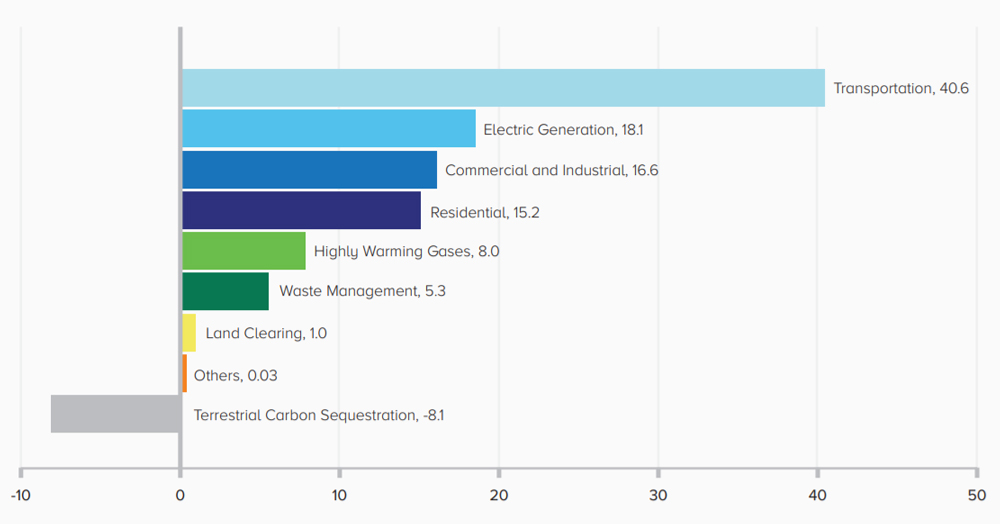
New Jersey’s greenhouse gas emissions totaled 97.0 million metric tons CO2e in 2018. | New Jersey Board of Public Utilities

“Some of these goals are set at a pretty high standard, could come at a high cost not only to residents but high energy users,” Bucco said, urging his colleagues to hold the bill until the report is completed.

Sen. Michael J. Doherty, a Republican who voted against the bill, said he believes the threat of climate change disruption is overplayed and echoed concern that it could be extremely expensive.

“The Earth, it’s a fact, has warmed up and cooled down all by itself. There’s a lot of scientists who say that we may actually be entering into a cooling period,” he said, adding that evidence around the world shows that “windmills don’t work. Windmills are breaking down. Solar panels aren’t working.”

“I foresee New Jersey being even more expensive with a very unreliable power generation system,” he said.

Climate Change `Not Baloney’

Sponsor Smith, speaking before the vote, said the evidence that the state and the nation are seriously threatened by climate change can be seen in daily news reports.

“New Jersey is on a straight line to becoming a piece of (fried) bacon,” he said. “The global climate change paradigm that’s out there is not baloney.” He said the state needs to put goals into legislation to prevent a new governor from  changing them.

“We have experienced what happens when governments change over,” he said. “A recent governor, who will remain nameless, went out of his way to revise the energy master plan goals downward.”

Republican Gov. Chris Christie, who served from 2010-2018, dismayed environmentalists by pulling New Jersey from the Regional Greenhouse Gas Initiative (RGGI) in 2011.

Murphy, who is reaching the end of his first term, will face Republican Jack Ciattarelli a businessman and former assemblyman, in the November election. Ciattarelli, who won his party’s primary on June 10 after falling short in a 2017 bid, was the most moderate of the four Republicans running in 2021 according to NJ Spotlight,, a non-profit news organization.

Ciattarelli’s campaign website, which has yet to flesh out his environmental plan, says of the candidate: “Safe drinking water, clean oceans and waterways, and open space preservation are imperative.  Jack will be a green governor.”

Environmentalists Want More

In a May 11 committee hearing on S3667, Smith said the goal of the legislation is to provide a continuance of the master plan proposals, which he described as a “terrific step in the right direction.”

“The next energy master plan may go backward, not forward,” he said. “So rather than put the goals of the energy master plan in a position where they can be lost, due to subsequent energy master plans, this codifies the goals,” he said. “So the only way they could be changed in the future is by changing legislation and going through the legislature.”

In the hearing, Smith’s bill drew mild opposition from the New Jersey Conservation Foundation and Clean Water Action, and wholehearted support from the Natural Resources Defense Council.

David Pringle, campaign director for Clean Water Action, said that the organization supports “the concept” of the bill but believes it should be tougher.

“It’s a do-nothing [bill], because the executive is already doing this,” Pringle told the hearing. He said it needs to have more stringent goals because the world has learned more about the need to meet climate change since the master plan was drafted. “The science got changed; the goalposts were moved. You know, the scientists were saying we need 80% reduction by 2050. They now say we also need 45% by 2030. So what we’re asking for you to do is to push the executive farther, not codify what the executive is already doing.”

Smith said it was essential to pass the bill before the legislature breaks for the summer on June 30, and said he feared legislation that goes beyond the goals in the master plan might fail. “If you don’t do anything about making this a statutory goal, a subsequent governor can change the goals,” he said.

The New Jersey Business and Industry Association, (NJBIA), opposed the bill, saying it does not believe the master plan, which state law requires to be updated every three years, should be codified into law.

“Circumstances change. Technology changes. Our understanding of facts, the economy changes,” said Ray Cantor, a lobbyist for NJBIA, one of the state’s largest trade groups, said. “We think the current process of the EMP (energy masterplan) works. And if the new governor or the same governor, or the technology changes, the EMP should change. But if you codify its goals through this legislation. It ties the hands of future decision makers.”

Texans’ Conservation Keeps ERCOT Grid Stable

The week began for ERCOT with a call for conservation on June 14 as unusually warm weather — even for Texas in June — and unexpected thermal generation outages threatened the state’s grid.

It ended quietly Friday evening when the grid operator, without fanfare, resumed normal operations.

In between, Texans spooked by ERCOT’s near collapse following the February winter storm and a Level 1 energy emergency alert in April reduced their consumption just enough to avoid further disaster.

Addressing the Public Utility Commission during an open meeting last Thursday, Woody Rickerson, ERCOT’s vice president of grid planning and operations, thanked Texans for doing their part.

“I think [conservation has] shown to be a very effective tool,” Rickerson said. “We’ve seen good response all week. Because of those actions, we’ve kept the grid in a very reliable state. Conservation gives us a tool to balance the load side of the equation.”

During the open meeting, Commissioners Peter Lake and Will McAdams repeatedly referred to a “confluence of events” that led to the conservation notice. With 9.1 GW of thermal resources offline at one point (three times above normal), wind resources coming in below forecast and above-normal temperatures driving record demand, ERCOT on June 14 was forced to ask customers to reduce their usage through Friday. (See Generation Outages Force ERCOT Conservation Alert.)

Staff were projecting a peak demand of 73 GW when ERCOT issued the conservation alert, but demand peaked at 69.9 GW on June 14 before dropping off. The grid operator still recorded 10 peaks above the previous record of 69.1 GW through Thursday.

“Yesterday is proof that simple conservation measures really do make a difference,” interim CEO Brad Jones said in a press release June 15.

The confluence of events, coming on the heels of the February disaster and another conservation call in April, again made ERCOT a subject of social media memes and the butt of national jokes. Late night comedian Stephen Colbert, emphasizing the “electric reliability” part of the ERCOT name, likened it to the fictional Sobriety Council of New Orleans.

“It’s kind of a misnomer,” Colbert said as his live audience laughed.

During the week, Amarillo and Texarkana both trumpeted the fact they are not part of the ERCOT grid. “We’re not getting our power from ERCOT,” KMXJ’s Michael Rivera wrote.

Both cities are in SPP’s Texas footprint. The 14-state RTO declared a resource alert June 14-16 because of outages, high energy use and other factors, but it did not ask for public action.

Texas Gov. Greg Abbott, who said “everything that needed to be done was done to fix the power grid in Texas” when he publicly signed legislation into law June 8, was noticeably quiet during the week. (See Abbott Signs Texas Grid Legislation into Law.)

ERCOT-Meme-(TheServerStore1-via-Twitter)-FI.jpg
Social media users made ERCOT the subject of a frequent meme. | @TheServerStore1 via Twitter

The #AbbottFailedTexas hashtag trended on Twitter before the governor, saying the ERCOT grid “is better today than it’s ever been,” broke his silence during a June 16 event to announce the state would build a crowd-funded wall on its Mexican border.

“The governor is over-optimistic,” Texas energy consultant Alison Silverstein said in an email. “As the past week has illustrated, ERCOT’s generation fleet is not yet ready for the hot summer weather we know lies ahead, and ERCOT doesn’t yet have a solid grasp on generation outage scheduling.”

ERCOT told the PUC on Thursday that it is still investigating why so much thermal generation was out of service. About 10 GW of thermal and renewable generation was still offline Friday when the alert expired.

“That’s an unusual number of forced outages of thermal units,” Rickerson told the PUC. “People need to understand those are mechanical failures that are occurring. They’re not planned.”

The commissioners queried Carrie Bivens, ERCOT’s Independent Market Monitor, as to whether there was any evidence of market manipulation. She assured them that the IMM is studying the event, just as it would any market event.

“We have tools and we have things we look at to determine whether there’s any evidence of physical withholding,” Bivens said. Any behavior that is a violation, Bivens told RTO Insider, would be referred to the commission for “potential enforcement.”

She reminded Lake and McAdams that the incentives for market manipulation are lower than normal because ERCOT’s systemwide offer cap has been reduced by rule from $9,000/MWh to $2,000/MWh. Prices peaked at $2,045.75/MWh in the Texas Panhandle on June 14 and reached only $605.74/MWh in ERCOT’s congested West zone on June 15 before falling to their normal $25 to $30 range.

“It’s a big risk to take, to try and effectuate [market manipulation] and you’re not going to get as much profit out of your fleet than you would with a $9,000 cap,” Bivens said. “I don’t think the conditions are necessarily ripe from that perspective.”

Noting the mechanical failures have “put us in a tight spot,” the commissioners are considering waiving ERCOT’s 60-day confidentiality period for making generation outages public. Lake said he would file a memo capturing his thoughts before Thursday’s open meeting.

“I think that that needs to be looked at,” McAdams said. “I want both the public and the legislature to understand that when forced outages occur … there are financial penalties. However, peer pressure is a real deal. Public eyes on these individual events may have a benefit.”

The commissioners noted several private companies already scrape grid operators’ market data for sale to market participants. Bloomberg on Friday named the four largest plants behind the thermal outages: Luminant’s Comanche Peak nuclear plant, knocked offline by a transformer fire on June 7 by back to full power on Saturday; Talen Energy’s Barney Davis plant; and NRG Energy’s Limestone and W.A. Parish plants.

Carrie-Bivens-(Texas-PUC)-FI.jpg
Carrie Bivens, ERCOT IMM | Texas PUC

Bivens told the PUC she wouldn’t have “strong concerns with one-off exposures” but indicated a need for some period of confidentiality. Beth Garza, Bivens’ predecessor at the IMM and now a senior fellow at R Street Institute, agreed.

“Competitive markets are most effective when market participants are focused on the costs and capabilities of their own resources,” she told RTO Insider, noting the delay of unit-specific availability information was a “regulatory compromise.”

“I support it as an effective general practice,” she said. “However, I would also support the ability for ERCOT to make generator availability data public immediately in the aftermath of predefined events.”

Silverstein was less optimistic, saying she doubted generators would “want the PUC to expedite public release of generator performance data.”

“The answer isn’t to do more of what’s failed us twice this year alone, but to develop additional resource options including much-expanded energy efficiency and dispatchable demand response,” she said.

“There is a lot on the table that gives the commission a lot of different tools to address issues that come up. I’m just concerned about how those changes get implemented,” said attorney Michael Jewell, whose firm represents market participants before the state.

In the meantime, ERCOT will continue to tighten its load and weather forecasts and improve its outage-scheduling practices, not to mention continue to integrate more renewables than any other grid operator — all on top of incorporating the legislative measures passed on by lawmakers.

“As our grid changes, we need to be able to change our processes and tools and even people to meet demand on the grid,” Rickerson said. The grid “doesn’t look like it did 15 years ago. It makes sense not to operate it like we did 15 years ago.”

DC Circuit Slaps FERC on Pipeline GHG Analysis

The D.C. Circuit Court of Appeals ordered FERC Tuesday to vacate its decision permitting a 65-mile natural gas pipeline, saying the commission had failed to follow its own rules on evidence of a need for the facility (20-1016).

The court said FERC failed to balance the benefits and adverse impacts when it approved a certificate of public convenience and necessity for the Spire STL Pipeline on a 3-2 vote in August 2018 (CP17-40). It said the commission “made a superficial effort to remedy the obvious deficits of the certificate order” when it rejected rehearing requests in November 2019 — the same month the line went into commercial operation.

ClearView Energy Partners told clients that “closure of the asset may be more a question of when than if.”

Parent company Spire (NYSE:SR) did not respond to a request for comment. Shares in the company, which has gas utilities in Alabama, Mississippi and Missouri and storage operations on the Wyoming-Utah border, dropped by $3.49/share (-4.67%) after the ruling.

The ruling by Senior Circuit Judge Harry Edwards and Circuit Judges David Tatel and Patricia Millett was a victory for the Environmental Defense Fund (EDF), which filed the court challenge after failing to block the certificate in proceedings before FERC.

No Takers

Spire announced plans for the project in 2016 and held an “open season” in August of that year inviting gas shippers to sign preconstruction contracts. When it got no takers — the St. Louis area was already served by five existing pipelines —  it signed an agreement with one of its affiliates, Laclede Gas Co. (now called Spire Missouri) for 87.5% of the line’s capacity. At the time, Spire Missouri obtained most of its natural gas from pipelines owned by Enable Mississippi River Transmission (Enable MRT), a unit of Enable Midstream (NYSE: ENBL).

In its January 2017 application to FERC, Spire conceded that the line was not being built to serve new load, but said it would provide other benefits, such as enhancing reliability and supply security by providing access to new sources of gas in the Rocky Mountains and Appalachian Basin and avoiding the New Madrid Seismic Zone. It also said it would eliminate the use of propane “peak-shaving” during periods of high demand. Spire later acknowledged that it had used propane peaking on only three days between 2013 and 2018.

The certificate application was protested by several stakeholders, including the Missouri Public Service Commission and Enable MRT, which said the project “ha[d] been shielded from a truly competitive market.”

Enable MRT also cited comments by Spire Missouri and Spire STL’s corporate parent that construction of the pipeline would increase shareholder earnings. It said the economic risks of the pipeline would be shifted onto Spire Missouri’s “captive ratepayers [for natural gas] and the ratepayers of pipelines that would experience decontracting due to” the new pipeline.

EDF told FERC there was a growing trend for utility holding companies making transactions committing retail utilities to new long-term capacity with their pipeline developer affiliates.

“The essence of this financing structure is to take a cost pass-through for a retail gas or electric distribution utility — a contract for natural gas transportation services — and pay those transportation fees to an affiliated pipeline developer entitled to accrue return on its investment from that same revenue,” EDF said. “Thus ratepayer costs which may not be justified by ratepayer demand are being converted into shareholder return.”

EDF asked the commission to “apply heightened scrutiny” to the application because of the affiliate relationship, saying “there is a gap … between state and federal regulatory oversight of affiliate precedent agreements, such as the one Spire STL has submitted in this proceeding to demonstrate market need.”

Balancing Benefits and Adverse Impacts

Under the Natural Gas Act, FERC can only issue a certificate if it finds that the new pipeline “is or will be required by the present or future public convenience and necessity.”

Spire-STL-pipeline-map-(Spire)-Content.jpg
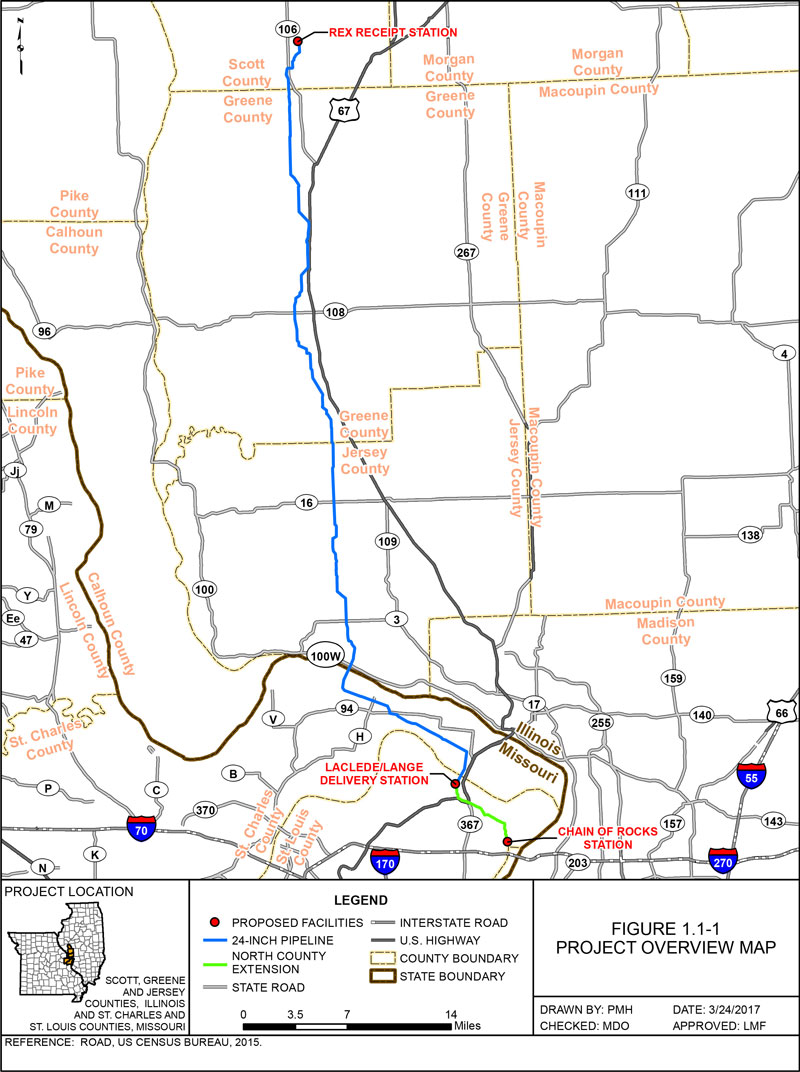
The Spire STL Pipeline spans 65 miles between Scott County, Ill., and St. Louis County, Mo. | Spire

If FERC concludes there is a need, it then determines whether there will be adverse impacts on “existing customers of the pipeline proposing the project, existing pipelines in the market and their captive customers, or landowners and communities affected by the route of the new pipeline,” according to the commission’s Certificate Policy Statement, issued in 1999 and clarified in 2000. If it finds adverse impacts, the commission must balance the public benefits —  such as meeting unserved demand, providing competitive alternatives or advancing clean air objectives — against the adverse effects.

The policy statement says FERC will “consider all relevant factors” to determine the need for a project and that the evidence “will usually include a market study. … Vague assertions of public benefits will not be sufficient.”

FERC’s decision acknowledged that the pipeline was not meant to serve new load and acknowledged the difference in the cost of gas delivered to Spire Missouri via the proposed pipeline versus current pipelines “was not materially significant.”

Nevertheless, the commission majority —  Republicans Kevin J. McIntyre, Neil Chatterjee and Robert F. Powelson — rejected calls for a market study.

Commissioners Cheryl LaFleur (D) and Richard Glick (D) dissented on the order. Glick, now FERC chairman, noted that “[t]here are several potential business reasons why [Spire STL]’s corporate parent might prefer to own a pipeline rather than simply take service on it, such as the prospect of earning a 14% return on equity rather than paying rates to [Enable] MRT or another pipeline company.”

Spire told FERC in 2019 that the pipeline, which runs between Scott County, Ill. and St. Louis County, Mo., cost about $287 million, an increase of $67 million (30%) from its original estimate.

FERC’s ‘Ostrich-like Approach’

The court concluded that FERC’s decision “principally focused on the precedent agreement between Spire STL and Spire Missouri in finding that there was market need for the project. And the commission stated that it would not `second guess’ Spire Missouri’s purported `business decision’ in entering into the precedent agreement with Spire STL, even though the shipper and the pipeline were affiliates. … We find that the commission ignored record evidence of self-dealing and failed to seriously and thoroughly conduct the interest-balancing required by its own Certificate Policy Statement.”

The court said FERC took an “ostrich-like approach” by failing to consider “plausible evidence of self-dealing.”

“The challenges raised by EDF and others were more than enough to require the commission to ‘look behind’ the precedent agreement in determining whether there was market need. If it was not necessary for the commission to do so under these circumstances, it is hard to imagine a set of facts for which it would ever be required.

“… Instead of evaluating the legitimate claims that had been raised, the commission simply stated that it had “no reason to second guess the business decision of” Spire Missouri.

The court said EDF had standing to challenge the certificate because at least four of the group’s members owned land transected by the pipeline and had property rights taken through eminent domain. Spire initiated eminent domain proceedings against more than 100 entities involving more than 200 acres of privately owned land, according to Glick.

However, the court said a woman who lived half a mile from the pipeline and was not subject to eminent domain, had no standing to challenge FERC’s environmental assessment, which found that construction and operation of the pipeline would have no significant environmental impact.

Remedy

The court said vacating the certificate order was an appropriate remedy because of the “identified deficiencies in the commission’s orders.”

The commission’s ability “to rehabilitate its rationale … is not at all clear to us at this juncture,” the court said. “Furthermore, remanding without vacatur under these circumstances would give the commission incentive to allow ‘build[ing] first and conduct[ing] comprehensive reviews later.’”

The court’s mandate, which makes the ruling binding, will be issued seven days after the D.C. Circuit addresses any petition for rehearing or en banc review.

ClearView Energy Partners said it didn’t expect FERC to appeal the ruling given its current composition. Chatterjee’s term expires at the end of June, and he is expected to be replaced by a Democrat, giving the Democrats a 3-2 edge under Glick.

“Spire could seek rehearing from the panel on this decision or the full D.C. Circuit (en banc), but absent FERC support we would give it scant odds of success. At this time, we think that an appeal to the U.S. Supreme Court would be unlikely to succeed should Spire STL pursue one,” Clearview added. “The D.C. Circuit may not necessarily continue to withhold the mandate pending Supreme Court review. In our view, closure of the asset may be more a question of when than if.”

Pamela Quinlan, Glick’s chief of staff, tweeted that the decision “is a very big deal” and why Glick is pursuing the Notice of Inquiry that will look at how FERC assesses need, among other issues (PL18-1). (See Glick Hits ‘Refresh’ at 1st FERC Open Meeting.)