FERC announced that it needs until June 2026 to act on the advanced notice of proposed rulemaking (ANOPR) initiated by the Secretary of Energy asking it to claim jurisdiction over the interconnection of large loads to the transmission system.
Secretary of Energy Chris Wright had asked for a ruling, which would have proceeded to the NOPR stage, by April 30.
“Our nation stands at a pivotal moment as we face rapid growth in demand from data centers and other large-scale consumers that are reshaping our transmission landscape,” FERC Chair Laura Swett said in a statement. “I want to reassure the public that we are addressing this challenge head-on, working tirelessly and collaboratively with stakeholders and federal partners to deliver real solutions. I encourage everyone to stay tuned as we build a resilient energy future together.”
FERC must balance speed with the need of responding to arguments in a voluminous docket because failure to do so would leave its actions vulnerable to court appeals. Hundreds of comments and replies totaling 3,500 pages have been filed in RM26-4, and in cases like it appeals are the norm. (See Parties Warn FERC Jurisdictional Fight Could Slow Data Center Connection Effort.)
Since the ANOPR was issued in October, FERC has been approving rules for specific markets meant to speed up data center interconnection.
It approved SPP’s High Impact Large Load (HILL) initiative in January 2026, which is meant to accelerate the interconnection of large loads and generators built to serve them. (See FERC Approves SPP’s Large Load Interconnection Process.)
FERC has approved other proposed tariffs and agreements for specific large load interconnections, while rejecting proposals that exceed its jurisdiction or lack reasonable cost allocation.
In “one of the largest and most brazen frauds in the history” of FERC, American Efficient has been ordered to pay a civil penalty of $722 million and disgorgement of unjust profits totaling about $410 million.
FERC’s ruling, issued late April 15, said the company “stole half a billion dollars from hard-working Americans by collecting compensation for fake ‘energy efficiency resources.’”
“This FERC will not stand for such scams,” Chair Laura Swett said in her opening comments at the April 16 monthly commission meeting.
“It’s particularly sad” the scheme emerged at a time when regular ratepayers have difficulty paying their bills, Commissioner David Rosner said at the meeting. This company is “an egregious outlier,” he added.
According to FERC, American Efficient’s affiliates began participating in PJM’s capacity market in 2014 and in MISO’s capacity market in 2017. The fraud involved “hijacking a regulatory mechanism intended to promote energy efficiency and converting it into an ATM for American Efficient’s worthless paper-shuffling scheme.”
“American Efficient operated a sweeping money-for-nothing scheme to extract capacity payments from PJM and MISO by falsely claiming ownership and control of energy efficiency resources,” according to a FERC press release about the ruling.
“Through this scheme, American Efficient bought sales data for EE products, papered those transactions as if it was acquiring rights to each product’s load reduction-related potential, and then monetized that sales data in the PJM and MISO capacity markets under the guise of offering actual capacity,” the commission said in its ruling.
Once the truth “about American Efficient’s business model emerged over time,” MISO and ISO-NE disqualified American Efficient from their capacity markets.
The independent market monitors for PJM and MISO later referred American Efficient to FERC for potential enforcement action. The commission’s Office of Enforcement began investigating the company in 2021, and in 2024 the commission issued the Order to Show Cause that started the proceeding.
In company comments included in the ruling, American Efficient says it does exactly what the FERC set out to achieve: “bringing within RTO/ISO capacity markets the benefits of permanent energy reductions by providing payments tied to those reductions.”
The company also “contends that it provides benefits by aggregating demand reductions from millions of individual product installations that would not otherwise be accounted for.”
American Efficient says FERC doesn’t have the authority under the Federal Power Act to order disgorgement. It argues that “if Congress wanted the commission to be able to order disgorgement of unjust profits under the FPA, it would have provided express authorization to do so, as it did in a section of the Natural Gas Policy Act (NGPA) that specifically identifies restitution.”
Despite harsh weather and unprecedented load growth expected throughout the Western Interconnection, Arizona utilities said they are well prepared to meet demand reliably in summer 2026.
“We do feel we have sufficient capacity to meet projected demand this coming summer,” said Grant Smedley, director of energy marketing and trading at Salt River Project. “We have sufficient fuel, and those generators are ready and maintained.”
Smedley’s comments came during an April 14 summer preparedness workshop hosted by the Arizona Corporation Commission.
Presentations from SRP and other Arizona utilities were preceded by an overview of conditions in the Western Interconnection by James Hanson, manager of operations analysis for WECC.
Hanson noted that March 2026 had been the hottest March on record in more than a dozen states. The heatwave decimated snowpacks in the Colorado River basin and parts of California. (See California Snowpack Near Record Lows as Summer Approaches.) Fire danger is expected to be above normal throughout much of Arizona and New Mexico through June.
A weather forecast for April through June shows an above-average chance of above-average temperatures throughout much of the Western Interconnection. In contrast to situations where a heat wave in one part of the interconnection is balanced by cooler temperatures in another region, the heat shown in the early summer forecast is widespread.
“When everyone’s hot, that excess energy is not available,” Hanson said. “It is serving local needs, and imports become very tight.”
The concerning weather trends are a backdrop to what Hanson called “unprecedented growth” in energy consumption and peak demand. Much of the load growth is due to large loads such as data centers.
Electricity demand is expected to grow by 25% across the Western Interconnection through 2035, with an even higher growth of 42% projected in the Southwest subregion.
Peak demand is projected to grow 20% over the next decade, from 160 GW in 2026 to 191 GW in 2035. The Southwest is projected to see 10 GW of peak demand growth over the next 10 years, or an annual average growth rate of 3%. The only WECC subregion with a higher annual growth rate is Mexico, at 4%.
“The West’s planned resource buildout will not keep up with anticipated load growth over the next decade, particularly in the Basin and Northwest subregions,” WECC said in its 2025 Western Assessment of Resource Adequacy, released in January.
Although 177 GW of new resources are planned, about 90% of those are inverter-based resources, such as solar, wind and batteries.
“Most of the new resources are weather-dependent, which creates uncertainty,” the WECC report said.
Commissioner Kevin Thompson called the high percentage of inverter-based resources “scary.”
“That’s absolutely bonkers to me,” he said.
Growing Peak Demand
SRP, Arizona Public Service and Tucson Electric Power each set peak demand records in August 2025, while exceeding their peak demand forecasts.
Utility representatives explained how they planned to meet the challenges of summer 2026.
Tim Rusert, director of power supply services at APS, said the company added 33,000 new customers in 2025, the most since 2007. In contrast to a demand growth rate of less than 2% from 2022 to 2025, the growth rate for 2026 is expected to be 5.3%.
“But we’re prepared. We’re focused on reliability,” Russert said.
The summer peak forecast for APS is 8,648 MW. The utility has 9,974 MW of accredited resources, or about 1,326 MW of reserves. With a 15.4% planning reserve margin, APS is exceeding its longstanding minimum reliability requirement, Rusert said.
Following a 2023 request for proposals, APS has added 1,000 MW of accredited capacity, including solar, storage, wind and natural gas. Two new gas turbines came online at the Sundance power plant in late 2025; eight more turbines are under construction.
“We maintain a balanced generation mix, which gives us reliability in all conditions,” Rusert said.
Resource Diversity
SRP’s peak demand forecast for the coming summer is 8,869 MW — about 300 MW higher than summer 2025. In addition to its peak retail load, SRP is planning for 1,112 MW of reserves and 22 MW of sales to small Arizona entities, for a total of 10,003 MW.
An expected capacity of 10,489 MW exceeds that amount. Capacity includes 5,665 MW of natural gas resources; 2,544 MW of renewables and storage; 1,455 MW of coal-fired resources; and 826 MW of nuclear resources.
“That diversity has served us really well over the course of our history,” Smedley said. “That’s going to continue to be a really significant focus for us moving forward.”
New resources for SRP include the 55-MW Copper Crossing Energy and Research Center project, SRP’s first owned and operated solar facility. The project uses three different types of solar panels, and SRP will compare their performance. The site also will test three types of solar trackers and three different inverters and will use sky cameras to estimate cloud impacts to solar production.
At TEP, the summer peak forecast is 2,513 MW, slightly higher than the summer 2025 peak of 2,500 MW, said Lauren Briggs, director of resource planning.
TEP’s planning reserve margin target is 16.5%. But with new resources coming online, TEP expects to exceed that in 2026 with 22.1%.
New resources include the 160-MW Babacomari solar project and the 100-MW Wilmot II solar and four-hour storage project. Both are now in service.
Roadrunner Reserve II, a four-hour, 200-MW storage project, is expected to be in service in May.
TEP also counts coal, natural gas, wind, demand response and power purchase agreements among its resources.
ALBANY, N.Y. — Renewables and storage remain central to New York’s energy vision, even as the path to realizing that vision becomes harder or merely different.
Some discussions April 15 at the New York Energy Summit veered toward the “harder,” as panelists offered assessments and strategies for the obstacles facing the state’s continuing efforts toward decarbonization.
These can be intentional obstacles created by a federal government focused on fossil fuels or inevitable collateral results of New York’s dense regulatory landscape. But the effects are similar: Most types of renewable energy development are moving far more slowly than hoped despite strong support.
“The past 16 months have been lively! There have been some changes made!” Marguerite Wells, executive director of the Alliance for Clean Energy New York, said as she introduced a panel on utility-scale wind and solar.
“Depending on how you count, there’s been anywhere between 16 and 20 adverse actions that have been taken against renewables” by the second Trump administration, agreed Zack Hutchins, director of public relations for Boralex.
Onshore wind and solar are central to New York’s near-term planning for renewable generation but still constitute only a small percentage of the total energy portfolio. The state’s high aspirations for offshore wind are paused until a more supportive administration returns to Washington. New nuclear is being planned but may be a decadelong prospect.
The growing need for power and the advanced age of existing generation are such that new gas-fired generation is being considered.
So the renewables community wants to keep skin in the game.
Walter Crenshaw, senior director of operations at AES, said his company is rushing to safe-harbor its projects as it navigates whipsaw policy changes and pursues market share.
“This time period also overlaps with this tremendous growth and demand that we’re all trying to satisfy. And so we have this kind of dual effect, which has been really hard on the industry,” he said.
There are ways to reduce adversity, Hutchins said: “One of the big things that we’re concentrating [on] at Boralex is trying to eliminate or reduce our federal interaction as much as possible.” This includes not triggering environmental reviews because those appear to be a quagmire.
The renewables industry has a steadfast supporter in the New York government, he added.
“The state reaction and the way that the state has stood up to help support contracted projects, mature projects — one of the shining lights of the past 16 months is just the step up in the level of collaboration,” Hutchins said.
The state’s long-running effort to streamline its regulatory structure is appreciated, Crenshaw said. “New York has done a good job with aggregating land-use permitting through ORES [the Office of Renewable Energy Siting], which I usually hold up as a model to our Virginia policy people and others in PJM and then in the Southeast.
“Having the very clear guidelines on land-use permitting in New York has been huge. It’s a lot of things, but we know what we need to do.”
That is the intent, said Georges Sassine, senior vice president for large-scale resources at the New York State Energy Research and Development Authority. He likened all the bottlenecks that once existed to “death by 1,000 paper cuts” and said they are being eliminated systematically. Individually, they are small, but collectively their removal will make a big difference.
As NYSERDA, ORES and other agencies have been streamlining the development process, NYISO has been streamlining the interconnection process. Wells asked the panel about the effect of NYISO queue reforms.
“We’re being forced to make these decisions about what is really viable much earlier than we did in the past,” Crenshaw said.
“It’s moved us towards larger projects as well,” Hutchins said, “because interconnection costs, they don’t scale. You can have a $14 million interconnection on a 60-MW facility, and same on a 200-MW facility. That’s been one of the big changes with Boralex’s approach.”
One recurring problem is labor, Wells said. Workers are trained to build renewables, and then the construction pipeline thins out, so they make a lateral move to another industry. Then the renewables pipeline perks up again, so more workers need to be trained.
In 2026, there are 1,500 MW of renewable capacity being built onshore, and 1,000 more is scheduled to start this year. Combined with the offshore wind construction, this is the most ever, she said.
“It’s a good problem to have, but it’s a challenging problem,” Sassine said. “How do you prioritize all of these different projects? And unfortunately, we’re not in a place where we can prioritize; we have to build all of them.”
And yet not all will be built.
Sassine acknowledged the simmering problem with large-scale renewables proposals that have seen significant cost increases and are not able to proceed to construction under the inflexible terms of their subsidy contracts with the state. (See related story, Another Mass Cancellation of Renewable Contracts Brewing in N.Y.)
“If your cost structure is dramatically changing and the projects are uneconomic, you’re being forced to face a tough business decision on whether you want to cancel these contracts with us or even cancel the projects altogether,” he said. “So these are very difficult decisions. We want you to build, but also, at the same time, we want to be protecting ratepayers.”
Distributed Resources
Small-scale solar has taken off in New York, a contrast to inherently slower-moving utility-scale solar development.
“I know that’s old news, but it’s important to remember the highs as we now clearly face a number of headwinds,” Gabrielle Stebbins, senior director of distributed energy resources at the Center for Sustainable Energy, said as she introduced a panel discussion on distributed solar.
Oliver Sandreuter, director of business development at Lodestar Energy, said the industry must rush to protect what it has now, through safe harboring, but also act to protect its future.
“It’s a critical period of time to go on offense from a policy, regulatory standpoint, as we think about what comes next,” he said. “A lot of that is, thankfully, state-driven conversation, and we are fortunate to be here in New York that has been, as mentioned, a critical leader in DG [distributed generation] deployment. We are, I think, one of, if not the only, state that can claim we are ahead of schedule and under budget with our DG goals.”
Kristina Persaud, senior principal at Advanced Energy United, said the solar industry needs to present itself as the solution at a time of pressing need for new electrons on the grid and mounting concerns overpaying for those electrons.
“We need to think about the speed to market, and we need to think about grid optimization, and solar checks all those boxes,” she said. “It’s the most cost-effective new generation. The speed to market compared to other things, it’s unbelievable.”
Jeff Lee, business development director at Nautilus Solar, said changes are coming. “I think our industry has a very bright future for the next few years with the implementation of safe harboring and so on,” he said, but after that, “it’s a brave new world.”
“New York has been a top 10 market for solar over the past several years,” said Peter Muzsi, vice president of business development at Core Development Group. “I think we will continue to evolve. There still will be solar, even after the” investment tax credit ends.
But there is and will continue to be local opposition to solar, some panelists said.
Moratoria are proliferating steadily, Lee said, as is disinformation.
“One partner of ours mentioned they had an honest question about how solar panels that are not even moving, just sitting there on fixed tilt, are going to attract UFOs,” he said. “These are not isolated incidents … and I see everyone nodding their heads here on the panel.”
“I’ve heard some very bizarre things, that solar panels reflect heat back at the sun and amplify the sun, and that’s what caused global warming,” Persaud replied. “Education is huge here. It helps with NIMBYism, community engagement, some of that pushback.”
Lee wondered if a semi-organized, pseudo-official truth effort might help tamp down some of these misconceptions or limit their impact. But Stebbins tamped down that idea.
“Unfortunately, a lot of times, once folks have bought into the concerns or the disinformation, you end up talking yourself into a backwards pretzel. Because by saying that is not true, you’re providing more petrol to the fire.”
In their monthly open meeting April 15, members of NERC’s Standards Committee voted to disband a group formed three years ago to upgrade the ERO’s functionally defunct standards grading process.
In 2016 the SC created a team comprising the chairs of the SC, Operating Committee and Planning Committee (the latter two being predecessors to the Reliability and Security Technical Committee), along with representatives from the regional entities and NERC staff, to grade selected standards annually, in response to a directive by the ERO’s Board of Trustees to research whether revised standards resulted in improvements. But the process was performed sporadically at best and has not been conducted at all since 2022.
The SC and the Compliance and Certification Committee formed the Standards Grading Task Force in 2023 to develop improvements to the process, but they “struggled to find a recommendation on the path” forward, SC Chair Todd Bennett, of Associated Electric Cooperative Inc., told members.
Bennett cited several factors for the lack of results, including “competing priorities in the industry,” resource constraints and the perception among stakeholders that because the grading process does not produce standard authorization requests leading to new standards projects, there is “no net benefit” to participating.
Another reason for rethinking the standards grading task force is the upcoming changes to the standards development process, driven by the recommendations of the Modernization of Standards Processes and Procedures Task Force adopted by the board in February. Bennett said the MSPPTF’s proposals — which would see the SC disbanded by the end of 2027 and the standards process revamped to work more efficiently with the benefit of artificial intelligence — led NERC to conclude that the standards grading task force, and the grading initiative overall, were no longer needed.
“I don’t think that we’ve lost anything other than a mandated plan to do this annual review of a subset of standards … that [has] yet to display any real benefits,” Bennett said. “The capability [to improve existing standards] is still there, if a [potential] correction is identified by NERC, one of the subcommittees or an industry group.”
The proposal passed with no votes against it and a single abstention by Kimberly Janas, of the Illinois Attorney General’s Office.
Standards Actions
Members next voted to approve the addition of six supplemental candidates to the standard drafting team for Project 2023-09 (Risk management for third-party cloud services).
NERC selected the candidates from nominees submitted by industry in a solicitation approved by the SC at its February meeting after four of the SDT’s original 13 members left the project. (See Members Seek Clarity on NERC Standard Committee’s Future.)
The expansion will leave the project with 15 team members, including the chair and vice chair. NERC Manager of Standards Development Jordan Mallory explained that ERO staff felt the project needed a full complement because of “the very heavy lift this team has to do.” Also, despite the absence of a deadline imposed by FERC or NERC’s board, Mallory said the cybersecurity issues addressed by the project mean the team will “need to move relatively quickly” to finish the standards. The proposal passed unanimously.
The committee then voted to authorize posting the proposed standard PRC-029-2 (Frequency and voltage ride-through requirements for inverter-based resources) (found on page 16 of the agenda), the product of Project 2025-05 (Ride-through revisions) for a formal comment and ballot period.
In Order 909, issued last August, FERC directed NERC to modify its standards to account for IBRs equipped with choppers: equipment that protects offshore wind projects during grid faults. FERC ordered NERC to submit the updated standards by August 2026. (See FERC Approves IBR Ride-through Standards.)
Because of the approaching deadline, Manager of Standards Development Alison Oswald explained to the committee, NERC felt it necessary to shorten the normal 45-calendar-day comment period to 30 days. The committee therefore approved a waiver allowing this reduction, along with shortening any additional comment and ballot periods to as few as 20 calendar days and the final ballot period from 10 calendar days to as few as five.
FERC has extended the timeline for the New England transmission owners to refund customers for excess revenues collected after the commission in March set a lower base return on equity with a 2014 effective date (EL11-66, et al.).
The deadline for completing the refunds — originally set for just 30 days after the March 19 ROE order — will now be May 20, 2027.
FERC’s 14-month refund timeline falls in between those proposed by a group of consumer advocates, state agencies and end users and jointly by ISO-NE and the TOs.
The latter sought to push the deadline to December 2027. The RTO argued that “proposed refund schedule represents the fastest timeline under which ISO-NE can calculate and administer the refunds.”
In contrast, the consumer groups argued that FERC should not allow an extension exceeding nine months.
“A limited extension of the refund deadline may be appropriate, but the wholesale 20-month extension requested by the [TOs] and ISO-NE is premature, unsubstantiated and excessive,” they wrote. They argued that ISO-NE and the TOs failed to provide evidence or detail to justify their timeline.
“Given the extraordinary nature of the financial burden endured by New England ratepayers since the commencement of these proceedings, the [TOs] and ISO-NE should make every available effort to issue refunds as soon as practicable,” the consumer groups wrote, arguing that ISO-NE transmission rates are “by far” the highest of any RTO.
They also urged ISO-NE and the TOs to refund customers “on a rolling basis” prior to the deadline, to the extent that this is possible.
TOs already are contesting the refund obligations, which they estimate to total more than $1.5 billion. Eversource Energy and Avangrid, the companies with the largest transmission footprints in the region, have asked FERC for a stay on the bulk of the refund obligations. (See New England TOs Seek Stay of ‘Astonishing’ Refund Obligations.)
On April 15, the two companies filed an emergency petition with the D.C. Circuit Court of Appeals with a similar request for a stay on the refund obligations.
“Absent a stay from this court, the order will impose immediate, irreversible financial and operational harm on the [companies] and their customers, harm that cannot be undone even if the order is later vacated,” they wrote.
“Critically, an extension of the refund deadline does not cure these harms,” they added. “Even if FERC were to grant additional time to process refunds, the [companies] would still be required to carry the full retroactive refund obligation on their balance sheets and to plan for its financing.”
PacifiCorp is on schedule to begin trading in CAISO’s Extended Day-Ahead Market on May 1, with the utility now in its final phase of market settlements and simulations testing.
Portland, Ore.-based PacifiCorp, which operates in six Western states, will be EDAM’s first participant, with PGE following Oct. 1.
The utility’s market simulations in EDAM’s parallel operations testing phase “have gone well overall, and we’ve been working through expected issues in close coordination with CAISO and our technology partners,” PacifiCorp spokesperson Omar Granados told RTO Insider.
“PacifiCorp continues to make steady progress on the systems and process changes needed to join EDAM, including routine software updates across multiple platforms,” Granados said. “A successful launch depends on tight coordination with CAISO and vendor, and we’re executing a sequenced rollout, with updates first at CAISO, then through PacifiCorp systems and outside vendors.”
Parallel operations testing has provided valuable insight into how the new imbalance reserve and reliability capacity products interact with energy supply and influence market prices, Granados said.
“While we continue to work through remaining market software items with CAISO and our vendors, the prices, awards and EDAM transfers we’re seeing are consistent with expectations and reinforce our confidence the market is operating as intended,” Granados said.
A 2024 study showed that PacifiCorp could earn up to $359 million a year in net benefits from participating in EDAM, nearly double a previous estimate. (See Updated EDAM Study Shows Doubling of PacifiCorp Benefits.) The study showed the utility could reduce its adjusted production costs by $53 million under and expanded EDAM footprint while earning an additional $120 million through EDAM congestion and transfer revenues.
Asked whether PacifiCorp thinks those estimated benefits still appear feasible based on the work the utility has been doing over the past few months to join EDAM on May 1, Granados said:
“While the study assumed a larger EDAM footprint than will be in place at go‑live, its key conclusions about the value of day‑ahead coordination remain consistent with what we’re seeing. Parallel operations show that the EDAM can efficiently schedule resources, transmission use and transfers to serve load at the lowest cost to customers. This lines up with the study’s findings on lowering electricity wholesale costs through improved scheduling.”
In January, PacifiCorp said a few challenges remained before the utility could go live in EDAM, including building and testing IT systems, and managing communication testing across numerous transmission customers and 14 neighboring utilities. (See EDAM Implementation Remains CAISO’s Focus in 2026.)
Granados told RTO Insider PacifiCorp has been addressing those challenges.
“We’ve been working closely with CAISO and our vendors to manage IT complexities and prepare for the market go-live, focusing on resolving key items and planning for future improvements,” he said. “Our transmission customers and neighboring utilities have been engaged and collaborative, and the volume of questions reflects solid progress and overall readiness.”
“We’ve also planned for unforeseen challenges by establishing tools and processes with CAISO to respond quickly and adapt as needed,” he added.
WASHINGTON — FERC Chair Laura Swett told the Energy Bar Association that she wants to push the commission’s authority as far as she can.
“I know very well from litigating where the absolute edge of precedent is on many topics in our jurisdiction, and I have an appetite to push right up to that edge, if it may secure effective results,” Swett said April 15. “But the other side of that coin is my borderline obsession — it’s not borderline; it’s a full-blown obsession. I’m obsessed with legal durability.”
Swett said her personal goal was to “be one of the most impactful chairmen in FERC history,” especially given the issues facing the regulator now.
“We are at a historic crossroads of some of the biggest issues of our lifetimes when it comes to energy,” Swett said. “And so, I recognize the great responsibility that the commission has right now, over the next few years. Everything has to be very thoughtful and very grounded in the law. I can only accomplish my personal goal if our orders stand the test of time and appeal.”
Working in a democracy means that FERC could have a very different composition in a few years with very different priorities.
“The only thing that I can do is help ensure that the orders that go out under my tenure are as tight and excellent as possible, and that means less susceptible to reversal on appeal,” Swett said. “When we leave out orders; if we don’t address arguments that are raised; if we don’t analyze the evidence, then we are vulnerable.”
Swett did not bring up any specific case regarding maximizing FERC authority, but the concept is at issue in Energy Secretary Chris Wright’s Advance Notice of Proposed Rulemaking, which directed the commission to consider assuming jurisdiction over large loads that connect to the transmission system by April 30. (See Energy Secretary Asks FERC to Assert Jurisdiction over Large Load Interconnections.)
While still fairly new to her current job, Swett has been working in and around FERC for 15 years, beginning as a law clerk at the Office of Enforcement while at Georgetown Law School, then becoming an investigator in the office and eventually an adviser to Chair Kevin McIntyre. In between stints at the agency, she worked in private practice representing all kinds of the entities the commission regulates.
“In the past 15 years, I kept a running list of observations about how FERC is run, how the industry is run and what we can all do better,” she said.
Swett is running FERC at a time when reliability is being challenged by the rapid integration of large loads, most notably — but not exclusively — data centers.
“Confronting the problem of large loads is, in my view, the most important and pressing problem in contemporary American public policy,” Swett said. “We have to ensure that these loads can connect quickly and efficiently, but at the same time, we have to ensure that the costs are allocated fairly.”
The authors of the Federal Power Act in 1935 did not anticipate artificial intelligence and the hyperscale data centers it needs, so now regulators and the industry need to evolve, she said.
“We have to use the precedent that we have and solve a problem that the law never anticipated,” Swett said. “However, the authors of the act did anticipate and understand the paramount importance of reliability.”
Reliability remains core to FERC’s mission, and it does not have to be in tension with integrating large loads, she said.
“There’s a lot of creativity that we’ve seen even in the past six months of my tenure, and stakeholders are committing to confront this problem head on, as are our partners at all levels of the government,” Swett said. “And the developers of organized markets have already proposed a number of creative solutions that FERC has approved.”
ALBANY, N.Y. — Another mass cancellation is potentially in the works for New York’s contracted renewable energy pipeline.
This one would not be as large as the infamous collapse in late 2023, which exceeded 8 GW, but would follow the same pattern: Renewable energy certificate (REC) contracts signed years ago not containing cost adjustment mechanisms and the state refusing to consider adding them after construction costs have soared.
Marguerite Wells, executive director of the advocacy and trade group Alliance for Clean Energy New York, said the projects at risk total roughly 3 GW of nameplate capacity.
Wells led a panel discussion April 15 at the New York Energy Summit focusing on the causes of this latest setback for New York renewables — inflation, tariffs and vanishing federal tax credits — rather than on the situation itself. (See related story, N.Y. Energy Summit Examines State of Renewables.)
Afterward, she told RTO Insider that while the state’s position is understandable, it does not make project economics work.
“That was the same problem that the earlier cohort, the big 90-project termination in 2023 had, because the contract is exactly fixed and flat and has no adjustability,” Wells said.
The New York State Energy Research and Development Authority (NYSERDA), which manages the REC process, had recommended in mid-2023 that the Public Service Commission (PSC) grant developers’ request for more money, but the PSC refused, triggering the mass exodus and a rush effort from NYSERDA to negotiate new contracts. (See Sweeping Reset Underway for NY Renewable Development.)
Asked for comment, NYSERDA indicated there would be no renegotiation of existing contracts in 2026, either.
“NYSERDA expects developers that have already signed contracts with New York State to honor their commitments,” a spokesperson told RTO Insider. “The competitive bidding process is designed to protect consumers and result in fair and cost-effective contracts, ensuring developers are not able to offload risk onto New York ratepayers. NYSERDA intends to continue to protect ratepayers by holding contractors to the terms they agreed to.”
But the economics of those contracts simply do not work in mid-2026, Wells said. The 3 GW is her best estimate of the capacity that could be lost as a result, a significant amount for a state far behind on its renewable energy goals.
“That is my math based on conversations with all of my members on the projects that have contracts and that are mature enough to actually go dig holes if they had a contract that held water,” she said.
The next step is unclear.
Wells does not know if NYSERDA will allow developers that cancel contracts to rebid the same projects into the upcoming 2026 large-scale renewables solicitation. It did after the 2023 exodus but did not allow it in the 2025 solicitation, she said.
Moving forward, there should be fewer of these wholesale collapses, Wells said.
“I think people across the state, no matter where they sit, are frustrated that renewables haven’t been built as fast as we all would wish,” she said.
But NYSERDA has revised its approach substantially, she added.
“Starting in the 2025 RFP, they put the [price] flexibility in there that we’d been asking for for years. And so I think this batch of three years of projects should be the end of this frustrating line of terminations.”
NYSERDA is in the process of contracting the 2025 solicitation and will announce results when it is completed.
ALBANY, N.Y. — Each year brings new progress and challenges for those planning, building, regulating and running New York’s grid.
Whether it balances out in one direction or another is a matter of opinion as much as detail.
As the 2026 New York Energy Summit opened April 14, the state has a new framework in place to expedite transmission development, its governor is steering away from some of the statutory requirements for power generation and the Coordinated Grid Planning Process has progressed significantly.
But tariffs and vanishing federal tax credits have altered the finances of many projects years in the making, and New York remains a costly and complex place to do business, even with the progress it has made.
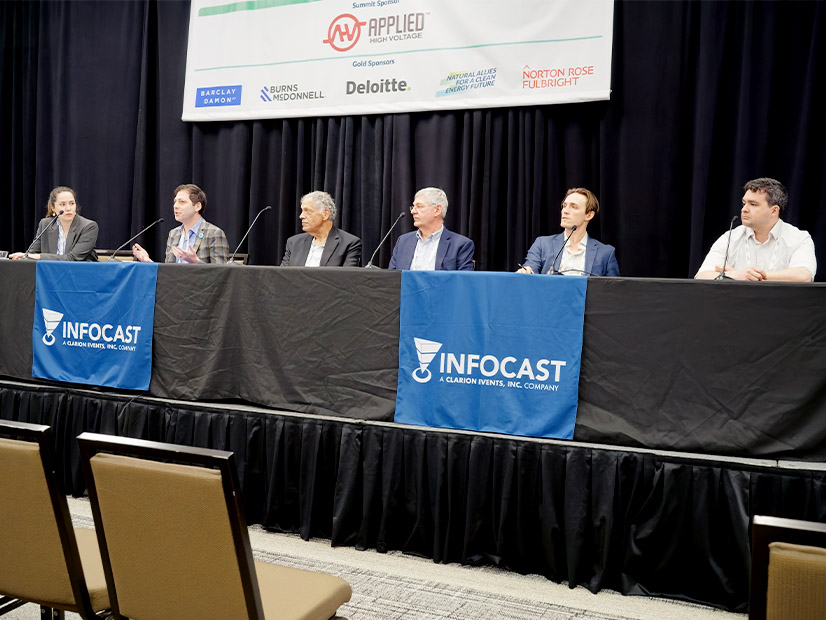
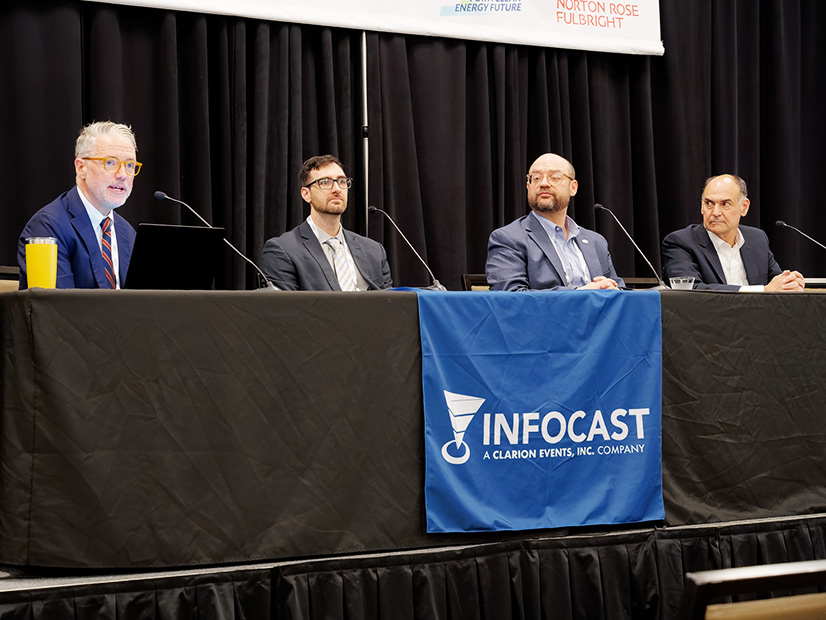
Finding the balancing point was a recurring theme at the Infocast event.
“If it was easy, anyone could do it; I think we have to continue to think big, and get big things done,” said Stuart Nachmias, CEO of Con Edison Transmission.
His suggestion — expand transmission headroom at the geographic confluence of customer demand and community support for meeting that demand — is at once logical to pursue and difficult to achieve.
“And we should build big when it comes to building transmission so that we have room for growth,” Nachmias said. “And I think that’s really something that we have not done well. It also seems to take too long, but we know what we can do, and we should just start doing that.”
This potentially bumps against the imperative to go easy on ratepayers in a state with some of the most expensive electricity in the U.S.
What should the state be doing now to address the soaring costs of the renewable energy it has been pushing so hard to build? moderator Robert Rosenthal of Greenberg Traurig asked his panel.
Nachmias didn’t sugarcoat his answer.
“Prices for everything have gone up. So I think it’s relative, and trying to mitigate the cost doesn’t mean they’re not going to go up, but to go up less.”
Stephane Desdunes, EDF Power Solutions’ vice president of development for Canada and the northeast U.S., said he has seen project costs jump $80 million over the course of 48 hours.
“When you look at what’s happening here in New York, across the U.S., we’re trying to clear a construction cliff. We’re trying to manage permitting risk. We’re trying to absorb tariffs while still trying to meet our contractual [commercial operation date]. I would say every day we wake up, we’re kind of hoping that the day goes well and the project won’t get canceled today.”
The continuing problems developing renewable energy in New York have set the stage for consideration of what until recently was a remote or even implausible concept: new gas-fired generation.
“That actually provides room to have the pragmatic discussion around, what can we bring to the table now to ensure that we have a reliable and resilient grid in this transition period?” said Sarah Salati, chief commercial officer of National Grid Ventures, which operates a gas-fired fleet in southern New York.
Some of those facilities have been in service for more than 50 years, she said, and repowering them would not only improve reliability but reduce emissions while renewable energy development gets back on track.
“We’ve estimated that if we repowered the assets that we have on Long Island, that it would be equivalent to basically taking 570,000 vehicles off the roads over a 15-year period,” Salati said.
Rosenthal flagged a detail of the state’s landmark 2019 climate law: New York must generate its electricity with zero emissions by 2040, which he said is a deterrent to any significant investment of funds in new gas-fired generation in 2026. He asked the panel if the Public Service Commission should exercise its authority to modify the 2040 target.
No one gave him a “yes” or “no,” but the clear sense was that natural gas should not be excluded from consideration.
“Without directly answering your question,” Nachmias said, “I would say reliability is paramount, and I think the state and the NYISO has been ringing the bell here.”
“It’s an optimization problem,” said Tom Vaccaro, vice president of development for TDI-USA Holdings. “The engineer in me knows that if you take resources off the table before you do the optimization calculation, you’re more likely to come to a suboptimal outcome.”
The grid is the most complex machine in human history, he said, and the clean energy transition is a fundamental reworking of it. No effort on that scale has ever proceeded on schedule or on budget, and the plan for achieving it will change over time even as the end goal does not, he said.
Zeryai Hagos, executive director of the state Office of Renewable Energy Siting and Electric Transmission, gave an update on the RAPID Act (Public Service Law Article VIII), the state’s effort to streamline permitting of large-scale transmission projects in the same manner it streamlined permitting of large-scale renewable generation.
The first set of regulations implementing the law took effect in March.
“As of right now, we are working with the first wave of utilities who are preparing to enter the pre-application process for the first Article VIII siting projects,” Hagos said.
Proposals along new rights of way may not advance any more quickly than under the old system, he said, but those that would follow existing rights of way and create no new impacts are expected to see a 50% reduction in their construction timelines.
Another moderator, John McManus of Harris Beach Murtha, framed his panel discussion as a look at the difficulty of hitting a moving target amid changing rules of engagement.
“The result is a transmission system that is actively being redesigned, not only while it’s being expanded and rebuilt, but also while it’s being used,” he said. “This panel is about that tension: How do you plan, finance and permit energy infrastructure in a world where the regulatory and policy landscape is still in flux?”
McManus asked Paul Haering, vice president of capital investment for New York Transco, whether he thought permitting would be faster under Article VIII, or it would just look faster because so much of the process would be moved from the application phase to the pre-application phase.
“I think we’ll have to see,” Haering said. “From our perspective, I think the level of effort is still going to be about the same. It just becomes a matter of the sequencing.”
He said he does like the concept, however. “I think a single one-stop shop for permitting for large infrastructure projects makes the most sense. At the end of the day, hopefully that results in a more efficient process. But I think the jury is going to still be out until we actually get through an Article VIII siting process.”
Schuyler Matteson, clean energy planning lead at the state Department of Public Service, picked up on Haering’s point: The RAPID Act is not just an attempt to speed the process but to reduce its internal friction.
“We don’t want people bouncing around between processes,” Matteson said. “Having a centralized place where everybody can go [and a] clearly understood process I think [are] very, very important. So even if it takes a similar amount of time, if it’s much, much clearer and it reduces risk, I think that’s going to be a win overall.”
McManus raised the often cited prospect of optimizing the existing grid with more speed and less money than would be required to expand the grid. Are grid-enhancing technologies an interim solution while new transmission is built or are they a replacement? he asked.
“Yes,” said John Bernecker, director of large-scale resources at the New York State Energy Research and Development Authority.
“We shouldn’t view it as one or the other,” he explained. “A lot of the barriers are, frankly, regulatory and market barriers that we should be focusing on addressing. A number of these technologies are quite mature and have significant deployment in other regions, and so we need to be focused on addressing some of the cultural challenges or resistance to their deployment where it exists.”
McManus broached another hot button issue: “Are any of you concerned that the pace and the scale of large load growth, as well as the economics and politics behind that, create pressure to make transmission planning decisions faster than may be prudent?”
Haering said New York seems unlikely to become a hotbed for data centers, but the concerns centered on their development are valid.
“I think the whole issue is cost causation and responsibility,” he said. “You don’t know how long some of these entities will be around for. Is their load really going to be their load? Is their load factor exactly what they said? Getting in front of this and making sure the policy’s set so that ratepayers don’t share the cost, I think, is critically important.”